Zenith Bank Plc has reaffirmed its commitment to supporting the Africa Business Ventures and Investment Group (ABVIG) to ensure the success of the Africa Climate Change and Green Investment Summit (AICIS-2026).
Dame Adaora Umeoji, Group Managing Director/CEO of Zenith Bank, made this known in a statement following a courtesy visit by Moses Owharo, Chairman of the AICIS-2026 Planning and Organising Committee, in Lagos on Thursday, October 23, 2025.
She said the bank would support the global summit scheduled for Nov. 25 to 28, 2026, aiming to promote sustainable infrastructure, climate resilience, and inclusive economic growth across Africa.
L-R: Dame Adaora Umeoji, GMD/CEO of Zenith Bank hqtrs., Lagos and Mr. Moses Owharo, Chairman Planning and Organising Committee, AICIS-2026
Umeoji highlighted Zenith Bank’s dedication to fostering partnerships that converted visionary ideas into measurable impact for communities and economies across the continent.
She stressed the critical role of women’s participation in sustainability and climate action, emphasising their contribution to building a resilient and equitable future for Africa.
“This renewed partnership signifies our commitment to advancing progress and sustainability together as we prepare for AICIS-2026,” Umeoji added, reflecting on the collaboration between Zenith Bank and ABVIG.
Owharo explained the visit sought to deepen the partnership, especially regarding climate change initiatives, noting Zenith Bank’s extensive branch network across Africa.
He hailed Zenith Bank’s invaluable support during the AICIS-2025 summit in Abuja and expressed optimism about continued collaboration to achieve shared climate goals.
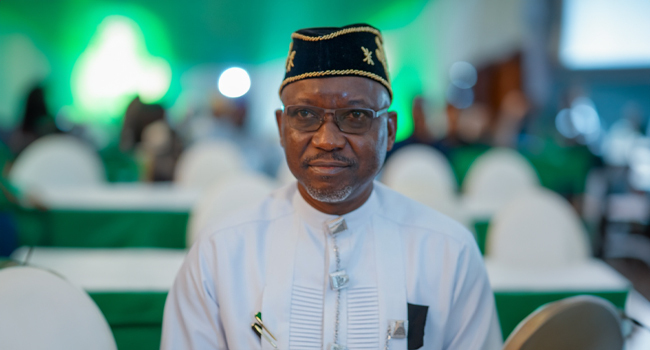
President Bola Tinubu has congratulated Dr Philip Mshelbila, Managing Director of Nigeria LNG Limited (NLNG), on his election as Secretary-General of the Gas Exporting Countries Forum (GECF).
Mshelbila was elected at the 27th Ministerial Meeting of the Forum held in Doha, Qatar.
The President also congratulated the Minister of State for Petroleum Resources (Gas), Ekperikpe Ekpo, on his emergence as President of the 2026 GECF Ministerial Meeting.
Minister of State Petroleum Resources (Gas), Mr Ekperikpe Ekpo
According to a statement by Presidential Spokesperson Mr. Bayo Onanuga, Tinubu said the development reaffirms Nigeria’s leadership in global gas diplomacy.
The President expressed confidence that both Mshelbila and Ekpo would represent Nigeria with distinction and foster stronger cooperation, stability, and inclusivity in the global gas market.
“The Nigerian government is proud of Mshelbila’s election as Secretary-General and Ekpo’s emergence as President of the GECF Ministerial Meeting, as the two positions reflect the international community’s confidence in Nigeria’s leadership and technical expertise in the global gas sector.
“Natural gas remains the cornerstone of Nigeria’s industrial growth, energy security, and economic transformation under our administration’s Renewed Hope Agenda.
“Our country shall remain a dependable voice in advancing equitable energy access and a cleaner energy future,” Tinubu is quoted as saying.
A non-governmental organisation (NGO), Health of Mother Earth Foundation (HOMEF), has stated that introducing Genetically Modified Organisms (GMOs) in Nigeria farming culture is not the solution to the nation’s food insecurity.
Ms. Joyce Brown, HOMEF’s Director of Programmes, stated this in Bakassi on Thursday, October 23, 2025, during a one-day practical agro-ecology training, themed, ‘’Solving the Food and Climate Crisis’’ for farmers in Bakassi.
The training exposed the farmers to the implications of GMOs and inorganic pesticides, while teaching them how to produce effective and environmentally friendly organic fertiliser and herbicides.
GMOs
According to Brown, the introduction of GMOs in the nation means a loss to Nigeria’s food sovereignty especially as farmers cannot replant GMO seeds and would have to depend on corporations and governments.
“This goes against the culture of farming in Nigeria where farmers are able to save, reuse and exchange seeds in a sustainable way to produce food.
“With GMOs, we also risk destruction of our soils; in 2024, the Association of Cotton Farmers reported that after three years of planting the GMO cotton, their soils have become unproductive to the local varieties.
“They also added that there is no substantial difference in the yield performance of the GMO crop over the local varieties,” she said.
She added that the challenge of food insecurity in Nigeria can only be resolved by providing extension services, solving the farmer herder clashes, proper storage facilities, among others.
On his part, Umo Isua-Ikoh, Coordinator, Peace Point Development Foundation (PPDF) partnering with HOMEF, noted that the training was necessary because there was a lot of ignorance on the issue of GMOs among Nigerians.
Isua-Ikoh said few years ago, the National Agency for Food and Drug Administration and Control (NAFDAC) declared that GMOs were not safe but in 2025, they returned to tell Nigerians that they were safe for consumption.
“We have done a lot of researches and tests and come to the conclusion that GMOs were not safe for human consumption
“My direct message to NAFDAC is to join the campaign to ban GMO products all over the nook and crannies of Nigeria, they do not benefit the nation, economically, culturally or health-wise,” he said.
Similarly, Ms Grace Bassey, leader of the Bakassi Legislative Council who commended HOMEF for coming to Bakassi, said she would follow-up on the petition against GMOs to ensure that Bakassi was free of them.
Mr. Asuquo Okon, on his part, appealed to the Federal Government to ban GMOs as it was altering their farming system, making them over reliant on corporations for seeds.
He said the excessive use of chemicals like inorganic fertiliser, herbicides, pesticides and the introduction of GMOs might be some of the things increasing the prevalence of some unexplainable illnesses in the nation.
The Nigerian Environmental Society (NES) has advocated for the enactment of stringent legislation to help address the worsening problem of poor waste management in Nigeria.
According to the group, Nigeria’s waste management challenges constitute a national disaster that necessitates the enactment of laws to enforce waste segregation from its source. Additionally, it is essential to integrate public awareness campaigns and robust institutional frameworks as fundamental components in reversing this troubling trend.
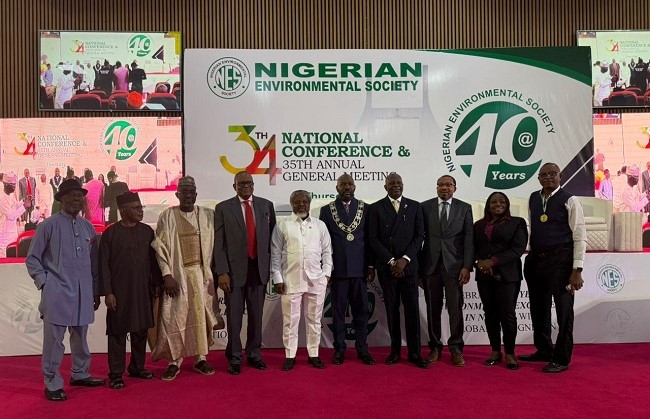
Speaking at a meeting it hosted in Abuja on Thursday, October 23, 2025, to celebrate its 40 years of existence and achievements, the president of the association, Dr Efegbidiki Okobia, told the participants that the NES would soon launch the Nigerian Environmental Outlook, a new tool that will track national environmental indicators and guide evidence-based policymaking.
Participants at the Nigerian Environmental Society (NES) 40-year celebration held in Abuja
“This is the beginning of another 40 years,” he said, because the roadmap will focus on practical implementation of the Nationally Determined Contributions (NDCs) and ensure that climate commitments get to the grassroots.
Dr Okobia, who expressed extreme delight over the milestone achievements of the NES since the last four decades, hinted that it has made giant strides with different partners across government and the private sector.
Reflecting on the historical record of his organisation, he reminisced about its inception with just ten professionals, primarily from the oil and gas sector. Since then, the society has expanded significantly, now comprising 35 chapters across Nigeria, in addition to one located in the United Kingdom.
The body also championed the passage of the Institute of Environmental Practitioners (IEP) of Nigeria Act in May 2023, a noteworthy accomplishment, which the NES boss described as a major breakthrough.
“That act has given a voice to environmental practice as a foundation in Nigeria,” he said.
Sarah Mukherjee, President and CEO of the Institute of Sustainability and Environmental Professionals (ISED), United Kingdom, who delivered her message virtually, referred to the NES as “a beacon of what can be achieved when a group of people come together with a vision and complete the hard work.”
Sarah, who spoke on the theme of Nigeria’s Contribution to Global Climate Action, congratulated the society for its 40 years of commitment to environmental advocacy, policy development, and capacity building.
“You should be rightly proud to celebrate 40 years of the society’s dedication to shaping national policies, from the National Policy on the Environment to the Environmental Impact Assessment Act,” she said. “It is a landmark achievement.”
She noted that many NES members have served on inter-ministerial committees, offered technical advice, and represented Nigeria at international environmental negotiations.
“The capacity of the Institute for Technology and professional collaboration has contributed significantly to the country’s environmental governance,” she added.
Sarah also drew parallels between Nigeria’s environmental challenges and those faced globally, citing issues such as waste management, pollution control, and energy efficiency as “shared struggles that demand shared learning and solutions.”
“There is so much that we can learn from each other,” she said, citing examples of flood adaptation work in Copenhagen where overflow areas were transformed into flood-proof cycling lanes. “These are the kinds of innovations that reflect what sustainable urban living can look like.”
In his goodwill message, Mr Hamid Adekunle, one of the society’s founding members, reflected on its humble beginnings and expressed gratitude for its growth.
“There were ten of us who started the Nigerian Environmental Society. I thank Almighty God that I am alive to see 40 years of the seed we planted,” he asserts.
He praised the current leadership for achieving the long-sought professionalisation of environmental practice, and he urged the next generation to prioritise research and innovation that address Nigeria’s unique environmental realities.
“I would like to see the society focusing on research and technology that reflect who we are as a country,” he said. “Let us look at the challenges of our regions and craft local solutions, not imported prescriptions.”
The representatives of member governments and observer organisations of the Intergovernmental Panel on Climate Change (IPCC) will be meeting in Lima, Peru, from October 27 to 30, 2025.
The Panel, comprising 195 member governments, is expected to continue discussions on the workplan of the Working Group contributions to the Seventh Assessment Report, as well as on the draft outline and workplan of the Methodology Report on Carbon Dioxide Removal Technologies, Carbon Capture Utilisation and Storage.
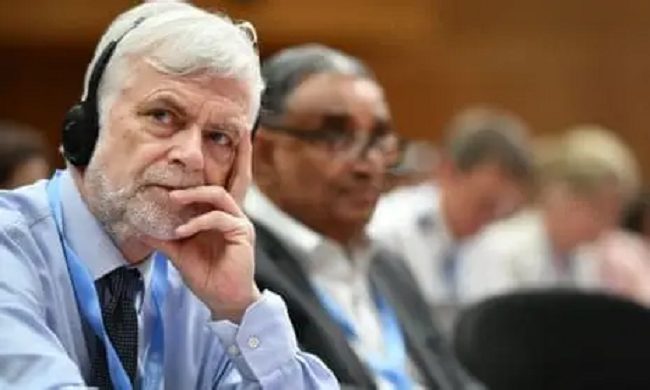
Jim Skea, IPCC Chair
The 63rd Session of the Panel, hosted by the Peruvian government, will also consider proposals for Expert Meetings and Workshops to be held in its current cycle as well as the IPCC’s programme and budget, among other business.
The opening session of the meeting will take place on Monday, October 27, 2025, at ESAN Convention Centre in Lima. During the opening, the Plenary will be addressed by IPCC Chair Jim Skea, Peru’s Minister of Foreign Affairs Ambassador Hugo de Zela, Deputy Minister of Strategic Development of Natural Resources for Peru’s Ministry of Environment, Raquel Hilianova Soto Torres, and Director of Climate Change Division of the UN Environment Programme (UNEP) Martin Krause.
The delegates will also see the video messages from Celeste Saulo, the Secretary-General of the World Meteorological Organisation and Simon Stiell, the Executive Director of the United Nations Framework Convention on Climate Change.
IPCC assessments provide governments, at all levels, with scientific information that they can use to develop climate policies. IPCC assessments are a key input into the international negotiations to tackle climate change. IPCC reports are drafted and reviewed in several stages, thus guaranteeing objectivity and transparency.
Comprehensive scientific assessment reports are published every five to seven years. The IPCC is currently in its seventh assessment cycle, which formally began in July 2023.
In a pivotal development in the fight for environmental justice, Shell and the South African Minister of Mineral and Petroleum Resources have applied for leave to appeal the recent judgment of Judge Mangcu-Lockwood of the Western Cape High Court, which found the environmental authorisation for offshore oil and gas exploration in Block 5/6/7, to be unlawful.
The case was initially filed by The Green Connection and Natural Justice, in a bid to defend the rights of coastal communities to sustain their ocean-dependent livelihoods, protect their food security and shield them from the deepening impacts of climate change.
Western Cape High Court, Cape Town, South Africa
Following an online hearing on October 16, 2025, Strategic Lead at The Green Connection, Liz McDaid, says: “This appeal attempt is disappointing but not surprising. It is clear that the oil and gas giants, together with government, are determined to push ahead despite the court’s recognition of serious environmental and procedural shortcomings. We will continue to stand firm for the rights of coastal communities and the protection of our oceans because the High Court’s ruling correctly highlighted serious procedural and environmental flaws in the approval process for Block 5/6/7.”
The Green Connection’s Community Outreach Coordinator, Neville van Rooy, adds: “For the people living along our coasts, this could be a serious development because thousands of coastal families who depend on small-scale fishing for their livelihoods may face immediate and long-term harm if the project proceeds. Any offshore drilling accident, including a “well blowout”, could devastate marine life and fisheries along South Africa’s west coast, with oil potentially drifting into Namibian waters via the Benguela Current. These are just some of the reasons why we keep raising our voices – loudly and clearly – to ensure that these risks are not brushed aside.”
The Green Connection says that this case may be part of a broader pattern in which fossil fuel companies and government authorities appear to repeatedly sidestep environmental safeguards, making court rulings, such as this one, a crucial defence for both people and the planet.
“Beyond the potential local impacts, we cannot ignore that production from this block could directly increase greenhouse gas emissions, possibly accelerating climate change. Climate change impacts could have a ripple effect on small-scale fisheries and the overall wellbeing of coastal communities,” adds van Rooy.
The Green Connection and Natural Justice now await judgment on whether the appeal can proceed and, if so, whether it will be heard by a Full Bench of the Western Cape High Court or the Supreme Court of Appeal.
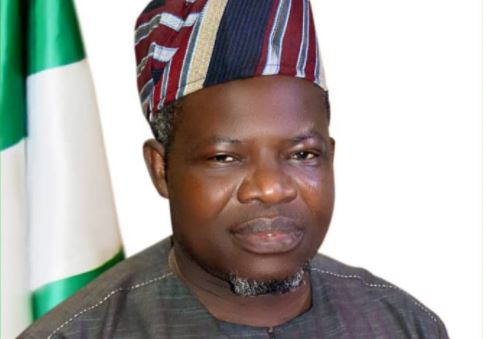
Katsina State has been ranked second in the 2025 Subnational Climate Governance Performance Rating and Ranking – an independent, research-based assessment developed by Professor Chukwumerije Okereke and the Society for Planet and Prosperity (SPP).
This, according to the promoters, marks one of the most significant recognitions of subnational climate leadership in Nigeria. Katsina’s leap of 23 places from the previous year is said to demonstrate tangible improvements in governance capacity and policy innovation directly informed by this evidence-based evaluation framework.
Katsina State official being awarded following its second placement in the 2025 Subnational Climate Governance Performance Rating and Ranking
The rating, launched in Abuja on October 14, 2025, by the Federal Ministry of Environment in partnership with SPP, the UK FCDO’s Partnership for Agile Governance and Climate Engagement (PACE), the African Climate Foundation, and others, assesses all 36 states across five governance pillars: institutional structures, policy frameworks, budgeting, implementation and monitoring, and public engagement.
Professor Mohammed Al-Amin, Special Adviser to the Governor on Climate Change, noted: ““This recognition heartens us. Coming in second among all Nigerian states is a clear signal that Katsina’s Green Growth Agenda is yielding results. Our administration is deeply committed to climate governance, not only in policy formulation, but also in practical implementation and transparency. We want climate action to translate into real, visible improvements in the lives of our people.
“The recognition validates our reforms and the technical guidance we’ve drawn from the Climate Governance Performance framework. It shows that evidence-based research can translate directly into institutional and policy change at state level.”
Professor Al-Amin highlighted the key areas of progress that contributed to the state’s strong performance and how these actions were premised on the rating and ranking methodology published by SPP in collaboration with the Federal government earlier in 2024.
Key Research-Informed Impacts
Institutional Strengthening: Guided by the performance indicators developed through the national Climate Governance Ranking research, Katsina established climate governance desks across ministries and created formal coordination mechanisms with local governments.
Policy Uptake: The 2024 Katsina State Climate Resilience and Green Economy Policy was designed to align with performance benchmarks highlighted in the Rating methodology, showing direct research-to-policy translation. One of the landmark policy innovations inspired by the ranking was the passage and implementation of the Katsina State Climate Resilience and Green Economy Policy (2024).
Budgetary Reform: Noting the high marks allocated to climate finance, we pushed very hard to drive climate-related funding which subsequently rose by 30% in 2025 – a measurable outcome linked to the project’s budgeting criteria and follow-up capacity-building workshops led by the research team.
Implementation and Public Accountability: The launch of Katsina Climate Watch, a digital transparency platform, mirrors the project’s call for improved visibility and citizen engagement in climate projects.
Governor Dikko Umaru Radda praised the result describing it as: “A testament to our administration’s proactive approach to governance, innovation, and environmental responsibility.”
He said this was a perfect example of “how collaborative research and data-driven policy can drive real transformation in governance and public service delivery.”
Minister of Environment, Balarabe Abbas, commended the top-performing states, urging others to adopt the Ranking framework as a “map for reform and learning.”
SPP submitted: “Katsina’s achievement demonstrates how rigorous academic research can have direct and verifiable impacts on public policy, institutional design, and environmental outcomes. The state’s adoption of evidence-based recommendations from the Subnational Climate Governance Performance Ranking illustrates a model of research-informed decision-making now influencing both federal-state collaboration and peer learning among subnational governments.”
Climate litigation is now being pursued across more countries than ever before, according to a report published by the UN Environment Programme (UNEP) and the Sabin Centre for Climate Change Law at Columbia University.
The report reveals how legal action is addressing issues such as greenwashing, carbon offsets, and energy-intensive data centres.
“Climate litigation has evolved into a powerful global tool for advancing climate action, and accountability,” said Inger Andersen, Executive Director of UNEP. “Transforming our energy, mobility, housing, and food systems must be a collective effort, through ambitious and science-based policymaking. Independent judicial systems are essential to ensuring this transformation is both just and effective.”
As of June 30, 2025, a cumulative 3,099 climate-related cases have been filed in 55 national jurisdictions and 24 international or regional courts, tribunals, or quasi-judicial bodies. This continues a trend in climate-related cases filed by 2022 (2,180 cases), 2020 (1,550 cases) and 2017 (884 cases). While cases from the Global South still represent less than 10 per cent in 2025, their share is steadily growing.
Since the first recorded climate litigation case nearly four decades ago, the field has expanded and matured. Litigation now covers virtually all aspects of climate governance, and similar patterns are appearing in litigation on related crises such as biodiversity and pollution.
The report highlights significant decisions from around the world including the landmark and recent Advisory Opinion of the International Court of Justice, which clarifies States’ obligations in addressing climate change. Courts are increasingly recognising the scientific basis for climate-related claims, including through attribution science that links specific extreme weather events to greenhouse gas emissions. These rulings help define global norms and obligations.
At the same time, the report also identifies anti-climate litigation is on the rise, with lawsuits aimed at deregulating environmental protections or deprioritising environmental, social, and corporate governance issues in investments. Particularly concerning is the increase in lawsuits against publicopposition to high-emitting projects, which target climate advocates, journalists, and civil society organisations.
Government and industry responses to UNEP’s more than 3,500 satellite methane alerts climbed from one to 12 per cent in the past year. Nevertheless, action must accelerate to minimise global temperature rise and achieve the Global Methane Pledge goal of curbing methane emissions 30 per cent by 2030, according to a new UN Environment Programme (UNEP) report.
Historically, emission inventories have underestimated methane emissions, making real-world data a critical tool to track and reduce this potent driver of global warming. The fifth edition of the UN Environment Programme’s (UNEP) International Methane Emissions Observatory (IMEO) publication, An Eye on Methane: From measurement to momentum, finds that member oil and gas companies of IMEO’s Oil and Gas Methane Partnership 2.0 (OGMP 2.0) are set to track one-third of emissions from global production using real-world measurements.
Methane emission: Gas flare site
And while government and company responses to alerts from IMEO’s Methane Alert and Response System (MARS) have grown tenfold over the previous year, nearly 90 per cent remain unanswered.
Atmospheric methane continues to be the second biggest driver of climate change after carbon dioxide, responsible for about one-third of the planet’s warming.
“Reducing methane emissions can quickly bend the curve on global warming, buying more time for long-term decarbonization efforts, so it is encouraging that data-driven tools are helping the oil and gas industry to report on their emissions and set ambitious mitigation targets,” said Inger Andersen, Executive Director of UNEP.
“But to keep the Paris Agreement targets within reach, the important progress on reporting must translate into cuts to emissions. Every company should join the Oil and Gas Methane Partnership 2.0, and both governments and operators must respond to satellite alerts – then they must act to reduce emissions.”
Industry transparency growing, but action must follow
The OGMP 2.0 is the world’s global standard for methane emissions measurement and mitigation in the oil and gas sector – and provides the foundation of methane regulations in the world’s largest buying market, the European Union.
Over the past five years, OGMP 2.0 membership has more than doubled to 153 companies in the countries, covering 42 per cent of global oil and gas production.
In total, one-third of global oil and gas production reports, or will soon report, emissions at OGMP 2.0’s Gold Standard – meaning emissions are tracked with real-world measurements. This positions a large amount of the global industry to effectively measure – and thus mitigate – emissions.
Of the companies that reported emissions data, 65 companies, representing 17 per cent of global oil and gas production, achieved Gold Standard. Some 50 companies, representing a further 15 per cent, achieved Gold Standard Pathway – meaning these companies are on track to soon reach Gold Standard reporting. Another 22 companies reported emissions data but did not meet Gold Standard requirements.
Methane alert responses rising, but not fast enough
Through MARS, UNEP has sent over 3,500 alerts about major emissions events across 33 countries. These alerts are based on satellite monitoring and artificial intelligence-supported analysis.
While last year only one per cent of MARS alerts received a response, this year the response rate rose to 12 per cent. This engagement with the system is yielding results. IMEO has documented 25 cases of mitigation action in ten countries since MARS was launched in 2022, including across six new countries during the past year. However, with nearly 90 per cent of MARS alerts ignored, governments and companies must increase their response rates.
The MARS system is also expanding to cover methane emissions from coal mines and waste sites – sectors where measurement is scarce, but targeted mitigation opportunities exist.
IMEO stepping up support
IMEO is stepping up its Steel Methane Programme, which targets emissions from metallurgical coal used in steelmaking. Metallurgical coal adds a quarter to the climate footprint of steel, yet these emissions can be mitigated at just one per cent of the cost of steel. Despite the availability of low-cost solutions – like oxidation and drainage systems – metallurgical coal methane remains largely overlooked in steel decarbonisation efforts.
The programme will bring new transparency to the sector through a Steel Methane Transparency Database of mine-level emissions that combines empirical studies, satellite data and industry partnerships.
Finally, IMEO has supported 46 peer-reviewed methane science studies across six continents. These studies have filled knowledge gaps, including by testing new technologies for measuring emissions from oil and gas facilities and quantifying emissions from metallurgical coal-producing regions. IMEO is also developing estimates for methane emissions from rice and livestock through country-wide baseline studies.
“Methane is one of the most potent greenhouse gases. Tackling it is among the fastest ways to slow global warming. Europe’s groundbreaking methane regulation reflects our determination to cut emissions through credible data and transparency. Market operators are increasingly on the lookout for cleaner fuels and verifiable emissions information is key. Credible data from UNEP’s IMEO enables standards and partnerships that make accountability the norm across global energy supply chains,” said Dan Jørgensen, European Commissioner for Energy and Housing.
“Methane mitigation is an urgent global challenge, and it begins with accurate, actionable data. Japan’s CLEAN initiative is encouraging information exchange among industries and drive reductions across the gas value chain in partnership with Oil and Gas Methane Partnership 2.0, while satellite missions like JAXA’s new GOSAT-GW will turn space-based observations into mitigation on the ground through UNEP’s Methane Alert and Response System. The Government of Japan expect IMEO to contribute to accelerating global action on methane emission reductions through collaboration with governments, industries, and civil society,” stated Takehiko Matsuo, Vice-Minister for International Affairs of the Ministry of Economy, Trade and Industry, Japan.
President Bola Tinubu has approved a two-year tenure extension for the Surveyor-General of the Federation, Mr. AbuduGaniyu Adebomehin.
The extension, effective from Jan. 5, 2026, was announced in a statement by Presidential Spokesperson, Bayo Onanuga on Wednesday, October 22, 2025, in Abuja.
According to the statement, the move follows the recent transfer of the Office of the Surveyor-General of the Federation (OSGOF) to the Presidency.
Surveyor General of the Federation, Mr Abuduganiyu Adebomehin
”Adebomehin had launched key reforms in geospatial data systems, which the President wanted to see fully implemented.”
Tinubu directed Adebomehin to consolidate the reforms during the extension period.
He emphasised national priorities such as land management, highway infrastructure coordination, erosion control, and related strategic programmes.
Adebomehin was first appointed surveyor-general by late president Muhammadu Buhari, effective Jan. 5, 2022.