Renaissance Africa Energy Company Limited has taken its energy security and industrialisation advocacy to the University of Ibadan with a commitment to education, youth empowerment, and community development.
Speaking on Friday, November 21, 2025, at the university’s alumni homecoming event, Managing Director and Chief Executive Officer of Renaissance, Tony Attah, hinged the economic emancipation and growth of Nigeria on the eradication of energy poverty and the embrace of sustainability, leveraging the country’s vast oil and gas resources.
Attah, who delivered the university’s Distinguished Alumni Lecture titled: “Energy, Security and Economic Sustainability: The Role of Nigeria’s Oil and Gas Sector in National Development”, described energy and economic growth as inseparable, noting that with energy security comes economic opportunities with the potential to transform the lives of millions of Nigerians.
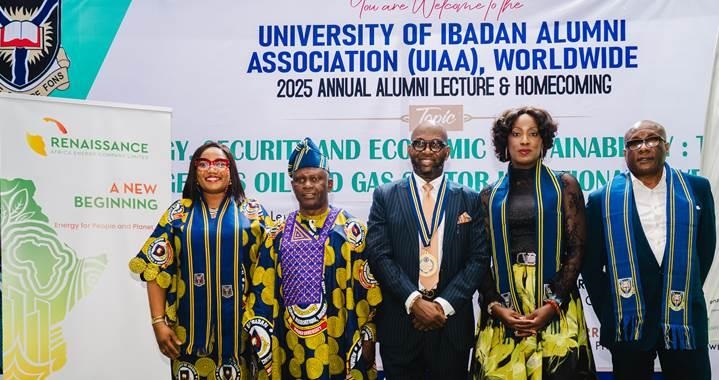
L – R: Chairman, University of Ibadan Alumni Lecture Committee, Dr. Irene Akhideno; Acting President of the alumni association, Dr. Terrumun Gajir; Managing Director and CEO, Renaissance Africa Energy Company Limited, Mr. Tony Attah, his wife, Mrs. Omah Attah; and Chairman and CEO, Air Peace Limited, Mr. Allen Onyema, at the 2025 University of Ibadan Alumni Association Homecoming event held at the university …on Friday.
According to Attah, Renaissance as a company was a child of necessity that has come to the Nigerian energy space to lead the path that would put the country at the centre of African development and industrialisation.
“With Renaissance, it’s a new beginning in Nigeria and we are focused on just what we need to do to rally the necessary support from private and government stakeholders to frontally address energy poverty that has plagued us for decades,” Attah said.
Attah was earlier received at the Faculty of Technology by the Dean, Professor Isaac Bamgboye, and other principal officers of the faculty.
The homecoming event witnessed the inauguration of a state-of-the-art synthetic mini football pitch donated by Renaissance and its joint venture partners – NNPC Limited, TotalEnergies and Agip Energy and Natural Resources. Attah described the pitch, named “Renaissance JV Arena”, as a lasting “symbol of excellence, vision, and commitment to youth and community development within the university,” by the joint venture partners.
On a personal level, Attah sponsored the renovation of the university’s Independence Hall reading rooms where he had spent some time as a young undergraduate. He also teamed up to support the “Light Up U.I. Project”, a solar-powered streetlights scheme donated by the Renaissance U.I. Alumni.
One of the highlights of the Friday event was the conferment of an Award of Excellence on Attah, in recognition of his outstanding contributions to the oil and gas industry, leadership in sustainable energy development, and commitment to education and community empowerment.
As the 30th session of the Conference of the Parties (COP30) to the United Nations framework Convention on Climate Change (UNFCCC) came to a close on Saturday, November 22, 2025, observers contend that the global summit ended with new promises but no plan to deliver fossil fuel phase-out, and that adaptation finance is still inadequate.
They point out that, at COP30, the world received another set of new words and promises, but still no plan to deliver on what science demands, communities need and what countries have already agreed upon during previous negotiations.
The outcome, they say, contains positive elements regarding the climate justice that communities have long fought for, including guidelines for a just and orderly transition to renewable energy with the establishment of the Belem Action Mechanism (BAM), including strong language on Indigenous rights.
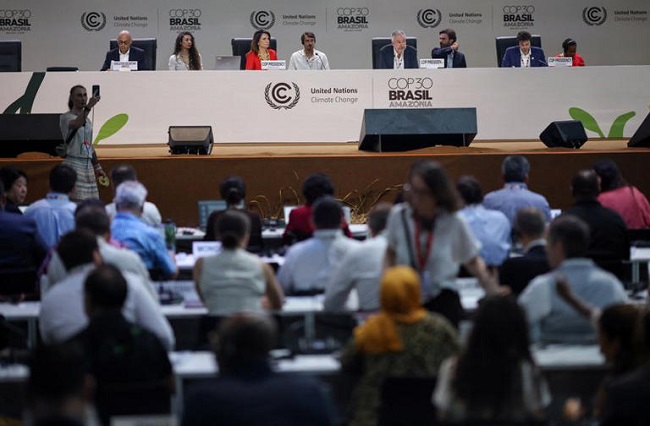
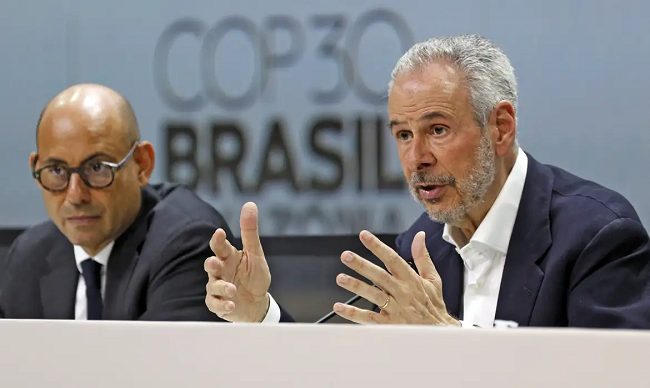
Brazil’s COP30 President Andre Correa do Lago and Executive Director Ana Toni attend a plenary session during the UN Climate Change Conference (COP30), in Belem, Brazil, November 21, 2025. Photo credit: REUTERS/Adriano Machado/Thomson Reuters
They stress that COP30 delivered a historic victory with the Just Transition mechanism – a breakthrough civil society, workers, and frontline communities fought for and won. But the broader Justice Package remains unfinished. Adaptation is weakened, and fossil fuel action is absent.
“This is an important signal that multilateralism can deliver – but a time-bound plan to wind down coal, oil, and gas is also urgently needed.”
They lament that, once again, countries leave with pledges on paper instead of the clear pathways, timelines, and funding required to get there and protect communities impacted by the climate crisis today; whilst rich countries avoided concrete commitments and refused to end their dependence on fossil fuels.
The activists welcome the adoption of the Just Transition mechanism as one of the strongest rights-based outcomes in the history of the UN climate negotiations but warn that COP30 has produced weak outcomes in the very areas that are critical to ensuring justice for vulnerable and frontline communities. A dangerously weak outcome on Adaptation finance leaves little hope for impacted communities.
Further adding to this injustice, governments, they say, did not deliver a concrete global response plan to address the ambition gap, and only agreed to have further processes to address this gap including on a just, equitable and orderly transition away from fossil fuels – while welcome, we need more than a process.
“We need implementation that includes finance to urgently address the root cause of the climate crisis,” they submit.
The real faultline running through COP30 was the refusal of developed countries to agree to the provision of finance across all areas. Their blocking of commitments on Adaptation finance, mitigation ambition, and the transition away from fossil fuels directly weakened the overall outcome. By once again failing to meet their climate-finance obligations – obligations grounded in historical responsibility – developed countries have undermined trust and fairness in the process and limited what this COP could have achieved.
A Breakthrough for Rights and Justice
The Just Transition mechanism stands as the major achievement of COP30 and for workers and communities across the world. More ambition on climate is possible if we put social justice at the heart. No COP decision has ever carried such ambitious and comprehensive language on rights and inclusion: human rights; labour rights; the rights of Indigenous Peoples, Afro-decendants; and strong references to gender equality, women’s empowerment, education, youth development, and more.
This outcome did not happen by accident. This is the result of the hard fought struggles and collective power of trade unions, communities, social movements, Indigenous Peoples’ organisations, and civil society over many years and especially escalating this year for an outcome at this COP.
The Just Transition mechanism, popularly known as the Belém Action Mechanism or BAM, by activists and chanted in the COP30 halls, also opens promising discussions on support for Just Transition pathways: a clear reference to additional, grant-based finance and recognition of the barriers that prevent Just Transition efforts.
A first victory in this process, this is by no means the end. Movements will remain active and determined to secure their seat at the table and ensure the agreed operationalisation of the mechanism by next year.
Adaptation: A Grim Outcome
In stark contrast to the Just Transition mechanism victory, the Adaptation outcome falls far short of what climate-vulnerable countries and communities urgently need – and expected from COP30.
The watering down of the obligations of developed countries to provide Adaptation finance, and pushing the time-lines to deliver the tripling of finance to 2035 is a betrayal of vulnerable and impacted people in the Global South and driven mainly by the EU and Japan. In addition, the absence of any reference to the Global Goal on Adaptation contributes to the weakness of this outcome on Adaptation.
Fossil Fuels: A Deep Disappointment
The final COP30 decision contains no mention of a just, equitable and fully-financed transition away from fossil fuels – an essential response to the ambition gap. Given that oil, coal and gas remain the root cause of climate breakdown, this omission represents a severe failure for COP30. However, the adoption of the Just Transition mechanism, which secures the interests of workers and communities in the energy transition, provides a pathway for countries to transition away from fossil fuels in a just, equitable and orderly manner, even if the political signal was lacking in the final decision.
Process Concerns: A Worrying Trend?
COPs must deliver concrete outcomes, not sink into cycles of dialogues, roadmaps, and reports. For this reason, Activists are concerned about the direction of recent COP processes.
COP29 in Baku was deeply challenging; Belém has not been much better. The growing presence of fossil fuel lobbyists and the persistent lack of transparency as negotiations increasingly take place behind closed doors, risks the erosion of trust in the process, already at low levels. The current trends are worrying and a review of the process and its governance is needed to ensure that the response to the global climate crisis meets the urgency and ambition needed.
Going forward, this process needs to be held accountable. Civil Society will hold governments to account at home and in these halls. Those governments who continue to hold back real progress will be called out. COP Presidencies have an important role to play in ensuring inclusivity, transparency and the meaningful participation of civil society.
Finance: When It’s Time to Pay Up, Ambition Disappears
Despite soaring rhetoric, wealthy countries failed to provide clarity on adaptation finance, the most urgent lifeline for communities already facing climate impacts. There is still no figure, no baseline, no guarantee of public finance, and now the timeline has been pushed back to 2035, making the balanced finance goal adopted last year even harder to achieve.
Frontline communities, including Indigenous and traditional peoples, are also and once again left waiting for direct access to finance while the EU, Japan, and Canada stalled progress. The EU in particular positioned itself as a climate leader while refusing to deliver on adaptation finance and even threatening to walk out when asked to do its fair share.
People Power and Global Momentum: The Bright Spot of COP30
Outside the negotiating rooms, Indigenous peoples, traditional communities and youth made themselves impossible to ignore. Their leadership was one of the strongest forces at COP30. They showed what real climate leadership looks like.
Momentum for a fossil fuel phase-out is also accelerating rapidly. What began with Brazil calling for a roadmap has grown into support from almost 90 countries, backed by civil society and business leaders.
Now that this coalition exists, the next step must be turning momentum into a plan. The Colombia fossil fuel phase-out conference in April and the Colombia-Netherlands-Brazil process must deliver the substance, benchmarks, and institutional backing needed to shape a credible global phase-out roadmap.
Ilan Zugman, Director for Latin America and Caribbean, 350.org: “In Belém, Indigenous peoples, traditional communities and frontline leaders made the message clear: real climate action means ending fossil fuels and delivering the finance figure that communities need to survive. The lack of concrete commitments in the final text of COP30 shows us who is still benefiting from the delay: the fossil fuel industry and the ultra-rich, not those living the climate crisis every day.
“Yet the courage on the streets of Belém and the world has ignited global momentum: what began as a single country, Brazil, calling for a roadmap to phase out fossil fuels has grown into a coalition of almost 90 countries pushing for it. The momentum is now unstoppable, starting with the fossil fuel phase-out conference in Colombia next April.”
Andreas Sieber, Associate Director Policy and Campaigns, 350.org: “Belém didn’t stumble. COP30 was steered into a shortfall. President Lula and Minister Marina Silva showed real leadership on confronting fossil fuels. But the Presidency negotiating team retreated behind closed doors, smothering the multilateral spirit needed for higher ambition, while wealthy countries refused to put real finance on the table.
“Yet momentum was unmistakable: nearly 90 countries demanded a roadmap to transition away from fossil fuels, and the Just Transition Mechanism proved multilateralism can still deliver. Those roadmaps now need institutional backing. Brazil must work transparently with Colombia and Pacific hosts ahead of Pre-COP to turn momentum into substance. The world was ready to turn the page on fossil fuels; a few parties were not.”
Fanny Petitbon, France Team Lead at 350.org: “In Belém, rich nations showed their unbearable hypocrisy: demanding ambition from those least responsible for the climate emergency, while systematically refusing to pay up their historical climate debt. The commitment to triple adaptation finance is weak, vague, and tragically late. When cyclones and droughts strike now, a 2035 deadline is a cruel joke.
“Self-proclaimed climate leaders like the EU, Japan, and Canada failed to adequately deliver for those already suffering, proving their leadership is hollow. In the meantime, they continue to pour billions of dollars into fossil fuel subsidies and to protect the privilege and interests of climate wreckers – the fossil fuel industries and the super-rich – by refusing to tax them to fund urgent climate action, despite strong public support.”
Fenton Lutunatabua, Pacific Team Lead at 350.org: “With the Belem Action Mechanism, we’re seeing progress. But without a transition away from fossil fuels, we’re stagnating at a time when our islands can’t afford even a small amount of delay. The COP30 statement does not mention a plan to end fossil fuels, nor does it allocate sufficient finance for frontline communities, and that casts a shadow over our time here in Belém. We need to address the obvious cause of the climate crisis and make sure that everyday people are able to survive it. The closing window on 1.5℃ means we’re walking a fine line here between survival and climate catastrophe”.
Masayoshi Iyoda, Japan Campaigner at 350.org: “COP30 in Belem is yet more proof that Japan fails to contribute to achieving the Paris 1.5 goal and protect Japanese people from the risk of climate disasters and the social and economic loss caused by addiction to fossil fuels. Japan did not play a role in supporting the transition away from fossils but instead offered up greenwashing technologies and false solutions. Japan must immediately start increasing its climate finance support for adaptation, loss and damage, and tripling renewables.
“A lack of ambition in Japanese climate policies is shown in Belem again and with the new coal-fired power plant project, GENESIS Matsushima, they are travelling in the wrong direction. A just roadmap of transitioning away from fossil fuels is what we need to respond to the science – not more investment in the most polluting industries.”
Tasneem Essop, Executive Director, Climate Action Network International, said: “We came here to get the Belém Action Mechanism – for families, for workers, for communities. The adoption of a Just Transition mechanism was a win shaped by years of pressure from civil society. This outcome didn’t fall from the sky; it was carved out through struggle, persistence, and the moral clarity of those living on the frontlines of climate breakdown. Governments must now honour this Just Transition mechanism with real action. Anything less is a betrayal of people – and of the Paris promise.
“Civil society held steady at this COP – together with frontline countries and movements who refused to let justice be pushed aside, even as some developed countries dug in their heels and tried to block agreement.
“We will continue to fight for Adaptation – that is essential for protecting people by investing in their resilience to climate impacts, securing the resources they need to withstand rising risks, and ensuring no community is left exposed. Without Adaptation finance and a just, equitable, and fully funded plan to transition away from fossil fuels, governments are not confronting the root cause of the crisis. We have a win for justice from COP30, but we keep fighting.”
Anabella Rosemberg, Just Transition Lead, Climate Action Network International, said: “Workers and environmental activists are united! The creation of a Just Transition mechanism is a significant achievement for social justice and climate justice, the people and the planet. The Just Transition mechanism comes with the most progressive rights-based framing we have ever seen in a COP decision.
“For the first time, labour rights, human rights, the right to a clean environment, Free, Prior and Informed Consent, and the inclusion of marginalised groups are all recognised as core to achieving more ambitious climate action. This didn’t come from nowhere. Social movements mobilised, organised, and put real solutions on the table. This is our victory, carved out despite all odds.
“But a mechanism grounded in rights is only powerful if it delivers. A Just Transition is not a side-chapter of climate policy – it is the lens through which the entire implementation of the Paris Agreement must now be guided. Now that the mechanism exists, governments must fill it with ambition, finance, and cooperation. Workers and communities have waited long enough – and we will keep fighting to ensure this mechanism which is for the people reaches the people.”
Mohamed Adow, Director, Power Shift Africa, said: “With an increasingly fractured geopolitical backdrop, COP30 gave us some baby steps in the right direction, but considering the scale of the climate crisis, it has failed to rise to the occasion. Among the green shoots to emerge was the creation of a Just Transition Action Mechanism – a recognition that the global move away from fossil fuels will not abandon workers and frontline communities.
“COP30 kept the process alive – but process alone will not cool the planet. Roadmaps and workplans will mean nothing unless they now translate into real finance and real action for the countries bearing the brunt of the crisis. Despite calling themselves climate leaders, developed countries have betrayed vulnerable nations by both failing to deliver science-aligned national emission reduction plans and also blocked talks on finance to help poor countries adapt to climate change caused by the global north
“Rich countries cannot make a genuine call for a roadmap if they continue to drive in the opposite direction themselves and refuse to pay up for the vehicles they stole from the rest of the convoy. Belém restored some integrity to the Global Goal on Adaptation, removing dangerous indicators that would have penalised poorer countries simply for being poor.
“The slow pace of finance negotiations is worrying. The promise to triple adaptation lacks clarity on a base year and has now been delayed to 2035, leaving vulnerable countries without support to match the escalating needs frontline communities are facing. As it stands, this outcome does nothing to narrow the adaptation finance gap. COP30 was supposed to have a big focus on raising funds to help vulnerable nations adapt to climate change. But European nations have undermined these talks and stripped away the protections poor countries were seeking in Belem.
“Europe, which colonised much of the global south, and then imperiled it further through its industrialised carbon emissions, now works against even efforts to help it adapt to the climate crisis. Even though COP30 didn’t achieve what we hoped, the very fact that fossil fuels, trade and the needs of the vulnerable are on the agenda is welcome. These are urgent, real-world issues that will not go away until action is taken.”
As COP30 wraps in Belém, Brazil, Mercy Corps is speaking out on the urgent need for climate action and adaptation finance for communities on the frontlines of the crisis. Ten years after Paris, the summit has failed to deliver the commitments people need to survive and thrive in a rapidly warming world, according to Debbie Hillier, Mercy Corps UNFCCC Policy Lead
COP30 was a failure for the communities on the frontlines of the climate crisis. Ten years after the Paris Agreement – in what was meant to be the “implementation COP” – leaders left Belém, Brazil, without the commitments needed to protect people already living with the devastating consequences of climate change. Despite record-breaking losses, escalating humanitarian need, and clear evidence that adaptation finance is dangerously insufficient, negotiators failed to deliver the scale of action this moment demands.
Debbie Hillier, Mercy Corps UNFCCC Policy Lead
Communities facing climate impacts urgently needed COP30 to deliver stronger mitigation ambition, a just transition away from fossil fuels, and – most critically – a substantial increase in adaptation finance. Instead, the final text made no progress towards transitioning away from fossil fuels, despite countries committing to this two years ago in Dubai. While a global agreement is preferable, Colombia and the Netherlands are showing real leadership by agreeing to co-host the first International Conference on the Just Transition Away from Fossil Fuels. This will be an important space to identify the necessary pathways to phase out fossil fuels, which will be incorporated in a roadmap, to be drafted by Brazil, ahead of COP31.
If the world fails to reduce emissions and mitigate the crisis, the cost of adaptation will continue to rise, and climate-vulnerable communities will continue to suffer the consequences.
Adaptation finance is not abstract. It determines whether farmers can protect their crops, whether coastal communities can reinforce shorelines, whether health systems can withstand climate-related disease outbreaks, and whether countries can build resilience rather than lose hard-won development gains.
While the COP30 outcome includes a new commitment on adaptation finance, it is deeply disappointing. It includes no baseline year, no clarity on the actual target, and no mechanism defining who is responsible for delivering the tripling. It also allows other flows such as concessional loans and private finance, and delays delivery to 2035 – far too late for communities already in crisis.
The adaptation finance pledge was part of a broader package agreed in Belém. COP30 adopted a set of indicators for the Global Goal on Adaptation (GGA) – in theory, a milestone that should enable the world to begin operationalizing the goal and tracking real progress. The new Belém–Addis Vision outlines a path for follow-up, and the Baku Adaptation Roadmap provides an opportunity for countries and stakeholders to shape implementation.
Yet the indicators themselves were the product of last-minute political bargaining, leaving them difficult to measure and lacking clarity. Most critically, without adequate finance, these indicators cannot translate into real resilience. Countries can monitor and report endlessly, but without resources, communities will not become safer or more prepared.
COP30 failed to correct the deep structural imbalance in global finance. There was no progress to end fossil fuel subsidies that continue to dwarf climate finance flows, nor to provide the debt justice needed by countries forced to spend more on repayments than protecting people from climate impacts.
References to finance for developing countries remain weak and fall short of core principles such as “polluter pays” and common but differentiated responsibilities and respective capabilities (CBDR-RC). Without addressing these systemic failures, the world will continue to invest more in driving the climate crisis than in solving it.
COP30 may have been called the “implementation COP” or the “people COP,” but in reality, it failed to turn commitments into action. Ten years after the Paris Agreement, communities cannot afford more empty promises. The signal on adaptation finance is far weaker than what vulnerable communities needed, but momentum for greater ambition remains – from civil society, from frontline countries, and from the International Court of Justice, which has underscored states’ legal obligations earlier this year.
The window to deliver climate justice is rapidly closing. COP30 did not go far enough, but the fight for a world where vulnerable communities can adapt and thrive must continue.
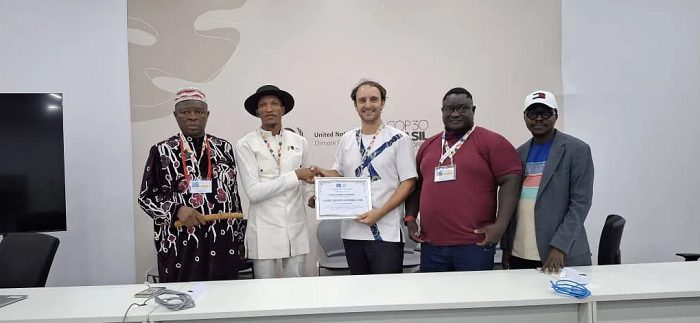
Gov. Hope Uzodinma of Imo State bas received a “Climate Change Champion” award from the United Nations of Youth Network at the 30th United Nations Climate Change Conference of the Parties (COP30) in Belem, Brazil.
Mr. Tony Velasco, the Global Coordinator of the network, said the award recognises Uzodinma’s efforts in promoting climate action and sustainable development, which include the launch of the “Hope Green Revolution” initiative in Imo.
Receiving the award on behalf of the governor, Dr Emeke Mandella, the Commissioner for Youth Development and Talent Hunt in Imo, described the Uzodinma’s perspective to scientifically introduce carbon capturing plants as excellent.
The award ceremony at COP30
According to him, Uzodinma’s ideology to launch the Hope Green Revolution Project on Nov.1, 2022 as natural solution to increase tree planting, was the best.
“Trees absorb CO2, provide barriers, protection and food.
“This under-scored his commitment to administrative policies that promote climate change mitigation. He mandated the 27 Local government council Chairmen to plant a minimum of 10,000 trees, every six months.
“He carried out land recoveries, forest protection and tree preservation. Trees play a crucial role in producing oxygen and absorbing carbon dioxide through the process of photosynthesis, which is essential for life on Earth.
“These above, strengthened His Excellency’s vision to launch the Hope Green Revolution Project on Nov. 1, 2022, which under-scored his commitment to administrative policies that promote climate change mitigation,“ he said.
According to him, the project to plant 30 million trees has been domesticated by the Imo State Ministry of Youth Development through massive climate change awareness campaigns by driving youths to show their positive concerns as climate change champions.
“To drive the climate change mitigation campaign and awareness further, we have introduced Project One Youth, One Tree.
“Knowing Nigeria as the most populous black nation on earth, above 60% of her population are youths with the energy, exploratory, innovative and domineering mindset to take on any task set before them.
“It is now our resolve as a youth ministry to capitalise on this strength and channel their positive energy towards climate change mitigation through tree planting,” he added.
Also speaking, Dr Goodluck Obi, the network convener, commended the ruggedness of the governor toward tree planting in Imo State , Nigeria affirming that he really deserved the award.
According to him, the effects of climate changes in Nigeria where Imo state is located in the eastern region include heatwaves, droughts, wildfires, erratic rainfall, floods, landslides, desertification and land degradation.
Obi further commended the governor for being at the front line for promoting youth involvement in climate action.
He urged other states and local governments in Nigeria to emulate Imo state governor in tree planting.
According to him, tree planting is the cheapest means of adaptation and mitigation against climate change.
He said the network had given the inaugural award to Mr Ayodele Adewale , the Chairman of Amuwo Odofin Local Government Area (LGA) in Lagos State in 2010.
He stated the government of Adewale planted and nurtured trees in all 11 wards of the local government area.
“Adewale created A green Club that was in charge of planting and nurturing the trees. There were Tree planting Clubs in Primary and Secondary Schools. He created a Special Climate Change Unit,” he added.
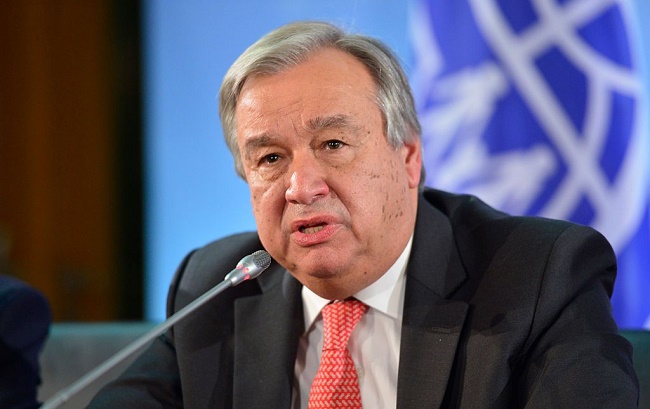
UN Secretary-General Antonio Guterres has urged the G20 leaders to lead with vision and passion to deliver on climate and economy actions.
Guterres told journalist in Johannesburg, South Africa on Friday, November 21, 2025, ahead of the official opening of the G20 Leaders’ Summit, taking place on the African soil for the first time.
The two-day summit, which opens on Saturday, comes at a febrile moment in global politics.
UN Secretary-General, António Guterres
“Now is the time for leadership and vision,” he said.
The G20 bloc is made up of the world’s largest economies, although the United States has announced it will not officially participate.
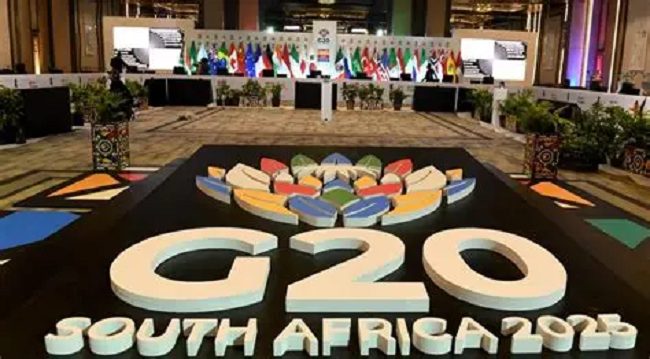
This year’s summit highlights the need for climate adaption and sustainable financing, under the theme “Solidarity, Equality and Sustainability.”
The UN chief is attending the summit to push for economic and climate action, as well as an end to spiralling conflicts around the world.
Developing countries, in particular in Africa, are suffering from a shrinking fiscal space, crushing debt burdens and a global financial architecture that is failing them, Guterres said.
The UN chief lamented that after decades of colonial rule, the continent remains “woefully under-represented” in global institutions.
“The G20 can help repair this historic injustice and drive reforms that give developing countries – and Africa in particular – a real voice in shaping global policies, and make global economic governance more inclusive, representative, equitable and effective in the years ahead,” he said.
Guterres called on the G20 to live up to commitments made in June at the Financing for Development Confrence in where countries promised to unlock more finance to drive sustainable growth.
That would entail tripling the lending power of multilateral development banks, reducing borrowing costs and enabling developing countries to mobilise domestic resources.
Countries have failed to keep temperatures to the 1.5 degrees Celcius temperature rise limit, Guterres cautioned.
“Avoiding more climate chaos means bridging the adaptation gap – urgently” and that requires a scale up of financing, namely, the doubling of adaptation financing to at least $40 billion this year.
He added that while 90 per cent of new power capacity is coming from renewables, while global investment in clean energy reached $2 trillion last year, only a negligeable proportion went to Africa.
“Africa should be at the heart of this clean energy revolution,” he pressed.
Listing some of the most devastating conflicts around the world including in Sudan, the Democratic Republic of Congo, Ukraine and Gaza, Guterres called for G20 members to use their influence to end the fighting.
“Everywhere – from Haiti to Yemen to Myanmar and beyond – we must choose peace anchored in international law,” he concluded.
Meanwhile, Vice-President Kashim Shettima is in Johannesburg, South Africa, for the G20 Leaders’ Summit.
The Vice-President, who will represent President Bola Tinubu at the summit, is scheduled to engage foreign leaders and development partners on issues relating to the economy, security, climate change, among others.
On arrival at the Waterkloof Air Force Base in Johannesburg, Shettima was received by the Minister of Finance and Coordinating Minister of the Economy, Wale Edun; and Chargé d’Affaires, Amb. Alexander Ajayi.
Others are Consul General, Amb. Umar Bashir; the Defence Adviser, Commodore Ibrahim Ari-Gwaska; and the Chief Director, West Africa Directorate, Department of International Relations and Cooperation (DIRCO), Nyameko Goso.
Also at the airport to welcome the Vice-President are the South African Minister of Small Business Development, Ms Stella Ndabeni-Abrahams, among other government officials.
The summit, scheduled to hold from Nov. 22 to 23 at the Johannesburg Expo Centre, will feature leaders from the world’s top 20 economies.
The event will also be attended by the representatives from the European Union, the African Union and key financial institutions.
The theme of the two-day summit is, “Solidarity, Equality, Sustainability,” and will afford participants, including Vice-President Shettima, the opportunity to deliberate extensively on issues concerning the economy, financing for development and debt burden.
The Vice-President is expected to hold bilateral meetings during the summit in furtherance of the Renewed Hope Agenda and to discuss regional and international peace, security, and development.
Shettima will return to Nigeria at the end of the engagements.
The Global Investments in clean energy are projecting a $1 trillion for grids, storage toward quadrupling sustainable fuels by 2035.
This is contained in an executive summary of the outcomes report on Global Climate Action Agenda at the 30th Conference of Parties in Belem, Brazil.
According to the report, thedeveloping countries are leading the race on industrial decarbonisation, tens of thousands of electric vehicles, thousands of gigawatts of renewable energy, hundreds of clean industrial projects, novel carbon removal technologies.
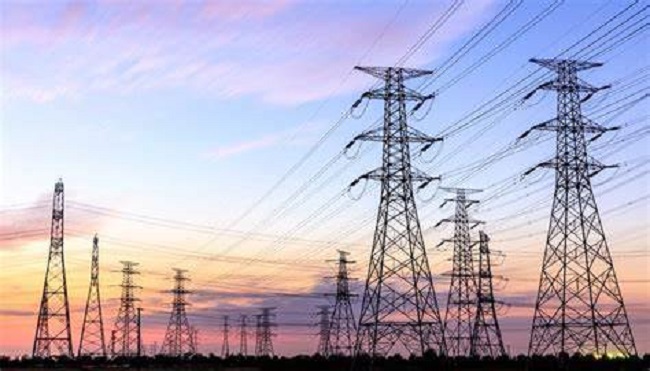
Power grid lines
“Under the COP30 Global Climate Action Agenda, the Green Grids Initiative launched at COP26, and the Utilities for Net Zero Alliance (UNEZA) launched at COP28, united with the Clean Energy Ministerial, IRENA, the IEA and others to deliver a global plan.
“The global plan is to accelerate expansion and resilience of power grids and invest $1 trillion to triple their collective renewable capacity by 2030.
“This is what it takes to transition the energy, transport and industry sectors away from fossil fuels, enabling increased energy access,“ he said.
The report said hundreds of million hectares of forest, land and ocean were protected or restored while millions of farmers were transitioning to regenerative agriculture practices.
It said traditional communities and Afro-descendant groups secured land rights of millions of Indigenous peoples.
It further said that a total of $9 billion in committed investment, covering more than 210 million hectares of land.
“Also, reaching 12 million farmers across more than 90 agricultural and food commodities building resilience across entire value chains in over 110 countries by 2030.
“This is how we steward forests, oceans and biodiversity, and how we transform the agriculture and food systems,” it said
The report pointed out that 437.7 million people became more resilient than to the race to resilience campaign.
According to the report, 162 companies, cities, and regions covering 25,000 buildings and $400 billion in annual turnover cut over 850,000 tonnes of CO₂ in 2024, surpassing one million tonnes reduced in total.
“The CHAMP coalition launched at COP28, delivered two-thirds of new nationally determined contributions with stronger subnational and urban content among its 78 members.
“Millions of jobs created, new skills developed to build resilience for cities, infrastructure and water, while fostering human and social development,” the report said.
According to the report, trillions of dollars pivot into the transition with new partnerships and innovation to scale finance from the private sector, governments, and financial institutions, including for adaptation finance.
“This is how climate action begins to function as an economy in its own right one that unleashes finance, technology and capacity-building to reward protection and long-term stability,” it said.
As the 2025 G20 Leaders’ Summit officially opens on Saturday, November 22, 2025, on African soil for the first time in history, African civil society, climate movements, and community organisations are sending an urgent message: Africa cannot confront the climate crisis while suffocating under unsustainable debt and loan-driven climate finance.
Climate justice must be debt-free, delivered through grants, not loans.
Thirty-three partners from across the African Climate Network, including 350Africa.org, Fair Finance Coalition of Southern Africa, Climate Justice Coalition, Botshabelo Unemployed Movement, Middelburg Environmental Justice Network and NuClimate vision, Newcastle Environmental Justice, Marikana Youth development organisation, released a joint open letter calling on G20 governments to urgent, justice-centred action, beginning with comprehensive debt relief and an immediate, systemic shift from climate loans to grant-based finance.
G20 Summit
Alia Kajee, Global Campaign Project Manager for 350.org, cautioned the leaders, saying, “The G20 kicks off in Johannesburg as COP30 enters its final days. This timing is critical. We call on the leaders currently at COP30 to take the momentum and passion from these negotiations directly to the G20 and ensure a binding commitment is made to deliver debt-free climate finance.
“Continued fossil fuel extraction is driving the climate crisis beyond the limits of a livable planet. African countries cannot be expected to respond to climate crises while trapped under suffocating levels of debt. We demand grants, not loans, as the only equitable solution. The G20 must show the political will to make the transition away from fossil fuels, backed by over 80 Parties at COP30, credible through grant-based debt justice.”
The G20 represents a shifting balance of global power, and momentum worldwide is moving decisively toward a transition away from fossil fuels. But that transition must be just. Without a complete phaseout of fossil fuels, there will be no planet left to finance and no future for the communities already on the frontlines.
Despite contributing only 4% of global emissions, African countries are enduring the most severe impacts: extreme droughts, deadly floods, heatwaves, cyclones, desertification, and cascading food and energy insecurity. Every shock pushes vulnerable nations deeper into debt as they borrow to rebuild destroyed infrastructure and protect communities.
Loan-driven climate finance is failing Africa. The continent needs $52–106 billion per year for climate adaptation, yet available finance remains scarce, delayed, and overwhelmingly loan-heavy, worsening the crisis Africa faces. Current flows leave a $127.2 billion annual adaptation gap through 2030.
The open letter from African Civil Society, Movements, and Partners within the 350Africa Network urges G20 leaders to commit to the following key demands:
Immediate and comprehensive debt relief for African countries.
Grants, not loans, are the primary channel for climate finance.
A fully grant-based Loss and Damage facility, accessible now.
A mandatory minimum 50% grant ratio at Multilateral Development Banks for adaptation finance.
Grant-based support for a just energy transition, including community-owned renewable energy systems, social protection for workers, and local grid investment.
In the wait for the final time-bound roadmap to phase out fossil fuels, recent developments, including President Lula’s commitment to push for a global transition plan and the Colombia Declaration, have been supported by over 80 countries, showing that global momentum is accelerating. However, African movements warn that no credible phase-out of fossil fuels will be possible without real, adequate, grant-based climate finance.
“Finance is the real blockage,” said 350Africa.org Interim South Africa Team Lead, Tshepo Peele. “We cannot phase out fossil fuels, scale renewable energy, or protect frontline communities without wealthy countries finally meeting their historic responsibility and fixing the global financial system. COP30 must deliver a funded, fair transition, and the G20 must show the political will to make that commitment a reality.”
When Nigerian billionaire Aliko Dangote landed in the Zimbabwean capital, Harare, last week to finalise his more than $1 billion investment deal with President Emmerson Mnangagwa, he was surrounded by unfamiliar faces which many Zimbabweans could not identify.
A few unassuming Zimbabwean business executives received Dangote, with Presidential Investment Advisor Paul Tungwarara and investment facilitator Josephine Mahachi, who is a familiar face in the Zimbabwean media space.
One of the businesspeople, among several others, who received Dangote at the Robert Gabriel Mugabe International Airport was Senziwani Sikhosana, a quiet and astute Zimbabwean businessman who prefers working discreetly in the boardroom shadows rather than in the full glare of publicity and limelight.
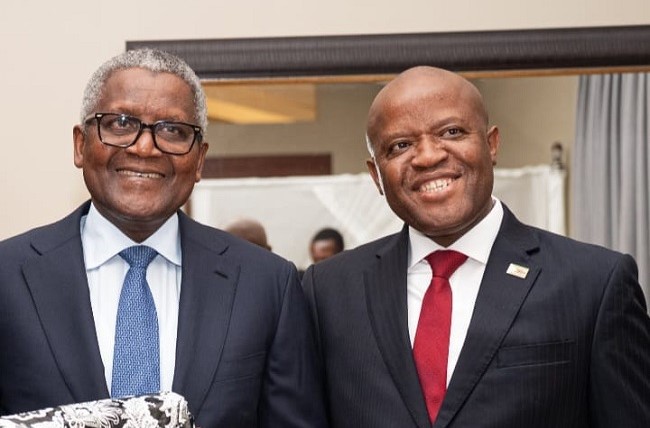
Dangote and Sikhosana
It was only recently that the media began to ask who Sikhosana is after his actions, which spoke louder than words.
The Dangote deal amplified the question.
Before that, besides a few who may have listened to some of his public addresses, not many outside Zimbabwe’s banking and financial services sector and the complex treasury or financial engineering world knew him.
Yet he has been a quiet force to be reckoned with, working in the professional field, setting up businesses and executing big financial transactions for the last 25 years
Before the Dangote visit, Sikhosana, whom industry colleagues prefer to simply call Sikho, had made a few prominent public appearances worth noting, most notably during the London Investment Conference in April 2023 and at the launch of TX Money Transfer in Harare around mid-2024.
The London Investment Conference held at the Queen Elizabeth II Conference Centre in London, which he co-organised with Zimbabwe’s Ministry of Finance and the fast-growing Victoria Falls Stock Exchange, as well as a UK-based consultancy, was attended by government officials, including Finance Minister Mthuli Ncube, influential business executives, international investors, and major company representatives from Zimbabwe and British capital markets players.
He was one of the key speakers at the high-profile conference.
He grabbed the limelight at the launch of TX Money, a platform aiming to improve financial remittance reliability, transparency, and efficiency in Zimbabwe.
It is also designed to ensure financial inclusion.
But still, the real question remains: Who is Senziwani Sikhosana?
Sikhosana is currently Bard Santner Incorporated’s chief executive officer.
Bard Santner Inc. is a Harare-headquartered financial services advisory company whose business operations span corporate finance, asset and wealth management, microfinance, and remittances.
The firm also engages in various corporate social responsibilities, especially sports sponsorship, particularly football, golf and cricket.
The company is based in Harare and has an office in Sandton, Johannesburg, South Africa.
It also has a strategic presence through an international office in New York, United States, to facilitate international investment, offer advisory services and cut financial transactions.
Working closely with his colleagues, including Tatenda Hungwe and Lucia Chingwaru, and investment facilitator Mahachi, Sikhosana became the mastermind behind the Dangote deal.
Arranging the deal involved planning, several meetings and execution with precision.
While many – and even much bigger – deals have been consummated in Zimbabwe, the significance of the Dangote visit lay in investor confidence-building momentum, the attendant positive contagion and game-changing perception.
Bringing Africa’s richest man and the wealthiest Black person in the world, with operations in 17 countries across the continent, to Zimbabwe – after failed attempts in 2015 and 2018 – was a strategic and significant groundbreaking move.
It will not fix all Zimbabwe’s numerous challenges but will certainly provide an impactful foreign direct investment inflow, employment, and investor confidence in the economy.
Dangote’s projects in Zimbabwe span cement manufacturing, coal mining, power generation, and a fuel pipeline from the west Atlantic coast of Namibia, where he is building a big refinery, to Botswana, Zambia and Zimbabwe, a massive investment.
Sikhosana’s financial expertise and dedication, instrumental in bringing Dangote back to Zimbabwe after failed attempts, will be required on these projects.
His team worked tirelessly for 16 months, conducting discreet negotiations that ultimately led to the signing of a landmark agreement with the government
This savvy business manoeuvre has not only earned him recognition but also positioned Zimbabwe as an attractive investment destination and created opportunities for others.
After months of courting Africa’s leading industrialist,
Sikhosana and his colleagues finally came face to face with Dangote at the Afreximbank Annual Meetings held in Abuja in June 2025.
Subsequently, they went back to see him at his headquarters in Lagos, Nigeria, where they toured his operations at Dangote Refinery.
At that meeting, it was agreed Dangote would come back to Zimbabwe to invest, but before all that, he had to meet Zimbabwe President Emmerson Mnangagwa to obtain the highest assurances, some of which would be to iron out whatever obstacles he had encountered in 2015, including mining concessions, tax incentives, technical details, work permits for experts and investment security.
Through this quiet phase of the deal-making process, Sikhosana and his team met Mnangagwa to clear the path for Dangote.
This led to Dangote’s visit to Harare last week and the signing of the investment agreement.
By training, Sikhosana is a banking and finance professional, as well as a chartered management accountant with over 25 years of experience.
He was educated at the National University of Science and Technology, where he earned a master’s degree in banking and commerce.
His expertise includes asset and liability management, fixed income, forex trading, and treasury management.
After working for various banks in Zimbabwe, including National Merchant Bank, Trust Merchant Bank, Kingdom Merchant Bank, and Interfin Merchant Bank, he went into transport logistics.
He established Burious Logistics, which grew to a peak of 40 trucks operating in southern Africa, transporting bulk goods across Zimbabwe, South Africa, Zambia, Botswana, and Namibia.
Concurrently, Sikhosana founded and operated Plastec Designs P/L, a plastics and allied products manufacturing company, as well as Refresh Industries P/L, which produced fruit juices.
This equipped him with not only knowledge of industrial operations as well as fast-moving consumer goods, but also the lived experience of 10 years of what a leader of a business conglomerate involved in trucking, manufacturing and production goes through in a challenging economic environment.
In 2016, Sikhosana went back into banking and helped to co-found Access Finance Group, which included Access Forex, where he was a shareholder and managing director.
The company had operations in Zimbabwe, South Africa and the United Kingdom.
After leaving Access Finance in 2022, Sikhosana set up Bard Santner with colleagues Hungwe, Chingwaru and Alfred Mthimkhulu, an experienced Zimbabwean asset management expert and finance lecturer from Stellenbosch University in South Africa.
Bard Santner has grown in leaps and bounds, handling huge transactions, including facilitating a $113 million property transaction involving The Grove Mall of Namibia, acquiring the Tetrad Financial Services-managed client’s portfolio, and now the Dangote deal, among many other big transactions.
Sikhosana’s experience in banking was profoundly shaped by three remarkable influences from distinguished captains of Zimbabwe’s financial sector, particularly Julius Makoni who awakened his sense of elegance and sophistication within the industry; Nigel Chanakira who anchored him and horned his technical skills and rigour in banking; and Farai Rwodzi who ignited his entrepreneurial spirit, which all define his fascinating journey in the enterprising and tumultuous business world.
Apart from learning from Makoni, Chanakira and Rwodzi, among others, Sikhosana is also getting more valuable knowledge and exposure working closely with Vinod Bussawah, a seasoned Mauritian financial executive who chairs Bard Santner.
The Mauritius-based Armed has vast experience spanning banking, logistics, manufacturing and fast-moving consumer goods.
The buccaneering Sikhosana is now with the continental industrial titan, Dangote, and is in the process of seizing the next rungs of his impressive career, helping to domesticate the Dangote Group investment portfolio in Zimbabwe through his Bard Santner, the nominated transaction advisors.
Greenpeace has called on the G20 to ramp up their plans to cut emissions and make progress on global tax reform by taxing the super-rich to unlock public finance for climate mitigation, adaptation and social justice.
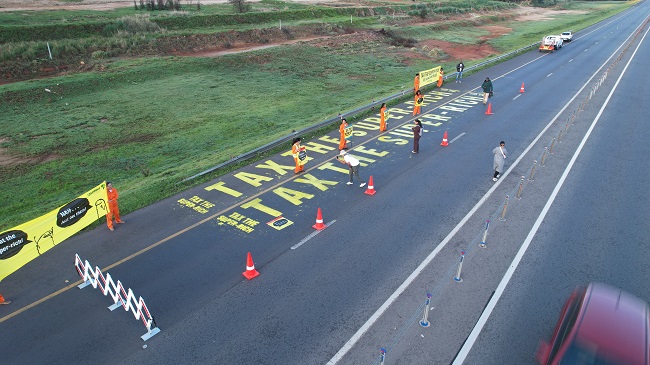
Ahead of the G20 Heads of States Summit, Greenpeace Africa activists also painted “Tax The Super-Rich” on a major road leading to the Johannesburg Expo Centre, where world leaders will be gathering.
The action comes at a pivotal moment as the UN climate conference COP30 in Belém, Brazil, winds down after difficult negotiations on efforts to transition away from fossil fuels, end forest destruction and to progress climate finance for vulnerable countries.
Greenpeace action
In Nairobi, the latest round of UN Tax Convention negotiations, which could unlock vital climate funds, have shown little interest in the proposal for a global minimum tax on the super-rich. The G20 Summit in South Africa now offers President Cyril Ramaphosa a critical opportunity to lead globally on climate justice, including advancing discussions on a wealth tax and raising ambition among G20 leaders.
Fred Njehu, Fair Share Global Political Lead, Greenpeace Africa,said: “Public momentum to tax the super-rich is fast growing – the political will has to follow with concrete actions. Billionaires in Africa and beyond are getting wealthier by the day, while billions are struggling with rising cost of living and escalating climate crisis.
“Making the wealthiest pay their fair share is essential to fund the fight against the climate crisis, mobilise domestic revenues for public services, and advance sustainable development. The G20 Summit is President Ramaphosa’s opportunity to turn words into action and show that South Africa – and Africa – can lead the world and secure a place in history.”
New analysis published in a recently released G20 report shows that, between 2000 and 2024, the world’s wealthiest 1% captured 41% of all new wealth, while just 1% went to the 50% of humanity at the other end of the scale. An Oxfam report found that over the last five years in Africa, the five richest African billionaires have increased their wealth by 88%.
At the INC-3 of the UN Tax Conventions in Nairobi this month, Greenpeace called for stronger commitments to secure much-needed public finance for climate mitigation, nature protection, and sustainable development by ensuring the super-rich and corporate polluters pay their fair share in taxes. These measures could deliver on the COP29 finance commitment for developed countries to mobilise at least $300 billion per year by 2035, and to scale up to at least $1 trillion in public finance in line with needs.
Cynthia Moyo, Lead Campaigner, Greenpeace Africa, said: President Ramaphosa must seize this G20 moment to back a Fair Share approach that makes the super-rich and big polluters pay what they owe. We cannot keep socialising costs while privatising profits. African citizens deserve transparency and a tax system that truly serves them.
“We cannot fund a green and equal future with a broken tax system. Tax justice is climate justice and without bold action on a global wealth tax and making polluters pay, the resources needed to protect people, and the planet will remain out of reach.”
Ahead of the G20 Summit, Greenpeace International launched a new report, revealing the insufficient climate ambition in new 2035 emissions targets (Nationally Determined Contributions – NDCs) of the G20 countries. The report, 2035 Climate Ambition Gap, revealed the 2035 climate action plans of the G20 would yield just a 23-29% cut in emissions towards the 60% global reduction that is needed.
Attending COP30 in Belém, Tracy Carty, Climate Politics Expert, Greenpeace International,said: “When the G20 countries – responsible for 80% of global emissions – deliver collective climate action plans that fall dangerously short, the world has a problem. Given their historic responsibility for emissions and greater financial capacity to act, developed G20 countries should be out front, cutting emissions far in excess of the 60% global average needed. The choices of G20 countries, especially developed ones, will make or break the 1.5°C goal, and it’s time to hold them to account.”
Global climate negotiations stretched into overtime on Friday, November 21, 2025, as countries failed to agree on emission cuts and financial commitments, raising fears the summit will end without meaningful progress on limiting global warming.
Negotiators at COP30 are deadlocked over mitigation targets, adaptation funding and climate finance as the conference runs past its scheduled conclusion.
The impasse threatens to undermine international cooperation on climate action.
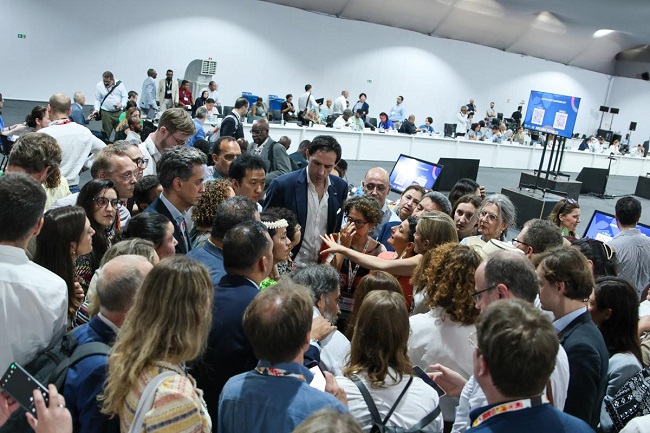
Delegates huddle during the Mutirão Mobilisation for the Belém Package
“This is not the moment for red lines – it is the moment for leadership. Parties must move out of their comfort zones and deliver a result that matches the scale of the climate crisis,” said Mattias Söderberg, global climate lead at DanChurchAid.
Draft negotiating texts released on Friday morning lack the ambition scientists say is necessary to limit warming to 1.5 degrees Celsius above pre-industrial levels, according to civil society observers.
Söderberg said countries must compromise across all major issues to produce a balanced agreement.
“The world will not accept a deal that ignores the emissions gap. We need a breakthrough on mitigation now — not next year, not in the next review cycle. Now,” he said.
He warned that adaptation assistance and finance for developing nations cannot be sacrificed in final negotiations.
“A balanced package means real progress for the communities already hit by climate change. Adaptation and finance cannot be bargaining chips – they are lifelines,” Söderberg said.
The talks have exposed familiar divisions between wealthy and developing nations over who bears responsibility for emissions reductions and climate financing.
Söderberg said all parties must make concessions to reach an agreement.
“No Party can leave Belém with everything they want—but they can leave with a deal that moves the world forward,” he said.
He said the outcome will determine whether the summit strengthens or weakens global climate cooperation.
“This summit will be judged by one metric: whether it moves us closer to solving the climate crisis. There is still time — but only if parties dare to act,” Söderberg said.