The Akwa Ibom State Government says it has commenced the process of establishing the State’s Electricity Regulatory Commission as well as concessioning of the Ibom Power Plant.
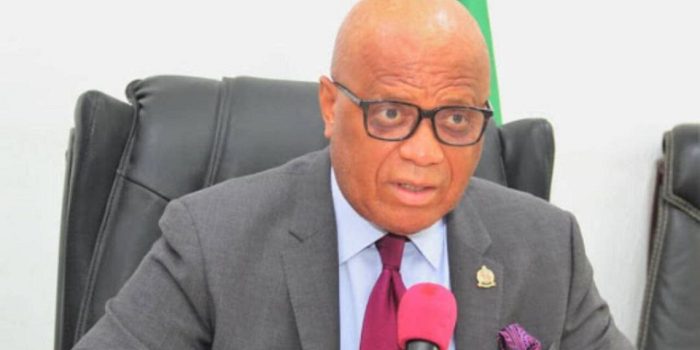
Mr. Iniobong Robson, state Commissioner for Power, disclosed this on Saturday, February 14, 2026, in Ikot Abasi Local Government Area of the state.
Robson explained that the development was part of effort to improve electricity supply across the state.
Pastor Umo Eno, Governor of Akwa Ibom State
He also said that the development followed the signing of the amended Electricity Act by President Bola Tinubu, which empowered states to generate, distribute and regulate electricity within their jurisdictions.
According to him, the amended version of the electricity Act 2023 which has just been signed by the President, now empowers states to take charge of both generation and distribution of electricity.
He added that the state government was taking advantage of the new legal framework to assume greater control over its power sector and address persistent electricity challenges.
He revealed that, within the shortest possible time, the state government would constitute a seven-member Electricity Regulatory Commission comprising five commissioners and two principal officers.
The commissioner also revealed that members of the commission would be selected based on professional competence, technical expertise and integrity to ensure effective regulation of the state’s electricity market.
Robson noted that the state was strategically positioned to drive power sector reform, citing its vast gas reserves and the existing Ibom power plant as critical assets.
“The state-owned power plant will be revitalised through concession to a technically and financially capable operator to enhance efficiency and increase generation capacity.
“The goal is to ensure full commercial operations and improve service delivery to residents,” he said.
He added that within six months of establishing the commission, regulatory oversight of electricity distribution within the state would begin transitioning from the federal regulator to the state authority.
According to him, this is in line with the provisions of the amended law.
He explained that while transmission of electricity would remain under federal control, the state could generate surplus power for export to other states through the national grid.
The commissioner acknowledged complaints from residents in some parts of the state over poor electricity supply, assuring that reforms were designed to address infrastructure deficiencies and improve service delivery.
He also said that the state government had developed a 10-year roadmap for the power sector, which include infrastructure upgrades, technical reviews and stakeholder engagement.
Robson expressed optimism that the reforms would position Akwa Ibom to achieve stable and reliable electricity supply in the long term.
Vice President Kashim Shettima has urged estate developers to adhere to regulatory standards, maintain professionalism in title documentation, and ensure quality construction and estate management.
Shettima made the call at the groundbreaking of Summit Estate Global in Apo Dutse, Abuja, on Saturday, February 14, 2026.
The project was organised by Summit Estate Global Ltd. and Homadil Realty Ltd.
Dignitaries at the groundbreaking of Summit Estate Global in Apo Dutse, Abuja
Shettima was represented by his Senior Special Assistant on Legal and Compliance, Mr. Bashir Maidugu.
He said the event represented more than a residential project, describing it as a vision anchored on structured urban growth, responsible investment and modern community living in the Federal Capital Territory.
“Let me first commend the promoters and technical partners whose foresight and commitment have brought this project to this stage.
“Real estate development requires not only capital, but patience, discipline, regulatory compliance, and confidence in the future. Summit Estate Global stands as evidence of that confidence.
“Abuja continues to evolve as a dynamic capital city, not merely the seat of government, but a centre of commerce, diplomacy, and innovation.
“Planned estates such as this reduces pressure on overstate districts, encourage organised land use, and enhance the overall aesthetics and functional profile of the city.
“I therefore encourage the developers to adhere to regulatory standards, maintain the highest levels of professionalism in title documentation, construction quality and estate management,” Shettima said.
Shettima stressed that housing remained fundamental to national stability, noting that Federal Government reforms were strengthening fiscal stability, improving the investment climate and unlocking productive sectors, including construction and real estate.
“The Federal Government remains committed to creating an enabling environment for responsible private sector participation in infrastructure and housing development,” he said.
Also speaking, the Chief Executive Officer of Homadil Realty Ltd., Dr Rebecca Godwin-Isaac, described the project as a reflection of innovation, quality and commitment to premium housing delivery in the territory.
“Indeed, it is luxury artistic where thoughtful design meets lasting value.
“Summit Estate Global is a short fully planned development which comprises 100 units of fully detached duplexes, optic bedroom duplexes; 50 units of semi-detached duplexes, block of flats, shopping malls, and other amenities.
“We extend our sincere appreciation to Federal Capital Development Authority (FCDA) under the able leadership of the Minister, Nyesom Wike for his vision, drive and steadfast commitment to the development of FCT.
“We also extend our profound gratitude to President Tinubu, our visionary leader and father. Under your leadership, Nigeria has witnessed unprecedented growth, particularly within the FCT.
“Your uncommon commitment to national renewal through both reform and decisive leadership has laid a strong foundation for economic confidence and progress within a short time,” she said.
Meanwhile, representatives of partner construction firms such as the Chief Executive Officer of J.I. Construct Ltd., Mr. Issac Yusuf, Valentino Resources, Tadas Okwonko and others, highlighted their roles in executing the project.
They, however pledged adherence to quality and regulatory requirements.
Highlights of the ceremony included ribbon cutting, symbolic foundation laying and cultural performances.
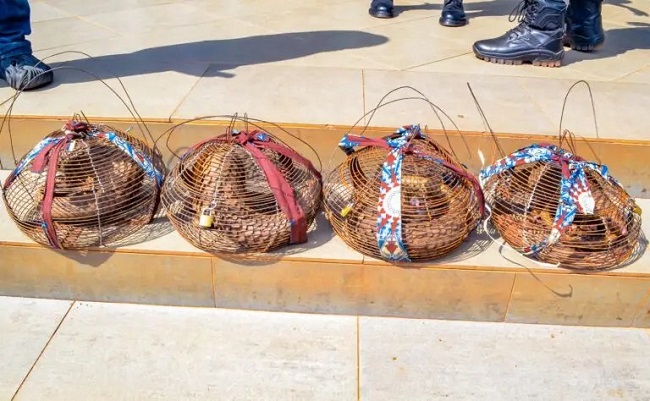
The Nigeria Customs Service (NCS), Ogun 1 Area Command, Idiroko, says it intercepted four live Pangolins, an endangered species, along the Yemoamota-Abule-Igboora axis of the state.
The Deputy Superintendent of NCS, Chado Zakari, also the Command’s Spokesperson, disclosed this in a statement made available to newsmen on Saturday, February 14, 2026, in Ota.
Zakari explained that the seizure underscored the Service’s unwavering commitment to the Convention on International Trade in Endangered Species of Wild Fauna and Flora (CITES).
our live Pangolins intercepted during a patrol operation by Nigeria Customs Area (NCS), Ogun 1 Area Command, on Thursday in Ogun State
According to him, at about 3.00 a.m. on Thursday, a patrol team acting on credible intelligence intercepted a motorcycle in the Yemoamota-Abule-Igboora, and Ebute Igboora axis of the command.
“Upon inspection, officers discovered four pangolins confined in wire mesh cages and concealed within a sack.
“The sophisticated nature of the packaging suggests the involvement of an organised smuggling syndicate.
“To evade arrest, the suspects abandoned their motorcycle and the endangered species, vanishing into the thick terrain as the evening fog rolled in,” he said.
Zakari said that prioritising the animals’ welfare after the seizure, the Command officially transferred the pangolins to the Wildlife Conservation Centre on Feb. 13, 2026.
He said that the handover was conducted by Assistant Comptroller Tajjudeen Bello (Acting Deputy Comptroller for Administration), on behalf of the Acting Customs Area Comptroller, Oladapo Afeni.
The area comptroller noted that the officers acted with remarkable courage and professionalism throughout the covert operations.
The comptroller reiterated the Command’s commitment to be steadfast in its vigilance against trans-border crime, and to collaboration with its partners to eliminate the illegal trade in endangered species.
Afeni issued a stern warning to smugglers and traffickers of endangered wildlife, urging them to desist from the act.
He emphasised that the command remained “battle-ready” and fully equipped to track down and apprehend anyone undermining the law.
The Federal Government of Nigeria has reaffirmed its commitment to strengthening food and nutrition security through expanded adoption of biofortified crops across the country.
The Permanent Secretary, Federal Ministry of Agriculture and Food Security, Dr Marcus Ogunbiyi, stated this at a national biofortification workshop in Kano on Saturday, February 14, 2026.
Ogunbiyi said ensuring food availability alone was no longer sufficient.
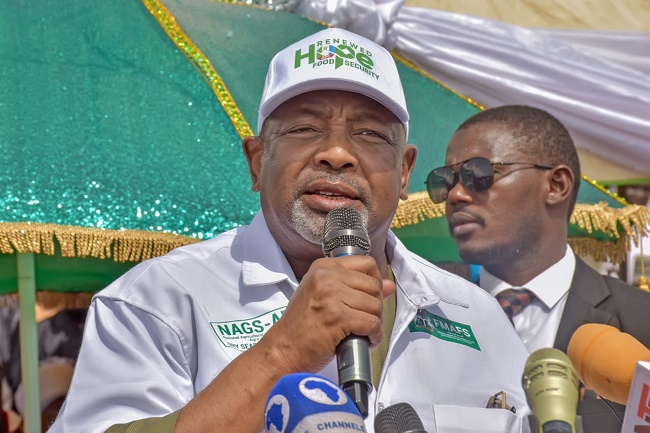
Minister of Agriculture and Food Security, Sen. Abubakar Kyari
He stressed the need to guarantee that food consumed by Nigerians was nutritious, safe, affordable and accessible.
Ogunbiyi lamented that malnutrition and micronutrient deficiencies remained major public health and economic challenges in the country.
He said, “Biofortification provides a cost-effective and sustainable approach to improving nutrition, particularly among women, children and vulnerable groups.
“The workshop was organised to review the mandate and operational framework of the National Biofortification Steering Committee and align it with national food and nutrition policies.
“Nigeria currently has the largest portfolio of biofortified crops globally, with iron-rich pearl millet, zinc-enriched rice, Vitamin A cassava, Vitamin A maize and Vitamin A sweet potato developed and promoted through partnerships with research institutions.
“The initiative has been integrated into national agricultural and nutrition policies, with private sector participation strengthening the value chain through seed multiplication, processing and market development,” Ogunbiyi added.
The participants emphasised the need for sustained investments in research, extension services and awareness creation to accelerate the adoption of biofortified crops nationwide.
The Green Climate Fund (GCF) has announced an accelerated programme of action in support of the government of Chad’s climate priorities. GCF, the world’s climate fund for developing countries, has committed to mobilise at least $100 million for Chad, subject to GCF Board approval.
The mobilisation of finance will provide urgently needed support for climate action, strengthening Chad’s efforts to adapt to the impacts of climate change. Mobilised finance will focus on the country’s climate priorities, supporting adaptive agriculture to reduce food insecurity and strengthening rural resilience in the face of climate change, while addressing the pressures of hosting refugee populations.
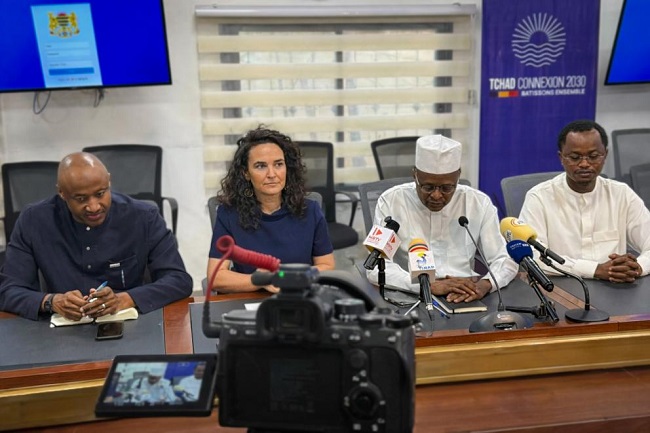
Amb. Seyni Nafo, Mafalda Duarte, Chad’s Minister of Finance, Budget, Economy and International Cooperation, and Chad’s Minister of the Environment, Fishery and Sustainable Development (from left to right) at a press conference on Thursday, February 12, 2026, in N’Djamena
The pipeline includes bringing a first-ever single-country project dedicated to Chad to the GCF Board for consideration at its meeting next month. GCF will also provide further capacity-building support to the government under its Readiness Programme, helping to coordinate climate planning, and prepare to successfully implement the climate projects in the pipeline.
The commitments were announced at the end of a mission to the country led by Mafalda Duarte, the Green Climate Fund’s Executive Director. The GCF delegation, which also included the GCF Board Co-Chair, Ambassador Seyni Nafo, undertook two days of meetings with the government.
Following the meetings, a communiqué and a joint declaration were made by Hassan Bakhit Djamous, Minister of the Environment, Fishery and Sustainable Development (MEPDD) and Mafalda Duarte, GCF Executive Director, outlining next steps arising from the mission. This includes a commitment to advance the application of the Ministry of Finance, Budget, Economy and International Cooperation (MFBEPCI) to become an Accredited Entity to GCF, and to develop a multi-annual partnership with the MFBEPCI.
Executive Director, Mafalda Duarte, stated: “GCF is committed to partnering with the government of Chad to support their response to climate change. Chad is one of the most climate-vulnerable countries in the world, and the investment pipeline we are announcing will provide urgently needed finance and accelerate the accreditation of the Ministry of Finance.
“Over the past two years, GCF has reformed to become more efficient and to enhance our impact. We are confident that by working with the government of Chad and our partner organisations, we can ensure that finance is allocated in alignment with government priorities and is deployed rapidly and effectively.”
Among the most climate-vulnerable countries in the world, Chad faces combined climate threats including droughts, flooding and desertification, which have created critical levels of food insecurity.
The country is also managing a large influx of refugees and high levels of internal displacement, as a consequence of climate change, instability and conflicts in neighbouring countries. Over one million Sudanese refugees and Chadian returnees have entered Chad from Sudan since the start of the conflict there in 2023.
The mission to Chad took place ahead of this weekend’s African Union Summit in Addis Ababa, where GCF will highlight its support for Africa, particularly in relation to water, this year’s theme for the Union.
We are in the midst of a great economic shift – one that will shape livelihoods and growth for decades to come.
The rise of AI and digitalisation, geopolitical changes, uneven population growth, and the urgent need to cut emissions and adapt to climate impacts are combining to profoundly reshape economies – particularly the labour market. Unlike geopolitical and technological shifts, which are likely to result in net job losses, the transition towards resilient, low-carbon economies could be a powerful engine for expanding the workforce.
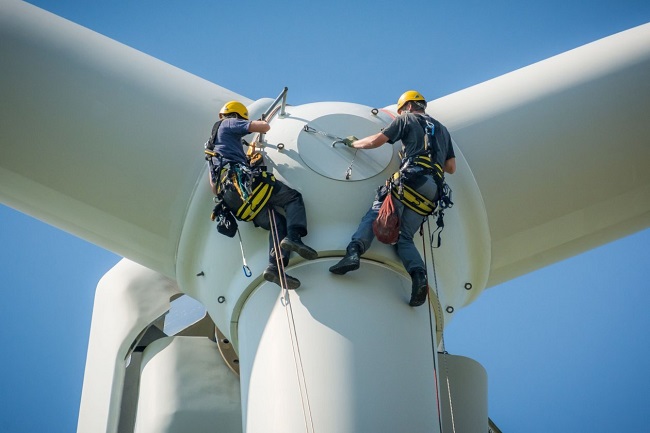
Maintenance workers service a giant wind turbine. Demand for renewable energy workers is growing as the world moves toward a low-carbon economy. Photo credit: Jacques Tarnero/Shutterstock
Our new research shows the low-carbon transition could create nearly 375 million additional jobs over the next decade in four key sectors: energy, construction, manufacturing and agriculture. This midpoint estimate reflects a 20% increase in jobs in those sectors at a time when AI and other factors threaten to shrink the labour force.
Which Jobs Will Grow in a Resilient, Low-carbon Economy?
Jobs in climate adaptation have received far less attention than those in clean tech, yet our research shows they could make up 280 million of the total. As the world warms, there is an urgent need for a multitude of workers to shore up the resilience of our crops and fisheries, revive biodiversity hotspots, and restore our terrestrial and wetland ecosystems. Similarly, there is growing demand for technicians to retrofit our buildings into energy-efficient shields against extreme heat and other climate threats.
Like any great economic shift, some sectors will benefit more than others. Agriculture and land use could be one of the largest sources of employment, with regenerative agriculture and nature-based solutions generating 195 million new jobs – equivalent to about 17% of the sector’s current workforce. Construction could see the largest percentage growth, adding 175 million jobs. That’s roughly 70% of today’s construction workforce.
This is a significant opportunity – but one that’s not guaranteed.
Securing hundreds of millions of good jobs requires governments and businesses to invest now in workforce development. This means equipping workers with the skills they need to install wind turbines and solar panels, retrofit buildings to reduce energy use, shift from conventional to sustainable farming, and more.
It means re-skilling people whose jobs may disappear, such as fossil fuel workers, while creating new opportunities for the labor force of the future. It means developing entrepreneurship to enable job growth. And it means righting some of the wrongs of the past, like expanding roles for women and others historically boxed out of job markets.
Prioritising people and their livelihoods can deliver so much more than job growth – it makes the transition to a resilient, low-carbon economy politically durable. If we get this transition right, it can ultimately create stronger economies, improve social cohesion as well as curb climate change.
While the low-carbon transition is likely to generate net job gains, it will involve substantial job churn. A total of 630 million workers will potentially be affected by job transitions. This is particularly evident in the energy space. While the sector will ultimately add 20 million jobs in electrification, renewable energy development, and power grid expansion, there will be less demand for jobs focused on fossil fuel extraction.
Each shows the low-carbon transition could create nearly 375 million additional jobs over the next decade in four key sectors: energy, construction, manufacturing and agriculture. This midpoint estimate reflects a 20% increase in jobs in those sectors at a time when AI and other factors threaten to shrink the labour force.
That’s why investing in workforce development and re-skilling is so essential. Opportunities and risks will need to be managed as jobs will be gained and lost across sectors and geographies. The transition can’t leave anyone behind – and with the promise of so many new jobs, it doesn’t have to.
But countries that potentially have the most to gain in terms of job creation are also the least equipped to seize the opportunity due to their labor market structure and lack of skills readiness and social protection measures. This includes many low-income countries in Africa.
Against this backdrop, closing the widening skills gaps in foundational, technical and transversal skills must become a much greater priority. The scale of the challenge is staggering: More than 760 million adults aged 15 and older do not possess basic numeracy and literacy skills; meanwhile, and 70% of children in low or middle-income countries cannot read by age 10. And while data on skills are relatively weak, estimates show that nearly three-quarters of youth aged 15-24 are off track in acquiring employment-relevant skills.
While these foundational skills are lagging, demand for green skills grew at a rate of 12% from 2023 to 2024 – twice the rate of supply.
Unless we take action to prepare now, the world will be hurtling toward a massive “talent crunch” that threatens to hold the global economy back and put a safe and sustainable future out of reach.
For example, a projected 14% shortfall in the number of renewable energy workers needed by 2030 could significantly slow the deployment of low-carbon technologies and delay emissions reductions. Over time, such delays would translate into higher cumulative emissions and increase the risk of additional warming, estimated at up to 0.7 degrees C. Every tenth of a degree of warming matters, increasing the risk of floods, droughts, wildfires and other dangerous impacts.
Creating the Workforce of the Future
So what will it take to reshape the labour force for the better while confronting climate change?
For one, governments and businesses will need to be intentional about putting people’s livelihoods at the center of their economic and climate strategies. They’ll need to improve labor market data and analysis and mobilise a better funded and more integrated policy response. This isn’t yet happening widely. Only half of countries’ national climate plans, or “NDCs,” reference workforce development strategies; only 1% offer concrete means of financing them. Corporate strategies are similarly scant on green skill-building.
The Philippines offers a model for others to follow. The country made green jobs a legislative priority, enshrined in policies like the Green Jobs Act, the Philippine Development Plan and the Labor and Employment Plan. It has also brought federal agencies together through the Inter-agency Committee on Green Jobs, led by the Department of Labor, to align education, environment, trade and finance around a shared goal: prioritising green workforce development and skill-building. This is the sort of coordinated planning and policymaking that can integrate low-carbon jobs across all parts of the economy.
Innovation is also key. Governments and businesses need to test, identify and scale a new generation of workforce development programs that are fit for purpose, flexible and modular, often working with delivery and implementation partners to translate policy objectives into effective programmes. This should include building smart accreditation and job matching platforms that offer pathways to jobs and livelihoods.
Programmes should prepare people for new and emerging low-carbon, climate-resilient jobs, as well as re-skill existing workers whose jobs are evolving. They should also include those typically left out of workforce development programmes, like informal workers, women and rural communities.
In Pakistan, energy utility company K-Electric’s Roshni Baji programme is one example of innovative workforce development. The programme helps women from low-income areas become certified electricians, a historically male-dominated field. Alongside technical skills, women receive education in motorbike riding, self-defense, communication and stress management.
It has already trained 200 women with electrical skills that are easily transferable to solar installation, microgrid maintenance, energy audits and other activities essential for greening the energy system. This is the type of innovation that can ensure the low-carbon transition benefits everyone.
And finally, none of this will happen without sustained investment. Workforce development and education are chronically underfunded, often treated as an expense rather than a high-return investment. Lower-income countries spend less than 0.1% of GDP on labour market programs. While high-income countries spend more, the percentage share has been declining over the past two decades
Governments and corporations alike must work together to align fiscal policy with employment goals and create the right incentives for businesses to invest in the capabilities of their workers. There’s a role for financial institutions like the multilateral development banks, too, in embedding workforce investments into climate and development finance.
Kenya’s plans show promise in this area. The country’s draft Green Fiscal Incentives Policy Framework seeks to mobilise private investments for a low-emissions, resilient economy – particularly in agriculture, which supports nearly 25% of Kenya’s GDP and is highly vulnerable to the impacts of climate change. The framework proposes tools to attract and de-risk private finance.
They include: a Green Investment Bank and Credit Guarantee Scheme to unlock loans for agribusinesses and green small- and medium-sized enterprises; a Green Bonds framework to channel capital market investments; and capacity-building to equip the workforce with relevant green skills. If effectively implemented, these mechanisms could stimulate job creation across sustainable farming, renewable energy for irrigation, and agricultural processing – sectors that are vital for both climate resilience and rural employment. This is the type of finance that can create multiple benefits at once.
Seizing the Moment
The economy is changing. Countries that adapt quickly will attract investment, lower costs, and create good, steady jobs. Those that hesitate simply risk falling behind.
The transition to a new and more resilient, low-carbon economy is ultimately about improving people’s lives, both today and in the future. This is true for so many things – breathing cleaner air, reducing energy bills, easing traffic congestion, and protecting communities from escalating storms, wildfires and withering heat. And if we seize this enormous opportunity, we can also deliver well-paid jobs, stronger local economies, and a more secure future for workers and their communities.
By Ani Dasgupta, WRI President and CEO; Liesbet Steer, Lead Author and Executive Director at Systemiq; and Ingrid-Gabriela Hoven, GIZ Managing Director
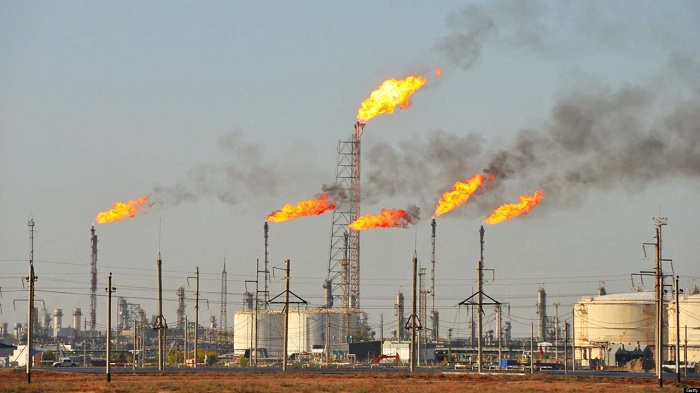
Nigeria LNG Limited (NLNG) has reduced Nigeria’s gas flaring from about 62 per cent to less than 12 per cent through its Train 1–6 operations, reinforcing its position as a leading example of gas monetisation in Africa.
The General Manager, Production, NLNG, Mr. Nnamdi Anowi, disclosed this during a panel session titled “De-Risking Investments in African Oil and Gas Projects” at the Sub-Saharan Africa International Petroleum Exhibition and Conference (SAIPEC) held in Lagos.
Anowi said NLNG’s operations have not only significantly curtailed gas flaring but have also boosted government revenues and contributed to national development. He revealed that the company is considering the development of Trains 8 and 9 as part of plans to further monetise Africa’s vast natural gas reserves and consolidate development gains.
Gas flaring
According to him, NLNG’s gas commercialisation model is anchored on revenue certainty, a critical factor in de-risking large-scale energy investments.
“For example, with Train 7, investors needed absolute clarity on revenue sources. Without long-term gas delivery contracts, no investor would commit funds to such a project,” Anowi said.
He stressed that governance and institutional credibility are equally vital, noting that investors must have confidence in a company’s strategy, leadership and technical capacity before committing capital.
On project execution, Anowi highlighted the importance of structured construction models that transfer significant risks away from company balance sheets through firm contractual arrangements that guarantee delivery timelines and cost discipline. He added that proper scoping and detailed engineering design must go beyond preliminary stages to provide financiers with the assurance required to back multi-billion-dollar projects.
Addressing the global energy transition debate, Anowi argued that Africa’s pathway must be just and pragmatic, focusing on decarbonisation without undermining development goals.
“Energy transition in the African context means energy addition,” he said, explaining that the continent must expand overall energy supply to meet growing demand.
He noted that global energy demand is increasingly driven by rising electricity needs, particularly from data centres, which require stable and substantial power supply. Renewable energy alone, he said, may not be sufficient to meet this expanding demand, underscoring the need for Africa to responsibly develop its natural gas resources as a transition fuel.
Anowi warned that when oil and gas projects are perceived as excessively risky, investors tend to withdraw, leading to stalled developments, job losses and lost revenues critical to national growth.
He described risk reduction in the oil and gas sector as a national economic priority, linking it directly to Nigeria’s energy security and long-term development objectives.
For NLNG, he said, de-risking entails maintaining reliable gas supply, honouring long-term contractual obligations and preserving its reputation as a dependable supplier to both domestic and international markets.
He further emphasised the importance of clear and consistent government policies, enforceable contracts and comprehensive project preparation before capital commitments are made. Such measures, he noted, enable financiers to provide funding at lower costs, ultimately benefiting the country.
Strong infrastructure, skilled local manpower and modern technology, he added, also play a pivotal role in reducing operational risks. Efficient pipelines, processing facilities and digital systems enhance safety, reliability and cost efficiency across the lifecycle of energy projects.
Looking ahead, Anowi called for coordinated efforts between government and industry players to expand proven and bankable projects capable of delivering measurable national value, stressing that the coming decade should prioritise investments that drive sustainable growth across Nigeria and the broader African energy landscape.
Women in Energy Network (WIEN) has pledged to take a frontline role in shaping the energy sector, calling for greater female participation in policy discussions and strategic decisions.
WIEN President, Mrs. Eyono Fatai-Williams, said on Thursday, February 12, 2026, during the 10th Sub-Saharan Africa International Petroleum Exhibition and Conference (SAIPEC) in Lagos.
She said women must position themselves as strategic contributors to the country’s energy future.
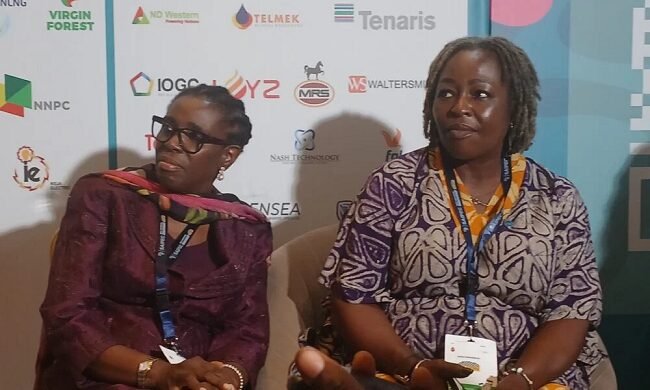
Women in Energy Network (WIEN) officials
According to her, the body represents women across the entire energy value chain, and it is critical that their voices are heard at key industry conferences.
“Women must not be seen merely as numbers. We are partners with measurable value to add,” she said.
She said the intervention by WIEN comes amid ongoing debates on balancing energy transition with energy security, stressing that the nation’s energy mix required inclusive dialogue.
“For WIEN, being deeply involved in the energy-mix conversation is non-negotiable.
She explained, “As a body that cuts across upstream, midstream, downstream, gas, power, and renewables, we are uniquely positioned to strengthen the dialogue and support policies that secure Nigeria’s energy future.”
Fatai-Williams noted that WIEN members were active participants in industry platforms, including the Petroleum Technology Association of Nigeria (PETAN), which reinforced the network’s commitment to strategic sector discussions.
She explained that WIEN is structured into specialised directorates; upstream, midstream, downstream, gas, power, and renewables, to ensure comprehensive representation across the energy value chain.
According to her, the network currently has over 30 corporate members and more than 1,000 individual professionals.
Beyond advocacy, she said WIEN focuses on capacity building, running networking sessions, knowledge-sharing forums, and masterclasses designed to address critical sectoral issues and enhance professional competence.
Fatai-Williams added that earlier in the week, she and her executive team led a mentorship session for young female professionals and university students, encouraging them to build resilience and pursue impactful careers in the energy industry.
“Our goal is to prepare the next generation of women leaders who will not only participate but shape the future of Nigeria’s energy sector.
“WIEN’s growing influence signals a broader push for inclusivity, ensuring women are not just present but instrumental in defining Nigeria’s energy trajectory,” she added.
The Nigerian National Petroleum Company Limited (NNPC Ltd.) declared N60.5 trillion in revenue and N5.76 trillion Profit After Tax (PAT) in the 2025 financial year.
The NNPC Ltd. in its December 2025 Monthly Report Summary, highlighted key figures including crude oil and condensate production, natural gas output, revenue, PAT, strategic initiatives during the period under review.
The report revealed that crude oil production remained relatively moderate and pipeline maintenance activities disrupted some operations in the financial year.
The Group Chief Executive Officer, NNPC Limited, Bayo Ojulari
It showed that average crude oil and condensate production stood at 1.54 million barrels per day (mbpd) showing steady output amid ongoing infrastructure upgrades and security challenges across producing regions.
It showed that gas production recorded 6,914 million standard cubic feet per day (mmscfd) in December as monthly figures showed output peaking above 7,500 mmscfd mid-year before tapering slightly toward year-end.
The report said gas sales was also steady averaging over 4,700 mmscfd showing NNPC’s leaning toward gas as Nigeria’s transition fuel and key revenue stabiliser.
The report also indicated that profitability saw dips in some months, with marginal losses recorded early in the year before rebounding strongly between March and June while operational reliability indicators improved considerably:
On upstream pipeline availability, Obiafu-Obrikom-Oben (OB3) Gas Pipeline recorded 100 per cent availability, Ajaokuta-Kaduna-Kano (AKK) Gas Pipeline, 91 per cent while the NNPC Retail (NRL) and station availability recorded 65 per cent.
The data revealed significant gains in network stability and product distribution efficiency, particularly in the second half of the year.
It said that planned maintenance and upgrade works at Stardeep-Agbami, Renaissance-Estuary Area (EA) and unplanned production facility outages affected December production performance.
It also reported successful completion of key engineering works, including river crossings and mainline welding operations as scheduled at AKK Mainline.
The company said it successfully completed the OB3 River Niger Crossing, all early works and commenced Pilot Hole drilling, adding that the project is on course and to be completed as scheduled.
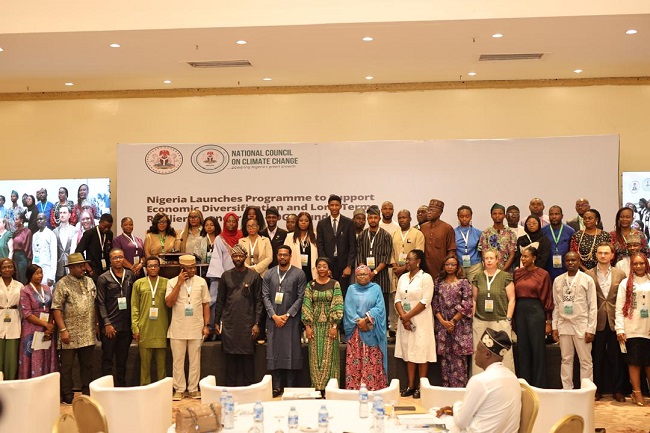
In response to the evolving energy landscape in the country, the Federal Government of Nigeria has unveiled the Nigeria Beyond Oil and Gas Alliance (BOGA) Fund Programme.
Nigeria’s economy remains significantly dependent on oil and gas revenues, with potential for fiscal volatility and transition-related risks as global energy systems shift. This two-year project aims to improve coordinated policy dialogue and strengthen the analytical basis for decision-making to promote a managed, evidence-based economic diversification.
It is also meant to help in translating evidence into actionable recommendations that are in line with Nigeria’s development priorities, such as its Nationally Determined Contributions (NDCs).
Participants during the official launch of the Nigeria Beyond Oil and Gas Alliance (BOGA) Fund Programme held in Abuja, Nigeria’s capital.
Speaking during the event, which was organised by the National Council on Climate Change (NCCC) in Abuja on Thursday, February 12, 2026, Minister of Budget and Economic Planning, Abubakar Bagudu, emphasised the importance of Nigeria’s economic diversification strategy.
According to him, Nigeria must prioritise its own assets and leverage the appropriate technology and expertise to promote sustainable growth, which calls for an economic diversification plan of action.
He went on to explain that this proposed economic diversification plan must be anchored in strong climate consciousness, stressing that Nigeria has the opportunity to grow its economy in ways that minimises environmental impact while strengthening resilience and creating jobs.
Director-General of the National Council on Climate Change (NCCC), Mrs. Omotenioye Majekodunmi, in her keynote speech at the occasion, observed that Nigeria’s journey beyond oil is not a retreat from our status as an energy powerhouse, but an evolution into a green energy giant.
“Our collaboration with BOGA reinforces our commitment to the 1.5°C pathway while prioritising a development trajectory that is fair, funded, and focused on the prosperity of our people,” Majekodunmi stated.
Sian Bradley, head of the BOGA secretariat, reiterated BOGA’s commitment to supporting countries at an early stage of planning for a just, orderly and equitable transition away from oil and gas.
She commended the acknowledgement of the economic challenges and the need for bold economic diversification pathways in Nigeria’s third NDC and highlighted the programme’s role in supporting the country’s first steps towards implementation, alongside wider efforts to advance decarbonisation and methane and upstream emissions reductions.
Dr Olumide Abimbola, Executive Director of the Africa Policy Research Institute (APRI), said the project will help Nigeria to develop a more comprehensive, mutual understanding of the potential implications of a shifting global energy landscape for the nation.
“It will also help us identify credible pathways for economic diversification beyond oil and gas and the kinds of policies and enabling conditions needed to unlock new opportunities and drive competitiveness,” Dr Abimbola asserts.
On his part, the Director General of the Society for Planet and Prosperity (SPP), Prof. Chukwumerije Okereke, underscored that Nigeria’s challenge is not simply to transition away from fossil fuels but to strategically manage the risks and opportunities of a changing global energy system.
Prof. Okereke, who was represented at the meeting by Timothy Ogenyi, hinted that the initiative is important because it anchors this transition in rigorous evidence, economic realism, and justice for workers and communities.
“SPP is honoured to contribute to this important endeavour alongside APRI, NCCC, BOGA, and our wider community of partners, and it is our prayer that this work will help shape Nigeria’s low-carbon sustainable development and the prosperity of our country,” he stated.
This project, which is led by the NCCC and implemented by APRI, reflects the nation’s commitment to its national and international efforts on climate action and emissions reduction. With this announcement, Nigeria becomes the fifth country in the world to establish the BOGA fund, joining the likes of Colombia.