Nigeria can transform risks and complexities in the oil and gas industry to opportunities for growth and development if operators and regulators collaborate in a business environment that encourages transparency and governance discipline without late-stage fiscal or regulatory shocks.
The remark was made on behalf of the Managing Director of Shell Nigeria Exploration and Production Company Limited (SNEPCo), Ronald Adams, at the 10th Sub Saharan Africa International Petroleum Exhibition and Conference (SAIPEC) which held in Lagos this week.
“Nigeria continues to demonstrate that Africa remains investable,” Adams said in remarks at a panel session on “IOCs – De-risking Investments in African Oil and Gas Projects,” where he was represented by SNEPCo’s Finance Director Tunde Oduwole.
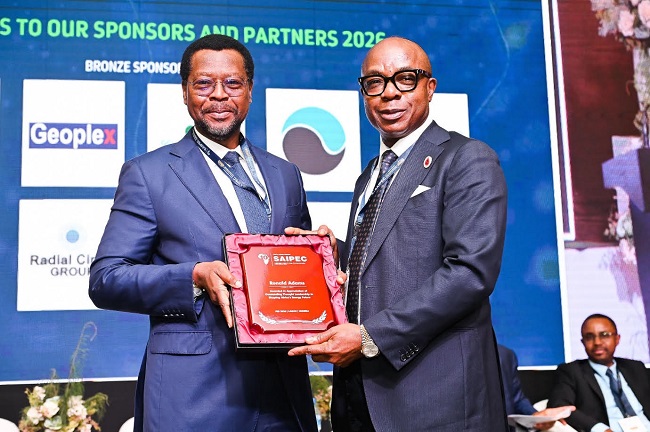
Tunde Oduwole, Finance Director at Shell Nigeria Exploration and Production Company Limited (SNEPCo), accepted the “Outstanding Thought Leadership In Shaping Africa’s Energy Future” award on behalf of Ronald Adams from PETAN Chairman Wole Ogunsanya at at the 10th Sub-Saharan Africa International Petroleum Exhibition and Conference (SAIPEC 2026), in Lagos
Describing Nigeria as “a test case for African de-risking,” Adams said: “When there is long-term predictability of the investment climate in terms of competitive and stable fiscal and regulatory frameworks, risks can be actively managed to unlock significant capital for growth and development even in challenging environments.”
He pointed out that the vision of the government for the Nigerian energy sector demonstrated in reforms and constructive engagements with regulators, operators and co-venturers had contributed immensely in “boosting investor confidence and reducing uncertainties.” The improved investment climate has yielded positive results with SNEPCo’s FIDs on Bonga North in 2024 and HI the following year. This is a good example for Africa, he said.
Commenting on the role of IOCs in de-risking, Adams noted that Bonga’s sustained performance for over two decades was a direct outcome of SNEPCo’s commitment to safety leadership, disciplined maintenance philosophy, operational excellence, and continuous investments in human capital. He said Bonga’s operational performance not only strengthens investor confidence but also helps to attract investments in the deep-water sector in the country.
Adams added: “Nigeria shows that Africa’s oil and gas projects can compete globally when technical excellence meets regulatory alignment and local content capability. The Nigerian experience provides a blueprint for unlocking capital, accelerating project timelines, and sustaining value creation across Africa’s evolving energy landscape.”
As African leaders convene at the African Union Summit to advance Agenda 2063 and assert the continent’s economic sovereignty, recent remarks by U.S. Ambassador to Namibia, John Giordano, appear to signal the scramble for Africa continues.
While the U.S. has imposed strict visa requirements on Namibians, the Ambassador seems to have openly positioned Namibia as central to securing U.S.’ future through its critical minerals and offshore oil.
US President Donald Trump addresses the 80th United Nations General Assembly
At a time when Africa is demanding climate justice, energy security and economic sovereignty, the U.S. is accelerating its geopolitical competition through extractivism, according to industry watchers.
They noted that expanding offshore oil in the Orange Basin is incompatible with global climate commitments and risks locking Namibia into stranded assets, debt and environmental harm while the benefits flow outward and the world accelerates towards clean energy.
Similarly, they added, the rush for critical minerals must not repeat the same extractive model that has historically left African communities with pollution, poverty, and displacement.
“A just energy transition must not become a greenwashed extension of neo-colonial extraction. Likewise, Africans cannot be excluded at the border while its resources are fast-tracked into foreign economies.
“The AU Summit is a moment to reaffirm that Africa’s resources must power Africa’s development first,” stated Oil Change International.
Thomas Muronga, Manager Kapinga KaMwalye Conservancy Namibia, said:“Namibia does not exist to secure another country’s future. Our resources are not open for exploitation while our people face visa barriers. Partnership must begin with respect for our sovereignty and our development priorities. Namibia’s future lies in clean energy security, and building value at home, not in becoming a safety net for foreign energy insecurity.”
Thuli Makama, Africa Director, Oil Change International, said: “Africa is already paying the price for a climate crisis it did not cause. Pursuing offshore oil fields in Namibia in the middle of that crisis is not development, it is extractivism. It exposes Namibia to economic volatility, and undermines investment in renewables that could deliver stable, affordable energy for Namibians.
“If the U.S. is serious about partnership, it should support Namibia’s renewable energy expansion, domestic processing of critical minerals, and policies that build long-term resilience, not double down on extractive models that externalize environmental costs and export profits.”
Speaking in Istanbul on Thursday, February 12, 2026, alongside incoming COP31 President Murat Kurum of Türkiye, United Nations Climate Change Executive Secretary, Simon Stiell, said cooperation on climate change can provide the cure to current political turmoil.
“We find ourselves in a new world disorder. This is a period of instability and insecurity. Of strong arms and trade wars. The very concept of international cooperation is under attack,” said Stiell in his first major speech since COP30.
“But climate action can deliver stability in an unstable world. Climate cooperation is an antidote to the chaos and coercion of this moment, and clean energy is the obvious solution to spiralling fossil fuel costs.”
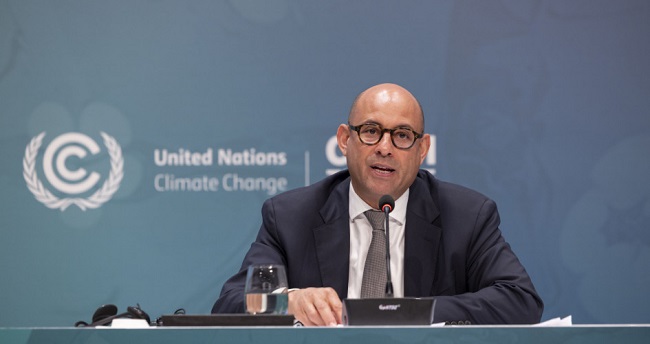
UN Climate Change Executive Secretary, Simon Stiell, during a press conference hosted by the COP31 President Designate, Minister Murat Kurum in Istanbul, Türkiye, on Thursday, February 12, 2026
He pointed to huge progress that has taken place in the past year.
“In the decade since Paris, clean energy investment is up tenfold – from two hundred billion dollars to over two trillion dollars a year.”
“And, in 2025, amidst all the economic uncertainty and gale-force political headwinds, the global transition kept surging forward: Clean energy investment kept growing strongly, and was more than double that of fossil fuels.”
“Renewables overtook coal as the world’s top electricity source.”
This real economic change built on progress in international climate negotiations and through national action.
“The majority of countries produced new national climate plans that will help drive their economic growth up and – for the first time – global emissions down.”
“At COP30: a trillion dollars for clean grids, and major investments in forest protection, climate health, and much more.”
COP30 also saw significant momentum in intergovernmental negotiations, including an agreement to triple adaptation finance to USD 120 billion a year by 2035, which will benefit African nations, as well as agreement on indicators to measure this progress.
Looking ahead to COP31 in Antalya, Türkiye, and COP32 in Addis Ababa, Ethiopia, Stiell highlighted a four-point plan for progress:
Rapidly scaling up a global pipeline of clean energy and climate resilience projects and match making between countries, companies, and investors at coming COPs.
“Hyper-charging the flow of finance” especially to developing countries, and all across Africa, ensuring countries have the support they need to deliver climate plans.
Building momentum through “coalitions of the willing” working on initiatives including roadmaps to transition away from fossil fuels and halt deforestation.
Moving the work of UN Climate Change closer to the real economy and working with Parties to improve climate negotiations.
Renaissance Africa Energy Company Limited reaffirmed its thought leadership position in the advancement of Africa’s local content as the company’s General Manager, Nigeria Content Development, Lanre Olawuyi, was on Wednesday, February 11, recognised with the prestigious Pioneers of SAIPEC Award during a ceremony at the just concluded Sub‑Saharan Africa International Petroleum Exhibition and Conference (SAIPEC) 2026 in Lagos.
Olawuyi received the honour following his impactful contribution as a panellist in the Local Content Masterclass: “Policy to Impact – African Success Stories.” His participation highlighted Renaissance’s deliberate, people‑centred and innovation‑driven approach to building local capacity across the energy value chain.
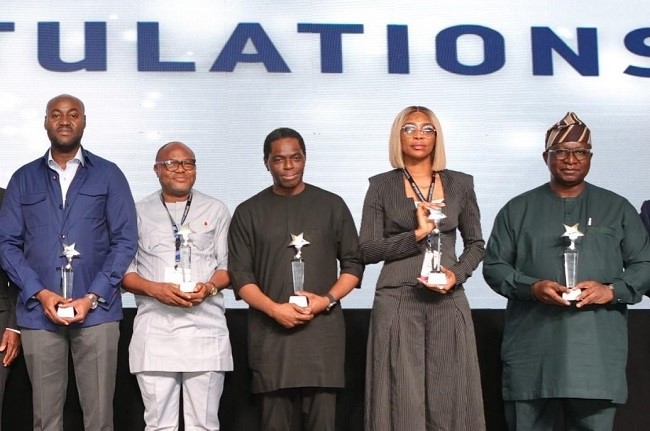
L – R: Executive Secretary, African Local Content Organisation, Ibrahim Talla; Executive Secretary, Petroleum Technology Association of Nigeria, Kevin Nwenze; General Manager, Nigeria Content Development, Renaissance Africa Energy Company Limited, Olanrewaju Olawuyi; Regional Manager, Africa Organisation, World Energy Council, Joy Osomiamhe; and Managing Director, Radical Circle Limited, Ranti Omole at the Award Night Ceremony of the 2026 Sub-Saharan Africa International Petroleum Exhibition and Conference in Lagos… on Wednesday
During the panel session, Olawuyi emphasised that Renaissance’s success is built on a foundational belief in human capacity development.
“Our first principle is simple: investing in people is where it all starts. If we get it right in developing people, we build a strong and reliable nation,” he said, underscoring the company’s commitment to nurturing engineering and geoscience talent through initiatives such as the Niger Delta Scholarship Programme.
He also spotlighted the company’s “Cradle to Career” programme, which supports students from primary school through university, resulting in over 800 trained beneficiaries, many of whom now work across the industry. Olawuyi shared compelling examples of Renaissance’s intentional shift from foreign supply chains to indigenous manufacturing.
One such success was the development of locally produced pipeline repair clamps – a product once sourced exclusively from abroad. By partnering with a Nigerian company in Warri, Renaissance enabled faster delivery, stronger supply security and job creation locally.
Speaking on employment creation, Olawuyi outlined Renaissance’s transformational approach to the Southern Swamp Associated Gas Projects (S‑S‑A‑G‑S), where the company engaged over 200 community contractors and employed more than 2,000 community members at peak, turning the project area into a significant hub of economic activity.
“This is what deliberate investment in local content looks like,” he noted.
In addition to the SAIPEC recognition, Renaissance has continued to earn industry-wide acclaim for its leadership in Nigerian Content development. In 2025, the company was named the Nigerian Content International Upstream Operator of the Year at the Nigeria Oil and Gas Opportunity Fair (NOGOF), where Managing Director, Tony Attah, also received the Local Content Icon of the Year award, underscoring Renaissance’s sustained contribution to enhancing local value creation across Nigeria’s energy sector.
The “Pioneers of SAIPEC” Award recognises individuals who demonstrate leadership, innovation and sustained impact on Africa’s energy landscape. Olawuyi’s contributions – from human capital development to indigenous manufacturing and community empowerment – exemplify Renaissance’s purpose-led approach to energy development.
Commenting on the recognition, a spokesperson for Renaissance said: “Lanre’s award is a testament to Renaissance’s philosophy that local content is not a burden – it is a national advantage. His leadership continues to demonstrate how policy can translate into measurable, life-changing impact across communities and industries.”
The Corporate Accountability and Public Participation Africa (CAPPA) has called on the Federal Government to fully regulate all nicotine products to curb addiction and safeguard public health.
Oluwafemi Akinbode, Executive Director of CAPPA, stated at a news briefing on Thursday, February 12, 2026, in Lagos that heated tobacco products should be regulated like regular tobacco products, as they contain tobacco sticks, aligning with global guidelines.
CAPPA shared findings from its latest report titled, “New Smoke Trap: New and Emerging Nicotine and Tobacco Products, Youth Exposure and Policy Gaps in Nigeria”.
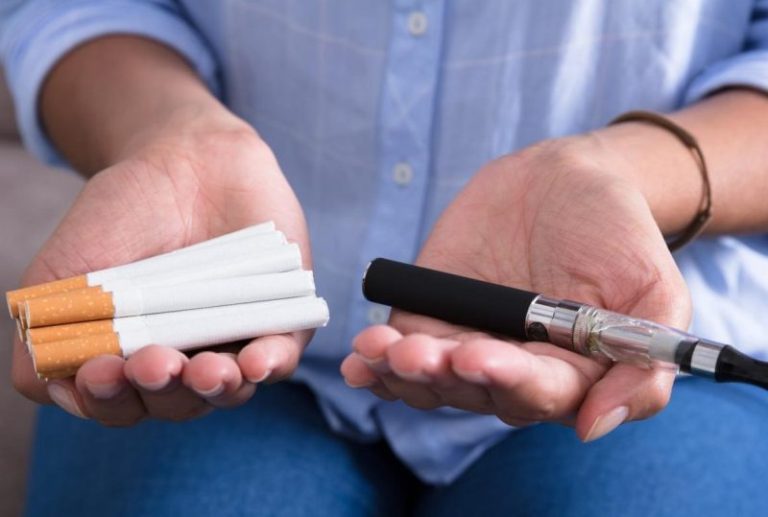
Nicotine and Tobacco
The study examines the rapid expansion of new-generation nicotine and tobacco products across Nigeria.
It also interrogates the regulatory and public health implications of that expansion at a time when the country’s demographic profile makes it uniquely vulnerable to industry manipulation.
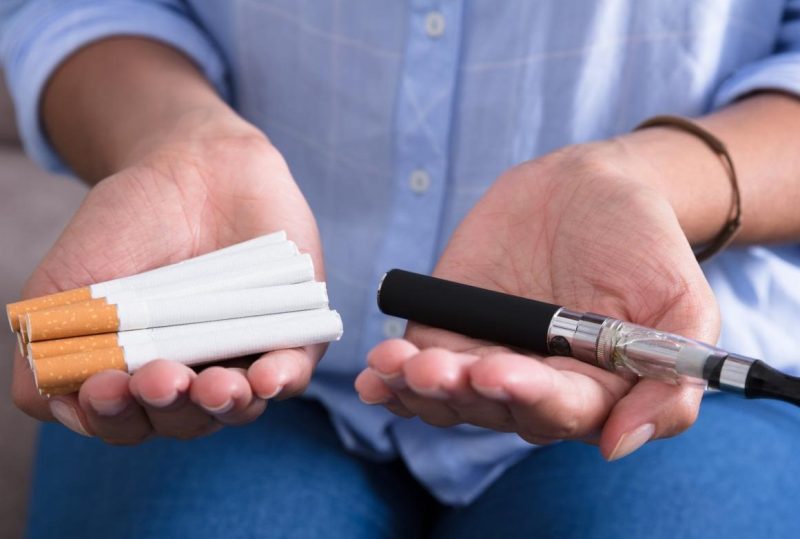
The products under examination include e-cigarettes commonly known as vapes, nicotine pouches, and heated tobacco products, all of which are now highly visible in supermarkets, embedded in nightlife environments.
The report emphasises that these products aggressively promoted across digital platforms are disproportionately accessed by young people, thereby normalising nicotine consumption within everyday youth culture.
Consequently, Akinbode recommended that emerging nicotine products be integrated into the excise tax framework to prevent price differentials from driving youth experimentation.
Akinbode said the research identified 781 nicotine and tobacco products, 573 of which were new and emerging nicotine and tobacco products (NENTPs).
He disclosed that e-cigarettes made up 522 of these, showing how deeply they have penetrated the market.
Akinbode noted that nicotine pouches, though not widely available in stores, are gaining traction online, while heated tobacco products, still a small market, are being positioned for future growth.
He said this rise exposes a regulatory loophole, explaining that Nigeria’s tobacco control laws are outdated, focusing on traditional tobacco products and leaving newer nicotine delivery systems unregulated.
“Many of these products are marketed as ‘tobacco-free’, with synthetic nicotine, exploiting legal loopholes and creating a false sense of safety.”
He emphasised that scientific evidence showed that synthetic nicotine is chemically identical to tobacco-derived nicotine and just as addictive.
“It binds to brain receptors, triggers dopamine, and can lead to dependence.
“High-dose exposure, common in these products, poses serious risks, especially to adolescents, whose developing brains are vulnerable to long-term effects like attention deficits, impulsivity, and increased addiction risk.”
According to him, the worst part is that these products are being marketed online with barely any age checks, making it easily accessible to young people, way easier than traditional tobacco.
Akinbode called on the Ministry of Health and Social Welfare, Standards Organisation of Nigeria, Ministry of Trade and Investment, Federal Competition and Consumer Protection Commission, and other agencies to harmonise their regulatory approaches.
He disclosed that the research identified divergent institutional understandings of these products, with some agencies viewing them primarily as commodities subject to trade standards and others recognising their public health implications.
According to him, such institutional fragmentation allows industry players to exploit regulatory gaps.
He disclosed that digital marketing posed an urgent growing threat, with influencers and algorithms normalising nicotine use among youths.
“Unless advertising and promotional loopholes are closed decisively, Nigeria will continue to witness the normalisation of nicotine consumption within online youth culture.”
Akinbode highlighted that public education must be revitalised to clarify that nicotine is addictive and harmful, even without smoke.
He stressed that Nigeria’s tobacco control future depends on evidence, unified regulation, and political courage, not industry narratives.
On the study methodology, he disclosed that the study conducted between October and December 2025, had field surveillance in Lagos, Enugu, and the FCT, combined with digital monitoring.
Similarly, Prof Lekan Ayo-Yusuf of Africa Centre for Tobacco Industry Monitoring and Policy Research (ATIM), said Nigeria could act early, before nicotine dependence becomes widespread and deeply rooted.
Ayo-Yusuf said the report provides evidence to act decisively, close gaps, align policy with evolving markets, and protect young people from a new cycle of nicotine dependence.
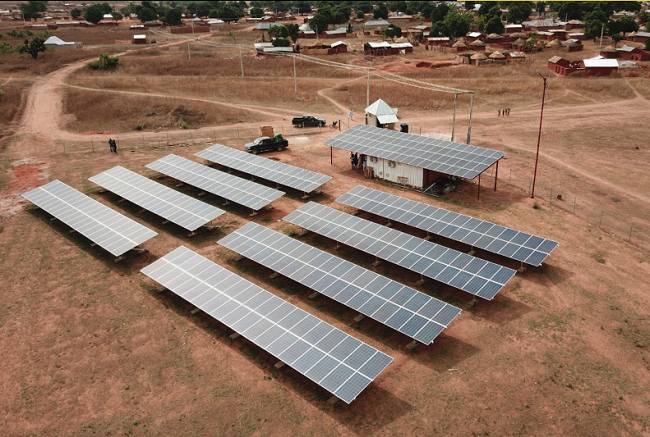
The Rural Electrification Agency (REA) and the Government of Korea have successfully electrified Rubochi and Ikwa Communities in the Federal Capital Territory (FCT), Abuja, with a 1-Megawatt (MW) solar mini-grid.
The project, tagged the “Nigerian-Korean Energy Project,” is expected to power over 4,000 households, delivering 900 kilowatts (kW) of electricity to Rubochi and 100 kW to Ikwa.
Since its inauguration five months ago, the 1MW clean energy system has been catalysing socioeconomic growth, improving security, and powering schools and hospitals in both communities.
A solar mini-grid system
The Minister of Power, Mr. Adebayo Adelabu, at the inauguration ceremony held on Thursday, February 12, 2026, in Rubochi, Kuje Area Council, emphasised that the project represented more than infrastructure delivery.
The minister was represented by the Permanent Secretary in the ministry, Mahmuda Mammam.
According to Adelabu, the project is a tangible outcome of strategic partnership, sound policy, and a shared commitment to inclusive development.
“It re-imposes our belief that access to reliable and sustainable electricity is not a privilege, but a fundamental driver of socio-economic transformation of all communities.
“The Federal Ministry of Power remains firmly committed to expanding access to clean, affordable, and reliable electricity across Nigeria, particularly for rural and underserved communities.
”This commitment is reflected in our strong support for decentralised renewable energy solutions as a practical and sustainable pathway to closing the nation’s energy access gap,”he said.
According to him, the successful execution of the project once again highlights the pivotal role of the Rural Electrification Agency as the federal government’s flagship institution for last mile electrification.
He said that through innovative programme and strategic partnership, the agency had continued to demonstrate that renewable energy could be deployed at a scalable level with measurable impact on livelihood and local economies.
Adebayo said that the Korean Energy Project being inaugurated aligned with the renewable agenda of this administration.
“Our partnership with the Republic of Korea reflects the strength of international cooperation founded on shared development objectives and technical excellence and mutual trust.
“We deeply appreciate the expertise, innovation, and support provided through this collaboration, which have contributed to the successful delivery of this project.
“I urge the community leaders and beneficiaries to take full ownership of this infrastructure, safeguard it, and ensure its effective and sustainable use,” he said.
On his part, the Minister of FCT, Mr. Nyesom Wike, said that the project was significant in many ways.
Wike, represented by his Chief of Staff, Mr. Chidi Amadi, said that the project was a reflection of the healthy bilateral relations between the Government of the Republic of Korea and the federal government of Nigeria.
”Indeed, it is a testament to the power of partnership and collaboration. It’s a shining example of what we can achieve when we work together to improve the lives of our people.
According to him, through this collaboration, the REA has also proven its capacity to think outside the box, not to mention its willingness to seek modern, innovative and environmentally friendly energy solutions for rural residents.
He said that the project was also in line with the Renewed Hope agenda of President Bola Tinubu, who had shown unprecedented concern for the development of satellite towns and rural communities.
Wike also said that massive infrastructure had already been deployed to the satellite towns and rural communities.
”Our rural roads come with solar fitted lightings and we have since embarked on the light up Abuja project – ensuring that every nook and cranny of the nation’s capital is well-lit.
”Let me use this opportunity to congratulate the over 4,000 households in Rubochi and Ikwa communities that are beneficiaries of this noble initiative.
“To them, I say this project is for you. May it bring prosperity, progress, and joy to your community.
“The FCT Administration is committed to the well-being of all residents and will continue to initiate and support development programmes that will enhance your quality of life,” he said.
The minister also appreciated the Government and people of the Republic of Korea as well as the leadership of the REA for their thoughtfulness in the provision of this strategic infrastructure and for the demonstration of their sincere concern for rural advancement.
Mr. Namgoong Tak, Charge d ‘Affairs Embassy of the Republic of Korea, said that the inauguration of the project marked a successful realisation of a shared vision that began several years ago.
According to him, the project is an in-kind grant funded by the government of the Republic of Korea and implemented in close partnership with the REA.
He noted that the Nigerian government was prioritising solar energy as a key solution to its electricity challenges, adding that “the project supports this direction as it aligns with the Presidential Power Initiative.”
He also highlighted that the project included a centralised energy management system at the REA headquarters, which enabled real-time monitoring and improved system management.
“We expect this will strengthen the reliability and sustainability of Nigeria’s mini-grid operations.
“As we have been doing over the past decades, we will continue to work with Nigeria to deliver greater impact to the people of Nigeria,” he said.
Earlier, the Managing Director of REA, Mr. Abba Aliyu, said that the project marked far more than the unveiling of infrastructure.
He said that it represented the activation of opportunity, productivity, and dignity for thousands of Nigerians.
Aliyu said that the project was designed as a complete, integrated energy solution.
”It brings together a robust solar generation plant, a modern distribution network, advanced metering infrastructure, and household energy appliances including lighting points and sockets that enable immediate productive use of electricity.
”Beyond the community level, an energy management system has been deployed at the REA headquarters, giving us real-time operational visibility and allowing the agency to provide continuous technical support to the Renewable Energy Service Companies responsible for operations and maintenance.
“Because of this comprehensive design, we have created an enabling environment that addresses one of the most persistent challenges in the off-grid sector — long-term sustainability,” he said.
According to him, both sites are fully operational and already providing stable, reliable power to households, small businesses, schools, healthcare facilities, and commercial clusters.
“Here in Rubochi alone, approximately 2,500 households and institutions are now connected.
“The impact is immediate and far-reaching. Small businesses can operate beyond daylight hours, students can learn in safer and better-lit environments, healthcare services are more reliable, and local economic activities are expanding creating jobs and strengthening livelihoods,” he said.
The Sa’Rubociyi of Rubochi, His Royal Highness, Alhaji Muhammad Ibrahim, commended REA and the Korean Government for siting the project in his community.
Ibrahim said that the project had brought relief to the community after many years of darkness.
The Lagos State Government has intensified enforcement on estates operating without approved layout plans and building permits.
The Commissioner for Physical Planning and Urban Development, Dr Oluyinka Olumide, made this known in a statement issued by the ministry’s Chief Public Affairs Officer, Mrs. Kehinde-Akinsanya Adetola, on Thursday, February 12, 2026.
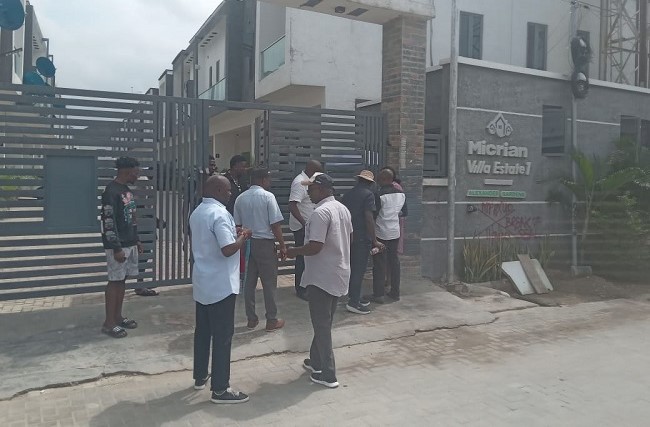
Olumide said the enforcement, carried out by the Office of Physical Planning and Urban Development, led by the Director of Development Matters, Mr. Hakeem Animashaun, targeted previously cautioned estates in the Lekki axis of the state.
Officials of Ministry of Physical Planning and Urban Development on enforcement to estates without approved layout plans
He reiterated the government’s zero-tolerance policy on unauthorised developments and urged estate developers to obtain layout approvals and building permits before starting construction.
According to him, the office of physical planning is statutorily mandated to ensure that all physical developments in the state comply with approved planning standards and regulations.
“We will continue to enforce compliance across the state. Developers must prioritise obtaining layout approvals and building permits to avoid sealing and other penalties,” he said.
The commissioner added that the enforcement drive was part of the state government’s commitment to orderly urban development, protection of infrastructure and sustainable growth, especially in fast-developing areas such as Lekki-Ajah.
He said similar enforcement operations would be extended to other parts of the state to strengthen compliance and uphold planning standards.
The enforcement team visited estates including Victoria Nest, Vistaview Estate, Empire Homes, JadeView Estate, BlessedView Homes and Micrian Villa Estate.
A don, Prof. Moshood Lawal, on Thursday, February 12, 2026, said that educating students to become responsible citizens and caretakers of the earth was far more than an academic subject.
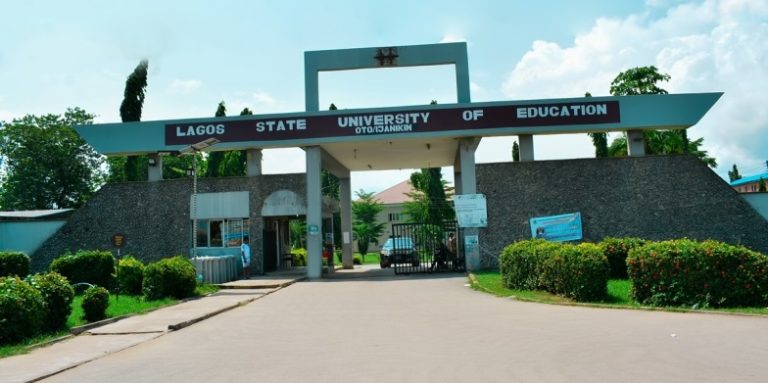
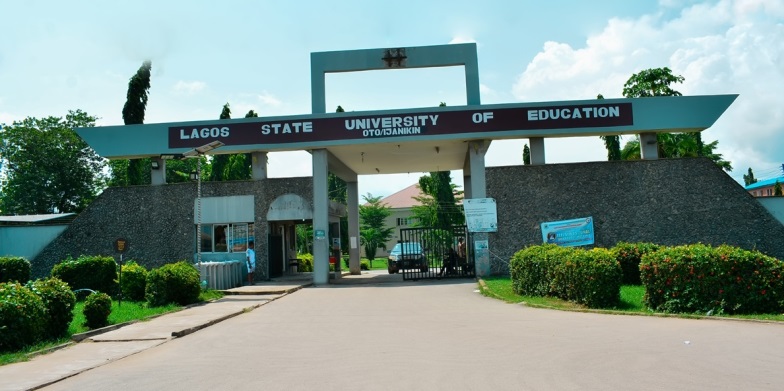
Lawal made this known while delivering the First Edition of the Inaugural Lecture Series of the Lagos State University of Education (LASUED) in Oto-Ijaniki.
Lawal is a Professor of Social Studies Education, Department of Sociological Sciences Education in LASUED.
Lagos State University of Education (LASUED), Oto-Ijaniki
The theme of the lecture was “Nurturing Eco-Conscious and Socially Just Citizen: My Scholarly Journey in Social Studies and Environmental Education”.
“This inaugural lecture has presented a fundamental realisation, which is environmental degradation and social injustice are not separate crises. They are intertwined.
“The deforestation, unsustainable natural resource exploitation issues I witnessed in communities from Oyo to Taraba State were not just a reflection of an ecological tragedy.
“It was a social story, destroying livelihoods and crushing the most vulnerable.
“Educating students to become responsible citizens and caretakers of the Earth is far more than an academic subject; it represents one of the most meaningful human endeavours,” he said.
The professor added that this envisioned a generation of citizens who not only would be caretakers of the planet but also embody principles of social justice in their everyday lives.
“They also integrate environmental responsibility with equitable and ethical conduct.
“This education is about shaping a future that reflects shared values and collective pride.
“By cultivating these values, we are better assured of an education that helps build sustainable and equitable communities committed to protecting both natural ecosystems and human dignity,” he said.
Lawal said that the understanding formed the bedrock of his desire to promote Eco-Social Justice Pedagogy.
“This I regard as not merely a teaching strategy but a philosophical commitment to an education that weds ecological awareness with the relentless pursuit of social equity.
“It is built on three pillars, understanding our Ecological Interdependence, upholding the Social Foundations of Sustainability that guarantee human dignity, and embracing citizenship as an active responsibility,” he said.
The professor said that the challenges that could obstruct the realisation of developing eco-conscious and social justice citizens were not insurmountable.
“They are a call to action. This lecture is that call. It is a plea to all of us educators, administrators, policymakers, to become weavers of a new social fabric.
“We must empower our teachers, reimagine our curricula, and align our resources to this most urgent of goals.
“This education is fundamentally about collaboratively shaping a future that reflects our highest ideals and one that we can take pride in inhabiting,” he said.
While dwelling more on the theme, Lawal said that social studies as a discipline was basically concerned with acquiring the knowledge, values, attitudes and skills.
He added that these knowledge and values were required for building a better life for people and coping with changes or alterations in the environment.
“Social Studies is an interdisciplinary field that draws upon insights from multiple disciplines to deepen understanding of human societies and their complexities,” he said.
He said environmental education was, therefore, all about helping everyone understand the natural world and people’s deep connection with it.
“It brings together ideas from Biology, Ecology, Geography, Chemistry, Earth Science, Economics, and the Social Sciences.
“These are to paint a clear picture of how our actions impact the environment and how the environment shapes our lives in return.
“At its core, environmental education encourages us to become aware of important issues like climate change, pollution, and the loss of biodiversity.
“It is not just about facts; it is about developing a sense of responsibility and care for the planet,” he said.
He added that the relationship between social studies and environmental education reflected a deeply interconnected and mutually reinforcing one.
“This emphasises the importance of understanding the social, economic, political, and cultural dimensions of environmental issues.
“Social studies, therefore, provides a vital platform for the integration of environmental education by contextualising environmental challenges within human societies and fostering critical thinking about sustainability and environmental justice,” he said.
The professor, however, recommended that there should be teacher training institutions.
He said the Nigerian education system required a comprehensive review of the curricula.
“The universities, colleges and faculties of education responsible for the preparation of pre-service teachers in social studies and environmental education within the Nigerian education system needs this review.
“These institutions must be positioned to produce graduates who will serve as catalysts for community transformation and national development.
“To achieve this, course structures should incorporate interdisciplinary perspectives that integrate technology, environmental studies, and the principles of social studies.
“LASUED should seriously consider introducing an undergraduate degree programme in environmental education, B.Sc. Ed. Environmental Education,” he said.
The Sokoto State Government, in partnership with International Alert Nigeria, has inaugurated a Project Steering Committee for implementation of the Powering Peace through Climate Action II project.
The inauguration followed resolutions adopted by stakeholders in peace-building, humanitarian and development sectors during a meeting on Thursday, February 12, 2026, in Sokoto, the state capital.
The move is aimed at strengthening coordinated responses to emerging climate-related security challenges.
Country Director, International Alert Nigeria, Kingsley Udo
Senior Project Officer, International Alert, Mr. Sanusi Audu, said climate change was shrinking grazing areas, reducing agricultural productivity and threatening livelihoods, thereby intensifying pressure on natural resources across many vulnerable communities in Nigeria.
Audu explained that declining access to land and water created competition among occupational groups, especially farmers and herders, leading to disputes that were largely resource-driven and increasingly linked to environmental stress factors.
He warned that addressing insecurity without recognising climate drivers would allow root causes to persist, stressing the need for climate-sensitive strategies to ensure long-term peace, stability and sustainable national development outcomes.
Vice Chairman of the committee, Mr. Mustapha Umar, emphasised the urgency of integrating climate considerations into conflict prevention and resolution frameworks at community, state and national levels for more effective interventions.
Umar, also Director of Relief and Rehabilitation at the State Emergency Management Agency, guided participants to outline actions including advocacy visits, community sensitisation and promotion of local ownership of climate resilience initiatives.
The District Head of Gagi, Alhaji Sani Umar-Jabbi, underscored the importance of coordinated strategies addressing climate and conflict challenges simultaneously to ensure inclusive responses involving government institutions, traditional authorities and grassroots stakeholders.
Umar-Jabbi called for conflict-sensitive policymaking that addressed underlying causes proactively, noting that climate change aggravated gender-based violence, poverty, social dislocation and declining educational outcomes in affected communities.
He stressed that mitigating climate impacts required collective action by government, civil society, development partners and citizens to achieve sustainable solutions capable of strengthening resilience and preventing recurring conflicts.
Participants observed that prioritising climate-sensitive conflict approaches would deepen understanding of the climate-security nexus and enable policymakers to design interventions addressing environmental pressures alongside socio-economic vulnerabilities effectively.
They added that adopting adaptive strategies could reduce climate-related conflicts, promote sustainable peace, support livelihoods and enhance resilience among populations most exposed to environmental and economic shocks.
Committee members include representatives of government ministries, community organisations, traditional institutions, persons with disabilities, civil society groups and the media.
The World Food Programme (WFP), in partnership with the Mastercard Foundation and implemented by Self Help Africa, has launched a solar drying hub in Kura Local Government Area of Kano State.
The move is aimed at reducing post-harvest losses, strengthening food systems and creating employment opportunities for youths and women.
The Country Director of Self Help Africa, Mrs. Joy Aderele, said at the inauguration on Thursday, February 12, 2026, in Kura that the facility was designed to address post-harvest losses and improve income for farmers in the horticulture value chain.
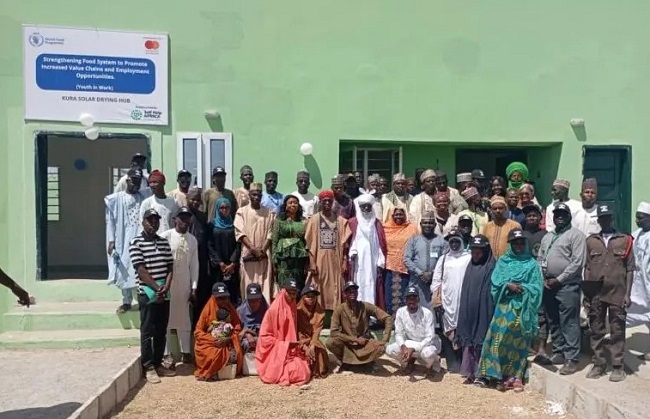
Delegates at the launch of the solar drying hub in Kura Local Government Area of Kano State
Aderele said Kura remained a major hub for tomatoes, peppers, onions and other vegetables that supply markets across Kano and beyond, but said that farmers often suffered losses due to poor storage and market glut.
She explained that the solar-powered drying technology would enable farmers and young entrepreneurs to preserve produce, extend shelf life and add market value.
According to her, the hub is expected to support more than 5,000 youths and create direct employment opportunities within the community.
Aderele commended WFP and the Mastercard Foundation for supporting youth empowerment and strengthening food systems through innovative interventions.
Also speaking, WFP Representative, Mrs. Esther Ogundari, appreciated community leaders and stakeholders for supporting the project, urging young farmers, especially women, to maximise the opportunities provided by the facility to boost productivity and income.
The Senior Programme Manager, Self Help Africa, Kano, Hajiya Hajara Mohammed, said the project, valued at N100 million, was designed to reduce post-harvest losses in horticultural produce.
Mohammed said the hub comprised solar and UV dryers capable of drying tomatoes within four to six hours and one to two days respectively.
She added that the facility could dry up to three tonnes of tomatoes daily and was projected to reduce post-harvest losses by about 50 per cent.
She said the project would operate as a community-based commercial service managed by cooperative groups to ensure sustainability.
The Secretary to the Kano State Government, Alhaji Umar Farouk-Ibrahim, represented by Rabiu Dahiru-Iliyasu, commended Self Help Africa for the initiative, describing it as a major boost to agricultural development in the state.
Also, the Chairman of Kura Local Government, Alhaji Rabiu Suleiman, commended Self Help Africa for implementing the project
Similarly, the District Head of Kura, Alhaji Lamido Abubakar-Bayero, said the project would help preserve farm produce and improve farmers’ livelihoods.
A tomato farmer, Rabiu Balarabe, also lauded the initiative, noting that it would significantly reduce losses previously recorded by farmers.
The event featured practical demonstrations on cutting and drying tomatoes using the facility.