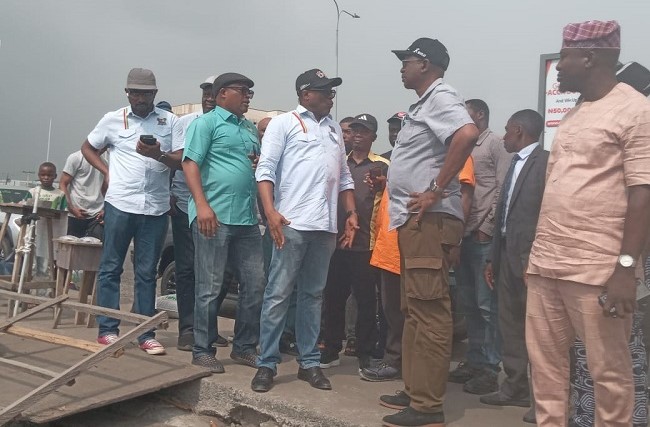
The Lagos State Government has commenced on-site assessment of informal spaces across key corridors of the state, beginning with the Lekki–Ajah axis, as part of deliberate efforts to ensure orderly, safe, and sustainable management of such spaces.
The assessment was led recently by the Commissioner for Physical Planning and Urban Development, Dr. Oluyinka Olumide; alongside the Special Adviser to the Governor on Survey Matters, Ayokunnu Adesina; the Permanent Secretary, Office of Physical Planning, Oluwole Sotire; the General Manager, Lagos State Informal Space Management Authority (LASISMA), and the Chief Executive Officer of OCTRAGON, Gbolahan Awonusi.
Lagos State Government officials during the on-site assessment of informal spaces
Speaking during the exercise, Dr. Olumide said that the physical inspection of informal spaces signalled the state government’s determination to turn such spaces around for the better.
According to him, Lagos was deliberately taking charge of its informal spaces to reposition them in line with global best practices and bring them to par with those in other notable cities around the world.
The Commissioner explained that the assessment would inform the development of practical prototypes to be deployed in pilot corridors, adding that OCTRAGON, as a private-sector partner, was collaborating with the Lagos State Government to ensure the orderly and sustainable management of informal spaces across the state.
Dr.Olumide further noted that effective management of informal spaces was critical for mobility, safety, urban aesthetics, and environmental protection, stressing that Lagos must optimise every available space to meet the demands of rapid urbanisation and population growth.
“In Lagos, every square metre of land matters, as we are the smallest State in the country by landmass, yet face intense urban and population pressure,” he said.
The on-site assessment marks another strategic step by the Lagos State Government towards integrated urban development, improved liveability, and the creation of a resilient, well-planned megacity.
Capacity development remains one of the most funded and trusted pathways to strengthen institutions, empower professionals, and accelerate economic growth, especially in Nigeria. From federal ministries to state agencies, NGOs, and agrifood enterprises, hundreds participate each year in training sessions on leadership, digital tools, monitoring and evaluation, agronomy, nutrition, finance, coordination, and more.
Development partners continue to invest heavily in workshops, technical training, leadership programmes, extension support, digital skills, and organisational development. And rightly so, because people are the backbone of every reform, policy, and food system we aim to transform. However, despite the significant investment, a recurring question remains: Why does capacity building sometimes seem slow in producing tangible, visible change?
Grace Omini
The evidence does not indicate a failure in the training itself, but rather a gap in how training interacts with the environment in which people operate. Capacity does not develop in isolation; individuals learn as part of systems, which are shaped by policies, incentives, structures, culture, tools, and politics.
Despite the heavy investment in training, Nigeria still faces massive gaps in talent, knowledge, and institutions. From state planning units to extension services, nutrition desks, research institutions, cooperatives, SMEs, and agribusinesses, capacity development is not optional; it is critical. Evidence from global development practice shows that training alone contributes only one component of long-term capacity development or change, and its impact depends heavily on organisational culture, leadership, and the systems that people return to after the workshop.
To unlock the full value of and/or upgrade capacity development in Nigeria, particularly for agriculture and food systems transformation, we need a broader, more holistic approach: An approach not just centred on building the people, but also on strengthening the organisations and aligning the systems they work within.
What Global Evidence Tells Us
International studies have consistently shown that while training builds knowledge, knowledge alone does not automatically translate into behaviour change or improved performance.
Here are three widely recognised findings:
1. Only a fraction of training is applied without system support
A significant body of research on training transfer indicates that knowledge gained in training does not automatically translate into behaviour change or organisational performance unless workplace conditions support it. 60–90% of knowledge acquired during training is not applied at work when the workplace lacks supporting structures, such as leadership, incentives, tools, and processes. This finding is supported by studies from around the world on workplace learning.
2. Training plus reinforcement outperforms training alone
A global evaluation comparing “training only” versus “training with follow-up support” found that participants with reinforcement activities such as coaching, practice, and application tasks had 2x higher skill uptake, and 48% greater improvement in work performance. This demonstrates that training content becomes more impactful when combined with follow-up structures that support actual application.
3. A World Bank IEG study confirms that training alone is insufficient
The World Bank’s Independent Evaluation Group (IEG) concluded that training must be combined with organisational reforms, institutional incentives and leadership engagement to achieve meaningful development outcomes: “Training on its own is rarely sufficient to build sustainable capacity.”
A Systems Lens for Nigeria’s Capacity Development
Nigeria needs capacity development, especially in agriculture, nutrition, climate resilience, extension systems, and public sector coordination. To unlock the full benefits of investments, capacity programmes must expand beyond the training room to consider three interconnected levels:
1. Individual Capacity
People still require skills in technical, managerial, digital, financial, analytical, gender-responsive, climate-smart, and leadership. However, learning is most effective when linked to real challenges they encounter daily.
2. Organisational Capacity
This is where learning turns into productivity with the right tools, processes, reporting structures, incentives, and decision-making culture. Without this layer, even the best-trained officers cannot perform effectively.
3. Institutional and System Capacity
This is where food systems transformation thrives. Capacity cannot work when policies conflict, coordination platforms are weak, accountability mechanisms are compromised, budgets are diverted, arrive late or don’t come at all, structures underperform or political transitions reset priorities.
When these three levels align, learning becomes performance, and performance leads to transformation.
Why This Matters for Nigeria’s Food Systems Transformation
Nigeria’s food system is complex and interconnected. Farmers depend on extension, extension depends on inputs and data, processors depend on markets, markets depend on policies, and nutrition outcomes depend on behaviour, affordability, and access.
Development partners fund capacity programmes because the sector cannot grow without skilled people and strong institutions. To drive real change, programmes must tackle the key challenges holding the system back, involve leadership to support learning, and combine training with follow-up coaching and practical tasks that encourage better decision-making, data use, coordination, and stakeholder engagement.
Solutions co-designed with participants increase adoption, while updating tools, SOPs, and frameworks helps embed new skills in the organisation. Success should be measured by improvements in coordination, service delivery, decision-making, data quality, farmer outcomes, and responsiveness, not just attendance. Strengthening policies, budgets, incentives, and data systems ensures these gains last.
Training will always matter. But training within a well-designed system is what truly brings lasting changes and capacity development.
The current opportunity is to ensure these investments create more profound, sustainable, and lasting impact. By adopting a systems-thinking approach, capacity development becomes more than just workshops; it transforms into a deliberate, structured pathway for strengthening institutions, energising public service delivery, enhancing agricultural productivity, improving nutrition outcomes, and accelerating food systems transformation.
By Grace Omini, Manager at Sahel Consulting Agriculture & Nutrition Limited
The Centre for Climate Change and Development (CCCD) at Alex Ekwueme Federal University, in partnership with the Institut du Développement Durable et des Relations Internationales (IDDRI) in Paris, under the Ukama Network, in collaboration with Nigeria’s Federal Ministry of Industry, Trade and Investment (FMITI) has successfully hosted a workshop on Trade, Investment and green industrialisation in Nigeria: strengthening relationship with the European Union.
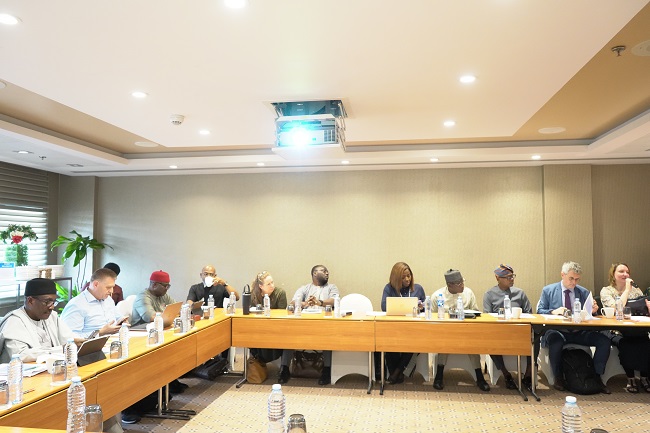
The workshop, which held at Transcorp Hilton Abuja, brought together over 50 high-level stakeholders, including policymakers, private sector leaders, diplomats, and development experts, to advance Nigeria’s green economic agenda and strengthen its position in green industrialisation, with a focus on the relationship with the European Union (EU).
Participants at the Ukama Platform workshop
As Nigeria seeks to diversify its economy from fossil fuels, stakeholders examined existing policies, institutional frameworks, and partnerships towards these goals, and offered recommendations. This intervention is of impeccable timing in light of recent geopolitical shifts, which have impacted several sectors and heralded international market realignments, highlighting the need to forge new international partnerships amidst the urgency to transition from fossil dependence.
Recently, Nigeria’s President Bola Ahmed Tinubu, speaking at the 2026 Abu Dhabi Sustainability Week, outlined Nigeria’s strategic vision of mobilising up to $20-$30 billion annually in climate finance for climate-resilient growth and energy transition. The workshop served as a timely platform to analyse the pathway to operationalising these national priorities through enhanced EU collaboration.
At the policy workshop, participants emphasised green industrialisation as an economic necessity, aligning with Nigeria’s Energy Transition Plan and net-zero goals by 2060, while identifying operationalisation gaps, opportunities, and making practical and actionable recommendations towards strengthening collaboration on sustainable trade and green industrialisation.
In his welcome remarks, Prof. Chukwumerije Okereke, CCCD Director and Ukama Co-Chair, highlighted the workshop’s focus on addressing structural vulnerabilities in Nigeria’s economy, such as over-reliance on oil exports, which accounts for 90% of Nigeria’s earnings, and leveraging global opportunities like the African Continental Free Trade Area (AfCFTA) and EU’s Global Gateway Initiative.
“This dialogue aims to access policy frameworks, identify barriers and opportunities, facilitate collaboration, curate actionable plans, and commitments to reposition Nigeria for sustainable, inclusive growth,” Prof. Okereke stated.
In his remarks, Dr. Sebastien Treyer, IDDRI Executive Director and Ukama Co-Chair, underscored the importance of mutual partnerships.
“We aim to identify factors blocking market access, with a focus on understanding the key issues faced by private players in Africa who want to invest in green industrialisation supply chains, and enhance investment relations between Nigeria and the EU, fostering shared prosperity and climate action,” he said.
Dr. Mrs. Rachel Mandi George, Director of Trade at FMITI, reaffirmed the Ministry’s commitment to policies promoting sustainable industrial development, renewable energy, and value addition.
“The steps taken by the European Union represent a shared commitment to shape a more resilient, inclusive, and sustainable economic future for Nigeria. As Africa’s largest economy and most populous nation, the choices we make today regarding industrial growth, trade, and investment will determine not only our economic prosperity but also our environmental sustainability and social wellbeing. Green industrialisation offers Nigeria a transformative pathway,” she stated.
Mr. Olamide Fagbuji, Senior Special Assistant to the President on Climate Technology and Operations, speaking on Nigeria’s policy landscape, outlined several policies developed by Nigeria to promote climate action.
“Nigeria, through the Climate Change Act, established the National Council on Climate Change to promote and coordinate national climate action. This body has enabled the development of several key policy frameworks, including the Energy Transition Plan (our blueprint for achieving net zero), the Long-Term Low Emission Development Strategy (LT-LED), and, notably, the Nationally Determined Contribution 3.0, published late last year. As a country, we remain focused on mobilising investment to ensure Nigeria meets its climate commitments,” he said.
In his Address, the Head of EU delegation in Nigeria, Ambassador Gautier Mignot, described the EU partnership offer as long-term, and sustainable, quality infrastructure that is beneficial to partner countries without creating new forms of dependency.
“At the regional level across West Africa, we are fostering integration and developing trade corridors while supporting the African Continental Free Trade Area. On industrialisation, our priority is to build the industries of the future, not the industries of the past, and to support companies through that transition. That commitment lies at the heart of our partnership with Nigeria. Specific strategies will reflect each country’s sovereign choices, and we are ready to provide technical assistance to both federal and state governments. Ultimately, our goal is to develop local value chains that deliver real benefits to partner countries,” he said.
Group Managing Director/Chief Executive Officer of Alfa Designs Nigeria Ltd., Mr. Quadri Fatai, says the company plans to invest in electric vehicles (EVs) as a long-term component of Nigeria’s energy transition.
Fatai said this in an interview, noting that while EVs offer near-zero emissions and environmental benefits, current realities in Nigeria make gas a more practical transition fuel in the short to medium term.
He said the company’s move to invest in electric vehicles would, however, depend on the resolution of critical challenges, particularly the availability of stable power supply and the cost of electricity.
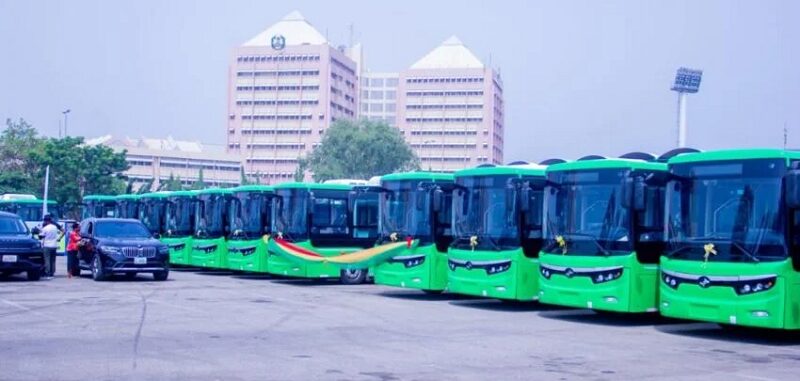
Electric buses
“The adoption of EVs must be guided by economic and infrastructural realities, particularly the availability, stability and cost of electricity,” he said.
Fatai explained that the decision to prioritise gas over petrol and diesel in Nigeria was largely driven by affordability and lower environmental impact, adding that the same cost-based logic must apply to EVs.
“When you charge a vehicle with expensive electricity, it no longer becomes economical. Cost is always a major concern for the populace.”
According to him, electric vehicles produce almost zero emissions at the point of use, unlike internal combustion engines and even gas-powered vehicles, which still emit carbon dioxide and, in some cases, soot due to incomplete combustion.
“With EVs, you are almost at zero emission. You don’t have carbon dioxide or soot formation from the vehicle, which makes it very attractive from an environmental standpoint.”
The Alfa Designs CEO said the company views EV investment as a “phase three” objective, to be pursued after Nigeria closes key gaps in power generation, transmission and distribution.
He said widespread and affordable electricity supply was essential before EVs could become commercially viable for most Nigerians.
“First, we need a steady and stable power supply. When we have enough power outlets and electricity becomes cheaper per kilowatt, then EVs will make more economic sense.
“Nigeria’s vast gas resources positioned the country to first use gas to address power deficits and reduce dependence on petrol, before transitioning more aggressively to electric mobility.
“Our company already has partnerships in the electric vehicle space but we deliberately chose not to prioritise large-scale deployment at this stage.
“We have partners working on electric vehicles, but our focus for now is gas. At present, the cost per kilowatt of electricity in Nigeria is still higher than the equivalent cost of gas,” he said.
He expressed optimism that increased domestic gas utilisation would eventually drive down electricity costs, making EV adoption more attractive in the future.
“With increased gas deployment for domestic power generation, electricity will eventually become cheaper. At that point, EVs will naturally become a more viable and competitive option,” Fatai said.
“A phased approach to energy transition will allow Nigeria to balance environmental goals with affordability and economic growth.
“Our approach is based on reality; once electricity becomes cheaper than gas on an energy-equivalent basis, EVs will become a natural next step,” he added.
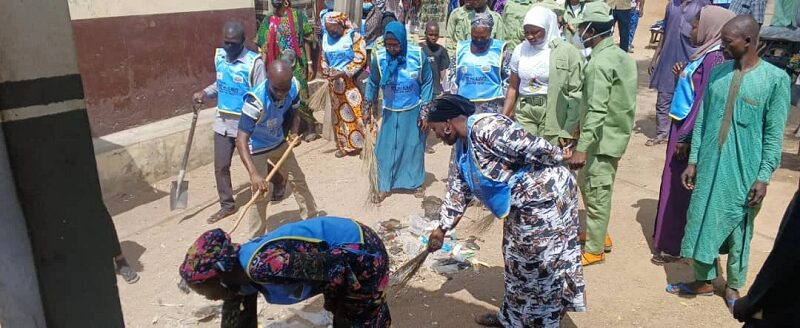
Water Sanitation and Hygiene (WASH) Coordinator under the United Nations Children Fund (UNICEF) project, Mr. Williams Wakili, has encouraged tailors to recycle textile waste in their shops to wealth,
The coordinator made the call at the WASH cleanup day camping for the tailors’ association in Ganye Local Government Area of Adamawa State on Friday, January 16, 2026.
He urged them to utilise the waste they generate from clothes they sew in making extra wealth out of it and to keep their environment clean.
Participants at the WASH cleanup day camping for the tailors’ association in Ganye Local Government Area of Adamawa State
“What we are trying to do is to begin to encourage tailors to reuse some of these materials, recycle them for better uses.
“We have seen other people, who produce doorstep carpet and some put it together to make multiple color clothes and dusters among others,” he said.
He noted that the method would go a long way to reduce dump sites of textile waste and make their environment clean for better living.
Mr. Jared Gangkuba, WASH Coordinator in Ganye, explained that the campaign was significant for the area and the state at large, in tackling the problem of waste generated from textiles.
According to him, the sensitisation will help to address some of the challenges on waste management.
He called on the community leaders and the tailors to take advantage of the campaign for more opportunities and improve sanitation in their respective communities.
Faruk Audu, a tailor, appreciated the sensitisation and awareness campaigns and pledged to apply the knowledge for maximum benefits and also step down to colleagues.
He recalled that before the training, some of them burn the waste materials instead of recycling them.
He added that, with the campaign, they would be able to recycle the waste in different ways, such as making pillows, mat, mopper and other things.
Gloria Ojojonah, a Corps member, also expressed confidence that with frequent campaigns, a lot would be achieved in respect to community waste management in the area.
The campaign was organised by Adamawa State Rural Water Sanitation and Hygiene Supply Agency with Support from UNICEF, funded by the Netherlands.
The event also featured sanitation exercise with NYSC Corps members and members of the Community.
The Department of Building, Faculty of Environmental Sciences, Niger Delta University (NDU), in Bayelsa State, on Friday, January 16, 2026, inducted its pioneer set into the Nigerian Institute of Building (NIOB).
The ceremony, which took place in the institution, is with the theme: “Building the Future; Innovating, Integrating and Inspiring in the Construction 4. Era”.
In his address, Dr Christopher Belonwu, Acting Head of Department (HOD), Building, described the occasion as a day of fulfilment, reflection and profound joy.
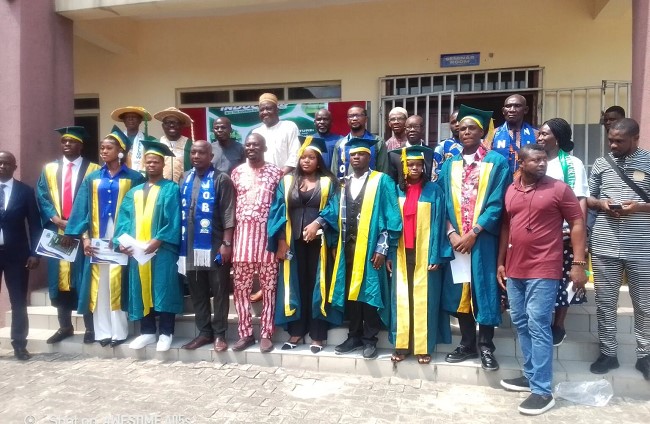
NDU graduates inducted into the Nigerian Institute of Building (NIOB)
Belonwu noted that the university was committed to raising competent ethical and industry-ready building professionals, who would contribute meaningfully to national development and global best practices in the built environment.
“As head of department, witnessing the induction of our graduates into the graduate cadre of the Nigerian Institute of Building, gives me joy.
“The Department of Building was officially kicked off in the 2019/2020 academic session with a clear vision.
“Like every worthwhile venture, the journey was not without challenges. We started with modest facilities, high expectations and an unshakable belief in what the department could become. Today, that belief has been validated.
“This induction ceremony marks the fruition of years of hard work, resilience and determination by our students who dared to dream, our lecturers who laboured tirelessly to impart knowledge and character, and the university management, whose support made this dream sustainable.
“To our pioneer graduates and those who have followed, you are not just a product of this department; you are its ambassadors, proof of concept and living legacy,” he stated.
According to him, being inducted into the graduate cadre of the Nigerian Institute of Building is more than a ceremonial rite.
He noted that it was a formal recognition of the readiness of the inductees to take their places in the professional community of builders.
“It signifies that you have met the academic and ethical thresholds required to begin your professional journey. With this honour comes responsibility.
“It is your responsibility to uphold the standard of the profession, to practice with integrity and to continuously develop yourselves in knowledge and skill,” he said.
He encouraged them to view this milestone as the commencement of a more significant journey, emphasisng the importance of embracing lifelong learning, seeking mentorship, fostering innovation, and upholding ethical standards above expediency.
On his part, the Vice Chancellor of the university, Prof. Allen Agih, described the occasion as important, having produced the first set of builders of the institution.
The vice chancellor, who was represented by Prof. Sylvester Ebibai, Dean, Faculty of Environmental Sciences, noted that the university was operating with global best practices, in line with the accreditation of the course.
He commended the lecturers, the professional bodies and the students, who were all set to soar as builders.
Ebibai urged the inductees to ensure they grow on the job.
In his remarks, Abimbola Kolade, President, NIOB, commended NDU for the training of the students and the knowledge gained as graduates inducted into the Nigerian Institute of Building.
Kolade, who was represented by Mr. Ahmed Baba Ahmed, former Chairman, NIOB Bayelsa chapter, encouraged them to excel in the building profession, innovate, research, and upskill to progress.
He also urged them to attend NIOB events for more knowledge.
Also, Mr. Akinola Bammeka, former National Publicity Secretary of NIOB, said that there are a lot of opportunities in the building industry.
He emphasised that achieving success requires effort and determination, stating that the magnitude of one’s effort directly impacts progress in their profession, and advised maintaining focus while avoiding obstacles to personal and professional growth.
The Federal Government of Nigeria has announced ban on mining of sand, 10-kilometre radius in River Niger, to protect the first and second Niger bridges.
Minister of Works, Mr. David Umahi disclosed this on Friday, January 16, 2026, in Asaba, Delta State, during the commissioning of the Second Niger Bridge Closed-Circuit Television (CCTV) Cameras Monitoring Centre.
He said the decision was taken by the Federal Executive Council as part of efforts to protect critical federal infrastructure across the country.
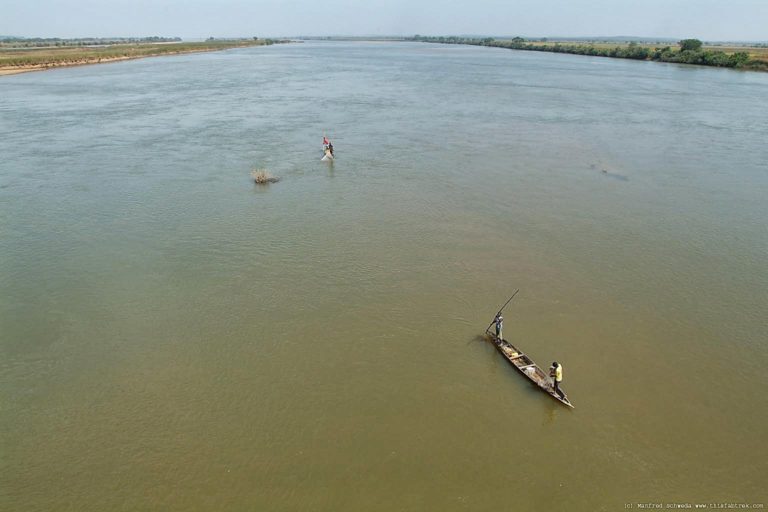
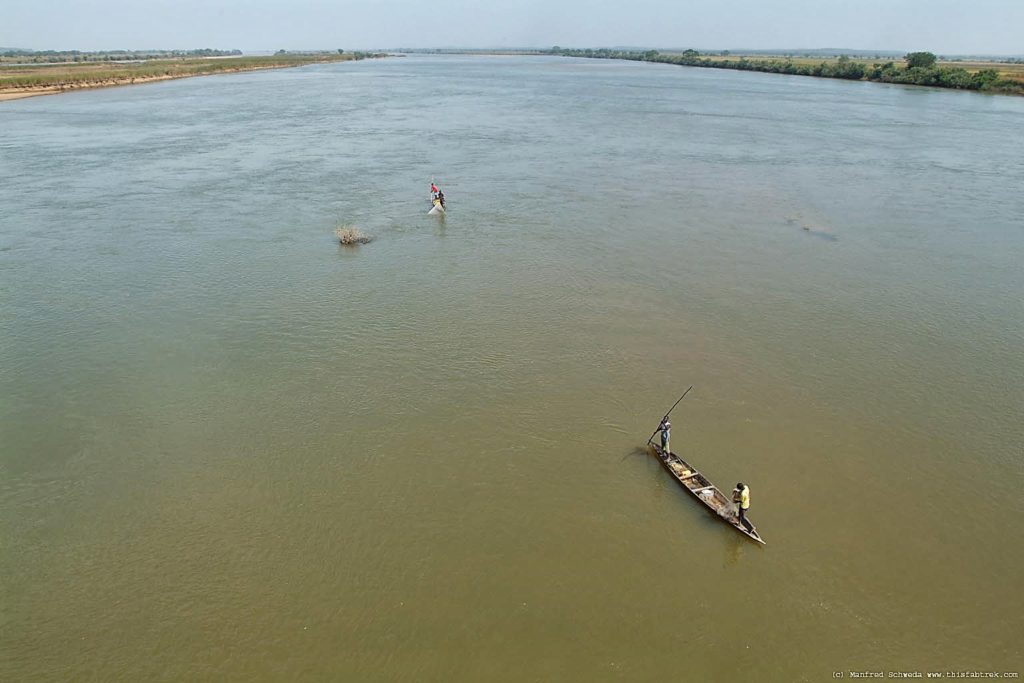
There are fears that the River Niger is drying up. On World Rivers Day 2016, there are concerns that many of the world’s rivers face severe and increasing threats associated with climate change, pollution, and industrial development
According to him, tolling on the second Niger bridge would not begin until all access roads at Anambra and Delta sections are completed.
He added that the CCTV monitoring centre was to ensure adequate security along the federal highway.
“The tollgate is ready but we won’t start tolling on the road until we complete the access roads and bypass roads that lead to bridge.
“The idea is that there will be no security checkpoints on the road, police and other security agencies will be at the CCTV monitoring centre and provide rapid response to emergencies within five minutes,” he added.
Umahi directed the Police command in Delta to ensure implementation of the ban as well as arresting offenders.
In his remarks,the Asagba of Asaba, Prof. Epiphany Azinge, commended the Federal Government for effectively completing the second Niger bridge and enumerated the socio-economic benefits of the project.
On his part, the Chairman, Anambra State Council of Traditional Rulers, the Igwe of Obosi, Chidubem Iweka, said that opening of the bridge has reduced traffic on the first bridge and eased movement during and after the yuletide.
Iweka expressed optimism that installation of the security camera would boost confidence of commuters plying the road.
He called for speedy completion of the access roads to the second Niger bridge.
The National Hydroelectric Power Producing Areas Development Commission (N-HYPPADEC) has sought partnership with the Taraba State Government to strengthen ecological interventions in dam-affected communities.
Its Managing Director, Alhaji Abubakar Sadiq, made the call during a management committee courtesy visit to Gov. Agbu Kefas on Friday, January 16, 2026, in Jalingo, the state capital.
Sadiq said the commission remained committed to addressing ecological damage from hydroelectric dam operations to promote sustainable socio-economic development in host communities.
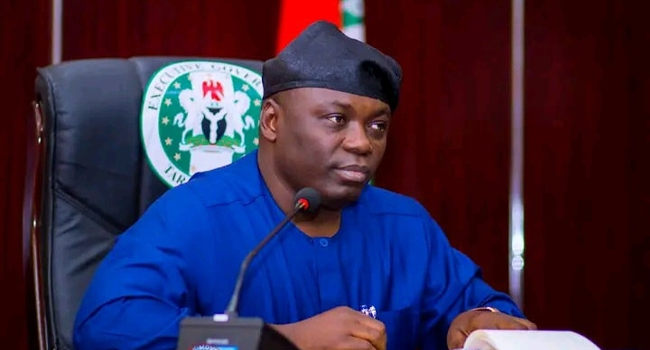
Governor Agbu Kefas of Taraba State
He said N-HYPPADEC had executed social and infrastructural projects in Wukari, Takum, Ibi, Ardo-Kola, Karim-Lamido, Jalingo, Yorro and Lau local government areas.
“In line with our mandate, we are reversing ecological damage while promoting sustainable development through targeted social and infrastructural interventions,” Sadiq said.
He said the commission installed solar-powered streetlights and constructed solar-powered boreholes to improve security, economic activities and access to clean water.
“Since 2024, we have supplied and installed 34 solar-powered streetlights across riverine communities and Jalingo metropolis,” he said.
Sadiq added that 15 solar-powered boreholes were constructed, while 32 power tillers were distributed to farming cooperatives to strengthen agricultural livelihoods.
He said two operational flying boats were provided along riverine corridors to enhance mobility and emergency response.
“Recognising Taraba’s riverine challenges, we delivered flying boats along the Lau–Karim-Lamido and Ibi–Wukari axes,” he said.
Sadiq said two water buses would also be delivered along the Ibi–Wukari route, each with a capacity of 34 passengers.
He added that drainage desilting works covering about 40 linear metres were undertaken, alongside transformer installations and payment of NECO fees for candidates.
Sadiq welcomed the inclusion of Taraba, Kaduna, Gombe and Nasarawa as member states of the commission in June 2023.
He said President Bola Tinubu’s decision acknowledged communities bearing environmental and social burdens of hydroelectric power generation.
“Flooding, erosion, displacement and livelihood disruption are real challenges driving the commission’s policy focus,” Sadiq said.
Governor Kefas commended President Tinubu for admitting Taraba into the commission and assured continued cooperation with development partners.
He said the state government remained committed to initiatives that would drive development and improve citizens’ wellbeing.
The delegation earlier visited the Aku Uka of Wukari, Dr Manu Ali, who praised the commission’s interventions.
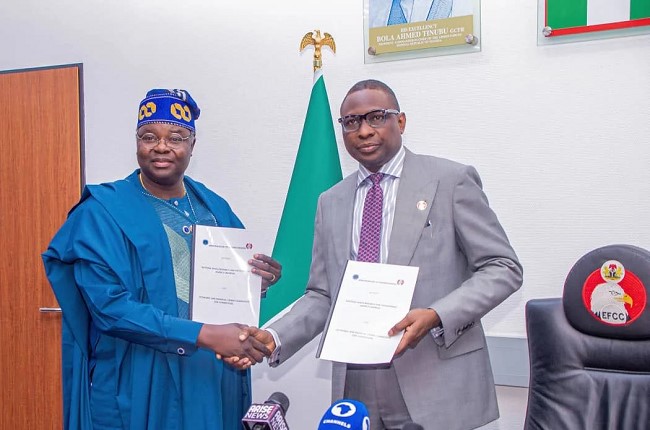
The National Space Research and Development Agency (NASRDA) and the Economic and Financial Crimes Commission (EFCC) have partnered to combat illegal mining and other crimes using geospatial intelligence.
The two organisations signed a Memorandum of Understanding (MoU) on Thursday, January 15, 2026, in Abuja to strengthen national security and enforce accountability across sectors of the economy.
Dr Matthew Adepoju, Director-General of NASRDA, said the partnership would strengthen the implementation of national space regulations, improve spectrum management and enhance oversight of activities within Nigeria’s rapidly expanding space ecosystem.
National Space Research and Development Agency (NASRDA) and the Economic and Financial Crimes Commission (EFCC) are partnering to combat illegal mining
“This is a milestone for justice and accountability and this agreement will ensure that both local and international organisations operating within Nigeria’s space sector fully comply with existing laws and regulatory frameworks.
“We cannot ignore that illegal mining is a major contributor to insecurity in the country, and NASRDA remains committed to regulating operators across the upstream, midstream, and downstream segments of the space sector to ensure full legal compliance,” Adepoju said.
According to him, the EFCC is the ideal partner for this mission, given the commission’s strong leadership, sound institutional management, and proven track record under its current Chairman,Mr Olanipekun Olukoyede.
Adepoju, however, said NASRDA would deploy advanced space and geospatial technologies to support the commission in carrying out its mandate more efficiently and in line with international best practices.
According to him, the implementation of the MoU will commence immediately.
Also, Olukoyede described the MoU as a clear demonstration of inter-agency cooperation and how such collaboration could strengthen institutional capacity and ensure the government delivered on its mandates.
He explained that a functional partnership between both parties would serve as a model for other ministries, departments and agencies to embrace cooperation as a pathway to stronger governance and national advancement.
He mentioned that NASRDA would supply advanced technologies to strengthen the EFCC’s investigative and asset-tracking capabilities, while they would apply its expertise to maximise the agency’s fraud-risk intelligence.
Benin-based NGO, Connected Advocacy, engaged the National Centre for Energy and Environment (NCEE) to explore collaboration on strengthening local engagement, research, and public advocacy around Nigeria’s energy transition agenda.
Mr. Israel Orekha, Executive Director of Connected Advocacy, made this known during a visit to the centre in Benin, Edo State, on Friday, January 16, 2026.
He said the organisation was keen on bridging the gap between Nigeria’s national energy transition plan and its implementation at the local and institutional levels.
The two teams during the visit
Orekha explained that the advocacy visit was in line with the implementation of the project titled “Taxation as a Phase-Out Strategy from Africa’s Fossil Fuel Industry.”
This project, he said, was being implemented with the support of the Civil Society Legislative Advocacy Centre (CISLAC).
“There is a national energy transition plan, but implementation remains a major challenge.
“Our concern is how this transition is domesticated within local processes, institutions and industries, including the oil and gas sector,” he said.
According to him, effective energy transition requires sustained research, capacity building and advocacy that speaks the “language of the people,” particularly industries and communities that were directly affected.
“What people do not understand, they cannot support. Awareness and capacity building, backed by research, are critical to driving a just and inclusive transition.
“That is why we are here, to see how this centre can work with us to take energy transition conversations beyond policy documents to real, local action,” he added.
In his response, the Director of NCEE, Prof. Emmanuel Ogbomida, welcomed the partnership, describing collaboration as central to the mandate of the centre under the Energy Commission of Nigeria (ECN).
“One of our core focus areas is strong collaboration, both nationally and internationally, especially in research, development and deployment of energy solutions.
“It is a privilege to host Connected Advocacy because advocacy and public engagement are essential to the acceptability of our projects,” Ogbomida said.
The director noted that NCEE was actively involved in projects linking energy, biosafety and climate change, with a growing emphasis on transitioning Nigeria from fossil fuels to renewable energy.
“Energy transition is at the heart of what we do here, moving from fossil fuel dependence to renewable energy.
“Renewable energy offers more reliable and sustainable power, which addresses the persistent challenge of unstable electricity supply in Nigeria,” he said.
Ogbomida also linked the collaboration to ongoing federal initiatives, noting that the current administration had placed energy transition high on its agenda.
“The President is already deploying solar power projects across the six geopolitical zones, targeting universities and key institutions.
“This shows that energy transition is not just policy; it is already being implemented, and the Energy Commission is championing that process,” he said.
He stressed that research alone was insufficient without effective communication and advocacy.
He added that partnerships with advocacy groups helped translate scientific work into public understanding and policy support.
“No matter how good your research is, if you do not communicate it effectively, the impact will be limited.
“Advocacy ensures that people understand what is being done and why it matters,” Ogbomida said.
Both organisations agreed that energy transition goes beyond renewable energy deployment to include energy efficiency, retrofitting existing systems and behavioural change in energy use.
They expressed commitment to developing a working framework to guide joint programmes, including workshops, training and public engagement initiatives.