Water Sanitation and Hygiene (WASH) Coordinator under the United Nations Children Fund (UNICEF) project, Mr. Williams Wakili, has encouraged tailors to recycle textile waste in their shops to wealth,
The coordinator made the call at the WASH cleanup day camping for the tailors’ association in Ganye Local Government Area of Adamawa State on Friday, January 16, 2026.
He urged them to utilise the waste they generate from clothes they sew in making extra wealth out of it and to keep their environment clean.
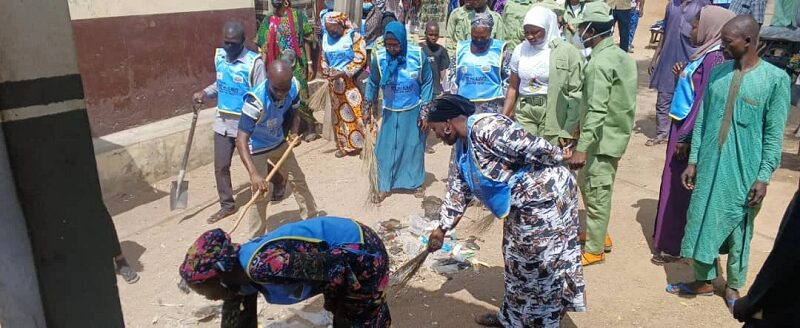
Participants at the WASH cleanup day camping for the tailors’ association in Ganye Local Government Area of Adamawa State
“What we are trying to do is to begin to encourage tailors to reuse some of these materials, recycle them for better uses.
“We have seen other people, who produce doorstep carpet and some put it together to make multiple color clothes and dusters among others,” he said.
He noted that the method would go a long way to reduce dump sites of textile waste and make their environment clean for better living.
Mr. Jared Gangkuba, WASH Coordinator in Ganye, explained that the campaign was significant for the area and the state at large, in tackling the problem of waste generated from textiles.
According to him, the sensitisation will help to address some of the challenges on waste management.
He called on the community leaders and the tailors to take advantage of the campaign for more opportunities and improve sanitation in their respective communities.
Faruk Audu, a tailor, appreciated the sensitisation and awareness campaigns and pledged to apply the knowledge for maximum benefits and also step down to colleagues.
He recalled that before the training, some of them burn the waste materials instead of recycling them.
He added that, with the campaign, they would be able to recycle the waste in different ways, such as making pillows, mat, mopper and other things.
Gloria Ojojonah, a Corps member, also expressed confidence that with frequent campaigns, a lot would be achieved in respect to community waste management in the area.
The campaign was organised by Adamawa State Rural Water Sanitation and Hygiene Supply Agency with Support from UNICEF, funded by the Netherlands.
The event also featured sanitation exercise with NYSC Corps members and members of the Community.
The Department of Building, Faculty of Environmental Sciences, Niger Delta University (NDU), in Bayelsa State, on Friday, January 16, 2026, inducted its pioneer set into the Nigerian Institute of Building (NIOB).
The ceremony, which took place in the institution, is with the theme: “Building the Future; Innovating, Integrating and Inspiring in the Construction 4. Era”.
In his address, Dr Christopher Belonwu, Acting Head of Department (HOD), Building, described the occasion as a day of fulfilment, reflection and profound joy.
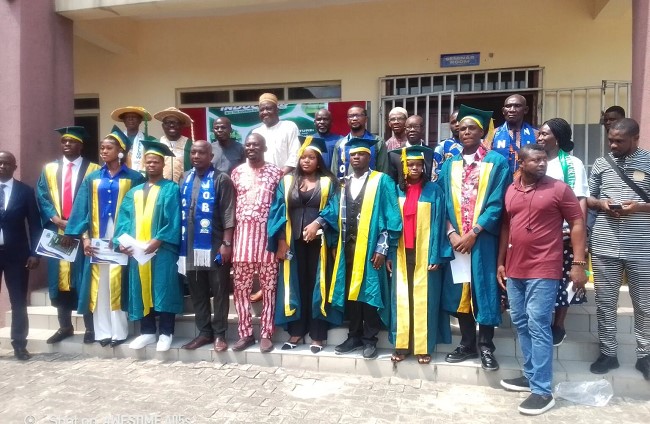
NDU graduates inducted into the Nigerian Institute of Building (NIOB)
Belonwu noted that the university was committed to raising competent ethical and industry-ready building professionals, who would contribute meaningfully to national development and global best practices in the built environment.
“As head of department, witnessing the induction of our graduates into the graduate cadre of the Nigerian Institute of Building, gives me joy.
“The Department of Building was officially kicked off in the 2019/2020 academic session with a clear vision.
“Like every worthwhile venture, the journey was not without challenges. We started with modest facilities, high expectations and an unshakable belief in what the department could become. Today, that belief has been validated.
“This induction ceremony marks the fruition of years of hard work, resilience and determination by our students who dared to dream, our lecturers who laboured tirelessly to impart knowledge and character, and the university management, whose support made this dream sustainable.
“To our pioneer graduates and those who have followed, you are not just a product of this department; you are its ambassadors, proof of concept and living legacy,” he stated.
According to him, being inducted into the graduate cadre of the Nigerian Institute of Building is more than a ceremonial rite.
He noted that it was a formal recognition of the readiness of the inductees to take their places in the professional community of builders.
“It signifies that you have met the academic and ethical thresholds required to begin your professional journey. With this honour comes responsibility.
“It is your responsibility to uphold the standard of the profession, to practice with integrity and to continuously develop yourselves in knowledge and skill,” he said.
He encouraged them to view this milestone as the commencement of a more significant journey, emphasisng the importance of embracing lifelong learning, seeking mentorship, fostering innovation, and upholding ethical standards above expediency.
On his part, the Vice Chancellor of the university, Prof. Allen Agih, described the occasion as important, having produced the first set of builders of the institution.
The vice chancellor, who was represented by Prof. Sylvester Ebibai, Dean, Faculty of Environmental Sciences, noted that the university was operating with global best practices, in line with the accreditation of the course.
He commended the lecturers, the professional bodies and the students, who were all set to soar as builders.
Ebibai urged the inductees to ensure they grow on the job.
In his remarks, Abimbola Kolade, President, NIOB, commended NDU for the training of the students and the knowledge gained as graduates inducted into the Nigerian Institute of Building.
Kolade, who was represented by Mr. Ahmed Baba Ahmed, former Chairman, NIOB Bayelsa chapter, encouraged them to excel in the building profession, innovate, research, and upskill to progress.
He also urged them to attend NIOB events for more knowledge.
Also, Mr. Akinola Bammeka, former National Publicity Secretary of NIOB, said that there are a lot of opportunities in the building industry.
He emphasised that achieving success requires effort and determination, stating that the magnitude of one’s effort directly impacts progress in their profession, and advised maintaining focus while avoiding obstacles to personal and professional growth.
The Federal Government of Nigeria has announced ban on mining of sand, 10-kilometre radius in River Niger, to protect the first and second Niger bridges.
Minister of Works, Mr. David Umahi disclosed this on Friday, January 16, 2026, in Asaba, Delta State, during the commissioning of the Second Niger Bridge Closed-Circuit Television (CCTV) Cameras Monitoring Centre.
He said the decision was taken by the Federal Executive Council as part of efforts to protect critical federal infrastructure across the country.
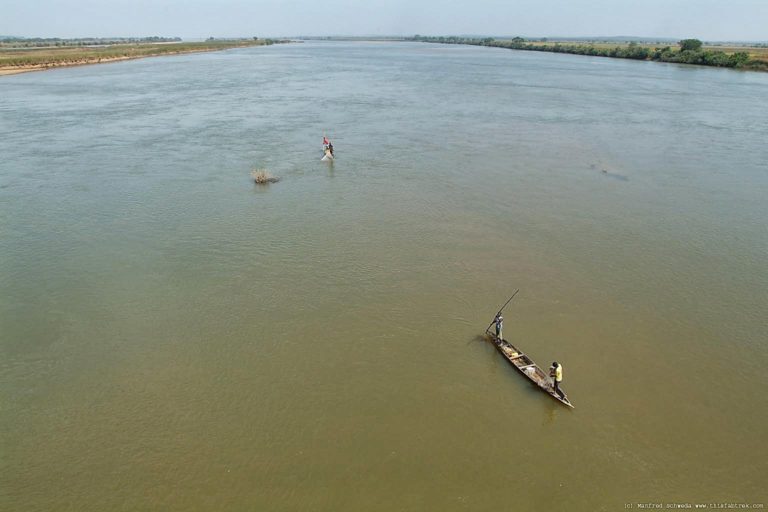
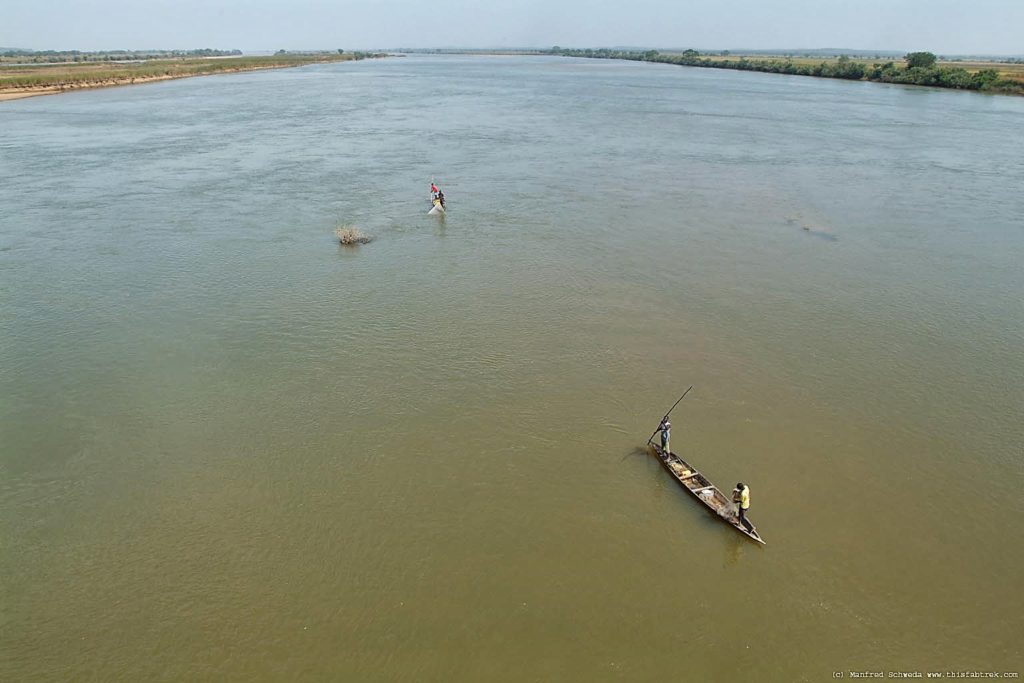
There are fears that the River Niger is drying up. On World Rivers Day 2016, there are concerns that many of the world’s rivers face severe and increasing threats associated with climate change, pollution, and industrial development
According to him, tolling on the second Niger bridge would not begin until all access roads at Anambra and Delta sections are completed.
He added that the CCTV monitoring centre was to ensure adequate security along the federal highway.
“The tollgate is ready but we won’t start tolling on the road until we complete the access roads and bypass roads that lead to bridge.
“The idea is that there will be no security checkpoints on the road, police and other security agencies will be at the CCTV monitoring centre and provide rapid response to emergencies within five minutes,” he added.
Umahi directed the Police command in Delta to ensure implementation of the ban as well as arresting offenders.
In his remarks,the Asagba of Asaba, Prof. Epiphany Azinge, commended the Federal Government for effectively completing the second Niger bridge and enumerated the socio-economic benefits of the project.
On his part, the Chairman, Anambra State Council of Traditional Rulers, the Igwe of Obosi, Chidubem Iweka, said that opening of the bridge has reduced traffic on the first bridge and eased movement during and after the yuletide.
Iweka expressed optimism that installation of the security camera would boost confidence of commuters plying the road.
He called for speedy completion of the access roads to the second Niger bridge.
The National Hydroelectric Power Producing Areas Development Commission (N-HYPPADEC) has sought partnership with the Taraba State Government to strengthen ecological interventions in dam-affected communities.
Its Managing Director, Alhaji Abubakar Sadiq, made the call during a management committee courtesy visit to Gov. Agbu Kefas on Friday, January 16, 2026, in Jalingo, the state capital.
Sadiq said the commission remained committed to addressing ecological damage from hydroelectric dam operations to promote sustainable socio-economic development in host communities.
Governor Agbu Kefas of Taraba State
He said N-HYPPADEC had executed social and infrastructural projects in Wukari, Takum, Ibi, Ardo-Kola, Karim-Lamido, Jalingo, Yorro and Lau local government areas.
“In line with our mandate, we are reversing ecological damage while promoting sustainable development through targeted social and infrastructural interventions,” Sadiq said.
He said the commission installed solar-powered streetlights and constructed solar-powered boreholes to improve security, economic activities and access to clean water.
“Since 2024, we have supplied and installed 34 solar-powered streetlights across riverine communities and Jalingo metropolis,” he said.
Sadiq added that 15 solar-powered boreholes were constructed, while 32 power tillers were distributed to farming cooperatives to strengthen agricultural livelihoods.
He said two operational flying boats were provided along riverine corridors to enhance mobility and emergency response.
“Recognising Taraba’s riverine challenges, we delivered flying boats along the Lau–Karim-Lamido and Ibi–Wukari axes,” he said.
Sadiq said two water buses would also be delivered along the Ibi–Wukari route, each with a capacity of 34 passengers.
He added that drainage desilting works covering about 40 linear metres were undertaken, alongside transformer installations and payment of NECO fees for candidates.
Sadiq welcomed the inclusion of Taraba, Kaduna, Gombe and Nasarawa as member states of the commission in June 2023.
He said President Bola Tinubu’s decision acknowledged communities bearing environmental and social burdens of hydroelectric power generation.
“Flooding, erosion, displacement and livelihood disruption are real challenges driving the commission’s policy focus,” Sadiq said.
Governor Kefas commended President Tinubu for admitting Taraba into the commission and assured continued cooperation with development partners.
He said the state government remained committed to initiatives that would drive development and improve citizens’ wellbeing.
The delegation earlier visited the Aku Uka of Wukari, Dr Manu Ali, who praised the commission’s interventions.
The National Space Research and Development Agency (NASRDA) and the Economic and Financial Crimes Commission (EFCC) have partnered to combat illegal mining and other crimes using geospatial intelligence.
The two organisations signed a Memorandum of Understanding (MoU) on Thursday, January 15, 2026, in Abuja to strengthen national security and enforce accountability across sectors of the economy.
Dr Matthew Adepoju, Director-General of NASRDA, said the partnership would strengthen the implementation of national space regulations, improve spectrum management and enhance oversight of activities within Nigeria’s rapidly expanding space ecosystem.
National Space Research and Development Agency (NASRDA) and the Economic and Financial Crimes Commission (EFCC) are partnering to combat illegal mining
“This is a milestone for justice and accountability and this agreement will ensure that both local and international organisations operating within Nigeria’s space sector fully comply with existing laws and regulatory frameworks.
“We cannot ignore that illegal mining is a major contributor to insecurity in the country, and NASRDA remains committed to regulating operators across the upstream, midstream, and downstream segments of the space sector to ensure full legal compliance,” Adepoju said.
According to him, the EFCC is the ideal partner for this mission, given the commission’s strong leadership, sound institutional management, and proven track record under its current Chairman,Mr Olanipekun Olukoyede.
Adepoju, however, said NASRDA would deploy advanced space and geospatial technologies to support the commission in carrying out its mandate more efficiently and in line with international best practices.
According to him, the implementation of the MoU will commence immediately.
Also, Olukoyede described the MoU as a clear demonstration of inter-agency cooperation and how such collaboration could strengthen institutional capacity and ensure the government delivered on its mandates.
He explained that a functional partnership between both parties would serve as a model for other ministries, departments and agencies to embrace cooperation as a pathway to stronger governance and national advancement.
He mentioned that NASRDA would supply advanced technologies to strengthen the EFCC’s investigative and asset-tracking capabilities, while they would apply its expertise to maximise the agency’s fraud-risk intelligence.
Benin-based NGO, Connected Advocacy, engaged the National Centre for Energy and Environment (NCEE) to explore collaboration on strengthening local engagement, research, and public advocacy around Nigeria’s energy transition agenda.
Mr. Israel Orekha, Executive Director of Connected Advocacy, made this known during a visit to the centre in Benin, Edo State, on Friday, January 16, 2026.
He said the organisation was keen on bridging the gap between Nigeria’s national energy transition plan and its implementation at the local and institutional levels.
The two teams during the visit
Orekha explained that the advocacy visit was in line with the implementation of the project titled “Taxation as a Phase-Out Strategy from Africa’s Fossil Fuel Industry.”
This project, he said, was being implemented with the support of the Civil Society Legislative Advocacy Centre (CISLAC).
“There is a national energy transition plan, but implementation remains a major challenge.
“Our concern is how this transition is domesticated within local processes, institutions and industries, including the oil and gas sector,” he said.
According to him, effective energy transition requires sustained research, capacity building and advocacy that speaks the “language of the people,” particularly industries and communities that were directly affected.
“What people do not understand, they cannot support. Awareness and capacity building, backed by research, are critical to driving a just and inclusive transition.
“That is why we are here, to see how this centre can work with us to take energy transition conversations beyond policy documents to real, local action,” he added.
In his response, the Director of NCEE, Prof. Emmanuel Ogbomida, welcomed the partnership, describing collaboration as central to the mandate of the centre under the Energy Commission of Nigeria (ECN).
“One of our core focus areas is strong collaboration, both nationally and internationally, especially in research, development and deployment of energy solutions.
“It is a privilege to host Connected Advocacy because advocacy and public engagement are essential to the acceptability of our projects,” Ogbomida said.
The director noted that NCEE was actively involved in projects linking energy, biosafety and climate change, with a growing emphasis on transitioning Nigeria from fossil fuels to renewable energy.
“Energy transition is at the heart of what we do here, moving from fossil fuel dependence to renewable energy.
“Renewable energy offers more reliable and sustainable power, which addresses the persistent challenge of unstable electricity supply in Nigeria,” he said.
Ogbomida also linked the collaboration to ongoing federal initiatives, noting that the current administration had placed energy transition high on its agenda.
“The President is already deploying solar power projects across the six geopolitical zones, targeting universities and key institutions.
“This shows that energy transition is not just policy; it is already being implemented, and the Energy Commission is championing that process,” he said.
He stressed that research alone was insufficient without effective communication and advocacy.
He added that partnerships with advocacy groups helped translate scientific work into public understanding and policy support.
“No matter how good your research is, if you do not communicate it effectively, the impact will be limited.
“Advocacy ensures that people understand what is being done and why it matters,” Ogbomida said.
Both organisations agreed that energy transition goes beyond renewable energy deployment to include energy efficiency, retrofitting existing systems and behavioural change in energy use.
They expressed commitment to developing a working framework to guide joint programmes, including workshops, training and public engagement initiatives.
A global operation against the illegal trafficking of wild fauna and flora has led to the seizure of nearly 30,000 live animals and the identification of 1,100 suspects.
From September 15 to October 15, 2025, law enforcement agencies comprising police, customs, border security and forestry and wildlife authorities from 134 countries made a total of 4,640 seizures during Operation Thunder 2025.
This record number of seizures included tens of thousands of protected animals and plants and tens of thousands of cubic metres of illegally logged timber, as well as more than 30 tonnes of species classified as endangered under the Convention on International Trade in Endangered Species of Wild Fauna and Flora (CITES).
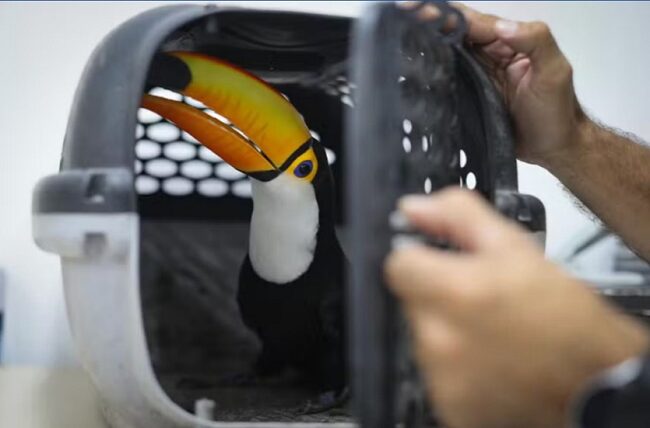
Nearly 30,000 live animals were seized during the operation. Photo credit: INTERPOL / WCO / Brazil Customs
Coordinated by INTERPOL and the World Customs Organisation (WCO), with the support of the International Consortium on Combating Wildlife Crime (ICCWC), the operation sought to intercept and seize illegally traded wildlife and forestry commodities across the global supply chain and identify, disrupt and dismantle criminal networks involved in these types of environmental crime.
While live animal seizures reached a record high this year – driven largely by demand for exotic pets – most wildlife trafficking involved animal remains, parts and derivatives, often used in traditional medicine or specialty foods. Estimates put the annual value of wildlife crime at $20 billion, but the clandestine nature of the trade suggests that the real figure is likely much higher.
From bushmeat to butterflies: Emerging threats in environmental crime
Operation Thunder 2025 revealed an escalating illicit trade of bushmeat, the term used for wild animal meat, especially from tropical regions. Belgian authorities intercepted primate meat, Kenyan officials seized over 400 kilogrammes of giraffe meat and Tanzanian law enforcement recovered zebra and antelope meat and skins valued at approximately $10,000. Globally, a record 5.8 tonnes of bushmeat was seized, with a notable increase in cases from Africa into Europe.
In 2025, enforcement actions also uncovered an increase in the trafficking of marine species, with more than 245 tonnes of protected marine wildlife seized worldwide, including 4,000 pieces of shark fins.
While iconic large mammals often dominate headlines in the fight against environmental crime, growing threats also include the trade of smaller species and plants.
For example, Operation Thunder 2025 revealed a sharp rise in the trafficking of exotic arthropods. Nearly 10,500 butterflies, spiders and insects — many protected under CITES – were seized around the world. Though tiny in size, these creatures play vital ecological roles. Their removal destabilizes food chains and introduces invasive species or diseases, posing serious biosecurity and public health risks.
The illegal plant trade also reached record levels in 2025, with over 10 tonnes of live plants and plant derivatives confiscated, driven by demand in horticultural and collector markets.
In 2025, illicit timber seizures continued to be significant, with more than 32,000 m3 and 14,000 pieces reported by countries. Illegal logging, which has a major economic, social and environmental impact, is estimated to account for 15-30 per cent of all timber traded globally.
Significant seizures around the world
South African authorities arrested 24 suspects and seized protected succulents, live pangolins and over 17,000 abalone (sea snails), as well as unlicensed firearms and ammunition.
A shipment from Asia intercepted at a North American mail centre contained over 1,300 primate body parts including bones skulls and other derivatives.
Indonesian authorities seized over 3,000 birds and 7,000 arthropods including, butterflies, spiders and centipedes.
Brazilian authorities dismantled a trafficking network, identified 145 suspects and rescued over 200 wild animals, including a crackdown on an international golden lion tamarin trafficking ring.
Tanzanian law enforcement and CITES authorities seized over 100 ivory tusks and pieces worth $415,000 and over 140 hippopotamus teeth worth $40,000.
Authorities in Qatar arrested an individual trying to sell an endangered primate for $14,000 on social media.
Mexican authorities seized seven animals in Sinaloa, including two tigers, along with firearm components frequently associated with organized crime activities.
More than 40 shipments of insects and 80 shipments of butterflies, originating in Germany, Slovakia and the UK, were intercepted at a US mail centre.
French customs seized 107 ivory pieces from marketplaces, while Austrian customs raided an online ivory dealer’s home and recovered six more pieces.
Vietnamese authorities arrested two individuals on a fishing vessel carrying 4.2 tonnes of pangolin scales and other reptile and bird parts.
In the Dominican Republic, authorities detained 90 individuals for crimes linked to illegal logging.
Germany intercepted over 1,000 illegal wildlife and forestry items including ivory, reptile parts, coral, plant derivatives and live specimens, primarily at mail centres and airports.
CITES Secretary General, Ivonne Higuero, said: “Parties are making tangible, measurable progress in tackling wildlife crime, as demonstrated by the results of Operation Thunder 2025. Their efforts highlight the power of collaboration, information-sharing, and the use of reliable data to guide enforcement action. With continued support from ICCWC, Parties are increasingly well equipped to counter the sophisticated criminal networks threatening wildlife. This collective approach will remain vital as we work together to stop wildlife crime worldwide.”
INTERPOL Secretary General, Valdecy Urquiza, said: “Operation Thunder once again exposes the sophistication and scale of the criminal networks driving the illegal wildlife and forestry trade – networks that increasingly intersect with all crime areas, from drug trafficking to human exploitation. These syndicates target vulnerable species, undermine the rule of law and endanger communities worldwide. Recognising these deeply interconnected crime threats, INTERPOL is committed to strengthening global policing responses, dismantling the entire ecosystem of illicit activity and protecting our planet’s shared natural and human heritage.”
WCO Secretary General, Ian Saunders, said: “Customs is the frontline defence against the surge in cross-border wildlife crime. Operation Thunder demonstrates Customs’ role in protecting society by intercepting illicit shipments, disrupting criminal networks, and protecting vulnerable species every day. This global threat demands collective action and the WCO is committed to delivering technical assistance, driving deeper intelligence exchange, and strengthening partnerships across the law-enforcement community to dismantle criminal enterprises and secure a sustainable future for the world’s biodiversity.”
Building a lasting defence against illicit trade
Months of preparation for Operation Thunder 2025 centred on the exchange of information, the sharing of actionable intelligence and the coordination of cross-border investigations among participating countries and regions, INTERPOL and the WCO. INTERPOL also issued 69 Notices during the tactical phase (11 Red, 11 Purple and 47 Blue) to support the identification, tracking and arrest of potential suspects identified in preliminary investigations.
A critical component of this operation was efficient cross-border collaboration between law enforcement and financial platforms to trace illicit financial flows. As these criminal activities become increasingly tied to cryptocurrency, the inherent opacity of digital assets demands sustained intelligence-sharing to enable successful prosecutions.
Beyond the immediate arrests and seizures, the intelligence gathered during Operation Thunder will help map global criminal networks. These insights will enable law enforcement agencies worldwide to refine their strategies, anticipate emerging criminal tactics and disrupt illicit supply chain activity, ensuring a sustained and effective response to transnational wildlife crime.
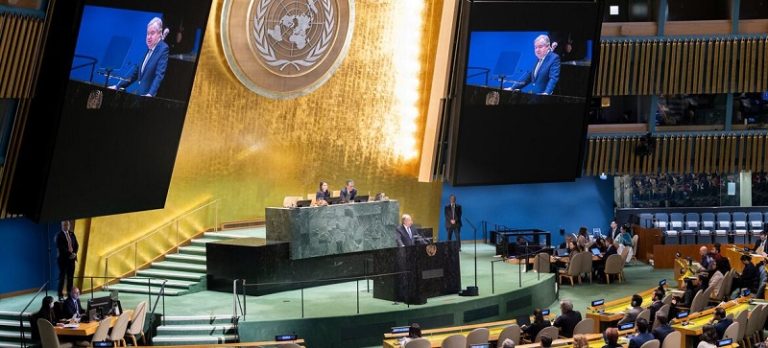
Speaking in the General Assembly on Thursday, January 15, on his priorities for 2026, UN Secretary-General, António Guterres, said the global system was under unprecedented strain from wars, division, climate breakdown and the erosion of respect for international law.
He framed the speech as both a diagnosis of the current global disorder and a personal commitment to press for change during his final year in office.
Rather than presenting a checklist of initiatives, he said he wanted to look beyond the coming year and focus on the “larger forces and megatrends shaping our world,” identifying three principles that must guide the work of the United Nations and its Member States.
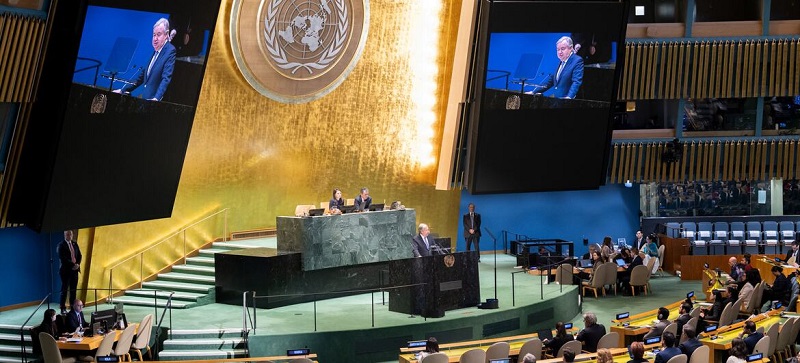
UN Secretary-General António Guterres (at podium) outlines his priorities for 2026 in the General Assembly Hall. Photo credit: UN Photo/Manuel Elías
At a time when geopolitical divisions are widening amid cuts to development and humanitarian funding, Mr. Guterres said multilateralism itself was being tested.
“That is the paradox of our era: at a time when we need international cooperation the most, we seem to be the least inclined to use it and invest in it,” he said, adding: “Some seek to put international cooperation on deathwatch. I can assure you: we will not give up.”
Peace is more than the absence of war
The UN chief highlighted ongoing UN engagement on conflicts from Gaza and Ukraine to Sudan and Yemen, while stressing that silencing the guns alone would not be enough.
“Peace is more than the absence of war,” he said, arguing that poverty, lack of development, inequality and weak institutions continue to fuel violence. “Sustainable peace requires sustainable development.”
Mr. Guterres was blunt about what he described as the visible erosion of international law. “The erosion of international law is not happening in the shadows. It is unfolding before the eyes of the world, on our screens, live in 4K,” he said.
He pointed to attacks on civilians and humanitarian workers, unconstitutional changes of government, silencing of dissent, trampling of human rights, and plundering of resources.
He also raised alarm about the growing concentration of wealth and power, noting that the richest one per cent now hold 43 per cent of global financial assets. “This level of concentration is morally indefensible,” he said.
Keep control of technology
Mr. Guterres also highlighted the challenges of emerging technologies, particularly artificial intelligence, cautioning that algorithms shaping public life must not be controlled by just a handful of companies. “We must ensure humanity steers technology, not the other way around,” he said.
Turning to climate change, the Secretary-General warned that a world in climate chaos “cannot be a world at peace,” stressing that while a temporary overshoot of the 1.5°C temperature threshold was now inevitable, it was not irreversible.
He urged faster emissions cuts, a just transition away from fossil fuels and scaled-up climate finance.
Mr. Guterres also underscored the need for reform of global institutions, including international financial bodies and the Security Council, arguing that “1945 problem-solving will not solve 2026 problems.”
Structures that fail to reflect today’s world, he warned, would lose legitimacy.
A personal note
In his address, the Secretary-General also struck a personal note, reminding delegates that this would be his last annual priorities address.
“Let me assure you that I will make every day of 2026 count,” he said. “I am fully committed and fully determined to keep working, to keep fighting, and to keep pushing for the better world that we know is possible.”
As climate impacts intensify across continents; manifesting in deadly heatwaves, prolonged droughts, flooding and food insecurity, the global community continues to search for pathways that balance ambition with implementation.
It was against this backdrop that the 30th Conference of the Parties (COP30) to the United Nations Framework Convention on Climate Change (UNFCCC) convened in Belém, Brazil, from Nov. 10 to Nov. 21, 2025.
The summit was designed to accelerate climate action and advance delivery on the Paris Agreement, the landmark international accord aimed at limiting global temperature rise to well below 2°C above pre-industrial levels, while pursuing efforts to cap warming at 1.5°C.
COP30
Under the agreement, countries submit Nationally Determined Contributions (NDCs) outlining how they plan to reduce greenhouse gas emissions and adapt to climate impacts.
With global emissions still off track; inspite recent slowdowns in growth, COP30 was widely viewed as a critical moment to bridge the widening gap between commitments and action.
At the close of the conference, parties agreed to significantly scale up climate finance for developing countries.
This included a commitment to triple support for mitigation and adaptation efforts, an outcome seen as pivotal for climate-vulnerable nations.
Speaking at the opening of COP30, the Executive Secretary of UN Climate Change, Mr. Simon Stiell, urged countries to deepen cooperation on emissions reduction and resilience-building, warning that delays would come at enormous economic and social costs.
According to him, accelerated emissions cuts and strengthened resilience are essential to restoring the 1.5°C target, even if global temperatures temporarily overshoot.
Stiell noted that a decade after the Paris Agreement was adopted, there were early signs of progress, with emissions growth beginning to slow as governments legislate and markets respond.
However, he stressed that current efforts remain insufficient.
“The science is clear: we can, and must, bring temperatures back down to 1.5°C. Lamenting is not a strategy, we need solutions,” he said.
Drawing inspiration from Belém’s location at the mouth of the Amazon River, Stiell likened effective climate action to a vast river system powered by many tributaries.
“To accelerate implementation, the COP process must be supported by many streams of international cooperation. Individual national commitments alone are not cutting emissions fast enough,” he added.
He warned that climate-related disasters are already shaving double-digit percentages off national GDPs in some regions, with droughts damaging harvests, driving food inflation and deepening poverty.
Economically, he argued, the case for transition is indisputable.
Renewable energy sources such as solar and wind have become the cheapest form of electricity in about 90 per cent of the world, while clean energy investments are projected to reach record highs by the end of 2025, outpacing fossil fuel investments by roughly two to one.
Against this background, Stiell said COP30 would focus on operationalising agreements to triple renewable energy capacity, double energy efficiency, and deliver at least 300 billion dollars in climate finance, with developed countries taking the lead.
Meanwhile, Nigeria reaffirmed its commitment to climate action, positioning itself as a key player in Africa’s green transition.
The Director-General of the National Council on Climate Change (NCCC), Mrs Tenioye Majekodunmi, said on the sidelines of COP30 that the country would intensify efforts to advance a green economy anchored on renewable energy, sustainable agriculture and improved waste management.
According to her, Nigeria’s climate commitment is backed by a national target to reduce emissions by 32 per cent by 2035.
“We have submitted our Third Nationally Determined Contribution; the first in West Africa approved the National Carbon Market Framework, and operationalised the Climate Change Fund,” she said.
Majekodunmi explained that the Federal Government would continue to support private-sector-led off-grid energy solutions, especially for hard-to-reach and underserved communities, in line with Nigeria’s Just Transition Guidelines and Action Plan.
“These measures will help decarbonise energy production while keeping Nigeria aligned with the Paris Agreement,” she added.
She further highlighted wind energy as an emerging pillar of Nigeria’s energy mix, urging stakeholders to translate potential into practical, large-scale deployment.
Prof. Magnus Onuoha, Executive Director of the West Africa Green Economic Development Institute (WAGEDI), said Nigeria’s growing policy architecture provides a strong foundation for scaling wind energy.
He recalled that the Electric Power Sector Reform Act of 2005 opened the door to private sector participation in power generation, while Nigeria’s ratification of the Paris Agreement in 2016 reinforced its commitment to low-carbon development.
According to him, domestic policies such as the Renewable Energy Master Plan (REMP) and the Climate Change Act of 2021 further accelerated renewable energy adoption.
He noted that the REMP targets renewable energy shares of 23 per cent by 2025 and 36 per cent by 2030, with wind energy identified as a strategic component.
Onuoha added that Nigeria’s Energy Transition Plan (2022) and the Nigerian Electricity Act (2023) marked important milestones, especially for off-grid electrification in northern and coastal regions.
“These frameworks provide a roadmap for attracting international support and financing, including partnerships with institutions such as the African Development Bank,” he said.
At the close of COP30, the Executive Director of the United Nations Environment Programme (UNEP), Mrs. Inger Andersen, said the newly launched Tropical Forest Forever Facility (TFFF), now valued at $6.7 billion, would support high-impact actions such as cutting methane emissions and protecting forests.
She noted that the conference recorded unprecedented participation by Indigenous Peoples and non-state actors, reinforcing global momentum beyond negotiation halls.
According to Andersen, COP30 demonstrated that the Paris Agreement is delivering results, including renewed calls to triple adaptation finance by 2035 and advance just transition mechanisms to ensure inclusive growth.
“Keeping 1.5°C within reach requires an unprecedented acceleration of implementation,” she said, adding that countries must treat their national climate plans as a baseline, not a ceiling.
As COP30 ends, attention is now shifting from pledges to performance.
The outcomes from Belém have set new benchmarks for finance, energy transition and forest protection.
However, whether these commitments translate into measurable action will determine the credibility of the global climate response.
The second half of 2025 marked a significant milestone for global climate transparency, as UN Climate Change completed 18 technical expert reviews of Biennial Transparency Reports (BTRs) under the Paris Agreement’s Enhanced Transparency Framework (ETF).
This brings the total to 50 reviews completed during the 2024–2025 biennium, engaging over 300 technical experts worldwide. This achievement reflects the accelerated operationalisation of the ETF and its role in enhancing transparency, trust and confidence under the Paris Agreement. Through these reviews, Parties received targeted feedback that supports continuous improvement in reporting.
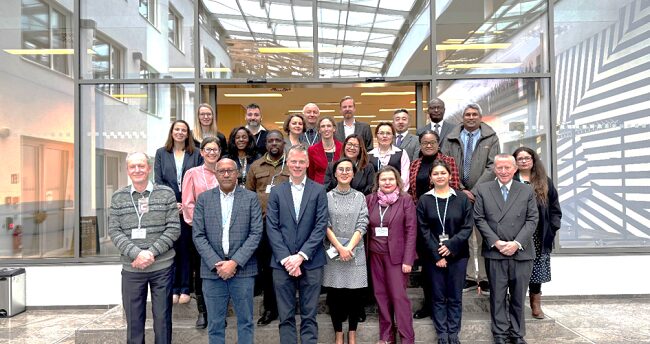
A Country Review in 2025
Beyond assessing greenhouse gas inventories and progress towards nationally determined contributions (NDCs), the BTR review process serves as a facilitative, trust-building mechanism. Reviews help identify areas for improvement and capacity-building needs, strengthen national transparency systems, and reinforce confidence in the robustness of climate data and information.
Reflecting on the milestone, Xuehong Wang, Director of Transparency at UN Climate Change, said: “The completion of 50 reviews demonstrates that the Enhanced Transparency Framework is moving into full implementation. These reviews provide Parties with practical, country-specific feedback that strengthens reporting systems, supports better policy decisions, and builds trust at the heart of the Paris Agreement.”
Among the completed reviews, seven included voluntary reviews of information on climate change impacts and adaptation, while 10 involved technical analyses of results from activities to reduce emissions from deforestation and forest degradation (REDD+), submitted on a voluntary basis in the context of results-based payments.
Support from Parties and partners during the 2024–2025 biennium played an important role in enabling the technical expert reviews, through the provision of supplementary financial resources. Their intention of continued support to technical expert reviews in the 2026-2027 biennium reflects ongoing commitment to strengthening transparency under the Paris Agreement.
Looking ahead, transparency efforts are set to scale up further. Over 30 BTR reviews are already scheduled for the first half of 2026, and lessons learned from the first 50 reviews will be used to refine review practices and enhance efficiency, while upholding the ETF’s principles of being facilitative, non-intrusive and respectful of national sovereignty.
To share experiences and lessons from the first cycle of technical expert reviews under the ETF, the UNFCCC secretariat will host a webinar on Wednesday, January 28, 2026, about the progress of ETF implementation under the Paris Agreement.
Additional insights are available in the Annual Report on Technical Expert Reviews, released at COP30, and in the latest BTR review newsletter.
As the ETF continues to mature, these 50 reviews represent concrete steps toward stronger transparency, improved climate action, and a more coherent global response to climate change.
See the detailed list of reviews conducted in 2024 and 2025 here.