Home Blog Page 34

NIMASA backs national maritime decarbonisation plan

0

The Nigerian Maritime Administration and Safety Agency (NIMASA) has pledged regulatory leadership and technical coordination to deliver a robust national maritime decarbonisation action plan.

The commitment was conveyed on Thursday, February 26, 2026, in Lagos during a national workshop on the IMO GreenVoyage2050 Project programme.

Director-General, Dr Dayo Mobereola, described the workshop as a critical step towards achieving the Federal Government’s blue economy and climate objectives.
NIMASA
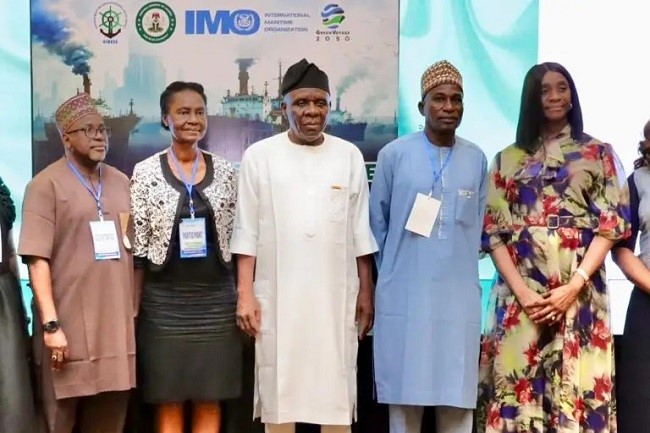
L-R: Kabiru Bello, Deputy Director, Marine Environment Management, MEM, Nigerian Maritime Administration and Safety Agency, NIMASA; Mrs Oritsematosan Edodo Emore, Nigeria Treasurer, Anglophone, Women in Maritime Organization of West and Central Africa, WIMOWCA; Mr Fatai Taiye Adeyemi Executive Director Operations, NIMASA; Dr John Ogwuche, representative of Minister of Marine and Blue Economy; and Dr Oma Offodile, Director, MEM, during the National Workshop on IMO GreenVoyage2050 programme in Lagos on Thursday

Mobereola, represented by Executive Director, Operations, Mr. Fatai Adeyemi, underscored the project’s importance in supporting developing countries to implement the IMO greenhouse gas strategy.

He said the emerging national action plan would reflect national realities, leverage existing capacity, address gaps and align with broader economic and environmental priorities.

“The transition is not merely about compliance with international obligations. It is about safeguarding the marine environment and national interest,” Mobereola said.

He added that the shift would protect public health, strengthen the blue economy and ensure Nigeria’s maritime industry remains competitive and future-ready.

Also speaking, Mrs. Astrid Dispert, Technical Manager of the IMO GreenVoyage2050 Project, stressed the initiative’s goal of advancing a coherent, globally aligned regulatory framework.

She emphasised NIMASA’s pivotal role in driving the project nationally and coordinating stakeholders toward effective maritime decarbonisation.

“The IMO GreenVoyage2050 Project provides technical expertise and institutional support to help countries develop and implement national action plans promoting sustainable shipping and clean technologies.

“Through this collaboration, the Federal Government is taking deliberate steps towards maritime decarbonisation and reinforcing its commitment to global climate goals,” she said.

By Aisha Cole

Benue inaugurates 90MW waste-to-energy project

0

The Benue State Government on Friday, February 27, 2026, flagged off a 90-megawatt waste-to-energy project aimed at generating electricity.

Performing the ceremony at Atumba Village, Guma Local Government Area of the state, Gov. Hyacinth Alia said the project would convert municipal and industrial solid waste into power and valuable by-products.

Alia said the facility would transform waste streams into electricity, alternative fuels, bio-fertiliser, methane-based products, and recyclable materials.

Hyacinth Alia
Gov. Hyacinth Alia of Benue State

Represented by his deputy, Dr Sam Ode, Alia said the project was capable of delivering long-term environmental, industrial, and energy transformation for Benue.

He said the project would provide employment for over 6,000 people, bring international expertise and technical innovation to the state’s infrastructure development.

Alia said it would also improve energy reliability, reduce power deficits, stimulate investment in energy-dependent sectors, and improve public health outcomes.

He urged the host community and all Benue indigenes to take ownership of the project.

He said the project represents a modern, technology-driven solution to waste management challenges, while simultaneously strengthening the state’s energy infrastructure.

The project is structured as a partnership between Sectorlead Ltd. and Benue State Government, to directly support public-private partnership (PPP) development.

By Emmanuel Antswen

Denmark emerges first EU country to eliminate mother-to-child transmission of HIV, syphilis

0

The World Health Organisation (WHO) has certified Denmark for the elimination of mother-to-child transmission (EMTCT) of HIV and syphilis, recognising the country’s sustained commitment to ensuring every child is born free of these infections.

“The elimination of mother-to-child transmission of HIV and syphilis marks a major public health achievement for Denmark,” said Dr Tedros Adhanom Ghebreyesus, WHO Director-General. “This milestone demonstrates that with strong political commitment and consistent investment in primary care and integrated maternal and child health services, countries can protect every pregnant woman and newborn from these diseases.”

Sophie Løhde
Sophie Løhde, Minister for the Interior and Health, Denmark

The validation, based on an assessment by WHO’s Regional Validation Committee in June 2025 and Global Validation Advisory Committee (GVAC) in August 2025, confirms that Denmark met all required targets from 2021 to 2024, including low transmission rates and high coverage of prenatal testing and treatment for pregnant women.

“As the first European Union country to achieve this public health milestone, Denmark’s success is a testament to the strength of its maternal health system and its long-standing commitment to reaching every pregnant woman with the care she needs,” said Dr Hans Henri P. Kluge, WHO Regional Director for Europe.

“Elimination means testing and treating at least 95 out of every 100 pregnant women – and keeping new infant infections below 50 per 100 000 births, year after year. Denmark has met these benchmarks through strong antenatal care, reliable data systems and respect for women’s rights. We will support Denmark as it works toward full triple elimination, when it adds hepatitis B,” added Kluge. 

Reaching this milestone reflects decades of sustained commitment by clinical and public health professionals, underpinned by strong health systems and universal health coverage including integrated screening during pregnancy. Denmark’s exemplary data systems, robust laboratory capacity, and high human rights standards have been essential to this success.  

“This validation by WHO is a proud moment for Denmark and the result of decades of work by our health-care professionals, midwives, and public health teams to ensure that every pregnant woman receives the screening and care she needs,” said Sophie Løhde, Minister for the Interior and Health, Denmark.

“Denmark’s universal health system – built on equal access for all – has been the foundation of this achievement. Being the first country in the European Union to reach this milestone is both an honour and a responsibility. We hope our experience can inspire and support other countries on their path to elimination, and we look forward to completing the journey with the addition of hepatitis B to achieve full triple elimination,” added Løhde.

Denmark’s experience demonstrates what is possible when rights‑based policies, high‑quality services, and strong data systems come together, providing a powerful model and motivator for other countries seeking to strengthen their EMTCT programmes. The country is also on track towards validating hepatitis B virus elimination. WHO is working with Denmark in advancing the triple elimination validation process.

Denmark joins 22 other countries and territories validated by WHO for the elimination of mother-to-child transmission of HIV, syphilis or hepatitis B virus, or certified on the path to elimination, along with Anguilla, Antigua and Barbuda, Armenia, Belarus, Belize, Bermuda, Brazil, Botswana, Cayman Islands, Cuba, Dominica, Jamaica, Malaysia, Maldives, Montserrat, Namibia, Oman, Republic of Moldova, Saint Vincent and the Grenadines, Sri Lanka, St. Kitts and Nevis, and Thailand.

Banks accused of ‘back-door’ funding for EACOP via €1.5bn TotalEnergies bond

0

The StopEACOP coalition has expressed concern over the issuance of a €1.5 billion bond for TotalEnergies by banks that had publicly distanced themselves from the controversial East African Crude Oil Pipeline (EACOP). The EACOP project has faced significant delays due to public pressure from coalition supporters and members who have highlighted the risks the project poses to financial institutions.

According to StopEACOP, all the banks that have participated in the issuance of the bond are among the more than 40 global banks that refused to finance the controversial project.

TotalEnergies
TotalEnergies

Société Générale publicly distanced itself from EACOP in 2021 while HSBC, Intesa Sanpaolo, J.P. Morgan, and Mizuho made the announcement in 2022. BBVA made the announcement late last year (2025). Consequently, TotalEnergies and other project backers have struggled to raise funds and have been forced to look internally, as reported in the latest risk brief from BankTrack. The new €1.5 billion bond, therefore, provides them with internal funds to complete the project.

“These banks want the PR benefit of saying that they won’t finance EACOP while quietly keeping TotalEnergies liquid through bond purchases. That’s effectively back-door pipeline funding dressed up in sustainability language. Finance capital is doing what it always does by protecting returns first, then hiring glossy reports to wash the oil and blood from the balance sheet,” said  StopEACOP Campaign Coordinator, Zaki Mamdoo.

He added that bonds are the most straightforward way for TotalEnergies to self-finance the project because they come with no strings attached and can be diverted to any projects that banks would not publicly support or associate with, including EACOP or the other highly controversial Mozambique LNG project, for which TotalEnergies is facing allegations of complicity in war crimes, torture, and enforced disappearances.

“The coalition cannot understand how these banks justify their involvement in issuing these bonds to TotalEnergies when they are aware that these funds could be diverted to projects they have publicly stated they do not support, citing reasons ranging from ‘extreme risks to communities’ along the pipeline route to ‘unacceptable risks’ to critical natural habitats, with a specific focus on human rights and climate impact?” Mamdoo stated.

“When Total makes internal loans available to EACOP Ltd., the money raised through these bonds becomes part of the machinery pushing this project forward. Communities lose land and livelihoods, repression deepens, ecosystems are put at risk, and the climate crisis accelerates, but bankers still collect their fees and coupons like it’s just another investment opportunity,” said Rachael Tugume, one of the EACOP project-affected-people from Hoima.

StopEACOP added: “As TotalEnergies, CNOOC, and host governments discuss plans for first oil by July 2026 – though this target is unlikely to be met – the impacts of the EACOP project are no longer hypothetical. Cases of human rights violations continue unabated. At the beginning of last year (2025), we witnessed the weaponisation of the Ugandan judiciary to suppress opposition to the project, as activists were denied bail and kept in jail for months.

“This began with the 11 activists arrested for protesting KCB Bank Uganda’s involvement in EACOP, who spent three months in jail, and now eight other activists associated with a student climate movement are still in jail for nearly seven months after protesting Stanbic Bank Uganda’s involvement in the EACOP project.

“Meanwhile, project-affected individuals with land grievances cannot find justice in court as their files go missing while the government forcibly evicts them.”

Diana Nabiruma of Africa Institute for Energy Governance (AFIEGO) said: “It is time banks walked the talk. They profess values such as respect for human rights, support for biodiversity conservation and being climate leaders among others. Despite this, they provide support to companies that do not espouse those values.  They support companies that cause grievous harm to people and nature. This must stop!”  

The coalition therefore condemns these banks for their actions that enable the controversial pipeline.

“They must recognise that, for every billion they help TotalEnergies raise, they greenlight ongoing harm and must bear equal responsibility for the risks EACOP poses to the people, climate, and environment.

“TotalEnergies’ ability to raise €1.5 billion with the assistance of banks that had opposed its fossil fuel expansion projects creates a crisis of public confidence in the banking sector and its commitment to climate policies and ESG standards. If banks truly oppose EACOP, they should not just refuse the headline project finance while continuing to fund the company building it. They must stop propping up TotalEnergies altogether. Anything less is hypocrisy in pursuit of quick profits that will haunt the whole world,” added the coalition.

ACB demands national ban as glyphosate found in South Africa’s staple foods

0

Through a formal, comprehensive, and urgent submission, the African Centre for Biodiversity (ACB) requests the Minister of Agriculture to deregister and ban glyphosate in South Africa, following new South African National Accreditation System (SANAS)-certified laboratory results showing glyphosate contamination in maize meal, wheat flour, bread, and baby cereal, with two products exceeding the legal default limit.

The ACB has also produced, for ease of reference, a briefing paper that unpacks the independent SANAS-certified laboratory results confirming that glyphosate and its toxic metabolite, aminomethylphosphonic acid (AMPA), are present in staple foods consumed daily by millions of South Africans, forming a core evidentiary component of the submission to the Minister.

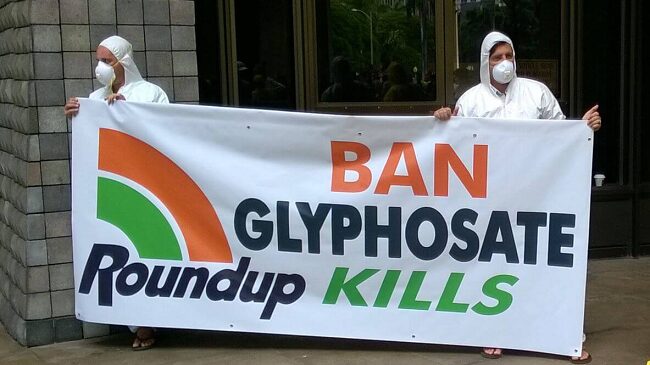
Glyphosate
Campaign against glyphosate

The submission cites the following core grounds:

  1. New South African laboratory evidence confirms dietary exposure through staple and baby foods.
  2. Major new international science, including the 2025 Global Glyphosate Study, shows carcinogenic effects at supposedly “safe” doses. The study shows statistically significant increases in tumours at levels regulators still claim are safe.
  3. The historically-relied-upon Williams, Kroes, & Munro (2000) industry-aligned paper defending glyphosate’s safety has formally been retracted on grounds of ghost-writing and undisclosed conflicts. The study has been used extensively by regulators to justify glyphosate’s safety, and its removal vitiates a cornerstone of global regulatory reliance.
  4. More than 192,000 lawsuits have been filed in the US, with US$6 billion in jury awards and over US$10–11 billion in settlements already paid. In February 2026, Bayer agreed to a US$7.25 billion national settlement to resolve current and future claims. This global legal fallout confirms that glyphosate-linked harms are being recognised and compensated in courts – and can no longer be dismissed as speculative.
  5. Legal duties under the Constitution, the National Environmental Management Act (NEMA), and the Fertilizers, Farm Feeds, Agricultural Remedies and Stock Remedies Act 36 of 1947 (Act 36 of 1947) require action in the face of serious or irreversible harm.

ACB’s test results: glyphosate is in the foods South Africans eat daily

Independent SANAS-certified LC-MS/MS laboratory testing found:

  • Impala Special Maize Meal: Glyphosate and AMPA (AMPA exceeded the default maximum residue limit (MRL))
  • Snowflake Wheat Flour: Glyphosate exceeded the default MRL
  • Sasko Premium White Bread: Trace glyphosate and AMPA
  • Cerelac baby cereal: Trace glyphosate

Glyphosate use on genetically modified (GM) herbicide-tolerant maize and within wheat production systems is resulting in residues that persist into final food products. Glyphosate and AMPA carry growing health concerns, with evidence linking them to cancer risks, endocrine disruption, and gut microbiome damage. AMPA is particularly worrying because it is highly persistent and has its own toxicological profile.

Their detection in everyday foods – including maize meal, bread, and baby cereal – means South Africans face continuous, involuntary exposure, including among infants and vulnerable households. Additionally, glyphosate use has been associated with a reduced nutritional profile of crops, further compounding the health burden on already stressed and vulnerable populations.

Zakiyya Ismail, ACB research coordinator, Pesticides, said: “The detection of glyphosate in Cerelac baby cereal is one of the most alarming findings. Infants are physiologically more vulnerable. The presence of glyphosate in baby cereal is unacceptable, unconscionable, and incompatible with South Africa’s Constitutional protections for children.”

ACB’s briefing explains that the AMPA exceedance in maize meal and the glyphosate exceedance in wheat flour highlight serious regulatory blind spots, where key residues are neither properly monitored nor effectively controlled. The briefing further emphasises that MRLs are not health-based safety standards. Rather, they are administrative thresholds designed to monitor compliance and facilitate trade, not to evaluate the real-world health risks associated with long-term dietary exposure.

As a result, MRLs fail to consider cumulative, chronic exposure, the combined effects of multiple residues, and the heightened vulnerability of infants and children, whose developing bodies are more susceptible to toxicants.

Mariam Mayet, Executive Director of the ACB, comments: “Our submission presents new test evidence, new global carcinogenicity findings, the collapse of the industry-funded safety narrative following the retraction of the 2000 Monsanto-linked paper, and massive global litigation, all of which make continued authorisation of glyphosate untenable. The government can no longer claim ignorance. The case for a ban is overwhelming.”

ACB calls for immediate government action

According to the group, South Africans deserve clean, safe, nourishing food – not chemical residues. “This is an opportunity for the Minister to act decisively to protect public health. Glyphosate must go!” it submitted.

In its submission to the Minister, the ACB demands:

  • Deregistration and prohibition of glyphosate under Act 36 of 1947.
  • Immediate restrictions on high-exposure uses (pre-harvest desiccation; public spaces).
  • Public advisories, specifically regarding baby foods.
  • A precautionary review of glyphosate-tolerant GM crop approvals to date.
  • A ban on future herbicide-tolerant GM crops.
  • A national phase-out plan with support for agroecological alternatives.

UK deepens partnership with Bayelsa on security, youth resilience, women’s empowerment

0

The British Deputy High Commissioner in Abuja, Mrs. Gill Lever OBE, has concluded a three-day working visit to Bayelsa State, strengthening UK–Bayelsa collaboration on community security, governance, youth development, and women’s political empowerment.

The visit formed part of the UK-funded Serious and Organised Crime (SOC) Prevent Programme, known locally as the Brighter Futures Programme, which supports at-risk young people with skills development, mentoring and resilience-building to prevent recruitment into criminal networks.

The programme, which has achieved an 80% successful diversion rate, is concluding its current phase in March 2026, with full ownership transitioning to the Bayelsa State Government, a testament to the strong local leadership and commitment that has defined the partnership from the outset.

British High Commission
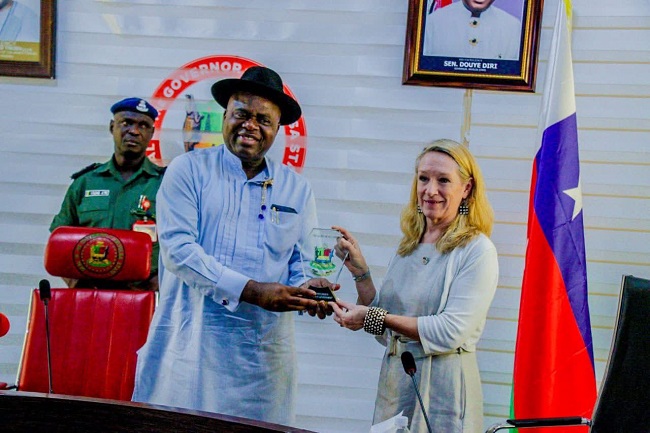
British Deputy High Commissioner in Abuja with Gill Lever OBE and Govenor of Bayelsa Sen. Douye Diri

During the visit, Mrs. Lever met with Governor Douye Diri to review progress on the programme and mark its successful conclusion. In recognition of his outstanding leadership and sustained commitment to youth protection, the UK formally acknowledged Governor Diri as a Prevent Ambassador. The meeting also explored opportunities to sustain and expand the programme’s impact across additional local government areas and vulnerable communities, ensuring the gains achieved are built upon long into the future.

The delegation also engaged with Dr Gloria Diri, the First Lady of Bayelsa State, focusing on advancing women’s political empowerment, strengthening leadership pipelines and expanding support to women and girls across the state.

A key highlight of the visit was an interactive session with civil society organisations representing political, social and media interests. These included the Pan Niger Delta Forum (PANDEF), Bayelsa Non-Governmental Organisations Forum (BANGOF), Nigeria Union of Journalists (NUJ), Civil Liberties Organisation (CLO), Fringe Voices, and the International Federation of Women Lawyers (FIDA) Nigeria. These organisations provided valuable insights on governance, civic participation, youth vulnerability and security trends, reinforcing their long-standing role in promoting peace, accountability and inclusion in Bayelsa.

The Deputy High Commissioner also paid a courtesy call on the Chairman of the Bayelsa State Council of Traditional Rulers, His Royal Majesty King Bubaraye Dakolo (Agada IV), Ibenanaowei of Ekpetiama Kingdom, discussing traditional leadership’s vital role in sustaining peace, community cohesion and support for positive youth development.

At a community town hall in Amarata, the delegation was welcomed by the SOC Prevent programme beneficiaries and stakeholders, celebrating how UK support has helped young people in Amarata and Amassoma gain marketable skills and build brighter futures away from organised crime.

The visit also took place against the backdrop of a landmark moment in UK-Nigeria relations. President Bola Tinubu is set to make a historic state visit to the United Kingdom from March 18 to 19, 2026, the first by a Nigerian leader in 37 years, hosted by His Majesty King Charles III and Her Majesty Queen Camilla at Windsor Castle.

The visit underscores the depth and ambition of the UK-Nigeria Strategic Partnership and the UK-Nigeria Enhanced Trade and Investment Partnership (ETIP), which together reflect both countries’ commitment to driving sustainable growth, creating opportunities, and building a future of shared prosperity.

Speaking at the conclusion of the visit, the Deputy High Commissioner said: “Bayelsa continues to demonstrate strong leadership in protecting young people, promoting good governance and strengthening community resilience. The Brighter Futures Programme has made a real and lasting difference to the lives of young people here, and I am proud that its legacy will now be carried forward by the Bayelsa State Government. Our partnerships here remain essential to building safer, more inclusive and more prosperous communities.”

The UK says it remains committed to advancing long-term stability, women’s empowerment and community-driven development in Bayelsa through partnerships with government, traditional institutions, civil society and community groups.

Over 127,000 pairs of glasses distributed as VCDF, SEEPCO launch free eye care services in Delta

0

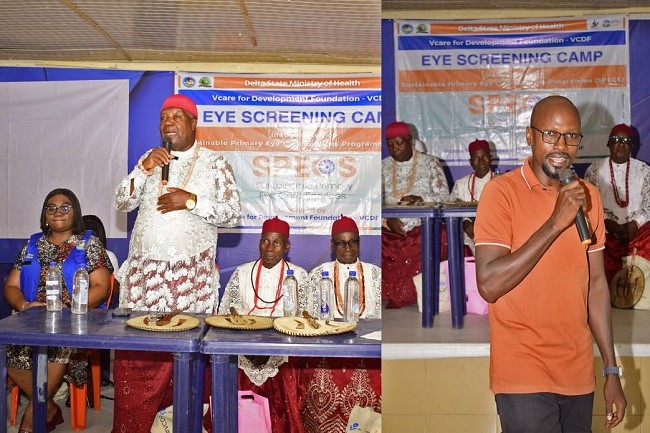
In a major boost to community healthcare delivery, Vcare for Development Foundation (VCDF) in partnership with the Delta State Ministry of Health has rolled out free comprehensive eye care services to residents of Ndokwa West Local Government Area of Delta State under the Sustainable Primary Eye Care Services Programme (SPECS). SPECS is supported by Sterling Oil Exploration and Energy Production Company Limited (SEEPCO).

The two-day flag-off ceremony commenced in Ashaka and concluded in Umusadege, Kwale. It was attended by stakeholders from the state, local government authorities, and host communities. The outreach attracted large participation from both young and elderly residents seeking eye screenings, treatment, and surgical care services.

SEEPCO
Representatives of Delta State Ministry of Health and Ndokwa West Local Government at the launch of the SPECS eye care programme

Representing the Delta State Commissioner for Health during the launch, the Programme Manager of the State Eye Health Programme, Dr. Gloria Mok, described SPECS as a significant intervention aimed at improving access to quality eye health services, particularly for indigent populations.

According to her, the collaboration will expand access to essential services including free cataract surgeries, eye screenings, medications, and corrective reading glasses for residents across the state.

She explained that the Sustainable Primary Eye Care Services Programme (SPECS), approved for implementation in 2025, is structured to integrate high-quality primary eye care into existing Primary Health Care (PHC) facilities statewide.

Dr. Mok further revealed that the initiative will strengthen the State Eye Health Programme and broaden the reach of the ongoing Jigibola Campaign across 75 Primary Health Care centres in the 25 Local Government Areas of Delta State.

Providing impact statistics, she disclosed that over 127,000 pairs of glasses have been distributed so far, while more than 230 healthcare workers have received training in primary eye care services. She expressed confidence that the programme would be expanded to other LGAs to ensure equitable access to quality eye care services for all citizens.

Also speaking, the Ophthalmologist for the SPECS Programme, Dr. Ernest Ogbedo, emphasised that the initiative was designed to eliminate barriers preventing rural dwellers from accessing essential eye care by bringing treatment directly to their communities.

Dr. Ogbedo noted that the programme is not a one-off medical outreach, but a sustainable intervention embedded within the primary healthcare system, with support from SEEPCO as part of its corporate social responsibility commitment to host communities.

On behalf of the beneficiaries, Mr. Prince Nwanze expressed appreciation to VCDF and SEEPCO, describing the intervention as timely and impactful, significantly easing the financial burden associated with eye treatment. VCDF, with consistent support from SEEPCO, has implemented similar eye care interventions in other states across Nigeria, reaffirming its commitment to delivering accessible, high-quality, and sustainable eye health services nationwide.

Energy advocates seek evidence-based approach to Nigeria’s transition ambition

0

Energy and green economic specialists have called on Nigeria’s federal government to adopt a more pragmatic strategy in its pursuit of a low-carbon economy.

They claim that this is significant because many of the existing laws and policies, such as the Nationally Determined Contributions (NDCs), intended to guide the country’s transition process, lack a scientific foundation regarding the political, economic, and sociocultural implications of decarbonising the nation’s oil sector.

Speaking at a stakeholder workshop in Abuja on Tuesday, February 24, 2026, organised by the Society for Prosperity and Planet (SPP) and its partners, they said that any real transition would undoubtedly have far-reaching effects on jobs, welfare, economic growth, government revenue, and political stability because of the country’s historical reliance on fossil fuels for more than 50% of its exports and public revenue.

SPP
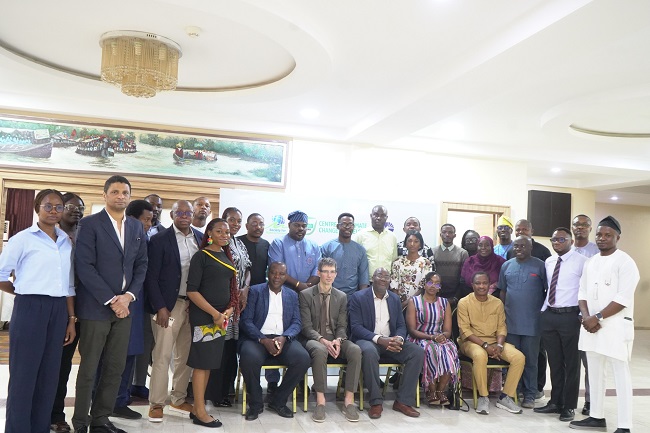
Participants at a workshop hosted by the Society for Prosperity and Planet (SPP) and its partners in Abuja to support Nigeria’s transition to a low-carbon economy

Although Nigeria has proposed using gas to address its transition issues through a phased-down plan of action, these experts, however, have expressed serious concerns about the net-zero-by-2060 pledge and the global and national climate imperatives. They contend that it calls into question whether gas can actually serve as a transition fuel, the timing and pace of a phase-down, and the macroeconomic consequences of alternative pathways.

According to SPP President, Prof. Chukwumerije Okereke, the need to find answers to this problem inspired his organisation and its partners to do research that carefully considers the environmental and economic effects of alternative pathways to using gas as a transition source of energy.

Therefore, the objective of the workshop, he elaborated, is to create a structured, inclusive, and intellectually rigorous space for key stakeholders to engage with the preliminary findings of the research programme. It is also intended to be a moment of collective sense-making rather than a presentation of final conclusions, to test assumptions, scrutinise new evidence, stress-test modelling scenarios, and reveal political, economic, and social insights that might not be visible from technical analysis alone.

“This is to ensure that the resulting outputs are analytically robust, politically grounded, and practically useful for informing Nigeria’s just transition pathways,” Prof. Okereke told the participants at the event.

In a similar vein, SPP researcher Mr. Uche Nnamani believes that evidence-based policies are still essential to ensuring that Nigeria’s transition to a low-carbon economy is in line with the nation’s growth since they offer useful information to direct stakeholders, investors, and policymakers.

“When we model things, we are not necessarily predicting the future; it’s to equip those who are making these decisions with the right information for them to know the direction they are taking,” he said.

Dr. Timothy Kelsall, a senior research fellow at ODI Global UK, asserts that data-backed research will help Nigeria create green jobs and enhance their understanding of how the government is spending the money saved from the removal of fuel subsidy.

According to him, such studies will also enable the country to determine which course to take in its energy transition strategy, whether gas, renewable, or otherwise, to ensure economic, environmental, and sociopolitical alignment throughout the process.

By Etta Michael Bisong, Abuja

SPP, SEB to host climate education training for teachers, students in Abuja

0

The Society for Planet and Prosperity (SPP) in collaboration with the Secondary Education Board (SEB) is set to organise a two-day interactive climate education event for teachers and students from 40 schools across Abuja Municipal Area Council (AMAC).

The trainings, scheduled to take place from March 3 to 4, 2026, will utilise the Climate Education Handbook developed by SPP, with support from the University of Bristol, to equip participating teachers with structured tools to integrate climate literacy into their teachings, while inspiring students to become environmental advocates. It will also focus on strengthening climate-related clubs in the schools to promote sustained student engagement and climate action beyond the classroom.

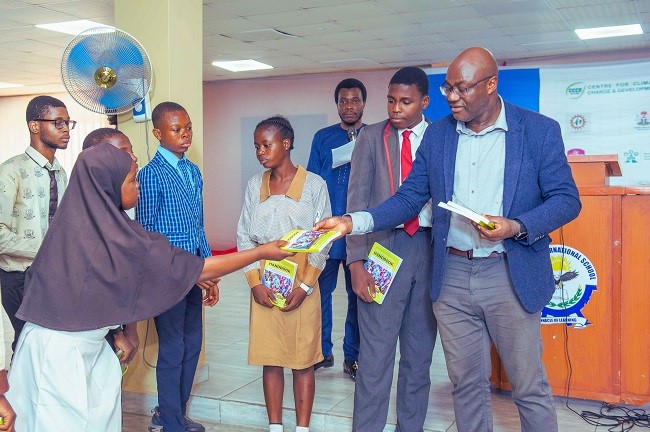
Climate Education Manual
Prof. Chukwumerije Okereke handing the Climate Education Manual to a student

SPP, a not-for-profit organisation at the forefront of climate policy discussions in Nigeria, has identified climate education as a strategic pathway for driving long-term environmental awareness and behavioural change among young people.

Speaking ahead of the event, Mr. Nnaemeka Oruh, Senior Policy Analyst at SPP, emphasised the urgency of early climate engagement.

“As climate change continues to shape the future of our planet, young people are being called to lead the way. We believe that it is important to have these conversations not only in the halls of power, but at the grassroots. Being informed is the first step to developing capacity, and our aim is to take climate knowledge directly into classrooms and empower students to become solution-driven leaders in their communities,” he said.

The Climate Education Manual was developed as a long-term resource for schools aligned with existing curricula, and designed to equip teachers with the tools to confidently deliver lessons on climate science and sustainable living.

By institutionalising climate education through this resource, SPP hopes to foster a generation of environmentally conscious citizens prepared to contribute meaningfully to Nigeria’s climate goals.

By Ugochukwu Uzuegbu, Communication Specialist, SPP

Nigeria targets $2.5bn carbon credit investment by 2030

0

Vice Chancellor of the University of Nigeria, Nsukka (UNN), Prof. Simon Ortuanya, says Nigeria targets $2.5 billion in high-integrity carbon credit investments by 2030, with its carbon market now established.

Ortuanya disclosed this at the Stakeholders` Validation Workshop on Potential and Challenges of Voluntary Carbon Market in Nigeria, on Thursday, February 26, 2026, in Abuja.

The programme was organised by Resources and Environmental Policy Research Centre, Environment for Development (REPRC-EfD) UNN.

Prof. Simon Ortuanya
Vice Chancellor of the University of Nigeria, Nsukka (UNN), Prof. Simon Ortuanya

Ortuanya noted that carbon markets, especially with Article 6 of the Paris Agreement enabling countries to trade carbon credits, are key to a low-carbon economy.

He explained that carbon markets are grouped into two: Compliance Carbon Markets (CCM) and Voluntary Carbon Markets (VCM).

According to him, while the VCM encompasses all transactions of carbon offsets not purchased under a regulated carbon market, CCM are marketplaces through which regulated entities obtain offsets under regulatory regimes.

“Although the compliance market remains hypothetical in Africa, the VCM has existed for over two decades and has shown remarkable growth since its inception, primarily driven by the private sector.

“Globally, the VCM is valued at 2 billion dollars in 2022. Analysts place Africa’s potential VCM value at up to 1.5 trillion dollars by 2050, provided integrity and equity are safeguarded.

“Meanwhile, with the carbon market now in place, Nigeria is positioning itself to capture a sizeable share of about 2.5 billion dollars in high-integrity carbon credit investment by 2030, aligned with article six,’’ he said.

The vice-chancellor warned that poor implementation could lead to carbon leakage and adverse effects on vulnerable communities, emphasising the need for strong governance systems to prevent negative distributional impacts.

He said stakeholder knowledge and collaboration were critical to addressing uncertainties in the carbon market, describing the workshop as an opportunity to validate findings on Nigeria’s carbon market potential and challenges.

According to him, the forum will examine issues including regulation, measurement, reporting, verification and community participation.

“The engagement will help develop actionable strategies balancing environmental integrity and equitable benefits.”

Ortuanya said UNN, through its research centre, has capacity to provide evidence-based policy guidance, noting that previous engagements on the project were held in January 2025 and July 2025.

The vice-chancellor, who was represented by Prof. Nnaemeka Chukwuone, Director of REPRC-EfD, Nigeria, thanked development partners and stakeholders for supporting the research and contributing expertise.

Chukwuone said that significant progress had been made since the study began over a year ago, culminating in the current validation stage of the research.

“Nigeria lacked a carbon market framework at the inception stage, but now has one,following sustained engagement with stakeholders and support from relevant authorities.

“Efforts are ongoing to strengthen implementation through capacity building, project registration and development of monitoring systems, with over 120 carbon projects already registered as of December 2025.

“Carbon market participation could reduce emissions, generate revenue, empower communities and support poverty reduction, while similar initiatives are gaining traction in countries such as Ghana and Kenya,’’ he said.

Chukwuone noted that investor confidence and interest in carbon market opportunities were now high across the country.

He commended the National Council on Climate Change for facilitating the framework and thanked other stakeholders for their support.

By Vivian Emoni