Home Blog Page 31

UNCCD COP17: Desertification summit to focus on healthy land for resilience, stability, prosperity

Five months ahead of the seventeenth session of the Conference of the Parties (COP17), Mongolia and the United Nations Convention to Combat Desertification (UNCCD) on Tuesday, March 17, 2026, unveiled the thematic days and action agenda for the conference, to be held in Ulaanbaatar from August 17 to 28 under the theme “Restoring Land, Restoring Hope”.

Delegates from UNCCD’s 197 Parties will join scientists, businesses and land stewards in Ulaanbaatar for COP17 to advance action for healthy land as a cornerstone of global resilience, stability and prosperity.

Scaled-up finance for land restoration and drought resilience, alongside the future of the world’s rangelands and pastoralists, will shape the COP17 agenda, with the conference aimed at translating global commitments into measurable progress on the ground. As the first of the three Rio Conventions COPs – on land, biodiversity and climate – meeting this year, UNCCD COP17 will set the pace for the rest of 2026 and beyond. 

Yasmine Fouad
UNCCD Executive Secretary, Yasmine Fouad

UNCCD Executive Secretary, Yasmine Fouad, said: “Over the past decade, countries have committed to restoring one billion hectares of degraded land by 2030 and more than 70 now have national drought plans. COP17 is our opportunity to turn these commitments into real change on the ground.

“That means mobilising finance at scale for land restoration and drought resilience, investing in preparedness rather than costly crisis response and recognising rangelands as vital assets for economies, cultures and climate. The thematic days and action agenda for COP17 reflect a simple truth: healthy land underpins food security, water availability, economic resilience and stability everywhere – and the time to act is now.” 

Mongolia’s Minister of Environment and Climate Change, Batbaatar Bat, stated: “For the Government of Mongolia, the Riyadh–Ulaanbaatar Action Agenda is a strategic, participatory framework to mobilise citizens, businesses, cities and all stakeholders to restore critical ecosystems, including rangelands and agricultural lands. It drives investment in the land–water nexus and strengthens drought resilience. We call on leaders from all sectors to join us at COP17 to accelerate solutions for resilient economies and societies.” 

To help focus discussions and mobilise action, COP17 will feature thematic days dedicated to key priorities on the global land and drought agenda. These will bridge political decisions with real-world solutions, making everyone part of a powerful Action Agenda to advance land restoration and drought resilience. The four thematic days planed for COP17 are:

  • Finance (August 24): Restoring land at scale requires around $1billion dollars per day, but current funding falls far short. Finance Day will bring together ministers of finance, development banks and the private sector to help close this gap and unlock large-scale investment. 
  • Water (August 25): By 2050, three out of four people worldwide are projected to face drought. Water Day will advance proactive drought risk management and strengthen cooperation on the integrated management of water resources. 
  • Land and People (August 26): Rangelands support the livelihoods of some 500 million people but remain among the most undervalued ecosystems globally. Land and People Day will place the voices of land stewards at the heart of discussions, highlighting the perspectives of Indigenous Peoples, local communities, pastoralists, youth, women and civil society organisations. 
  • Food Systems and Soil Health (August27): By 2050, the world will need to produce at least 50 per cent more food, even as food systems remain the leading driver of land degradation globally. Food Systems and Soil Health Day will connect soil restoration to food security, agricultural productivity and the livelihoods of farming communities. 

“The thematic days of COP17 are designed to focus global attention where it matters most – on the solutions and partnerships needed to restore land, strengthen drought resilience and support the people who take care of our ecosystems. By bringing together governments, scientists, businesses, local and pastoralist communities as well as Indigenous Peoples around shared priorities, we aim to move from commitments to implementation and help ensure that healthy land continues to sustain communities, economies and ecosystems for generations to come,” added Executive Secretary, Fouad. 
Powering Nigeria’s future: A review of ministers since 1999 and today’s reform agenda

Since the return to democratic governance in Nigeria in 1999, the Ministry of Power has remained one of the most consequential portfolios in the federal cabinet. Electricity is the backbone of economic growth, industrial productivity, and national development. Over the past two and a half decades, several distinguished leaders have steered the sector through complex reforms, infrastructure deficits, and evolving market realities.

Among those who held the mantle are respected figures such as Bola Ige, Barth Nnaji, Liyel Imoke, and Babatunde Raji Fashola. Each brought unique perspectives and reforms to the sector, laying the groundwork for the transformation Nigeria continues to pursue today.

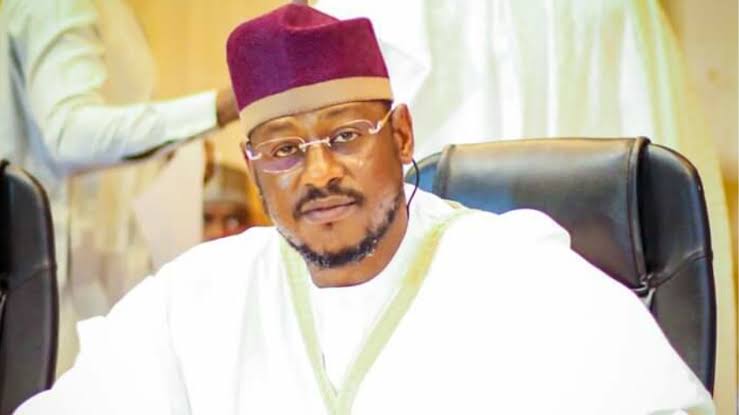
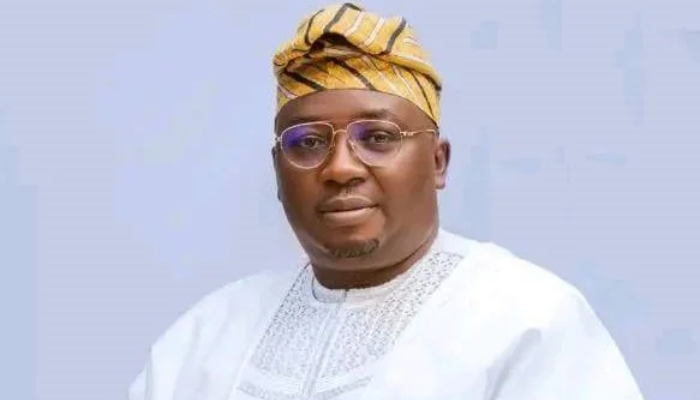
Adebayo Adelabu
Minister of Power, Mr Adebayo Adelabu

Today, the sector is being steered by the current Minister of Power, Adebayo Adelabu, whose reform-driven approach has sparked fresh conversations about the future of electricity in Africa’s largest economy.

A Look Back: The Reform Efforts of Past Power Ministers

The Visionary Beginnings: Bola Ige

The late Chief Bola Ige served as one of the earliest Ministers of Power in the Fourth Republic. His tenure focused largely on restoring public confidence in a power system that had deteriorated after years of military rule. Although his time in office was tragically cut short, he helped initiate discussions around restructuring the electricity sector and modernizing the national grid.

The Reform Architect: Barth Nnaji

Professor Barth Nnaji played a pivotal role during one of the most defining periods of the power sector. As minister, he helped drive the privatization process of the generation and distribution companies that emerged from the unbundling of the Power Holding Company of Nigeria (PHCN). His work helped establish the foundation for Nigeria’s current electricity market structure.

Administrative Stabilization: Liyel Imoke

During his time overseeing the sector before becoming governor, Liyel Imoke focused on administrative coordination and project supervision. His leadership contributed to stabilising ongoing generation projects and reinforcing federal oversight during a period of policy transition.

Infrastructure and Market Coordination: Babatunde Raji Fashola

Former Lagos governor Babatunde Raji Fashola served as Minister of Power, Works and Housing during a period of integrated infrastructure management. His tenure emphasised transmission expansion, financial interventions for distribution companies, and coordination between electricity supply and broader national infrastructure projects.

While these ministers made notable contributions, the Nigerian power sector has remained a work in progress, requiring continuous reform, investment, and policy innovation.

The Adelabu Era: A New Reform Momentum

Under the leadership of Adebayo Adelabu, the ministry has pursued a broad and multidimensional reform strategy aimed at addressing long-standing structural issues in the electricity ecosystem.

Observers of the sector note several areas where the current administration’s efforts have expanded beyond previous frameworks.

 1. Legislative and Policy Reforms

One of the defining features of the current minister’s tenure has been the acceleration of legislative alignment with Nigeria’s evolving electricity market. Working within the framework of the Electricity Act and related policies, the ministry has promoted greater decentralisation, enabling states and private investors to participate more actively in electricity generation and distribution.

This policy direction is widely viewed as a turning point toward a more competitive and flexible power market.

 2. Market and Tariff Reforms

Another major focus has been tariff restructuring aimed at improving cost recovery while protecting vulnerable consumers. By promoting a more transparent tariff system tied to service delivery, the ministry seeks to attract investment and reduce the financial fragility that has long plagued the electricity market.

While tariff reforms often generate public debate, industry analysts acknowledge that sustainable electricity systems require financially viable market structures.

 3. Transmission and Distribution Infrastructure Expansion

A significant component of the minister’s agenda has been the strengthening of Nigeria’s transmission and distribution backbone.

Transmission capacity expansion, grid modernisation initiatives, and improved coordination with distribution companies have all been prioritised. These efforts aim to reduce bottlenecks that have historically prevented generated electricity from reaching consumers.

 4. Energy Transition and Renewable Expansion

In line with global energy trends, the ministry has also increased focus on renewable energy and energy transition strategies. Through collaborations with agencies such as the Rural Electrification Agency, distributed solar systems and mini-grid solutions are being deployed to electrify underserved rural communities.

This distributed energy model has the potential to bring electricity to millions who remain outside the national grid.

 5. Human Capacity Development

Human capital development has also emerged as a key priority. The ministry has placed renewed emphasis on strengthening training programs at the National Power Training Institute of Nigeria (NAPTIN), ensuring that engineers, technicians, and power sector professionals possess the skills required for modern electricity systems.

A stronger technical workforce is essential to sustaining long-term reforms.

 6. Local Content and Manufacturing Development

Another notable initiative has been the push for local manufacturing within the renewable energy ecosystem. The minister has promoted policies encouraging domestic production of solar panels, batteries, and electricity meters.

This strategy not only supports energy access but also stimulates industrial development and job creation within Nigeria.

Navigating Political Headwinds

In recent months, the minister has faced waves of criticism in sections of the media and political space. However, supporters argue that much of the negative publicity may be connected to emerging political dynamics ahead of the 2027 electoral cycle.

With increasing speculation about his political ambitions in Oyo State, analysts note that both internal party rivals and opposition figures may seek to shape public narratives around his performance.

In political environments where reform policies – especially tariff adjustments – can be unpopular in the short term, ministers often face criticism despite long-term strategic goals.

A Possible Future Beyond the Power Ministry

Looking ahead to the 2027 elections, many political observers believe that Adebayo Adelabu possesses several attributes that could position him strongly should he pursue the governorship of Oyo State.

Several factors stand out:

 1. Technocratic Leadership Experience

His stewardship of one of the most complex federal ministries has required navigating policy, economics, infrastructure management, and stakeholder negotiations.

 2. Reform-Oriented Governance

His emphasis on structural reforms – legislative, market, and infrastructural – reflects a governance style focused on long-term solutions rather than short-term political gains.

 3. Economic Development Perspective

Energy reform is deeply connected to economic growth. Experience in managing such a critical sector provides insights valuable for state-level industrial development.

 4. Institutional Capacity Building

His focus on human capacity development and local manufacturing demonstrates an appreciation for sustainable development through skills and industry.

 5. Strategic Vision for Energy and Industrialization

A leader who understands the link between electricity access and economic productivity can play a transformative role at the state level.

 Conclusion: Powering Reform, Shaping the Future

The story of Nigeria’s electricity sector since 1999 is one of gradual reform, evolving policy frameworks, and persistent challenges. From the early reform visions of leaders like Bola Ige to the privatization era driven by Barth Nnaji and the infrastructural coordination efforts of Babatunde Raji Fashola, each administration has contributed to shaping the sector.

Today, under Adebayo Adelabu, the ministry is pursuing an ambitious mix of market reform, infrastructure investment, renewable energy expansion, and human capital development.

While the full impact of these reforms will unfold over time, one reality is increasingly clear: Nigeria’s energy future will depend on sustained leadership, policy continuity, and bold structural transformation.

And for leaders willing to navigate that challenge, the opportunity to shape both national infrastructure and political legacy remains immense.

By Adedayo Olowoniyi, Chief Technical Adviser to Minister of Power, Chief Adebayo Adelabu

NAF commends LAWMA over swift waste evacuation

The Nigerian Air Force (NAF) Base, Ikeja, has commended the Lagos Waste Management Authority (LAWMA) for its swift evacuation of accumulated waste within the Base.

This is contained in a statement signed by the Director, Public Affairs LAWMA, Mr. Mukaila Sanusi, on Monday, March 16, 2026, in Lagos.

Air Commodore Mohammad Imam, Commander of the 651 Base Services Group, gave the commendation during a courtesy visit to the LAWMA headquarters in Lagos.

LAWMA
Air Commodore Mohammad Imam, Commander of the 651 Base Services Group (left), with Managing Director of LAWMA, Dr Muyiwa Gbadegesin

“Imam said the Authority’s deployment of about 20 waste evacuation trucks helped clear refuse from the Base and improved sanitation within the environment.

“We are here to sincerely appreciate the management and staff of LAWMA for the excellent job done in evacuating waste from the Base,” he said.

He said the intervention demonstrated LAWMA’s commitment to environmental cleanliness across Lagos State.

Imam also commended the reintroduction of the monthly environmental sanitation exercise in the state, scheduled to commence from the last Saturday of April.

He described the initiative as a commendable step towards strengthening public hygiene and environmental responsibility.

He pledged the support of the Nigerian Air Force for the state’s sanitation initiatives, assuring that officers from the Base would assist in ensuring compliance with environmental standards.

Responding, the Managing Director of LAWMA, Dr Muyiwa Gbadegesin, thanked the delegation for the visit and for acknowledging the Authority’s efforts.

Gbadegesin called for stronger collaboration between LAWMA and the NAF, especially in technical engagement and operational cooperation to enhance environmental management.

He said Lagos State was gradually transitioning from a linear waste disposal system to a circular economy model where waste is treated as a resource.

He cited the biodigester facility at Ikosi Fruit Market as an example where organic waste is processed to produce biogas for energy use.

He also highlighted LAWMA Academy initiative, which introduces school children to waste sorting and recycling practices.

Gbadegesin said the Authority would continue to strengthen partnerships with institutions and communities to promote sustainable waste management across the state.

Nigeria can weather global crisis, seize energy opportunities – NUPRC Board Chairman

0

Nigeria is in a relatively strong position to navigate the situation and possibly benefit from emerging opportunities in the current global crisis.

Sen. Magnus Abe, Board Chairman designate of the Nigerian Upstream Petroleum Regulatory Commission (NUPRC), made the comment in an interview with newsmen in Abuja on Monday, March 16, 2025.

Abe was screened by the Senate Committee on Petroleum Resources (Upstream) earlier.

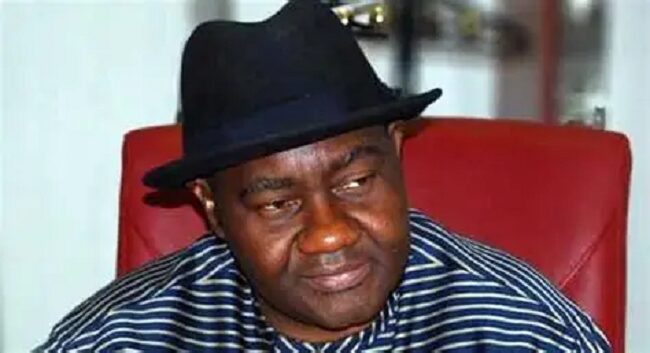
Sen. Magnus Abe
Sen. Magnus Abe

The committee, chaired by Sen. Eteng Williams, representing Cross River Central Senatorial District, had earlier screened Abe and two others for appointment as chairman and non-executive commissioners of the commission.

He said that although the current global crisis presents serious economic challenges, Nigeria could seize energy opportunities.

Abe said that the difficulties being experienced were not unique to Nigeria but are part of a wider global challenge affecting many nations.

He explained that while rising global tensions could push up the prices of petroleum products locally, Nigeria may also gain from increased revenues due to higher international crude oil prices.

According to him, the situation should be viewed as ‘a balancing act’ where the negative effects of rising energy costs could be offset by improved earnings from oil exports.

He also emphasised the importance of recognising Nigeria’s position within the global community, noting that certain international developments inevitably affect all countries.

“Some of the developments happening around the world are beyond the control of any single country.

“As members of the global community, there are situations we simply cannot escape,” he said.

While discussing the economic implications, he stressed that the human cost of global conflicts should not be ignored, noting that lives are being lost and communities are being affected across the world.

“Our collective prayer should be that this crisis, which in my opinion is unnecessary and harmful to the entire world, is resolved as quickly as possible so that global recovery can begin,” he said.

In spite of the challenges, he urged Nigerians to adopt a balanced outlook and recognise that difficult periods can also create opportunities for growth.

He pointed out that disruptions in global gas supply could open the door for Nigeria to expand its own gas production, potentially generating employment and boosting economic activity.

Similarly, he said higher oil prices could make investments in marginal oil fields economically viable, projects that were previously considered unprofitable under lower market conditions.

On his appointment, Abe expressed gratitude to President Bola Tinubu for the confidence reposed in him and other members of the board.

He described the appointment as both a privilege and a responsibility to contribute to the administration’s Renewed Hope Agenda aimed at restoring confidence and growth across key sectors of the Nigerian economy.

“I am sincerely grateful to Mr President for considering us worthy to serve. We see this as an opportunity to contribute our quota to the Renewed Hope Agenda and to help rebuild confidence among Nigerians,” he said.

He also highlighted the importance of the Petroleum Industry Act, noting that the law provides a strong framework to address many longstanding issues in the oil and gas sector.

According to him, challenges such as pipeline vandalism and tensions with host communities can be better managed through the Act’s provisions.

Earlier during the screening, one of the nominees for non-executive commissioner of the NUPRC board, Paul Jezhi, identified discrepancies in crude oil measurement at custody transfer points as a long-standing challenge in the sector.

He told lawmakers that the deployment of modern metering technology could significantly reduce the problem.

“The discrepancies in crude oil at the custody point have been a long-time issue.

“Modern meters can now record measurements within a margin of plus or minus one to five, and when such meters are deployed, these discrepancies will largely disappear,” he said.

Jezhi also recommended the adoption of drones and satellite technology to strengthen surveillance against oil theft and pipeline vandalism, particularly in the Niger Delta.

President Tinubu had earlier written to the Senate seeking confirmation of 21 nominees for the boards of the NUPRC and the Nigerian Midstream and Downstream Petroleum Regulatory Authority.

In the letter, the president nominated Abe as chairman of the NUPRC board.

Abe, a former senator and one-time board member of the Nigerian National Petroleum Corporation, currently serves as chairman of the National Agency for the Great Green Wall.

By Naomi Sharang

Middle East conflict: Oil from emergency reserves will soon start flowing – IEA

0

Oil from the International Energy Agency (IEA) emergency reserves will soon start flowing to global markets following the announcement on March 11, 2026, that IEA Member countries will make 400 million barrels of oil available to the market in response to the disruptions resulting from the Middle East conflict.

Individual implementation plans have been submitted to the IEA by Member countries. These plans indicate that stocks will be made available by IEA Member countries in Asia Oceania immediately while stocks from IEA Member countries in the Americas and Europe will be made available starting from the end of March.

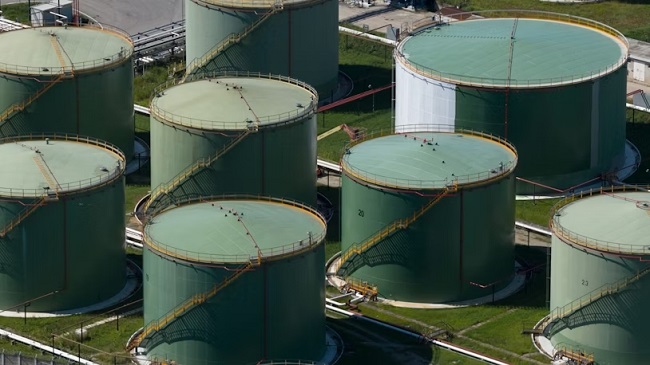
Oil reserve
Oil reserve

This is the sixth time that IEA Member Countries have taken emergency collective action to support oil markets in the history of the IEA, which was created in 1974. Previous collective actions were taken in 1991, 2005, 2011, and twice in 2022.

The war in the Middle East is creating the largest supply disruption in the history of the global oil market. This emergency collective action, by far the largest ever, provides a significant and welcome buffer.

But the most important factor in ensuring a return to stable flows is the resumption of regular transit of shipping through the Strait of Hormuz. Adequate insurance mechanisms and physical protection for shipping are key to the resumption of flows.

According to the IEA Oil Market Report (OMR), with crude and oil product flows through the Strait of Hormuz plunging from around 20 mb/d before the war to a trickle currently, limited capacity available to bypass the crucial waterway, and storage filling up, Gulf countries have cut total oil production by at least 10 mb/d. In the absence of a rapid resumption of shipping flows, supply losses are set to increase.

It added: “Widespread flight cancellations in the Middle East and large-scale disruptions to LPG supplies are expected to curb global oil demand by around 1 mb/d during March and April compared to previous estimates. Higher oil prices and a more precarious outlook for the global economy pose further risks to the forecast. Global oil consumption is now set to increase by 640 kb/d y-o-y in 2026 – down 210 kb/d from last month.

“Oil prices have gyrated wildly since the United States and Israel launched joint air strikes on Iran on February 28. Disruptions to Middle Eastern supplies due to attacks on the region’s oil infrastructure and the cessation of tanker traffic through the Strait of Hormuz sent Brent futures soaring, trading within a whisker of $120/bbl. Prices subsequently eased with Brent around $92/bbl at the time of writing – up $20/bbl for the month.”

Reacting to the current global crisis, Director of Power Shift Africa, Mohamed Adow, said: “The current oil turmoil is a brutal reminder that dependence on fossil fuels leaves countries exposed to crises they cannot control. Nations that invest in renewable energy are far more resilient because the sun and wind cannot be blockaded, stockpiled or weaponised. The lesson for governments everywhere is clear, accelerating the transition to clean energy is not just about climate – it’s about energy security and economic stability.

“The disruption to oil markets shows exactly why Africa must not be locked into fossil fuel dependence. Europe got itself hooked on fossil fuels in the last century and is now going through the process of weaning itself off reliance on oil and gas.

“Africa doesn’t need to fall into the same trap and can use this moment to take a better path, one where we avoid locking in dirty energy infrastructure. It is renewable energy that offers a route to real energy sovereignty.”

Katsina competition to showcase students’ understanding of climate change

Katsina State Government has launched the 2026 Climate Change Competition for students to showcase their understanding of the phenomenon.

The Chief Press Secretary to Gov. Dikko Radda, Mr. Ibrahim Kaula-Mohammed, made this known in a statement in Katsina, the state capital, on Monday, March 16.

He stated that the competition was organised through the Katsina State Climate Change under the Gov. Dikko Radda Green Prize Initiative.

Dikko Radda
Governor Dikko Radda of Katsina State

According to him, the competition is to inspire youth engagement in environmental sustainability.

Kaula-Mohammed quoted the Senior Special Assistant to the governor on Climate Change, Mr. Suleiman Ribadu, as saying: “Students from primary, junior and senior secondary schools across Katsina State can participate.

“This competition promotes climate awareness and environmental responsibility among our youth.”

He added that participants were expected to produce short video presentations based on climate quotations from Gov. Radda’s speeches, demonstrating knowledge of climate change adaptation, mitigation and environmental stewardship.

The competition, he said, aligned with Radda’s vision to build a climate-resilient and environmentally sustainable Katsina State.

“Winners will receive the prestigious Gov. Dikko Radda Green Prize, which include cash rewards, certificates and special recognition.

“Entries will be evaluated by a panel of experts who will assess students’ understanding of climate issues and their commitment to environmental action,” he said.

He stated that students can apply online on www.govdikkogreencompetition.com., to be submitted not later than April 10.

He encouraged eligible students to participate and contribute their ideas to Nigeria’s climate agenda.

By Zubairu Idris

CMS, Agege, others top good air quality index – LASEPA

0

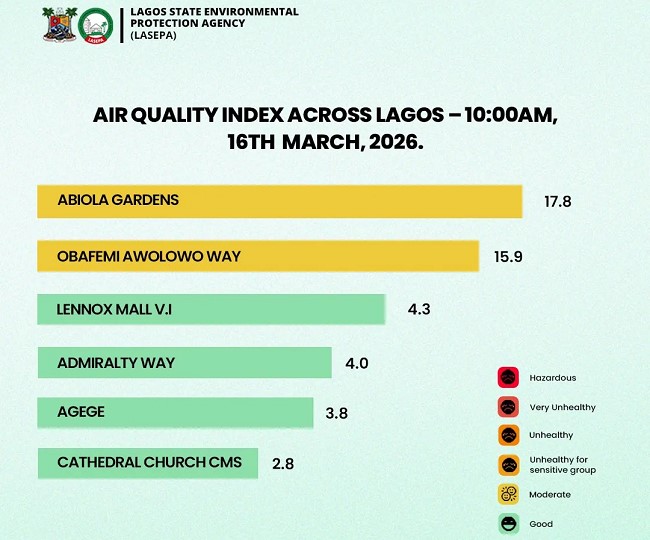
Cathedral Church CMS, Agege, Admiralty Way and Lennox Mall have recorded good air quality index, data from the Lagos State Environmental Protect Agency (LASEPA) has shown.

LASEPA released the Air Quality Index (AQI) report for locations across Lagos on Monday, March 16, 2026.

The report showed moderate air quality levels at Abiola Gardens and Obafemi Awolowo Way, with index readings of 17.8 and 15.9 respectively.

Air Quality Index
Lagos Air Quality Index

Other monitored locations recorded good air quality levels.

They include Lennox Mall, Victoria Island (4.3), Admiralty Way (4.0), Agege (3.8) and Cathedral Church CMS (2.8).

However, a clean energy campaigner has commended LASEPA for monitoring and releasing air quality data across the state.

Mr. Weyinmi Okotie, the Africa Clean Energy Campaigner at the Global Alliance for Incinerator Alternatives, gave the commendation on Monday while reacting to LASEPA’s latest Air Quality Index report.

Okotie said it was important for governments to invest in air monitoring systems and provide regular updates to the public on environmental conditions.

According to him, many Nigerian states do not yet have air quality monitoring facilities capable of providing real-time data to residents.

“We need to commend Lagos for even having air monitors and providing updates on air quality,” he said.

He, however, noted that interpreting air quality results requires understanding the context, methodology and environmental factors involved in the monitoring process.

Okotie explained that air quality readings were usually calculated over a 24-hour period, which could include hours when human activities such as traffic are minimal.

“For example, a location like CMS may experience heavy vehicular movement during the day, but at night activities reduce significantly,” he said.

He added that the placement of monitoring equipment and wind direction could also affect the accuracy of readings recorded by monitoring stations.

According to him, an air monitor located upwind or downwind of pollution sources may capture different levels of pollutants depending on wind movement.

He said the availability of air monitoring systems remained an important first step in improving environmental management and public awareness.

By Fabian Ekeruche

Fossil fuel dependency ripping away national security, but renewables turn the tables – Stiell

Remarks delivered by UN Climate Change Executive Secretary, Simon Stiell, at the Green Growth Summit in Brussels, Belgium, on Monday, March 16, 2026

Recent weeks have developed yet another abject lesson.

Fossil fuel dependency is ripping away national security and sovereignty, and replacing it with subservience and rising costs.

Simon Stiell
UN Climate Change Executive Secretary, Simon Stiell, during a press conference hosted by the COP31 President Designate, Minister Murat Kurum in Istanbul, Türkiye, on Thursday, February 12, 2026

And Europe is more reliant on fossil fuel imports than almost any other major economy.

That cost you over €420 billion in 2024 alone.

Fossil fuel dependency means economies, household budgets, and business bottom lines at the mercy of geopolitical shocks and price volatility in a chaotic world.

A world of trade turmoil, strong-arm politics, and war.

The European Central Bank had recently said that the EU economy is in a good place.

But electricity prices are spiraling. And ​​​​inflation will likely return.

Because war in the Middle East has sent the oil and gas prices soaring. Just as war in Ukraine did before.

The impact of faltering energy supplies is being felt around the world.

From universities closing early in Bangladesh. To plans to cut public working hours in the Philippines. Countries are reeling.

Some responses to the fossil fuel crisis – incredibly – argue for doubling-down on the cause of the problem and slowing the shift to renewable energy. Even though it is clearly cheaper, safer, and faster to market.

This is completely delusional.

Because history tells us, this fossil fuel crisis will happen again and again.

In this new world disorder where some major powers do as they please, unconstrained by economic logic or current alliances.

My message to ministers meeting today in Brussels is simple: meek dependence on fossil fuel imports will leave Europe forever lurching from crisis to crisis, with households and industries literally paying the price.

All as climate disasters wreak havoc the world over – pushing costs up and economic growth down, and taking a massive human toll.

In Europe, climate extremes cost €43 billion in economic losses, last summer alone. And that is a conservative estimate.

While the fossil fuels that supercharge disasters rake-in trillions in taxpayer-funded subsidies globally. Money that could be better spent.

But renewables turn the tables.

Sunlight doesn’t depend on narrow and vulnerable shipping straits.

Wind blows without massive taxpayer-funded naval escorts.

Renewable energy allows countries to insulate themselves from global turmoil, and to side-step might-is-right politics.

Renewable energy also delivers on people’s top priorities across the continent: security, well-paid jobs, better health, and relief from rising living costs.

There’s a lot of commentary about populism at the moment.

But the reality is, what most voters are demanding​, ​climate action delivers at scale.

Renewables and resilience keep bills down and create far more jobs. 

Cutting-out fossil fuel pollution cleans our air, improving health and quality of life.

And meeting the EU’s 2040 emissions reduction target would boost your economy by 2%. This will add hundreds of billions of Euros every year, and deliver vast human and societal benefits, including more stability.

Today, Europe has a once-in-a-generation opportunity to harness these benefits.

Building on its longstanding climate leadership.

And cement competitiveness, stability, and rising living standards for years to come.

In an era of chaos, capital is searching for safe, strategic growth, sending record sums into Europe.

The EU can turn that trend into a permanent pillar of jobs and prosperity with strong climate action:

In climate resilience – essential to human safety and economic stability as disasters intensify.

And by setting out how you will thrive in a decarbonising world – as electrification accelerates, supercharging clean energy services, and innovation.

The opportunities are immense.

Last year, renewables overtook coal as the world’s top electricity source.

Over $2 trillion was invested in clean energy. Double that of fossil fuels.

Already, Europe is a leader in climate action and ambition.

Your Emissions Trading Scheme is driving investment and innovation.

And European companies are at the forefront of clean industries and growth:

Like SSAB, Maersk, and Holcim – leaders in green steel, shipping, and cement.

Or Siemens, Schneider, and IPS – pioneers in wind power, energy storage, and electro-tech services.

Europe can permanently seize the multi-trillion-euro goldmine of investments that are just getting started.

By embracing green growth, drawing on your many strengths – education, strong institutions, smart regulations, social justice, and innovation and intellectual property.

And by backing it up with plans and policies. 

That deliver on your NDC – in full and on time.

That show how you will transition away from fossil fuels, swiftly and fairly.

That upgrade grids – improving connections across borders.

That stand firm behind the ETS – as more than 100 companies requested just last week, while also recognising complex trade issues, and the need for an inclusive global transition.

And that position you at the fore of the electro-tech revolution, including through your Electrification Action Plan.

Europe’s companies are essential to supporting these efforts.

To continuing your leadership.

And pushing governments for more – showing you’re behind them.

Because stronger policies mean more secure economies, and more opportunities for business, as decarbonisation reaches positive tipping points.

And a faster transition around the world means greater gains for Europe and its businesses of all sizes.

A prosperous EU depends on strong partnerships that empower others, especially developing nations.

And on global supply chains that can withstand climate extremes – crucial to keeping inflation down.

Climate cooperation is a cure for the chaos of this moment, and beyond:

Through trade deals and partnerships, countries can create the conditions for more stable and sustainable economies the world over.

COPs are at the heart of those efforts.

And they are delivering – even if not fast enough.

UN convened cooperation and European leadership have been critical to global climate action – the Paris Agreement has roughly halved projected global temperature rise.

It has unleashed the global clean energy revolution.

And last year, amid gale-force political headwinds, every country at COP30 said Paris is working, and resolving to make it go further, to go faster.

Year after year, EU leadership has driven ambition at COPs.

I urge you to keep it up. Stand up for the process. And step up to the moment.

As we move into a new era of climate action – an era of implementation – there are vast opportunities.

Increasingly, COPs will match-make between governments, businesses, and investors to turn commitments into huge benefits for people.

That’s what’s known as the Action Agenda. It’s as much a part of the Paris Agreement as the negotiations.

And it’s making significant progress – at COP30, a trillion dollars were committed to grids and storage, major funding breakthroughs were delivered on health and climate, and huge steps forward were made in resilience and protecting forests.

COP31 in Türkiye will drive this same approach forward.

So, I urge you to seize this moment. With companies coming to COPs to secure agreements that help tackle the climate crisis while boosting their bottom lines.

And the EU building new partnerships that benefit all, through your global gateway.

Invest​ing​ in value chains in partner countries, accelerating their transitions, and building their resilience. Strengthening alliances in the process.

This goes to the heart of what Europe stands for.

Last century, ​when ​a continent reeling from war came together to build the foundation of integration, energy was top of that list.

Because countries understood that secure and affordable energy, achieved through cooperation, were the basis of peace and prosperity.

Today, these truths are more important than ever.

Tinubu backs Nigerian media’s fight for fair revenue from Big Tech, promises tariff relief

0

President Bola Ahmed Tinubu has said his government will support the evidence-led campaign of the Nigerian media against Big Tech dominance, anti-competitive activities, and the harsh economic headwinds affecting local media.

He described the press as an “indispensable partner” in the nation’s journey towards economic stability, press freedom, and social cohesion.

At a meeting at the State House on Friday, March 13, 2026, the President said his government would help dismantle the fiscal hurdles and “digital cannibalisation” currently threatening the survival of the press.

President Bola Tinubu

He gave this assurance during an interfaith dinner with a high-level delegation from the Nigerian Press Organisation (NPO), led by the NPO President and Publisher of The Guardian, Lady Maiden Alex-Ibru.

The delegation also included industry leaders and patrons, among them Aremo Olusegun Osoba; publisher of Vanguard, Mr. Sam Amuka; Chairman of THISDAY/ARISE News Channel, Prince Nduka Obaigbena; Chairman of Channels Television, Dr John Momoh; Director-General of the Nigerian Television Authority (NTA), Alhaji Saliu Abdulhamid Dembos; former NPAN President and veteran journalist, Mr. Ray Ekpu; President of the Nigerian Guild of Editors (NGE), Mr. Eze Anaba; President of the Guild of Corporate Online Publishers of Nigeria (GOCOP), Mr. Danlami Nmodu,; and President of the Nigeria Union of Journalists (NUJ), Comrade Alhassan Yahya Abdullahi, among others.

Also present were executive members of NPAN, managing directors of media houses, top media practitioners across all platforms, and representatives of civil society.

President Tinubu said his government was already reviewing the tariff exemption list and would consider the inclusion of the items used by the media, such as newsprint, plates, chemicals, and radio and television broadcast equipment, which currently attract tariffs of 5 to 10 per cent. If this happens, these items would enjoy a status similar to that of educational and research materials.

With the media industry reeling from skyrocketing newsprint and equipment costs, President Tinubu signalled his administration’s readiness to intervene by reviewing tariffs.

“You have the government’s full support, because we know how important your work is to the sustenance of democracy,” the President said.

Earlier, the Deputy President of the Newspaper Proprietors’ Association of Nigeria (NPAN) and Publisher of BusinessDay, Mr. Frank Aigbogun, in a speech delivered on behalf of the NPO, accused some tech companies of increasingly “scraping” proprietary creative content to train AI models, often by breaching digital paywalls.

Aigbogun requested the president to direct the Federal Competition and Consumer Protection Commission (FCCPC) to work with the media to investigate complaints that Big Tech dominance and anti-competitive practices were costing local media at least 70 per cent of its legitimate income, estimated by some sources at hundreds of millions of dollars, in addition to the loss of jobs and opportunities.

Before the President’s response, the Minister of Information and National Orientation, Alhaji Mohammed Idris, said the government had already begun “engaging Big Tech,” companies including Meta and Google.

“The government will not allow anybody to come here, reap from our economy, and go away without giving back,” he said.

Among other dignitaries present at the meeting were Vice President Kashim Shettima, as well as senior aides and special advisers to President Tinubu.

It will be recalled that the NPO had, in January, written to the government and also published a statement complaining about the existential threat Big Tech operations pose to local media.

Zikora Ibeh: Makoko and the politics of displacement in Lagos

One fact is now unmistakable. The Lagos State Government appears determined to empty Makoko of its inhabitants. But for the mass protest organised by the Coalition Against Demolition, Forced Evictions, Land Grabbing and Displacement on January 28, 2026, the historic riverine community might well have been erased with little public scrutiny and even fewer qualms.

That demonstration laid bare the depth of grievance simmering across Lagos. Nearly five thousand residents gathered in collective resistance, many of them survivors of forced evictions and illegal demolitions in Owode Onirin, Oworoshoki, Bariga, Ajegunle, Sogunro, and other communities.

Makoko
A displaced Makoko resident

Makoko itself had become the immediate flashpoint, suffering yet another cycle of destruction. In December 2025, armed demolition teams backed by state authorities entered the settlement under the pretext of enforcing a 30–100 metre safety corridor beneath a high-tension power line. That explanation quickly collapsed under the weight of the events that followed. The demolition squad pushed far beyond the stated boundary, uprooting thousands of residents and destroying homes and vital amenities such as schools.

The extraordinary brutality saw houses set ablaze with families still inside, while tear gas and live ammunition were discharged freely in the densely populated area. The assault left many injured and claimed several lives, including week-old infants exposed to tear gas and a pregnant woman who bled to death after being prevented from leaving the area during the exercise.

Confronted by mounting public outrage, the state eventually suspended the demolitions. But not before security forces under the command of the Lagos State Commissioner of Police, Jimoh Moshood, violently dispersed peaceful protesters gathered outside the Lagos State House of Assembly on January 28, firing teargas and leaving scores badly wounded.

Only after the backlash did the Lagos State House of Assembly, which had earlier ignored repeated pleas from residents and civil society groups to intervene, suddenly discover the urgency of action and constitute an ad hoc committee to examine the clearances and consider redress for affected communities.

Yet the manner in which the hearings proceeded raised concerns about whether the process was meant to deliver justice or legitimise a predetermined outcome.

From the outset, the inquiry kept civil society organisations and independent legal counsel at a distance. Impoverished residents, unaware of their right to broader representation, were left to face lawmakers largely alone. At one session, individuals who were not Makoko residents were asked to leave the room. Traumatised residents hesitated to insist on wider participation for fear of antagonising the very committee examining their plight.

This subtle pressure forced residents, already at their lowest, to engage the panel without advocates or proper legal representation. Responsibility, however, lies squarely with the lawmakers who organised the hearings. Fully aware of the imbalance, they embraced it. One can only conclude that the arrangement spared them the discomfort of public scrutiny and ensured the proceedings unfolded largely on their own terms.

The result is the recent resolution adopted by the Lagos State House of Assembly urging the state government to relocate residents of Makoko, Oko-Agbon and Sogunro communities to Agbowa in Epe.

A Dishonest Resolution

The first problem with the Assembly’s recommendation is its sheer dishonesty. Residents of Makoko never reached any agreement with the panel of inquiry to relocate outside their community. Presenting relocation to Epe as the logical solution merely disguises the Assembly’s endorsement of a state-driven displacement agenda.

Even where relocation is considered, international human rights standards provide clear guidelines. The United Nations frameworks on resettlement and internal displacement, which the Lagos State Government itself invokes through its claimed collaboration with the UN  on a proposed Makoko redevelopment project, state that displacement must rest on compelling reasons, credible evidence, and a clear legal basis. Above all, it must involve genuine consultation and the informed consent of affected communities.

The African Commission on Human and Peoples’ Rights reinforces this position, holding that evictions carried out without consultation, compensation, and adequate resettlement violate the rights to housing, property, and human dignity.

Yet the Lagos State Government under Governor Babajide Sanwo-Olu has met none of these standards. Instead, its actions have drawn opprobrium and judicial rebuke, leading to court orders  restraining the state, its agencies, and the Nigeria Police Force from further unlawful demolitions of waterfront communities.

Curiously, although the Assembly’s resolution acknowledges that living conditions in Makoko worsened after the demolitions, it says nothing about accountability for the deaths, injuries, displacement, and trauma inflicted on residents.

Clearing Land for Whom?

Viewed against Lagos’s own history, the relocation proposal raises a question. Forced clearances of working-class neighbourhoods have repeatedly preceded the capture of valuable urban land by elite and capitalist interests. Communities long neglected by government are routinely branded unsafe or environmentally problematic, then cleared in the name of urban renewal. In time, the same land resurfaces as the site of luxury estates for affluent buyers. In other cases, it lingers in speculative limbo as phantom projects that exist more in glossy brochures and investment prospectuses than in reality.

Events unfolding along the Makoko waterfront affirm this trend. Landfilling began along parts of the lagoon even as the state-backed demolitions were underway. Local accounts and media reports suggest that these activities are linked to a private real estate company known as FBT Coral, which has been associated with discussions about redeveloping the area. The implications are difficult to ignore.

Only weeks ago, the Lagos State Government, responding to outrage over its actions in Makoko, announced plans to transform the community into a modern “Water City” backed by partners from the United Nations. According to the state, the project is meant to improve housing and sanitation conditions and help more than two hundred thousand residents adapt to climate change.

Yet if relocation remains the state’s preferred solution, another question arises. Who exactly is the proposed Water City meant to serve?

There is also a deeper climate hypocrisy embedded in the relocation argument. Lagos is a coastal city already confronting sea-level rise and intensifying flood risks. Around the world, planners increasingly study climate-resilient waterfront settlements and nature-based adaptation strategies. Makoko, particularly its stilt communities that extend into the lagoon, represents a remarkable example of such informal adaptation. Homes stand on stilts that have endured for years in the water. Mobility is water-based, and residents possess generations of practical knowledge about lagoon conditions.

Instead of studying how such communities live with water, Lagos continues to promote elite waterfront developments that reclaim land from fragile coastlines and reshape the lagoon environment. Ironically, these capital-intensive projects, which serve narrow class interests, pose far greater ecological risks than a fishing settlement ever could.

The Right to City for All

The House of Assembly may have passed a resolution calling for Makoko’s relocation, but the century-old community is not a settlement that can simply be uprooted and replanted elsewhere. It is a living lagoon community sustained for generations by fishing, canoe transport, petty trade, and market exchange closely tied to its location in Lagos.

Fisherfolk rely on deep knowledge of fishing grounds, tidal rhythms, and seasonal patterns. Canoe operators navigate routes that link the settlement to the city’s commercial arteries, while market women depend on nearby urban consumers who buy their daily catch. Uprooting the community would fracture this intricate ecological and economic system and sever connections that cannot easily be rebuilt elsewhere.

History shows that when communities are displaced from the places where their social systems are rooted, the consequences are rarely benign. The loss of economic ties, social networks, and cultural familiarity compounds over time, leaving communities poorer and more vulnerable.

The Makoko crisis also forces a more fundamental question about what citizenship means in a city like Lagos. Cities are not just arrangements of land, buildings, and infrastructure. They are spaces produced through the labour, culture, and survival of the people who inhabit them. This is the essence of the Right to the City, a principle that holds that urban space belongs to those who build it through their daily lives.

The Right to the City envisions cities and human settlements as common goods meant to benefit everyone. It rejects the notion that urban development should function as a transfer of the city from the many who build it to the few who can afford to hijack it. Yet this is precisely the road Lagos has consistently travelled.

Makoko offers Lagos a chance to rethink its urban future. Instead of riding roughshod over poor communities, the state should recognise them as part of the city’s social and ecological fabric. Any redevelopment must begin with the rights and participation of residents and with full accountability for years of neglect and the harms already inflicted.

Ibeh, a researcher and development advocate, is the Assistant Executive Director at Corporate Accountability and Public Participation Africa (CAPPA)