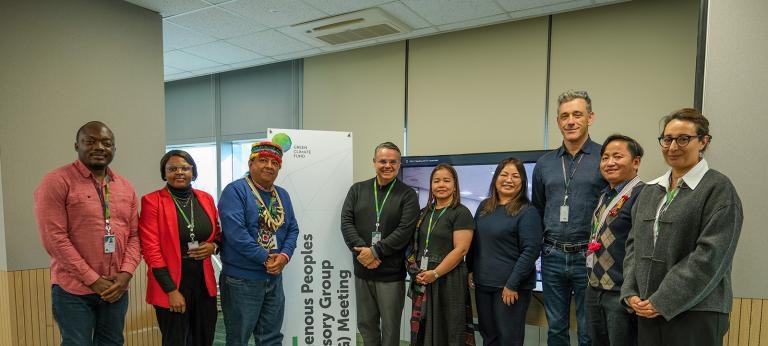
The Green Climate Fund’s Indigenous Peoples Advisory Group convened its seventh meeting (IPAG-7) from December 16 to 19, 2025. Held at the GCF headquarters in Songdo, Republic of Korea, the four-day meeting brought together IPAG members and the GCF Secretariat to review implementation of the Indigenous Peoples Policy and set strategic priorities for enhancing Indigenous Peoples’ access to climate finance.
IPAG-7 kicked off with welcome remarks by Eleni Kyrou, Head of the Office of Sustainability and Inclusion, followed by the election of Helen Biangalen Magata as its Chair. The meeting adopted an agenda focused on strengthening institutional practice and enhancing access to climate finance for Indigenous Peoples.
Participants at the GCF IPAF 7 meeting
The discussions focused on several key areas for 2026, which included establishing GCF’s approach on direct access to climate finance for Indigenous Peoples, organising the GCF Global Conference with Indigenous Peoples, and updating the Operational Guidelines of the Indigenous Peoples Policy to incorporate lessons learned to date.
The IPAG and the Secretariat agreed to co-organise and jointly promote the GCF Global Conference with Indigenous Peoples, which will take place in April 2026. The IPAG also welcomed the inclusion of its members in GCF Regional Dialogues and requested participation in GCF’s 2026 Global Planning Meeting.
The IPAG commended the positive impact of the Indigenous Peoples Policy and committed to issuing a brief highlighting these achievements. However, the group emphasised the need for continued institutional support to strengthen the inclusion of Indigenous Peoples in all GCF processes, including Locally Led Climate Action (LLCA) and REDD+, and to advance the development of dedicated modalities to enhance access for Indigenous Peoples’ organisations.
The IPAG welcomed GCF’s new LLCA framework and invited the Secretariat to develop specific guidance for engaging Indigenous Peoples’ organisations. At the same time, it emphasised that all activities of REDD+ and the Tropical Forest Forever Facility must comply with the Indigenous Peoples Policy and recognise non-carbon benefits.
The meeting closed with appreciation from the IPAG to the GCF leadership and Secretariat for their engagement and collaboration.
The outcomes of IPAG-7 chart a clear path for deepening the GCF’s partnership with Indigenous Peoples and integrating their vital knowledge and leadership into the core of climate finance delivery.
The eighth IPAG meeting is scheduled for May 2026 at the GCF headquarters.
As Nigeria’s population continues to grow, estimated by the United Nations Population Fund to reach over 237 million by 2025 – so does the volume of waste generated across the country. With over 32 million tonnes of solid waste produced annually according to the World Bank, the pressure on city authorities and private stakeholders to develop sustainable waste management systems has never been greater.
Among the most transformative responses to this challenge is the Extended Producer Responsibility (EPR) policy, introduced in 2014 through the National Environmental Standards and Regulations Enforcement Agency (NESREA). This policy gave birth to the Food and Beverage Recycling Alliance (FBRA) in 2018, Nigeria’s first Producer Responsibility Organisation (PRO) for the food and beverage sector.
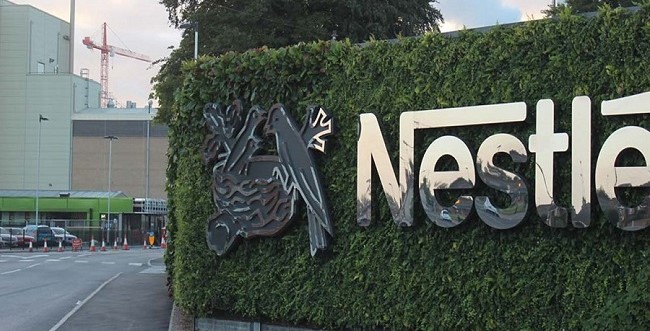
Nestle says it is committed to making 100% of its packaging recyclable or re-usable by 2025 to protect the environment
Since its establishment, FBRA has evolved from a consortium of four founding members into a robust alliance of 42-member organisations by 2025, collectively driving the recovery, recycling, and circular management of post-consumer packaging waste. The Alliance has successfully collected over 100,000 metric tonnes of plastic waste from the environment, redefining waste not as a nuisance but as a resource within Nigeria’s circular economy.
“While FBRA may not be a household name on the streets, its impact is visible in cleaner communities and empowered waste collectors, particularly in Lagos State,” said Victoria Uwadoka, Corporate Communications, Public Affairs and Sustainability Lead at Nestlé Nigeria.
Beyond being one of Nigeria’s largest and most trusted food and beverage companies, Nestlé Nigeria has taken a bold leadership role in environmental sustainability and waste management. The company’s approach goes beyond people and profit, it embraces planet stewardship as a core business principle.
Nestlé Nigeria was one of FBRA’s founding members, and over the years has remained one of its most active supporters and advocates.
Victoria Uwadoka explains: “Though as producers we compete commercially, we unite as collaborators when it comes to fulfilling shared environmental responsibilities.”
This collaborative spirit has been the foundation of Nestlé’s pioneering achievements in packaging innovation and waste recovery. In December 2023, the company achieved 100% plastic neutrality, taking back every tonne of plastic it put into the market. This milestone underscores Nestlé’s commitment to ensuring that the volume of packaging material it introduces into the environment is matched by an equivalent amount recovered and recycled.
Furthermore, Nestlé became the first company in Nigeria to incorporate 50% recycled polyethylene terephthalate (rPET) into its Nestlé Pure Life water bottles, fully compliant with the Standards Organisation of Nigeria’s food-grade packaging standards. This initiative reflects not a one-time commitment but a sustained effort toward circularity, a feat many producers have yet to match consistently.
Through FBRA’s framework, Nestlé Nigeria and other producers have been able to galvanise the waste value chain, from collection to transformation, ensuring that plastics are retrieved, recycled, and reintegrated into production cycles. The Alliance’s model demonstrates that when producers, recyclers, collectors, and regulators collaborate, waste becomes wealth.
“The manufacturers do not produce plastics to litter the streets,” Uwadoka explains. “Consumers discard them, but through FBRA’s system, that waste is recovered, creating jobs and value in the process.”
She further emphasised the importance of circularity in Nestlé’s sustainability approach: “Every bottle that is taken out and doesn’t end up in the ocean is one bottle less of a problem. Closing the loop is key, circularity is the destination. It’s not just about collection but ensuring we use, collect, transform, and reuse.”
The FBRA-Nestlé partnership exemplifies how industry-led collaboration can drive real impact in environmental management. Through shared responsibility, continuous investment, and innovation, both organisations are not only addressing Nigeria’s waste challenges but also advancing global sustainability goals.
As Nestlé Nigeria continues to take the lead in closing the loop and FBRA strengthens the bridge between producers and recyclers, the message is clear: building a cleaner, more sustainable Nigeria is a collective effort – and progress is well underway.
Walking into a typical primary healthcare centre in Nigeria, one is often confronted by overworked health workers juggling long queues, limited diagnostic tools and incomplete patient records.
By contrast, in better-equipped facilities, digital platforms powered by Artificial Intelligence (AI) can already analyse symptoms, flag high-risk cases and support clinical decisions within seconds.
This stark disparity captures Nigeria’s evolving relationship with AI in healthcare; a space marked by high expectations, but also deep concerns about readiness, regulation and public trust.
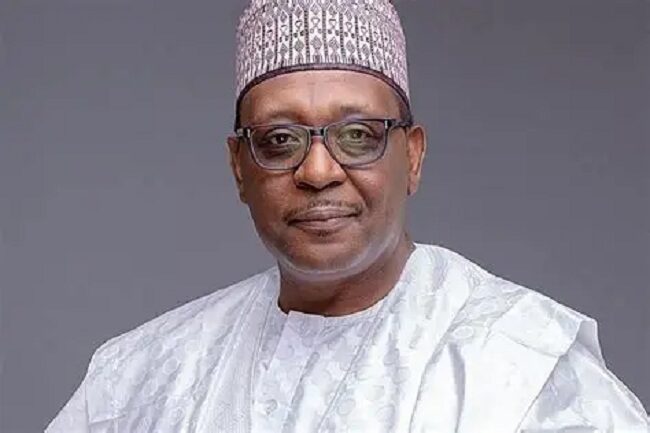
Coordinating Minister of Health and Social Welfare, Dr Muhammad Ali Pate
Health experts say AI has moved beyond the realm of distant innovation to become a practical tool for healthcare delivery in Nigeria.
Its relevance is growing as the country faces an overstretched workforce, a rising disease burden and mounting pressure to achieve Universal Health Coverage (UHC).
In recent months, initiatives such as the launch of AI-enabled healthcare platforms and renewed policy conversations have brought the debate into sharper focus.
While proponents argue that AI could help Nigeria overcome long-standing structural weaknesses, critics warn that weak data systems, poor infrastructure and regulatory gaps may limit its impact, or even cause harm.
Speaking in Abuja at the inauguration of the Koyo Navigate App, an AI-enabled healthcare service platform, the Speaker of the House of Representatives, Mr. Tajudeen Abbas, described AI as a potential equaliser in a health system marked by inequality.
“AI-driven services are not just technological upgrades; they are pathways to better health outcomes, dignity and independence,” Abbas said.
He noted that, globally, AI had proved effective in accelerating diagnostics, supporting early intervention and enabling more personalised care.
Beyond political endorsements, health technology experts say AI is already transforming healthcare delivery worldwide, offering lessons Nigeria could adapt to its own context.
At the Afrihealth Conferences and Exhibitions in Abuja, Dr Kunle Kakanfo, founder of Artificial Intelligence for Social Impact Development (AI4SID), said Nigeria must harness AI to strengthen its fragile health system.
“We are seeing AI used in clinical decision support, with chatbots helping people identify basic symptoms and supporting healthcare workers to determine which conditions require urgent attention,” Kakanfo said.
According to him, AI is also facilitating task-shifting, predictive disease surveillance and more efficient resource planning.
“Given the inefficiencies within our healthcare system, AI can serve as a leapfrog innovation to fast-track efficiency,” he added.
For others, the appeal of AI lies primarily in its ability to stretch Nigeria’s limited human resources.
Mr. Abdulhamid Yahaya, Deputy Director for Global Health Informatics at eHealth Africa, said Nigeria’s low doctor-to-patient ratio made technology indispensable.
“Nigeria is severely overburdened. Community health workers operate with limited tools and resources, yet the patient load is among the highest,” he said.
“So how do you scale? Use AI technology. It helps you to take a simple, effective use case and replicate it thousands, millions of times”.
Similarly, Dr Francis Ohanyido, Director-General of the West African Institute of Public Health, outlined AI as a transformative technology that could redefine work and healthcare delivery if properly understood and managed.
“AI will not take people’s jobs; those who refuse to adapt will lose theirs, AI is here to stay and must be seen as a partner, not a threat,” Ohanyido warned.
He added that a growing AI ecosystem could become a major driver of economic recovery and talent retention if harnessed through innovation, partnerships and sound regulatory frameworks.
“The African AI industry could generate between 13 and 18 billion dollars by 2030.
“If implemented well, Nigeria could lead this growth, attract investment and curb healthcare workforce migration”.
Albeit this optimism, concerns remain substantial.
At the global level, the World Health Organisation (WHO) has warned that although the use of AI in healthcare is accelerating, legal and ethical safeguards are lagging behind.
In a report titled “Artificial Intelligence Is Reshaping Health Systems: State of Readiness across the WHO European Region”, the organisation noted that AI is already helping doctors detect diseases earlier, reduce administrative burdens and improve patient communication.
However, it cautioned that weak regulation could widen inequities rather than close them.
“While the technology is reshaping how care is delivered, data interpreted and resources allocated, without clear strategies, data privacy protections, legal guardrails and investment in AI literacy, we risk deepening inequities,” said Dr Hans Kluge, WHO Regional Director for Europe.
The WHO observed that although many countries recognise AI’s transformative potential, only a few have developed dedicated national strategies, with legal uncertainty and financial constraints remaining major barriers to adoption.
These concerns resonate locally.
Dr Kemisola Agbaoye, Director of Programmes at Nigeria Health Watch, said Nigeria still faces major gaps in data quality, infrastructure, skills and public trust.
“Data is foundational. You cannot build a realistic AI healthcare system without reliable data,” she said.
She also pointed to trust deficits at the community level.
“When communities are told that healthcare workers will rely on AI tools, a great deal of trust-building is required.”
Nevertheless, she acknowledged gradual progress.
“There is a lot happening. Are we ready for AI in healthcare? Not yet; but we are moving in that direction,” she said.
In response, the Federal Government says steps are being taken to address these challenges.
Dr Leke Ojewale, Senior Technical Adviser to the Coordinating Minister of Health and Social Welfare on Digital Health, said the Nigerian Digital Health Architecture (NDHA) is being developed to ensure AI tools operate within a unified and secure system.
“We are building the NDHA to ensure that all AI tools in health plug into a single, interoperable framework,” Ojewale said.
He explained that the architecture would be anchored on national registries and a Health Information Exchange to support secure data sharing and responsible AI deployment.
On the legislative front, the National Assembly has also pledged support for digital health innovation.
The Senate President, Sen. Godswill Akpabio, said lawmakers were committed to advancing legislation that supports telemedicine, electronic health records and the use of AI for diagnosis and surveillance.
“We will advance legislation that supports digital innovation, telemedicine, electronic records and AI-driven diagnosis and surveillance,” he said.
“We must build a digital backbone that connects every primary health centre to every tertiary hospital, ensuring continuity of care, transparency and accountability”.
He stressed that innovation was no longer optional.
“We cannot build a 21st-century nation with 19th-century tools. Innovation is not an accessory; it is our lifeline.”
Even so, experts agree on a critical caveat; AI must complement and not replace human judgement.
Aligning with this view, the Nigeria Medical Association (NMA), Kwara Chapter, said the use of AI in medicine should enhance human intelligence rather than substitute it.
The chapter’s chairman, Prof. Abdulrahman Afolabi, said no algorithm could replicate the compassion, moral reasoning and trust that define the physician-patient relationship.
“Physicians must be active participants in shaping this transformation, not passive observers.
“We must ensure that technology serves humanity, not the other way around,” he said.
Without technology, analysts warn, Nigeria may struggle to meet its UHC targets. With it, the country has an opportunity to improve diagnostics, surveillance and access to care at scale.
For now, the conversation continues, balancing optimism with caution.
Policymakers, health workers and citizens are weighing how best to harness artificial intelligence to strengthen healthcare delivery while protecting patients, data and public trust.
The Anambra State Government has expressed concern over the alleged noise pollution from church activities during school hours in Onitsha, the commercial nerve centre of the state.
Commissioner for Education, Prof. Ngozi Chuma-Udeh, made the remark, while speaking on a petition written to the ministry by a private school in the city.
The school alleged that the noise from the activities of a nearby church during school hours was disrupting its academic activities.
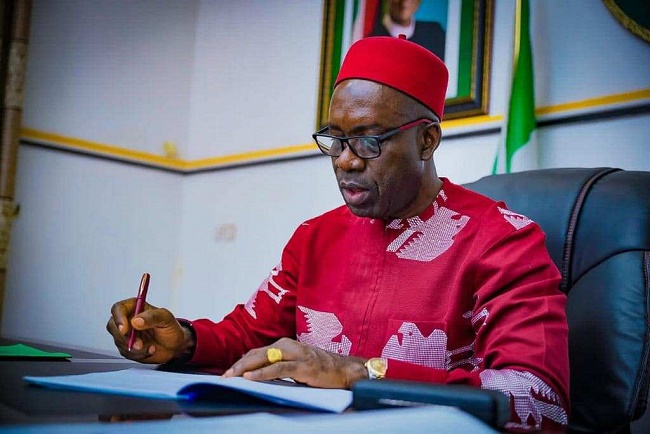
Gov. Charles Soludo of Anambra State
Chuma-Udeh described the development as worrisome.
The petition, signed by the proprietress of the school, Mrs. Ngozi Udeh, was written against Divine Dominion Prophetic Ministry, located directly opposite the school premises.
According to Udeh, the church, which was built in 2024, recently intensified its activities, generating excessive noise, particularly on Tuesdays, when services reportedly run from 10:00 a.m. to 4:00 p.m.
She further alleged that the noise was consistently distracting students and teachers, thereby disrupting teaching and learning during school hours, in spite of several appeals to the church leadership.
Addressing both parties in her office in Awka, on Tuesday, January 13, 2026, the commissioner said the Gov. Chukwuma Soludo-led administration would not condone any act that infringes on the constitutional right of students to learn in a peaceful and conducive environment.
She emphasised that noise pollution was an offence under the Nigerian law and was punishable once established.
She, therefore, advised religious institutions to ensure that noise generated from their premises was properly contained, especially when schools are located within hearing distance.
Chuma-Udeh also urged the church leadership to explore peaceful ways of coexisting with the school, in alignment with the true values of Christianity, and given that the school had existed in the area before the church was built.
She ordered the church to reschedule its weekday activities to commence from 4:00 p.m., after school hours.
She warned that failure to comply with the directive would compel the ministry to involve the Ministry of Environment, with the attendant legal consequences.
The commissioner said that while churches might hold activities from morning to evening on Saturdays and Sundays, external examinations, such as WAEC, NECO and JAMB, must take precedence, even on Saturdays.
Responding, the Assistant Pastor of the church, Mr. Emmanuel Ukpabi, promised that the church would work harmoniously with the school to ensure mutual respect and peaceful coexistence.
The Dangote Petroleum Refinery has launched an expansion programme to more than double capacity from 650,000 barrels per day to 1.4 million within three years.
The Managing Director and Chief Executive Officer, Mr. David Bird, disclosed this on Wednesday, January 14, 2026, during an interactive media session in Lagos.
Bird said the expansion would use a “roofless replication” model, duplicating existing infrastructure to accelerate delivery without altering core engineering designs.
Managing Director and Chief Executive Officer, Mr. David Bird, with other Dangote Petroleum Refinery officials at the media session
“Once engineers start tinkering with designs, projects return to prolonged engineering stages. Our approach avoids that.
“We will not re-engineer or redesign. This allows us to move directly into procurement and construction,” Bird said.
He expressed confidence the expansion would be completed within three years, citing extensive preparatory work already carried out at the Lekki site.
Bird said procurement of long-lead items would begin immediately, with completion targeted for the first quarter of 2026.
He added that site preparation and piling works were expected to begin before the end of January 2026.
“The remarkable thing about this site is the foresight of Aliko Dangote.
“The land has already been reclaimed, raised and prepared. Much of the pre-investment that delays projects has already been done,” he said.
Bird said steelwork for the expansion could begin emerging before the end of the year, reinforcing confidence in the project timeline.
He said the refinery would continue prioritising local capacity development by upskilling Nigerian workers and deepening domestic technical expertise.
On operations, Bird said the refinery imports 100 per cent of its crude feedstock by sea, enabling it to process diverse crude grades.
“This is not a traditional refinery tied to a single pipeline or crude stream.
“We can process Nigerian grades, alternative crudes, intermediate feedstocks and blending components. That flexibility guarantees security of supply,” Bird said.
He said advanced conversion units, described as the plant’s “moneymakers”, enable production of high-quality fuels meeting market specifications.
In spite of not operating at full capacity, Bird said the refinery consistently delivers products safely and reliably, even during planned maintenance.
“We have built enough resilience to take individual units offline and still meet market demand,” he said.
Bird said the refinery supplied over 50 million litres of Premium Motor Spirit daily throughout the festive season.
He disclosed current PMS production of between 50 and 52 million litres daily, with average truck-out volumes of about 50 million litres.
On the naira-for-crude policy, Bird said discussions were ongoing with NNPC Ltd. to increase crude supply under the arrangement.
He urged stronger implementation by government and regulators.
“Effective execution of the naira-for-crude policy is critical to boosting domestic refining, stabilising fuel prices and easing operational pressures,” Bird said.
Bird, an Australian and former Shell executive, assumes office in July 2025.
His appointment marks a strategic shift as the refinery scales operations and consolidates its role in Africa’s energy landscape.
Bird brings over 17 years’ global experience, with senior roles across Australia, Singapore and the United States.
He previously served as Vice President of Shell’s Prelude Floating LNG Project and supported commissioning of the Motiva Refinery in Texas.
In Singapore, he managed Shell’s largest Asian refinery, overseeing over 500,000 bpd and major expansion projects.
He also served as Senior Vice President at Santos Ltd and most recently as Chief Executive Officer of OQ8 in Muscat, Oman.
Industry analysts say Bird’s experience positions him strongly to lead Dangote Refinery, seen as central to Nigeria’s industrial revival and energy security goals.
The Niger Delta Blue Economy Investment Summit has initiated a strategic partnership with Caverton Marine to promote safer, more efficient, and climate-friendly marine transportation across the Niger Delta.
The collaboration, announced following a high-level engagement between the Summit’s organising committee and Caverton Marine in Lagos, is aimed at addressing persistent safety challenges on the region’s waterways while accelerating the adoption of modern, low-emission passenger vessels.
Caverton Marine, an indigenous boat manufacturing and marine logistics company, has gained national recognition for its role in transforming water transportation in Lagos through public-private partnerships, including the recent delivery of world-class passenger ferries for the Lagos State Government.
Summit Co-convener, Dr. Uche Igwe (right), in a warm exchange with the Managing Director of Caverton Marine, Mr. Olubode Makanjuola
Speaking after the meeting, Cedric Ogwu, a member of the Summit’s organising committee, said the engagement was driven by the need to replicate proven models of success in the Niger Delta.
“We are encouraged by the visible improvements in water transportation and passenger safety in Lagos and by the role Caverton has played in achieving those outcomes. The Summit provides a platform to explore how similar solutions can be deployed across the Niger Delta, where water transport is not optional but essential,” he said.
Ogwu noted that the Summit will serve as a convening space for governments, investors, and operators to scale infrastructure that reduces accidents, improves commuter confidence, and supports sustainable economic activity in coastal communities.
Responding, the Managing Director of Caverton Offshore Group, Mr. Bode Makanjuola, welcomed the partnership and described the Summit as a timely intervention.
“The vision behind this Summit is ambitious, and we are keen to be part of it. Caverton is already working with some states in the Niger Delta, but there is room to do much more,” he said.
Makanjuola disclosed that the company now manufactures passenger boats that meet global safety and quality standards, including fully electric ferries designed to lower operating costs and reduce environmental impact over the long term.
“Many accidents on our waterways are preventable, often linked to equipment failure and substandard vessels. By deploying certified boats built to international specifications, these risks can be significantly reduced,” he added.
Also commenting, Co-convener of the Summit, Dr. Uche Igwe, said Caverton’s entry into electric ferry manufacturing aligns strongly with global energy transition goals.
“The development of fully electric ferries presents a major opportunity for the Niger Delta. It supports climate mitigation, reduces carbon emissions, and positions the region to attract green investment into marine transportation,” he said.
The Niger Delta Blue Economy Investment Summit will hold from February 9 to 11, 2026, at Four Points by Sheraton Hotel, Ikot Ekpene, Akwa Ibom State. The event will bring together policymakers, investors, industry leaders, and development partners to unlock investment opportunities across the region’s blue economy.
Attendance by high-level speakers and resource persons, including former Prime Minister of Tunisia, Mehdi Jomaa, has been confirmed.
A new report by the Copernicus Climate Change Service shows that 2025 was the third hottest year on record, marking the first time that a three-year period has exceeded the 1.5°C limit. Experts warn that, based on the current rate of warming, the 1.5°C heating threshold will likely be breached by the end of 2030, or over a decade earlier than predicted.
The report notes that air temperature over global land areas was second warmest, while the Antarctic saw its warmest annual temperature on record. Temperature rise in 2025 was mainly due to “the build-up of greenhouse gases in the atmosphere, from continued emissions and reduced uptake of carbon dioxide by natural sinks” – underscoring the urgent need for a fossil fuel phaseout.
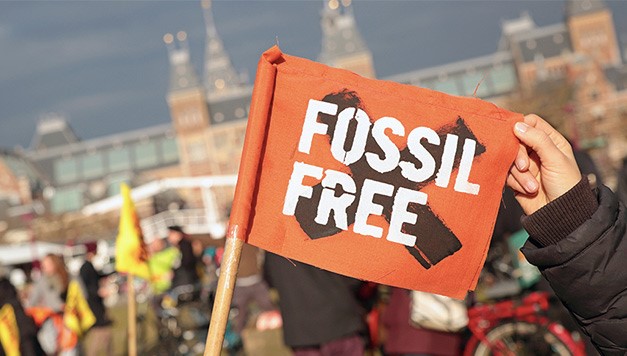
Fossil fuel divestment campaign
Just two weeks into 2026, wildfires ravaged parts of Australia and Argentina, and South Africa, a snowstorm brought disruption in Europe, and floodwaters inundated Indonesia.
Savio Carvalho, 350.org Managing Director for Campaigns and Networks, said: “Another year in the top three hottest on record, and communities everywhere are feeling it. Extreme weather isn’t rare anymore – it’s driving up food prices, insurance premiums, water shortages, and upending daily life across the globe.
“Governments know fossil fuels are the cause of climate breakdown, yet they keep stalling on the transition. We don’t have the luxury of wasting time or taking side paths – we are running out of time. We need to do what’s right now: a global phase out of fossil fuels is urgent. We already have the renewable energy solutions we need – what’s missing is the political will. We can prevent the worst if we act now.”
Fenton Lutunatabua, 350.org Programme Manager Pacific & Caribbean, said: “We cannot afford to let the 1.5-degree target slip away. We literally cannot afford the financial cost of it. In the Pacific, climate disasters are costing us billions of dollars in recovery and rebuilding. A world beyond 1.5 degrees would devastate our resources even more. The cost of this trajectory extends beyond finances; it threatens the very existence of our people. Entire villages in Fiji are being uprooted and relocated, losing connection to traditional lands and fishing grounds.
“Atoll nations like Tuvalu and the Marshall Islands are grappling with both adaptation and addressing the reality of potential forced migration. To give up on 1.5 degrees is to say that any of these realities are acceptable. Every fraction of a degree we can save is a chance at a livable future for our people. We can only do that by moving beyond fossil fuels as rapidly as possible.”
Meanwhile, Indonesia experienced some of the worst climate-fueled disasters in 2025. More than 1,100 lives were lost in Sumatra after a rare tropical cyclone triggered flash floods, while 18 were killed in Bali’s worst flooding in decades. Bali flood victims, including a 350.org organiser, are suing the Indonesian government for damages, following an International Court of Justice ruling on state accountability for climate harms.
Suriadi Darmoko, 350.org Organiser and plaintiff in Bali climate lawsuit, said: “Entire communities are still buried in mud. Thousands of families are still grieving and struggling to have their basic needs met. We refuse to be treated as mere climate disaster victims. Our leaders have kept the world hooked on fossil fuels even as they knew decades ago it would lead to such tragedies.
“The Indonesian government must honour its commitments to limit temperature rise below 1.5 C and take immediate action to phase out fossil fuels. Science and justice is on our side – we’ll make sure that big polluters pay for climate devastation.”
Founder and chairman of the Savannah Centre for Diplomacy, Democracy & Development, and former Chief of Staff to President Muhammadu Buhari, Prof. Ibrahim A. Gambari, has commiserated with Maureen Chigbo and her family on the tragic loss of her elder sister, Barrister Nwamaka Chigbo, on January 5, 2026.
The condolence letter, personally signed by Prof. Gambari and addressed to Dr Maureen Chigbo, was dated January 12, 2026.
“I sincerely sympathise with you and your family on this huge and irreplaceable loss. I want to take solace in the knowledge that your sister has lived her life in accordance with the teachings of Jesus Christ and has touched so many lives with her benevolence,” said Gambari, who was also former Permanent Representative of the Federal Republic of Nigeria to the United Nations and former Under Secretary-General and Head of the United Nations Department of Political Affairs.
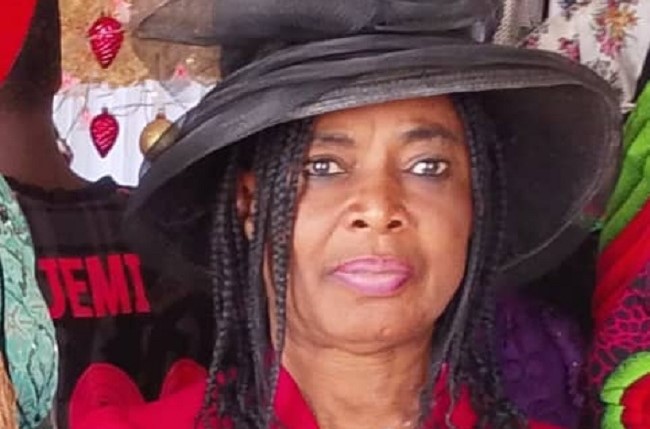
The late Princess Nwamaka Mediatrix Chigbo
He prayed for Nwamaka’s soul to rest in peace, adding: “And may the Lord give you and the family the fortitude to bear this pain.”
Realnews reports that the family of Princess Nwamaka Mediatrix Chigbo, an Abuja-based lawyer, sadly announced her brutal death at the hands of still-to-be-identified kidnappers in the Nigerian Federal Capital Territory on Monday, January 5, 2026.
Before her abduction, Barrister Nwamaka was on the phone with her sister Anthonia, who briefly interrupted the call to attend to a client. When she reverted, the barrister’s phone was still live, and Anthonia could hear her sister’s distress cry before the phone suddenly went dead and unreachable.
Anthonia alerted her elder sister, Maureen Chigbo, and other family members, who called the lawyer’s number repeatedly to reach her or her abductors to no avail.
When a call finally went through, a male voice rained curses in English and Hausa language, saying: “Thunder fire you there, send three million Naira or else we will kill her.”
The captors gave no further details and abruptly terminated subsequent calls. Barrister Nwamaka’s family later tried to contact the Police Force Public Relations Officer and left a text message on her phone. They were referred to two police complaint numbers.
The family equally sent a distress text and WhatsApp message to the Inspector General of Police (IGP), and also contacted the FCT Police Commissioner, who immediately linked them up to the Commander of the Scorpion Squad, in charge of kidnapping in Abuja.
The Commander later called to inform the family that the police were tracking the kidnappers, who were said to be “in motion and would likely drop the lawyer off once they might have collected the ransom.”
The kidnappers never initiated any calls, and when Nwamaka’s family members reached them through her phone for clarification on how the ransom would be paid, they only heard the lawyer screaming in pain, “I am dying. …save me, please send the money, I am dying,” before the phone finally went dead again.
The family maintained contact with the Police Commander throughout Monday night to follow up on the rescue operation.
At 4 am on Tuesday, January 6, when Maureen called the Commander, he expressed surprise that the lawyer had not called or returned home. He then promised to escalate the rescue operation.
The Commander later called to inform the family that “a lady had been found in a critical condition” and taken to an Abuja specialist hospital. He requested that Nwamaka’s picture be sent for identification purposes.
Maureen immediately took a flight from Lagos to Abuja and, on reaching the hospital, saw her sister’s lifeless body in the mortuary with bruises, swollen eyes, and a cracked skull, all signs of a tortured death.
The Chigbo family has met with the Police authorities, who assured them that the case was under investigation and that the culprits would be apprehended.
Nwamaka was an active member and former treasurer of the Nigerian Bar Association, Abuja, member of the International Federation of Women Lawyers (IFWL), FIDA and Global Association of Female Lawyers (GAFA). She was a former President of Catholic Lawyers Association, Abuja.
An ardent Catholic, Nwamaka authored a book on Infant Jesus, and until death was the vice president of the Infant Jesus Association, member of the Mother of Perpetual Help Catholic Group among other religious groups.
The family expresses its gratitude to the Police for their efforts and cooperation so far, and urges the force to ensure that justice is served in Nwamaka’s case.
The family also wishes to thank Nwamaka’s friends, colleagues and well-wishers for their support and prayers. Her funeral arrangements will be announced as soon as possible.
TotalEnergies has announced the signing of an agreement with Vaaris for the sale of its 10% non-operated interest in the Renaissance Joint Venture (formerly SPDC JV) in Nigeria, for a total consideration of $800 million. The transaction is subject to customary closing conditions and regulatory approvals.
The Renaissance JV, comprising NNPC Ltd (55%), Renaissance Africa Energy Company Ltd (30%, operator), TotalEnergies EP Nigeria (10%), and Agip Energy and Natural Resources Nigeria (5%), holds 18 licenses in the Niger Delta region.
TotalEnergies
Under the agreement, TotalEnergies will transfer its 10% interest in 15 oil-producing licenses and three gas-producing licenses to Vaaris. TotalEnergies will retain full economic interest in the gas licenses, ensuring continued support for Nigeria LNG, which currently sources 50% of its gas supply from these assets.
TotalEnergies continues its portfolio reshuffling in Nigeria after key milestones achieved in 2025 focusing on operated assets: entry in PPL2000/2001 offshore exploration in August 2025, the increase of stakes in OPL257 and the sale of non-operated OML118 both in November 2025.
TotalEnergies says it is committed to support the country strategy to grow production in Nigeria: onshore along the gas value chain as demonstrated by the FID of Ubeta gas project in 2024 on OML58 and offshore oil and gas.
The Christmas Eve fire outbreak at a 25-storey building on Lagos Island has once again thrust Nigeria’s emergency response system into the public spotlight.
It has also renewed concerns over the country’s preparedness for large-scale disasters.
According to the Lagos State Emergency Management Agency (LASEMA), the inferno at the Great Nigeria Insurance building claimed three lives and left at least 12 others injured, while goods worth millions of naira were destroyed.
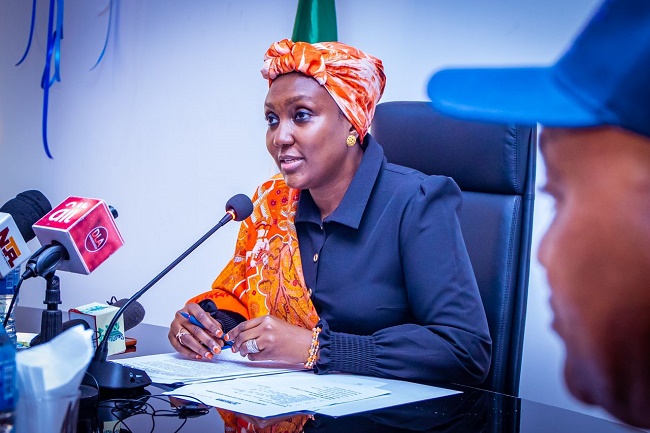
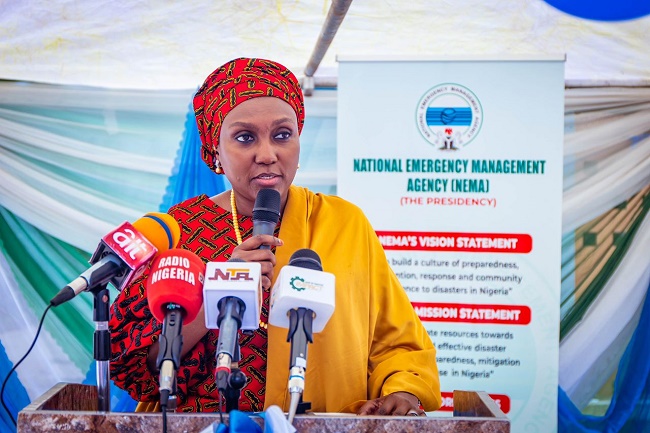
Director-General of NEMA, Zubaida Umar
Disturbingly, the bodies of the deceased were only recovered from the rubble four days after the incident; an outcome that has fuelled public criticism.
This is not an isolated case.
Previous fire incidents, including the blaze that displaced traders at the Tejuosho Market in Yaba, Lagos, were similarly met with complaints from victims over delayed and poorly coordinated responses.
Beyond fire outbreaks, other emergency situations have also exposed systemic weaknesses.
On Dec. 29, a tragic road crash involving British-Nigerian boxer Anthony Joshua at the Sagamu end of the Lagos–Ibadan Expressway claimed the lives of two of his friends.
Although dissimilar in nature, the handling of the aftermath attracted widespread criticism, especially over the timeliness and efficiency of emergency services.
Against this backdrop, experts describe Nigeria’s emergency response landscape in 2025 as one of mixed fortunes.
On the one hand, it has been marked by catastrophic failures; on the other, by the gradual emergence of technology-driven solutions.
Albeit the existence of a formal institutional framework under the National Emergency Management Agency (NEMA), analysts argue that the system remains dangerously reactive rather than proactive.
Dr Adeleke Pitan, an emergency response expert, notes that the current approach often waits for disasters to occur before mobilising resources, instead of using predictive data to pre-position assets in high-risk locations.
He emphasised that the first 60 minutes following a traumatic incident; the so-called ‘Golden Hour’, is critical to survival.
However, in Nigeria, this window is frequently lost to traffic congestion, weak communication systems and the absence of decentralised response units.
The devastating floods in Mokwa, Niger State, in May 2025 underscore this challenge.
The disaster left 159 people dead and nearly 100 others missing.
NEMA said it had issued early warnings ahead of the flooding, working in collaboration with the Nigerian Meteorological Agency (NiMet) and the Nigeria Hydrological Services Agency (NIHSA).
“In collaboration with NiMet and NIHSA, NEMA’s early warning systems involved disseminating seasonal climate predictions and real-time flood alerts via radio, television, social media and town criers,” the agency said.
Nevertheless, analysts such as Richard Davies argue that early warnings alone are insufficient when local emergency infrastructure lacks the capacity to respond.
Citing a joint assessment by the International Organisation for Migration (IOM), NEMA and partners, Davies said 3,018 individuals across 503 households were directly affected by the Mokwa floods.
“Of these, 1,590 people were displaced, while 1,428 remained in damaged or flooded homes. At least 265 houses were destroyed and a further 20 were severely damaged,” he said.
Beyond weak local capacity, limited resources remain a major constraint for emergency responders.
A recent publication by Emergency Response Africa (ERA) revealed that, as of early 2025, Lagos State reportedly had only one functional heavy-duty crane dedicated to major rescue operations.
“Many critical tools such as cranes, earthmovers and fire trucks have exceeded their operational lifespan,” the report stated.
“As of 2024, the state reportedly had just one functional crane for major rescue operations, which is grossly inadequate for a megacity of over 20 million people.
“Compounding the problem, spare parts for these ageing machines are increasingly difficult to source, as some models are no longer in production.
“This forces LASEMA to depend on private contractors for critical equipment; an option that is both costly and unreliable,” ERA added.
The healthcare technology firm also identified low public awareness, shortages of skilled emergency personnel and fragmented coordination among response agencies as persistent challenges.
Experts argue that effective emergency management must begin long before disasters occur, through strict regulatory enforcement.
They stress that agencies such as state ministries of physical planning must be fully integrated into the emergency response chain to prevent avoidable incidents.
They cite the Ojodu-Berger building collapse of April 2025, which left one person dead and 13 others trapped.
Investigations later revealed that the structure had undergone unauthorised modifications.
More broadly, analysts observe that disaster management in Nigeria is frequently hampered by weak coordination among federal, state and local institutions.
To address this, they advocate the creation of a unified digital dashboard to enable real-time inter-agency coordination, alongside the full implementation of a functional national ‘112’ emergency helpline.
Public–private partnerships are also gaining attention.
For instance, collaborations with firms such as ERA deploy GPS-enabled routing systems to dispatch the nearest available ambulance, helping to bypass referral delays that often prove fatal.
NEMA’s Director-General, Mrs. Zubaida Umar, has consistently called for a fundamental shift in thinking; from reaction to prediction.
“Emergency management can no longer be reactive; it must be predictive, preventive and participatory.
“Our citizens should not encounter us only when disaster strikes. They should see us every day, building safer communities, raising awareness and ensuring preparedness,” she said.
Experts say this shift must be backed by investment in physical mitigation measures such as dams, embankments and improved drainage systems, rather than allocating the bulk of resources to post-disaster relief.
Similarly, long-term recovery efforts should move beyond the distribution of relief materials to rebuilding climate-resilient housing and restoring farmlands after floods.
As part of a broader overhaul, analysts also argue that Nigeria must abandon the practice of waiting for emergency fund approvals after disasters occur.
Instead, they recommend the establishment of dedicated, pre-approved state-level emergency funds that can be accessed immediately once a disaster is declared.
This, they say, would require states to halt the diversion of ecological funds and ensure that every local government area maintains a trained Community-Based First Responder network.
Finally, experts call for a comprehensive review of the National Disaster Response Plan to reflect modern emergency response strategies and clearly define the roles and call-out procedures of all stakeholders.