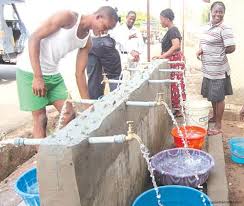
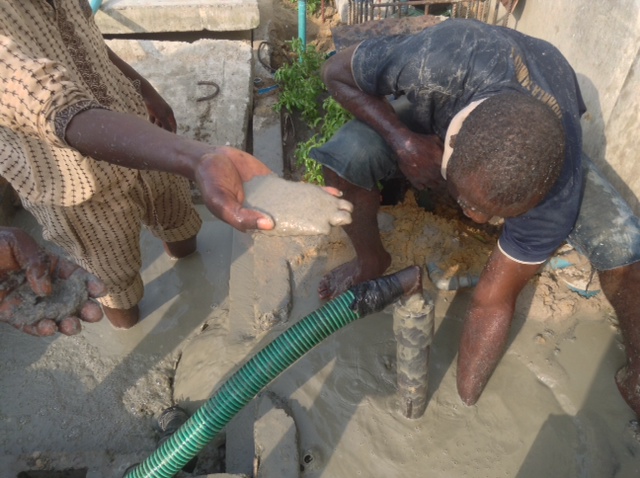
Some residents in Lagos want the state government to make portable water accessible to all to address the high cost of buying the commodity and to check the spread of water borne diseases.
They made the call while speaking with correspondent Innocent Onoh on the occasion of this year’s World Water Day Celebration with theme: “Wasted Water”.
The 29th Meeting of the Adaptation Fund Board, which was held in Bonn, Germany on March 16 to 17 2017, has endorsed a $6.8 million proposal submitted by the World Meteorological Organisation (WMO) entitled: “Agricultural Climate Resilience Enhancement Initiative (ACREI).” Targeted countries include Ethiopia, Kenya and Uganda.
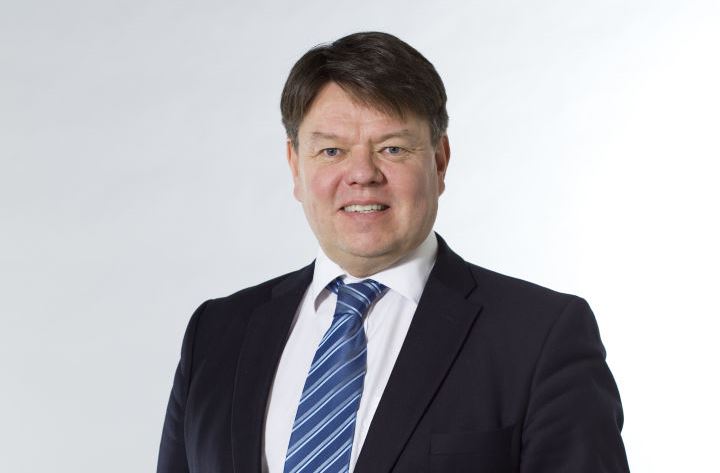
Petteri Taalas, Secretary-General of the World Meteorological Organisation (WMO).
This makes WMO the first Multilateral Implementing Entity to have a regional proposal approved by the Adaptation Fund Board under the Pilot Programme for regional projects and programmes.
The goal of the project is to develop and implement adaptation strategies and measures that will strengthen the resilience of vulnerable smallholder farmers, agro-pastoralists and pastoralists in the Horn of Africa to climate variability and change in line with the IGAD Drought Disaster and Sustainability Initiative (IDDRSI) programme, the National Adaptation Plans of Action (NAPAs) and Development Strategies/Visions of participating countries.
The project will seek to improve adaptive capacity and resilience to current climate variability and change among target farmers, agro-pastoralists and pastoralists community in Ethiopia, Kenya and Uganda which are extremely vulnerable to climate variability during the last 30-60 years.
The project will be implemented by WMO. Executing Entities will include the Food and Agricultural Organisation (FAO) and the Inter-Governmental Authority on Development (IGAD), with active participation of the National Meteorological and Hydrological Services (NMHS) of the targeted countries.
The Adaptation Fund finances projects and programmes that help vulnerable communities in developing countries adapt to climate change. Initiatives are based on country needs, views and priorities. It was was established under the Kyoto Protocol of the UN Framework Convention on Climate Change, and has committed some $357.5 million in 63 countries since 2010 for climate adaptation and resilience activities.
The Fund is financed in part by government and private donors, and also from a two per cent share of proceeds of Certified Emission Reductions (CERs) issued under the Protocol’s Clean Development Mechanism projects.
In May 2015, The Fund invited eligible Kyoto Protocol Parties to submit proposals for regional (multi-country) projects and programmes, using the services of accredited multilateral (MIE) and regional (RIE) implementing entities, and involving national implementing entities (NIEs) when possible, and/or other national institutions, in implementation arrangements. Proposals submitted would be considered under the pilot programme for regional projects and programmes of the Adaptation Fund. WMO is the first MIE to be the beneficiary of this pilot programme with ACREI.
Speaking to Pacific island leaders and diplomats in Suva recently, the incoming President of the UN Climate Change Conference in Bonn in November (COP23), Fijian Prime Minister Voreqe Bainimarama, said his most important goal was to preserve the multilateral consensus for decisive action on climate change that was reached in the Paris Climate Change Agreement at the end of 2015.
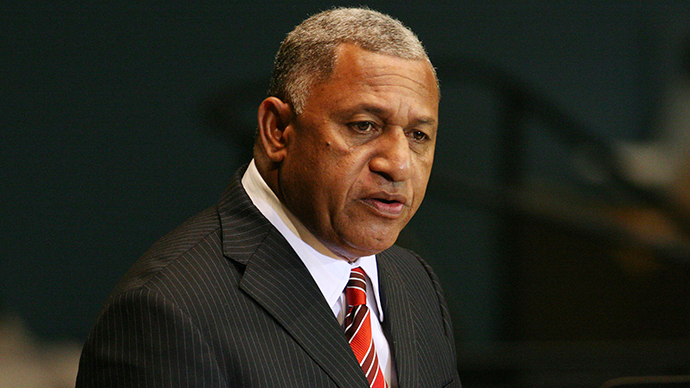
Voreqe Bainimarama, Prime Minister of Fiji
“We cannot afford to have any government renege on the commitments that were made. Many countries face short-term domestic pressures, and there is no doubt that changing the behaviors that led us to this crisis will not be easy, but the rewards will be great. And besides, we have no choice,” he said.
The Fijian Prime Minister was speaking at a preparatory meeting for the UN Ocean Conference in June. The conference is designed to help reverse the decline in the health of world’s oceans, currently under threat from growing pollution and the impacts of climate change.
“In a very real sense, we are fighting a two-front war. One front is the fight to keep the oceans clean and to sustain the marine plant and animal life on which we depend for our livelihoods and that keep the earth in proper balance,” the Fijian leader said. “The other front is the fight to slow the growth of global warming and, unfortunately, also to adapt to the changes we know are coming – to rising seas, encroaching sea water, violent storms and periods of drought.”
The Fijian Prime Minister called on Pacific island leaders to persuade all governments to adhere to the universal agreement clinched in Paris and to fully implement it, and to prompt other leaders to start devising more radical action to accelerate the reduction of carbon emissions. In terms of his priorities for COP23, the incoming President of the Bonn meeting Voreqe Bainimarama said he intended to place a special emphasis on climate adaptation through financial models and technical solutions, to get the world to focus on developing new and innovative ways to build resilience to the effects of climate change.
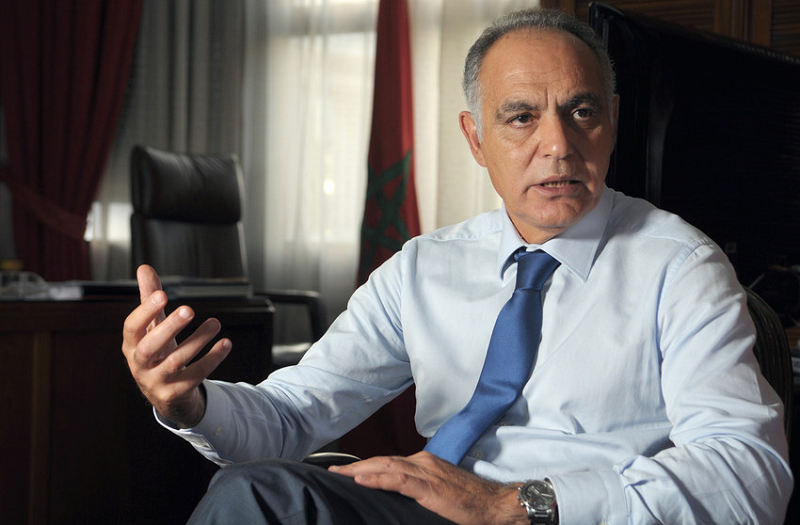
COP22 President and Morocco’s Minister of Foreign Affairs, Salaheddine Mezouar, presided over a meeting of the COP22/CMP12/CMA1 Bureau, on Friday, March 17 2017 in Rabat, Morocco, that included the participation of the international members of the COP22/CMP12/CMA1 Bureau, a high-level delegation from the United Nations Framework Convention on Climate Change (UNFCCC) headed by Executive Secretary, Patricia Espinosa and the chairs of the two permanent subsidiary bodies of the Convention; the Subsidiary Body for Scientific and Technological Advice (SBSTA) and the Subsidiary Body for Implementation (SBI), in addition to Ambassador Deo Saran representing the incoming COP23 Fiji Presidency.
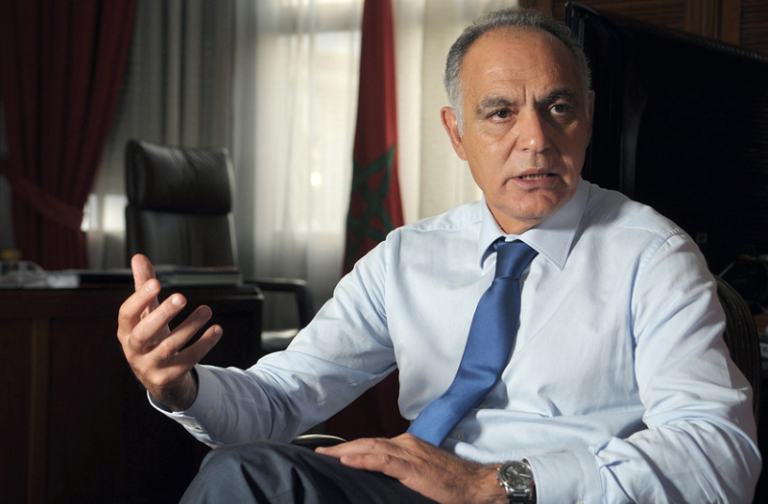
COP22 President, Salaheddine Mezouar
This meeting served as an opportunity to review the outcomes of COP22 and the initiatives of the Moroccan Presidency that will continue to exercise the function until November 2017, as well as to advance preparations for the forty-sixth sessions of the SBSTA and the SBI and the third part of the first session of the Ad Hoc Working Group on the Paris Agreement (APA) to be held from 8-18 May 2017 in Bonn, Germany, headquarters of the UNFCCC Secretariat. The meeting was also an occasion to exchange on expectations for COP23 to be organized by Fiji in Bonn from 6-17 November 2017.
The President emphasised the continued commitment of governments to the Paris Agreement, which has now been ratified by 134 parties. He also highlighted that COP22 strengthened the role of the private sector and civil society and that their commitment to climate action is essential to move forward towards a low carbon future.
“Work continues after Marrakech and we continue to make progress on our established roadmap and focus on climate finance. COP22 was on African soil and surpassed expectations. The success of Marrakech was the result of commitments from all stakeholders, consolidation around the implementation of the Paris Agreement and the role of non-state actors in climate action” declared Salaheddine Mezouar.
He updated the bureau on the financial roadmap as well as on some of the concrete initiatives supported by the Moroccan presidency, including the creation of the Blue Fund for the Congo Basin, the ad-hoc committees’ ambitious regional project in the Sahel, and support to Small Island Developing States.
At the COP22 Marrakech conference, governments confirmed their commitment to make rapid progress towards full implementation of the Paris Climate Change Agreement, the first universal agreement which aims to prevent global warming rising beyond humanity’s ability to manage the impacts. This new era of implementation and action for climate and for sustainable development was captured in the Marrakech Action Proclamation.
“The next two years must see major progress towards the low carbon, sustainable development model which offers the only realistic path to security and well-being for everyone. Marrakech showed that governments, business and civil society together are acting to achieve that timetable,” said Patricia Espinosa, Executive Secretary of UNFCCC.
The May Sessions in Bonn will be an opportunity to advance work on the Paris Agreement Rulebook and Facilitative Dialogue both scheduled for completion by 2018.
Nigerian-born British boxer, Anthony Oluwafemi Joshua, who is the current International Boxing Federation (IBF) heavyweight champion, reckons he can become Britain’s first sporting billionaire.
Anthony Joshua
His first target is £284 million, made by David Beckham (footballer), considered to be Britain’s richest sportsman of all time.
Joshua has done the sums and thinks it is possible to break the one-billion-pounds barrier by the time he hangs up his gloves.
But first, the Watford’s world heavyweight champ will need to rustle up some hundreds of millions of pounds to displace the iconic Beckham.
If he could double that, Joshua could take over from American Floyd Mayweather as the biggest ring earner.
Joshua, 27 said:”When I first started, the aim was to become a multi-millionaire. Being a millionaire is good but you have to set your sight higher.
“If I’m making £10 million from my next fight, my next target has to be making 10 times than that. And if I get to 100-15 million pounds, why not go for the billion.
Joshua’s next payday is his April 29th superfight with Wladimir Klitschko in front of 90,000 fans at the Wembley. And the former hero is predicting he will KO the former world champion, who will be 14 by fight night.
Despite it being only Joshua’s 19th pro bout, the IBF Champ said: “I think I’ll knock Klitschko out.”
His last fight saw Joshua knockout Eric Molina in the third round.
He has held the IBF heavyweight title since 2016, having previously held the British and Commonwealth heavyweight titles from 2015 to 2016.
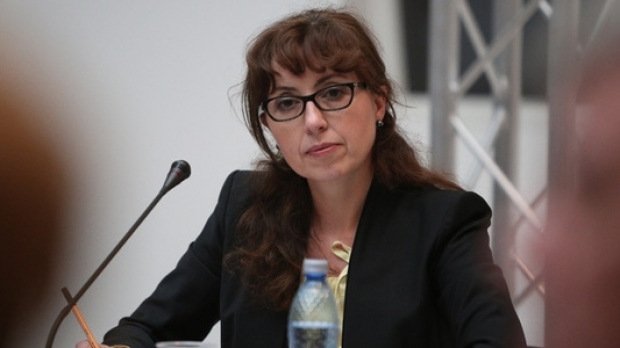
Cristiana Paşca Palmer on Monday, March 20, 2017 assumed office as the new Executive Secretary of the Convention on Biological Diversity (CBD), the principal global treaty on biodiversity. She succeeds Braulio Ferreira de Souza Dias, who served as Executive Secretary between January 2012 and February 2017.
Cristiana Paşca Palmer, Executive Secretary of the Convention on Biological Diversity (CBD)
Adopted by governments in 1992 in Rio de Janeiro, Brazil at the same time as the UN Framework Convention on Climate Change (UNFCCC), the Convention has near-universal membership, with 196 Parties. The overarching goals of the Convention are the conservation of biodiversity, the sustainable use of its components, and the fair and equitable sharing of the benefits arising from the utilisation of genetic resources. Two protocols have been adopted under the Convention. They include the “Cartagena Protocol on Biosafety Cartagena Protocol on Biosafety” and the “Nagoya Protocol on Access to Genetic Resources and the Fair and Equitable Sharing of Benefits Arising from their Utilisation”.
Ms. Paşca Palmer assumes her duties following the successful conclusion of the CBD COP13 Conference (thirteenth meeting of the Conference of the Parties to the Convention on Biological Diversity, Eighth meeting of the Conference of the Parties serving as the meeting of the Parties to the Cartagena Protocol on Biosafety, Second meeting of the Conference of the Parties serving as the meeting of the Parties to the Nagoya Protocol on Access and Benefit-sharing), held last December in Cancun, Mexico. Ms. Paşca Palmer has extensive experience in policymaking on the environment and sustainable development, as well as with the implementation policies, programmes and projects at the national and international levels.
A Romanian national, Ms. Paşca Palmer most recently served, from November 2015 to January 2017, as Romania’s Minister for Environment, Waters and Forests. In that capacity, she headed the Romanian delegation at the 2015 Paris Climate Conference, where she signed the agreement on behalf of Romania, the 2016 Marrakech Climate Change Conference, and the 2016 UN Biodiversity Conference in Cancun. As Head of the Ministry of Environment, Ms. Paşca Palmer oversaw eight individual agencies – including the National Environmental Protection Agency, the Environmental Fund Administration, the National Forest Authority, Romania’s Water Administration, and the Romanian Meteorological Administration – totaling approximately 30,000 staff and a $250 million annual budget.
Prior to serving as Minister for Environment, Waters and Forests, Ms. Paşca Palmer was Head of the Climate Change, Environment and Natural Resources Unit within the European Commission’s Directorate-General for International Cooperation and Development between 2011 and 2015. Her duties included overall management of European Union international cooperation and development in the areas of environment, climate change, forests, desertification, and disaster risk reduction.
One of the most significant biodiversity related efforts conceived and led by Ms. Paşca Palmer was the design of the EU’s “Biodiversity for Life Initiative” (B4Life), a $1.2 billion comprehensive flagship programme, financing innovative initiatives linking biodiversity conservation with food security and green economy transformation. She was also a Policy Analyst on International Relations and the Western Balkans in the European Commission’s Directorate-General for Climate Action, from 2010-2011.
Ms. Paşca Palmer also brings experience in mobilising civil society in support of the environment. She was the founder and president of Green Cross Romania and was Country Director Romania for Fauna & Flora International (FFI), often referred to as the world’s first conservation society, where she, among other things, managed FFI’s in-country operations in Romania during the implementation of a $8.8 million GEF and World Bank Biodiversity Conservation Project, which pioneered the first system for protected areas’ management in Romania in the post-communist era.
Born in 1968, Ms. Pașca Palmer holds a PhD in International Relations from the Fletcher School of Law and Diplomacy, with a focus on development economics, business management and environmental sustainability. She holds a Master in Public Administration from the John F. Kennedy School of Government at Harvard University and a Master of Science in Systems Ecology and Management of Natural Capital from the University of Bucharest. Ms. Pașca Palmer is the recipient of U.S. and European academic scholarships (Edward S. Mason, Joint Japan/World Bank, Marie Curie, and Henry R. Luce), and was awarded the Gorbachev Award for “significant contributions to the environment” by former USSR President Mikhail Gorbachev. She enjoys the outdoors and has a great interest in ethnography and folklore.
Ms. Paşca Palmer joins the Convention at a crucial moment, with only four years remaining in the UN Decade on Biodiversity, and for Parties to achieve the current Strategic Plan for Biodiversity 2011-2020. She will lead the preparations for the fourteenth Conference of the Parties (COP14) which will take place in Egypt in 2018, the 25th anniversary of the year that the Convention entered into force in December 1993, and will also oversee the process for Parties to develop the set of commitments that go beyond 2020.
The Secretariat of the Convention on Biological Diversity is based in Montreal, Canada.
The African civil society has expressed reservations regarding what it terms efforts by the European Union and France to takeover the Africa Renewable Energy Initiative (AREI), a supposed African-owned and African-led initiative that was endorsed by all 55 African Heads of State to scale up renewable energy on the energy-starved continent.
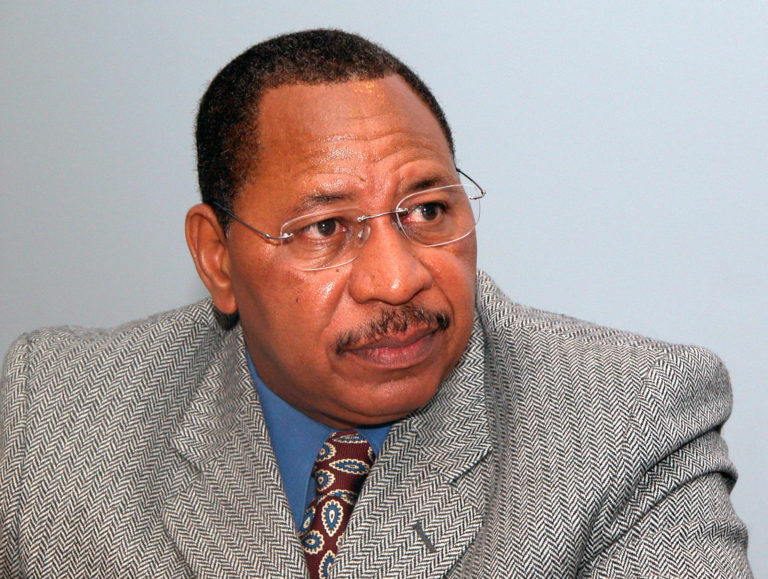
As a result of the alleged EU and France interferance in the Africa Renewable Energy Initiative (AREI), Head of the Independent Delivery Unit (IDU), Youba Sokona, who is regarded as a prominent African scholar and vice-Chair of IPCC, has declared his resignation
The AREI was launched by the African governments with the support of African citizens during COP21 in Paris, with the goal to provide at least 10 billion watts (10GW) of new and additional renewable energy to Africa’s peoples by 2020, and put the continent on course to add at least another 300 GW and achieve universal access to energy for all Africans by 2030. It was supported by $10 billion in pledges for 2015-2020 by developed countries in Paris.
AREI, as defined in its framework, principles and work plans, is meant to aligned with African values of people-centred approaches, community rights, equity and a bold vision of Africa taking a global lead towards flourishing societies powered by clean and renewable energy.
Since Paris, an Independent Delivery Unit (IDU) was set up to deliver in accordance with AREI’s people-centred principles and approaches. The expectation was that a Board with Heads of State representing each African sub-region would be established, supported by a technical committee involving broad representation and participation by civil society.
However, there are fears that AREI’s integrity and promise of bringing light and energy to Africa’s people is now being threatened by the efforts of the European Union and France for what the CSOs term “premature undue approval” of projects not related to Africa, and seeming attempts to co-opt the initiative to serve European ends, supported by a small handful of Africans.
It was gathered that, at a Board Meeting convened recently in Conakry, Guinea on Saturday, March 4 2017, the European Union and France:
Publicly “announced the preparation of 19 new renewable energy projects, with a total potential investment of €4.8 billion” – when they are actually claiming to provide 1/16th or €0.3 billion of this amount, not all of which is for “new projects” or even for “renewable energy”, and with no clarity whether any of these are “additional’” efforts.
Managed to have rammed through the Board for adoption these partly EU-funded projects, despite the express objections from some African countries and institutions, and contrary to the principles of African ownership that would expect project priorities and proposals to stem directly from African countries.
Ignored and bypassed AREI’s own evaluation process in accordance to its criteria – developed with African and northern government, civil society and other stakeholder inputs. These require all projects be assessed in line with AREI social, environmental, gender and other principles and safeguards before any approvals can be made.
Claiming Board memberships when they seem to have only been invited to the meetings and contrary to the idea there should be one developing and one developed non-African country in the Board.
Pushed for the imposition of EU technical experts to supposedly take control of AREI core documents to be consistent with European interests
The group stated: “All the above seems to have caused the Head of the Independent Delivery Unit, a prominent and well-respected African (Youba Sokona), to declare his resignation. These actions have been enabled by one or two African states while the interests of the majority of States, and of Africans, have been set aside.
“While we acknowledge that the EU has scaled up support for African renewables since COP21 in Paris, these most recent behaviours are completely unacceptable. Recycling existing projects as ‘new’ ones for AREI virtually ensures it will fail to meet its goal of 10 billion watts of ‘new and additional renewable energy generation capacity by 2020’, leaving Africans in the dark.
“Listing projects in numerous African countries without their consent means these countries may miss out on genuinely new and additional resources from AREI in the future, undermining the legitimate expectations of those countries and their people.
“These carefully staged interferences in Africa’s institutions threaten not merely the potential of AREI to deliver new renewable energy, they call into question the independence and sanctity of African governance arrangements, including the African Union.
“Based on these concerns, we call on all African States, leaders and people to demand genuinely people-centred renewable energy for Africa, building on the great model set out by AREI and endorsed by all African countries.”
The group has thus made the following demands:
That the European Union and France step aside and abandon any aspirations to have seats as Board members, and ensure AREI remains African-led and African-owned. AREI must be run by Africans for Africans. Interference in African governance belongs to another era.
Full accountability, transparency and participation must be provided for African states and for civil society in all aspects of AREI. The Initiative cannot and must not become a tool for one or two African States to benefit themselves or their European counterparts.
That any ‘endorsement’ by the Board of the 19 existing EU projects is indefinitely suspended until a thorough review against AREI Criteria, environmental and social safeguards, prior informed consent by the States and citizens concerned, and active civil society participation are undertaken. It must be for individual African states and people, not the EU, to propose projects to AREI.
That all further funding and projects through AREI be genuinely “new and additional” to ensure the delivery of real outcomes for our people, with no more accounting tricks, and to ensure that developed countries are accountable and meet their financial obligations.
That active participation by all civil society constituencies is ensured at all levels of AREI including its governing bodies, its workplan and project development, and project implementation on the ground.
That African countries immediately take action to put AREI back on track and ensure full independence for the Independent Delivery Unit from donors, the African Development Bank and other third parties, and the reinstatement of its Head.
“We call for all partners in government, academia, faith-based, labour, gender, environmental, community-based organisations, national coalitions and regional and international networks to join us in championing a truly African-led and people-centred approach to renewable energy on our continent. AREI needs to succeed,” declared the group.
In a reaction, Mithika Mwenda, Secretary General of the Pan African Climate Justice Alliance (PACJA), said: “This hijack by the EU and France threatens to undermine the values that AREI stand for. The social and environmental criteria to protect communities’ interests are at risk. African leadership of the initiative is being undermined. And the financial pledges made at COP22 will be worthless if the EU only plan to re-brand pre-existing projects as finance for AREI.
“Not only are AREI, its vision and promise at stake, but the belief that it is possible to pursue bold, people-centred, transformative change that does not get corrupted.
“What happened in Conakry is disheartening. But we now have a clear opportunity to re-assert the great values and principles behind AREI, and to raise attention and necessary pressure to reclaim the initiative. We have to mobilise civil society and African countries. We have to create the conditions for Sokona to come back and continue the work, in collaboration with civil society and others, to make AREI’s bold visions come true.”
The Environmental Rights Action/Friends of the Earth Nigeria (ERA/FoEN) has hailed the decision of the Lagos State Government to discard what it tags “anti-people” sections of the new Environment Law that had attracted wide-spread criticism from civil society and grassroots stakeholders.
The law had criminalised the sinking of boreholes without official permission
Sections of the law made public at a Public Hearing organised by House Committee on the Environment on Thursday, February 9, 2017 include provisions that appeared to give a considerable amount of powers to the Lagos Commissioner for Environment, criminalisation of the sinking of boreholes, imposition of fines of N100,000 on defaulters and prison terms for anyone in Lagos that sells or transports water, among others. It also had, according to ERA/FoEN, “a booby trap” woven into an irrevocable standing order on payments to contractors and concessions.
Civil society and grassroots stakeholders had also faulted the observed near total lack of consultation of a broad spectrum of stakeholders and Lagos citizens before the Public Hearing and what seemed like the hasty passage of the bill by the Lagos House of Assembly on Monday, February 20, 2017. The groups also alerted on the inaccessibility of the law more than two weeks after the Wednesday, March 1 signing by Governor Akinwunmi Ambode.
In a statement issued in Lagos on Monday, March 20, 2017 and made available to EnviroNews, ERA/FoEN said it got the final version of the law at the weekend, pointing out that the removal of controversial sections of the law was a “positive moment” for the Ambode administration and the Lagos House of Assembly.
ERA/FoEN Deputy Executive Director, Akinbode Oluwafemi, said: “We are so impressed that the Lagos government allowed the voice of the people to prevail in its decision to finally expunge sections of the new Environment Law that are clearly anti-people and may have been sneaked into the document by proponents of Public Private Partnership (PPP) model for the water sector.
“Those provocative sections make the Lagos citizen a victim of the failure of successive administrations to invest sustainably in the water sector. By the sheer act of discarding them, the Governor Ambode administration has demonstrating that it is a listening one and we commend this.”
The ERA/FoEN boss however added that the language of the new law is still deliberately skewed to open the door to full privatisation of the water sector while ignoring proven solutions that the state government can learn from countries that have remunicipalised after burning their fingers on the myth called PPP promoted by the World Bank and International Finance Corporation (IFC).
He restated the position of local and international civil society and grassroots groups on the platform of the Our Water Our Right Coalition that solutions have been proposed in the document – “Lagos Water Crisis: Alternative Roadmap for Water Sector”, copies of which have been made available to relevant government agencies and the office of the governor, urging the governor to take a critical look at the document.
“With the removal of anti-people provisions in the Environment law it is still not yet uhuru. We still restate our opposition to PPP in the water sector which the state is still pressing ahead with. We are determined to challenge this false solution through lawful means including public demonstrations in the days ahead,” Oluwafemi insisted.
The Cross River State Government has admitted errors observed in its third failed attempt to get its Environmental Impact Assessment (EIA) report on the proposed 260-kilometre Superhighway project approved by the Federal Government.
Minister of State for Environment, Ibrahim Usman Jibril, observed that consultant to the project has not done a thorough job on the EIA
Last week, officials of the Federal Ministry of Environment in a stormy stakeholders’ family meeting it organised in Calabar, the state capital, rejected the EIA report submitted by the state, saying: “Definitely that is a document (EIA) that cannot even meet IFC (International Financial Corporation) and World Bank safeguard issues; they have a standard. Looking at the document we have standards that have not been met. An EIA report is a legal requirement which is used to the show level of your commitment regarding environmental and social issues and, at the end of the day, it will also dove-tail into your environmental management plan.
“If there are issues that need to be addressed and which are yet to be addressed, unless that is well addressed adequately, definitely if gaps are left it will be difficult for the Ministry (of Environment) to give the nod.”
Some of the areas faulted include: the baseline study, lack of stakeholder or community engagement, issues of “cut and paste” or observed plagarism, traffic management plan, impact analysis and management plan, financial plan, and others which the Minister of State for Environment Ibrahim Jibril, represented by the Director on EIA in the ministry, John Alonge said, “The Federal Ministry observed that the state government’s consultant to the project has not done a thorough job and we will encourage the consultants to do a thorough job. We are expecting a robust report that will address all environmental and social issues that need to be addressed so that we can have a class document that can meet international best practices.”
The state’s Deputy Governor, Prof Ivara Esu, who stood in for Governor Ben Ayade, said, “It is obvious that all is not against the issue of Superhighway, however we also noted that our consultants have to look at issues suggested and how we can remedy that. We shall do more consultations of the communities involved to capture all. We have noted the expert advice and various issues raised and how they will be addressed, we are a listening government, we want the UN-REDD and funding to continue. We are very anxious about resumption of activities on the Superhighway. Please, do all you can to assist us positively.”
Earlier in his opening address, Gov. Ayade said the Federal Government was frustrating the state “in all areas yet we forge along but environmental tools are to help human beings. As a people who have been denied all these, we need to take our destiny by our hands. We pass a law on absolute conservation, so how else can we show commitment to the forest?
“The Cross River National Park has been turned into an evil forest,” he said, noting that elsewhere like in South Africa superhighway pass through their national park but in the state “the old trees cannot even absorb carbon dioxide anymore and they begin to dry gradually. So the forest is not adding value because it is aging away.”
Despite pressure from members the Nigeria Labour Congress (NLC) who thronged the venue of the event along with civil servants, civil society groups like the Rainforest Resource and Development Centre (RRDC), the Ekuri Initiatives, Wildlife Conservation Society (WCS), Health of Mother Earth Foundation (HOMEF) and others, insisted that the proper thing must be done to ensure that the Superhighway, when constructed, will not impact negatively on the people and the environment.
Executive Director of RRDC, Odey Oyama, said, “It is the contention of the RRDC that the Cross River State Government, under any guise whatsoever, cannot alter the boundaries of the park without the authorisation and approval of the National Assembly, and the President of the Federal Republic of Nigeria. By the provisions of the section 94 of the Land Use Act No. 6 of 1978, the Cross River State Government is precluded from altering the territories of the Park as described in the National Park Service Act, which has been passed by the President.”
He further said: “It is worthy of note that the Oban Hills Division of the Cross River National Park, by virtue of section 50 (2) (b) of the National Park Service Act, CAP N.65, LFN, 2004 is the property of the Federal Government, approved and gazetted in 1998 and the proposed Superhighway’s route has encroached upon the gazetted territory as evidenced in the attached map.”
Equally commenting, the Chairman of the Ekuri Initiative, Martins Egot, said: “We were there to discuss the EIA document and we saw a display of politics by the NLC carrying placards and trying to intimidate everyone to ensure that the state goes ahead with the project with or without approved EIA, and from the presentation of the state they admitted errors in the EIA and moved forward to make promises of what they will do without correcting the flaws and it is was not correct as alleged by the governor that some people and NGOs are paid to frustrate the Superhighway.
“The Ekuri people have not been captured in the EIA and it is wrong to say that the Ekuri forest is degraded buy a community in a tropical high forest. So, clearly, all has admitted that the EIA is faulty so the proper thing has to be done.
“We expect the government to do the proper thing and ensure that all grey arrears as listed by the Federal Ministry of Environment are captured for the interest of all before talking of doing the Superhighway.”
The Nigerian Slum / Informal Settlement Federation (Federation) and the Justice & Empowerment Initiatives Nigeria (JEI) have condemned the demolition and forced eviction of the Otodo Gbame community, an act believed to have been carried out by the Lagos State Government, albeit on Friday, March 17, 2017.
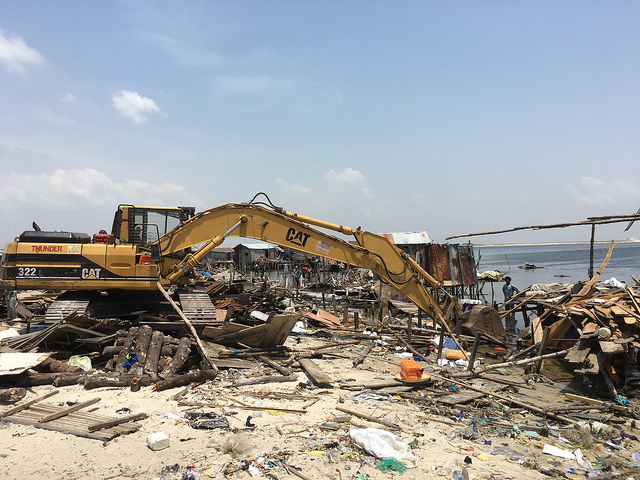
Otodo Gbame community under demolition on Friday, March 17, 2017
The groups, in a statement made available to EnviroNews on Monday, March 20 2017, stated that the demolition was executed “in brazen disregard for a subsisting order of court prohibiting the eviction of Otodo Gbame and other Lagos waterfronts”.
According to the Federation and JEI, around 8am on the fateful day, residents of Otodo Gbame – an ancestral, predominantly Egun fishing settlement in Lekki – spotted excavators by the entrance of their community. Community members were then said to have notified their legal counsel at JEI and proceeded to approach the demolition squad said to be led by the Lagos State Task Force, who said they were on orders from the Lagos State Governor, accompanied by Military Police and the Nigerian Security and Civil Defense Corps who said they were under orders from the Lagos State Commissioner of Environment.
Community members, and later their counsel from JEI, presented documents evidencing a court order from the Lagos State High Court enjoining the government from demolishing their community. But the demolition squad turned a deaf ear, allegedly saying: “This is Lagos State. We don’t care about court orders; take it to the Governor.”
The demolition squad, JEI noted, presented no court order or other document authorising the demolition.
The statement reads: “Facing an imminent threat of unlawful forced eviction, the community members bravely attempted to form a human shield to peacefully stop the excavators from entering the community. Security forces then, reportedly, started firing tear gas and live bullets to disperse the crowd. Residents had no choice but to flee and begin scrambling to salvage what possessions they could.
“The demolition squad began demolishing their homes using three excavators, one of which was a “swamp buggy” specially contracted by the State Government to demolish all the structures built on water – a traditional building technique used by Egun fishing communities along the Lagoon. Later in the day, a fourth excavator joined the squad. Two ‘Black Maria’ mobile detention vehicles were on site throughout the demolition as a warning against any resistance.
“By early evening, all the homes and businesses built on land had been destroyed, rendering an estimated 4,698 residents – including children and the elderly – homeless in a matter of hours. There was no prior notice, no consultation, and no alternative shelter or resettlement offered.
“It will be recalled that the threat to the Lagos waterfronts began when Lagos State Governor Akinwunmi Ambode announced to the media on 9 October 2016 the government’s intention to ‘start demolishing all shanties on waterfronts across the State within seven days.’ Based on mapping and profiling done by the Federation in informal settlements across Lagos, we believe at least 40 communities and over 300,000 residents fell under this threat of imminent eviction.
“Accordingly, more than 20 Federation member communities joined together to write to Governor Ambode calling for retraction of the threat and requesting for dialogue to explore alternatives to eviction. Two peaceful protests brought thousands of waterfront residents to the gates of the Governor’s office and the State House of Assembly, but to no avail. To the contrary, the Lagos State Government proceeded to demolish Ilubirin on 15 October 2016. Finally, the threatened waterfronts had no option but to proceed to court to enforce their fundamental rights.
“On 7 November 2016, Honourable Justice S. A. Onigbanjo of the Lagos State High Court granted an injunction restraining the Lagos State Government and the Nigerian Police Force from proceeding with any demolition of the waterfronts. Despite this order, on 9-10 November 2016, Otodo Gbame community was demolished and over 30,000 residents forcibly evicted by arson attack and an excavator that began working in the dead of night while residents were sleeping.
“The November demolition of Otodo Gbame has been broadly condemned as a forced eviction and a gross violation of human rights, including by the United Nations Special Rapporteur on Adequate Housing, Amnesty International, and countless others.
“On 26 January 2017, Honourable Justice Onigbanjo delivered a landmark ruling in the case brought by waterfront residents. His Lordship found that demolitions on short notice without provision of alternative shelter constitute cruel, inhuman and degrading treatment in violation of the right to dignity enshrined in Section 34 of the 1999 Constitution of the Federal Republic of Nigeria and Article 5 of the African Charter on Human and Peoples’ Rights. Rather then entering final judgment, Honourable Justice Onigbanjo then ordered the parties to attempt mediation through the Lagos State Multi-Door Courthouse and ordered them to maintain the status quo – refraining from any evictions – during the pendency of the mediation and the suit.
“With the ongoing litigation and the protection of the court order, a fraction of Otodo Gbame evictees whose homes were demolished in November 2016 were able to rebuild, providing themselves with basic shelter from the elements and spaces in which to carry on their livelihoods.
“These are the homes and business that were, once again, brutally and unlawfully demolished by the Lagos State Government on 17 March 2017 – just a week after the waterfront communities was sitting in a mediation session with the government to try to discuss alternatives to eviction.
“We condemn such impunity and brazen disregard for the rule of law, which is incongruous with a democratic society and Lagos’s aspiration to be a center of excellence and global megacity.”