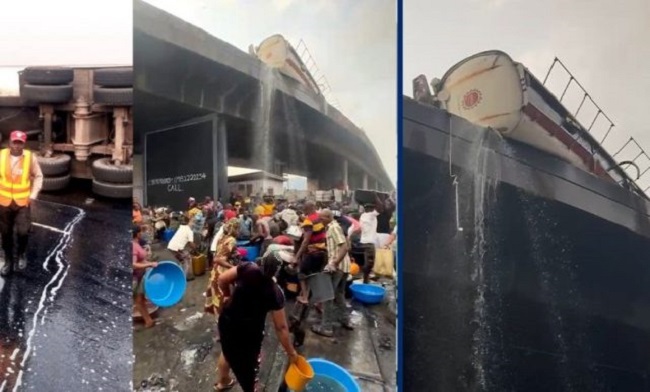
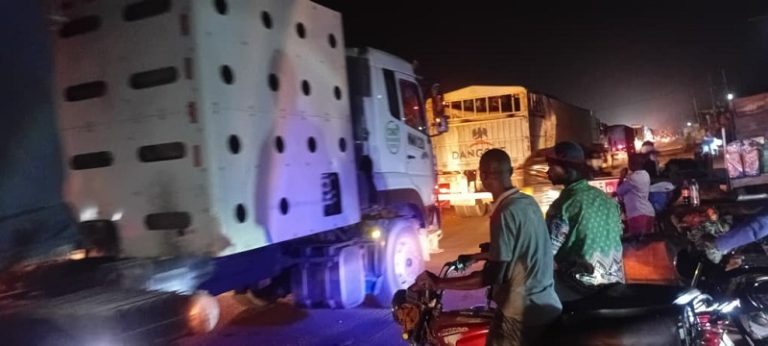
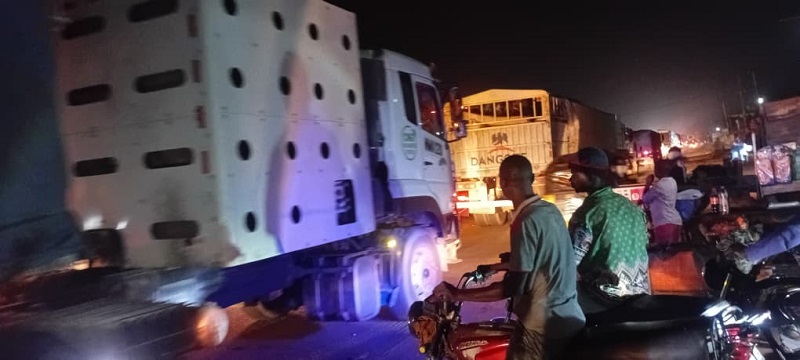
A diesel tanker overturned on Tincan-Liverpool Bridge in Apapa, Lagos State, on Monday, January 19, 2026.
The incident occurred inward Mile 2, spilling diesel and disrupting movement along the busy corridor.
Commuters were unable to pass through the road as traffic slowed to a crawl.
Lagosians scooping fuel
Videos circulating on social media showed residents and commuters scooping diesel from the fallen tanker.
The footage captured scenes of confusion as people rushed to collect the spilled fuel amid congestion.
The Lagos State Traffic Management Authority (LASTMA) confirmed that the tanker was loaded with diesel.
“There’s a fallen tanker loaded with diesel on top of Liverpool bridge inward Mile2,” LASTMA said.
The agency said the spill was caused by a damaged tank.
“The diesel is spreading on the bridge as a result of the damaged tank,” it added.
LASTMA said security agencies were alerted shortly after the incident.
“Men of the Nigerian Police Force from Area B and other safety Agencies have been swiftly notified.”
Emergency response teams later arrived at the scene to manage the situation.
“Men of Lagos State Fire Service and rescue team are on the ground doing the needful. Traffic has been diverted to the other side of the bridge for safety measures,” the statement said.
The authority said further restrictions were put in place pending recovery of the tanker.
“Pending the time of the recovery, Liverpool Bridge has been cordoned off, and Counter flow method of traffic control is in use. Vehicular movement along the corridor is very slow. Plan your movement.”
The incident happened at Liverpool Bridge in Apapa, with operatives from the Lagos State Fire and Rescue Service and the Nigerian Police Force deployed to the area.
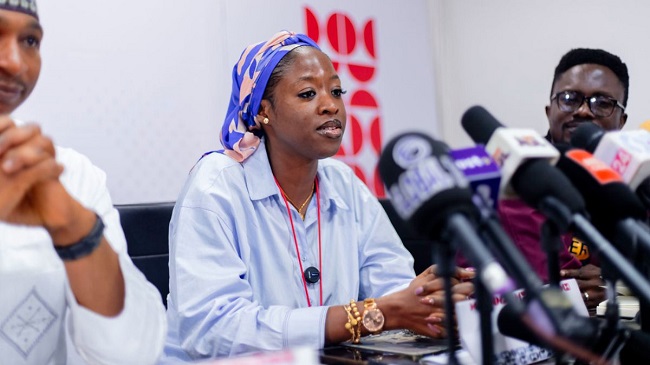
The Founder and Convener of the 2026 Africa Women in Housing and Construction (AWHC) Conference and Business Expo, Flora Anne, says it aims to enhance gender-responsive development in Africa’s built environment.
Anne said on Monday, January 19, 2026, in Abuja that the conference would examine the role of housing and construction in advancing inclusive economic growth.
Anne said that the conference, themed “Work, Wealth and Worth: Redefining Work, Building Wealth, Elevating Worth in Africa’s Built Environment Inclusive”, would also spotlight decent work, and gender equity across Africa.
Flora Anne
According to her, the event is designed to contribute to broader conversations around gender-responsive development during the International Women’s Month of March.
“This is because while Africa’s housing and construction sector holds significant potential for job creation and economic expansion, women remain disproportionately excluded from access to finance, technical roles, entrepreneurship opportunities, and decision-making positions.
“Addressing these challenges requires deliberate policy engagement, institutional collaboration, and inclusive sector reforms.”
Anne explained that hosting the conference in March align with global efforts to spotlight women’s contributions to economic development.
She added that it would also address persistent gaps in access, women’s participation, and leadership within key productive sectors such as housing and construction.
According to her, AWHC’s theme reflects the interconnection between productive work, sustainable wealth creation, and human dignity, particularly for women operating across the housing and construction value chain.
The founder said that the two-day conference would bring together government policymakers, housing authorities, financial institutions, developers, professional bodies, civil society organisations, and private sector stakeholders from across Africa.
Anne said that discussions would focus on key areas including affordable housing finance, public-private partnerships, real estate market dynamics, technology and sustainability in construction, urban development.
She added that discussions would include women’s leadership and participation across the housing value chain.
“In addition to policy and technical sessions, the event will feature a business exhibition, showcasing building materials, construction technologies, and housing solutions relevant to Africa’s urban and development needs.
“The conference will highlight pathways for inclusive participation by encouraging collaboration between men and women in building resilient and sustainable housing systems.
“The platform is also expected to support knowledge exchange, mentorship, and engagement opportunities for emerging professionals and small and medium-sized enterprises operating within the sector,” she said.
According to Anne, outcomes from the AWHC conference are expected to contribute to national and regional conversations on housing delivery, employment generation, and gender equity, in line with the objectives of International Women’s Month.
She described AWHC as a pan African platform committed to promoting gender balance, capacity development, and inclusive participation within the housing and construction sectors.
“Through advocacy, professional engagement, and policy dialogue, AWHC supports initiatives that advance sustainable and equitable development across Africa.”
She said the 2026 AWHC would hold as part of activities marking the International Women’s Month scheduled to hold from March 16 to 17 in Abuja.
The Federal Government says it is intensifying efforts to address Nigeria’s growing housing deficit through a new national housing strategy focused on land reforms, urban renewal, and public-private partnerships.
The Minister of Housing and Urban Development, Ahmed Musa Dangiwa, said this while declaring open the 14th meeting of the National Council on Lands, Housing and Urban Development on Monday in Ilorin, Kwara State.
The 14th National Council had the theme: “Achieving Housing Delivery and Sustainable Cities Through Effective Land Management, Urban Renewal, Promotion of Local Building Materials, and Public-Private Partnership in Nigeria.”
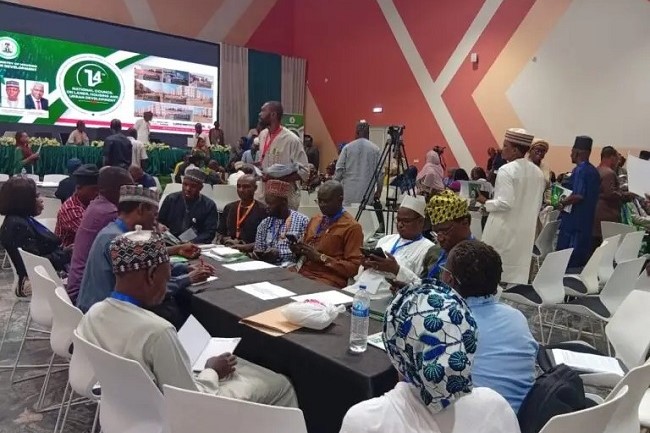
Participants at the 14th meeting of the National Council on Lands, Housing and Urban Development in Ilorin, Kwara State
Represented by Alhaji Mukhtar Ilyasu, the Director of Planning, Research and Statistics in the ministry, Dangiwa said that the strategy placed effective land administration at the centre of housing delivery nationwide.
He explained that the policy adopted urban renewal as a key tool for rebuilding Nigerian cities, while positioning private sector investment as the main driver of mass housing development.
”Nigeria’s housing deficit, estimated in the tens of millions, remains one of the country’s most pressing social and economic challenges, driven by rapid urbanisation, population growth and rising construction costs.
“The new framework is expected to guide housing delivery, land administration, and urban development planning across the Federation in the coming years.
”Urban renewal and regeneration have been adopted as national policy tools to modernise cities, curb uncontrolled urban expansion, and respond to population pressure and climate challenges,” he said.
The minister also disclosed that the Federal Government was prioritising the large-scale use of locally sourced building materials and construction technologies to reduce costs, improve affordability, and strengthen domestic industries.
He said public-private partnerships would serve as the main engine for mass housing and urban infrastructure delivery across the country.
The Kwara Commissioner for Housing and Urban Development, Dr Segun Ogunshola, said challenges affecting housing provision persisted, but the state government was implementing measures to address land and housing shortages.
He said the 20,000-unit Kwara Smart City Project was already laying the foundation for a next-generation mega city, adding that the project’s master plan had been reviewed to improve livability.
The commissioner added that municipal areas across the state had been upgraded with improved water supply, road networks, and other infrastructure to enhance urban development and beautification.
Earlier in her remarks, the Permanent Secretary, Kwara State Ministry of Housing and Urban Development, Alhaja Risikat Abdulazeez, called for a holistic approach to reducing the housing deficit amid rapid urbanisation.
The National Council Meeting is a forum that provides a strategic platform for aligning federal and state policies and accelerating reforms in the housing and urban development sector.
The meeting remains a critical avenue for strengthening intergovernmental collaboration, reviewing sectoral policies, and evolving practical solutions to fast-track the delivery of affordable housing and sustainable urban development across the country.
Participants at the meeting include states’ commissioners, permanent secretaries, directors in charge of Lands, Housing and Urban Development and chief executives of Housing Corporations.
Surveyor-Generals, professional bodies, and other key stakeholders in the built environment sector were also present.
The Environmental Health Council of Nigeria (EHCON) has declared a public health emergency over environmental diseases linked to greenhouse gas emissions nationwide.
The council’s Registrar and Chief Executive Officer, Dr Yakubu Baba, confirmed this on Monday, January 19, 2026, at a news conference in Abuja.
Baba said the declaration aligned with President Bola Tinubu’s Renewed Hope Agenda to strengthen environmental public health nationwide.
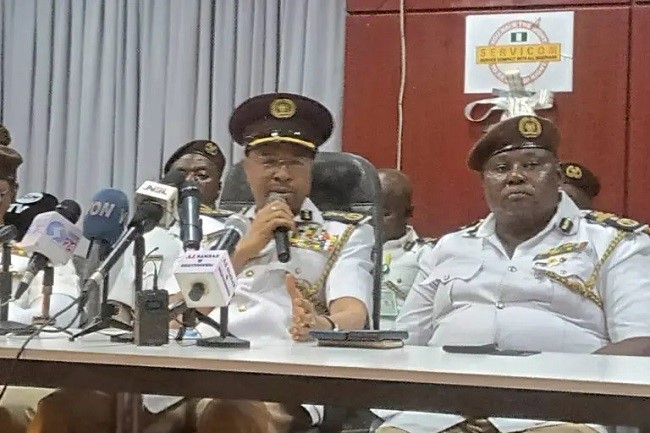
Officials of the Environmental Health Council of Nigeria (EHCON) at the news briefing in Abuja
He said EHCON was raising a national alarm over the silent but rapidly escalating burden of emission-related diseases.
According to him, environmental diseases from greenhouse gas emissions represent one of the greatest silent public health threats of this period.
“Declaring a state of emergency is not an exaggeration; it is a necessity. EHCON stands fully prepared, alongside partners, to lead this urgent response.
“The health of Nigerians today and tomorrow depends on actions taken now. We call on government, industry, communities and the media to support this initiative,” Baba added.
He said the council was also raising awareness about the health burden of combustion-engine pollution across the country.
Baba said the emergency declaration was necessary as Nigeria faces rising, preventable deaths from pollution-induced diseases daily.
He attributed the situation to unregulated reliance on combustion engines, weak emission controls, rising healthcare costs and loss of productive human capital.
Baba warned that failure to act decisively would overburden the healthcare system and undermine national development.
“Our investigations reveal environmental diseases linked to air pollution are increasing beyond the long-term public health impact of COVID-19,” he said.
He said many Nigerians who neither smoke nor drink are increasingly diagnosed with acute and chronic respiratory infections.
Baba listed associated conditions as lung and other environmentally induced cancers, cardiovascular diseases, systemic inflammation and climate-related dust exposure.
“These are linked to prolonged exposure to black carbon, particulate matter and toxic emissions from generators, heavy vehicles and industrial operations,” he said.
He added that marine engines, port activities, mining and petroleum operations worsened the largely invisible but devastating emergency.
Baba said emergency actions included intensified inspections of high-emission facilities and transport corridors, alongside mandatory compliance audits.
Other measures include sanctions under the 2024 Environmental Health Provision Rules and targeted emission-reduction interventions.
He said EHCON would deploy 70,000 environmental and public health response staff nationwide for surveillance and rapid response.
Additional measures include regulating fuel additives, mandatory emission testing for generators and vehicles, and phased restrictions on highly polluting engines.
Baba said the response would reduce pollution-related deaths, improve air quality and strengthen environmental public health governance.
He added that enhanced compliance would boost national resilience against environmental health threats.
The United Nations has called for stronger global media engagement on humanitarian crisis around the world, particularly the situation in Yemen.
The organisation said that limited international attention is hampering awareness and support, at a time when millions face deepening food insecurity, health risks and shrinking aid resources.
The UN Resident and Humanitarian Coordinator for Yemen, Mr. Julien Harneis, made the call on Monday, January 19, 2026, during a news conference on the humanitarian situation in the country.
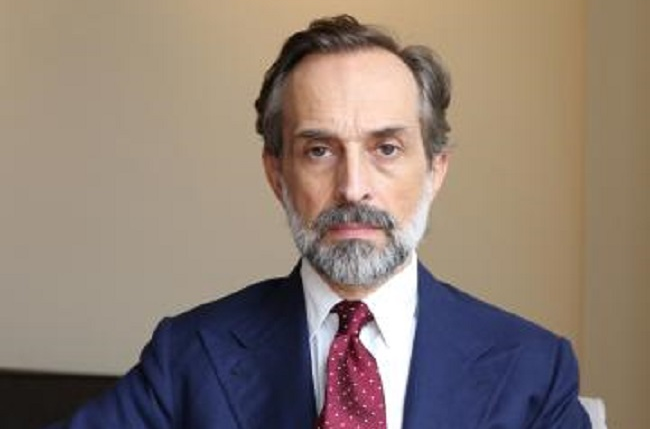
UN Resident and Humanitarian Coordinator for Yemen, Mr. Julien Harneis
He warned that the situation in Yemen is expected to deteriorate further in 2026, amid worsening food insecurity, economic pressures and reduced funding for critical services.
Harneis noted that in 2025 alone, about 19.5 million people were in need of humanitarian assistance, while the Humanitarian Response Plan was only 28 per cent funded.
He attributed the bleak outlook to economic and political decisions that were exacerbating food insecurity across all parts of Yemen.
According to him, the worsening food situation is already manifesting in rising levels of malnutrition and increased pressure on the health system.
Harneis noted that Yemen’s health system had been supported by the United Nations, in collaboration with the World Bank for the past 10 years, but warned that this support would significantly reduce.
“We’re going to see a major change there, where the health system is not going to be supported in the way it has been in the past, and that is going to have very major consequences.
“Yemeni government lacks the capacity to finance and sustain the health system, leaving the country vulnerable to disease outbreaks.
“In a country which has already seen the highest rates of measles in the world, and which has frequently had cholera epidemics, we’re going to be very vulnerable to epidemics across the country, particularly in the North,” Harneis added.
The UN official said that humanitarian operations in northern Yemen were further complicated by the detention of 73 UN personnel as well as the seizure of UN offices.
He described the detentions as part of a broader pattern, noting that staff of international NGOs, embassy workers, activists and political actors, had also been detained often without public attention.
Harneis said that UN was working with the broader humanitarian country team, including international and national NGOs, to explore how other organisations could step in to cover gaps left by the UN.
He, however, stressed that some capacities were unique to UN agencies.
“Only the UN agencies have the scale of response that is required for a country where, for example, 2,300 primary health care facilities have been supported by UN agencies.
“No INGO has the capacity to support all of that,” he said.
He acknowledged that the humanitarian community would attempt to restructure and reorganise its response, but described the current circumstances as “deeply challenging”.
On media coverage, Harneis said that while regional and Arabic-language media paid attention to developments in Yemen, there was limited access to areas outside government control.
He added that although humanitarian organisations regularly briefed the UN Security Council and the Office of the High Commissioner for Human Rights on the situation, international media engagement remained insufficient.
“The international media is not engaging with Yemen in the way that is needed now and the UN also needs to do more outreach.”
He clarified that while food insecurity was a major concern, it was not the direct cause of death.
He argued that food insecurity contributes to malnutrition, but so do poor access to clean water and lack of access to healthcare services.
According to him, when these factors combine with poor socio-economic conditions, they result in malnutrition, leading to increased mortality and morbidity, especially among children.
Harneis consequently, identified Nutrition, public health at the primary healthcare level, as well as freedom and security, as key priorities for humanitarian actors.
The Lagos State Government on Monday, January 19, 2026, said that the demolition of distressed structures would continue as part of efforts to protect lives, property and environment in the state.
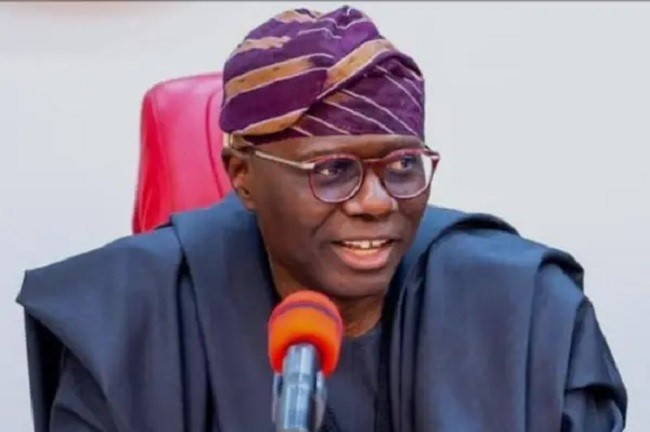
Gov. Babajide Sanwo-Olu said that the exercise followed comprehensive safety assessments conducted by relevant government agencies, stressing that public safety remained top priority of his administration.
“Buildings should be 150 meters away from high tension, we have been in dialogue with the baales of these communities.
Gov. Babajide Sanwo-Olu of Lagos State
“The people crying than the bereaved are those organisations that get grants from foreign humanitarian groups, we know these things but things can’t continue like that.
“We will not hesitate to take decisive actions, including evacuation and demolition of distressed buildings, where they pose a threat to lives and public safety,” he said.
Sanwo-Olu noted that the measures were necessary to prevent avoidable disasters, especially in densely populated areas, adding that the government would continue to act proactively rather than reactively.
He appealed to residents, to cooperate with government officials and comply with safety directives, adding that such actions were taken in the collective interest of the public.
“These decisions are never taken lightly, but they are essential to protect lives and ensure the wellbeing of our people,” he said.
The governor also said that the exercise was part of a broader environmental management strategy, aimed at addressing structural failures, urban congestion and environmental risks in the state.
“Our responsibility goes beyond buildings; it includes protecting our environment and ensuring a safe, resilient and liveable Lagos for present and future generations,” Sanwo-Olu said.
The governor consequently, assured residents, that the state government would continue to strengthen environmental monitoring, and enforce building regulations.
Sanwo-Olu said that this will promote sustainable urban development, to minimise risks associated with environmental degradation.
Nigeria’s oceans, rivers, and lakes hold enormous economic promise.
However, for many citizens, the term Blue Economy remains unfamiliar, distant, and poorly understood, in spite of its growing national attention.
According to the World Bank, the Blue Economy is the sustainable use of ocean and water resources for economic growth, livelihoods, and jobs, while preserving aquatic ecosystems for future generations.
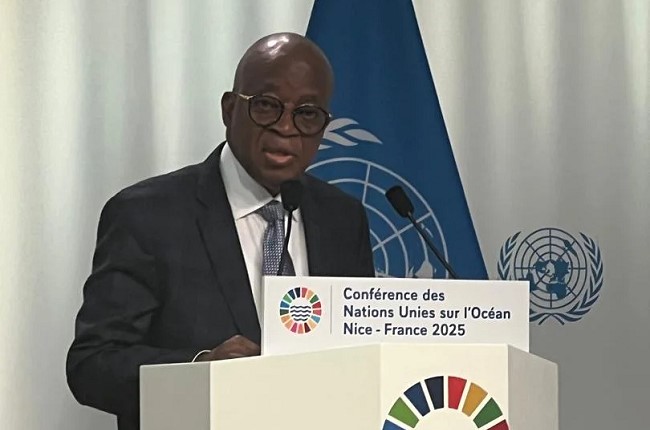
Minister of Marine and Blue Economy, Adgboyega Oyetola, addressing the United Nations Ocean Conference in Nice, France on June 10
In Nigeria, this concept spans shipping, fisheries, aquaculture, inland waterways, marine tourism, coastal infrastructure, and renewable energy.
Indeed, the blue economy represents an untapped economic frontier capable of supporting the livelihoods of millions if properly developed and understood.
Recognising this potential, President Bola Tinubu established the Ministry of Marine and Blue Economy in 2023 to coordinate maritime development and diversify the economy beyond oil.
Moreover, the Minister of Marine and Blue Economy, Adegboyega Oyetola, asserts that the sector can greatly boost non-oil revenue, reduce unemployment, and support national development if harnessed effectively.
He adds that Nigerians must understand how the blue economy affects their daily lives; from food prices to jobs and transportation.
With an extensive coastline of about 853 kilometres, alongside vast rivers and lakes, the country is strategically positioned to benefit from fisheries, coastal tourism, shipping logistics, and renewable marine energy.
Experts also note that the sector can strengthen food security through improved fisheries and aquaculture, reducing dependence on imported fish and seafood products.
Nevertheless, many Nigerians continue to overlook the riches beneath their waters, failing to see the marine sector as a pathway to shared prosperity due to lack of knowledge.
Dr Chika Eze, a maritime analyst, explains that limited public understanding remains a major obstacle.
“Many Nigerians still associate the sea only with fishing, ignoring its wider economic value.
“Consequently, Nigeria’s waters hold vast economic promise, yet many citizens remain unaware of how the blue economy can drive jobs, food security, and diversification,” he said.
Globally, the United Nations estimates that the blue economy contributes over $1.5 trillion annually, with developing countries harnessing marine resources to drive inclusive economic growth and strengthen climate resilience.
In this context, Nigeria, with its vast coastline and extensive inland waterways, is well positioned to tap into these opportunities, especially in job creation, food security, and sustainable livelihoods across coastal and riverine communities.
Fisheries and aquaculture experts emphasise that better management and investment in the sector could greatly reduce Nigeria’s reliance on fish imports while creating employment opportunities for youths and women along the value chain.
However, albeit these potential benefits, awareness gaps have slowed community participation, private investment, and youth interest in maritime careers, even as policy attention grows at the federal level.
A vox pop conducted in Abuja revealed a striking knowledge gap among ordinary Nigerians, especially young people expected to drive future economic growth.
For instance, Amina Yusuf, a 300-level sociology student at the University of Abuja, says she has heard about the blue economy but lacks in-depth knowledge of the sector and its operations.
Similarly, Samuel Okorie, a final-year economics student, described the concept as abstract.
“We study diversification, but no one really explains how the sea or rivers fit into Nigeria’s economy,” he said.
Meanwhile, a youth corps member, Blessing Danjuma, admitted she associated marine activities strictly with coastal states but lacked knowledge of Nigeria’s inland waterways, careers, and job opportunities related to the blue economy.
On a slightly brighter note, Ibrahim Sadiq, a geography undergraduate, showed some awareness.
“I think it has something to do with fishing, ships, cargos, and using water resources to boost the country’s economy,” he said.
Experts argue that this limited understanding reflects weak public education and minimal integration of maritime studies into mainstream academic and civic discourse.
Dr Emeka Akabogu, a maritime economist, notes that awareness gaps reduce youth interest, private investment, and community participation across maritime value chains.
“When people don’t understand opportunities, they can’t prepare for them or demand accountability. Therefore, awareness is as important as infrastructure,” he said.
Meanwhile, environmental analyst, Dr Funke Adebayo, warns that ignorance also fuels environmental abuse.
According to her, people protect what they understand.
“Without proper knowledge of the blue economy and the benefits of Nigeria’s waters, they continue to be dumping grounds for waste, especially plastics”.
To address this, Adebayo recommends media campaigns, simplified storytelling, documentaries, and human-interest features linking marine resources to everyday Nigerian experiences.
She also advocates for integrating blue economy studies into secondary and tertiary curricula, especially in coastal and riverine states, alongside campus seminars, debates, and innovation challenges to build early understanding and skills.
Furthermore, community outreach, town hall meetings, and partnerships with traditional institutions can help Nigerians see marine resources as assets for development rather than neglected spaces.
In addition, the supervising ministry should partner with the Nigerian Maritime Administration and Safety Agency (NIMASA), National Inland Waterways Authority (NIWA), and Nigerian Port Authority (NPA) to ensure unified messaging and visible grassroots engagement nationwide.
Ultimately, as Nigeria seeks economic diversification, unlocking the wealth beneath its waters will depend not only on policy but also on how well citizens understand, embrace, and participate in the blue economy.
Until awareness deepens, many Nigerians may continue walking past rivers and coastlines without realising the opportunities flowing quietly beneath their waters.
Nevertheless, analysts emphasise that economic gains must align with environmental sustainability to prevent pollution, overfishing, and ecosystem degradation.
Kenya began selling a 65 per cent stake in its state oil pipeline firm on Monday, January 19, 2026, aiming to raise 106.3 billion shillings ($825 million) in its biggest-ever initial public offering.
The sale is part of a drive by President William Ruto’s government to divest from state companies to raise funds for new infrastructure and sovereign wealth funds.
It is also reducing its stake in telecoms operator Safaricom (SCOM.NR).
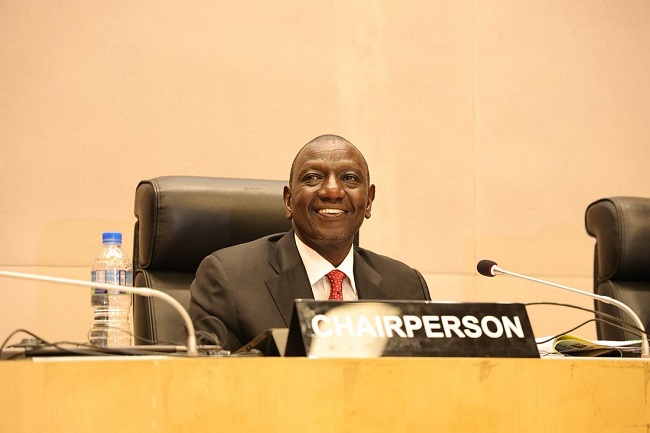
Kenyan President, William Ruto
The government priced the IPO in Kenya Pipeline Company at nine shillings per share, the offer documents showed. The sale will run until February 19, and the shares will be listed for trading on the Nairobi bourse on March 9.
The Kenya Pipeline IPO will be the regions biggest, topping an initial sale of Safaricom shares to the public in 2008 when the government raised 50 billion shillings.
It came amid a global recovery in equity capital markets and as stock markets hit record highs.
Equity capital markets activity totalled 738.4 billion dollars in 2025, up 15 per cent year-on-year, marking the strongest annual period for global equity capital markets activity in four years, according to LSEG data.
Just over a fifth of that was raised through equity capital markets offerings by issuers in Europe, the Middle East and Africa.
On Sunday, January 18, 2026, travellers on the Abuja-Lokoja highway were once again caught in hours-long traffic gridlock, renewing concerns about the fragility of Nigeria’s road infrastructure and the growing human and environmental cost of repeated transport failures.
Passengers travelling from Lagos and other southern states towards the north said vehicles barely moved for several hours, with some commuters reporting delays of up to eight hours, while others said they spent close to two days on the road.
The gridlock comes barely weeks after a similar congestion episode in December, when motorists and bus passengers were stranded overnight along the same corridor despite official assurances that traffic flow had been restored.
Lokoja gridlock
Lokoja in Kogi State occupies a strategic position in Nigeria’s transport network, serving as a convergence point for traffic moving between the south, north and eastern parts of the country. However, the city’s road infrastructure has long struggled to cope with increasing vehicle volumes, heavy-duty trucks and seasonal travel surges, leaving little room for diversion when disruptions occur.
For many travellers, the experience has become disturbingly familiar.
“You think it has been solved because you hear traffic has cleared, but after some time you are stuck again,” a passenger travelling north from Lagos said. “This time, some people were on the road all night.”
Beyond delays, prolonged congestion raised safety and welfare concerns, particularly as night fell. Travellers described growing anxiety over personal security, access to food and water, and uncertainty over when movement would resume.
Commercial drivers operating on the route said gridlocks in Lokoja are often triggered by a combination of broken-down vehicles, narrow road sections and the absence of functional alternative routes.
“When something goes wrong here, everything stops,” a bus driver explained. “There is no bypass, no other road to pass.”
A source familiar with operations around the corridor said a disruption linked to water infrastructure around the Ganaja axis may have contributed to the latest delays, though authorities are yet to issue an official explanation.
In past incidents, the Federal Road Safety Corps (FRSC) has attributed gridlock on the Abuja-Lokoja axis to traffic volume and obstructions, often deploying personnel to manage traffic and clear stalled vehicles.
Transport analysts, however, argue that traffic control alone cannot resolve what is essentially a structural problem.
Nigeria’s reliance on overstretched federal highways, combined with limited investment in bypasses, rail freight alternatives and long-term urban transport planning, have left key transit cities like Lokoja vulnerable to repeated congestion.
Environmental observers also warn that prolonged gridlocks increase fuel consumption and vehicle emissions, compounding environmental and climate pressures while offering no economic benefit.
As traffic gradually eased after several hours, many travellers were left with lingering questions about how long the relief would last and when permanent solutions would replace temporary fixes.
Connected Development (CODE) has launched a new project to promote transparency, accountability and domestic financing for Nigeria’s health security and epidemic preparedness.
The non-profit organisation announced in a press release signed by its communications and media relations officer, Nankpak Cirfat, on Monday, January 19, 2026, that the initiative is part of an analysis and capstone project of the Global Health Advocacy Incubator, which is supported by Resolve To Save Lives.
Titled “Tracking BHCPF NCDC Gateway Funds for Strengthening Health Security in Nigeria (Project Track – BHCPF),” the group added that the project is designed to deliver measurable outcomes, including improved transparency on Nigeria Centre for Disease Control (NCDC) gateway disbursements.
It said the programme also seeks independent evidence to support oversight and performance assessment, stronger data-driven advocacy for domestic health security financing, and a replicable accountability framework for tracking health security investments.
The statement went on to highlight that the Basic Health Care Provision Fund (BHCPF) remains the country’s primary domestic financing mechanism for strengthening the health system, and within this framework, the NCDC gateway is the only BHCPF channel that directly supports disease surveillance, outbreak response, laboratory systems, and emergency coordination.
Furthermore, it noted that, despite the introduction of BHCPF 2.0 in October 2025 by the Nigerian government, which strengthened accountability and performance expectations, public visibility into NCDC gateway disbursements and utilisation remains limited, as Nigeria’s epidemic preparedness and response capacity depends significantly on sustained domestic financing for health security.
“Increased domestic financing commitments have not been matched with transparent utilisation data, weakening performance assessment and constraining policy-relevant advocacy,” the press circular stated.
Therefore, through this initiative, CODE aims to generate actionable evidence within six months (January-June 2026) to support improved oversight, learning, and sustained investment in health security.
It went on to reveal that the Project Track BHCPF will apply CODE’s FollowTheMoney accountability methodology, combining Freedom of Information (FOI) requests, policy and guideline reviews, administrative data analysis, and a focused sub-national case study to assess preparedness outcomes.
According to the organisation, advocacy efforts will include the production of policy briefs aligned with national budget and oversight cycles, structured engagement with oversight bodies and decision-makers, and strategic media engagement to strengthen public accountability.
“This is a timely response to the critical need for transparency and accountability in how domestic resources for epidemic preparedness are utilised, and also strengthening health security is not only about funding but about accountability and learning,” said Hyeladzira Mshelia, CODE’s acting chief executive officer.
Mshelia submitted that, through Project Track – BHCPF, CODE aims to maintain its commitment to enhancing transparency, accountability, and citizen-driven oversight within Nigeria’s health sector. The initiative seeks to ensure that domestic health security financing leads to measurable outcomes in preparedness and resilience.