Home Blog Page 1895

Group wants Enugu to emulate Anambra’s anti-smoking law

0

The New Life Community Care Initiative (NELCCI) has commended the Anambra State House of Assembly for enacting a law to regulate smoking in public places, saying there is need for law makers in Enugu State to enact a similar law.

Cigarette-smoking
According to scientists, tobacco smoking is dangerous to health

Ikem Uzoezie of Aguata 2 state constituency in Anambra State presented the bill for a law on regulation of smoking in public places, which was read for the first time last week during plenary.

The bill, if passed into law, would curtail indiscriminate smoking of any kind in open places.

In a statement issued in Enugu, NELCCI Executive Director, Florence Ifeanyi-Aneke, said that the bold step taken by the lawmakers in Anambra is the first attempt to curtail the epidemic of tobacco in eastern Nigeria and should be replicated in Enugu and other eastern states.

Ifeanyi-Aneke said the importance of having such a law in Enugu is necessitated by a recent report by the Environmental Rights Action and Nigeria Tobacco Control Research Group (NTCRG) which listed Enugu among states targeted by tobacco companies to market tobacco to kids.

She explained, “Big Tobacco, Tiny Targets Nigeria Report noted that school age children are exposed to cigarettes sold side by side candies and of course, this is a ploy to lure them into procuring the colorful cigarettes after which they remain hooked for life.”

She cautioned that if laws are not put in place to check the trend, the next generation of tobacco addicts was already being groomed and would pose a threat to economic growth when they start coming down with tobacco-induced illnesses.

The activist also asked the Consumer Protection Council (CPC) and other relevant agencies of government to begin enforcing the nine provisions of the National Tobacco Control (NTC) Act which does not require any law to be operationalised.

The nine provisions include a ban selling of tobacco to persons below the age of 18 years, prohibition of sale of tobacco in certain public places and sale of cigarettes in single sticks, among others.

Sanitation, personal hygiene can control malaria, say health officers

0

There will not be the need for the Federal Government to commit $300 million to eliminating malaria if the citizens can ensure sanitation and personal hygiene, the Environmental Health Officers Association of Nigeria (EHOAN) said in Lagos on Friday, April 27, 2018.

Isaac Adewole
Minister of Health, Isaac Adewole

National President of EHOAN, Mr Samuel Akingbehin, who spoke to the News Agency of Nigeria (NAN), said that environmental health was essential to eliminating malaria.

“It was in the news few days ago that the Federal Government earmarked $300 million for elimination of malaria.

”Such money should be used for other capital projects because environmental health – sanitation and personal hygiene – is capable of reducing the burden of malaria.

”Every individual, every government should embrace it because what you throw to the environment, the environment will throw back at you,” he said.

The EHOAN president said that there was correlation between waste in the environment and malaria, hence, the need for environmental sanitation and personal hygiene.

According to him, waste comprises miscellaneous articles, rubbish, bottles, water retaining items and others.

He said that when waste retained water, it would breed malaria, noting that malaria-causing mosquitoes – female anopheles mosquitoes – developed rapidly in such a condition.

”Apart from water retaining items, refuse blocking our drains also results in stagnant water. When that happens, it creates a veritable avenue for breeding of mosquitoes, and these mosquitoes will transmit malaria to man.

”Malaria can be controlled through effective environmental sanitation.

“If our water bodies are made free-flowing, the vector which is mosquito will not breed there, and when the vector is eliminated or reduced drastically, it translates to reduction of malaria and malaria burden.

”If living rooms or houses are spread with net in the windows, mosquitoes will be prevented from coming in contact with human blood,” Akingbehin explained.

He also advocated the use of insecticide-treated mosquito nets to  prevent mosquitoes from having contact with man.

The EHOAN president advised that flowers  in the environment should be regularly trimmed to avoid mosquitoes.

He said that water-retaining plants such as like banana, plantain and cocoyam should be removed from the immediate environment to reduce breeding of mosquitoes.

According to him, another veritable action is chemical control of mosquitoes – the use of mosquito repellents and insecticides to reduce mosquitoes.

”It is the duty of every individual to make sure that water does not stagnate in his premises.

”People should fill up lowline portions of their compounds to ensure that drainage systems are flowing free.

”People should make sure that wells are covered and that refuse within the compounds are closed in a tight-fitting receptacle to avoid breeding of mosquitoes so that, together, we can chase malaria out,” he said.

NAN reports that the 2018 World Malaria Day was celebrated on Wednesday with the theme: “Ready To Beat Malaria”.

The Federal Government had on April 22 committed to securing $300 million from the World Bank, Islamic Development Bank and African Development Bank to eliminate malaria.

By Florence Onuegbu

427,000 affected by heavy flooding across Somalia since April – UN

0

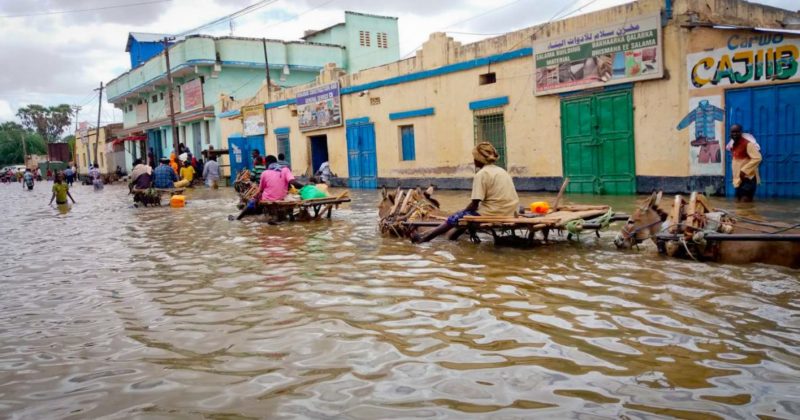
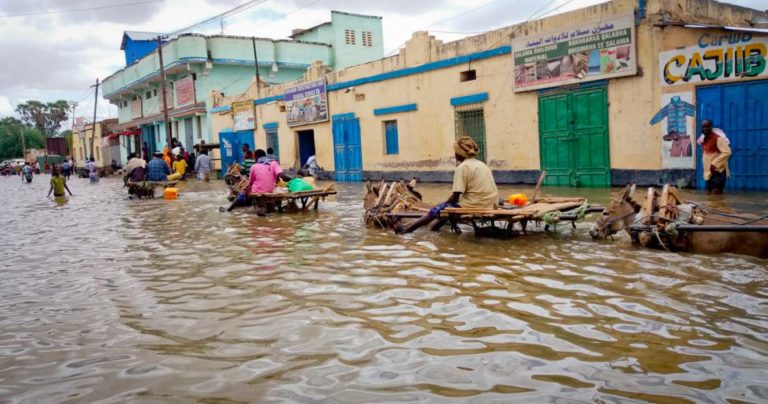
The UN said no fewer than 427,000 people have been affected by heavy flooding across Somalia since April, 2018.

Somali flood
Flooded street in Beledweyne, Somalia. Photo credit: ICRC

The UN Office for Coordination of Humanitarian Affairs (OCHA) said nearly 175,000 out of the 427,000 have been displaced as a result of the flash and river flooding in Hirshabelle, South West and Jubaland states as well as Banadir region.

The UN agency said in its latest flooding update released on Thursday (April 26, 2018) night that rainfall has been above average over broad areas of Somalia, adding that short-term forecasts suggest heavy rainfall is likely to continue over the coming week both inside Somalia and within the Ethiopian highlands.

“Other central and northern parts of the country are expected to receive moderate to high rains in the coming week with regions of Puntland being the exception,” said OCHA.

The UN agency said the projection for heavy rains coupled with the high river levels mean that riverine flooding will continue in the Juba and Shabelle river basins in the coming week.

In Jubaland, the number of displaced people spiked from an estimated 28,200 on April 22 to 42,300 people who are part of the 165,000 people affected in the state with the worst affected areas of Bu’aale, Garbahaarey, Ceel Waaq, Luuq, Baardheere and Saakow.

The Horn of Africa nation’s local authorities have called on the federal government and humanitarian agencies to help those who are in very critical conditions.

In Baidoa town alone, about 174,000 people have been affected by flooding, said the UN, adding that over half of their existing shelters cannot withstand heavy rains, and many have already been washed away.

Many community latrines have been destroyed or filled with flood water. Forecasts predict more heavy rains in the coming week.

“In Hiraan region, the Shabelle River has already burst its banks, displacing over 122,000 people in Belet Weyne town and nearby riverine villages,” said the UN.

The UN agency said some 54,000 people in makeshift shelters in the Mogadishu area have been affected in settlements for the displaced.

More flooded communities are reported in the Galgadud, Gedo and Middle Shabelle regions.

Dead Sea flash flood death toll rises to 10 as questions loom

0

The death toll from this week’s Southern Israeli flash floods rose to 10 on Friday, April 27, 2018 after another teenage hiker was found dead in the area, local media reported.

Flood
Ella Or, Gali Balel, Agam Levi, Shani Samir, Adi Ra’anan, Yael Sadan, Maayan Barhum, Romi Cohen and Tzur Alfi were killed in a flash flood April 27, 2018

The toll now includes nine females and one male aged 17 and 18.

The teens were among a group of 25 young hikers hit by flash floods in Nahal Tzafit, a riverbed near the Dead Sea on Thursday.

The group was part of the Bnei Zion pre-military academy, which had approved the expedition, despite repeated warnings about adverse weather conditions.

Local media reported that two staff members at the academy, including its head, had been detained and questioned by police and that a third was placed under house arrest.

Several days of heavy rain in Israel have caused flooding throughout the country.

On Tuesday, a 17-year-old Palestinian girl near Bethlehem and an Israeli-Arab teenager in southern Israel were killed in flash floods.

REDD+: Nigeria initiates moves to take inventory of forest emissions

0

Consequent upon its commitment to reducing emissions from deforestation and forest degradation (REDD) through the implementation of REDD+ Readiness activities, Nigeria has commenced moves to assess its historical emissions to establish a Forest Reference Emission Level (FREL). The FREL is a benchmark on which REDD is measured.

FAO-REDD+
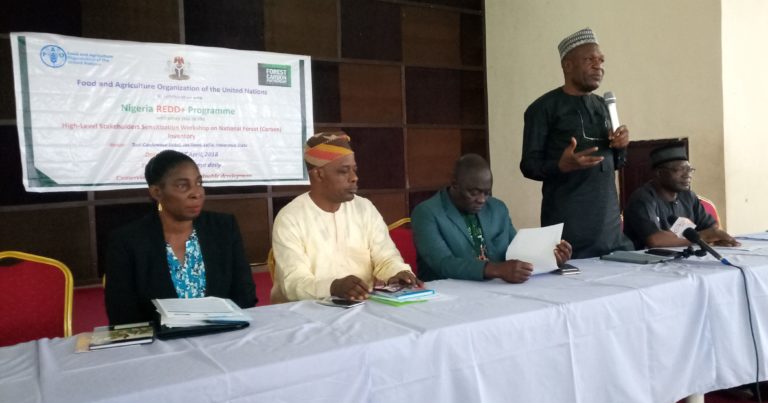
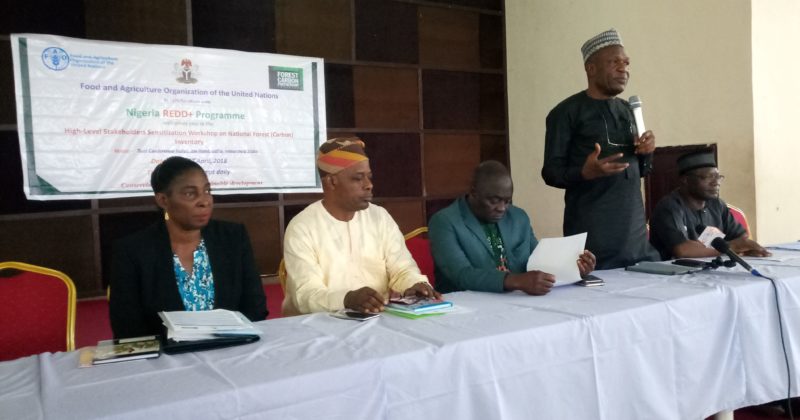
L-R: Mrs Achuna Obi-Amadi, Director of Forestry in Enugu State; S. O. Tiamiyu, a Deputy Director representing the Director of Forestry in the Federal Ministry of Environment; Randolph Para, a Permanent Secretary representing Abdulhameed Kwara, Nasarawa State Commissioner for Environment and Solid Minerals; Dr Moses Ama, National Coordinator, Nigeria REDD+ Programme; and Dr John Fonweban, Regional Technical Adviser, FAO REDD+ Programme, representing Suffyan Koroma, the FAO Country Representative in Nigeria… during the opening of the workshop

The initiative, which is a way of verifying whether the nation’s actions REDD+ Readiness actions are yielding the desired results, will likewise put in place a National Forest Monitoring System (NFMS) to monitor, report and verify (MRV) results of REDD+ activities.

In achieving this, the Food and Agriculture Organisation of the United Nations (FAO) is supporting the government to undertake a Forest Inventory in various states.

Mr Suffyan Koroma, the FAO Country Representative in Nigeria, in Lafia, Nasarawa State on Thursday, April 26, 2018 at the opening of a two-day workshop to raise awareness on “National Forest Inventory under REDD+ programme’’ restated the UN body’s desire to help Nigeria achieve the objective.

Koroma, who was represented by Mr John Fonweban, Regional Technical Adviser, FAO REDD+ Programme, said the inventory would sample all forest and land use types in Nigeria.

He said the step would enable them to estimate emission factor for accurate figure based on the destruction of the different types of forest in Nigeria.

Koroma said FREL would serve as a standard on which future REDD+ activities would be measured during the implementation of the strategy in the Country.

The FAO official said the workshop had become imperative to raise awareness mostly on data collection because inadequate data had been a major factor militating against forestry development in Nigeria.

He said the socio-economic aspect of the inventory was also very crucial as they provided a better understanding of forest resource use by the population.

Koroma said the inventory would also help in the establishment of possible links between forest resources use, employment and livelihoods.

“It is an inventory that covers all the land use types in the sense that you have one hectare of forest destroyed and used for agric plantation you will be able to see how much you are losing,’’ he said..

The FAO official said that the workshop would also serve as tools for advocacy and resource mobilisation for sustainable forest management at the country level.

S. O. Tiamiyu, a Deputy Director representing the Director of Forestry in the Federal Ministry of Environment, described the planned forest inventory as, according to him, “our problem is inadequate data.”

“We need this to plan and assess our performance in the forestry sector. Please assist us whenever our officials come to your state,” he stated.

Mrs Achuna Obi-Amadi, Director of Forestry in Enugu State, spoke on behalf of the Directors of Forestry, saying: “We are excited about the programme. We are looking forward to it, and we promise that we will deliver.”

Dr Moses Ama, National Coordinator, Nigeria REDD+ Programme, said that the objective of the workshop is to sensitise and raise awareness on the upcoming field data collection in various states where the inventory would be conducted across the country, as well as solicit support of stakeholders towards a smooth forest inventory.

“The meeting should be as engaging as possible. Beyond forestry, we should interact and reconnect with ourselves,” he said.

Participants at the workshop were drawn from Forestry Departments domiciled in various Ministries across the country, relevant agencies and non-governmental organisations.

UN, 16 banks produce guidance on climate-related risks, opportunities

0

Sixteen leading banks from four continents, convened by the UN Environment Finance Initiative (UNEP FI), on Thursday, April 26, 2018 published a jointly developed methodology to increase banks’ understanding of how climate change and climate action could impact their business.

Christian Thimann
Christian Thimann, UNEP FI Co-Chair

The understanding is said to be fundamental to enable banks to be more transparent about their exposure to climate-related risks and opportunities in line with the TCFD. It will also inform banks’ strategies to contribute to and benefit from the low-carbon economic transition and help them engage and support their customers to that effect. This, the proponents say, is key because the climate-related risks and opportunities that banks face arise primarily from their services to clients.

The methodology and supporting materials are the first output of a unique and collaborative process over the past 10 months. It has brought together various functions from within the banks including credit risk, stress testing, sustainability and business development with leading scientists and risk and investment management experts.

The banks that are leading this work and that are currently piloting the methodology are ANZ, Barclays, BBVA, BNP Paribas, Bradesco, Citi, DNB, Itaú Unibanco, National Australia Bank, Rabobank, Royal Bank of Canada, Santander, Société Générale, Standard Chartered, TD Bank Group and UBS. They were guided by the consultancies Oliver Wyman, Mercer, Acclimatise and supported by scientists from the International Institute for Applied Systems Analysis (IIASA) and the Potsdam Institute for Climate Impact Research (PIK).

“Many of the environmental challenges that the world faces today, especially climate change, can be traced back to one fundamental root cause: short-termism. Financial markets can become a catalyst for action on sustainability, but for that they need to become more long-term oriented,” said Erik Solheim, Head of UN Environment. “The beauty of the TCFD framework is that it encourages organisations to consider and disclose long-term impacts. This change in perspective is what we need to achieve sustainable development. That’s why as UN Environment we are excited to be working with such committed leaders in the finance industry.”

The methodology provides the first publicly available guidance designed specifically for banks to carry out forward-looking, climate-related risk and opportunity assessments as envisioned by the TCFD. More specifically, the methodology helps banks to apply the state-of-the-art global climate change scenarios that are available today – such as those developed and offered by PIK, IIASA, and the International Energy Agency (IEA) – to evaluate the risks and opportunities that the low-carbon economic transition may present to their lending portfolios.

“When we published our recommendations less than a year ago, we were deliberate in viewing banks and other financial institutions not only as consumers of climate-related disclosures, but also as preparers and issuers of such disclosures. We did so to emphasise the key role that financial institutions will have to play both in safeguarding financial stability and financing economic decarbonisation,” said Christian Thimann, UNEP FI Co-Chair, TCFD Vice-Chair, and Senior Executive at AXA. “That is easy to understand. The hard part is finding effective yet practical ways for financial institutions to take such action, to carry out the required assessments, and to meaningfully disclose. I am thankful for the contribution that this group is today making to that effect.”

The methodology is designed to:

  • Build upon existing risk assessment expertise, procedures, and models already used by banks;
  • Enable informed assessments of how risk exposures – and new potential opportunities – might develop in the future, under various climate mitigation scenarios;
  • Allow institutions to examine risk and opportunities across a range of geographies and sectors, and
  • Provide longer-term insights that go far beyond the usual stress-testing horizon of 2-3 years.

The progress made through the publication of this framework is foundational. “Through this highly collaborative effort of scientists, risk practitioners and sustainability experts, we have set forth an innovative methodology that will serve to underpin enhanced climate-risk aware decision making and resource allocation,” said John Colas, Oliver Wyman Partner and Vice Chairman, Financial Services Americas. “We expect that this methodology will be further strengthened, as practices evolve and new and more granular data emerges from industry practitioners, corporates, policy makers, and climate scientists.”

Additional work is still needed across sectors and areas of expertise to develop best practices. Most publicly available scenarios are not intended for financial risk assessment. Together the scientific community and financial institutions could improve the granularity of the models and advance the financial risk variables generated. There will also be value in banks and borrowers engaging so that enhanced borrower-level information becomes available. Like the development of macroeconomic stress testing at financial institutions, forward-looking climate assessments and disclosures will continue to improve over time.

Nigeria to host ECOWAS regional disease surveillance project

0

The Nigeria Centre for Disease Control (NCDC) will host the Regional Disease Surveillance Systems Enhancement (REDISSE) project which would strengthen disease preparedness and response architecture in ECOWAS sub-region.

Dr Chikwe Ihekweazu
Dr Chikwe Ihekweazu, Chief Executive Officer, NCDC

Dr Chikwe Ihekweazu, the Chief Executive Officer, NCDC, made this known in a statement issued on Thursday, April 26, 2018 in Abuja.

Ihekweazu said the project was a World Bank credit-financed that would focus on strengthening the disease preparedness and response architecture in member countries, including Nigeria.

He said the country’s REDISSE project would be jointly inaugurated by the Minister of Health, Prof. Isaac Adewole, and Minister of Agriculture and Rural Development, Chief Audu Ogbeh, on April 27.

He added that the National Steering and Technical Committees, which include members from government agencies, academia and civil society, would also be inaugurated.

“Within the One-Health framework, activities within the project will be implemented jointly by the Federal Ministry of Health and the Federal Ministry of Agriculture and Rural Development.

“With the funding provided through the project, Nigeria will have increased access to flexible and easily deployable resources.

“This will support the development of a robust public health emergency preparedness and response system, a main priority for NCDC. The World Bank credit facility also aims at minimising the economic consequences of disease outbreaks,’’ he said.

He however noted that ECOWAS experienced outbreaks of other diseases such as Cerebrospinal Meningitis, Lassa fever, Yellow fever, Cholera and Monkey pox since the Ebola outbreak in 2014.

Ihekweazu said the World Bank set up REDISSE project to cover all countries in the ECOWAS sub-region in response to the gaps identified during the 2014‒2015 West Africa Ebola crisis.

By Mustapha Yauri

Rhino poaching: Former First Lady of Zimbabwe under investigation

0

An investigation into Grace Mugabe, the former First Lady of Zimbabwe, was announced last month, after evidence of her connections to the illegal wildlife trade was uncovered by Australian photo-journalist, Adrian Steirn. If arrested and charged, this could change the landscape of the enforcement for wildlife crime across Africa.

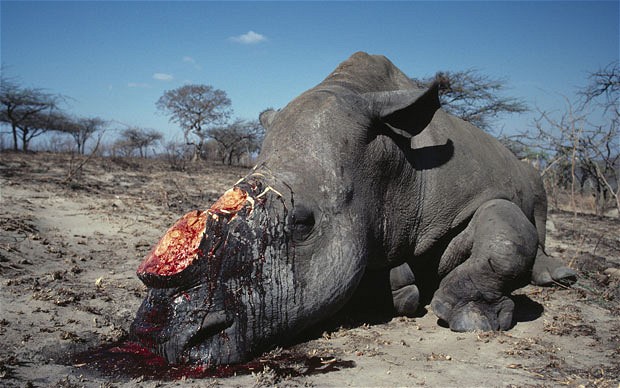
Poached rhino
A poached rhino. Photo: www.telegraph.co.uk/ALAMY

But observers wonder if a prosecution will be possible.

Zimbabwe is home to both black and white rhinos and has the fourth-largest national population of Critically Endangered black rhino. Unfortunately, in 2017, 36 rhinos were killed by poachers in the country.

The new President of Zimbabwe, Emmerson Mnangagwa, sanctioned an urgent investigation into the former First Lady’s activities, following evidence of systemic smuggling of ivory, rhino horn, diamonds and gold.

For four months, Adrian Steirn posed as a potential customer for illegal wildlife products, finding a number of links between Grace Mugabe, poachers on the ground and those working to send illegal items out of the country. In conversations with ivory and rhino horn dealers, Steirn came to understand that goods marked as the First Lady’s were able to pass through customs without being searched.

The poachers that had offered Steirn ivory were arrested and found in possession of six large elephant tusks. But any evidence connecting these crimes to the former First Lady is crucially important if a prosecution is to be successful and Zimbabwe’s political landscape could mean that this is difficult to secure.

In 2008 and 2009, 39 suspects were arrested in Zimbabwe for various rhino-related crimes, but only five were successfully prosecuted and convicted. Of these five, just two received substantial sentences befitting their crimes, whilst the other three got away with paltry fines. This was due to a combination of factors including: poor investigation of the cases; inadequate preparation and presentation in courts by the prosecution; likely cases of corruption; and a general lack of appreciation by court officials of the severity of the rhino poaching crisis. However, in 2010, poacher Tichaona Mutyairi, was sentenced to 17 years in jail, a punishment that better matched the scale of his crimes.

While this was a positive step towards better enforcement of wildlife crimes, it does not mean that all future poaching crime investigations will be straightforward. Corruption is widespread and poaching is often just one aspect of illegal activity by much larger networks of major organised crime syndicates. While the new Zimbabwe government may have stated a “no nonsense approach” to wildlife trafficking, in 2009 President Mnangagwa himself was accused of having links to rhino poachers.

World Migratory Bird Day: Unifying voices for conservation

0

“Unifying our Voices for Bird Conservation” is the theme of World Migratory Bird Day 2018. This year, the campaign will have a new global dimension, bringing together the world’s main migration corridors, also called flyways, for celebrations all across the world – and for the first time, with two peak campaign days in the year.

Migratory-Birds
Migratory birds

As birds migrate during different seasons throughout the year, World Migratory Bird Day will be observed on both the second Saturdays of May and October (May 12, 2018 and October 13, 2018), making it possible for individuals and organisations to organise educational activities and awareness-raising events in their countries at the time of migration.

The African-Eurasian Flyway, the Americas Flyway and the East-Asian Australasian Flyway link breeding, stop-over and wintering sites of billions of migratory birds which roam across the planet. Migratory birds such as the Arctic Tern travel more than 70,000 km from Iceland to Antarctica and back every year. Habitat loss, illegal hunting, collision with and electrocution by power lines as well as pollution and poisoning put their survival at risk.

Migratory birds cross international borders during their migrations and require quality habitats and a network of suitable sites to support their annual journeys. International cooperation across the entire migratory range is therefore essential. International treaties such as the UN Convention on the Conservation of Migratory Species of Wild Animals (CMS), the Agreement on the Conservation of African-Eurasian Waterbirds (AEWA) and the Migratory Bird Treaty Act (MBTA), one of the oldest wildlife protection laws, are indispensable for coordinated conservation actions among countries.

Environment for the Americas (EFTA), CMS and AEWA recently entered a partnership to unify their respective campaigns, IMBD and WMBD, and are working together to organise a new World Migratory Bird Day. This year, they are uniting for the first time to emphasise the importance of migratory birds globally and are calling for a better protection of the birds and their habitats.

India’s first inspection manual for monitoring emissions, effluent released

0

Pollution monitoring and control has always been a challenge in India, and one of the key loopholes has been a weak and lax monitoring and compliance enforcement mechanism. In 2017, Centre for Science and Environment (CSE) had published a set of broad guidelines for installing and operating continuous emission monitoring systems (CEMS) in India. This year, CSE has followed it up by releasing its Inspection Manual for CEMS and CEQMS (continuous effluent quality monitoring systems) implementation in India.

Chandra Bhushan
Chandra Bhushan, Deputy Director General, Centre for Science and Environment (CSE)

The Manual, the first publication of its kind in India, was released at a training programme on industrial pollution management organised by CSE in Kokata on Thursday, April 26, 2018 for state pollution control board (SPCB) officers. The event was conducted jointly with the West Bengal Pollution Control Board (WBPCB) and the Swedish Environmental Protection Agency (SEPA).

Said Sanjeev K. Kanchan, programme manager, Environmental Governance-Industry, CSE: “This handbook is a tool for SPCBs to facilitate inspection of CEMS and CEQMS installations in India. Industries can use this handbook for self-assessment of installation, and for better use of equipment and investments in it. The handbook is also a capacity building tool which gives broad information of CEMS and CEQMS systems, their functions, operational maintenance and data reporting practices.”


Why the manual?

Even though India has tightened its norms with time, pollution has kept growing in leaps and bounds because of lack of monitoring and compliance enforcement. According to CSE researchers, industries fake compliance by under-reporting their pollution levels, while the existing regime fails to ensure credible pollution monitoring and accurate data reporting. Since SPCBs rarely get a chance for on-site inspection, no one checks the ground reality of pollution control by the plants.

In 2014, the Central Pollution Control Board (CPCB) had initiated real-time monitoring of pollution from 17 categories of highly polluting industries and pollution control facilities like waste incinerators, bio-medical incinerators, common effluent treatment plants etc. It also mandated the installation of CEMS for monitoring stack emissions and CEQMS for monitoring effluent quality. Installation of CEQMS was also mandated for industries that were disposing effluents into the river Ganga and its tributaries.

Guidelines for installation of these technologies were published by the CPCB as well as CSE, but in the absence of effective inspection and monitoring, they did not serve any purpose. CSE’s Inspection Manual is expected to bridge that gap.

Said Kanchan: “In India, the rapid and high rate of industrialisation and the resultant pollution means we need a sophisticated pollution monitoring, control and reporting regime – for this a well-developed continuous monitoring and reporting system and a time-bound action plan are essential. We strongly believe that a real-time monitoring system if implemented properly can catapult environmental compliance enforcement into the 21st century. We hope the handbook will help us in this.”

For the uninitiated, CEMS and CEQMS are important tools for pollution monitoring, control and reporting. The systems ensure data accuracy, higher monitoring frequency, minimal manual intervention, firm regulatory monitoring and better transparency to strengthen the pollution control regime. Whereas continuous monitoring of ambient air quality is now a common system, continuous emission monitoring of stationary sources has been made mandatory in many industrialised and developing countries like the US, EU, China and Brazil.