24.8 C
Lagos
Thursday, December 25, 2025
Home Blog Page 1888

EU suspends funding to Kenya over indigenous human rights violations

0

The European Union (EU) on Wednesday, January 17, 2018 suspended a multi-million-euro project in the face of mounting evidence that its funds were being used to carry out violent human rights abuses.

Sengwer indigenous people
Indigenous people from the Sengwer community in western Kenya. Photo credit: REUTERS/Katy Migiro

The news came less than 24 hours after guards working from the EU-funded Kenya Forestry Service mounted a raid in Embobut Forest, where the Sengwer indigenous people live, shooting and killing 41-year-old Robert Kirotich and wounding another.

The EU Ambassador to Kenya, Stefano A. Dejak, has condemned the news, saying: “Yesterday’s shooting took place after we had formally alerted Kenya’s Government that the use of force by Kenya Forest Service guards in the Embobut Forest or elsewhere against innocent locals would lead the EU to suspend its financial support for conservation work on the country’s water towers. Accordingly we are now suspending the support to the Water Towers Programme with the Government of Kenya.”

In response to the news, Elias Kimaiyo, of the Sengwer, said: “This is the beginning of a first step in our land rights struggles. If they had listened to us (and we have been crying for a long time), then this would not have happened, and the funds could have been used in a constructive way to help conservation and not used in a violent way for human rights violations. It seems to have taken Robert Kirotich being sacrificed for these people to listen.

“That they suspend this money is good news, but the major thing is they come to the table and listen to us, and work together as we live peacefully on our lands, to make sure our human rights are respected and to let us conserve our lands in the ways we know well, with support from the Government, the Europeans themselves, and any other conservation agencies, provided that our land rights ownership are recognised.”

Earlier this week, three UN Special Rapporteurs wrote to the EU, urging them to suspend funding to the WaTER Project amid concerns about the ongoing human rights atrocities.

Dr Justin Kenrick, a senior policy advisor at Forest Peoples Programme, has been working with the Sengwer on their land rights issues. Speaking from Kenya, he said: “We welcome the fact the the EU has suspended the WaTER Project, but unless they help act swiftly to stop the evictions and violence, and to persuade the Ministry to adopt a rights-based approach then they are simply avoiding, rather than genuinely taking, responsibility for the harm they have been funding.

“The Sengwer are calling for these human rights abuses to stop immediately, and for an expert meeting to be urgently convened in Nairobi to establish a clear road map to change Ministry policy so it abandons this outdated, violent, counter-productive approach and adopts modern conservation methods that recognise Sengwer’s rights.

“A modern rights-based approach would protect communities’ rights, and enable state agencies to support the community in protecting their forests.  It would also enable the Ministry to continue to receive substantial funding rather than scaring development partners away.

“The Sengwer of Embobut only wish to live in peace, and to have the right to practise their way of life, a way of life that strongly protects their forests. We need to urgently change what has been an appalling record of development partners funding for an approach that has been committed to human rights violations. The Africa Court ruling in May 2017 that the Ogiek of Mau were wrongly evicted, and the Special Rapporteurs’ call for an approach that respects human rights, have helped contribute to the tireless work and bravery of the communities as they seek to secure their human rights and protect their forests.”
EU-funded scheme: Guards kills indigenous Sengwer man in Kenya

0

Forty one-year-old Robert Kirotich was on Tuesday, January 16, 2018 reportedly shot by EU-funded guards working for the Kenya Forestry Service. Another wounded man, David Kipkosgei Kiptilkesi, was taken away by the guards and his condition said to be unknown.

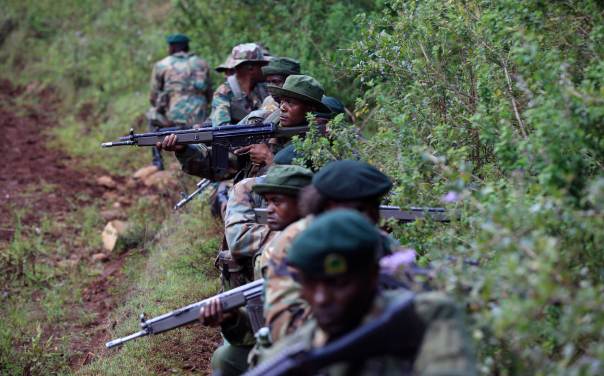
Kenya Forestry Service
Kenya Forestry Service guards

At 2pm on Tuesday, Robert Kirotich was said to be herding cattle in Kapkok Glade, in the Embobut Forest area of the Cherangany Hills in west Kenya when he was attacked by a group of around 40 guards working for the Kenya Forestry Service (KFS). He was shot and killed and his body was retrieved by community members at 6.30pm same day, the Forest Peoples Programme (FPP) disclosed in a statement .

On Christmas Day, guards employed by the KFS entered Sengwer lands and forcibly evicted them, supposedly in the name of conservation. After evicting them, they set fire to their homes. The violence was one of many forced evictions that the community has endured and they have continued, on 29 December, 1 January, and right up to today. On January 4, the Sengwer held a press conference, calling for change for the new year.

Three UN Special Rapporteurs this week wrote to the EU urging them to suspend funding to the WaTER Project. John H. Knox, Special Rapporteur on the issue of human rights obligations relating to the enjoyment of a safe, clean, healthy and sustainable environment; Michel Forst, Special Rapporteur on the situation of human rights defenders; and Victoria Tauli-Corpuz, Special Rapporteur on the rights of indigenous peoples, jointly said: “We call on the Kenyan authorities to urgently halt the evictions of Sengwer community and undertake impartial investigations of these attacks. Furthermore, we urge the European Union to suspend funding for the project until measures have been taken to uphold international standards on indigenous peoples’ rights.”

The guards are working for the EU-funded Water Towers Protection and Climate Change Mitigation and Adaption (WaTER) project, a  €31 million programme which states its aim as being to help eradicate poverty through improving the productivity of ecosystem services in two of Kenya’s five water towers.
Another Sengwer man, Paul Kitum Kiptuga, was reportedly shot at while at home a week ago. He said: “At around 12.30 noon, about 10 KFS guards arrived at my home. At that time there was a community member who was living nearby who saw the KFS rangers coming towards my home and called loudly that KFS are coming, you must run as fast as possible. I left everything and ran.

“At 300 metres from my home, the KFS guards saw me. As I was escaping I looked back to see how near they were. At that moment I saw them about to shoot and heard the gun shot and the bullet fly past me.

“After the first shot, they were shouting at me to stop and others were shouting ‘kill him, kill him, kill him’. Another live bullet came past me and then I managed to enter the forest. I heard the last shot as I disappeared into the forest and crossed the stream which slowed them down as they tried to chase me.

“Then the KFS guards went back to my homestead and I climbed to a higher place to be able to see what they were going to do next. I could see them clearly collecting some paper and blankets and other things to put into my house before setting fire to it.”

The Sengwer are calling for the EU WaTER project to be stopped. They applaud its aim of seeking to protect the forests but they state that funding a government agency – KFS – that acts so inhumanely, with no interest in human rights or conservation, is a way of destroying the very community that depends on and cares for their ancestral lands, Embobut forest.

Milka Chepkorir Kuto, a Sengwer woman, said: “How many of us will have to die for the EU to listen?”
Yator Kiptum, a Sengwer leader, said: “The EU must act now by cancelling the WaTER Project. How many Sengwer must be killed by the KFS guards before the EU listen to the voiceless members of the Sengwer indigenous peoples, who are trying to live peacefully on their ancestral lands?”

Violence against the Sengwer has taken the form of forced evictions, arbitrary arrests, the burning of their homes, and violence, it was gathered.

Article 63.2.d.ii of Kenya’s Constitution acknowledges the right of indigenous peoples to control and management of their land.

From 2007 to 2013 the World Bank funded the Natural Resource and Management Project (NRMP) in Embobut forest, which resulted in years of forced evictions of the Sengwer people. Despite this, the EU began funding a project in the same area. The WaTER Tower is a six-year  €31 million project that began in June 2016, and is set to run into 2020.

Kenya Forestry Service is Government agency that oversees development and management of forest resources in the country.

Why heaps of refuse litter Lagos, by government

1

The 57 Chairmen of Local Government and Local Council Development Areas (LCDAs) in Lagos State on Tuesday, January 16, 2018 attributed the uncleared waste in some parts of the state to the transition period in relation to the effective implementation of a new waste management policy by the authorities.

Lagos
Heaps of refuse by the Lagos Central Mosque on Tuesday, January 16, 2018

In the bid to overhaul the existing solid waste management process, the Governor Akinwunmi Ambode administration in December 2016 unveiled the “Cleaner Lagos Initiative”, which state officials say was informed by numerous flaws in the structure as well as dynamics of the existing system.

But, over a year on, the dream initiative appears to be tottering, and mountains of refuse now litter the streets of the much-vaunted Centre of Excellence.

Nonetheless, the council chairmen have thrown their weight behind the new waste management policy, which is encapsulated in the Cleaner Lagos Initiative.

Rising from an emergency meeting on Tuesday that focused on the resurgence of refuse on major highways and road medians across the state, the chairmen expressed optimism in the effectiveness of the new policy to birth a comprehensive and world class waste management system, just as they urged residents to cooperate with government during the transition period.

The council chiefs, who met under the auspices of Conference 57, their umbrella body, commended Governor Ambode for his vision to improve the cleanliness of the environment through a total sanitation solution and engagement of an environmental utility group, Visionscape Sanitation Solutions, to implement the new waste policy.

In a communiqué read at the end of the meeting by the group’s chairman, Omolara Essien, the council chiefs attributed the uncleared waste in some parts of the state to the transition period, but said it had become necessary to appeal to residents to exercise patience with government, as all hands were on deck to resolve the situation as quick as possible.

The chairmen said: “We appreciate the enormous difficulties and the challenging logistics which the establishment of a new agency to collect waste for 22 million residents would present to any government in any circumstances. Therefore, the current presence of uncleared waste is a result of the transition from an old system that was considered not efficient enough to a new system which effectiveness has also been recorded in other parts of the world.

Cleaner Lagos Initiative
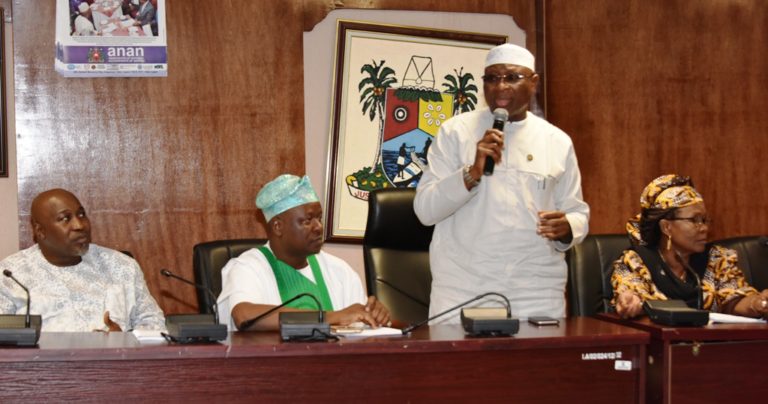
L-R: Special Adviser on Cleaner Lagos Initiative, Adebola Shabi; Commissioner for Information & Strategy, Kehinde Bamigbetan; Commissioner for Local Government & Community Affairs, Alhaji Muslim Folami; and Chairman, Lagos Mainland Local Government/ Chairperson, Conference 57, Mrs. Omolola Essien, during a press conference on Cleaner Lagos Initiative at the Secretariat, Alausa, Ikeja, Lagos, on Tuesday, January 16, 2018

“We are aware that Visionscape has successfully set up its system in Lagos State. It has employed personnel to carry out many of these functions. It has also been able to receive some percentage of its equipment which it is deploying gradually to residential areas and also trying to evacuate waste.

“Unfortunately, the bad practice of taking residential waste to medians which was in nefarious activities of those who wanted to avoid paying PSP contractors in the old era has continued and is threatening to sabotage the current efforts of the government to quickly evacuate waste. This has been worsened by the activities of the cart pushers who collect money from innocent citizens but dump their refuse on the medians.”

The chairmen specifically commended the state government for re-asserting the ban on cart pushers, warning that anyone found to be involved in such illegal activities, henceforth, would be made to face the wrath of the law.

In the meantime, the council bosses said the 57 LGAs and LCDAs in the state would deploy security personnel and vigilante to the main streets in their neighborhood to combat the menace, and also deploy more tippers and trucks to complement ongoing efforts to evacuate waste from road medians and in the communities, just as they urged Community Development Associations (CDAs) and the residents in general to team up with government to restore a clean environment across the state.

Commissioner for Information and Strategy, Mr. Kehinde Bamigbetan, on his part, assured residents that government was working round the clock to clear the waste from the streets and road medians, however urging residents to desist from patronising cart pushers.

“What we are witnessing is a phase, but government has mobilised all its machinery and you can see that the local governments and local council development areas are also on board to ensure that we evacuate these waste in the shortest possible time,” Bamigbetan said.

Also Speaking, Special Adviser to the Governor on CLI, Mr. Rasheed Shabi, said the government has carried out an extensive awareness in local governments and is also collaborating with Community Development Associations (CDAs) and Community Development Committees (CDCs) to get Lagosians ready for the new phase of waste management.

Shabi also assured that efforts would be intensified to clear up waste dumped on road medians across the state within the next 72 hours.

Also speaking, Senior Special Assistant to the Governor on Community Affairs, Alhaji Tajudeen Quadri, urged residents to embrace the new initiative and resist the temptation to dump refuse on road medians.

“My advice is that people should not be inpatient by taking their refuse to the roads, but they should pack it neatly in front of their houses, Visionscape is up to the task, they have started distributing waste bins and very soon they would get to our houses,” Quadri said.

Agriculturist urges gradual implementation of open grazing law

0

The Manager of Yobe Pilot Livestock Development Programme, Dr Mustapha Gaidam, has called for intensive sensitisation and mobilisation of stakeholders before the enforcement of the ban on open grazing.

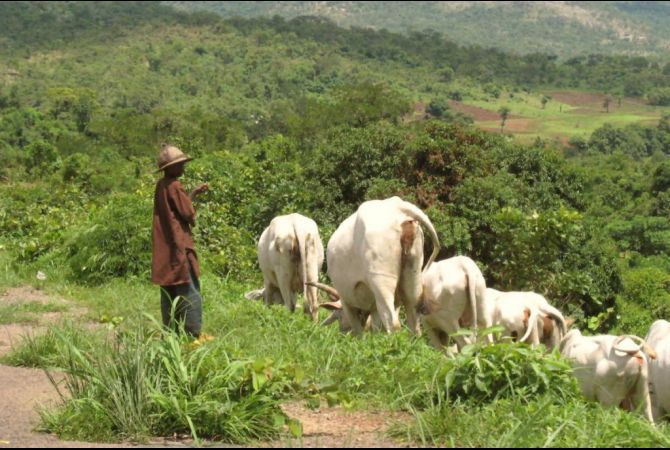
Open grazing
Open grazing

Mustapha gave this advice in an interview with the News Agency of Nigeria (NAN) on Tuesday, January 16, 2018 in Damaturu, the Yobe State capital.

“There is the absolute need for dialogue, intensive education, sensitisation and mobilisation for both crop and livestock farmers to appreciate the advantages.

“So far, the anti-open grazing law enacted by Benue, Taraba, Ekiti and Edo states has failed to serve the purposes for which it was established, considering the unfortunate incidences in Benue and Taraba.

“The law was intended to provide solution to farmers/grazers conflicts but unfortunately, the two groups have lost many lives and property,” he said.

Mustapha suggested that the provisions of the 1999 Constitution and the ECOWAS protocol must be considered in the formulation and implementation of any laws including the anti-open grazing law.

The manager argued that civil and traditional authorities must work towards establishing mutual trust and mutual agreement among stakeholders on systematic and gradual enforcement of the anti-open grazing law in the states contemplating the idea.

He expressed fear that the rising tension between farmers and herders in the affected states of the federation will soon translate into low crop and livestock farming activities in the country with threat to food and protein security.

Mustapha also described the demarcation and protection of stock routes as“ imperative” to facilitate movement of cattle across the country, provision of health facilities and water points to avert encroachment on farmlands by the animals.

He explained that cattle-ranching has many advantages to both herders and farmers considering the peculiarities of the occupation of the two groups.

“In Yobe, we enjoy a very long peaceful co-existence between farmers and cattle breeders because government has provided incentives to livestock farmers just as it subsidises fertiliser and other inputs to farmers.

“Government has also demarcated over 1,500 kilometres of cattle routes, provided water points, mass vaccination of animals and food supplement among others and there was no conflict for close to 10 years now,” Mustapha said.

Jury begins evaluation for 11th Cycle of Dubai International Award

0

A five-member jury drawn by the Dubai Award Secretariat as well as the United Nations Human Settlements Programme (UN-Habitat) on Monday, January 15, 2018 began the evaluation process for the 11th cycle of the Dubai International Award for Best Practices. The Jury will select a final 10 winners from the 110 projects which qualified to this stage from the Technical Advisory Committee evaluation process also held in Dubai on October 30 to November 3, 2017. A total of 89 countries and territories submitted entries for this prestigious award.

Dubai
Dubai

The Dubai International Award for Best Practices recognises significant contributions and innovations aligned with key New Urban Agenda themes of National Urban Policy, Participatory Slum Upgrading, Monitoring Mechanisms, Urban Redevelopment, Urban Planning and Design, Municipal Finance, Legislation as well as Rules and Regulations.

These practices will also:

  • Have a demonstrable and tangible impact on improving people’s quality of life;
  • Are the result of effective partnerships between the public, private and civic sectors of society; and,
  • Are socially, culturally, economically and environmentally sustainable.

In his welcome note, the Director General of Dubai Municipality, Mr. Mohammed Mutaiwei,  thanked the jurors for their commitment and effort to conduct the final evaluation process of the submissions in a transparent manner, and the significance of these practices for the international community.

The Chief of the Best Practices Unit at UN-Habitat, Ms. Åsa Jonsson, highlighted the fact that member states, and all other UN-Habitat partners ranging from NGOs to academia, are in one way or another looking for best practices to inspire and help guide their work, even though they may carry different terms such as “best in class examples” or “case studies”. Similarly, people on panels, and making presentations all take pride in showcasing what is ultimately their – or their organisation’s – best practices.

“The importance of the Award is to recognise and disseminate such best practices from multiple sectors – to help guide and feed into policies and programmes,” she added.

According to the organisers, the initiatives are examples of how the global community is working to achieve the Sustainable Development Goals and the New Urban Agenda while spreading inspiration to encourage others.

“Through this award, we are able to recognise and document these initiatives in order to make them known to the world. Since 1996, we have had over 100 award winners whose projects have had a positive impact on improving the living environment.”


Jury Evaluation Process

Behind closed doors, the jury members closely review, discuss and evaluate the entry submissions according to their professional expertise and the evaluation criteria for the seven categories. On the final day, the jurors will determine which entries will be awarded based on impact, partnership, sustainability, leadership and community empowerment, gender equality and social inclusion, innovation within local context, and transferability, alongside the specific criteria for each category.

Five jurors from different countries were selected based on their area of expertise and their understanding of the categories. The evaluation process, it was gathered, will be done in a fair, transparent and independent manner.

FADAMA III spends N437m on road construction, dams rehabilitation in Niger

0

The FADAMA III Additional Financing (AF) Programme in Niger State says it has spent N437 million on constructing a road and rehabilitating two dams in three local government areas of the state.

Adetunji Oredipe
Dr Adetunji Oredipe, World Bank Task Team Leader for the FADAMA III Programme

Alhaji Baba Shaba, the Communication Officer of FADAMA III (AF) Programme in the state, made this known in an interview with News Agency of Nigeria (NAN) in Minna, the state capital, on Tuesday, January 16, 2018.

He said that N270 million was spent on the nine-kilometre road in Edozhigi community of Gbako Local Government Area to facilitate the efforts of farmers to transport their produce to the markets.

“The newly constructed road covers about nine kilometres and each kilometre costs N30 million. This road is very important to farmers in the area, particularly because we are encouraging them to adopt all-year round farming.

“The irrigation dam is located along the road, hence the need to construct the road to make the dams accessible to the farmers,’’ he said.

Shaba appealed to farmers in the area to take due advantage of the road to increase their productivity, while shunning middlemen who were always interested in buying their crops at giveaway prices.

In a related development, the communication officer said that the FADAMA III (AF) programme had rehabilitated an irrigation dam in Edu, Lapai Local Government Area at the cost of N70 million.

Besides, Shaba said that N97 million was spent on construction of an irrigation dam in Loguma, Agaie Local Government Area of the state.

He said that the rehabilitation and construction of the irrigation dams were aimed at facilitating the efforts of the farmers to engage in dry-season farming and boost food security in the country.

By Rita Iliya

Nigeria benefits from AfDB’s generational shift in agriculture

0

As part of its goal to see a generational shift in agriculture on the continent, the African Development Bank (AfDB) has taken its “Farming is Cool” initiative to school children in Nigeria.

farming-can-be-fun
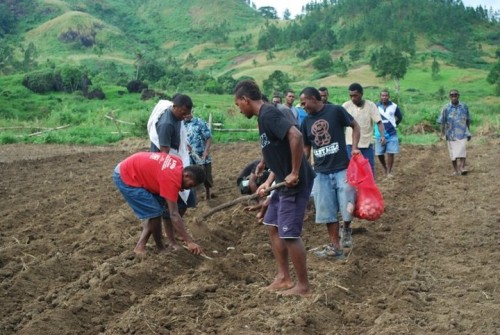
Youths involved in farming. Photo credit: smeonline.biz

The Bank has also launched a Junior Art Contest in Nigeria to promote the potential of agriculture to secondary school children.

Africa is hoping to feed itself and to eradicate malnutrition by 2025, but the average age of farmers on the continent is currently 60 years.

The President of the AfDB, Akinwumi Adesina, will present prizes to the three winners from the month-long contest at the commissioning of the Nigeria office building on Thursday, January 18, 2018 in Abuja. The winners will receive partial scholarships of N1 million, N500,000 and N250,000 as first, second and third place prizes, respectively.

“The art competition was conducted to sow a seed of awareness in young minds of the significance and potential of agriculture in the development of a nation’s economy. The ‘Farming is Cool’ campaign strives to flip the script on farming as a last resort by emphasising and promoting it as a viable wealth-creation option,” said Ebrima Faal, Senior Director of the Nigeria Country Department at the AfDB. “It targets youth and children to encourage positive thought and action towards an agricultural revolution.”

The Bank is accelerating agricultural development through its Feed Africa Strategy with planned investment of $24 billion over the next 10 years.

The goals of the Bank’s Feed Africa strategy are to help eliminate extreme poverty in Africa by 2025; end hunger and malnutrition in Africa by 2025; make Africa a net food exporter; and, move Africa to the top of export-orientated global value chains where it has comparative advantage.

Feed Africa includes include agricultural finance models that will benefit youth, as well as other groups; it will rely on the Jobs for Youth in Africa Strategy to increase the representation of youth in agriculture and agribusiness and equip them with the necessary skills to be successful.

Nigeria’s President, Muhammadu Buhari, will commission the new office complex of the AfDB in Abuja on January 18, 2018, consolidating the country’s position as the Bank’s largest shareholder.

Why right to water should be enshrined in Constitution, by ERA

0

The Environmental Rights Action/Friends of the Earth Nigeria (ERA/FoEN) has written President Muhammed Buhari on the need to enshrine water as a human right in the Nigerian Constitution.

suleiman adamu kazaure
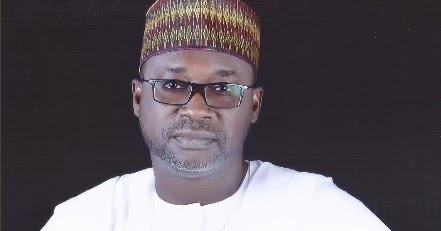
Suleiman Adamu Kazaure, Water Resources Minister

ERA/FoEN is asking President Buhari to throw his weight behind demands by civil society and other groups for democratically-controlled water systems that guarantee universal access to all Nigerians irrespective of their status.

The letter  was also copied to the offices of the vice-president, Professor Yemi Osinbanjo, and the Minister of Water Resources, Suleiman Hussein Adamu.

The group said that while the Buhari administration has taken a right step in the ongoing technical audit of all projects in the water sector, decades of reliance on donor-funded water projects have pushed behind the human right to water and projected instead, privatisation in all forms including Public-Private Partnerships (PPPs) that leave out the larger segment of Nigerians who yearn for unfettered access to portable and safe water.

The group frowned at the World Bank and private water industry it accused of being behind the growing proposals for water privatisation or PPP plan in many states, particularly in Lagos where the Lagos State Water Corporation (LWC), is pushing very hard for a dangerous privatisation of water under a PPP model that has failed in other parts of the world.

According to the ERA/FoEN, such failures have been recorded in Manila in the Philippines whereas part-owner of water corporations that win PPP contracts, the World Bank positioned itself to profit from this model, as well as Nagpur in India, Paris, Jakarta and Dar Es Salaam, among others that have experimented with PPPs but had to roll back to remuncipalisation.

The text of the letter said: “PPPs do not bring the benefits that are being mouthed by the promoters but rather it leads to hike in prices, job losses, lower quality, unfulfilled infrastructure promises and shut offs for those who cannot pay.”

Aside enshrining the human right to water in the Nigerian constitution, the group recommended that the administration should reject all forms of water privatisation and commodification and fully uphold the human right to water as an obligation of the government, representing the people.

It demanded the integration of broad public participation in developing plans to achieve universal access to clean water; rejection of contracts designed by, involving, or influenced by the International Finance Corporation (IFC), and asked that state governments disclose all discussion and contracts regarding water, including formal and informal advisory roles with IFC and World Bank. The letter also asked the Buhari administration to build the political will to prioritise water for the people to open the door to a comprehensive plan that invests in the water infrastructure necessary to provide universal water access, create jobs, improve public health, and invigorate the Nigerian economy.

Australia calls for scientists to save Great Barrier Reef corals

0

Australia has issued an open call to scientists to help save the corals of the Great Barrier Reef with a $2 million challenge, an Environmentalist said on Tuesday, January 16, 2018.

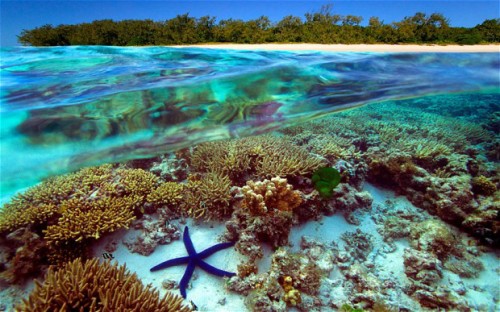
In Australia’s Great Barrier Reef
In Australia’s Great Barrier Reef – the world’s largest coral reef system – rising water temperatures are causing coral bleaching, and ocean acidification is restricting coral growth and survival. Photo credit: telegraph.co.uk

A reef is a bar of rock, sand, coral or similar material, lying beneath the surface of water; it may go as deep as 261 feet (80m) below the surface.

According to Frydenberg, the Reef is the planet’s greatest living wonder.

“This is an open invitation to our greatest scientific minds, to develop innovative solutions which will protect corals and encourage the recovery of damaged reefs.

“The scale of the problem is big and big thinking is needed, but it’s important to remember that solutions can come from anywhere,’’ Frydenberg said.

Report says the Great Barrier Reef is the world’s largest conglomerate of coral reefs, larger than Italy.

It is one of most bio-diverse ecosystems on the planet and home to millions of marine life-forms.

It is also a top tourist attraction in Australia, generating some $6.4 billion a year.

But rising ocean temperatures and environmental degradation have led to large-scale coral bleaching in the last two years.

Scientists have warned that unless more is done to address climate change, the Reef will be destroyed within our lifetime.

The government called for scientists to find novel solutions to restore reefs and boost coral abundance.

Frydenberg said solutions could focus on anything from reducing the exposure of corals to physical stressors, to coral regeneration by cultivating reef-building coral larvae.

“Proposals need to “be mindful of” the Aboriginal and indigenous communities, as well as other users like visitors, tourism operators, recreational and commercial fishers,’’ Queensland Environment Minister Leeanne Enoch said.

In 2017, the Australian government narrowly avoided having the Reef added to the UNESCO “in danger” list after promising to spend $2 billion to implement measures to protect and manage it.

Gombe residents warned against dumping refuse in drains, waterways

0

Gov. Ibrahim Dankwambo of Gombe State has called on the people of the state to refrain from dumping refuse in drainage channels and waterways so as to avert flooding.

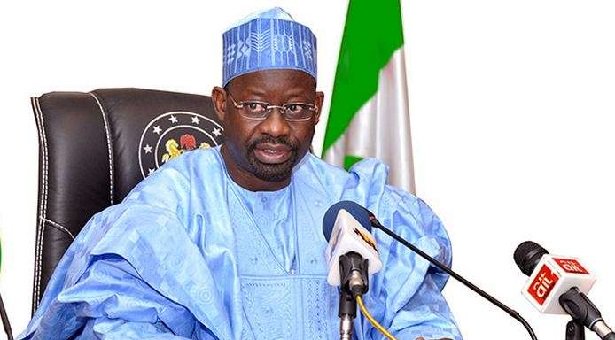
Ibrahim Dankwambo
Gov. Ibrahim Dankwambo of Gombe State

Dankwambo made the call during an inspection visit to Dukku Motor Park new roundabout in Gombe on Monday, January 15, 2018.

He said that his administration was striving to address the problem of flooding in the state, hence the need for the citizens to support the efforts.
“I want to use this opportunity to call on residents to stop dumping refuse inside waterways, especially down east where the drainage system is narrow.
“For us to address the issue of flooding around these places, we need to pull down some houses, compensate the house owners and expand the channel.

“This will enable the large volume of water that comes from various sources to pass through the channel without any obstruction,” he said.

Besides, Dankwambo said that the areas that were recovered after the construction of the roundabout would be used for the construction of modern, beautiful shops to beautify the place.

The governor assured the people that the shops would be allocated to them whenever the construction was completed.
Dankwambo commended the officials of the Ministry of Works who supervised the contractors that executed the roundabout project for their quality service delivery.

×