Home Blog Page 1883

Sea levels rise as tonnes of Antarctic ice melts

0

Ice melt has caused sea levels to rise by eight mm since 1992, according to leading scientists on Thursday, June 14, 2018.

Melting Antarctic ice

Australian scientists from the Commonwealth Scientific and Industrial Research Organisation (CSIRO) teamed up with international researchers to study the Antarctic and concluded that the eight-mm rise in sea levels corresponded to approximately three trillion tonnes of ice melt.

Their research was published in the scientific journal Nature on Thursday.

Using 24 different satellite-based estimates, the group demonstrated a tripling of ice-loss in western Antarctica between 1992 and 2017.

Lead author and senior scientist, CSIRO Oceanographer Steve Rintoul, expressed concerns over the Antarctic ice sheet, commenting that “the largest mass loss is observed where relatively warm ocean waters are melting floating ice shelves from below.”

“As the ice shelves thin and weaken, they provide less resistance to ice flow from the continent to the sea,” Rintoul said.

“A critical question for the future is how ocean-driven melting of Antarctic ice shelves will change as the earth warms.”

“Continued high greenhouse gas emissions risk committing us to changes in Antarctica that will have long-term and far-reaching consequences for Earth and humanity.”

The study is part of a special collection of articles on Antarctica that includes Australian research on the role of the Southern Ocean in sea-level rise.

It explores how Antarctica and the Southern Ocean will change over the next 50 years, and how those changes will impact the rest of the globe.

Two scenarios are considered: one in which greenhouse gas emissions remain unchecked, and one in which strong action is taken to limit emissions and to manage increased human use of Antarctica.

If the high emissions continue, major ice shelves will collapse by 2070, according to the report, which also suggests sea level rise would accelerate to rates not seen in 20,000 years.

Furthermore, ocean acidification and over-fishing will alter Southern Ocean ecosystems, and a failure to manage increased human pressures will degrade the Antarctic environment, the report indicates.

Duanne White, associate professor at the University of Canberra, commended the paper as “a thorough assessment of the current state of knowledge of Antarctic ice loss.”

How smoking hastens symptoms of stroke, by cardiologist

0

A cardiologist with Lagos University Teaching Hospital (LUTH) Idi-Araba, Dr Akinkumi Afolabi, has said that cigarette smoking hastens the symptoms of stroke in heavy smokers.

tobacco smoking
Smoking

Afolabi disclosed this in an interview with News Agency of Nigeria (NAN) on Thursday, June 14, 2018 in Lagos.

He said smoking could increase the risk of having stroke by at least 50 per cent, causing possible brain damage and death.

He added: “One way that smoking can increase risk of stroke is by increasing chances of developing brain aneurysm.

“This is a bulge in a blood vessel caused by weakness in the blood vessel wall.

“This can rupture and lead to extremely serious condition known as subarachnoid haemorrhage.

“Subarachnoid haemorrhage is a type of stroke which causes extensive brain damage and death.

“Within two years of stopping smoking, risk of stroke can be controlled but the patient needs treatment and proper monitoring,’’ Afolabi said.

He explained that smokers were liable to heart attack, premature aging and other cardiac complications.

He said: “Smoking also increases the risk of having heart attack and coronary heart disease.

“Smokers have increased chance of getting stomach cancer or ulcer, which weaken the muscle that controls the lower end of gullet (oesophagus).

“Smoking also reduces the amount of oxygen that gets to the skin and makes the body to age faster
and look grey and dull. The toxins in the body also cause cellulite.

“However, once people stop smoking, it will prevent further deterioration to the skin.”

The cardiologist urged government at all levels and the Federal Ministry of Health to create more awareness about the risk of tobacco use.

By Oluwakemi Oladipo

Anambra to spend N4.1b on farming in 2018

0

The Anambra State Government says it will spend N4.1 billion on strategic agricultural development initiative in the 2018 planting season.

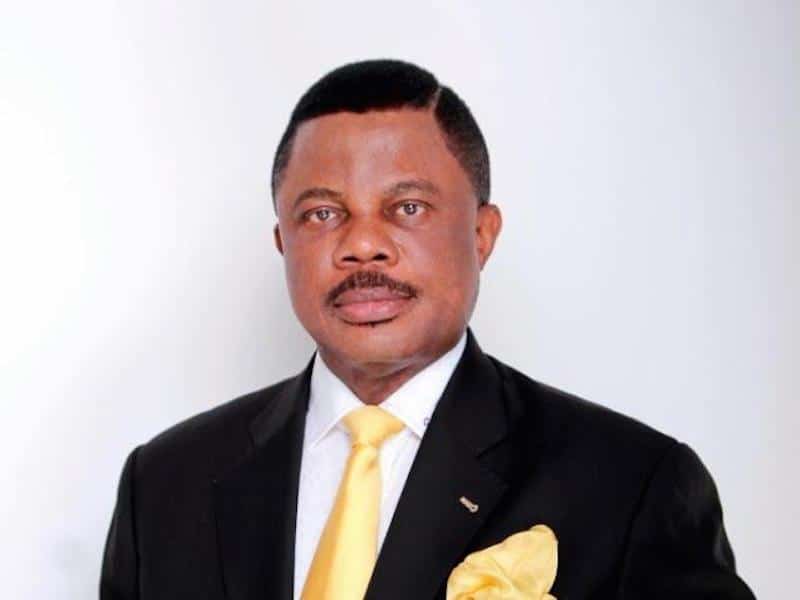
Willie Obiano
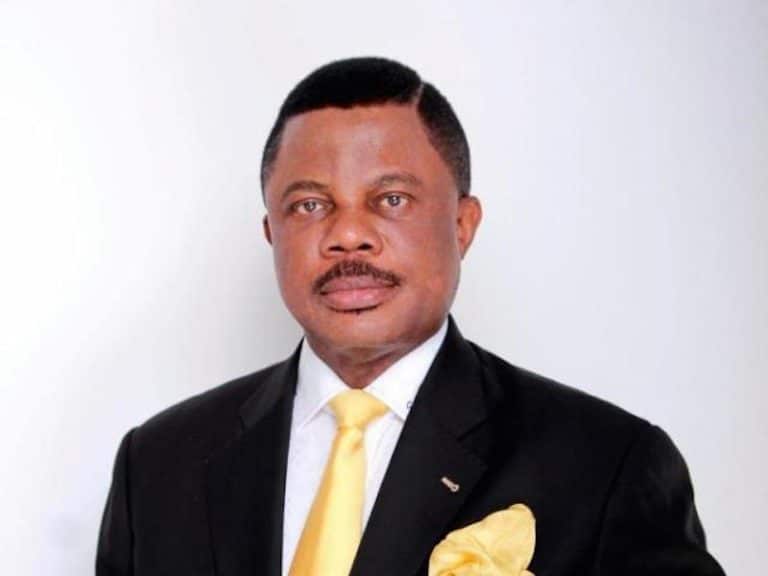
Chief Willie Obiano, Governor of Anambra State

Commissioner for Agriculture, Mechanisation, Processing and Export, Mr Afam Mbanefo, disclosed this to the News Agency of Nigeria (NAN) on Thursday, June 14, 2018 in Awka, the state capital.

Mbanefo said that the state would, during the period, evolve and apply sustainable cluster-based farming initiative to boost agriculture.

“The cluster-base is a major method in driving modern agriculture. The ministry will apart from development of cluster farming initiative, provide farm inputs and motorcycles to farmers in the state.

“Gov. Willie Obiano’s administration is keen in empowering small holder farmers and I urge more farmers to get registered with the ministry to benefit.


“Plans are underway to introduce a Mobile App for Agricultural Extension and Farmer Information Management System to develop the sector more.

“A comprehensive four-year development plan has been developed for different agricultural produce and farm types to increase productivity and effective land utilisation,’’ he said.

The commissioner said that government aimed to achieve in the coming years, an agricultural system that would feed the people, protect the environment and return investments.

Mbanefo said that the state received commendation from the Federal Ministry of Agriculture and Rural Development, for its effective implementation of good agricultural policies which had improved agriculture.

He said that the ministry had designed programmes to create more jobs and alleviate poverty through favourable agricultural policies.

By Joy Mbachi

Experts laud review of National Building Code

0

Experts in the building and construction industry on Thursday, June 14, 2018 in Lagos lauded the Federal Government’s efforts in reviewing the National Building Code (NBC) of 2006.

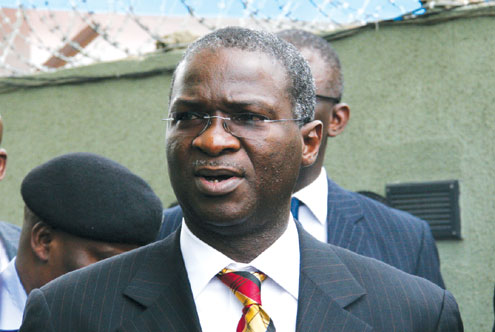
Gov-Babatunde-Fashola3
Minister of Power, Works and Housing, Babatunde Raji Fashola (SAN)

They said in Lagos that the review was a good development, describing it as a right direction and synergy for effective housing delivery in the country.

The Federal Government had on Tuesday announced a new National Building Code that would regulate construction with the aim of improving on measures to safeguard lives and property.

Mr Babatunde Fashola, the Minister for Power, Works and Housing, made the announcement at the ministry’s headquarters in Abuja, while inaugurating members of the Architects Registration Council of Nigeria (ARCON).

“Given the number of deaths and the risk associated with wrong plans for buildings and other construction projects, it becomes imperative for government to adopt deliberate measures to check the avoidable loss of lives and property, hence the new code,’’ Fashola said.

The experts said the NBC, as instituted by professional bodies in the construction industry in 2006, was supposed to be reviewed at five years intervals.

According to them, this is the first time it is being reviewed.

Contributing, Mr Chucks Omeife said that the Federal Government should propose an Executive Bill to the National Assembly for an enabling law/legislation that would enforce the various provisions of the NBC.

Omeife, the President, Chartered Project Management Institute of Nigeria (CPMIN), said that passage of the bill would guarantee orderly and effective building environment.

“In the real sense, it will expand the scope of the code in terms of professionals responsibilities, expanding industry issues relating to materials, science and technology.

“The implementation and enforcement of the Code has been the problem and still remains the problem. It is a scenario of a motion without movement.

“This government can make the difference by putting in place an enabling legislation to back up the Code,” Omeife said.

Also, Mr Kenneth Ndukwu, the President, Nigerian Institute of Building (NIOB), urged stakeholders in the industry to have positive attitude for the expectations of the building code to be realised.

Ndukwu said that stakeholders should continue to ensure full implementation of the code for a well-regulated and effective operation in the building and construction industry.

“The review and announcement of the new building code is a good development, but stakeholders still expect more.

“The issue of quackery, non-involvement of professionals, poor workmanship, use of untested/substandard materials and neglect of safety standards on construction sites that lead to building collapse will be checked,” he said.

In his remarks, Mr Fitzgerald Umah, the Chairman, Nigerian Institute of Architects (NIA), Lagos chapter, said that the code would promote professionalism in the building industry.

Umah noted that activities and operations of the industry were not properly regulated due to lack of laid down rules.

He said that the enforcement of the building code remained the sure way to penalise any erring professional.

By Okuanwan Offiong and Lilian Chukwu

States tasked on smart cities

0

The Project Manager, United Nations Habitat for a Better Urban Future, Prof. Mustapha Zubairu, on Wednesday, June 13, 2018 urged state governments to work assiduously toward developing smart cities.

Smart city
Smart city

Zubairu, who made the call at the 2018 International Conference of the Nigerian Building and Road Research Institute held in Abuja, said that states which develop smart cities were likely to become technology and innovation hubs.

The conference, which has the theme: “Sustainable Development Goals (SDGs) and the Nigerian Construction Industry: Challenges and the Way Forward’’, focuses on creating awareness on the need to implement sustainability in construction practices and evolve new strategies to embed sustainability into construction activities.

According to him, most smart city applications are built around the Internet of Things (IOT)-objects embedded with sensors and wireless connectivity and analytics tools to enable them send and receive data that can be analysed and acted upon.

“The effectiveness and sustainability of cities and towns are hinged on subsisting level of good governance and a paradigm shift is required to build good understanding, mutual respect and partnership between state governments and residents of the cities,” Zubairu said.

He, however, expressed concern over illegal access to data generated from smart cities.

“Among the challenges to overcome in establishing smart cities in Nigeria are that since the internet is a global network, it will be difficult for Nigeria alone to control and prevent illegal access to data generated from its smart cities.

“Most of the private sector organisations that collect and store citizen’s data are not legally bound to protect their rights,’’ Zubairu said.

He called for the amendment of the 2012 National Urban Development policy to incorporate a national goal, objectives and strategies on smart city.

According to him, there is also need to allocate a percentage of the Ecological Fund to finance the development of components of smart cities such as research and development on improving cyber security as well as developing smart digital infrastructure.

By Ikenna Uwadileke

Oyo evolves technology-driven solution to environmental challenges

0

As part of its transformation efforts, the Oyo State Government in collaboration with a waste management firm has evolved a technology-driven method of tackling various environmental challenges in the state.

Ibadan
Ibadan, Oyo State, Nigeria

Dr Bisi Akin-Akinlabi, the Special Adviser to the Governor on Education, made the disclosure at a news conference on Wednesday in Ibadan.

The News Agency of Nigeria (NAN) reports that the news conference held at the Technical University (Tech-U), Ibadan, as part of activities to herald the OYOMESI Festival of Learning.

The Oyo State Model Education System Intervention (OYOMESI) is an initiative of the state government aimed at raising competent civil citizens.

NAN reports that the weeklong event would hold from June 29 to July 5.

Akin-Alabi also stated that the festival would host a competition tagged “Hackaton”, a technology-driven competition aimed at providing IT solutions to identified environmental management challenges.

“Among the challenges to be examined are Waste Collection Billing and Payment System; Reporting of Illegal Dumpsites; City Enumeration and Management, and Recycling Measurement and Reporting,” she said.

She noted that the competition would attract an investment of N2 million for the winners coupled with mentorship and coaching from experienced IT and business professionals.

Mr Paul O’ Callaghan, Managing Director, WestAfrican ENRG Limited, said that the competition was the first in Nigeria, adding that no fewer than 250 participants had signified intention to participate in the competition.

Also speaking, Prof. Ayobami Salami, the Vice Chancellor of Technical University,  said the festival of learning in the state coincided with the first anniversary of the institution.

He said the aim of establishing the university was to find  innovative solutions to human challenges on daily basis, noting that this  aligns with the focus of  the Hackaton competition.

The event was attended by Mr Akin Oyedele, Senior Special Assistant to the Governor on Media, Prof. Adesola Ajayi, Deputy Vice-Chancellor, Technical University  and Mr Alex Oladeji, Registrar, Technical University.

By Akeem Abas

Global urban inhabitants expected to hit 2b by 2030

0

The Director-General, Nigerian Building and Road Research Institute (NIBBRI), Prof. Danladi Matawal, says additional two billion urban inhabitants are expected by 2030.

Nigeria Population
Nigeria’s population is said to be equivalent to 2.55% of the total world population

Matawal made this known on Wednesday, June 13, 2018 in Abuja during 2018 NBRRI International Conference.

The theme of the conference is: “Sustainable Development Goals (SDGs) and the Nigerian Construction Industry – Challenges and the Way Forward”.

According to him, the development will be a consequence of rapidly growing cities in Africa, Asia and Latin America.

“With this rapid growth comes an urgent need for sustainable building and construction through the integrated, global approach and support of UN as well as other country programmes.

Matawal said Nigeria ought to key into the rest of the world for innovative, simple, cheap and user-friendly solutions to develop the nation’s building environment.

He said that such effort would help to harness benchmarks of the UN-SDGs to develop a sustainable built environment to satisfy the needs of the present without destroying the potential of the future.

The Minister of Science and Technology, Dr Ogbonnaya Onu, said the present administration was committed and determined to rebuild nation’s infrastructure, particularly in the area of housing and roads.

According to him, a good network of roads is vital in the transportation of men, women, children and goods from one part of the country to another.

“We need decent houses for our citizens, the rich and the poor, the old and the young to live in. We also need houses for our schools, hospitals, offices, markets to mention a few.

“We need roads connecting our numerous cities, our rural areas and those leading from urban to rural areas. We also need roads to our farms, homes, schools, hospitals, markets and places of relaxation and entertainment.

“This is very important in getting Nigerians to know the various parts of the country and hence help promote national unity and stability,” he said.

He said that such effort would open areas of business through the utilisation of locally available materials for the construction of roads, houses and creation of wealth for individuals and the nation at large.

Onu said the conference would showcase enormous achievements made by researchers in NIBRRI, adding that the ministry had planned to help the institute to become one of the best in the world.

“Recently NIBRRI protected its intellectual property right by securing a patent for its laminated bamboo board. This product utilises wastes bamboo during construction. This is one of the wastes to wealth initiative of the institute.

“This product is durable and termite resistant, which serves as a heat insulation. Its strength is comparable with those of structural timber product like plywood and provides aesthetics to the interior of a building,” Onu said.

By Gabriel Agbeja

AfDB to invest $120m to boost cassava, others

0

The African Development Bank (AfDB) said is to invest $120 million in the next three years to boost cassava production and transform eight other commodities.

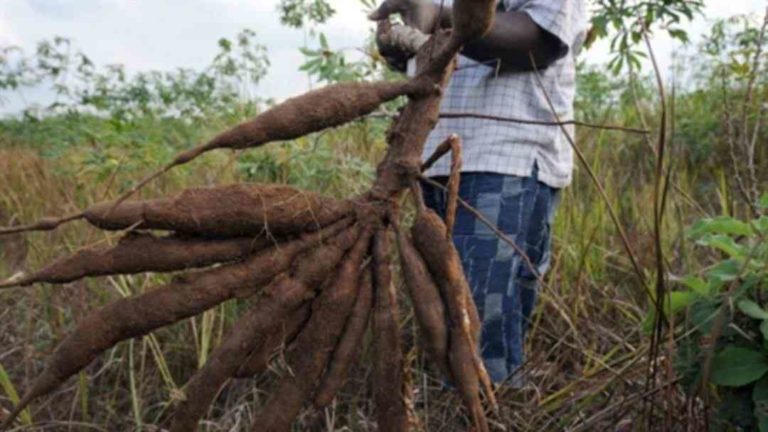
cassava
Cassava farming

AfDB’s Director of Agriculture, Dr Martin Fregene, made the remark at the ongoing conference on Global Cassava Partnerships (GCP) for the 21st Century in Cotonou, Republic of Benin.

The News Agency of Nigeria (NAN) reports that the conference is the fourth in its series.

Fregene said in a statement that the nine commodities were cassava, rice, maize, sorghum, millet, wheat, livestock, aquaculture, high iron beans, orange-fleshed sweet potatoes.

He said that transforming cassava on the African continent would help African nations to cut imports and redirect about $1.2 billion into African domestic economies.

“The bank’s investment in cassava comes at a time when African governments are scaling up efforts to end food imports and create wealth.

“Cassava is a strategic crop for Africa food security and wealth creation for youth and women.

“Another dimension to the importance of cassava is in nutrition, where cassava can enhance the nutrition of children directly or as feed for poultry and other livestock,’’ Fregene said.

He said that the largest volume of cassava coming from Africa supported more than 350 million people.

Dr Kenton Dashiell, Deputy Director-General for Partnerships for Delivery at the International Institute of Tropical Agriculture (IITA), said at the event that unlocking the potential of cassava required partnerships, according to the statement.

Dashiell said that close collaboration of partners in the cassava value chain would address constraints facing the crop.

He commended the GCP21 for filling the gaps in cassava research and development by organising conferences, thereby enabling experts to share knowledge on innovations in cassava.

NAN reports that the GCP21 is a not-for-profit international alliance of 45 organisations coordinated by Claude Fauquet and Joe Tohme of the International Centre for Tropical Agriculture (CIAT).

By Itohan Abara-Laserian

UNODC recommends community-based treatment for drug addicts

0

The United Nations Office on Drugs and Crimes (UNODC) has recommended community-based treatment model as intervention for curbing abuse of narcotic and psychotic drugs in Nigeria.

Fedotov
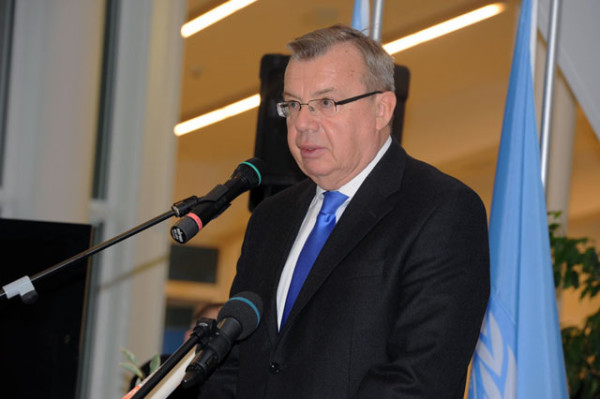
Yury Fedotov, Executive Director, United Nations Office on Drugs and Crime (UNODC)

The Project Officer of UNODC, Mrs Harshet Virk, made the recommendation in Enugu on Wednesday, June 13, 2018 at the first South East Round Table on Substance Abuse organised by the Pharmaceutical Society of Nigeria (PSN) in collaboration with Bensther Foundation.

Virk explained that the community based treatment model encompassed such elements like outreach, recovery management and social services, referral for treatment, screening and assessment of substance use disorders.

Others, she said, include long and short term treatment and outpatient treatment.

“These treatments work for the drug dependency users whether they are suffering from drug intoxication, dependence syndrome or harmful use,” Virk noted.

She pointed out that chaining drug addicts or stigmatising against drug users would only compound the problem as it would in no way help the victims.

According to Virk, there is no cure for drug dependency users but only treatment.

“Let us be true to ourselves. There is no cure all over the world for drug dependency users but there are treatment processes for them,” she said.

She described the proposed model as `a human right centred drug treatment’ aimed at reversing the negative impact of persisting drug use disorders and helping addicts to recover from the disorder.

The project officer said that UNODC had trained 2,000 staff that would implement the model in 10 states including Enugu State where Model Treatment Centres had been planted noting that funding for drug issue was limited.

In his remarks, the state Chairman of PSN, Dr Egbuna Udeorah, said the society had done a lot of sensitisation to eliminate drug abuse among the youth in the state.

Udeorah, however, said the organisation lacked funds and mobility to reach the hinterlands and appealed for assistance from the state government and corporate organisations.

Earlier, Mr Nonso Maduka, Executive Director of Bensther Foundation, said recommendations and deliberations made at the summit would be compiled and sent to relevant bodies for further actions.

Maduka called on relevant agencies to make funds available for similar programmes in order to combat drug abuse ravaging the society.

SEMA sensitises Kaduna residents to flood issues

0

The Kaduna State Emergency Management Agency (SEMA) says it has started sensitising residents to early-warning flood signals in the flood-prone areas of the Kaduna metropolis.

kaduna
A flooded neighbourhood in Kaduna. Photo credit: saharareporters.com

Mr Ben Kure, the Executive Secretary of SEMA, said this on Wednesday, June 13, 2018 in an interview with News Agency of Nigeria (NAN) in Kaduna.

He said that the agency had embarked on the public sensitisation campaign in flood prone-areas around Kigo Road, Nassarawa, Gonin Gora and Unguwar Romi in Kaduna.

Kure stressed that the campaign was undertaken because of the need to remind the residents of the need to relocate from flood-prone areas to safer places, in view of the predictions of Nigerian Meteorological Agency (NIMET).

According to him, the state government has made adequate arrangements to cater for potential Internally Displaced Persons (IDPs) in the flood-prone areas.

He, however, urged the residents to get ready for their relocation at the slightest indication of major flooding of nearby rivers and streams.

He also said that in the event of flooding, public primary schools would be used as temporary IDPs camps.

Kure advised the residents of the state to heed the advice of the state government to relocate from flood-prone areas to safer places.

He also urged the residents to clear the drainage channels in their neighbourhoods, while refraining from dumping garbage in the drainage channels so as to prevent their blockage.

By Ezra Musa