Home Blog Page 1883

Anti-tobacco campaigners engage Abuja community

0

Tobacco control campaigners have challenged communities to do more to make the Nigerian government to enforce the National Tobacco Control (NTC) Act 2015 to avert a looming health crisis in the country.

Cigarette-smoking
According to scientists, tobacco smoking is dangerous to health

They made this demand at a Community Tobacco Control Parliament held in Jahi 1 community, Abuja, where the dangers of tobacco to the youth dominated discussions.

Among a host of groups that were at the community are the Environmental Rights Action/Friends of the Earth Nigeria (ERA/FoEN), the Nigeria Tobacco Control Alliance (NTCA), Gatefield, and Cedars Foundation, among others.

Philip Jakpor, ERA/FoEN Head, Media & Campaigns, while explaining the purpose of the Parliament, revealed that tobacco kills nearly six million people annually with the figures set to hit eight million from year 2020 if nothing is done to nip it in the bud.

In his presentation titled: “Health Impacts of Tobacco”, Jakpor said that the decision of the tobacco community to commence aggressive grassroots campaigns as exemplified by the Parliament was because of the rising deaths from tobacco which can be pegged to smokers’ ingestion of 4000 chemicals including some carcinogens and pathogens while smoking or causing others to via second hand smoke.

He listed some of the dangerous chemicals in cigarette to include carbon-monoxide, tar which coats the lungs like soot in a chimney, methane, Acetone which is used in nail polish remover, and formaldehyde – a colorless liquid used to preserve the dead. Others are ammonia which is used as flavoring in dry cleaning and benzene which is a hydrocarbon obtained from coal.

Akinbode Oluwafemi, deputy executive director of ERA/FoEN, in a presentation titled: “Reversing the tobacco menace through the National Tobacco Control Act”, said that the rate of addiction to tobacco by the youths, particularly girls was becoming worrisome, even as he added that tobacco is the gateway to addiction to other harmful substances such as cocaine, heroin and marijuana.

He also drew the attention of the participants to shisha which he said, the tobacco industry deliberately portrays as less harmful even when medical experts have through researches proven otherwise.

The ERA/FoEN boss said that the campaign at the policy level with documents was being complemented at the local level with pictorials that will help the under-informed to grasp the magnitude of tobacco harms. He promised the community that the tobacco control community will ensure that pictorial advocacy materials get to them before the commemoration of the 2018 World No Tobacco Day event themed: “Tobacco and Heart Diseases”.

Adewunmi Emoruwa of Gatefield spoke on the threats posed by youth uptake of the smoking habit while Micheal Olaniyan, representative of the Campaign for Tobacco-Free Kids (CTFK), said that the tobacco menace is global in nature but more prevalent in Nigeria and other developing nations with weak legislations and no legislation at all in some places. To that effect, he said the CTFK is working with its local partners to ensure that effective legislation guided by the World Health Organisation- Framework Convention on Tobacco Control (WHO-FCTC) is in place.

Earlier, Village Head of Jahi 1 community, Seriki Adamu Dogo, said that the visit to the community was a very welcome one and encouraged the TC community not to relent but to take the campaign to other communities across the country.
Fistula Day: UNFPA offers 100,000 surgeries in 15 years

0

The UN Population Fund (UNFPA) says it has conducted more than 100,000 surgical repairs on Nigerian women and girls who suffered Obstetric Fistula (VVF) in the last 15 years. The agency said that more than 18,000 of such surgeries were carried out in 2017 alone.

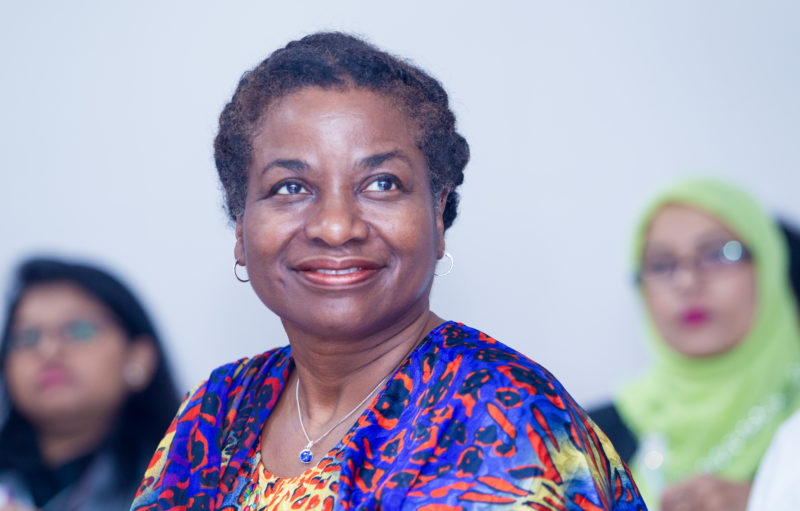
Dr. Natalia Kanem
Dr. Natalia Kanem, UNFPA Executive Director

Dr Natalia Kanem, the Executive Director, UNFPA, made this known in a statement issued on Tuesday, May 23, 2018 in Abuja to commemorate the 2018 International Day to End Obstetric Fistula.

Kanem said that UNFPA had led the campaign to end the scourge in partnership with nearly 100 agencies around the global and hundreds of others at the national and community levels.

“Since 2003, UNFPA the leader of the global campaign to end fistula, has, with its partners supported nearly 100,000 live-transforming surgeries to heal the physical and psychological wounds of fistula survivors.

“Over the last 15 years, UNFPA has directly supported more than 100,000 surgical repairs for women and girls, with more than 18,000 surgeries in 2017 alone.

“It is time we end the needless suffering caused by fistula in keeping with the 2030 Agenda and the Sustainable Development Goals.

“Let us commit to putting the furthest behind first and ensuring human rights, well-being and dignity for all.

“UNFPA is committed to ending fistula within a generation, and we call upon the world to join us in this bold endeavour,’’ she said.

The executive director said that on daily basis, more than 800 women die from pregnancy-related complications globally.

She added that fistula had been virtually eliminated in developed nations, but it was estimated that more than two million women and girls bear the scourge in developing nations.

Kanem said that fistula was preventable and, in most cases, can be repaired surgically, with estimates showing that between 50,000 and 100,000 new fistula cases occur annually.

She said the 2018 International Day to End Obstetric Fistula, observed on May 23, has a theme “Leaving no one behind: Let us commit to ending fistula now!”

She urged countries and the international community to significantly step up efforts to ensure that every potential new case of fistula was prevented.

She also urged key stakeholders to ensure that every woman or girl suffering from fistula is treated and receives adequate follow-up, social reintegration and rehabilitation support.

“In this way, in the spirit of the Sustainable Development Goals (SDGs), we can reach those `furthest behind’ and achieve `hope, healing and dignity’ for all,” she said.

Kanem said that eliminating fistula was a key element of “leaving no-one behind.

“Thus, it is critical to integrate fistula into the national-level planning for the SDGs.

“UNFPA should take every opportunity to incorporate fistula into national-level planning to achieve the SDGs, including countries’ targets and indicators under the SDGs,’’ she said.

By Mustapha Yauri

AfDB, Korea initiate measures to achieve Africa’s rapid industrialisation

0

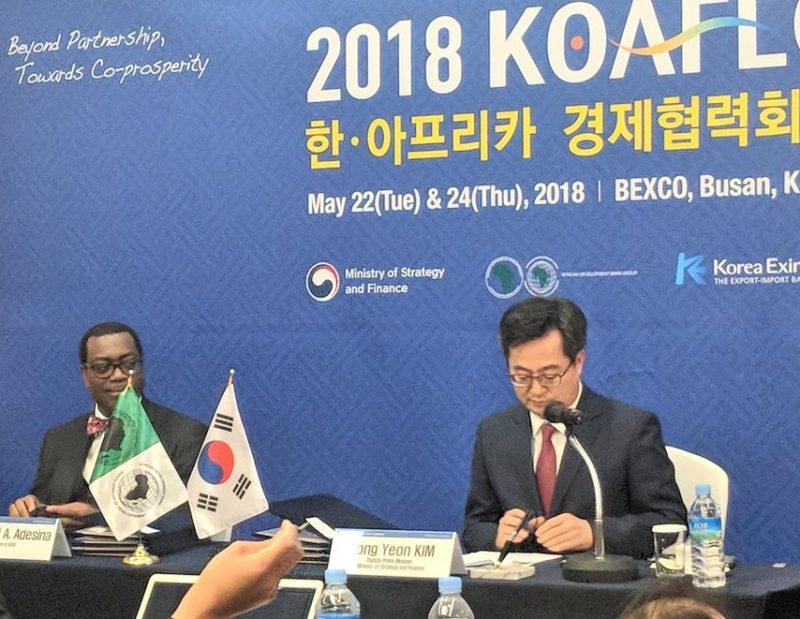
African countries, through the African Development Bank (AfDB) on Tuesday, May 22, 2018 in Busan, South Korea, opened a new chapter in the continent’s efforts to industrialise under an economic cooperation with the Africa-Korea Economic Cooperation (KOAFEC).

AfDB
AfDB President, Dr Akinwumi Adesina, with the Korean Deputy Prime Minister, Dr Yeon Kim

Finance Ministers and Central Bank Governors of the 54-nation continent, at a Ministerial Roundtable spearheaded by KOAFEC and AfDB, rose from a session at the Busan Exhibition Centre with a consensus to utilise Africa’s comparative advantage in agriculture to achieve rapid industrialisation.

AfDB President, Dr Akinwumi Adesina, announced resolutions of the session, that the countries examined critical issues militating against the continent’s desire to achieve greatness through industrial and technological breakthrough.

He said the countries agreed to invest massively on digital infrastructure by closing the huge gap, adding that the energy, transport and other critical sectors would be accorded adequate attention to achieve greatness and financial inclusion.

The ministerial session also opted for proper long term planning for industrialisation towards economic competition with the rest of the developed nations.

“The private sector roles are also critical in this direction as the participants agreed to mobilise the stock exchange in closing the infrastructure gaps.”

Adesina also signed a four-pronged Memorandum of Understanding with the Korean Government on technical and general cooperation agreements, including a technical corps programme and energy facilities.

He said after signing the documents on behalf of the AfDB, that the contents would assist Africa on exchanging high technical linkage and ideas as Korea was determined to drive digital economy and high industrialisation for Africa.

Adesina announced that the bank was investing on some African universities in science and technical education to produce highly skilled manpower to drive the continent’s desire for competency, research and scientific innovation.

Commenting on China’s current massive participation in Africa’s development, he said the Asian country was involved in massive investment on infrastructure development through close relationship with the governments.

“There is no competition between China and Africa but partnership; we have to build wider partnerships and China is part of Africa’s development.

“Investments and training by China are critical to Africa but the nature of trade with China has to be value-based, not just exports.

The Korean Deputy Prime Minister, Dr Yeon Kim, signed for the government, saying that Korea would assist in technological advancement of Africa’s fast growing economies.

By Idris Abdulrahman

Africa CDC responds to Ebola outbreak in DRC

0

The Africa Centres for Disease Control and Prevention (Africa CDC) is deploying 25 epidemiologists, laboratory experts, and anthropologists to support the government of the Democratic Republic of Congo’s (DRC) efforts to control the recent Ebola virus outbreak in Mbandaka and Bikoro.

Dr. John Nkengasong
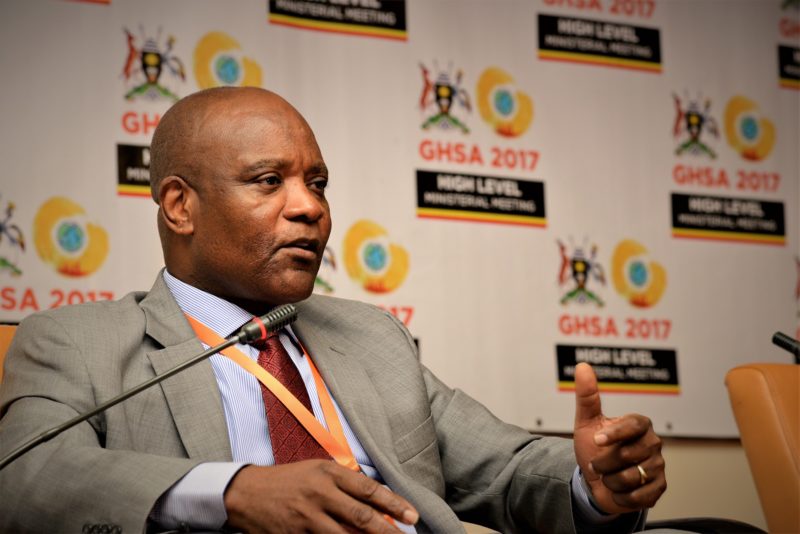
Dr. John Nkengasong, Director of the Africa CDC

Following the announcement on May 8, 2018 of the Ebola outbreak by the government of DRC, the Africa CDC deployed an assessment mission within 48 hours and activated its Emergency Operational Centre to link, scan and monitor the situation.

“The global community needs to respond to this outbreak as a crisis and not as an emergency, by quickly deploying public health assets to the affected areas expiditiously. I want to applaud the Minister of Health of the DRC for his exemplary leadership in managing this current outbreak so far. “All our efforts should be geared towards supporting his leadership,” said Dr. John Nkengasong, the Director of the Africa CDC, upon his return this week, with a high level delegation, to the affected areas in Mbandaka and Bikoro.

The DRC government is working with partners to improve coordination mechanisms, enhance surveillance, laboratory confirmation, contact identification and follow-up, case management, infection prevention and control, safe and dignified burials, social mobilisation and community engagement, logistics, risk communication, vaccination, partner engagement, research and resource mobilisation.

During the Africa CDC team’s visits they assisted the Ministry of Health, together with other partners, to develop three strategies:

  • Surveillance and contact tracing,
  • Defining the various health areas affected, and
  • Laboratory testing and network.

The Africa CDC will provide up to $2 million to support Africa CDC interventions. Due to the remote nature of the Equateur Province, it is expected that more efforts will need to be put in supply chain issues to ensure that essential items needed are delivered swiftly.

Last week the African Union Peace and Security Council was briefed on the situation and will continue to receive reports.  Under Article 6(f) relating to its mandate with regard to humanitarian action and disaster management the Council can authorise deployment of military and civilian missions and assets to tackle emergency situations as it did in August 2014 in the Ebola outbreak in the West Africa sub-region. This outbreak is the 9th outbreak of the Ebola virus disease over the last four decades in the country. The affected health area of Bikoro covers 1,075 km and has a population of 163,065 inhabitants. This huge population is supported by only three hospitals and 19 health centres, most of which have limited functionality.

The risk of speard of the virus is high at national and regional levels due in part to the proximity of the epidemic focus to the Congo River which links with the capitals of the Republic of Congo and the Democratic Republic of Congo and the Central African Republic. As such, Africa CDC is coordinating with these countries to ensure that their surveillance systems are activated and information is shared in real time.

The Africa CDC supports all African countries to improve surveillance, emergency response, and prevention of infectious diseases. This includes addressing outbreaks, man-made and natural disasters, and public health events of regional and international concern. It further seeks to build the capacity to reduce disease burden on the continent.

Sub-Saharan Africa to receive £25m in new programme aimed at early career scientists

0

A new sub-Saharan Africa grant scheme, Future Leaders – African Independent Researchers (FLAIR) Fellowships, opened for applications on Monday, May 21, 2018. The scheme offers talented African early career researchers who have the potential to become leaders in their field, the opportunity to develop an independent research career in a sub-Saharan African institution.

Prof Felix Dapare Dakora
Prof Felix Dapare Dakora, President, African Academy of Sciences (AAS)

The programme is being run in partnership with the African Academy of Sciences (AAS) and the Royal Society, with support from the UK’s Global Challenges Research Fund.

The aims of the FLAIR fellowship programme are:

  • Developing Africa’s next generation of research leaders – supporting talented early career African researchers to establish their scientific independence, focus on developing their research and become leaders in their chosen discipline covering natural sciences.
  • Supporting excellent research – enabling African researchers to address areas of global significance across the natural sciences through high-quality research, advancing knowledge and innovation which aims to benefit their country and address aspects of the Sustainable Development Goals.
  • Enhancing research environments – working through relevant partners, awards will contribute towards institutional research capacity strengthening and establishing good financial grants practice in African universities and research institutions.
  • Fostering collaboration and impact – establishing mutually beneficial long-term links between African Fellows and UK researchers to harness the expertise of the UK research base through equitable partnerships and enhancing knowledge exchange and translation into sustainable policy and practical benefits.

Professor Richard Catlow, Foreign Secretary of the Royal Society said: “We are delighted to have joined in partnership with the African Academy of Sciences, and are looking forward to working together with support from the Global Challenges Research Fund, to launch the FLAIR Fellowships.

“Science is a truly global endeavour that benefits from a diversity of approaches and experiences. Our ambition for FLAIR is that it will help to establish the next generation of leading African scientists, supporting them in partnership with the African Academy of Sciences to realise their goals and forge independent paths in research, whilst addressing the global challenges that are directly relevant to their countries and developing countries more broadly. FLAIR also provides an opportunity for these future leading scientists to tap into the network of scientific excellence that both the Academies’ represent, to take advantage of training and mentoring opportunities, as well as building lasting connections and international collaborations with peers across Africa and UK scientists.”

Prof Felix Dapare Dakora, AAS President said: “The AAS sees postdoctoral training as a critical stepping-stone to a successful research career and to promote globally competitive research in African universities and research institutions.

“This partnership with the Royal Society enables us to address critical gaps in the continent’s research capacity to ensure thriving ecosystems and catalyse science-driven enterprises as well as to help African scientists to develop their careers and to support them to provide solutions to improve the quality of lives for all Africans.”

Each Fellowship provides:

  • Up to £150,000 per year, for two years initially, to include funding for research fellow’s salary, research expenses, equipment, training, travel and subsistence and institutional overhead.
  • In addition the scheme will provide a wider programme of support to develop fellows as independent research leaders including training and mentoring, and opportunities to network and develop international collaborations.

N500m spent monthly on waste disposal has yielded limited results – Rivers

0

Gov. Nyesom Wike of Rivers State says his administration has spent N500 million monthly on waste management without satisfactory result.

Nyesom-Wike
Nyesom Ezenwo Wike, Governor of Rivers State

Wike disclosed this in Port Harcourt, the state capital, on Tuesday, May 22, 2018 during a media chat with newsmen in the state in commemoration of his administration’s third anniversary.

He lamented that the funds and efforts so far expended on waste management had yet to yield any desired impact.

In order to get better results, the governor said that he would consider employing another waste contractor in hopes he would do a better job.

He said that he was also considering venturing into recycling for waste-to-wealth project.

“The issue of waste is worrisome even in Nigeria. This is an area I think I have not done well; it is very critical and challenging.

“So far, my administration has ordered more than 20,000 waste bins to enhance proper waste collection and disposal within the metropolis and its environs.

“I am reiterating my administration’s readiness to rid the state capital and its environs of waste.

“We need all residents’ cooperation to restore Port Harcourt to its Garden City status,’’ Wike said.

He said that his administration might introduce a taskforce on waste collection in special places like markets, shops and other places where  high volume of refuse are generated.

“We will clamp down on street trading to boost sanitation in the Port Harcourt metropolis and environs

“Street traders from neighbouring states who do not contribute revenue to the state come to do business in the morning and litter the city with refuse.

“It is inherent in us to drop waste everywhere and litter the environment,’’ the governor said.

Ondo partners NAPTIP to eradicate child trafficking, labour

0

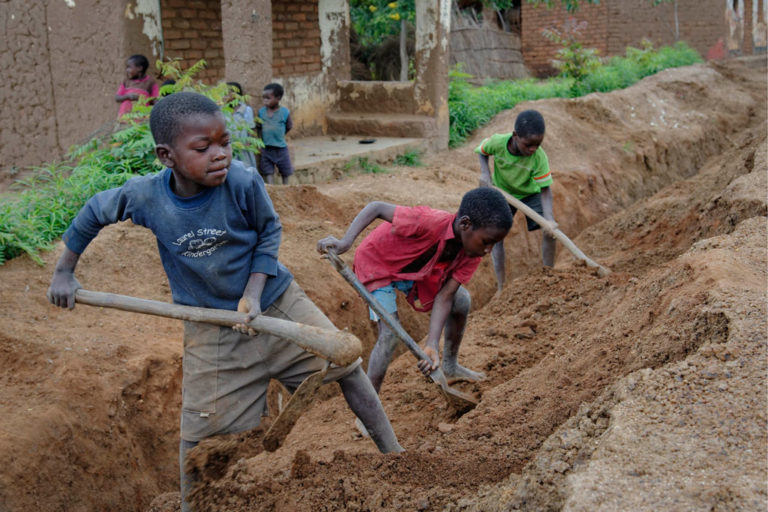
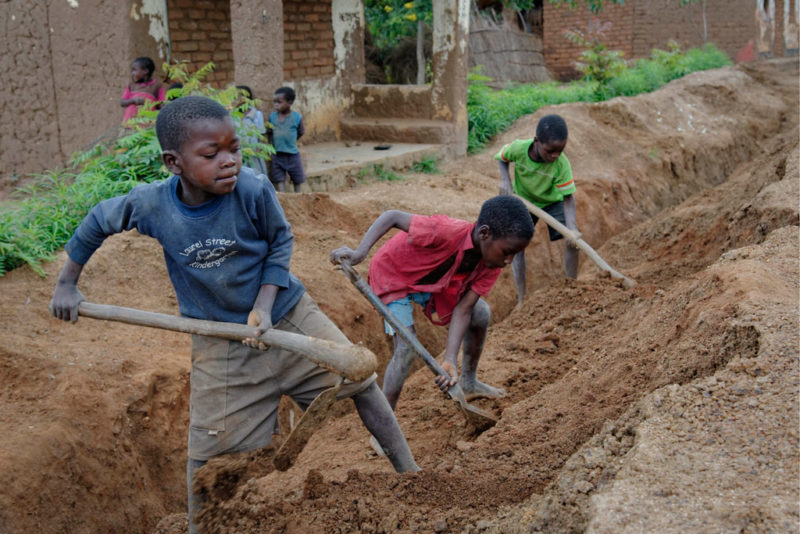
The Ministry of Women Affairs and Social Development in Ondo State is partnering with the National Agency for the Prohibition of Trafficking in Persons (NAPTIP) to eradicate child trafficking and child labour in the state.

Child labour
Child labour

Mrs Omowumi Olatunji-Edet, the State’s Commissioner for Women Affairs and Social Development, made this known on Tuesday, May 22, 2018 at a one-day training/consultative meeting organised for members of State Working Group on Anti-Human Trafficking and Child Labour.

Olatunji-Edet bemoaned the increasing danger which child trafficking and child labour activities pose to children everywhere.

“But with the realisation of the education policy of the state government, there is no duty more important than ensuring that children are protected.

“The present administration in the state has resolved to strengthen the State Working Group so as to bring activities of child traffickers under control in the state,” she said.

The commissioner urged members of the state working group to make use of the opportunity offered by the training “as it will go along way in putting the working group in a good stead and cope with the challenges posed by activities of human traffickers in the state”.

She also called on members of the public to always speak out when they suspect any form of child abuse and possible trafficking of any child.

“Do not keep quiet, endeavour to contact the nearest security post, you never can tell whose child is involved,” she said.

Mr Ganiyu Alao, the Zonal Commandant of NAPTIP in Osogbo, Osun, said the training would create awareness on harmful effects of Human Trafficking/Child Labour.

Alao said the importance of the awareness creation of Human Trafficking could not be overemphasised “as it can be compared to a beam that lights a path so that people will not fall into the deep pit of human traffickers and child abusers”.

According to him, the programme will go a long way in positively impacting on the lives of young people who are the hope and future leaders of the country.

The commandant said that the training would also enlighten participants to be trained on the various new trends of the crime, the existing control structure of Human Trafficking in Nigeria, reporting, investigating, rehabilitation of victims and prosecuting cases of human trafficking.

“It is imperative to note that a nation confronted with human trafficking, which is an evil scheme targeted at the youths, cannot make progress is bound to suffer serious consequences, ranging from economic to socio-cultural problems,” he said.

By Oluwafemi Ojo

Catholic doctors warn against GMOs

0

The chairman, Association of Catholic Medical Practitioners of Nigeria (ACMPN), Owerri Archdiocese, Dr Prince Philip C. Njemanze, has reaffirmed the need for precautionary approach towards consuming genetically modified organisms (GMO) foods and planting the crops.

GMOs
GMOs

He made the submission at the quarterly press briefing of the ACMPN on Monday, May 21, 2018.

The ACMPN Annual General Scientific Conference had published earlier the observations arising from the 12th scientific conference and annual general meeting with the theme “Genetically-Modified Organisms: How Harmful, Harmless or Beneficial?”, that took place at the Catholic Institute of West Africa (CIWA), Port Harcourt from July 6 to 8, 2017. In attendance were medical doctors, scientific experts in biotechnology and nutrition especially those concerned with food safety regulation.

The general consensus was on the need for precautionary approach towards the introduction of GMO c rops into our food system. The participants expressed concern on the rapid introduction of GMO crops into our food system without adequate assurance of safety and declared it highly immoral and a threat to food security.

Experts agreed that food safety certification usually takes several decades since effects take place at molecular genetic level before subsequent clinical manifestation. It is therefore irresponsible for any organisation or association, medical or scientific to give a risk free certification for any GMO crop to be used as food prior to long-term effects monitoring and continuing experimentation. Moreover, scientific studies in animals fed with GMO foods have shown detectable biological changes of cellular transformation into cancer cells or other forms of biochemical malfunction leading to liver failure and kidney failure. Studies in humans show strong association of GMO food with allergic reactions and mental diseases such as autism spectrum disorders.

Dr Njemanze said: “The provision of unsafe food is no solution to hunger, but rather results in even greater health hazards. The use of transgenic crops which implies changing genetic material could be used for good and bad purposes. For example, the insertion of a sterilising gene called Epicyte gene in Corn flex could sterilise children of school age using Corn flex in a school feeding programme, leading to loss of generations of people in Nigeria. These genetic changes are not reversible. There should be heightened attention to food safety in schools with feeding programs. Moreover, school feeding poisoning linked to insecticides have occurred in India.”

Experts deplore the unacceptable influx of GMO crops and foods into Nigeria. Nigeria is a signatory to the United Nations Cartagena Protocol on Biosafety, which is a legally binding protocol to the Convention on Biological Diversity (CBD) adopted by unanimous consent with 135 countries present. The Protocol covers the “trans-boundary movement, transit, handling and use of all living modified organisms that may have adverse effects on the conservation and sustainable use of biological diversity, taking into account risks to human health”.

The Nigerian Government established the National Biosafety Management Agency (NBMA) in 2015 to provide a regulatory framework, institutional and administrative mechanism for safety measure in the application of modern bio-technology in Nigeria with a view to preventing any adverse effect on human health, animals, plants and the environment. However, the NMBA is grossly ill-equipped, understaffed and has no present capacity to perform her mandate. This is unfortunate since food security is the most important of all national security concerns. The ACMPN therefore advocates increased funding for equipment and higher level of human resources preparedness for the NMBA.

ACMPN affirms that none of the major challenges that Nigeria faces in the agricultural sector can be addressed by deploying GMO or Hybrid seeds in the fields.

“The challenges mitigating against development of agriculture (poor transportation, land reform, lack of amenities in rural agricultural settings, lack of irrigation technology, lack of fertiliser, poor use of organic farming, lack of preservation technology, poor cost management, improper export and import controls, lack of subsidies and loans, aging manpower, lack of electricity, societal perception, etc) would not be addressed by deploying GMO or Hybrid crops.

!Rather, new and more complex problems could be introduced including long-term environmental and health hazards (cancers, allergies, infertility, autism spectrum disorders, ecosystem disequilibrium), which has been demonstrated by several groups of scientists in evidence-based studies.

Similar precautions have been issued in a report on GMO by a scientific experts’ committee setup by Catholic Bishops’ Conference of Nigeria (CBCN) along with the Nigerian Supreme Council on Islamic Affairs(NSCIA) under the aegis of the Nigerian Inter-Religious Council (NIREC),” stated Njemanze.

Kaduna warns of flash floods in five councils

0

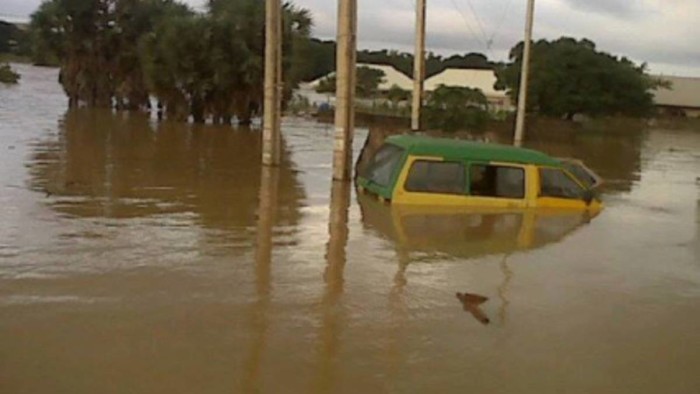
The Kaduna State Government has warned of imminent flood in five local government areas (LGAs) of the state.

kaduna
A flooded neighbourhood in Kaduna. Photo credit: saharareporters.com

Malam Abdullahi Rigasa, the General Manager, Kaduna Environmental Protection Authority (KEPA), made this known at a news conference on 2018 flood outlook projection on Tuesday, May 22, 2018 in Kaduna, the state capital.

He listed Igabi, Kaduna North, Kaduna South, Soba and Kaura Local Government Areas as the councils to be affected.

He urged residents of the five flood-prone areas to be at alert.

Rigasa said the mandate of KEPA was to prevent the occurrence of flood and ensure that residents were well prepared for any imminent floods.

“Last year, the expectation of flood was 14 local councils but recorded in Kaduna South, North, Kaura and Chikun local government areas with no casualties.”

He advised residents of the area to take proactive measures such as clearing water channels and avoid activities that could block the free flow of water.

He further advised relevant agencies to perfect their emergency evacuation plans and activate them as quickly as possible.

By Ezra Musa

Kenya to reform laws to boost biodiversity conservation

0

Kenya plans to reform its laws in order to enhance biodiversity conservation and sustainable utilisation of national resources, a government official said on Tuesday, May 22, 2018.

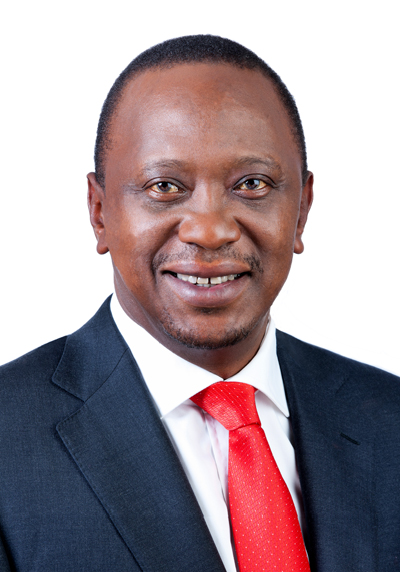
Uhuru Kenyatta
Uhuru Kenyatta, the President of Kenya

The Cabinet Secretary in the Ministry of Environment, Keriako Tobiko, said in a statement published in the Daily Nation that the country’s efforts to conserve biodiversity had not matched increasing evidence of biodiversity loss.

“The ministry of environment had formulated and reviewed laws and regulations to implement the provisions of the constitution as well as the objectives of the Convention on Biological Diversity,” Tobiko said.

“The new legislative frameworks are geared to enhance biodiversity conservation and sustainable utilisation of our national resources,” Tobiko said in remarks marking the International Day for Biological Diversity.

He said the day was important to international, regional, national and local communities as it had created public awareness on the link between biodiversity and sustainable development.

“It, therefore, provides an opportunity for Kenya to communicate to the world the importance of biodiversity, its conservation and sustainable use of its components, and the equitable sharing of benefits by the uses of genetic resources.”

He said the key challenges impeding Kenya’s progress in sustainable use of biodiversity included poaching, illegal trade in wildlife and timber products, human-wildlife conflicts, encroachment of habitats, pollution, as well as poor disposal of waste.

According to the ministry of environment, Kenya is abundantly endowed with biodiversity, and this has direct and indirect benefits to livelihood support systems of local communities and Kenya’s socio-economic development.

Tobiko added that biodiversity was also playing a major role in climate change adaption through the provision of a variety of genetic materials that could be used to develop crops that can cope with extreme climatic conditions and mitigation through carbon sequestration by the different ecosystems.

The Principal Secretary in the ministry, Charles Sunkuli, said that Kenya had made considerable progress in implementing the Nagoya Protocol on access to genetic resources, which was adopted by the Conference of the Parties to the Convention on Biological Diversity.

Dorington Ogoyi, CEO of National Biosafety Authority, said that Kenya was currently domesticating the provisions of the Cartagena Protocol on Biosafety that is a party to the Convention on Biological Diversity. He said Kenya’s 2009 Biosafety Act was meant to domesticate the provisions of the Cartagena Protocol.

“The country has further developed four regulations to implement the biosafety laws and has submitted three national reports on the Implementation of Cartagena Protocol on Biosafety to the Biosafety Clearing House,” Ogoyi said.

He noted that the lack of a state-of-the-art molecular laboratory for detection and testing of genetically modified organisms posed a challenge to full implementation of the Cartagena Protocol.