Despite environmental issues being transboundary in nature, countries in Africa appear not to be working together as one to address inherent challenges.
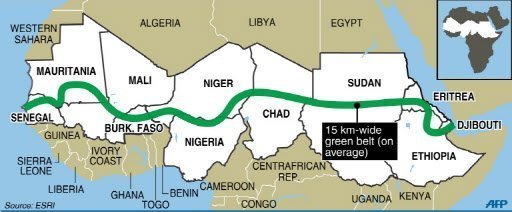
The Great Green Wall Initiative is an attempt by Nigeria and several other African nations to address the problem of desertification and land degradation, while hoping that it will provide sustainable alternatives for millions of young people considering migrating from poverty-stricken areas in Africa’s Sahel region. Photo credit: theodysseyonline.com
This turned out to be the view of majority of the stakeholders sampled by EnviroNews. Common transboundary environmental issues facing African countries include sea level rise, coastal erosion, desertification, drought, pollution and illegal mining, among others.
“African nations are not united. Neither do they address our environmental challenges with a common voice nor provide adequate resources to mitigate them,” insists Ayo Tella of the Initiative for Nature and Human Development (INHD).
Executive Director, Centre for Energy and Environmental Sustainability, Chike Chikwendu, states that collective efforts in tackling the problems are lacking due mainly to low financial capacity and the traditional loyalty of these countries to different foreign western countries.
“Therefore, individual country efforts usually result in ad-hoc solutions that are quickly obliterated by the rampaging global warming effects. Examples abound. In Lagos, the government has succeeded in stemming the coastal erosion at the Bar Beach while the beaches of Benin Republic, Togo and Ghana are fast being washed away. Second, the Great Green Wall project across the Sahel in the West African sub-region succeeded in some countries but is a failure in Nigeria where issues of corruption and transparency has affected the implementation of the project. Many more examples abound,” says Chikwendu.
He, therefore, urges African nations to cooperate in addressing their common environmental problems.
Ghanaian environmental journalist, Mary Ama Kudom-Agyemang, stresses that Africa’s unity to her common environmental issues is evidenced in the African Union’s (AU) New Partnership for Africa’s Development (NEPAD) initiative, which is the strategic framework for the continent’s socio-economic development that addresses major challenges facing Africa such as poverty.
“NEPAD’s programmes are focused on some key thematic areas including agriculture and food, security, climate change and natural resources management and regional integration, which all have bearings on the continent’s environment. Thus, the AU is strategically positioned to direct a pan-African approach to tackle common environmental problems,” says Kudom-Agyemang.
But she laments that Africa currently lacks structure for environmental governance, “a situation that can be blamed on national governments”.
“Individual countries do not seem to appreciate the need to tackle environmental issues from a common front and as such have so far not demonstrated the political will nor committed funds to address environmental problems as a priority.
“It appears Africa’s unity, in this wise, is merely rhetoric and there is urgent need to go beyond the talks and translate commitments and plans into action at the individual country level to the wider regional blocks,” she adds.
Director, Health of Mother Earth Foundation (HOMEF), Nnimmo Bassey, explains that even though Africans are concerned about addressing common environmental issues, there are however “big challenges in having a coherent approach as there is no holistic matrix by which the ensure a composite tackling of the problems”.
His words: “You will notice this even within nations. Until countries treat environmental issues as the cross-cutting issues they are, approaches will remain fragmented and sometimes counterproductive. The other matter is that our countries are dependent on the extractivist path for financial flows. This disposition does not promote environmental care.
“Violent conflicts add to the challenges of environmental protection. Equally, dependence on food aid provides an avenue for genetic contamination of our food systems, especially through so-called food aid as was the attempted case in Zambia in 2002 and Angola and Sudan in 2004. In recent years unverified seeds have been distributed to farmers in Nigeria through aid. These and other factors inhibit a coordinated approach to environmental issues in our nations and on the continent.”
But National Network Coordinator, CSDevNet, Atayi Babs, believes that African nations are united in their resolve to address common environmental issues as, according to him, they speak with one voice at international climate negotiations.
“This they achieve through the instrumentality of the African Group of Negotiators (AGN), the African Ministerial Conference on Environment (AMCEN), and the Council of African Heads of States on Climate Change (CAHOSCC), he submits, adding:
“Through these platforms, African nations generate and project the African voice which is usually underpinned by realities of the local communities and contributions by non-state actors outcomes which are key essentials for informed policy formulation and monitoring of its implementation at all levels.
A study by the India, New Delhi-based research and advocacy body, Centre for Science and Environment (CSE), has exposed what looks like a large-scale illegal presence and sale of genetically modified (GM) processed foods in the country.
GMOs
Without the approval of the Food Safety and Standards Authority of India (FSSAI), production, sale and import of these foods is banned in India.
CSE’s Pollution Monitoring Laboratory (PML), which conducted the study, tested 65 food products available in Indian markets – 32 per cent of these were found to be GM-positive. These food products were purchased randomly from retail outlets in Delhi-NCR, Punjab and Gujarat. Both imported (35) and domestically produced (30) samples were tested – imported samples fared worse: 80 per cent of the products which were found to be GM-positive, were imported.
The products which were found to be GM-positive include infant food, edible oil and packaged food snacks. Most of these are said to be imported from the US, Canada, the Netherlands, Thailand, and the UAE. These products were produced from or contain soya, cotton seed, corn or rapeseed (canola), which are known GM crops of the world.
Releasing the results of the study here today, CSE director general Sunita Narain said: “Our government says it has not allowed the import of GM food products. Then how is this happening? We have found that laws are not the problem – the regulatory agencies are.”
Adding to this, Chandra Bhushan, deputy director general, CSE, said: “We had been hearing about the presence of illegal GM food in India, and decided to do a reality check by testing processed foods. We were shocked to know the scale in which GM foods have penetrated the Indian market. The regulatory authorities are to blame here – the FSSAI has not allowed any GM food on paper but has failed to curb its illegal sales.”
What is GM? Why should we worry?
“GM – genetically modified – products, especially food, raise a crucial question of safety: a question of how safe they are. The jury is still out on this,” says Narain. This is because GM food involves taking genes (DNA) from different organisms and inserting them in food crops. There is a concern that this ‘foreign’ DNA can lead to risks such as toxicity, allergic reactions, and nutritional and unintended impacts.
Most countries in the world, including India, have decided to take a ‘precautionary’ approach to GM food. They have set stringent regulations for approval and labelling. The EU, Australia, New Zealand, Brazil and South Korea have made it mandatory to label GM food so that consumers have a choice about what they are eating.
What did the CSE study find?
GM food contains foreign promoter and terminator genes. More than 90 per cent of GM crops in the market contain promoter genes like 35S promoter of cauliflower mosaic virus (CaMV) and FMV promoter of figwort mosaic virus, and NOS terminator of Agrobacterium tumefaciens. Using quantitative Polymerase Chain Reaction (qPCR), CSE’s lab screened the food products to ascertain if they had a combination 35S promoter, NOS terminator and FMV promoter.
The key findings of the study are:
32 per cent (21 out of 65) of the food product samples tested were GM-positive. About 80 per cent (16 out of 21) of those which tested positive were imported. These were made of or used soy, corn and rapeseed and were imported from Canada, the Netherlands, Thailand, the UAE, and the US.
56 per cent (9/16) of oil samples, 25 per cent (10/39) of packaged food samples and 25 per cent (2/8) of infant food samples were GM-positive.
The CSE lab also tested five samples of cottonseed oil from India – all tested positive. This is because BT-cotton is the single GM crop that has been allowed for cultivation in the country. Says Bhushan: “But this should worry us. Firstly, no permission has been given for the use of GM cottonseed oil for human consumption. Secondly, cottonseed oil is also mixed in other edible oils, particularly vanaspati, which means we are consuming it without knowing.”
GM contamination was found in infant food, sold for children with medical ailments, including allergies. Two products by Abbott Laboratories, the American healthcare company, were found to be GM-positive — one was for lactose-intolerant infants and the other was a hypoallergenic (for minimising the possibility of an allergic reaction). Neither product has any label warning parents that this food has GM ingredients.
Other than edible oil, no processed food sample manufactured in India was found
GM-positive.
65 per cent (13/20) GM-positive samples did not mention anything about GM on their labels. These include the following:
Canola oil brands (‘Farrell’ imported from UAE by Jindal Retails (India) Pvt Ltd; ‘Hudson’ from UAE, marketed by Dalmia Continental Pvt Ltd; ‘Jivo’ imported from Canada by Jivo Wellness Pvt Ltd); and cottonseed oil brands from India (‘Ankur’, ‘Ginni’, ‘Tirupati’ and ‘Vimal’).
Packaged foods like ‘Pancake syrup original’ and ‘Popcorn Hot N’ Spicy’ — both products of American Garden – imported in India by Bajoria Foods Pvt Ltd; ‘Froot Loops’ — a sweetened multigrain cereal from Kellogg’s imported by Newage Gourmet Foods; and ‘Crispy corn snacks’ from Bugles – distributed by General Mills Inc, USA and imported by Newage Gourmet Foods.
Three products made false claims suggesting that no GM ingredient is used. These were ‘Candrop’ Canola oil from Canada imported by Century Edible Cooking Oils Pvt Ltd; ‘Mori-nu silken tofu’ from the US, imported by Olive Tree Trading Pvt Ltd; and ‘PromPlus sweet whole kernel corn’ from Thailand imported by Guru Kirpa Impex.
Four products that carried labels of genetic engineering technology were ‘Butter and Garlic Croutons’ from Mrs Cubbison’s; ‘Corn puffs’ by Trix – distributed by General Mills Sales Inc, USA; ‘Original syrup’ from Aunt Jemima – distributed by Quaker Oats in the US; and ‘Dark corn syrup’ from Karo, US. All four products were imported by Newage Gourmet Foods.
What do the laws say?
The Environment Protection Act (EPA) strictly prohibits import, export, transport, manufacture, process, use or sale of any genetically engineered organisms except with the approval of the Genetic Engineering Approval Committee (GEAC) under the Ministry of Environment, Forests and Climate Change.
The 2006 Food Safety and Standards Act (FSSA) prohibits import, manufacture, use or sale of GM food without FSSAI’s approval.
The Legal Metrology (Packaged Commodities) Rules 2011 mandate that GM must be declared on the food package.
The Foreign Trade (Development and Regulation) Act 1992 says that GM food cannot be imported without the permission of GEAC.
Anyone who imports, manufactures, uses or sells GM food, is liable to be prosecuted under the above Acts.
The FSSAI has now issued a draft notification on labelling, which includes GM food. Says Amit Khurana, programme director, food safety and toxins, CSE: “The FSSAI notification says that any food that has 5 per cent or more GM ingredients, shall be labelled, provided this GM ingredient constitutes the top three ingredients in terms of percentage in the product. The exemption limit of 5 per cent is very relaxed compared to other countries such as the EU, Australia and Brazil, which have limits at or below 1 per cent.”
“But there is a catch,” he adds. “It is very difficult for government to quantify the GM content in all foods: the tests are prohibitively expensive and technically cumbersome. This means that the regulatory agency is asking companies to ‘self-declare’ and say that they are within the 5 per cent limit and therefore, need not carry the label of GM.”
Says Bhushan: “The draft GM labelling regulations shows the double standard of FSSAI. On one hand, FSSAI has set stringent conditions for labelling organic food, which is a safe and healthy. At the same time, it is proposing to give a huge exemption for labelling GM food, safety of which has been a matter of concern.”
What does CSE recommend?
The FSSAI must identify all GM products being sold in the market and prosecute companies and traders responsible.
It must set up a safety assessment system for approval of both domestic and imported GM foods.
The limit for GM labelling exemption should be set at 1 per cent GM DNA and not on the basis of weight of ingredients. Only unintentional contamination should be exempted.
The FSSAI should adopt qualitative screening (such as through quantitative polymerase chain reaction – qPCR) as an enforcement tool and the onus of proving unintentional presence should be on the food manufacturer. It must set up laboratories to screen GM foods for effective monitoring.
A symbol-based label such as “GM” should be displayed on the front of packs which carry GM food — just like the green “tick” along with the words “Jaivik Bharat” proposed for organic food.
Says Narain: “In 2008 (updated in 2012), the Indian Council of Medical Research (ICMR) had issued guidelines for determining safety of such food – it cautioned that ‘there is a possibility of introducing unintended changes, along with intended changes, which may in turn have an impact on the nutritional status or health of the consumer.’ Keeping this in mind, India should adopt a health-based precautionary principle approach to GM food regulation and labelling.”
Desmond Majekodunmi, renowned environmentalist and founder Lufasi Nature Park; David Omaghomi, executive director of Eco-Restoration Foundation; and others have called on government and other stakeholders to put a stop to mangrove destruction and other forms of environmental degradation in Nigeria.
Mangroves
They spoke at the Mangrove Expo in commemoration of the International Day for the Conservation of the Mangrove Ecosystem at the Lekki Conservation Centre (LCC) in Lagos. The activists lamented the destruction of mangroves, especially in the Niger delta region.
According to Majekodunmi, the mangrove is one of the most valuable parts of the ecosystem.
“Mangroves sequester more carbondioxide than the rain forest,” he noted.
Describing the environment as “our life support system, which we inherited in very good condition and holding in trust for our children”, he called for sustenance of that heritage.
“Our children’s life support system is in our hands. We should not destroy it.”
Omaghomi tagged government the prime suspect in environmental degradation, as it seemed to collude with oil companies through laws that do not allow the environment regulators to perform.
He also fingered the Nigerian National Petroleum Corporation (NNPC) in the conspiracy against the environment. “NNPC should be ashamed of itself as a regulator.”
Lamenting that the mangroves in the Niger Delta are facing extinction, he charged the oil and gas companies to engage in mangrove restoration projects because their activities were destroying the mangroves.
Commending the Nigerian Conservation Foundation (NCF) for efforts in conserving the environment, he called on more organisations to be part of the initiative to protect the environment.
While urging security forces in the Niger Delta to be environmentally-responsible, he charged government to stop illegal refiners whose activities release more carbon dioxide and black soot into the environment than flared gas.
The mangroves, according to him, serve as natural groins by preventing coastal erosion.
“One artificial groin costs about N1 billion,” disclosed.
Jerry Chidi, a documentary photographer, who had a photo exhibition on the mangroves at the event, reeled out some of the benefits of the mangrove.
“The mangrove environment has a lot of aesthetic values and appearance; endless expanse of evergreen trees with webbed roots digging in and out of water, the mudflats literally crawling with life; crabs, mudskippers, periwinkles and others make up this ecosystem. Then you see fishing activities everywhere. The mangrove environment is indeed a treasure of resource and beauty,” he said.
Chidi is publishing a book on Man and Mangove, which was previewed at the occasion by Frank Ugiomoh, a professor of Arts, History and Theory from the University of Port Harcourt (UNIPORT), Rivers State.
Previewing the 174-page book that focuses on mangrove forests in Nigeria, the don urged oil and gas companies in Nigeria to give the publisher the leverage to reproduce the book to reach majority of the citizens.
The author told newsmen that the book communicates environmental stewardship.
In his welcome address, Muhtari Aminu-Kano, Director-General of NCF, represented by Joseph Onoja, the Director of Technical Programmes, said the foundation was pleased to partner with Chidi, for the first time to host the event.
“Whatever we think we do, we make an impact on the environment,” he added.
Adedayo Mahmud of NCF, in his vote of thanks, said the event was a call for action to change attitudes.
“NCF cannot do it alone; we are reaching out and we need more partners,” he added.
The UN Development Programme (UNDP) and the Government of Japan have launched the distribution of agricultural inputs and solar lanterns to communities ravaged by insurgency in Adamawa State.
Governor Bindo Umaru Jibrilla of Adamawa State
The information is in a statement made available to News Agency of Nigeria (NAN) on Thursday, July 26, 2017 by Mr Lucky Musonda, the Head of Communications, UNDP Nigeria.
Musonda stated that victims of Boko Haram attacks in Loko village of Song Local Government Area of Adamawa were the first set of beneficiaries of the support.
He added: “This intervention is part of ongoing efforts by UNDP to support victims of the Boko Haram insurgency in the three most affected states of Adamawa, Borno and Yobe.
“At the height of the insurgency which claimed many lives and caused billions of dollars in damage to property and key infrastructure, thousands were displaced across the region, some into neighbouring countries.
“The return of peace to previously captured communities and declaration by respective states of their safety has facilitated voluntary return of populations to their places of origin – most of them still in need of basic infrastructure and sources of livelihoods for the families to survive.”
According to him, UNDP is implementing several interventions in the North-East through close collaboration with respective state governments and funding support from partners, including the Government of Japan.
“In 2018, Japan is providing $2.5 million to facilitate implementation of initiatives to support 2,200 farmers and 500 small businesses.
“The investment will also facilitate the rehabilitation of five community infrastructure and an estimated 850 locals will be provided with emergency employment opportunities,’’ Musonda said.
The spokesman explained that the agricultural inputs, such as sprayers, fertiliser and farming tools, would be distributed to 9,000 households across the North-East region for use during this year’s farming season.
He, however, said that priority would be given to female-headed households.
The UNDP Deputy Country Director for Operations, Betty Wabunoha, reaffirmed UNDP’s commitment to support rebuilding efforts and livelihoods to stimulate early recovery and lay a solid foundation for development to take place again in the region.
Betty said: “Allow me to extend UNDP’s appreciation to the Government of Japan and Panasonic Corporation for the partnership and support in helping conflict affected communities in Nigeria.”
The Ambassador of Japan to Nigeria, Yutaka Kikuta, said that the North-East was an economically promising region but devastated by insurgency and pledged that the government of Japan would assist to ensure that interventions in the region helped to stabilise affected communities.
He added that “the joint-work of Japan’s public and private initiative will bring light, a brighter future to your lives in this region.”
He reassured that the Government of Japan would continue to support Nigeria’s efforts aimed at restoring stability and livelihoods for the communities in the North East region.
Mr Haruna Furo, the Permanent Secretary, Adamawa State Emergency Management Agency, thanked UNDP, the Government of Japan and Panasonic Corporation for the support.
Solar lanterns donated by Panasonic, a Japanese company, were also distributed during the ceremony.
The ceremony was attended by Loko community members and representatives of the Adamawa State Government.
Mars will make its closest approach to Earth in 15 years on July 31, which means the red planet will be shinier and bigger and easier to observe, said U.S. space agency NASA.
Sunrise in Mars
The two planets will be just 57.6 million km apart on July 31, while Mars will appear brightest from July 27 to July 30, making it easier to be seen with telescope or the naked eye.
“It’s magnificent. It’s as bright as an airplane landing light,” said astronomer Harry Augensen from Widener University, Pennsylvania.
“Not quite as bright as Venus, but still because of the reddish, orange-ish-red color, you really can’t miss it in the sky.”
Before the closest approach, Mars will be in opposition on Friday, which means Mars and the Sun will appear in opposite positions as viewed from Earth.
On the same day, the longest total lunar eclipse of this century will be visible in Africa, Asia, Australia, Europe and South America.
Mars will look fainter by mid-August since it travels farther away from Earth in the orbit around the Sun.
Mars and Earth were closer than this year in 2003, when the two planets were just 55.7 million km apart, which was the closest in nearly 60,000 years and won’t happen again until 2287, NASA said.
How to release the postal sector’s immense potential in service delivery and profitability is the topic of the Universal Postal Union’s Ministerial Strategy Conference to be held in Addis Ababa, Ethiopia from September 6 to 7, 2018.
UPU’s Deputy Director General, Pascal Clivaz
Speaking about the forthcoming conference, UPU’s Deputy Director General, Pascal Clivaz, said: “UPU is proud to hold the conference in Addis Ababa. The views of ministers and regulators are vital to the future of the global postal sector as innovative policies and regulations can energise the sector and stimulate efficiency.”
Titled, “Gearing up the postal sector to drive socio-economic development”, the conference will hear from high profile speakers including ministers in charge of the sector, regulatory chiefs, heads of intergovernmental agencies, and other senior leaders.
Held two days, panel sessions include discussions on developing effective policies, encouraging investments in the postal sector, regulating in the age of digital innovation, and the importance of partnerships in sustaining the relevance of the sector.
The conference will take place during UPU’s Extraordinary Congress in Addis Ababa, from September 3 to 7, which is scheduled to discuss the reform of the Union as the spur for encouraging significant changes in the overall postal sector.
In May, UPU released its annual “Postal Development Report” exploring the relationship between a country’s postal development and progress on the 2030 Agenda for Sustainable Development. Research, for example, found that postal infrastructure is relatively more resilient than any other national physical infrastructure, as its operations rely primarily on people.
Britain recorded its hottest day of the year on Thursday, July 26, 2018 as a report warned that a heatwave blamed for more than 2,000 deaths in 2003 could become a summer norm in the country.
Sunbathers in Brighton
“It’s officially the hottest day of the year so far! Charlwood in Surrey has reached 33.9 degrees Celsius – and we’re likely to see hotter yet,” tweeted the national weather forecaster, the Met Office.
The weather forecaster said earlier that it expected temperatures to peak at about 36 degrees Celsius in south-eastern England, which would exceed the 2017’s high of 34.5.
The Met Office said some parts of Britain have recorded nearly 60 consecutive “dry days,” with less than 1 millimetre of rainfall, but heavy rain is forecast to bring relief to some areas from Friday.
Britain’s all-time record of 38.5 degrees Celsius was set during the 2003 heatwave, with similar hot spells likely to become common by the 2040s, according to a report by lawmakers.
The average number of heat-related deaths is expected to reach 7,000 annually by the 2050s, partly because of an ageing population, said the Environmental Audit Committee of parliament’s elected main house, the Commons.
Despite recognising the severity of the risk, “the government fails to give leadership on planning for the effects of heatwaves on public health; social services; and critical national infrastructure such as transport, digital systems and water supply,” the report said.
“Heatwave warnings are welcomed as barbecue alerts, but they threaten health, well-being and productivity,” said opposition Labour lawmaker Mary Creagh, the committee’s chair.
“The government must stop playing pass the parcel with local councils and the National Health Service and develop a strategy to protect our ageing population from this increasing risk,” Creagh said.
Nigeria will on the night of Friday, July 27, 2018 experience a spectacular total lunar eclipse, which will last for one hour, Prof. Augustine Ubachukwu, has said.
Total lunar eclipse
Ubachukwu, the leader of Astronomy and Astrophysics Research Group of the University of Nigeria, Nsukka, disclosed this on Thursday in an interview with the News Agency of Nigeria in Abuja.
“Nigeria is set to experience a very spectacular total lunar eclipse on Friday, July 27, weather permitting.
“It will be visible from 9:30 p.m. and last till 11: 220 p.m. “This total lunar eclipse will be primarily visible from the world’s Eastern Hemisphere, which are Europe, Africa, Asia, Australia and New Zealand.
“Part of South America will be able to watch the final stages of the eclipse just after sunset on July 27.
“New Zealand will catch the beginning stages of the eclipse before sunrise on July 28.
“It will be the century’s longest total lunar eclipse with a whopping one hour and 43 minutes in totality.
“It starts with a partial eclipse at 7:24 p.m. The total eclipse begins at 8.30 p.m., and ends at 10.13 p.m. The peak of the eclipse will occur at 9.22 p.m. The partial eclipse ends at 11.19 p.m.,’’ he said.
Ubachukwu observed that a lunar eclipse could occur only on the night of a full moon.
The scientist said during a total lunar eclipse, the earth completely blocks direct sunlight from reaching the moon, while the only light reflected from the lunar surface would be refracted by earth’s atmosphere.
According to him, unlike solar eclipses, lunar eclipses are safe to view without any eye protection or special precautions as they appear dimmer than the full moon.
The professor, however, said that the next total lunar eclipse that would be visible in Nigeria would occur on Jan. 21, 2019.
Prof. Rabiu Babatunde, the Director, Centre for Atmospheric Research in Kogi State, told NAN that people should not be perturbed at the occurrence.
Babatunde said that the event underscored the fact that planetary objects, including the earth were in a state of defined continuous motion.
He said that the occurrence necessitated the need for scientists to continue monitoring and exploring the dynamics of the motion and the phenomena associated with them.
“Keeping tab on the dynamics will enable scientists sensitise the global community of any hazard associated with such occurrences,’’ he said.
A pygmy elephant was shot dead on Borneo island after it destroyed villagers’ crops, a Malaysian wildlife official said on Thursday, July 26, 2018, the latest of the endangered creatures to be killed.
A pygmy elephant in Borneo. Photo credit: Sylvain CORDIER/Gamma-Rapho via Getty Images
The male elephant, believed to be about four years old, was found on Monday by the side of a road in the state of Sabah, on the Malaysian part of Borneo, local wildlife department director, Augustine Tuuga, told AFP.
He said the “merciless” killing was carried out near a remote settlement, and authorities were investigating who was responsible.
“(The elephant) was killed out of revenge for destroying crops,” he said, adding the crops included palm oil trees.
He said the creature’s tusks remained intact, indicating the elephant was not killed by poachers seeking to sell its ivory on the black market.
It was the latest case in Malaysia of human-animal conflict, which happens when human settlements or agricultural plantations expand into a species’s natural habitat.
Malaysia is home to vast tracts of rainforest and a kaleidoscope of exotic wildlife, from elephants to orangutans and tigers, but the numbers of many rare species have fallen dramatically in recent decades.
As well as human-animal conflict, many endangered animals are hunted for their body parts which fetch a high price for use in traditional medicine in China, and elsewhere in Asia.
At least 18 pygmy elephants have been killed in Malaysian Borneo since April, The Star newspaper reported. Causes of death included elephants being targeted by poachers and poisoning.
Pygmy elephants are baby-faced with large ears, plump bellies and long tails that sometimes drag on the ground, according to environmental group WWF.
Rainforest-clad Borneo is the world’s third-largest island and is shared between Malaysia, Indonesia and Brunei.
Extreme weather, including record temperatures and heatwaves, drought and disastrous precipitation, has marked the first half of summer in the northern hemisphere. This has had widespread impacts on human health, agriculture, ecosystems and infrastructure and led to devastating wildfires.
WMO Deputy Secretary-General, Elena Manaenkova
“2018 is shaping up to be one of the hottest years on record, with new temperature records in many countries. This is no surprise. The heatwaves and extreme heat we are experiencing are consistent with what we expect as a result of climate change caused by greenhouse gas emissions. This is not a future scenario. It is happening now,” said WMO Deputy Secretary-General, Elena Manaenkova.
The persistency of high temperatures in some regions – including northern Europe – as been due to a stationary high-pressure system. This is common in summer in both Northern and Southern Hemispheres. The jet stream, a core of strong winds around 10 kilometers above the Earth’s surface that blow from west to east and which steer weather around the globe – is generally slower in summer and occasionally become weaker than usual, then very settled weather occurs on the surface.
There is much scientific research into whether climate change and substantial changes to sea surface temperature, escalated by high multi-decadal natural variability, are contributing to more profound effect in altering the atmospheric circulation and so leading to more “blocking patterns.”
Drought and heat in northern Europe
WMO’s Regional Association for Europe’s Climate Centre on Climate Monitoring, operated by the German Weather Service, DWD, issued a second Climate Watch advisory with guidance on drought and above normal temperatures valid from July 19 until August 6. The guidance product, used by National Meteorological Services to issue national warnings and forecasts, referred to “a continuation of the drought situation and above-normal temperatures for at least the next two weeks for northern Europe (from Ireland to the Baltic States and southern Scandinavia).
“The weekly temperature anomalies are forecasted with up to +3 to +6°C (in the first week in parts +6 to +10°C). The probability that precipitation will be below the lower tercile is more than 70% in the first week and more than 50% in the second week. This drought may be accompanied by water scarcity, local thunderstorms, risks of wildfires and harvest losses since soil moisture is reduced,” it said.
Amid an extended heatwave in Scandinavia, temperatures topped 30°C in the Arctic Circle. Norway saw a record temperature of 33.5°C in Badufoss on July 17, and it reached 33.4°C in Kevo, Finland. Influenced by a warm wind, the far north of Norway (Makkaur) saw a new record minimum overnight temperature of 25.2°C on July 18.
The heatwave followed an exceptionally dry and warm May in northern Europe, leading to a a sustained elevated risk of forest fires throughout Scandinavia and the Baltic region. Sweden reported about 50 forest fires burning in mid-July.
Deadly fires fanned by extremely high winds killed dozens of people near Athens on the night of July 24 in one of Greece’s worst tragedies for years. Temperatures on July 23 reached about 38°C and there were strong west winds. Greece, however, has not witnessed below average precipitation so far this summer and so meteorological conditions in Greece cannot be compared to Scandinavia.
Ireland recorded heatwaves at 15 synoptic stations (five consecutive days or more with maximum temperature over 25°C) and an absolute drought at all its stations.
The UK saw its driest first half of summer on record, with just 47 mm between June 1 and July 16. The Met Office has said that the heatwave will continue across much of England this week, with temperatures peaking up to 32-34°C in a few places on July 27 or 28.
Armenia saw a heatwave from June 29 to July 12. The average daily air temperature was 4 – 7° C above normal and up to 9°C in some region. A new record temperature of 42.6°C was observed at Areni on July 12.
The combination of little precipitation and sustained above-average temperatures impacted agricultural production (primarily cereals and hay), while water supply disruptions or restrictions are reported locally. No significant rain is expected until at least mid-July, nor are temperatures forecast to return at normal during the same month, according to the Copernicus European Drought Observatory.
Conversely, southern parts of Europe including parts of Spain, Italy, Greece and Turkey, have been witnessing below average temperatures and above average precipitation for the early part of summer.
The conditions were due to a persistent anticyclone, or high pressure, system blocked over northern Europe. Atmospheric blocking over the northern North Atlantic involves isolation of large regions of air from the westerly circulation for 5-14 days or more.
Atmospheric blocking alters normal climates across Europe and Russia by shifting storm tracks. Typically associated with an anticyclone, the zonal wind pattern known as the jet stream deviates from its mean position and its westerly winds reroute north and south of the anticyclone. Blocking is typical winter weather phenomena, but it can also influence summer weather patterns as well and it could be linked to extremes such as Russian heat wave in 2010.
Recent analysis suggests that climate change from human activities, also called anthropogenic forcing, might indeed affect the characteristics of blocking events in the Euro-Asia sector, in particular leading to longer blocking episodes.
Another possible player in creating summer atmospheric blocking situations is the interaction between the atmosphere and the Atlantic Ocean, which modulates sea surface temperature patterns on decadal time scales. These surface temperature patterns can influence the occurrence probability of summer blocking.
Extreme temperatures
An intense heatwave hit Japan. Within the nationwide observation network deployed by the Japan Meteorological Agency (JMA), 200 out of 927 stations recorded maximum temperature exceeding 35 degrees Celsius on July 15. On July 19, JMA issued a warning of very high temperatures from July 24 to August 2. Kumagaya set a new maximum daily temperature record of 41.1°C, with Oume on 40.8°C on July 23, according to JMA. Both are near Tokyo. The dangerously high temperatures and humidity came as Japan sought to recover from its worst flooding and landslide disasters in decades.
While issuing warnings of dangerously high temperatures, JMA also produced “Weather Analysis Maps” showing meteorological conditions and temperatures, updated every hour.
The Korean Meteorological Administration issued a severe warning for several days that daily maximum temperatures will be more than 35 degrees, as a number of daily temperature records were broken. It said that no big change was expected in the pressure system, with hot conditions likely to continue until the end of July.
Ouargla, in Algeria’s Sahara Desert, reported a maximum temperature of 51.3°C on July 5. It is likely that this is the highest reliable temperature ever recorded in Algeria. WMO’s Weather and Climate Extremes Archive currently lists Kebili, Tunisia, as being Africa’s highest temperature with 55°C recorded in July 1931. However, there have been questions about the reliability of colonial era temperature records in Africa.
On June 28, Quriyat, just south of Muscat, on the coast of Oman, recorded a 24-hour minimum temperature of 42.6°C, meaning that the coolest overnight temperature did not drop below that level. Although highest “low” temperature is not currently monitored as a category in the WMO Weather and Climate Extremes Archive, it is believed to be the highest such temperature ever recorded by a thermometer.
Many parts of North Africa saw a heatwave from July 3 to 10. Morocco saw a new record of 43.4°C at Bouarfa on July 3. High temperatures are also forecast for the week beginning July 23.
The station of Furnace Creek in Death Valley national park in California, USA, recorded a temperature of 52.0°C on July 8. The station holds the record for the highest recorded temperature on Earth at 56.7°C (134°F), on 10 July 1913.
Other parts of California were also gripped by extreme heat. Downtown Los Angeles set a new monthly July minimum overnight record of 26.1°C on July 7. Chino, near Los Angeles, saw a record temperature of 48.9°C (120°F). Burbank airport set a new absolute record of 45.6°C (114°F) on July 6, beating 45°C in 1971, and Van Nuys Airport saw a record temperature of 47.2°C (117°C) according to the US National Weather Service.
NWS issued an excessive heat warning for South East California and Southwest and South-Central Arizona, valid through July 25. It said temperatures in Las Vegas valley may reach up to 46°C and Death Valley National Park 53°C. Waco, Texas reported an all-time high temperature record of 45.6°C on July 23.
In Canada, a heatwave combined with high humidity in the province of Quebec contributed to dozens of deaths, especially among the vulnerable and elderly.
At the same time, parts of Eastern Canada saw a brief return of wintery weather, with snow in parts of Newfoundland and Cape Breton (Nova Scotia), and temperatures of -1C, in St John’s and Halifax. Winter weather this late in the year is rare, this being the first since 1996.”
Temperatures were exceptionally high over large parts of northern Siberia in June 2018. That trend continued through the first week of July. The Western Siberian Hydromet Center of Russia issued a storm warning due to temperatures of more than 30°C for more than five days, expected to last between 9 and 16 July. This creates high risks of wildfires as well as of power supply, transportation, and utility services disruptions and drowning of people escaping the heat in water. Krasnoyarsk Region reported daily anomalies of 7°C above average, with fires already impacting about 80,000 hectares of forest.
In addition to the exceptionally high over large parts of northern Siberia in June 2018, temperatures were also well above average over much of the USA, central Canada and North Africa, and over the Middle East and northern China.
The contiguous USA had 3rd hottest June on record. But many parts of the country had well above average minimum overnight temperatures, according to the US National Centers for Environmental Information. In 2018 (as of July 9), there have been 6 weather and climate disaster events in the USA, with losses exceeding $1 billion each across the United States. These events included 4 severe storm events and 2 winter storm events. Overall, these events resulted in the deaths of 36 people and had significant economic effects on the areas impacted.
Japan Heavy Rain Event
Japan suffered the worst flooding and landslide in decades, with many daily rainfall records broken between June 28 and July 8. According to official government figures, more than 200 people lost their lives. Around 10,000 houses have been destroyed and/or inundated.
Japan is one of the world’s best prepared countries for disaster risk reduction and disaster management. JMA issued emergency warnings in advance, targeting as many as eleven prefectures in the country to alert people to the significant likelihood of catastrophes. The emergency warning system was launched by JMA in 2013, based on lessons from the major tsunami caused by the 2011 Great East Japan Earthquake. In addition, JMA dispatched its experts as the JMA Emergency Task Team or JETT, to local governments in the region to best support multi-hazard disaster prevention activities. It set up a web portal dedicated to the heavy rain event.
Between June 28 and July 8, there was extraordinarily heavy rainfall caused by a huge amount of water vapor from a stationary rainy front, in addition to damp air remaining from Typhoon Prapiroon. West Japan and Hokkaido experienced record precipitation during the period, according to the Japan Meteorological Agency (JMA).
Total precipitation at many observation sites reached two- to four times the mean monthly precipitation for July. For instance, 1,800 mm of rain fell in Shikoku, 1,200 mm in Tokai, 900 mm in North Kyushu, 600 mm in Kinki, and 500 mm in Chugoku. This triggered a large number of landslide, inundation and flood events.
Relationship with Climate Change
Episodes of extreme heat and precipitation are increasing as a result of climate change. Although it is not possible to attribute the individual extreme events of June and July to climate change, they are compatible with the general long-term trend due to rising concentrations of greenhouse gases.
Many recent studies have found that the probability of the extreme event has been influenced by human activity, either directly or indirectly. Of a set of 131 studies published between 2011 and 2016 in the Bulletin of the American Meteorological Society, 65% found that the event’s probability was significantly affected by anthropogenic activities. In the case of some extreme high temperatures, the probability increased by a factor of ten or more.
It has been more difficult to identify anthropogenic influence in the attribution of precipitation extremes. Whilst some studies have found that the probability of some extreme precipitation events was increased, most often indirectly, by climate change, for many other studies the results have been inconclusive. This is because the underlying long-term climate signal in extreme precipitation is less clear than it is for temperature and, because extreme precipitation events typically occur on shorter spatial scales than extreme temperature events. At present, attribution studies are mostly carried out in research mode in peer-reviewed literature.
The IPCC 2012 Special Report on Extreme Events anticipates for example that “it is likely that the frequency of heavy precipitation or the proportion of total rainfall from heavy falls will increase in this century over many areas of the globe” and that “a 1-in-20 years annual maximum daily precipitation amount is likely to become a 1-in-5 to 1-in-15 years event by the end of the 21st century in many regions”.