Visionscape Sanitation Solutions (VSS) says it has closed two of its Transfer Loading Stations (TLS) in Lagos for upgrade to accelerate waste management in the state.
A transfer loading station in Lagos
The Chief Executive Officer of VSS, Mr John Irvine, said on Thursday, August 2, 2018 in Lagos that the closed stations were located around Murtala Muhammed Airport and Agege areas of the state.
A TLS is a building or processing site for the temporary storage of waste before taken to an engineered permanent site. It is an integral part of the waste management treatment infrastructure chain.
Irvine said that the company was aware of the recent complaints about the resurgence of waste across the state, especially in the Lagos West axis.
According to him, the acceleration of waste infrastructure has made it necessary to temporarily close two transfer loading stations in Lagos West axis for upgrade and refurbishment of the facilities.
“As a result, there is a backlog of waste, as Waste Collection Operators experience a high turn-around time.
“This underscores the importance of infrastructure to the waste management system and our role remains the provision of efficient facilities,” Irvine said in a statement.
He said that the company remained committed to working with all stakeholders in carrying out its respective roles and responsibilities.
The CEO said that Visionscape would continue to support the waste collection efforts through its monitoring and intervention team.
Egyptian authorities have referred a zookeeper in Cairo to a public prosecutor for interrogation over allegedly having painted stripes on a donkey to make it look like a zebra, an official said on Thursday, August 2, 2018.
Donkey painted to look like a zebra
Late last month, a visitor to the government-owned International Garden municipal park in the eastern Cairo district of Nasr City posted a picture on Facebook, showing a donkey with smudges on its face.
The animal also had long, pointed ears – unlike those of a zebra.
The picture soon caused a massive stir on social media, drawing an initial denial from authorities.
However, Mohammed Sultan, the head of Specialised Parks in Cairo, on Thursday accused the zoo keeper of having painted the donkey to look like a zebra, purportedly to deceive visitors.
“The keeper, who leases the place, has tarnished the reputation of the park. Faking a zebra is an unacceptable act,” Sultan said.
“The administration of the park has notified the prosecution of the incident.”
Sultan added that the zoo authorities had also decided to terminate the lease contract with the suspect whom he did not name.
Several patriots die unrewarded in Nigeria, as well as, in other countries. In some cases, no names or record are made public by the government to honour such folks. Park rangers fall right into this category.
Female park rangers
According to the Conservator-General of the National Parks Service, Ibrahim Goni, a total of 29 officers have died in active service across Nigeria’s seven National parks. With more unpleasant statistics unfolding, could it be possible that we are fast losing our rich biodiversity to poachers?
In 2017, the International Ranger Federation reported that 105 Rangers were killed worldwide. As at July 2018, another 128 rangers have been recorded to have lost their lives in active duties, with 63 of them in Africa, it does not seem we are winning.
The Convention on International Trade in Endangered Species of Wild Fauna and Flora (CITES) identified some species such as elephants, rhinos, pangolins, and rosewood among those that heighten the risks rangers face across the world. As more gory pictures of different wildlife species (like elephants) litter our timelines, and thousands of wildlife species (like pangolin) worth millions of dollars are seized, illegal killing of and illicit trafficking in wildlife is on the rise in Nigeria, even more than we can track.
While we all can’t carry guns and march onward to the borders of the national parks or other protected areas, there is a lot we can do to merge forces with relevant agencies like the National Park Service and our park rangers in ensuring poachers lose their dirty jobs.
The basic and simplest is to increase data-based, people-tailored education about Wildlife Conservation. There is a need for intentional conservation and for action-targetted conversations about the roles of individuals – especially young ones, and communities – with emphasis on rural communities. The precarious task of wildlife conservation must not be left solely on the shoulders of rangers – Park Rangers, else we all will wake to discover our once-rich wild places are completely empty.
The World Ranger Day is a day that annually commemorates rangers killed or injured in the line of duty and celebrates the critical work rangers do to protect the world’s natural and cultural treasures/biodiversity. July 31st, 2018 marks the 11th global anniversary of World Ranger Day, since the first was held in 2007 by the International Rangers Federation.
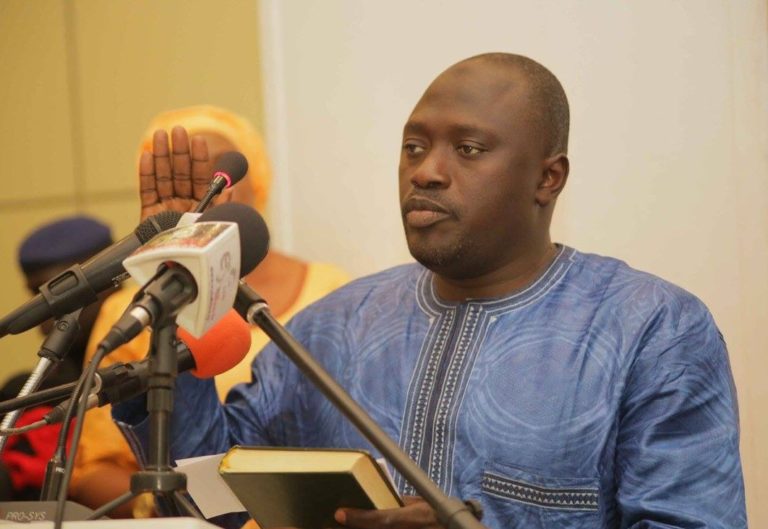
Gambian Minister of Environment, Climate Change and Natural Resources, Lamin Dibba, has called on the populace of the country to put up concerted efforts in curbing the negative impacts of pesticides and chemicals.
Minster of Environment, Climate Change and Natural Resources in Gambia, Lamin B. Dibba
He noted that his Ministry is aware of the health concerns resulting to local exposure to chemicals especially Persistent Organic Pollutants (POPs), and the impact upon women and, through them, upon future generations. He added that, considering a community with a low level of awareness, The Gambia has recognised the urgent need to take steps towards the development of an institutional framework for the sound management of chemicals to support a rapidly growing industrial and agricultural sector.
Dibba made these statements during the opening ceremony at the national inception workshop on the institutional capacity building for the implementation of the multi-lateral environment agreements in the Gambia held recently in Banjul. With participants drawn from all walks of life dealing with chemical, the daylong dialogue was designed to build the capacity of stakeholders on the dangers inherent in the utilisation of chemicals, most specially by farmers and women.
The Gambian government is partnering with development partners such as the United nations Environment Programme (UNEP) in implementing the project as part of the implementation of the Multilateral Environment Agreements such as the Stockholm Convention on Persistent Organic Pollutants (POPs), the Basel Convention on control of Trans-boundary movement of hazardous wastes and their disposal, the Rotterdam Convention on the Prior Informed Consent Procedure on International trade in Hazardous chemicals, the Minamata Convention on Mercury and the Strategic Approach to International Chemicals Management (SAICM).
All the Conventions, Dibba revealed, have a common objective of protection of human health and the environment. He reiterated that the Government of The Gambia attaches high priority to reducing chemicals pollutions and to promoting sound management of chemicals and associated wastes. He pointed out that The Gambia had been working closely with international partners on the implementation of the chemicals Conventions, which it considered crucial to further strengthening international commitment on the reduction of chemicals exposure.
To meet her obligations under the various Conventions, the minister disclosed that Gambia had developed strategies and plans that would outline the situation of chemicals in the country with the ultimate goal to protect human health and the environment from the risks posed by the unsound use, management and releases of chemicals.
He told the participants that, turning to the resources required to implement the MEAs, it is not possible to over-emphasise the importance of consolidating the resource base for assisting countries in the implementation of conventions and other activities to protect human health and the environment. He expressed confidence that the special programme to support institutional strengthening at the national level for implementation of the Basel Convention, the Rotterdam Convention on the Prior Informed Consent Procedure for Certain Hazardous Chemicals and Pesticides in International Trade, the Stockholm Convention, the Minamata Convention and the Strategic Approach to Chemicals Management established by the United Nations Environment Assembly at its first session would play an important role in that regard.
The objective of the Special Programme, he said, is to support country-driven institutional strengthening at the national level, in the context of an integrated approach to address the financing of the sound management of chemicals and wastes, considering the national development strategies, plans and priorities of each country, to increase sustainable public institutional capacity for the sound management of chemicals and wastes throughout their life cycle. Institutional strengthening under the Special Programme will facilitate and enable the implementation of the chemical convention to which The Gambia is a State Party.
The successful implementation of the Special Programme funded projects, he said, would derive a lot from civil society input, and therefore public participation is critical in addressing chemical issues and their health and environmental effects and in developing adequate responses which respond to their situation and circumstances, including opportunities for providing input at the national level regarding implementation of the Conventions.
“Recognising the importance of stakeholder participation, this National Inception Workshop is being held to map out strategies of implementation and to identify roles and responsibility for different stakeholders. Chemicals impacts on many sectors, including policy-making, law-making, environmental protection, agriculture, public health, industry and the private sector, the public and various interest groups. In order to make an effective and successful project, a wide range of stakeholders must be involved and engaged in the process,” Dibba pointed out.
Some of chemicals substances are pesticides, he said whilst many others are industrial chemicals or unwanted products of industrial processes or combustion which are toxic and adversely affect human health and the environment around the world. Because they can be transported by wind and water, most chemicals (POPs) generated in one country can and do affect people and wildlife far from where they are used and released. This therefore calls for the need to engage other countries in the crusade to mitigate negative impacts.
“I would also like to acknowledge the support of the Special Programme Secretariat and other partners in the spirit of cooperation and commitment for working with the Government of HE Adama Barrow in trying to meet our obligations towards Multilateral Environment Agreements. We should all understand that environmental protection thorough sound management of chemicals is not the government’s duty alone; but that all and sundry must demonstrate their commitments and take an active role,” he concluded.
In his welcoming remarks, the Executive Director of the National Environmental Agency (NEA), Momodou Jaama Suwareh, revealed that chemicals are important determinants for sustainable development, sound environmental health and quality of life, but noted that while the use of chemicals in all human activities (such as agriculture, health, energy production, manufacture, services and residential) contribute to improving the quality of life, it also raises concerns about its harmful effects on workers, consumers, the environment and society at large through exposure.
Suwareh further adduced that accidental releases from the distribution, consumption and disposal of chemicals may permanently damage soil, water and air.
He revealed that the Stockholm Convention is a legally binding international instrument, designed to lead to gradual decrease of the presence of persistent organic pollutants in the environment. He noted that the Gambia is a party to the Stockholm Convention. Persistent organic pollutants (POPs) are toxic chemicals that adversely affect human health and the environment around the world.
Because they can be transported by wind and water, Suwareh warned that most POPs generated in one country can and do affect people and wildlife far from where they are used and released, and they persist for long periods of time in the environment and can accumulate and pass from one species to the next through the food chain.
Registrar of Pesticides and Hazardous Chemicals at the NEA, Omar Bah, revealed that the objectives of the workshop are to sensitise stakeholders on the project and its activities, to encourage support, cooperation and commitment from the stakeholders for the implementation of the project, and to foster inter-institutional and bi-lateral collaborations in the implementation of the MEAs.
Bah listed the objectives to include: to capture the experiences, expertise, and concerns of the stakeholders/resource persons and factoring them into the project implementation; to come up with recommendations that will enhance the successful implementation of the project; and to enlighten the people living in The Gambia on sound chemical management.
Some of the expected outcomes, he added, are: to develop and monitor the implementation of national policies, strategies, programmes and legislation for the sound management of chemicals and wastes; promote the adoption, monitoring and enforcement of legislation and regulatory frameworks for the sound management of chemicals and wastes; and promote the mainstreaming of the sound management of chemicals and wastes into national development plans, national budgets, policies, legislation and implementation frameworks at all levels.
The dialogue was facilitated by Kei Ohno-Woodall, a programme officer at the Secretariat of the Basel, Rotterdam and Stockholm Conventions, who noted that the objective of the Rotterdam Convention is to promote shared responsibility and cooperative efforts among parties in the international trade of certain hazardous chemicals to protect human health and the environment from potential harm and to contribute to their environmentally sound use.
The first comprehensive overview for more than a decade of the state of knowledge about global biodiversity and the contributions of nature to people is nearing completion with a final meeting of authors this week at the Senckenberg Biodiversity and Climate Research Centre (BiK-F), in Frankfurt Germany.
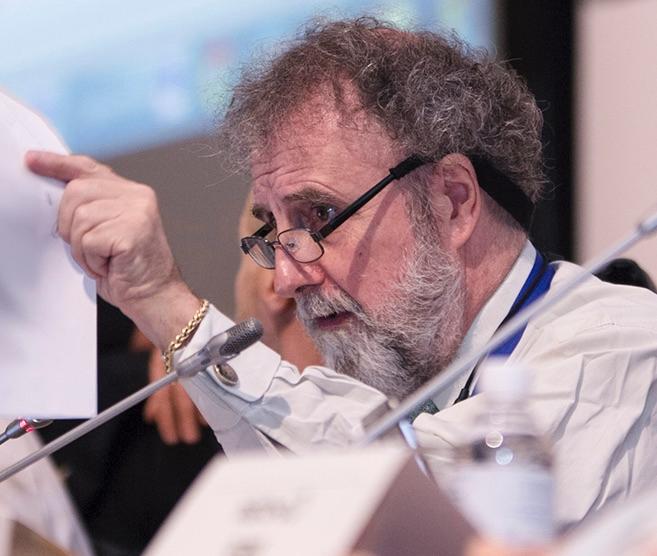
Sir Robert Watson, Chair of IPBES
Under the leadership of Professors Josef Settele (Germany), Sandra Díaz (Argentina), and Eduardo S. Brondízio (Brazil & USA), 150 expert authors from over 50 countries around the world have contributed for almost three years to a massive interdisciplinary collaboration under the Intergovernmental Platform on Biodiversity and Ecosystem Services (IPBES).
The resulting Global Assessment of Biodiversity and Ecosystem Services will be considered by representatives of 130 Governments in May 2019, in Paris, at the seventh session of the IPBES Plenary (#IPBES7). The research covers land-based ecosystems, inland waters and oceans, looking back 50 years to evaluate changes, and forward to consider scenarios, possible pathways and policy options. Once published, it is expected to inform policy and action on biodiversity to 2030 and beyond.
Speaking about the importance of the research, Prof. Dr. Katrin Böhning-Gaese, Director of the Senckenberg Centre, said: “Biodiversity loss is a major threat to human wellbeing, and there is a growing need for better scientific evidence in policy and decision making. This is the major goal of IPBES, and it is also why Senckenberg is pleased to host this third and final author meeting of the Global Assessment. Research on biodiversity loss and its causes is a major focus of the more than 300 Senckenberg scientists, some of whom also contribute to the IPBES assessments.”
“The IPBES Global Assessment is, in many ways, a successor to the landmark Millennium Ecosystem Assessment, published in 2005,” said Prof. Josef Settele, briefing journalists on Thursday, August 2, 2018. “Since then, the world has agreed to a range of key commitments – such as the Aichi Biodiversity Targets, the Sustainable Development Goals and the Paris Agreement on climate change. The Global Assessment will help decision-makers, at every level, to assess progress, identify major gaps and consider a range of policy options to meet these key undertakings. Of particular importance in our research has been the exploration of ways to achieve climate change reduction, the conservation of biodiversity, and the global environment more broadly.”
Sir Robert Watson, Chair of IPBES, also used the meeting to officially announce the selection of the eminent experts who will lead two new IPBES assessments starting this year.
The co-chairs of the IPBES assessment on the diverse conceptualisations of multiple values of nature will be: Prof. Patricia Balvanera (Institute for Ecosystem and Sustainability Research, National Autonomous University of Mexico); Brigitte Baptiste (General Director, Alexander von Humboldt Institute, Colombia); Prof. Unai Pascual (Ikerbasque Research Professor at the Basque Centre for Climate Change (BC3), Spain, and Associated Senior Research Scientist at the Centre for Development and Environment (CDE), University of Bern, Switzerland); and Prof. Mike Christie (Director of Research, Institute of Business and Law, Aberystwyth University, United Kingdom).
The technical support unit, which will coordinate the production of this assessment, will be based in Morelia, Mexico, and hosted by the Institute for Research on Ecosystems and Sustainability (IIES-UNAM), the Secretariat of Institutional Development (SDI-UNAM), and the University Seminar on Society, Environment and Institutions (SUSMAI-UNAM) all within the National Autonomous University of Mexico (UNAM), and the Mexican Commission for Knowledge and Use of Biodiversity (CONABIO).
The co-chairs of the IPBES assessment on the sustainable use of wild species will be: Dr. Marla R. Emery (Research Geographer with the United States Department of Agriculture, Forest Service Research and Development); Dr. Jean-Marc Fromentin (French Research Institute for the Exploitation of the Sea (lFREMER)); and Prof. John Donaldson (Chief Director – Biodiversity Research, Assessment and Monitoring, South African National Biodiversity Institute).
The technical support unit will be based in Montpellier, France, and co-hosted by two organisations the Foundation for Research on Biodiversity (FRB), and the Agence Française pour la Biodiversite (AFB).
Germany has published the first report on the utilisation of genetic resources through the Access and Benefit-sharing (ABS) Clearing-House by issuing a checkpoint communiqué concerning research on ants from South Africa. This was rapidly followed by checkpoint communiqués from Malta and Qatar.
Cristiana Paşca Palmer, Executive Secretary of the Convention on Biological Diversity (CBD). She has urged all Parties to the Biosafety Protocol that have yet to do so, to ratify the Supplementary Protocol as soon as possible
The ABS Clearing-House is a global repository of information that helps provide legal certainty and transparency in the context of the Nagoya Protocol on Access to Genetic Resources and the Fair and Equitable Sharing of Benefit Arising from their Utilisation. Part of the role of the ABS Clearing-House is to enable countries to monitor how genetic resources are used along the value chain for commercial or non-commercial research, which is particularly useful when genetic resources have left the country.
Dr. Cristiana Paşca Palmer, Executive Secretary of the Convention on Biological Diversity and United Nations Assistant Secretary-General, said: “The monitoring system is a key piece of the Nagoya Protocol, and I am very pleased to see it being put into action. Being able to track the use of genetic resources is critical to creating trust between users and providers of genetic resources. The ABS Clearing-House is a unique feature of this international agreement and provides an important tool for connecting users and providers of genetic resources.”
The system for monitoring the utilisation of genetic resources is further explained in a short video launched during the recent meeting of the Convention’s Subsidiary Body on Implementation: https://absch.cbd.int/database/VLR/ABSCH-VLR-SCBD-240572.
The checkpoint communiqués from Germany and Malta also mark the first time that interoperability functions have been used to automatically publish information on the ABS Clearing-House. In this case, information published on the European Union’s (EU) DECLARE tool, an EU-wide tool which enables users of genetic resources to submit the required due diligence declarations, was automatically transferred and published on the ABS Clearing-House. Using interoperability mechanisms like the application programming interface of the ABS Clearing-House is a practical and efficient way for Parties to the Nagoya Protocol to automate the publication of information on the Clearing-House.
Additional countries have also joined the Nagoya Protocol in recent weeks following ratifications by Afghanistan, Austria, Central African Republic and Palau. This brings the total number of ratifications to 109.
Dr. Paşca Palmer said: “These recent ratifications demonstrate that implementation of the Protocol is gaining momentum. The more countries participate, the better the Nagoya Protocol can meet its objective of contributing to conservation and sustainable use of biodiversity through access to genetic resources and benefit-sharing.”
Members of Abadawa community in Lere Local Government Area of Kaduna State said on Wednesday, August 1, 2018 that adequate sanitation and good hygiene practices have significantly improved the quality of their lives.
Nasir el Rufai, Governor of Kaduna
They also said that access to clean water 24 hours a day was another life changing experience that have added value to the lives of the about 2,500 inhabitants of the community.
They stated this while interacting with the News Agency of Nigeria (NAN), who was in the community to access the impact of the Phase II of Sanitation, Hygiene and Water in Nigeria (SHAWN) project.
Mrs Khadijat Adamu, a member of the community’s Water, Sanitation and Hygiene Committee, said that until the SHAWN project, the community sees sanitation and good hygiene practices as exclusive to urban life.
“As a rural community, we erroneously assumed that access to clean water, maintaining clean environment and good hygiene practices were the privilege of the rich in urban areas.
“This is a community where until now, our only source of water was a well dug in 1954 and dries-up every year between April and May, forcing us to share water with animals in nearby stream.
“With the absence of toilets, we defecate openly including our backyard, while our children do it in any available space in the house.
“We simply had no idea of how to keep our environment clean; why we should wash our hands always; and how our unhygienic practices predispose us and our children to all kinds of preventable diseases.
“For us, these unhygienic practices are normal lives of rural dwellers, and so we live a life of envy and wish that someday, we shall relocate to urban areas where quality of life is assured.
“There, we will get to drink clean water and live in clean environment away from the flies, reptiles and all kinds of insects that we shared our homes with,” she said.
She, however, said that the coming of SHAWN project in the community had changed their negative perception about life and proved that even rural dwellers could live a quality life.
According to her, the project provided a motorised borehole that supply the community with clean water for 24 hours, and equipped them with life changing knowledge about sanitation and good hygiene practices for healthy living.
Similarly, the Chairman of the community’s WASH Committee, Malam Samaila Matu, said that every household now have a toilet facility to check against open defecation.
Matu also said that the committee mobilise resources through levy and fines to maintain the water facility and goes round every two week to ensure that every household maintain a clean environment.
The District Head of Abadawa, Malam Dahiru Abubakar, equally described the SHAWN project as a “life changer’’ for his people, and thanked UNICEF, Kaduna State Government and other partners for making his community a beneficiary.
According to him, the project has ended the community’s circle of hardship in accessing clean water, while good hygiene practices have curbed the prevalence of preventable diseases, particularly among children under five years.
The story was no different in Unguwan Rimi, a community of about 3,600 people also in Lere local government area, where the community compete with animals for water in the river when available wells dried up between April and May.
A 10-year-old Yasir Ya’u said he spent about three hours daily to fill a 75 litre container with water from the river for his mother after returning from school.
Ya’u, a primary four pupil of Universal Basic Education Primary School, Unguwan Rimi, added that he has developed back pain due to the long distance and hours spent to get water.
“However, my story had changed when in 2017 a motorised borehole was provided for our community under the SHAWN II project.
“The development has ended my years of agony and pains and provided me with more playing hours,’’ he said.
Malam Ibrahim Shuaibu, another member of the community, thanked UNICEF and Kaduna State Government for improving the quality of life of rural dwellers, noting that “water is life”.
NAN reports that the SHAWN II project is aimed at improving access to sanitation, hygiene and water supply to all citizens through eradication of open defecation, hand washing promotion, sanitation and provision of water facility.
It is being funded by United Kingdom’s Department for International Development (DFID) and UNICEF with counterpart funding from the state governments of Kaduna, Katsina, Zamfara, Benue, Bauchi and Jigawa.
Forest Green Rovers from England has become the world’s first UN certified Climate Neutral Now football club by pledging to measure, reduce and offset greenhouse gas emissions during their upcoming season.
Forest Green Rovers’ pitch
Sports and leisure activities around the world have a major role to play to reduce climate impacts and limit the average global temperature rise to as close as possible to 1.5 degrees above pre-industrial levels, in line with the goals of the Paris Agreement.
“This commitment is part of a growing movement where all of civil society, including the world of sports, has begun to act on climate change,“ said Miguel Alejandro Naranjo Gonzalez of UN Climate Change, who works with on Climate Neutral Now initiatve.
Forest Green Rovers joins international sports organisations such as Fédération Internationale de Football Association (FIFA) and the Adidas Group to take climate action in partnership with the UN.
Sports and leisure activities often have high carbon footprints, for example from the travel of large numbers of peoples to key events. Such events need to involve offsetting, sustainable catering and energy from renewable sources to be climate-friendly.
For this sector, taking climate action makes simple economic sense. Threatened by supply chain disruption, extreme weather events and rising resource costs, forward-thinking organizations support bold climate action. By greening their operations, sports teams and management organisations are creating jobs and becoming more competitive.
“The fact that Forest Green Rovers as a relatively small club has joined the Climate Neutral Now initiative demonstrates that everyone can score goals for climate action. Such action requires first and foremost a commitment to sustainable life styles, and not necessarily a big budget,” said Mr. Naranjo.
Athletic organisations inspire and delight citizens all over the world, and as such can greatly increase awareness and promote additional climate action from everyday citizens.
“We’re finding that the combination of a football club and the environment is really something special,” said Forest Green Rovers Chairman Dale Vince in an interview with UN Climate Change.
“The work we do has resonated with a global audience, people who have an interest in the environment and have become fans of FGR because we stand up for these issues, or football fans that have just never seen a club take a stance like this before and get it. It’s a new combination that’s getting traction everywhere,” added Mr. Vince.
The club has proven with their diet, energy consumption, water usage, and transportation methods that their sustainability and climate ambition, in day-to-day operations, can be replicated at any level.
After switching to a plant based diet, for all players, fans, staff, to mitigate the environmental impacts of meat consumption, Forest Green Rovers is the world’s only vegan football club and has been described by FIFA as “The Greenest Football Club in the World”.
Forest Green Rovers takes major steps to be sustainable by being powered by 100% green energy with solar panels, using a solar powered robot to cut the team’s pitch, recycling rainwater from the team’s pitch and stands and including electric vehicle charging facilities at its stadium.
Currently the club is planning to build the “greenest football stadium in the world” which will be an all wooden stadium.
“It’s part of a 50-hectare development we call Eco Park, which is roughly half sports complex and half green-tech business park. The whole development will bring a 16% increase in biodiversity. It shows development done in the right way can be sustainable in every sense,” said Mr. Vince.
“We always felt that football fans are a passionate group of people. If we could invoke the same kind of passion for environment issues that they feel for their club, we could create some passionate environmentalists and drive change that way,” he added.
UN Climate Change encourages sports organisations around the world to follow the example of Forest Green Rovers to become Climate Neutral.
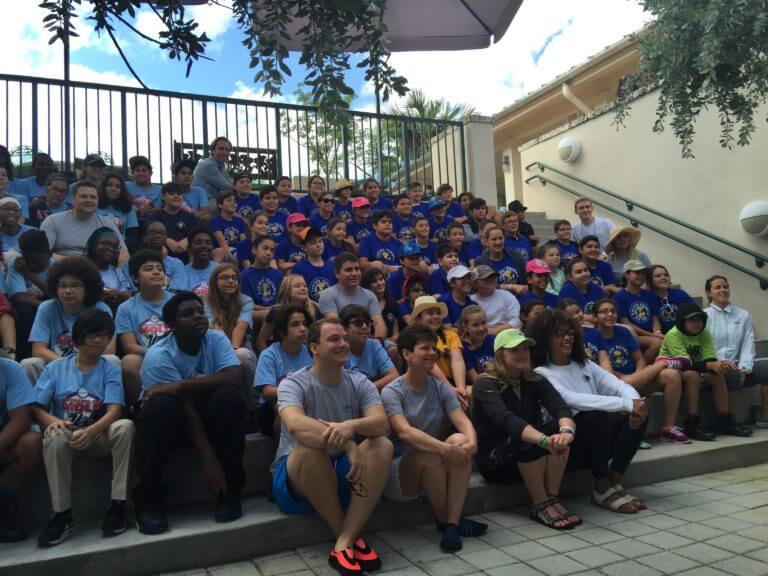
Some 32 EarthEcho Youth Leadership Council and Water Challenge Ambassador members, ages 13-22, from across the world will convene on Thursday, August 2, 2018 in Washington, DC, for the annual Leadership Summit.
Participants at an event by the EarthEcho Youth Leadership Council and Water Challenge Ambassador
The EarthEcho Youth Leadership Council (YLC) is a group of environmental advocates and problem solvers who are committed to inspiring and empowering others to take action. Throughout the year, they work to develop new programming with EarthEcho’s staff to ensure that programmes authentically engage with young people as advocates and leaders. A core belief of EarthEcho International is that young people are the hearts and minds – not just the hands and feet – of the environmental movement.
The EarthEcho Water Challenge Ambassadors represent a new initiative developed by the YLC. These young people hail from communities across the U.S. and have committed to taking action around water quality in their home communities. The Water Challenge Ambassadors are participating in professional development to prepare them to lead water monitoring events in 20 communities across the U.S. on Water Monitoring Day on September 18.
While these young people are on their way from communities in Australia, Chile, Hawaii, Michigan, Florida, Puerto Rico, and many more, they are still fundraising to support their travel to Washington.
Some health stakeholders in Nasarawa State have urged husbands to help promote and support six months exclusive breastfeeding by encouraging their wives.
Breastfeeding
The stakeholders made their opinions known in separate interviews with the News Agency of Nigeria (NAN) on Wednesday, August 1, 2018 in Akwanga Local Government Area of the state where the 2018 World Breastfeeding Week was kicked off with a news conference.
The state is joining in the celebration of the annual World Breastfeeding Week held every year from Aug. 1 to Aug. 7, to promote exclusive breastfeeding for the first six months which yields tremendous health benefits, providing critical nutrients, protection from deadly diseases.
The theme of the 2018 celebration is “Breastfeeding: The foundation for Life’’.
Dr Absalom Madawa, Director, Primary Health Care, Nasarawa state Primary Health Care Development Agency (NSPHCDA), told NAN that husbands need to play their role in the entrenchment of six months exclusive breastfeeding in the society.
He added that the crucial position husbands occupy in the society and in the lives of a child made it imperative to urge them to support their wives in raising a child properly by encouraging six months exclusive breastfeeding for the benefit of a child’s health and nutrition.
“Husbands play a crucial role here. They need to support the women to give breast milk to the child and to give it exclusively for the first six months.
“Sometimes, you find husbands challenging their wives on why the child is not given water.
“But all the water the child needs is in the breast milk. The child does not need any additional water because inside the breast milk and part of its content is water and that is enough.
“So I use this opportunity to urge our men to always encourage their wives on breast milk so as to raise healthy children,” he said.
Another health stakeholder, Dr Ibrahim Alhassan, Director, Public Health, Nasarawa state Ministry of Health, said the consequences of malnutrition goes beyond the physical illnesses it causes.
“Husbands need to be supportive because the consequences of malnutrition go beyond the physical illness the patient may suffer.
“There is also mental retardation and mental challenge for the children affected. Once that happens, academic performance becomes a challenge,” he warned.
Hajiya Amina Ahmed, Director of Social Mobilisation, NSPHCDA, however said apart from the crucial support from husbands, employers need to promote breastfeeding by creating an enabling environment for nursing mothers to constantly attend to their infants.
“The role husbands play is too crucial to ignore. That is why we have to continue to enlighten them to encourage and not discourage their wives to embrace exclusive breastfeeding.
“Employers also have a role to play because we have women who are been employed in different places. So employers cannot but promote breastfeeding for them and to that they have to create the enabling environment for them to be able to have their children within earshot of that.
“This is because when the child needs breast milk, the child can be given because breast milk is given on demand so that if the child cries one million times, the mother has to provide breast milk one million times,” she said.