The Lagos State Government has urged members of the public to be wary of the activities of unauthorised law enforcement officers.
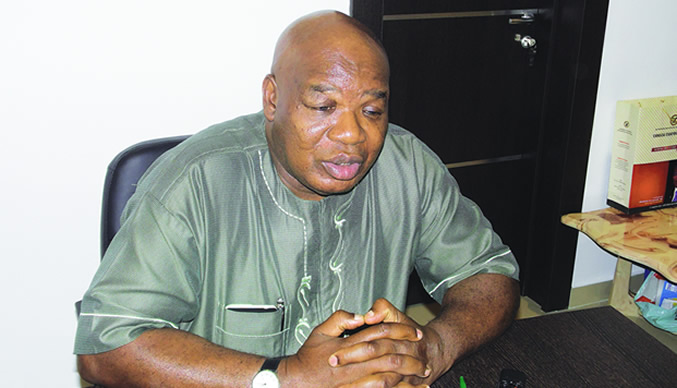
The Lagos State Commissioner for Environment, Mr Babatunde Durosimi-Etti
Commissioner for Environment, Mr Babatunde Durosinmi-Etti, said in a statement on Friday, July 27, 2018 that the officers go about defrauding people, in the guise of environmental law enforcement.
Durosinmi-Etti said that the government was perturbed by activities of some bad eggs among public servants, who sometimes abuse the enforcement process to defraud Lagosians.
He said that nemesis had caught up with six officers, who were out on the mission to defraud some hotels in the state, namely JCB Hotel in Omole and Roneks Hotel in Akowonjo.
“Yesterday, managers of the JCB Hotel, Omole and Roneks Hotel, Akowonjo reported the nefarious activities of six officers, who abused the enforcement procedure with the intent to personally enrich themselves.
“These officers are Alaba Alegbe – a Principal Scientific Officer, Famuyiwa Olawale – a Grade Level 10 Officer, Olodun Lateef – Grade Level 10, Agbotoba David – Grade Level 09, Waliu Olajide – Grade Level 10 and Bukky Ajibabi – a Grade Level 09 Officer,” the commissioner said.
He said that the Enforcement Department of the ministry, which was promptly directed to swing into action and investigate the matter, found overwhelming evidence against the officers.
According to him, the evidence includes video recordings and telephone conversation recordings to suggest that the concerned officers have compromised their positions.
Durosinmi-Etti said that government would apply appropriate disciplinary measures, which would include prosecution in the law court to serve as deterrent.
He warned members of the public to stop giving monetary inducement or any form of enticement to officers, who are carrying out enforcement duties.
The commissioner urged Lagosians to always request for the identity of officers and crosscheck abatement notices with the Ministry of Environment or the relevant agencies of the Ministry, in case they found the need to do so.
He said that the government would continue to sanction all dubious enforcement activities by unauthorised persons.
Durosinmi-Etti urged Lagosians to report such unauthorised activities to the ministry through the following numbers: 08023156132, 08027887359; 08037147279; 08186983656.
The World Health Organisation (WHO) and partners have called on countries to urgently increase hepatitis testing and treatment services in order to eliminate viral hepatitis as a public health threat by 2030. The calls come in the lead-up to World Hepatitis Day 2018 to be observed on Saturday, July 28, The Day focuses on the theme: “Test.Treat.Hepatitis.”
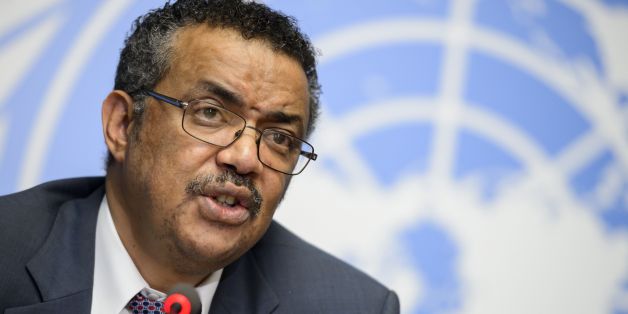
Dr Tedros Adhanom Ghebreyesus, Director-General of the World Health Organisation (WHO). Photo credit: AFP / FABRICE COFFRINI / Getty Images
WHO Director-General, Dr Tedros Adhanom Ghebreyesus, said in a video statement, “We have a clear vision for elimination, and we have the tools to do it. But we must accelerate progress to achieve our goal of eliminating hepatitis by 2030.”
Viral hepatitis B and C affect 325 million people around the world. Left untreated, these infections lead to liver cancer and cirrhosis, which together caused more than 1.3 million deaths in 2015 alone.
Worldwide, less than 20% of people had access to testing and treatment services for hepatitis B and C infections at the end of 2016.
To mark World Hepatitis Day 2018, WHO is holding several events with the Government of Mongolia, a country that is heavily burdened by hepatitis but also a champion in the global fight.
Over 10% of Mongolia’s three million people are living with chronic hepatitis infection. The country started its national Healthy Liver Programme in 2017, with ambitious targets for 2020.
“Within the first year of the national programme, which targeted the 40–65 year age group, we were able to reach more than 350 000 people with hepatitis testing,” said Ms Davaajantsan Sarangerel, Minister of Health, Mongolia. “Over 70% of people diagnosed with hepatitis were provided with life-saving treatment.” The country aims to provide hepatitis B and C screening to 1.8 million people aged over 15 years.
Mongolia’s progress in the fight against hepatitis is led by political commitment and an ambitious universal health coverage agenda. The country is the first lower-middle-income country in Asia and the Pacific to commit to hepatitis elimination, by ensuring universal access and health insurance coverage for hepatitis testing and treatment for its entire population.
The Western Pacific Region has the largest number of people living with chronic hepatitis infections among the six WHO regions. At the end of 2015, an estimated 14 million people were living with chronic hepatitis C infection and 115 million with chronic hepatitis B infection. Everyday, 1200 people in the Region die because they are unable to access effective hepatitis care.
“It is encouraging to see one of the most affected countries in our Region demonstrate such leadership,” said Dr Shin Young-soo, WHO Regional Director for the Western Pacific. “As we work towards the goal of eliminating hepatitis, Mongolia sets a great example for other countries in the Region to follow.”
Aiming to speed up global progress, WHO is also releasing new global guidelines on hepatitis C treatment. The guidelines enable major simplifications in the delivery of curative therapy to the 70 million people living with chronic hepatitis C in the world.
“Eliminating hepatitis will require ongoing innovation, better medicines, and improved health services,” said Dr Gottfried Hirnschall, WHO Director for HIV and Hepatitis. “Our new recommendations should pave the way for everybody with hepatitis C to access testing and curative treatment now.”
WHO and global partners are sharing the experiences of countries such as Mongolia to promote sustained political commitment and broad-based partnerships in many other countries. Reinvigorated action and investments in viral hepatitis are necessary to achieve a world where transmission is halted and everyone living with viral hepatitis has access to safe, affordable and effective care and treatment.
Cotton farmers in Nigeria may have been given a lifeline following the official registration of two Bt Cotton varieties known as MRC 7377 BG 11 and MRC7361 BG11 by the National Committee on Naming, Registration and Release of Crop Materials.
The GM Bt Cotton is said to have failed in Burkina Faso, with farmers making claims from Monsanto
The Director/CEO National Biotechnology Development Agency (NABDA), Prof. Alex Akpa, disclosed in Abuja on Thursday, July 26, 2018 that the approval and registration were granted at the 26th meeting of the committee which held recently in Ibadan, Oyo State.
Prof. Akpa said the official registration marked the entry into the nation’s agricultural system, the first home grown genetically modified crop.
“Bt Cotton varieties that have just been registered are highly viable when compared to the local conventional alternative, the yield is 4.1 to 4.4 tonne per hectare while the local variety is 600 to 900kg per hectare,” he said.
According to him, there are other crops undergoing confined field trials at various stages in different research institutes across the country.
“With this development, Nigeria has demonstrated that it has the institutional capacity and human resources to safely deploy genetic engineering in the agricultural sector.
“This feat achieved by this registration goes to show also that the federal government investment in our research institute is not in vain.
“With encouragement and support from the government, Nigeria has registered its home-grown GM Cotton saving our farmers the trouble of contending with the local conventional variety which is no longer accepted at the international market,” he added.
The DG noted that the development has a wider implication for the socio-economic development of Nigeria as comatose textile industries that have been under lock and key over the years now have hope of resuming production as farmers will have access to high yielding cotton variety.
“This new variety that has just be officially registered has the potential of being adopted in all the Cotton growing zones of Nigeria with maturity of 150 -160 days.
“It is resistant to Bollworm complex, high seed cotton yield, early maturity tolerant to suckling insect pest with fibre length of 30.0 to 30.5mm and a fibre strength of 26.5 to 27.0 g/tex (tenacity) and micronaire (strength) 3.9 to 4.1,” Prof. Akpa said.
Both varieties were developed by Mahyco Nigeria Pvt. Limited in collaboration with the Institute for Agricultural Research, Ahmadu Bello University, Zaria.
The Governor of Edo State, Mr Godwin Obaseki, has constituted a taskforce to halt the destruction of forest reserves in the state.
Governor Godwin Obaseki of Edo State
Obaseki announced in Benin, the state capital, on Thursday, July 26, 2018 that the constitution of the taskforce was to find an immediate end to the alarming rate of depletion of the state’s forest resources.
According to him, the integrity of forests in Edo has been compromised with unscrupulous people tying down the state’s public wealth.
“Illegal logging is rife and much of it takes place at night with the bio-diversity being destroyed. These practices have exposed us to harsh effects of climate change and global warming.”
The governor explained that the constitution of the team demonstrated the commitment of his administration toward enthroning best practices in forestry management.
He said that a forestry commission would also be set up to ensure sustainable protection of the forests.
“The threat posed by climate change is real. We cannot leave our future to chance.
“We are already grappling with desertification in the north with the associated crisis and flooding, resulting from indiscriminate felling of trees.
“The taskforce will also guide the State Government on partnerships to ensure the protection and preservation of the reserves’ diverse plants and animals,’’ he said.
The taskforce is headed by the Secretary to the State Government, Mr Osarodion Ogie, and other members of the state’s executive council.
Tunisia and the African Development Bank (AFDB) have signed an agreement for the launch of a pilot project to use drones for data collection to enhance management of agricultural projects in the country.
A drone
The project, to be implemented over the next 10 months, would receive technical management and assistance from South Korea, Minister Zied Laadhari announced during the signing ceremony on Thursday, July 26, 2018.
Laadhari, Tunisia’s Minister of Development, Investment and International Cooperation, was joined by Park Jae-Min, Vice-Mayor of Busan City and Mohamed El Azizi, Director General of the Bank’s North Africa office. The ceremony was also attended by Agriculture Minister Samir Taïeb, and Korea’s ambassador to Tunisia, Cho Koo-Rae.
The pilot project will focus on agricultural operations in Sidi Bouzid in central Tunisia, under the management of Busan Techno Park, a Korean government agency based in Busan, South Korea. Laadhari said the agency would provide equipment – drones and associated computer systems – training, as well as technology transfer.
The agency has already tested the drones for efficacy in managing similar urban projects. Korea is a leading country in the development and use of Unmanned Aerial Vehicle (UAV) for real-time data collection and processing. Drones have been used in agriculture to provide fast and accurate data, helping to improve decision-making at all stages of a project, from preparation to implementation and evaluation.
Laadhari said the pilot was expected to benefit piloting and monitoring of irrigated areas, management of water resources, water tables as well as the effects of climate change in the pilot area.
A founding member of the Bank Group, Tunisia was one of its first beneficiaries in 1967. Currently, the Bank’s portfolio in Tunisia is worth over $2.3 billion covering more than 40 projects and programmes.
A water irrigation and supply system funded by the African Development Bank (AfDB) has transformed the lives of rural farming communities in Cape Verde’s Santiago Island, sparing farmers grueling treks of up to 20 kilometres to fetch water for farming and daily use.
The Picos and Engenhos Watershed Management project has benefited women
Santiago Island, Cape Verde’s largest and most important agricultural centre, depends on water for its survival, but for years had been beset by endemic water shortages. Traditionally women, who make up a significant percentage of farmers, were hardest hit by the shortfall in supply.
The Lopes family are typical farmers hailing from the rugged terrain on Santiago Island. For generations, families like theirs struggled to eke out a living on land that was both hard to work and had low yields. In the dry season, many people headed for the towns in search of work.
That is now mostly a thing of the past, thanks to the Picos and Engenhos Watershed Management project, funded with a $7.55 million loan from the AfDB. A steady flow of water has led to increased agricultural output for 17 new farming associations that have brought together almost 1,000 women smallholder farmers.
Fifty-year-old Amalia Lopes is a member of one of the women’s cooperatives which are showcasing the dramatic change to Cape Verde’s agricultural landscape. Now Lopes looks forward to higher sales of beans and bananas from her newly irrigated fields. She can even afford to send her son to university in Praia, the capital of Cape Verde.
“The right conditions are now in place,” she says, as she calls on youths to make the most of the improved conditions.
As livelihoods improve, women are beneficiaries
Under the Picos and Engenhos Watershed Management project, irrigation systems, wells and reservoirs were constructed over a seven-year period. The bank also helped organise and support vocational training. Courses in long-term agricultural produce, constructional and agricultural engineering, and livestock management or pasture improvement were organised. Most of the beneficiaries have been women.
“Things are better today,” says Lopes.
Statistics back her optimism. Official figures show average salaries have risen to about $1,900 a year. Lopes has even become a spokesperson for her women’s cooperative. She has appeared on TV and radio news and current affairs shows and achieved minor celebrity status in her district when she became one of the first local women to visit Brazil, a country which shares a common linguistic background with Cape Verde.
Herminia Minha is another example of the success of the project. She is one of many women who can sell their produce in local markets in Picos at competitive prices. Now Minha makes enough profit to afford higher education for her children – something that was unthinkable just a few years ago.
“Better irrigation means a greater variety of fruit and vegetables and water for homes,” Joana Lopes says, “I now grow potatoes, tomatoes, cabbages, beetroots, and Chinese cabbage. I sell a lot of lemons at the markets.”
Currently Cape Verde imports 70-75% of its food needs, but authorities are optimistic that the evolution in agricultural techniques and irrigation will rapidly narrow that figure.
The AfDB’s active portfolio in Cape Verde stands at $101,000,000, covering energy, transport, water and sanitation, social, agriculture, and governance.
Despite environmental issues being transboundary in nature, countries in Africa appear not to be working together as one to address inherent challenges.
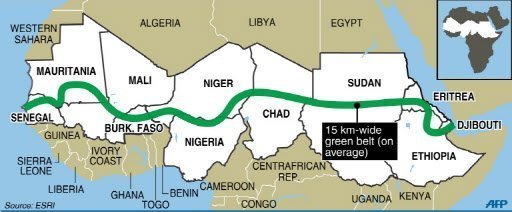
The Great Green Wall Initiative is an attempt by Nigeria and several other African nations to address the problem of desertification and land degradation, while hoping that it will provide sustainable alternatives for millions of young people considering migrating from poverty-stricken areas in Africa’s Sahel region. Photo credit: theodysseyonline.com
This turned out to be the view of majority of the stakeholders sampled by EnviroNews. Common transboundary environmental issues facing African countries include sea level rise, coastal erosion, desertification, drought, pollution and illegal mining, among others.
“African nations are not united. Neither do they address our environmental challenges with a common voice nor provide adequate resources to mitigate them,” insists Ayo Tella of the Initiative for Nature and Human Development (INHD).
Executive Director, Centre for Energy and Environmental Sustainability, Chike Chikwendu, states that collective efforts in tackling the problems are lacking due mainly to low financial capacity and the traditional loyalty of these countries to different foreign western countries.
“Therefore, individual country efforts usually result in ad-hoc solutions that are quickly obliterated by the rampaging global warming effects. Examples abound. In Lagos, the government has succeeded in stemming the coastal erosion at the Bar Beach while the beaches of Benin Republic, Togo and Ghana are fast being washed away. Second, the Great Green Wall project across the Sahel in the West African sub-region succeeded in some countries but is a failure in Nigeria where issues of corruption and transparency has affected the implementation of the project. Many more examples abound,” says Chikwendu.
He, therefore, urges African nations to cooperate in addressing their common environmental problems.
Ghanaian environmental journalist, Mary Ama Kudom-Agyemang, stresses that Africa’s unity to her common environmental issues is evidenced in the African Union’s (AU) New Partnership for Africa’s Development (NEPAD) initiative, which is the strategic framework for the continent’s socio-economic development that addresses major challenges facing Africa such as poverty.
“NEPAD’s programmes are focused on some key thematic areas including agriculture and food, security, climate change and natural resources management and regional integration, which all have bearings on the continent’s environment. Thus, the AU is strategically positioned to direct a pan-African approach to tackle common environmental problems,” says Kudom-Agyemang.
But she laments that Africa currently lacks structure for environmental governance, “a situation that can be blamed on national governments”.
“Individual countries do not seem to appreciate the need to tackle environmental issues from a common front and as such have so far not demonstrated the political will nor committed funds to address environmental problems as a priority.
“It appears Africa’s unity, in this wise, is merely rhetoric and there is urgent need to go beyond the talks and translate commitments and plans into action at the individual country level to the wider regional blocks,” she adds.
Director, Health of Mother Earth Foundation (HOMEF), Nnimmo Bassey, explains that even though Africans are concerned about addressing common environmental issues, there are however “big challenges in having a coherent approach as there is no holistic matrix by which the ensure a composite tackling of the problems”.
His words: “You will notice this even within nations. Until countries treat environmental issues as the cross-cutting issues they are, approaches will remain fragmented and sometimes counterproductive. The other matter is that our countries are dependent on the extractivist path for financial flows. This disposition does not promote environmental care.
“Violent conflicts add to the challenges of environmental protection. Equally, dependence on food aid provides an avenue for genetic contamination of our food systems, especially through so-called food aid as was the attempted case in Zambia in 2002 and Angola and Sudan in 2004. In recent years unverified seeds have been distributed to farmers in Nigeria through aid. These and other factors inhibit a coordinated approach to environmental issues in our nations and on the continent.”
But National Network Coordinator, CSDevNet, Atayi Babs, believes that African nations are united in their resolve to address common environmental issues as, according to him, they speak with one voice at international climate negotiations.
“This they achieve through the instrumentality of the African Group of Negotiators (AGN), the African Ministerial Conference on Environment (AMCEN), and the Council of African Heads of States on Climate Change (CAHOSCC), he submits, adding:
“Through these platforms, African nations generate and project the African voice which is usually underpinned by realities of the local communities and contributions by non-state actors outcomes which are key essentials for informed policy formulation and monitoring of its implementation at all levels.
A study by the India, New Delhi-based research and advocacy body, Centre for Science and Environment (CSE), has exposed what looks like a large-scale illegal presence and sale of genetically modified (GM) processed foods in the country.
GMOs
Without the approval of the Food Safety and Standards Authority of India (FSSAI), production, sale and import of these foods is banned in India.
CSE’s Pollution Monitoring Laboratory (PML), which conducted the study, tested 65 food products available in Indian markets – 32 per cent of these were found to be GM-positive. These food products were purchased randomly from retail outlets in Delhi-NCR, Punjab and Gujarat. Both imported (35) and domestically produced (30) samples were tested – imported samples fared worse: 80 per cent of the products which were found to be GM-positive, were imported.
The products which were found to be GM-positive include infant food, edible oil and packaged food snacks. Most of these are said to be imported from the US, Canada, the Netherlands, Thailand, and the UAE. These products were produced from or contain soya, cotton seed, corn or rapeseed (canola), which are known GM crops of the world.
Releasing the results of the study here today, CSE director general Sunita Narain said: “Our government says it has not allowed the import of GM food products. Then how is this happening? We have found that laws are not the problem – the regulatory agencies are.”
Adding to this, Chandra Bhushan, deputy director general, CSE, said: “We had been hearing about the presence of illegal GM food in India, and decided to do a reality check by testing processed foods. We were shocked to know the scale in which GM foods have penetrated the Indian market. The regulatory authorities are to blame here – the FSSAI has not allowed any GM food on paper but has failed to curb its illegal sales.”
What is GM? Why should we worry?
“GM – genetically modified – products, especially food, raise a crucial question of safety: a question of how safe they are. The jury is still out on this,” says Narain. This is because GM food involves taking genes (DNA) from different organisms and inserting them in food crops. There is a concern that this ‘foreign’ DNA can lead to risks such as toxicity, allergic reactions, and nutritional and unintended impacts.
Most countries in the world, including India, have decided to take a ‘precautionary’ approach to GM food. They have set stringent regulations for approval and labelling. The EU, Australia, New Zealand, Brazil and South Korea have made it mandatory to label GM food so that consumers have a choice about what they are eating.
What did the CSE study find?
GM food contains foreign promoter and terminator genes. More than 90 per cent of GM crops in the market contain promoter genes like 35S promoter of cauliflower mosaic virus (CaMV) and FMV promoter of figwort mosaic virus, and NOS terminator of Agrobacterium tumefaciens. Using quantitative Polymerase Chain Reaction (qPCR), CSE’s lab screened the food products to ascertain if they had a combination 35S promoter, NOS terminator and FMV promoter.
The key findings of the study are:
32 per cent (21 out of 65) of the food product samples tested were GM-positive. About 80 per cent (16 out of 21) of those which tested positive were imported. These were made of or used soy, corn and rapeseed and were imported from Canada, the Netherlands, Thailand, the UAE, and the US.
56 per cent (9/16) of oil samples, 25 per cent (10/39) of packaged food samples and 25 per cent (2/8) of infant food samples were GM-positive.
The CSE lab also tested five samples of cottonseed oil from India – all tested positive. This is because BT-cotton is the single GM crop that has been allowed for cultivation in the country. Says Bhushan: “But this should worry us. Firstly, no permission has been given for the use of GM cottonseed oil for human consumption. Secondly, cottonseed oil is also mixed in other edible oils, particularly vanaspati, which means we are consuming it without knowing.”
GM contamination was found in infant food, sold for children with medical ailments, including allergies. Two products by Abbott Laboratories, the American healthcare company, were found to be GM-positive — one was for lactose-intolerant infants and the other was a hypoallergenic (for minimising the possibility of an allergic reaction). Neither product has any label warning parents that this food has GM ingredients.
Other than edible oil, no processed food sample manufactured in India was found
GM-positive.
65 per cent (13/20) GM-positive samples did not mention anything about GM on their labels. These include the following:
Canola oil brands (‘Farrell’ imported from UAE by Jindal Retails (India) Pvt Ltd; ‘Hudson’ from UAE, marketed by Dalmia Continental Pvt Ltd; ‘Jivo’ imported from Canada by Jivo Wellness Pvt Ltd); and cottonseed oil brands from India (‘Ankur’, ‘Ginni’, ‘Tirupati’ and ‘Vimal’).
Packaged foods like ‘Pancake syrup original’ and ‘Popcorn Hot N’ Spicy’ — both products of American Garden – imported in India by Bajoria Foods Pvt Ltd; ‘Froot Loops’ — a sweetened multigrain cereal from Kellogg’s imported by Newage Gourmet Foods; and ‘Crispy corn snacks’ from Bugles – distributed by General Mills Inc, USA and imported by Newage Gourmet Foods.
Three products made false claims suggesting that no GM ingredient is used. These were ‘Candrop’ Canola oil from Canada imported by Century Edible Cooking Oils Pvt Ltd; ‘Mori-nu silken tofu’ from the US, imported by Olive Tree Trading Pvt Ltd; and ‘PromPlus sweet whole kernel corn’ from Thailand imported by Guru Kirpa Impex.
Four products that carried labels of genetic engineering technology were ‘Butter and Garlic Croutons’ from Mrs Cubbison’s; ‘Corn puffs’ by Trix – distributed by General Mills Sales Inc, USA; ‘Original syrup’ from Aunt Jemima – distributed by Quaker Oats in the US; and ‘Dark corn syrup’ from Karo, US. All four products were imported by Newage Gourmet Foods.
What do the laws say?
The Environment Protection Act (EPA) strictly prohibits import, export, transport, manufacture, process, use or sale of any genetically engineered organisms except with the approval of the Genetic Engineering Approval Committee (GEAC) under the Ministry of Environment, Forests and Climate Change.
The 2006 Food Safety and Standards Act (FSSA) prohibits import, manufacture, use or sale of GM food without FSSAI’s approval.
The Legal Metrology (Packaged Commodities) Rules 2011 mandate that GM must be declared on the food package.
The Foreign Trade (Development and Regulation) Act 1992 says that GM food cannot be imported without the permission of GEAC.
Anyone who imports, manufactures, uses or sells GM food, is liable to be prosecuted under the above Acts.
The FSSAI has now issued a draft notification on labelling, which includes GM food. Says Amit Khurana, programme director, food safety and toxins, CSE: “The FSSAI notification says that any food that has 5 per cent or more GM ingredients, shall be labelled, provided this GM ingredient constitutes the top three ingredients in terms of percentage in the product. The exemption limit of 5 per cent is very relaxed compared to other countries such as the EU, Australia and Brazil, which have limits at or below 1 per cent.”
“But there is a catch,” he adds. “It is very difficult for government to quantify the GM content in all foods: the tests are prohibitively expensive and technically cumbersome. This means that the regulatory agency is asking companies to ‘self-declare’ and say that they are within the 5 per cent limit and therefore, need not carry the label of GM.”
Says Bhushan: “The draft GM labelling regulations shows the double standard of FSSAI. On one hand, FSSAI has set stringent conditions for labelling organic food, which is a safe and healthy. At the same time, it is proposing to give a huge exemption for labelling GM food, safety of which has been a matter of concern.”
What does CSE recommend?
The FSSAI must identify all GM products being sold in the market and prosecute companies and traders responsible.
It must set up a safety assessment system for approval of both domestic and imported GM foods.
The limit for GM labelling exemption should be set at 1 per cent GM DNA and not on the basis of weight of ingredients. Only unintentional contamination should be exempted.
The FSSAI should adopt qualitative screening (such as through quantitative polymerase chain reaction – qPCR) as an enforcement tool and the onus of proving unintentional presence should be on the food manufacturer. It must set up laboratories to screen GM foods for effective monitoring.
A symbol-based label such as “GM” should be displayed on the front of packs which carry GM food — just like the green “tick” along with the words “Jaivik Bharat” proposed for organic food.
Says Narain: “In 2008 (updated in 2012), the Indian Council of Medical Research (ICMR) had issued guidelines for determining safety of such food – it cautioned that ‘there is a possibility of introducing unintended changes, along with intended changes, which may in turn have an impact on the nutritional status or health of the consumer.’ Keeping this in mind, India should adopt a health-based precautionary principle approach to GM food regulation and labelling.”
Desmond Majekodunmi, renowned environmentalist and founder Lufasi Nature Park; David Omaghomi, executive director of Eco-Restoration Foundation; and others have called on government and other stakeholders to put a stop to mangrove destruction and other forms of environmental degradation in Nigeria.
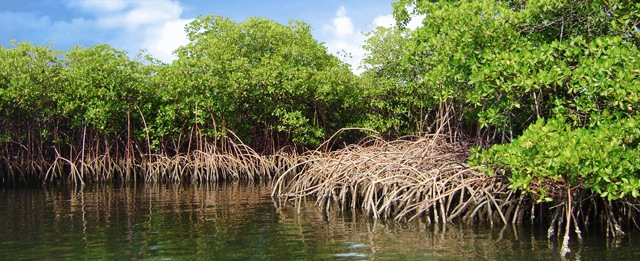
Mangroves
They spoke at the Mangrove Expo in commemoration of the International Day for the Conservation of the Mangrove Ecosystem at the Lekki Conservation Centre (LCC) in Lagos. The activists lamented the destruction of mangroves, especially in the Niger delta region.
According to Majekodunmi, the mangrove is one of the most valuable parts of the ecosystem.
“Mangroves sequester more carbondioxide than the rain forest,” he noted.
Describing the environment as “our life support system, which we inherited in very good condition and holding in trust for our children”, he called for sustenance of that heritage.
“Our children’s life support system is in our hands. We should not destroy it.”
Omaghomi tagged government the prime suspect in environmental degradation, as it seemed to collude with oil companies through laws that do not allow the environment regulators to perform.
He also fingered the Nigerian National Petroleum Corporation (NNPC) in the conspiracy against the environment. “NNPC should be ashamed of itself as a regulator.”
Lamenting that the mangroves in the Niger Delta are facing extinction, he charged the oil and gas companies to engage in mangrove restoration projects because their activities were destroying the mangroves.
Commending the Nigerian Conservation Foundation (NCF) for efforts in conserving the environment, he called on more organisations to be part of the initiative to protect the environment.
While urging security forces in the Niger Delta to be environmentally-responsible, he charged government to stop illegal refiners whose activities release more carbon dioxide and black soot into the environment than flared gas.
The mangroves, according to him, serve as natural groins by preventing coastal erosion.
“One artificial groin costs about N1 billion,” disclosed.
Jerry Chidi, a documentary photographer, who had a photo exhibition on the mangroves at the event, reeled out some of the benefits of the mangrove.
“The mangrove environment has a lot of aesthetic values and appearance; endless expanse of evergreen trees with webbed roots digging in and out of water, the mudflats literally crawling with life; crabs, mudskippers, periwinkles and others make up this ecosystem. Then you see fishing activities everywhere. The mangrove environment is indeed a treasure of resource and beauty,” he said.
Chidi is publishing a book on Man and Mangove, which was previewed at the occasion by Frank Ugiomoh, a professor of Arts, History and Theory from the University of Port Harcourt (UNIPORT), Rivers State.
Previewing the 174-page book that focuses on mangrove forests in Nigeria, the don urged oil and gas companies in Nigeria to give the publisher the leverage to reproduce the book to reach majority of the citizens.
The author told newsmen that the book communicates environmental stewardship.
In his welcome address, Muhtari Aminu-Kano, Director-General of NCF, represented by Joseph Onoja, the Director of Technical Programmes, said the foundation was pleased to partner with Chidi, for the first time to host the event.
“Whatever we think we do, we make an impact on the environment,” he added.
Adedayo Mahmud of NCF, in his vote of thanks, said the event was a call for action to change attitudes.
“NCF cannot do it alone; we are reaching out and we need more partners,” he added.
The UN Development Programme (UNDP) and the Government of Japan have launched the distribution of agricultural inputs and solar lanterns to communities ravaged by insurgency in Adamawa State.
Governor Bindo Umaru Jibrilla of Adamawa State
The information is in a statement made available to News Agency of Nigeria (NAN) on Thursday, July 26, 2017 by Mr Lucky Musonda, the Head of Communications, UNDP Nigeria.
Musonda stated that victims of Boko Haram attacks in Loko village of Song Local Government Area of Adamawa were the first set of beneficiaries of the support.
He added: “This intervention is part of ongoing efforts by UNDP to support victims of the Boko Haram insurgency in the three most affected states of Adamawa, Borno and Yobe.
“At the height of the insurgency which claimed many lives and caused billions of dollars in damage to property and key infrastructure, thousands were displaced across the region, some into neighbouring countries.
“The return of peace to previously captured communities and declaration by respective states of their safety has facilitated voluntary return of populations to their places of origin – most of them still in need of basic infrastructure and sources of livelihoods for the families to survive.”
According to him, UNDP is implementing several interventions in the North-East through close collaboration with respective state governments and funding support from partners, including the Government of Japan.
“In 2018, Japan is providing $2.5 million to facilitate implementation of initiatives to support 2,200 farmers and 500 small businesses.
“The investment will also facilitate the rehabilitation of five community infrastructure and an estimated 850 locals will be provided with emergency employment opportunities,’’ Musonda said.
The spokesman explained that the agricultural inputs, such as sprayers, fertiliser and farming tools, would be distributed to 9,000 households across the North-East region for use during this year’s farming season.
He, however, said that priority would be given to female-headed households.
The UNDP Deputy Country Director for Operations, Betty Wabunoha, reaffirmed UNDP’s commitment to support rebuilding efforts and livelihoods to stimulate early recovery and lay a solid foundation for development to take place again in the region.
Betty said: “Allow me to extend UNDP’s appreciation to the Government of Japan and Panasonic Corporation for the partnership and support in helping conflict affected communities in Nigeria.”
The Ambassador of Japan to Nigeria, Yutaka Kikuta, said that the North-East was an economically promising region but devastated by insurgency and pledged that the government of Japan would assist to ensure that interventions in the region helped to stabilise affected communities.
He added that “the joint-work of Japan’s public and private initiative will bring light, a brighter future to your lives in this region.”
He reassured that the Government of Japan would continue to support Nigeria’s efforts aimed at restoring stability and livelihoods for the communities in the North East region.
Mr Haruna Furo, the Permanent Secretary, Adamawa State Emergency Management Agency, thanked UNDP, the Government of Japan and Panasonic Corporation for the support.
Solar lanterns donated by Panasonic, a Japanese company, were also distributed during the ceremony.
The ceremony was attended by Loko community members and representatives of the Adamawa State Government.