Home Blog Page 1774

Climate Diplomacy Week: EU, others urge positive global climate action

0

Following a week-long series of activities by the European Union and partners, the Climate Diplomacy Week 2018 in Nigeria was rounded off in Abuja on Friday, September 28, 2018.
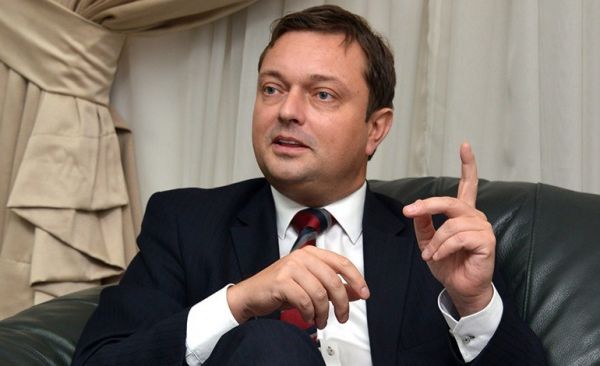
Ketil Karlsen
Head of Delegation to Nigeria and ECOWAS, Ambassador, Ketil Karlsen

The European Union delegations around the world utilised the Climate Diplomacy Week as a time to reach out to communities and partner organisations to highlight positive global action and collaboration on climate change. The focal areas of the programmes were on renewable energy, food security, water management, waste management, youth engagements, and environmental degradation as it relates to climate change.

The week opened in Abuja on Monday, September 24 with a policy dialogue and panel discussion on Energy Efficiency and Renewable Energy potentials. In attendance were the European Union, Head of Delegation to Nigeria and ECOWAS, Ambassador Ketil Karlsen; Regine Hess, Deputy Head of Mission, Embassy of the Federal Republic of Germany, Abuja; Representatives from the Federal Ministry of Environment, civil society organisations, corps members and members of the public.

In line with the central theme for the EU climate diplomacy week 2018, “Talanoa Dialogue”, a panel session focused on Youth Involvement in Climate Action held on Thursday, September 27. The panel, which was moderated by ‘Seyifunmi Adebote, had as panelists Climate Change and Sustainability expert, Linda Akpami; Climate Reality Leader, Abdullahi Ali Buhari; and Femi Akanji, CEO of Dapper ESL. The interactive session ended with the audience pledging to take six different climate actions towards Nigeria achieving her Nationally Determined Contribution (NDC).

The event ended on Friday, September 28 with a dialogue on waste management. Maria Yetano Roche of the Wuppertal Institute for Climate, Environmental and Energy made a presentation on “Climate Change and Waste in Nigeria: Challenges and Opportunities”; Funto Boroffice, CEO of Chanja Datti Recycling Limited, made a presentation on “Integrating Economic Incentives to Promote Environmental Consciousness”; and Manuina Maibe, Head of Product Development, Sustainability and CSR of Visionscape Group Nigeria, made a presentation on “Sustainable Systems for Waste Management in Emerging Markets”.

There were exhibitions and presentations by a number of resource persons and schools, movie screenings and other activities as other lineup of the week’s activities. The Climate Diplomacy Week 2018 in Nigeria by the European Union Delegation in Nigeria and ECOWAS, the Embassies of Germany, Sweden, and France, One Environment, Stop Don’t Drop, Chanja Datti and #PickThatTrash has been able to raise public awareness, open platforms for further discussions, and promote policies and practices for a climate-resilient future.

By ‘Seyifunmi Adebote, Abuja
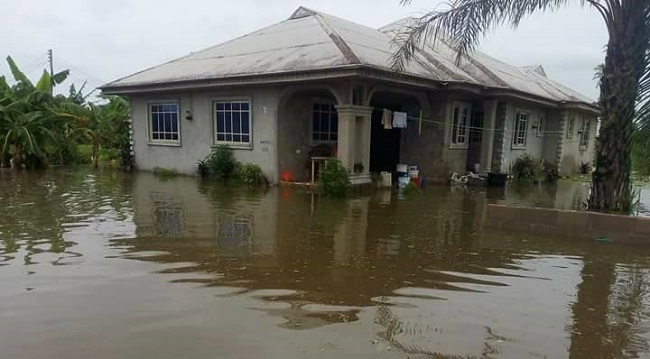
150,000 persons displaced by flood in Bayelsa

0

No fewer than 150,000 persons have been displaced by flood in Bayelsa State, the National Emergency Management Agency (NEMA) disclosed on Sunday, September 30, 2018.

Yenagoa
Flooding in Yenagoa, Bayelsa State

Mr Yakubu Suleiman, Co-ordinator, Emergency Operation Centre E, Rivers/Bayelsa Territory of NEMA disclosed this in an interview with the News Agency of Nigeria (NAN) in Yenagoa, the state capital.

Suleiman said that several homes, farmlands, schools and churches were submerged in the affected communities across eight Local Government Areas (LGAs) of the state.

He said the agency was taking inventory of the affected persons to ensure that they were free from diseases.

Suleiman said that the displaced persons have been evacuated to the Internal Displaced Persons (IDPs) camp in Biseni, while some tents have been mounted at the Egbebiri Community, all in Sagbama LGA.

“We have carried out assessment on the affected communities, and we discover that no fewer than 150, 000 persons have been displaced and the number keep growing because the water is rising daily.

“Several communities have been submerged; markets, schools, hospitals and churches are already under the water.

“We have cleared some portions of lands for the IDPs at Biseni and we have mounted some tents at Egbebiri Community, all in Sagbama LGA.

“We have over 110 tents to be mounted in different locations; the emergency monitoring team is working round the clock to ensure that every affected home is assisted.

“The medical teams are on ground from the Federal and State Ministries of Health, to be assisted by members of the Red Cross Society, to avoid spread of diseases because of polluted water.

“On portable water for the affected persons, we have brought water treated plants to be installed in the camp, so, that the people will have access to portable water,” he said.

The mostly affected communities are in Adagbabiri, Anibeze, Biseni, and Trofani in Sagbama LGA.

By Christian Ogbonna

World Habitat Day: Effectively managing community waste

0

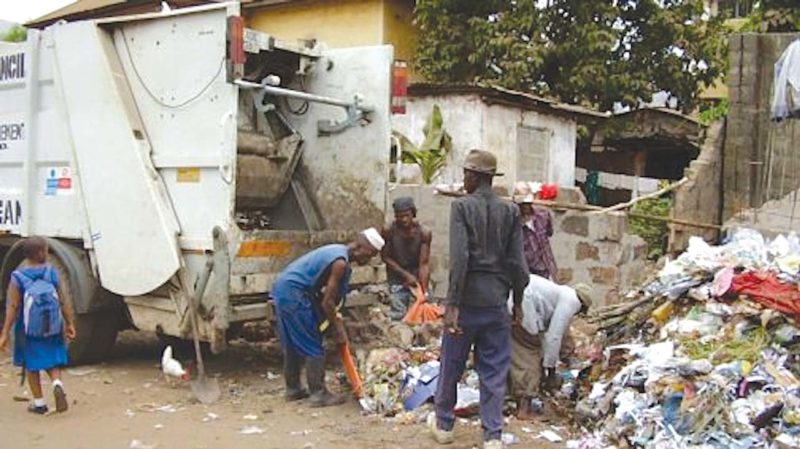
The state of Lagos in Nigeria is currently having its fair share of waste management challenges, which is giving the government as well as the governed a cause for concern.

waste managers
Waste management: Lagos waste PSP operators at work

But solid waste management is a global issue that affects everyone, the United Nations has said. According to the global body, the amount of waste produced by individuals is growing daily and often costs local authorities a large proportion of their budget.

The UN is bothered by the fact that poor solid waste collection and disposal can lead to serious health problems from uncontrolled dump sites and waste burning. It also leads to polluted air and water.

This is topic of focus as the world observes the 2018 World Habitat Day on Monday, October 1. This year’s theme is “Municipal Solid Waste Management” with the main global observance taking place in Kenya.

The UN designated the first Monday of October of every year as World Habitat Day to reflect on the state of our towns and cities, and on the basic right of all to adequate shelter. It also reminds us we all have the power and the responsibility to shape the future of our cities and towns.

According to the UN, a change in public attitudes to minimise waste and stop littering, the regularisation of informal waste pickers, increased recycling and reusing, sufficient funding, solid waste planning including adequate landfill sites, can help cities to improve the current state of solid waste management and save money to become “waste-wise cities”.

Latin American countries sign treaty to protect environmental defenders

0

Twelve countries – from Antigua to Mexico to Argentina – on Thursday, September 27, 2018 signed the Escazú Agreement during the 73rd session of the United Nations General Assembly.

Berta-Caceres
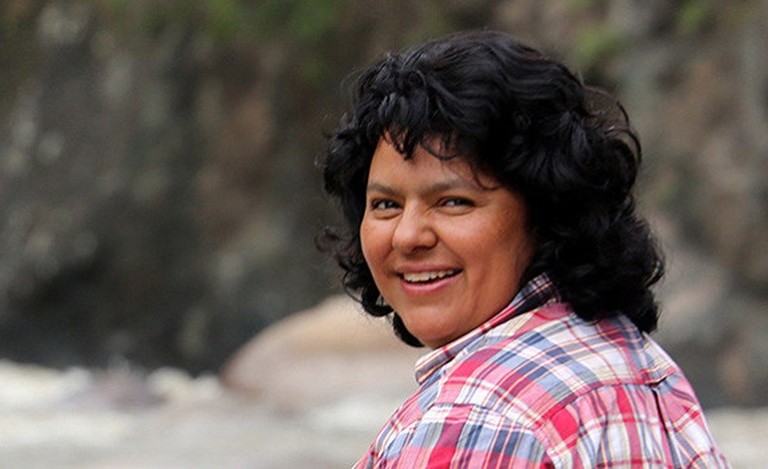
Honduran prize-winning campaigner Berta Caceres was slain by gunmen on March 3, 2016 weeks after opposing a hydroelectric dam project

Said to be a first-of-its-kind human rights treaty, the agreement gives community members in these countries more say over projects or development that impact them and their environment. The agreement also makes it clear that these governments should be informing the public about potentially polluting projects, such as mining activity, as soon as possible.

Most importantly, perhaps, the treaty draws attention to the dangers environmental activists can face in this region of the world. The issue goes beyond their ability to speak freely and critically. This year alone, at least 66 environmental defenders have been killed so far, per The Guardian, which tracks this data in partnership with human rights group Global Witness. Last year, 197 environmental defenders were killed worldwide.

Sixty percent of these deaths occur in Latin America. And indigenous people are disproportionately at risk. The agreement notes that countries should take investigations seriously and create welcoming environments for radical thoughts as part of improving defenders’ protections.

“The Escazú Agreement has the potential to greatly reduce conflict and expand rights to all people,” said Andrew Steer, CEO of World Resources Institute, an international group researching issues around the environment, in a press release. “This will send a clear message throughout the region that all people should have the right to a healthy environment without fearing for their lives.”

Countries in Latin America and the Caribbean took steps to finalise the treaty earlier this year in a meeting that was six years in the making. The issue became more pressing as a growing number of deaths received media attention, including that of indigenous Honduran activist Berta Cáceres, who was killed in her home in 2016. Her family is still in search of justice, and they have little faith in the Honduran government’s ability to seek it. Cáceres’ trial was set to begin last week but was postponed after concerns over the judges covering up evidence.

Honduras still hasn’t signed the treaty, but the 12 signatures are enough for it to move forward. Hopefully, this Central American country – and the 21 other countries left to sign on – hopes on sooner rather than later to help stamp out the merciless killing of people who simply demand a right to clean air, water, and land.

Images: WWF at Global Climate Action Summit

0

Leaders in business, local government, and from across communities have continued to step up around climate action.

Under the umbrella of the 30×30 Forest, Food and Land Challenge, the World Wildlife Fund (WWF) and over 100 NGOs, businesses, state and local governments, indigenous groups and communities at the recently held Global Climate Action Summit (GCAS) in San Francisco, California, issued 17 commitments to advance the forest, food and land agenda.

“Land, and how we use it, is the second largest source of emissions, but can deliver up to 30% of the climate solutions needed to meet the targets set by the Paris Agreement,” says Sara Thomas the WWF Director, Activism and Outreach.

Business and local leaders weren’t the only ones making gains for climate action:

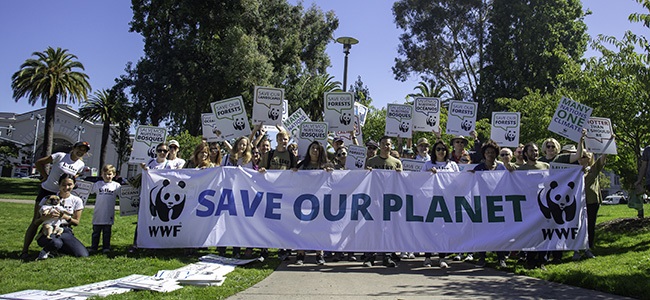
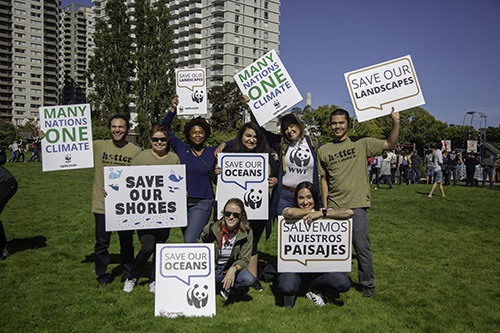
An estimated 30,000 people took to the streets of San Francisco to speak out for strong climate action. Behind the WWF banner were 200+ WWF staff and supporters marching through San Francisco, with Panda Ambassadors mobilising in more than 10 cities across the country.

World Wildlife Fund
WWF at the Global Climate Action Summit
World Wildlife Fund
WWF supporters and staff get ready for the Rise For Climate Mobilisation
World Wildlife Fund
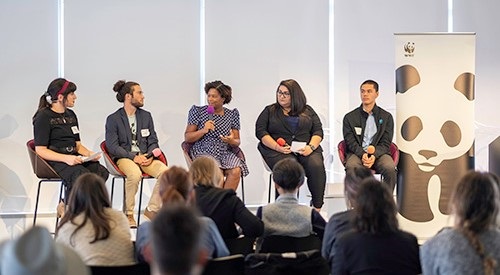
WWF hosted the “Climate Change in My Lifetime” a panel featuring four activists from all corners of the US and their experiences with climate change in their daily lives


181 countries to tackle Big Tobacco at global treaty talks

0

In a few days, as many as 181 countries will converge on Geneva, Switzerland, for the Eighth Conference of the Parties (COP8) to the World Health Organisation Framework Convention on Tobacco Control (WHO-FCTC) to shut off one of the last avenues of influence the tobacco industry has to interfere with public health policymaking at the talks.

geneva-switzerland
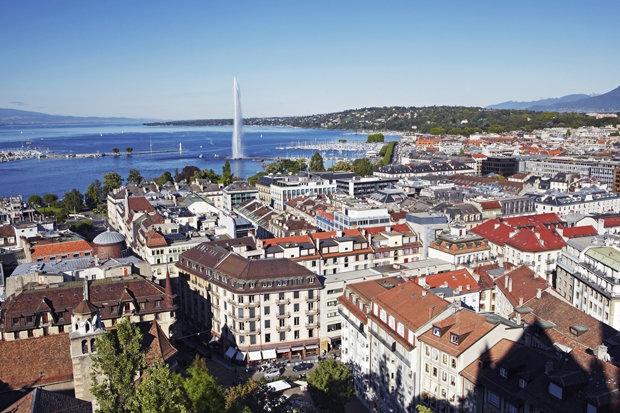
Geneva, Switzerland will host the Eighth Conference of the Parties to the World Health Organisation Framework Convention on Tobacco Control (WHO-FCTC COP8) in October, 2018

At the conference holding from October 1 to 7, 2018, countries will advance a provision that will prohibit the tobacco industry from exploiting public badges, which are allegedly used by tobacco industry representatives to delay, block and weaken the treaty.

In the past year, in advance of COP8, Big Tobacco has allegedly escalated its attempts to re-normalise the industry: doubling down on promoting heat-not-burn products and launching a billion dollar foundation in hopes of regaining supposedly lost footing in policymaking spaces. This year, governments will also advance policies to eliminate the trade.

The policy to kick Big Tobacco out stems from a broader treaty directive called Article 5.3 that prevents industry interference in the halls of government. Internal industry documents show that when the tobacco industry successfully gains access to the talks by attending on public badges, they obtain confidential information, lobby government delegates, and attempt to water down public health policy.

“The number one barrier to fully implementing this life-saving treaty is industry interference,” said Michel Legendre, associate campaign director with Corporate Accountability. “With Big Tobacco on the defensive, and governments poised to give it the boot, the outcomes of this year’s Conference of the Parties will mark a turning point for public health.”

The policy decision to truly eliminate the industry from the halls of negotiation will have resounding implications for policymaking spaces in other arenas, like the U.N. Framework Convention on Climate Change, where industry interference inside of the negotiating spaces appears to have been a significant barrier to real success.

“The Public Badges policy is a revolving door that Big Tobacco continues to exploit. The talks present a crucial opportunity for Parties to bound together to finally shut that door to stop Big Tobacco meddling,” said Philip Jakpor, Network for Accountability of Tobacco Transnationals (NATT) Nigeria Spokesperson.

The global tobacco treaty, known formally as the World Health Organisation Framework Convention on Tobacco Control (FCTC), entered into force in 2005. To date, 181 countries and the European Union have become Parties to the treaty. It contains the world’s most effective tobacco control and corporate accountability measures – estimated to save more than 200 million lives by 2050 when fully implemented.

Other key developments/issues of focus at the Eighth Conference of the Parties to the Framework Convention on Tobacco Control include:

  • The Philip Morris International-funded Foundation for a Smoke-Free World has launched and is expected to lobby heavily in support of the industry at this year’s negotiations.
  • For the first time, governments have seen hundreds of newly public internal documents that detail Big Tobacco’s extensive lobbying and manipulation schemes to undermine the talks.
  • E-cigs regulation
  • Strengthening of FCTC Article 19 with focus on facilitating access to justice for victims of smoking-related disease; healthcare cost recovery; and enforcing existing tobacco control measures or general laws relevant to tobacco, including injunctive relief.

World Bank invests $1b in battery storage for developing countries

0

The World Bank has announced its investment into battery storage for developing countries.

Riccardo Puliti
Senior Director and Head of Energy & Extractives at the World Bank, Riccardo Puliti

Battery storage allows for wind and solar energy to be used at a much greater scale by making it possible to store electricity and use it when it needs it the most.

However, battery technology is expensive and not yet widely developed in large-scale projects. Notably, in developing countries the gap is acute, despite wind and solar energy having great potential.

The financial institution has created a new programme which aims to close this gap.

The Accelerating Battery Storage for Development programme is a new, first of its kind, global initiative to accelerate the development of battery storage for energy systems in developing and middle-income countries.

This is great news for developing countries who often have unreliable electricity. The programme intends to combat this by increasing grid stability as well as helping move them towards a new generation of renewable energy.

The goal is to finance 17.5 gigawatt hours of battery storage by 2025.

Senior Director and Head of Energy & Extractives at the World Bank, Riccardo Puliti, said: “We are seeing historic low prices for solar and wind energy, and countries want to use as much of it as possible to meet their energy needs. But to make full use of solar and wind power, we need at-scale and affordable battery storage. Our goal is to catalyse new markets that will help drive down costs and make batteries a viable storage solution for developing countries.”

By Rachel Cooper, Climate Action

Why countries should continue use of Clean Development Mechanism

0

National representatives working on the Kyoto Protocol’s Clean Development Mechanism (CDM) – which has registered thousands of climate and development projects worldwide – have called for greater promotion of the mechanism to help ensure its continued use in the international response to climate change.

Global DNA Forum
L-R: Luca Brusa and Ovais Sarmad, UN Climate Change; Arthur Rolle, Chair, CDM Executive Board; Lorna Ritchie, DNA Forum Co-Chair (Global) for 2018; and Piotr Dombrowicki, Vice-Chair, CDM Executive Board at the Global Designated National Authorities (DNA) Forum meeting in Bonn, Germany

CDM projects earn a saleable credit for each tonne of CO2 they reduce or avoid. The incentive has led to registration of more than 8,100 projects and programmes in 111 developing countries and the issuance of almost two billion certified emission reductions (CERs).

CDM Designated National Authorities (DNAs) from 59 countries, who were at UN Climate Change in Bonn, Germany, for three days of meetings and a technical workshop from September 19 to 21, 2018 want those numbers to grow. For that to happen in any significant measure, demand for CERs, and thus their price, must rise.

The DNAs see the Paris Agreement, adopted in 2015, as a new opportunity for the CDM and called on the Board that oversees the mechanism to step up promotion so the CDM can retain a place in countries’ evolving climate efforts.

“Despite low demand there is still quite some interest in the CDM and new opportunities exist for the CDM,” said Arthur Rolle, Chair of the CDM Executive Board, in his remarks to DNAs. “Many think that the CDM is dead, but it is not.”

In fact, projects continue to be registered and CERs continue to be issued, just not in the numbers seen in 2008-2012 when the CDM was a key tool under the Kyoto Protocol and countries could use CERs to cover a part of their emission reduction commitments under the Protocol.

Countries have yet to ratify a second commitment period of the Kyoto Protocol and have turned their attention to the Paris Agreement, which also allows for use of markets and mechanisms like the CDM and calls for creation of a sustainable development mechanism.

“CDM’s achievements and contribution have demonstrated its potential as a successful tool for mobilising finance in climate action and as a driver for sustainable development,” said Ovais Sarmad, Deputy Executive Secretary of UN Climate Change, in his remarks. “There are on-going efforts to nurture demand for CDM and CERs in the compliance and voluntary markets and enhance its contribution to closing the pre-2020 emission gap.”

The CDM Executive Board this month released an online report on the achievements of the CDM. The DNAs in Bonn urged the Board to make those achievements better known, as a matter of urgency, with a view to having the mechanism continue beyond the Protocol’s second commitment period, due to end in 2020.

The Global DNA Forum meeting is convened annually, with participation of DNAs from around the world supporting the CDM at the national level, to build capacity, share information, and discuss how to further support climate action through the CDM.

The Global DNA Forum elected Mr. Albert Magalang (Philippines) and Mr. David Hynes (UK) as global Co-Chairs for 2019, replacing Ms. Maia Tskhvaradze (Georgia) and Ms. Lorna Ritchie (UK), respectively. Mr. Magalang is Head, Climate Change Office, Environmental Management Bureau, Department of Environment and Natural Resources, Philippines. Mr. Hynes is a policy advisor at the Department for Business, Energy and Industrial Strategy, UK.

The Forum elected regional Co-Chairs for 2019, as follows:

  • African Group, Co-Chair, Mr. Hans Djamba (Democratic Republic of Congo) and Ms. Nagla Jebroy (Sudan) as alternate.
  • Asia-Pacific, Co-Chair, Mr. Albert Magalang (Phillipines) and Ms. Dilruba Akter (Bangladesh) as alternate.
  • Latin America and the Caribbean, Co-Chair, Mr. Federico Grullon De La Cruz (Dominican Republic) and Ms. Ximena Figueroa (Colombia) as alternate.
  • Eastern Europe, Co-Chair, Mr. Mykhailo Chyzhenko (Ukraine) and Mr. Jeyhun Hasanov (Azerbaijan) as alternate.
  • Western Europe, Co-Chair, Mr. David Hynes (United Kingdom) (no alternate).

Outstanding environmental changemakers receive UN’s Champions of the Earth award

0

Six of the world’s most outstanding environmental changemakers were recognised on Wednesday, September 26, 2018 with a Champions of the Earth Award, the UN’s highest environmental honour.

Champions of the Earth award
The Champions of the Earth awardees

This years’ laureates were recognised for a combination of bold, innovative, and tireless efforts to tackle some of the most urgent environmental issues of our times. The winners of the 2018 Champions of the Earth Awards are:

  • Joan Carlingis recognised with the lifetime achievement award for her work as one of the world’s most prominent defenders of environmental and indigenous rights. Carling has been at the forefront of the conflict for land and the environment for more than 20 years. Her tireless and selfless fight for the environment has made her a champion to peoples and communities all over the globe.
  • Beyond Meat and Impossible Foodsare jointly recognised in the Science and Innovation category, for their revolutionary development of a popular, plant-based alternative to beef, and for their efforts to educate consumers about environmentally conscious alternatives.
  • Emmanuel Macron, President of France and Narendra Modi, Prime Minister of India, are recognised in the Policy Leadership category for their pioneering work in championing the International Solar Alliance and promoting new areas of levels of cooperation on environmental action, including Macron’s work on the Global Pact for the Environment and Modi’s unprecedented pledge to eliminate all single-use plastic in India by 2022.
  • China’s Zhejiang’s Green Rural Revival Programmeis awarded for Inspiration and Action for the transformation of a once heavily polluted area of rivers and streams in East China’s Zhejiang province. This exceptionally successful eco-restoration program shows the transformative power of economic and environmental development together.
  • Cochin International Airportwill take home the award for Entrepreneurial Vision, for its leadership in the use of sustainable energy. Cochin is showing the world that our ever-expanding network of global movement doesn’t have to harm the environment. As the pace of society continues to increase, the world’s first fully solar-powered airport is proof positive that green business is good business.

“In a world of uncertainty, this is certain: We will not solve the extraordinary challenges our world faces today without extraordinary talent, new thinking and bold ideas,” said Head of UN Environment, Erik Solheim. “The Champions of the Earth Award and Young Champions of the Earth Prize recognize those not afraid to chart unknown waters or be the voice of the voiceless. These people are changing our world today for a better tomorrow.”

The awards were presented during the Champions of the Earth Gala in New York City, on the sidelines of the 73rd UN General Assembly. The gala, hosted by actor and environmental activist Alec Baldwin and model, actress, producer and UN Environment Goodwill Ambassador Dia Mirza, brought together a cross section of world leaders and influencers to celebrate momentum for change in defense of our one planet.

The Champions of the Earth award is the UN’s highest environmental recognition celebrating exceptional figures from the public and private sectors and from civil society, whose actions have had a transformative positive impact on the environment.

Past laureates include: Afroz Shah, who led the world’s largest beach cleanup (2016); Rwandan President Paul Kagame (2016); former US Vice-President Al Gore (2007); Ocean Cleanup CEO Boyan Slat (2014); scientist-explorer Bertrand Piccard; and developer of Google Earth, Brian McClendon (2013).

Also honoured at the event were seven environmental trailblazers between the ages of 18 and 30, taking home the coveted Young Champions of the Earth Prize, for their ambitious project ideas to restore and protect the environment.

Eco-friendly Forest Green Rovers receives UN award

0

League Two side Forest Green Rovers’ eco-friendly initiatives received recognition from the United Nations on Thursday, September 28, 2018 as the club won the Momentum for Change climate action award.

 Forest Green Rovers
An impression of the new Forest Green Rovers FC Stadium

Rovers, which is currently eighth in the fourth tier of English soccer, has won admirers from around the world, thanks to the soccer outfit’s green ethos, becoming the first vegan club in England and the first to become carbon neutral.

“We’re pretty chuffed to have this recognition from the UN for our work in promoting sustainability through sport,” Rovers chairman, Dale Vince, said.

Apart from a vegan menu, the club has also incorporated a host of eco-positive features, including an organic pitch, electric car chargers and a solar powered robot lawnmower.

“Plenty of people doubted we could make this improbable combination of a football club and the environment work, but it’s proven to be a powerful combination,” Vince added.

Rovers, which is based in the southwest county of Gloucestershire, is now looking to build the world’s first modern-age wooden soccer stadium.

The UN award was presented at the Climate Week NYC, one of the key sustainability summits in the international calendar in New York.

Rovers will now travel to the next UN climate change conference in Katowice, Poland in December.