Home Blog Page 1745

Cities ‘highly exposed’ to disasters, says report

0

A UN Department of Economic and Social Affairs (DESA) publication has found that nearly three in five cities with populations greater than 500,000 people are at high risk of a natural disaster. The information is contained in a data booklet titled, “The World’s Cities in 2018” and released recently.
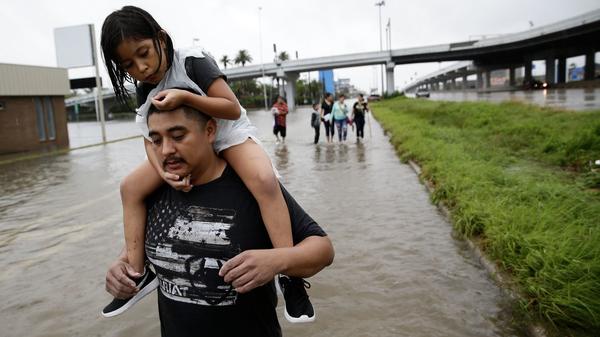
Harvey storm
In Houston, Jesus Nunez carries his daughter Genesis, 6, as he and other family members flee their flooded home. Photo credit: Robert Gauthier / Los Angeles Times

According to the publication’s findings, 679 of 1,146 cities inhabited by more than half a million people are vulnerable to cyclones, floods, droughts, earthquakes, landslides or volcanic eruptions. Combined, these cities are home to 1.4 billion people – a third of the world’s population. The booklet draws on projections from DESA’s “World Urbanisation Prospects: The 2018 Revision” report and notes the importance of understanding urbanisation trends as being key to implementing SDG 11 (sustainable cities and communities).

The data booklet offers a definition for the term “city,” distinguishing between administrative boundaries, those delineated by “contiguous urban areas,” and broader metropolitan areas that feature a degree of economic and social interconnectivity. The means of defining a city, it stresses, affects the assessment of its population, with metropolitan areas being home to significantly larger numbers of people than the “city proper” as defined by an administrative boundary.

The publication notes that the world’s cities are growing in both size and number, with most megacities – defined as having more than 10 million inhabitants – being in the global South. Nine of the 10 cities projected to become megacities by 2030 are in developing countries.

In a news release, lead author of the publication Danan Gu, DESA, emphasises the importance of cities, noting that urban areas produce approximately three quarters of the world’s economic output. The study, he highlights, aims to better understand cities’ vulnerability, in order to both protect human life and limit economic and infrastructural damages from natural disasters. Key to doing so, he adds, is ensuring preparedness, good governance and resilient infrastructure.

However, these features are more commonly found in cities within high-income countries. Thus, with most of the world’s fastest growing cities being in Asia and Africa, the study reveals a gap, and a need to ensure that cities in developing regions are resilient to natural disasters. DESA’s press release points to a recent report by the UN Office for Disaster Risk Reduction (UNISDR) which finds that only one high-income territory in the past 20 years ranks in the top ten for economic losses as a percentage of gross domestic product (GDP).
Polio immunisation: WHO collates empty viles for accountability

0

The World Health Organisation (WHO) is collating empty viles of polio vaccines used in Dange Shuni Local Government Area of Sokoto State for accountability, reports the News Agency of Nigeria (NAN).

Polio
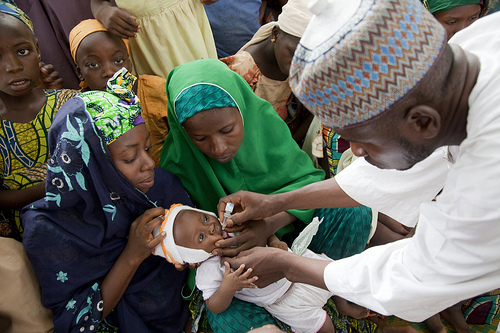
Polio immunisation in Nigeria. Photo credit: comminit.com

Malaw Zayyanu Muazu, WHO Accountability Officer, disclosed this in an interview with NAN on Sunday, November 11, 2018 hinting that the measure is to ensure proper accountability of vaccines.

Muazu explained that this was also to ensure that the viles cover the number of eligible children in the area.

“We are collecting all the used viles in order to curb diversion of vaccines in the local government.

“We have 11-man team posted to Dange Shuni Local Government Area to ensure accountability which will reveal if the eligible children are all immunised,” he said.

Muazu added that the number of viles received in the local government for Oral Polio Vaccines (OPV) are 3,090 while the Injectable Polio Vaccines (IPV) are 1,235.

NAN reports that a team coordinator in charge of polio immunization at Bangida Baga ward in Bodinga Local Government Area of Sokoto state was recently arrested over alleged diversion of oral and injectable vaccines.

The coordinator (name withheld) was said to have taken the vaccines meant for the ward in Bodinga to his personal residence.

The Executive Director of the state Primary Health Care Development Agency, Alhaji Adamu Romo, told NAN that the suspect was paid his dues for the exercise but wondered he betrayed the trust invested in him (coordinator).

“We gave him the vaccines, his allowance and all that he requires for the commencement of the exercise at the ward which he diverted to his personal residence,” Romo said.

The director said both the vaccines and the money have been recovered by the police from the suspect, assuring that they will follow the case to its logical conclusion.

He said that the agency had taken strict measures to forestall reoccurance.

By Hauwa Gold

Africities 8, in Marrakesh, explores sustainable cities’ transition

0

City dynamics and sustainable development will be tabled for discussion as the United Cities and Local Governments of Africa (UCLG Africa) holds the eighth edition of the Africities Summit (Africities 8) in Marrakesh, Morocco, from November 20 to 24, 2018.

marrakech
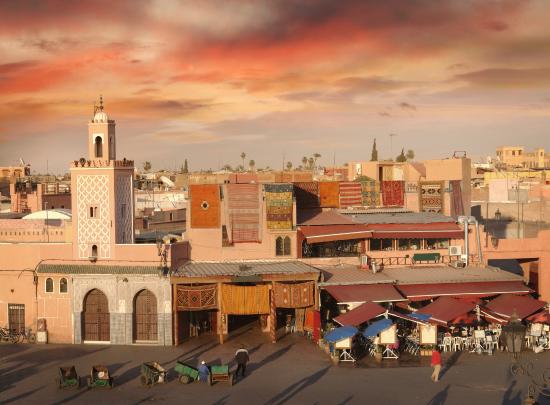
Marrakech, Morocco will host the Africities Summit (Africities 8)

The UCLG Africa, described as the Pan-African Organisation of Local, Regional and Sub-national Governments, is holding the event in collaboration with the Moroccan Association of Presidents of Communal Councils (AMPCC), with the support of the Ministry of the Interior of the Kingdom of Morocco.

The theme for Africities 8, considered the “largest democratic gathering on the continent”, is: “The transition towards sustainable cities and territories: The role of Local and Sub-national governments of Africa.”

According to UCLG Africa, Africities 8 will examine the challenges of Africa in a globalised and urbanised world, while highlighting the dimensions of transition from the current mutations to focus on the role and strategies African local and sub-national governments can adopt.

“The Africities Summits is Africa’s most important platform for dialogue on decentralisation, local governance, and the contribution of local and regional governments to Africa’s development and integration. Africities 8 in Marrakesh aims to link long-term thoughts of the future, to actions that need to be taken, in order to define the bifurcation of the cities and territories of Africa towards a path of sustainable development,” submits UCLG Africa.

In order to identify the mutations that define transition, Africities 8 adopts the following dimensions:

  • Demographic transition;
  • Ecological transition;
  • Democratic and political transition;
  • Political and democratic transition;
  • Economic and social transition;
  • Geopolitical transition; and
  • Cultural and communicational transition.

The challenge for African local authorities is to define and implement a new approach that encourages coalitions between institutions, populations and territories, notes the organisers, saying that the Summit will be attended by over 5,000 participants including ministers, governors, city mayors and other local elected officials, officials of central and local administrations, civil society organisations and NGOs, associations and trade unions, economic operators in the public and private sectors as well as representatives of the social and solidarity-based economy, traditional authorities, researchers and members of the academia, international cooperation agencies, associations of inhabitants, and other stakeholders.

The Africities Summit will also host the Africities International Exhibition, which will allow institutions, and businesses from both the public and private sectors, associations and other stakeholders, to present their experiences, products, methods and tools.

Buhari seeks Lake Chad intervention as NCF visits

0

President Muhammadu Buhari says his administration will continue to keep the issue of reviving the Lake Chad on the front burner and exert more commitment from the developed countries to do the needful.

NCF Buhari
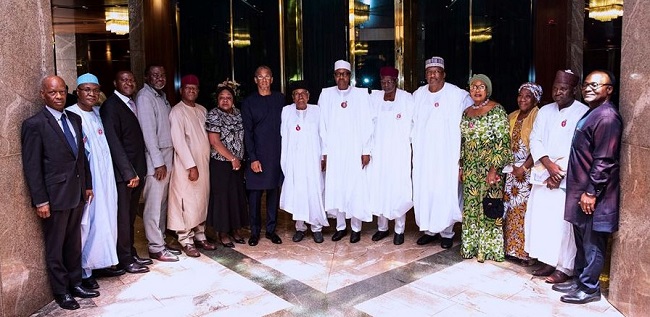
President Muhammadu Buhari with members of the NCF delegation during the visit to State House, Abuja. Photo credit: Sunday Aghaeze

Buhari gave the assurance when he received the Nigerian Conservation Foundation (NCF) and his investiture as Patron of the Foundation, at the State House, Abuja, on Friday, November 9, 2018.

The president said it was regrettable that the issue of the receding Lake Chad had not been addressed till recent times.

He said: ‘‘The problem of climate change is real. The desert encroachment is aggravating it. The population explosion in Nigeria is another big challenge.

‘‘The drying up of Lake Chad is a serious thing for Nigeria and the Lake Chad Basin countries. Nigeria is much more affected because fishing, animal husbandry and farming are affected very seriously.

‘‘We are trying to prick the conscience of the developed countries that have the resources and the technology to quickly execute the inter-basin transfer from Congo Basin to Chad Basin.’’

President Buhari also welcomed the advocacy by the Foundation on the need to protect endangered plants and animals in the country.

To this end, the President directed the Federal Ministry of Environment to reflect this in its budgetary requirements in the next fiscal year.

He added that ‘‘the rate at which animals are being hunted and eliminated around the country, we must seriously give the forest reserves our support and attention as much as we can’’.

Earlier in his remarks, Alhaji Ahmed Joda, Member, Board of Trustees of the NCF, told the President that the nation’s wildlife was fast becoming extinct.

He added that, for more than 10 years, the rate of deforestation in Nigeria had been one of the highest in the world with the country losing close to 95 per cent of its original forest cover.

Joda thanked the President for placing great emphasis on environmental issues, especially the aspect of climate change, and invited him to take charge of “Greening Nigeria”.

He said: ‘‘We are all proud of the role that the Nigerian delegation headed by Mr President played during the climate change agreement in Paris and your single-minded determination to keep the issue in the front burner both at home and abroad.

‘‘Your Government has also recorded remarkable achievements in addressing soil erosion with about 60 projects executed by the Ecological Funds all over Nigeria.

‘‘This is not surprising when we remember that it was you, in your first coming as Head of State, that signed the first comprehensive law that addressed the protection of endangered plants and animals in Nigeria through the ‘Endangered Species Decree of 1985’.’’

By Ismaila Chafe

Switzerland ratifies Kigali Amendment as 60th Party

0

Switzerland has ratified the Kigali Amendment to the Montreal Protocol. It is the 60th Party to the Amendment.

Doris Leuthard
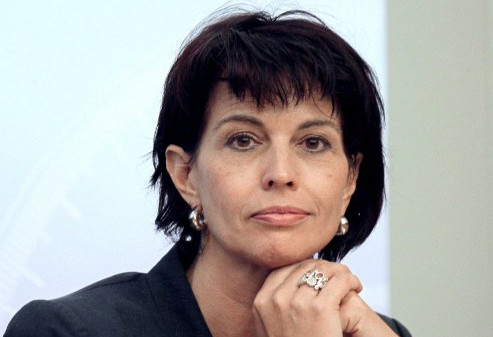
Doris Leuthard, President of Switzerland

The Kigali Amendment to the Montreal Protocol aims to bring about a global phasedown of hydrofluorocarbons (HFCs), which are powerful greenhouse gases.

HFCs, used mainly in refrigeration, air conditioning and heat pump equipment, are thousands of times more harmful to the climate than CO2. In response to the rapid growth of HFC emissions, the 197 parties to the Montreal Protocol adopted the Kigali Amendment in 2016 to reduce gradually their global production and consumption.

The Kigali Amendment was adopted by 197 parties meeting in the Rwandan capital on October 15, 2016. The amendment sees developed countries take the lead on phasing down HFCs, starting with a 10% reduction in 2019 and delivering an 85% cut in 2036 (compared to a 2011-2013 baseline).

Kigali has already reached the threshold to enter into force, having been ratified by the required 20 parties at the end of 2017.

“We encourage all Parties to the Montreal Protocol to take action on HFCs as soon as possible,” said Miguel Arias Cañete, the EU commissioner for climate action and energy. “Delivering on the Kigali commitments will play a vital role in our global efforts to tackle climate change, as well as driving innovation and creating new economic opportunities in the refrigeration and air conditioning sector.”

Global implementation of the Kigali Amendment would prevent up to 80 billion tonnes CO2 equivalent of emissions by 2050. This would make a significant contribution to the Paris Agreement objective of limiting the global temperature rise to well below 2°C.

Head of UN Environment, Erik Solheim, described the development as “absolutely critical to addressing climate change and rising temperatures around the world”.

“The Kigali Amendment to the Montreal Protocol can bring critical benefits to our planet by fighting global warming. The Kigali Amendment could avoid up to 0.50C of global warming by the end of the century while continuing to protect the ozone layer,” said the UN body.

The Kigali Amendment will enter into force on January 1, 2019.

Ebola outbreak in DRC conflict zone ‘remains dangerous, unpredictable’ – UN

0

The World Health Organisation (WHO) and the UN Organisation Stabilisation Mission in the Democratic Republic of the Congo (MONUSCO) say the Ebola outbreak in DRC remains dangerous and unpredictable.

Monusco
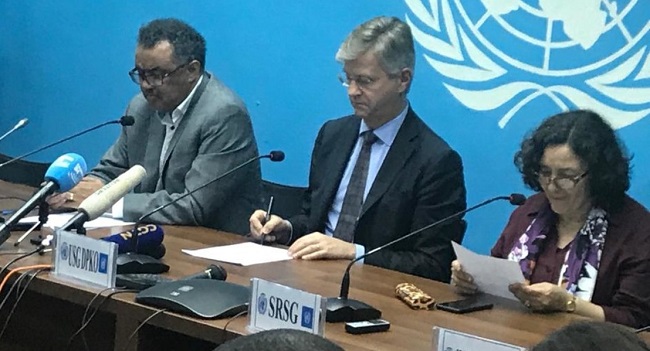
Director General of WHO, Tedros Ghebreyesus (left), with UN Peacekeeping chief, Jean-Pierre Lacroix

The Director General of WHO, Tedros Ghebreyesus, and UN Peacekeeping chief, Jean-Pierre Lacroix, sated this after a joint mission to the epicentre of the epidemic, around the city of Beni close to the Ugandan border,

Ghebreyesus and Lacroix saw conditions on the ground for themselves, along with Minister of Health Oly Kalenga, and they met local officials, health workers, civil society leaders, and peacekeepers.

The top UN officials, however, noted that new measures to tackle the Ebola outbreak in DRC were working.

Since the outbreak began in August, there have been 308 cases and 191 deaths, about half of which have been in Beni, which has a population of around 800,000.

The UN Stabilisation Mission in DRC, MONUSCO, said it has taken an active approach in recent weeks to quell armed group activity in the North Kivu area, and protect Beni from conflict.

“While this has contributed to a decline in new cases over the past two weeks, the situation remains of grave concern,” WHO said in a press statement.

Under the leadership of the Ministry of Health, WHO and partners are using community surveillance in areas which are difficult for outsiders to navigate, allowing workers to trace the contacts of anyone who has been infected.

“We are facing numerous complex challenges, but it’s encouraging and inspiring to see that our efforts to deliver as one UN, have been extremely successful in many hotspots and will help to end the outbreak and save lives,” Lacroix said.

The current epidemic, the country’s 10th, is on track to surpass the previous largest outbreak in 1976, which saw 318 cases in total, leading to 280 deaths, WHO said.

Since the outbreak began, MONUSCO said it assisted in the Ebola response by providing logistical support, office facilities, transportation, communication and with keeping staff safe, from security threats.

After decades of conflict, Ebola response teams have faced misinformation and mistrust from some local populations who are reluctant to allow vaccination programmes or follow rules for contact tracing and safe burials.

The WHO chief said: “The fact that we have so far prevented Ebola from spreading into neighbouring countries is a testament to the hard work and determination of staff from all partners.

“As complex and challenging as this outbreak is, I am confident that working together with the Ministry of Health, MONUSCO and all our partners, we can and will end it”.

Patients are being treated in six newly-build centres that are operated by the Ministry of Health and partners, with each supported by a mobile laboratory to rapidly diagnose cases and guide treatment.

“To date, 27,000 people have been vaccinated against Ebola, and almost every new patient receives one of four investigational treatments, something which was never previously possible during an Ebola outbreak,” WHO said.

The UN agency noted that despite the loss of life, 91 people have recovered and returned to their communities due to the hard work and joint efforts of national and international responders.

By Prudence Arobani

NOSDRA urged on idle oil installations ahead Ogoni cleanup

0

The Civil Society Legislative Advocacy Centre (CISLAC), a civil society organisation (CSO), has called for repair or removal of non-producing oil installations in the Niger Delta region.

CISLAC NOSDRA
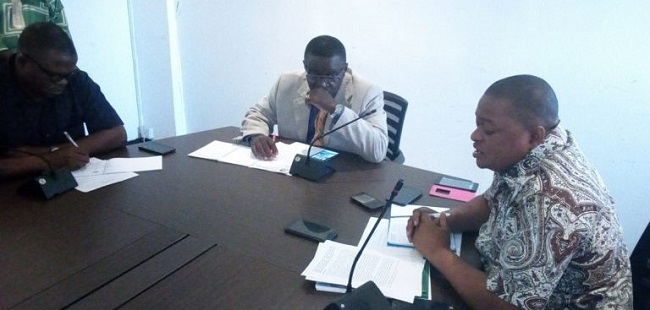
Director-General of NOSDRA, Mr Peter Idabor (middle), with the Senior Programme Officer of CISLAC, Mr Salaudeen Hashim (right), at the meeting

Executive Director of CISLAC, Malam Auwal Ibrahim, made the call during a courtesy visit to Mr Peter Idabor, the Director-General, National Oil Spill Detection and Response Agency (NOSDRA), in Abuja on Friday, November 9, 2018.

Represented by Mr Salaudeen Hashim, the Senior Programme Officer of the centre, Ibrahim said the repair or removal of idle oil facilities was key in any environmental remediation.

The appeal comes ahead of the commencement of the much-awaited cleanup of Ogoni land in December.

‘‘Oil assets in the area still have the tendency of repoluting the environment when they are not serviced or decommissioned.

‘‘So, we believe that we need to strengthen collaboration and coordination, among agencies of government, toward the realisation of a successful remediation, restoration and rehabilitation of Ogoni land,’’ he said.

Ibrahim also said that getting multinational oil companies to properly handle their facilities in the region was part of an advocacy partnership deal that CISLAC was seeking with NOSDRA.

The proposed partnership is aimed primarily to support implementation of the United Nations Environment Prgramme (UNEP) report on the Niger Delta.

Under the proposed collaboration, the group is asking NOSDRA to institutionalise regular interface between the oil corporations operating in the region and CSOs.

‘‘The objective is to strengthen collaboration and coordination among agencies of government toward the realisation of a successful remediation, restoration and rehabilitation of Ogoni.

‘‘Such forum would enable stakeholders to further review remediation techniques, where necessary, and appraise the performance of the emergency measures to see where gaps exist and the available alternatives.

‘‘It would also support regular and objective feedback on what is happening and what needs to be done toward creating a safe and healthy Ogoni in particular and the Niger Delta in general.

‘‘NOSDRA can do this under its mandate of striking partnership with internal and external stakeholders, including multinational oil companies, private interest, communities and civil society groups,’’ he said.

Responding, Idabor lauded CISLAC for the idea which he said was a commendable departure from the antagonistic disposition of most CSOs to government.

Idabor said NOSDRA was willing to partner with CISLAC, noting however that the agency’s role in the Ogoni cleanup was mainly regulatory.

He immediately directed his officials to raise a three-man team to liase with CISLAC to work out the proposed partnership deal.

The NOSDRA boss sought the assistance of CSO in producing database of abandoned installations in the Niger Delta to guide the anticipated engagement with the companies concerned for necessary action.

By Harrison Arubu

Group claims release of GM mosquitoes in Burkina Faso risky, unethical

0

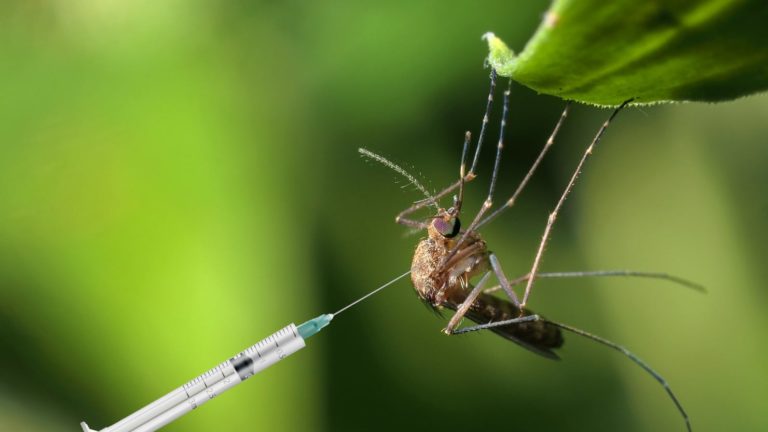
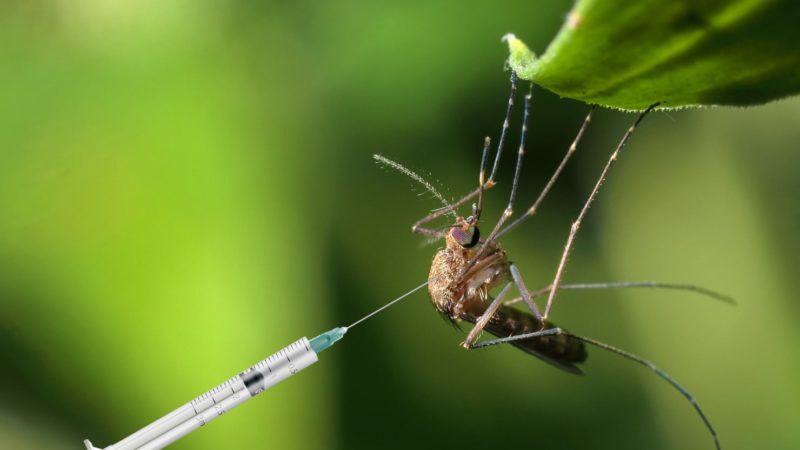
Genetically modified (GM) “male-sterile” mosquitoes are due to be released in the very near future, in Burkina Faso by the Target Malaria research consortium, the African Centre for Biodiversity (ACB) has disclosed.

Target Malaria acknowledges however that there are no benefits to the proposed GM mosquito release.

GM mosquitoes
The National Biosafety Agency of Burkina Faso is under pressure not to release sterile genetically modified male mosquitoes as planned

According to Mariam Mayet, Executive Director of the ACB, “There is absolutely no justification for releasing these GM mosquitoes. It is highly unethical and totally unacceptable to conduct experiments which carry risks, yet do not bring any benefit for malaria control in Burkina Faso.“

The application to make open releases of GM mosquitoes was reportedly approved by the National Biosafety Agency (Agence Nationale de Biosécurité, ANB) in Burkina Faso in September 2018 and, as a result, the first open releases of GM mosquitoes in Africa are planned for the coming year.

The open release is intended to test the infrastructure and systems for future release for, as yet, experimental technologies, notably “gene drive” mosquitoes. Target Malaria’s ultimate aim is to release gene drive mosquitoes, with the aim of reducing the population of Anopheles mosquitoes, which can transmit the parasite that causes malaria. The hope is that reducing the mosquito population will reduce the risk of malaria transmission and hence disease incidence.

However, the proposed release of GM “male-sterile” mosquitoes, meant to only be for training purposes, is not expected to deliver any benefits for malaria control in Burkina Faso. This is not an early stage trial for later releases of the gene drive mosquitoes, but releases of an entirely different GM mosquito.

Instead, the release of the GM mosquito poses risks, including the incidental release of some biting female GM mosquitoes during the experiments, according to the ACB. While Target Malaria claims that the number will be small, nevertheless, since GM female mosquitoes can bite humans and spread disease, the release of biting females still poses some risk to local people.

ACB claims it has evidence that Target Malaria is paying compensation of 400 CFA francs (approximately 70 US cents) per hour to local villagers to allow for the collection of biting female mosquitoes from their own bodies.

“The use of a financial incentive to individuals to expose themselves to biting female mosquitoes, and potentially to malaria, is also ethically extremely questionable,” said Dr. Helen Wallace, Director of GeneWatch UK.

There is no published environmental risk assessment (ERA), other than that published by Target Malaria and there has been no public consultation, apart from “public engagement” activities conducted by Target Malaria (the organisation proposing the releases). Any decision on open releases of GM mosquitoes requires meaningful public consultation, as mandated by the Cartagena Protocol on Biosafety, to which Burkina Faso is a Party, insists the ACB.

“The lack of a comprehensive, published ERA, which has been subject to a full public consultation, undermines the legitimacy and credibility of the reported approval of these experiments,” said Lim Li Ching, Senior Researcher from the Third World Network. “Without this, local people cannot be fully informed about the risks before making a decision on whether to accept them.”

According to scientists, malaria is a serious public health issue that disproportionately affects Africa.

“Instead of investing in risky GM technologies, what is needed is a more holistic approach to significantly and sustainably decrease the burden of malaria – one that integrates interventions and research on health, climate, agriculture (and eventually economics and housing) – in tackling the main factors contributing to the disease and its transmission,” said the ACB.

Ministers devise plan to fast-track action on health, environment

0

African ministers of health and environment have agreed on a 10-year strategic plan to increase investment and accelerate joint health and environment priorities.

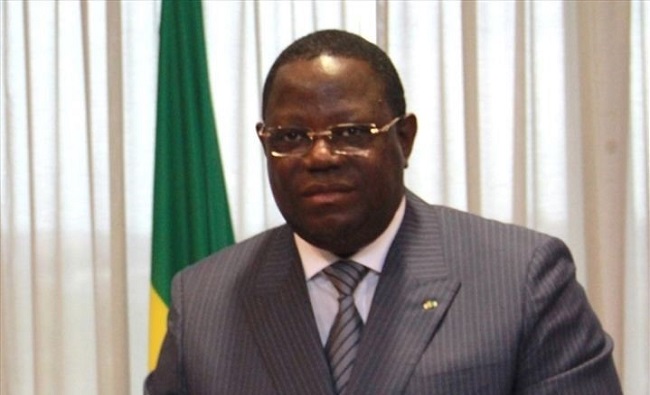
Franck Emmanuel Issoze-Ngondet
Prime Minister of Gabon, Franck Emmanuel Issoze-Ngondet

The “Strategic Action Plan to Scale Up Health and Environment Interventions in Africa 2019 – 2029 to the African Union” was adopted on Friday, November 9, 2018 at the closing of the Third Interministerial Conference on Health and Environment held in Libreville, the Gabonese capital, from November 6 to 9.

The Prime Minister of Gabon, Franck Emmanuel Issoze-Ngondet, said: “We must go further, particularly in terms of mobilising material and financial resources for the implementation of national plans, but also in terms of clarifying and sharing responsibilities.”

Nearly one in four premature deaths in Africa are linked to the environment and climate change threatens to increase the number of health emergencies and outbreaks in the coming years. African leaders have recognised the need for health and environment sectors to work together since the 2008 Libreville declaration and in 2010 the Luanda Declaration led to the creation of the Health and Environment Strategic Alliance, which is viewed as a pathmaker.

“The Health and Environment Strategic Alliance in Africa represents a powerful model of multisectoral partnership, which is exactly what we need to achieve the sustainable development goals,” said Dr Tedros Adhanom Ghebreyesus, WHO Director-General in a video message.

Ministers agreed to strengthen policy frameworks and institutional mechanisms for more integrated interventions as well as develop innovative platforms for funding, including more domestic resources allocated to joint actions on health and environment.

Rapid and unplanned urbanisation and industrialisation in Africa is increasing the risk of chronic diseases such as cancer, heart disease and stroke.

“We must act on air pollution, the biggest killer of humans that causes 7 million deaths annually on our planet. Governments, businesses and citizens are stepping up responses to pollution and environment degradation, but we need to do far more,” said Erik Solheim, Head of UN Environment Programme (UNEP).

“There are inspiring examples across Africa. We must take the opportunity to share best practices and learn from each other. We need urgent, large scale and coordinated actions. We need to scale-up government and private sector investments. Together we can beat pollution and improve the health of our citizens,” he added.

Supported by the WHO, UNEP and development partners, the action plan can positively change the course of sustainable development in Africa, it was gathered.

“A penny saved today in avoiding the prevention of ill health, is a pound spent tomorrow on rising hospital bills, lost work days, and cleanup costs,” said Dr Matshidiso Moeti, WHO’s Regional Director for Africa. “We need a new business model based on an integrated approach to programming and service delivery.”

The economic cost of premature deaths from air pollution is estimated at $450 billion. The economic loss due to the lack of access to safe drinking water and sanitation is estimated to be 5% of the region’s gross domestic product.

The return on investment in health and environment will have significant social and economic impact for Africa. For instance, the benefits from eliminating lead in gasoline on a global scale have been estimated at $2.45 trillion per year, saving an estimated one million premature deaths per year.

The Ministers at the conference called on the President of Gabon as host country to present the strategic action plan for endorsement by the African Union and the outcomes will provide invaluable inputs to the fourth session of the United Nations Environment Assembly to be held from March 11 to 15, 2019 in Nairobi, Kenya.

Senators laud biosafety agency’s GM lab

0

The Senate Committee on Environment has lauded the National Biosafety Management Agency (NBMA) over its modern state-of-the-art Genetic Modification (GM) Detection and Analysis Laboratory.

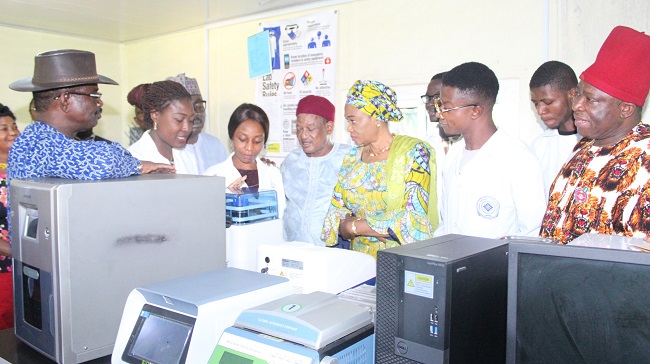
NBMA Senate
Officials of the NBMA briefing members of the Senate Committee on Environment during the visit

The senators made the commendation during an oversight visit to the agency in Abuja on Thursday, Nov. 8, 2018 while they were taken on a tour of the agency’s laboratory.

Chairman, Senate Committee on Environment, Senator Oluremi Tinubu, said that, in such a short time of establishment, the agency has achieved a lot in terms of equipment, personnel and performance.

Senator Tinubu, who said the committee came to ascertain the level of performance for the years 2017 and 2018 of the agency’s budget, also commended the Director General/CEO of the agency, Dr Rufus Ebegba, for achieving so much in a short time.

Dr Ebegba presented the 2017 and 2018 budget performance to the committee, noting that the essence of the GM detection and analysis laboratory is to ensure that no Genetically Modified Organism (GMO) is allowed into the country without proper verification and authorisation.

While presenting the budget, the DG/CEO said that, in 2017, about N243,734,400 was appropriated, about N170,806,235 was released and N170,806,235 was expended.

Dr Rufus said for 2018, about N258,069,920 was appropriated, N25,860,992 was released and about N25,851,051 has been expended so far.

The eight-man Committee promised to relate the progress and needs of the agency back to the National Assembly for onward action.

The DG/CEO thanked the Senate Committee on Environment for the encouragement during the visit.