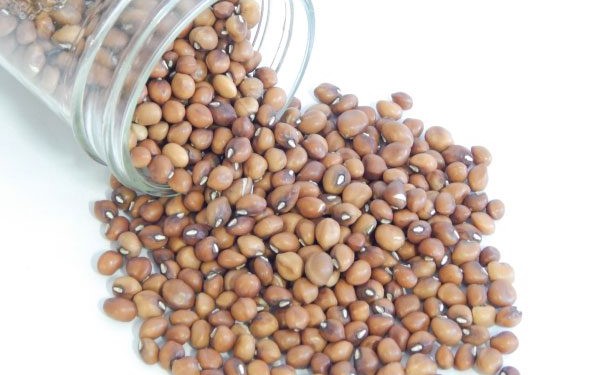
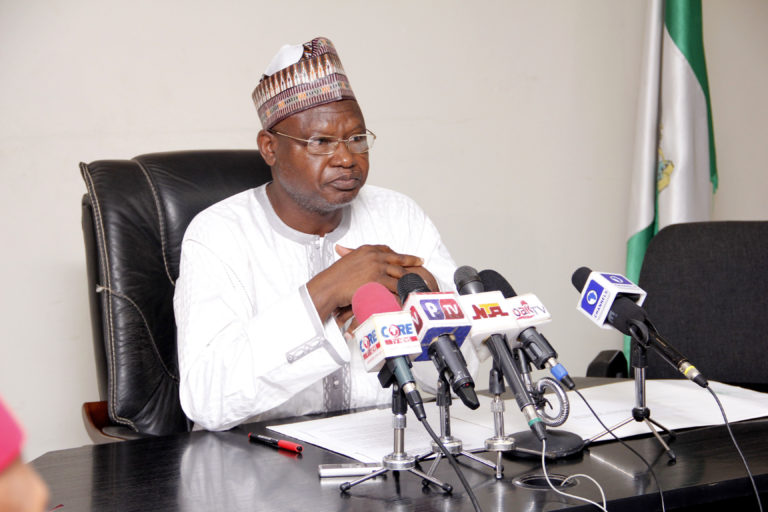
Country Coordinator of the Open Forum on Agricultural Biotechnology in Africa (OFAB), Mrs Rose Gidado, says Nigeria is ready to adopt bio-technology (BT) in boosting production of cowpea.
Cowpea
Gidado made this known in an interview with News Agency of Nigeria (NAN) in Abuja on Friday, December 7, 2018.
Bio-technology is a term adopted by an international convention to refer to techniques for the manipulation of genetic materials and the fusion of cells beyond normal breeding barriers.
According to Gidado, scientists developed the intervention called BT cowpea to help farmers due to huge percentage loss of yield to insects.
She explained that BT cowpea, which was developed via modern biotechnology, would tackle the insect called Maruca that destroyed cowpea yield.
She said: “The maruca pod borer feeds on every part of the cowpea plant, this occurs every season which results in yield losses through premature dropping of flowers.”
She noted that the BT cowpea, which built its own potential against the insect called maruca lava, was, however, not dangerous to humans.
She noted that “work on BT cowpea has been completed and confining trials have been carried out. Due process was followed for the past nine years.
“Data has been generated, multi-location trials and farm trials by some selected farmers have also been observed.
“Farm trials means some farmers were given the crops. They actually planted the BT beans along their own local varieties for two years and recorded huge difference.
“The gene in the BT cowpea is for insect resistant. Once you plant beans and it gets to the stage of flowering, the maruca at its lava stage feed on the flowers and seed formation, causing great loss to farmers.
“The farmers suffer loss, they lose up to 80 per cent of their yield,” she said.
On the BT Cotton recently launched by the Minister of Science and Technology, Dr Ogbonaya Onu, she said farmers would soon experience high yield of cotton through enhanced protection from insects/pests and diseases.
Gidado said that the BT cotton, which matured earlier than the conventional one, had increased intolerance to heat, drought, environmental stress, and significant reduction in the use of pesticides.
“The benefits of BT cotton to consumer include extra income for the family, healthier oil, increased protein and good textile materials.
“BT cotton helps to reduce agriculture’s negative impact on land, conserves soil and energy, reduces greenhouse gases, thereby mitigating the effects of global warming, minimises use of toxic herbicides and conserves soil fertility and natural resources.”
OFAB is an informative platform which brings together stakeholders in the field of biotechnology and the public as a whole to facilitate interactions.
The organisation also promotes the sharing and exchange of knowledge, experiences, contacts and explores news avenues to bring the benefits of biotechnology to agricultural sector.
OFAB is an initiative of the African Agricultural Technology Foundation (AATF), Nairobi.
In Nigeria, the National Biotechnology Development Agency (NABDA) is the host organisation of OFAB, while the Agricultural Research Council of Nigeria (ARCN) is the co-host.
Chinese scientists have designed a new biodegradable and bioactive material that can enhance wound-healing and skin regeneration.
Skin regeneration
It is difficult for skin wounds to completely heal in cases of large-area burns, severe microbial infections and diabetes.
Chronic wounds greatly increase the pain and medical costs of patients. There is, therefore, a great need for biomedical materials that can facilitate wound-healing and efficient anti-infection capacities.
Researchers with Xi’an Jiaotong University in northwest China’s Shaanxi Province have designed a kind of biomimetic antibacterial material that can facilitate skin regeneration.
It has skin-like elasticity and good biocompatibility and can help prevent multidrug-resistant bacterial infection.
In experiments conducted on mice, the material enhanced the wound-healing and regeneration of skin appendages such as hair follicles, and finally lead to skin tissue regeneration.
The designed biomaterial could become a competitive multifunctional dressing for bacteria-infected wound-healing and skin regeneration.
The research provides a new strategy for the design of biomedical materials for regenerative medicines.
Nigeria has lauded the international support to the country and neighbouring countries in addressing the challenges caused by the Boko Haram terrorists and the shrinking of the Lake Chad.
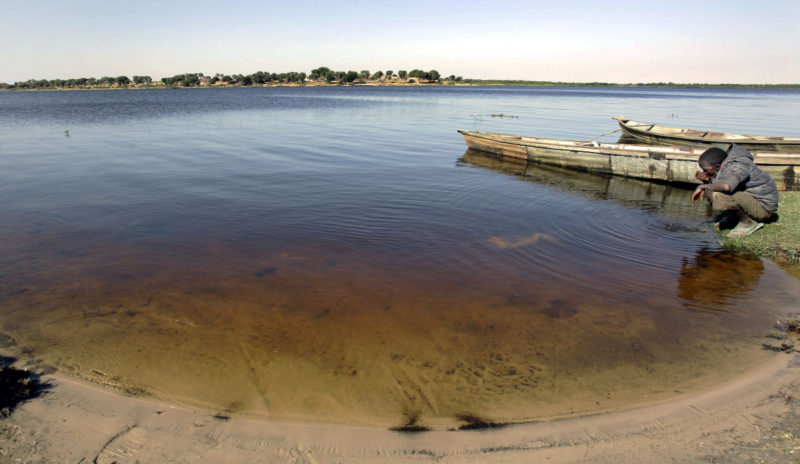
Scientists say the Lake Chad, that borders Nigeria and some other countries, has shrunken by 95 percent over the past 50 years. They have also linked the Boko Haram insurgency to the lake’s situation. Photo credit: AP/Christophe Ena
Nigeria’s Ambassador and Permanent Representative to the UN, Prof. Tijjani Bande, stated this in New York at the Security Council Open Debate on the Role of States, Regional Arrangements and the United Nations in the Prevention and Resolution of Conflict.
Bande said: “As we all know, the Lake Chad region has been facing its worst crisis ever, primarily because of the impact of climate change.
“However, the ability of the Lake Chad basin countries to obtain international support and attention is paying off.
“An array of countries – Norway, Germany, UK, U. S., China, Canada and others – have joined the UN to provide financial and technical support to the on-going efforts to not only conquer Boko Haram, but also work at the same time across the whole pillars, as the only way forward.
“Indeed, so successful has this been, since the visit by the Security Council in March 2017, and the various pledging conferences – Abuja, Oslo and Berlin – that we are even talking of recharging of the basin, to restore and or stabilise the livelihood of some 45 million people affected by this unfortunate situation.
“Through it all, ECOWAS, AU and the UN have been working very well together to galvanise support, towards the same end”.
Bande pledged Nigeria’s resolve to continue to support efforts at maintaining peace and security in all regions of the world.
According to him, more than ever, there is the need to strengthen collaboration between the UN and the various regional and sub-regional organisations around the world.
The need to ensure that effective and mutually reinforcing mechanisms (both regional and global) that are flexible and responsive enough to ensure peaceful coexistence among communities are prioritised, he said, were critical.
Bande said it was imperative to ensure that a means of financing regional bodies-led peace support operations that were authorised by the Security Council would be predictably and sustainably worked out.
“We owe this to the millions that suffer and are waiting for our help.
“In this regard, I wish to commend the Secretary-General on the current AU-UN partnership on peacekeeping, as this is a right step in the right direction,” he said.
The envoy said in the effort to prevent and resolve conflicts, there is the need to also take due cognisance of the structural challenges to peace and security.
These challenges, like climate change, mismanagement of natural resources, cross border and international crime, are at the root of some of the worst conflicts of our time, he said.
The Nigerian envoy added that the challenges are best tackled through a broad collaboration among States, sub-regional and regional organisations and the UN.
According to the UN, nine years into the conflict, the humanitarian emergency in the Lake Chad region is among the most severe in the world.
The world body says while the crisis is unfolding in a region already affected by severe underdevelopment, poverty and climate change.
The impact on the lives of around 17 million people is devastating, with women, youth and children bearing the brunt.
In 2018, more than 10 million people require humanitarian assistance and protection.
The humanitarian response was expanded significantly in 2017, reaching over six million people with life-saving assistance and protection, and effectively averting a famine.
But needs in the affected regions remain acute and will persist at large scale into 2019 and beyond. Humanitarian organisations are requesting 1.6 billion dollars for 2018.
Support from the international community to national efforts will be essential in the coming months to ease hunger, provide water, shelter, hygiene, healthcare, protection and education, and help communities rebuild their lives and livelihoods.
The UN also said without continued assistance, hard hit communities risk sliding back into distress.
Minister of State for Environment, Alhaji Ibrahim Usman Jibril, has been selected as the 13th Emir of Nasarawa emirate in Nasarawa State.
Environment Minister of State, Ibrahim Usman Jibril
The emergence of Jibril as the new emir followed the death of Alhaji Hassan Abubakar II, the 12th emir, who died earlier in Novembber after a brief illness.
The appointment was announced by the commissioner for Local Government and Chieftaincy Affairs in the state, Mr Haruna Osegba, on Thursday, November 6, 2018 in Lafia, the state capital.
He said Gov. Umaru Al-Makura had already approved the selection of Jibril as the successor to late Abubakar 11.
The new Nasarawa emir has over 30 years of working experience, 25 of which were spent as a Land Officer in the administration of the Federal Capital Territory, Abuja.
Jibril is a land reform specialist, a former Deputy Director, Development Control Abuja, and has worked with more than five FCT Ministers.
He was once the Director of Land Administration Department of the FCT.
He was a seasoned technocrat with specialisation in urban renewal, spatial data management and land information system, Nasarawa Geographic Information System (NAGIS) where he became known as the “NAGIS’s Brain Box.”
Termed as a workaholic, strict disciplinarian, experienced and a corrupt-free technocrat by his colleagues and those whom have worked with him, Ibrahim holds the highly ranked traditional title of – Wamban Nasarawa.
Osegba said the governor has met with traditional rulers to ratify the decision of kingmakers from the emirate.
He disclosed that the meeting also ratified the selection of Mr Lawrence Sylvester Ayih, as the new “Abaga Toni” of Toni kingdom to succeed his late father, Dr Sylvester Oho Ayih, who died in September 2017.
The commissioner said the governor was satisfied with the choices of the kingmakers and commended their maturity during the selection process.
He also congratulated the new first-class chiefs for ascending the throne of their forefathers and wished them a happy and prosperous reign in their chiefdoms.
Since its issuance in 1991 by the Department of Petroleum Resources (DPR) in the Ministry of Petroleum Resources, the Environmental Guidelines and Standards for the Petroleum Industry in Nigeria (EGASPIN) has remained an imperative document in the Nigerian oil and gas sector.
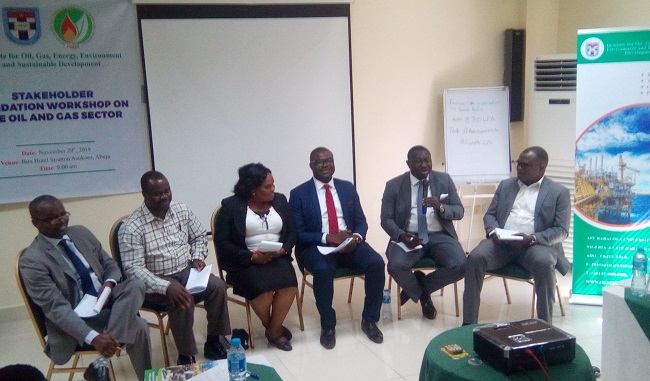
L-R: Bashir Mohammed Bello (General Manager, Business and Government Relations, Shell), Chima Williams (legal practitioner and activist), Dr Florence Masajuwa (Dean, Faculty of Law, Edo State University, Iyamho), Prof. Damilola Olawuyi (Director, OGEES Institute), Dr Abdul Karima Kana (Attorney General and Commissioner for Justice, Nasarawa State), and Oladipo Obanewa (National Oil Spill Detection and Response Agency), at an experience sharing session during the validation workshop in Abuja
EGASPIN outlines environmental and safety standards that must be complied with by oil operators in the country to prevent, minimise and control pollution from the various aspects of petroleum operations. In line with the DPR’s resolve periodically update the publication “as new knowledge becomes available”, EGASPIN was revised and updated in 2002.
Sixteen years later in 2018, the Institute for Oil, Gas, Energy, Environment and Sustainable Development (OGEES Institute) of the Afe Babalola University, Ado Ekiti in Ekiti State, appears to have revisited the much-vaunted document, in an apparent bid to determine its alignment with international best practices.
OGEES Institute, which has been undertaking a comprehensive review of the regulatory framework for environmental protection in the Nigerian oil and gas sector, embarked on a study in this regard. The findings by the institute’s research team on the project were the subject of discussion by a gathering of stakeholders at a validation workshop that held in Abuja on Thursday, November 29, 2018.
“Given the significance of EGASPIN to enhancing environmental sustainability and good governance in the Nigerian oil sector, it is pertinent to review and assess various aspects of the document in the light of the current knowledge and advancements in international best practices, laws, governance methodologies and pollution control technologies,” said Prof. Damilola Olawuyi, Director, OGEES Institute.
He listed the objectives of the study to include:
Reviewing and evaluating EGASPIN to determine its alignment with international best practice on environmental protection, especially during approval, operations and decommissioning phases of the oil and gas sector value chain;
Identifying existing gaps; and,
Providing recommendations and improvements that would increase its effectiveness.
Authored by Prof. Olawuyi and Dr Zibima Tubodenyefa (of the Niger Delta University), the study, among others, compared EGASPIN with the environmental regulation and processes in the comparator countries with respect to stringency, transparency and compliance.
International best practice on stringency, transparency and compliance, it was gathered, were drawn looking at three stages in the life cycle of an oil and gas project: approval of the project, construction and operations, and closure or decommissioning.
“This report and its recommendations aim to help stakeholders in the Nigerian oil and gas industry, especially the DPR, to improve EGASPIN’s contribution to achieving efficient, safe, orderly and environmentally responsible development of Nigeria’s oil and gas resources,” stated Dr. Tubodenyefa.
Participants at the recently held National Environmental Congress (NEC) by Environmental Rights Action/Friends of the Earth Nigeria (ERA/FoEN) have collectively developed a template for the Federal Government of Nigeria to follow if energy democracy must be realised in the country.
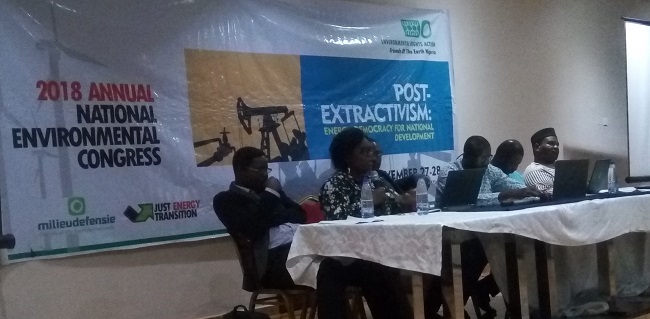
Delegates at the opening of the Environmental Rights Action / Friends of the Earth Nigeria (ERA/FoEN) 11th Annual National Environment Congress in Port harcourt, Rivers State
The NEC, themed: “Post-Extractivism: Energy Democracy for National Development”, was a convergence of civil society, community groups, youths, government officials, labour unions, the academia, and the media. The presentations and conversations highlighted the possibilities of life after oil in Nigeria and the urgent need for that energy transition.
At the close of the Congress, which is the organisation’s 11th edition, a communique issued reflected a collective agreement by participants providing a template for relevant Ministry, Departments, and Agencies of the Federal Government of Nigeria.
The communique reads:
The Nigerian government prioritises national and community energy needs over global economic models that largely promote inequalities.
The Nigerian government promotes decentralised alternative energy with a focus on renewable energy which must be clean, affordable for local communities, off and mini-grids, environment-friendly.
Zero tariffs are imposed on renewable energy products to allow greater energy access.
Nigerian government and governments on the African continent prohibit the importation of obsolete vehicles and machines as well as a ban on generator sets in all MDAs at the federal, state and local government levels.
Nigerian government establishes clear and appropriate institutional infrastructure and frameworks to support expanding energy supply and access and their sustainability. Sustainable energy policies must be harmonised and integrated with development at all levels.
A renewable energy development model that is backed by an Act of Parliament.
The World Bank, the Nigerian government and financial institutions divest funding, loans, and subsidies from fossil fuel development and oil prospecting and instead invest in renewable sources of energy.
Nigerian government show more commitment to its much-touted transition from fossils by allocating a reasonable percentage of its annual budget to funding for research and development of alternative energy sources such as solar, wind, and biomass, among others.
A substantial percent of the Ecological fund be used to fund renewable energy projects.
Renewable energy as a course of study should be included in school curriculum.
The polluters-pay principle to be applied to fossil fuels corporations.
The media deepen understanding of energy issues as well as the struggles against environmental and climate injustices.
The Congress held in Port Harcourt, Rivers State from November 27 to 28, 2018.
Just days before the conference began in Katowice, the COP Presidency announced that a number of the meeting’s corporate sponsors would be from the coal, gas and fossil fuel financing industries.
Climate justice groups including Corporate Accountability and Friends of the Earth International warned that the fossil fuel industry’s overbearing presence through trade and other groups was undermining the talks and promoting false solutions to the climate crisis.
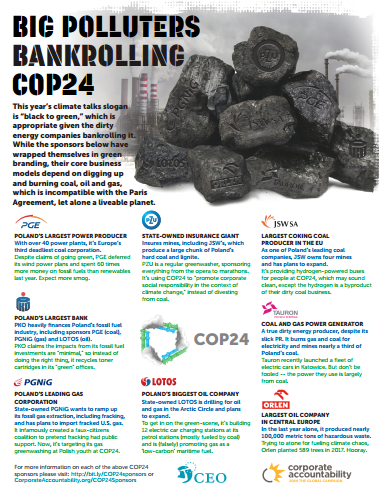
The infographics noted that the slogan for the climate talks – Black to Green – effectively captures the fact that Big Polluter sponsors have wrapped themselves in green branding while their core business digs up and burns coal, oil and gas, which is incompatible with the Paris Agreement and a liveable planet.
Sriram Madhusoodanan, deputy campaigns director at Corporate Accountability, said: “The fact that the negotiations charged with solving the global climate crisis are being bankrolled by Big Coal is absolutely unacceptable. Big Polluter sponsors like JSW are not only able to use sponsorship to greenwash their images, but also sponsorship will likely buy them access to the talks themselves – a massive conflict of interest. It’s like a gun control policy meeting being paid for by the National Rifle Association. Or public health talks bankrolled by Big Tobacco.
“Such sponsorship raises serious questions about what access and influence sponsorship buys and could risk calling into question the legitimacy of these talks before they even begin. Big Polluters have no place bankrolling or participating in the UN climate talks. Period.
“It is precisely for this reason that a global movement has issued the People’s Demands and specifically called for governments to protect the talks from Big Polluter interference.”
Akinbode Oluwafemi of the Environmental Rights Action/Friends of the Earth Nigeria said: “The fact that the corporate sponsors of the talks are from the same polluting industry responsible for the climate crisis, leaves room for doubt on the directions the talks will go. The People’s Demands are explicit on the need to exclude Big Polluters from the discussions. No other way will lead to pro-people outcomes.”
The infographics list eight companies that are sponsoring the COP24. They are Tauron Polska Energia S.A – Poland’s second biggest electricity generator and supplier from coal and gas, JSW – one of the largest tar producers in Europe, Polska Grupa Energetyczna – the largest energy sector company, and PZU – the lead insurer of the Polish coal sector.
Others are PKO Bank – one of the largest fossil fuels financier, PGNiG – leading gas corporation. Grupa LOTOS S.A – which is into extraction and processing of crude oil, and PKN Orden – the largest oil conglomerate and petrol retailer in Poland.
In the light of the ongoing 24th Session of the Conference of the Parties (COP24) to the United Nations Framework Convention on Climate Change (UNFCCC) in Katowice, Poland, Garba Shehu, Senior Special Assistant to President Muhammadu Buhari on Media and Publicity, attempts an overview of Mr President’s presence at the global summit, even as he sheds some light on the leader’s ideologies on the topic of discussion
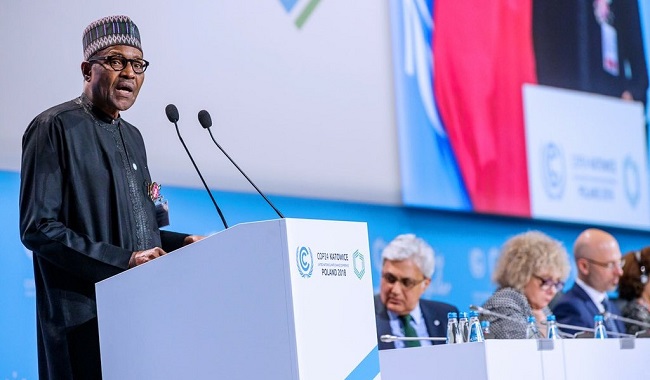
President Muhammadu Buhari delivering an address to the opening session of United Nations Climate Change Conference in Katowice, Poland
This year’s annual conference of the Parties to the UN Framework Convention on Climate Change (UNFCCC) is currently taking place in Katowice, Poland. It opened on December 2nd and will run until the 14th.
There are about 22,000 delegates from 200 countries at the conference, including President Muhammadu Buhari who joined other world leaders for the high-level meeting on December 2 and 3.
As an aside, the choice of Katowice by the Polish hosts of the conference is a deliberate one, aimed at bringing home the lessons of the devastation caused by climate to the global environment.
Katowice is the coal mining and steel making stronghold of the country. Coal powers 80 per cent of Poland’s electricity, on account of which Katowice is the 36th of Europe’s 50 most polluted cities.
Smog, manifesting air pollution can get so bad that it would sometimes be difficult to breathe.
It’s perhaps on account to avoid the air that many delegations chose to stay in Kraków, a distance of 80.4 km (some one hour-drive) from Katowice, for their residency while attending the conference.
Beyond this, there is everything positive to say about infrastructure in both cities, much of it put in place during the communist era, attesting to claims that in some ways, communism did work for the people.
Tagged “COP24” in UN parlance, this meeting had the objective of drawing up final rules and guidelines for the implementation of the Paris Agreement on Climate Change. When it is agreed to, it will enable the Agreement to be put into practice all around the world.
The Paris Agreement was adopted in December 2015. The global action plan set out in Paris is to put the world on track to avoid dangerous climate change by limiting global warming to well below 2°C above pre-industrial levels, and pursuing efforts to limit the temperature rise to 1.5°C.
The agreement came into effect on November 4, 2016 and has since been signed by nearly 200 counties including Nigeria.
Signatories also include the United States, Australia and Argentina, three countries that are now reversing their acceptance of the terms of the agreement.
In the specific case of Donald Trump’s America, he doesn’t even believe that global warming has a connection with carbon emissions, a sin visited on the world by rich, industrial nations led by America.
This year’s climate conference came at a time of growing concern about the deteriorating global climate situation. It has been determined that in carbon dioxide levels, the year 2017 was the highest they have been in 3-5 million years.
According to the National Agency for Space Administration, NASA, 2017 was the second-hottest year globally since 1880; the Arctic was warming twice as fast as anywhere else on earth in 2017 and sea levels are rising at the fastest recorded rate in 2,000 years.
As enunciated by President Buhari in his speech at Katowice, the consequences of this are seen in the rising global temperatures, erratic rainfall, sand storms, desertification, floods, cold waves, low agricultural yields and drying up of water bodies.
“It is no surprise that the effects are felt more on the vulnerable communities that lack the capacity and technology to properly address such challenges,” he said.
In that speech, President Buhari made it clear that we in Africa contributed little, if any to the climate change menace but were suffering its consequences.
He graphically cited the case of the Lake Chad, down from 25,000 square kilometres to 2,500 sq. km, ten per cent only of its established size and with that, jeopardising the livelihoods of 40 million inhabitants of the basin found in Nigeria, Niger, Chad and Cameroon.
The consequences of these on the ecosystems are extreme poverty, the displacement of people, and support for banditry and terrorism.
In calling for international support to recharge Lake Chad with waters from the Congo Basin in Central Africa, President Buhari made clear that Nigeria remains committed to saving the Lake from possible extinction.
In search for solutions, he revealed that an International Conference held earlier in February this year in Abuja has helped in creating additional awareness globally on the serious environmental and security challenges facing the Lake Chad region.
Furthermore, he said, “A consensus was reached at the said Conference to the effect that an inter basin water transfer from the Congo Basin remains the most sustainable option available to resuscitate and safeguard this precious water body that was once the 6th largest fresh water Lake in the world.”
The President also did his duty of projecting Nigeria as a responsible nation-state, playing by international rules, taking upon herself the ambitious “Nationally Determined Contributions” targeted to reduce its greenhouse gas emissions up to 20 per cent by 2030 and, given international support, by 45 per cent in 20 years.
It is clear that the Nigerian leader has cast himself in the role of an activist and global environmental champion to the admiration of many including Antonio Guterres, the UN Secretary General.
His support for the Paris Agreement is unmistakable, partly on account of his view of it as a vehicle for the remission of past ills visited on the environment that led to the consequences of climate change imposed on Nigeria and other African countries.
He sees the risks to our farmers who are involved in frequent deadly attacks against each other with herders; he is concerned about rising oceans that threaten our communities along the thousands of kilometres of coastline; he knows first-hand, the damage from the desert encroachment, forcing millions of our citizens into climate migration.
His determination to make a difference is driven by a strong sense of mission, to do something about the dangers now or confront a bigger calamity in the years to come.
He has an interesting narrative from the Magazine, National Geographic he read about 40 years back, in which a report was made of a research by a UK scholar around 1925 warning as at that time that Lake Chad needed an infusion of waters from the Congo Basin or else it would dry up.
Because nothing was done to forestall this, Lake Chad is today 10 per cent of its original size and, receding even more.
For him, therefore, the adoption “of a strong Paris work programme, with clear provisions on all key issues including transparency, finance, mitigation and adaptation,” is a key priority as it is for the European Union and other countries.
When it comes to the assumption of responsibility for the work that needs to be done and who pays for it, President Buhari as do many other activist-leaders, hold the view that since the developed countries have been the major polluters over the years, and they are not in any way denying that, they should assume a greater role in fighting global warming.
One of these ways includes the Green Climate Fund established by the Paris Agreement into which they would make an annual payment of USD 100 billion to help lift up the less developed countries suffering the consequences of climate change. President Buhari said African countries must draw from this fund for the restoration efforts to make the needed impact.
For us in Nigeria however, the President made it clear that we are not resting on our oars, waiting for manna to fall from heaven, but rather promoting technologies and practices such as sustainable land management, climate resilient agriculture, water efficiency and clean energy.
“We have also developed insurance-based initiatives to deal with losses and damage, as well as adaptation to internally acceptable practices,” he told the UN Climate Change Conference in Katowice.
Some of the specifics in this regard include: the determined efforts to end gas flaring in the Niger Delta, ahead of the stated schedule; provision of solar power up to 13,000 megawatts; efficient energy through mass transit and reduction of cars and the improvement of the electricity grid system.
The President also mentioned the successful take-off in the Nigerian Stock Exchange of the green climate bonds to help us fund renewable energy and reduce carbon emissions.
The Nigerian Government, President Buhari also announced, has specifically developed Sectoral Implementation Plans (SIPs) in five priority sectors namely: Oil and Gas; Agriculture and Land Use; Transport; Industry; Energy and Power.
These steps as choreographed by President Buhari, had the effect of presenting Nigeria as a nation acting responsibly within the global community. If every country would do their part in a responsible way as we are doing, the world would have been saved, in 2017 alone, of disasters triggered by weather and climate-related hazards to the cost of $320 billion.
The UN says these economic losses will increase and will have a bigger impact on the lives and livelihoods of the poorest and most vulnerable, and that by the year 2030, climate impacts could push an additional 100 million people into poverty.
The statistics also show that by 2050, as many as 143 million people could become climate migrants in just three regions (sub-Saharan Africa, South Asia and Latin America), with individuals, families and even whole communities forced to seek more viable and less vulnerable places to live.
Beyond his very engaging participation in the conference, the President used his presence in Poland to advance the country’s international relations by holding separate bilateral meetings with the President and Prime Minister of Poland, both of whom talked about their investment plans for Nigeria; the President of Austria who expressed a strong support for the recharging of Lake Chad; the Prime Minister of the Netherlands with whom the Nigerian leader discussed matters of investment, the reform of our livestock and farm agriculture; and the President of Switzerland whose country had done so much, and is expected to do more in helping us to secure the release of the remaining Chibok girls and other hostages seized by Boko Haram.
As he did in every country he visited, President Buhari met the Nigerian community who asked so many questions including the one on his alleged cloning, a question he considered laughable and dismissed as incredible.
When, at the end of the interaction they asked him, “What do you want us as Nigerian citizens to do for you?” The President answered to a thunderous ovation: “Vote for me!”
In a mark of international statesmanship, President Buhari ended his engagements in Poland with a visit to Auschwitz, described as the largest concentration camp established by the Nazi regime in pursuit of the “Final Solution.”
One million and three hundred thousand (1.3m) people, 90 per cent of them Jews were exterminated mostly in gas chambers by the Nazi occupiers during World War II.
His visit has been marked as a gesture to the global and domestic audiences.
In solemnity, President Buhari entered some of the detention camps, the execution wall and walked through the remaining gas chamber still standing in the camps.
He laid a wreath in honour of the dead and signed the condolence register in which he wrote, quoting Shakespeare that the “evil that men do lives after them…”
Auschwitz-Birkenau had a sobering effect on President Buhari as well as members of his delegation that included the Governors of Enugu, Kogi and Niger states
The visit showed the essential Buhari to the world: Kind, gracious and considerate, a leader who at every given opportunity pledged commitment to complete freedom of faith, but one who, ironically, is questioned in his motives by people he dismissed as “illiterates and ignorant.”
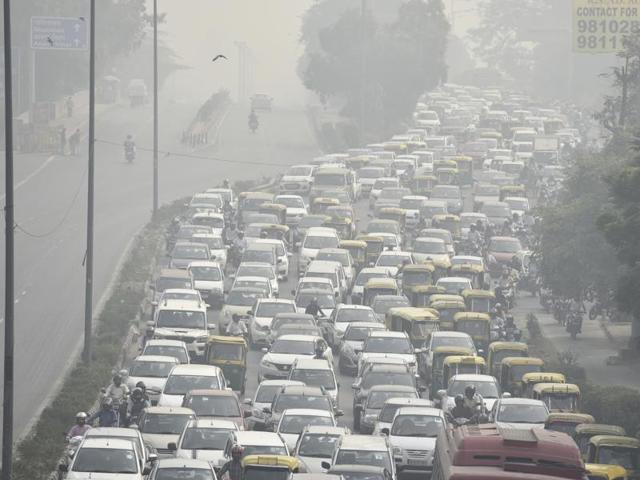
India’s toxic air claimed 1.24 million lives in 2017, or 12.5 per cent of total deaths recorded that year, according to a study published in the Lancet Planetary Health on Thursday, December 6, 2018.
As Delhi’s pollution levels rise to severe, the EPCA has directed governments to impose all conditions under the Graded Response Action Plan under severe category
More than 51 per cent of the people who died because of air pollution were younger than 70, said the study conducted by academics and scientists from various institutions in India and around the world.
It was funded by the Bill & Melinda Gates Foundation, the Indian government and the Indian Council of Medical Research.
Of the total, about 670,000 died from air pollution in the wider environment and 480,000 from household pollution related to the use of solid cooking fuels.
The Indian capital, New Delhi, was most exposed to the tiny particulate matter, known as PM 2.5, that can reach deep into the lungs and cause major health problems, the study concluded. Some Northern states closer to Delhi were almost as bad.
“The findings of this study suggest that the impact of air pollution on deaths and life expectancy in India might be lower than previously estimated, but this impact is still quite substantial,” the study said.
Delhi’s air was “very poor” on Thursday, according to a federal pollution agency. The city’s quality of air has swung between “severe” to “hazardous” levels multiple times in the past two months.
The city residents’ apparent lack of concern about the toxic air – whether through ignorance, apathy or the impact of poverty – gives federal and local politicians the cover they need for failing to vigorously address the problem, pollution activists, social scientists and political experts have said.
Earlier this year, the World Health Organisation said India was home to the world’s 14 most polluted cities.
Average life expectancy in India in 2017 would have been higher by 1.7 years if air quality was at healthy levels, the report said.
That isn’t as gloomy as some other recent studies. For example, the University of Chicago’s report released last month said prolonged exposure to pollution reduces the life expectancy of an Indian citizen by over four years.
Still, the new study shows India has a higher proportion of global health loss due to air pollution – at 26.2 per cent of the world’s total when measured in deaths and disability – than its 18.1 per cent share of the world’s population.
The United Nations Human Settlements Programme (UN-Habitat) has donated 50 public toilets to the Kogi State Government.
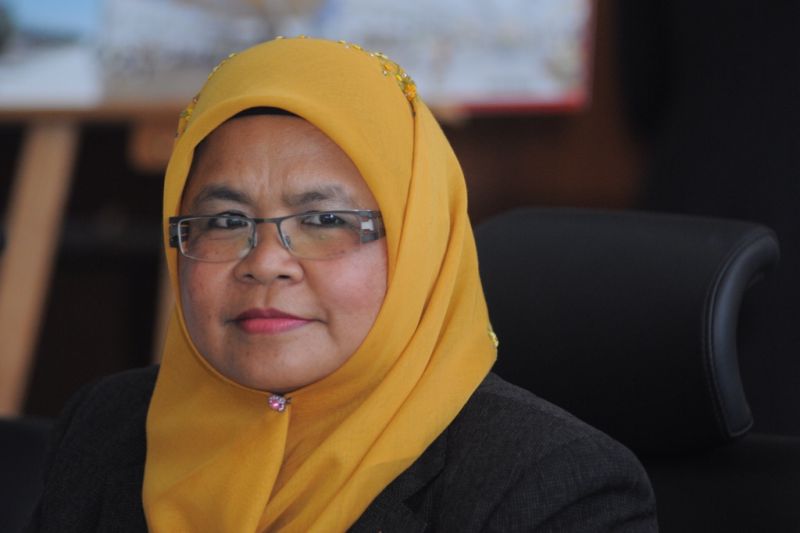
Maimuna Moh’d Sharif, Executive Director of the United Nations Human Settlements Programme (UN-Habitat)
Director of Sanitation in the Ministry of Environment, Mr Aaron Zakari, disclosed this on Thursday, December 6, 2018 in Lokoja, the state capital, during a town hall meeting organised by the Justice, Development and Peace Development Commission (JDPC).
Zakari, who said that the donation was made early this year, said that five of the toilets had reached different completion stages and would be ready for use early next year.
He said that construction work on 15 of the toilets would begin in March 2019, saying that UN-Habitat had decided that the toilets will be built in phases.
The Director said that the ministry would ensure that the public toilets were sited in strategic locations across the state’s three senatorial districts.
According to him, 19 of the public toilets were built in different parts of Lokoja by non-governmental organisations and public spirited individuals.
The Director, however, said that lack of water and other accessories had made it impossible for government to inaugurate the toilets for public use.
Zakari said that the state government was planning to provide boreholes for each of the toilet early next year.
The JDPC is implementing a project on increasing citizens’ participation in inclusive governance for improved water, sanitation and hygiene practice in 13 communities in Kogi State.
On sanitation, Zakari said that the dump site at Felele area of Lokoja would be relocated within the next 90 days.
He said that the state government had acquired another vast pice of land on Agbaja Road as the new dump site, even as he appealed to residents to continue to bear with the government.
Also speaking, the General manager of the Kogi State Water Board, Mr Abdulsalam Mohammed, said that the water scarcity being experienced in Lokoja in the past 10 days was due to electricity problem.
He said that efforts were being made to rectify the problem and restore normal supply to the city.
The general manager said that the reticulation of the Greyare Lokoja Water Works to Felele, Zone 8, Crusher and Zango Daji communities was being delayed by lack of funds.
The Lokoja District Coordinator of JDPC, Rev. Fr Leonard Odomeja, appealed to the state government to speed up action on all ongoing water projects in the state.
Odomeja, who was represented by his Programme Manager, Mr Simon Enejoh, also pleaded for the establishment of public toilets along highways and native areas to reduce open defecation and improve personal hygiene of the people.
Community leaders of Kabawa, Adankolo, Sarki Nnoma and Felele, who were present at the meeting, gave update about water supply, hygiene and sanitation in their various communities.
They pleaded with the state government and political office holders to take the issues of water, sanitation and hygiene seriously to ensure improved condition of living for the people.