Brazil’s government is increasing oversight over non-governmental organisations (NGOs) working in the country and will control public funds given to such groups.
Jair Bolsonaro, President of Brazil
This was disclosed by Government Secretary Carlos dos Santos
Cruz in a local interview published on Monday, January 7, 2019.
Cruz said the initiative would help determine whether the
organisations were fulfilling their roles of carrying out works that complement
government actions.
His remarks, published on the G1 news portal, came on the
heels of an executive order issued last week.
The order gave the new administration of far-right
President Jair Bolsonaro, potentially far-reaching and restrictive powers over
non-governmental organisations.
“The government’s intention is to optimise the use of public
funds and bring more benefits to the people assisted by the NGOs,” Cruz said.
He denied the intention was to restrict their activity.
“The plan is not to interfere in the life of the
organisations or restrict anything. But it’s public money. There needs to be transparency
and there needs to be results,” Cruz said.
Leaders of NGOs that work in Brazil, such as Jose Miguel
Vivanco, Director of the Americas division of Human Rights Watch, said the
decree on NGOs could be viewed in a positive light, but also expressed concerns.
If the new rules “facilitate a constructive relationship
between international civil society groups and the government,” that is
positive.
But Vivanco said he was also worried about how far the
Bolsonaro government would go in monitoring the groups.
Rules to increase oversight over non-government
organisations was one of the very first acts of Bolsonaro, the right-wing
president sworn-in on Jan. 1.
Bolsonaro’s temporary decree expires after 120 days unless
it is ratified by congress.
It gives Cruz’s office the power to “supervise,
co-ordinate, monitor and accompany the activities and actions of international
organisations and non-governmental organisations in the national territory.”
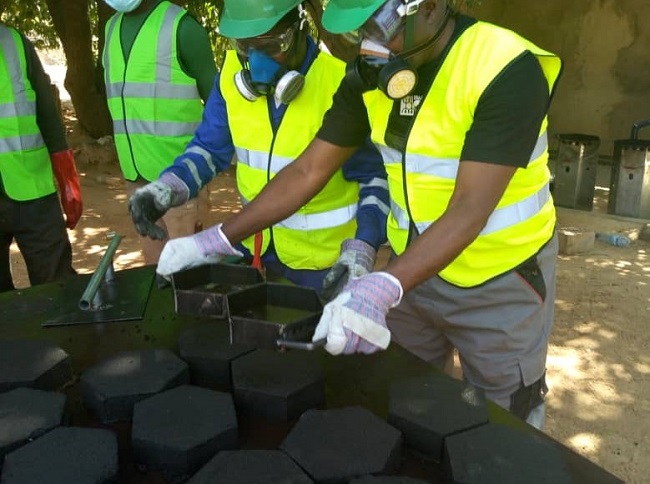
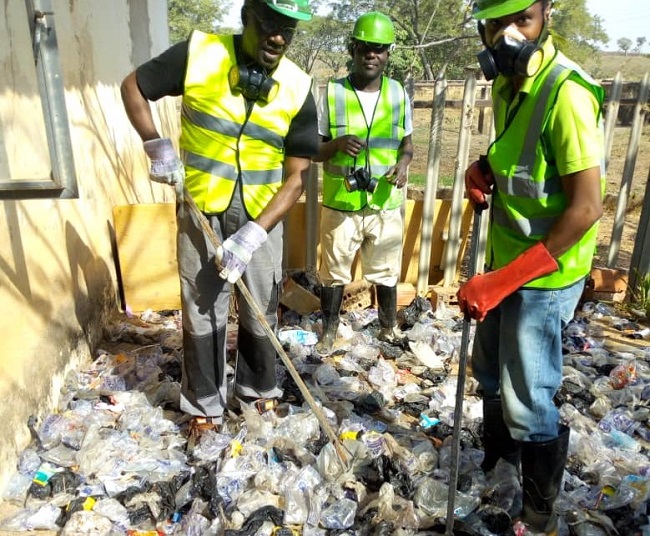
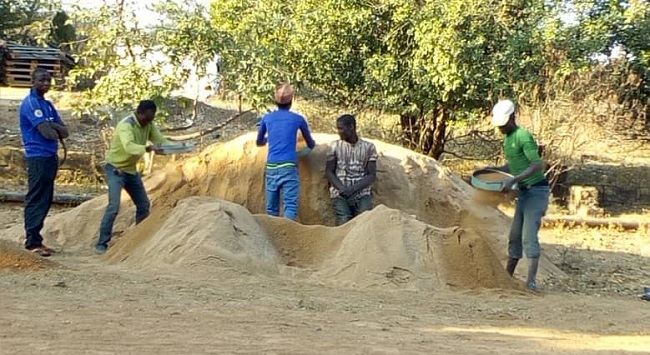
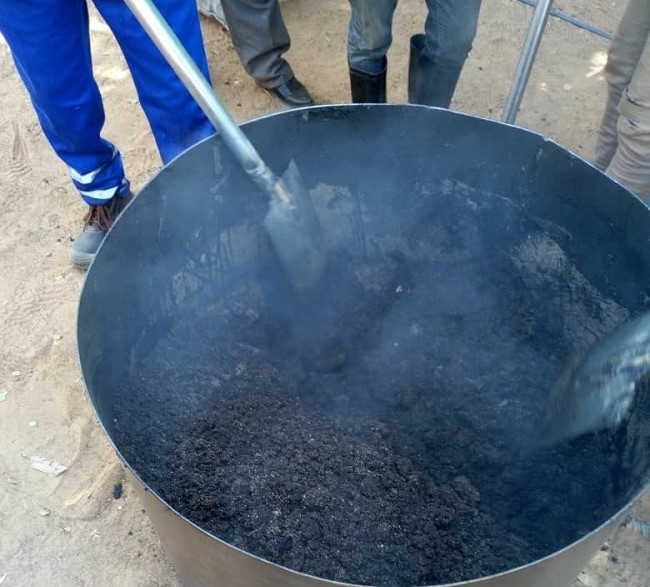
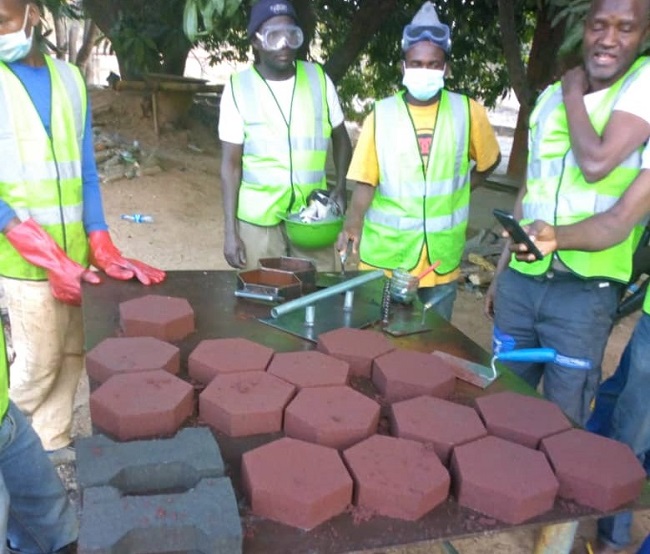
The Developmental Association for Renewable Energy (DARE) has began training youths on how to recycle plastic waste, albeit to make interlocking tiles, blocks, roofing tiles, and to decorate homes.
The Kaduna-based not-for-profit group takes EnviroNews through the process on Sunday, January 6, 2019.
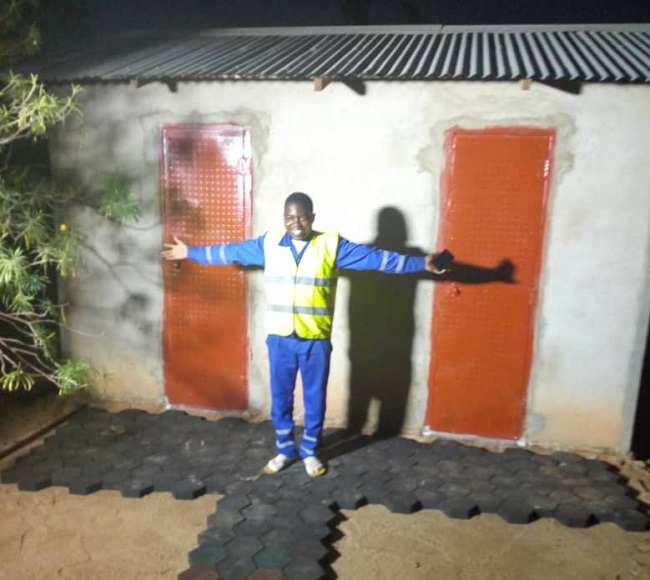
Sorting out the plastic wastes gathered from the communal waste dumpSieving fine sand off larger particles Mixing the sorted plastic waste with fine sharp sand under a temperature of about 500 degree CForming different geometric forms of interlocks and in various coloursBrown interlocksGreen interlocksOne of the trainers seems excited with the practical laying of the first tranche of the interlocks
Efforts to save the human and physical ecologies of Nigeria’s
Niger Delta region has turned out for the better, courtesy of a government
initiative to shield the area from the vagaries of the global changing climate.
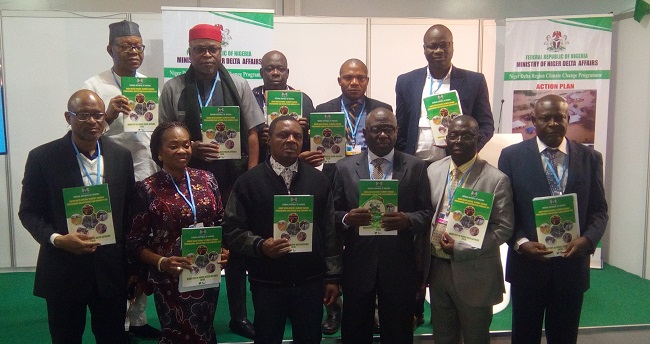
Formal presentation of the Niger Delta Region Climate Change Programme and Action Plan (NDRCCP-AP) at COP24 on Wednesday, December 12, 2018
Supposedly harbouring the largest mangrove swamp in Africa
with numerous species of flora and fauna, the ecologically sensitive region is
however an environmentally notorious spot – courtesy of oil pollution and the
abundance of greenhouse gases from flared associated gas.
Bothered that the existing policies, programmes, actions and
measures are insufficient to address the level of risk posed by climate change
in the region, the Ministry of Niger Delta Affairs has developed the Niger
Delta Region Climate Change Programme and Action Plan (NDRCCP-AP) to address
inherent gaps. The document was presented to delegates at the UN Climate Change
Conference (COP24) held December 2018 in Katowice, Poland.
“Weak technical capacity and lack of appropriate institutional
framework and governance instruments particularly at the national level are
additional challenges pegging climate change response in the Niger Delta region
and are some of the factors for poor participation by Nigeria and particularly the
region in opportunities for addressing climate change issues,” disclosed Dr
Samuel Adejuwon, Nigeria’s erstwhile climate chief and consultant to the Niger
Delta Ministry.
The NDRCCP-AP, according to the ministry, is based on the
principle of social and economic development and poverty eradication are the
first and overriding priorities of developing countries and that a low-carbon
development strategy is indispensable to sustainable development, in line with
the United Nations Framework Convention on Climate Change (UNFCCC).
Besides being in line with the national Policy on
Environment, the NDRCCP-AP is said to complement the nation’s action in
implementing various international conventions, treaties and protocols
especially the principles of the Paris Agreement.
The document aims at guiding the region and other
stakeholders on the implementation of collective measures to address climate
change impacts and causes through adaptation, mitigation and other measures,
while assuring sustainable socio-economic development through harmonised and
coordinated strategies, programmes and actions to combat climate change.
According to the NDRCCP-AP, climate change impacts on nearly
all sectors of the economy in the Niger Delta but mostly on land use and infrastructure,
human health, human settlement, energy, water, agriculture and food security,
biodiversity and ecosystem services, tourism, industry and transport.
While the Department of Environmental Management of the ministry will coordinate and manage the implementation of the Programmes and Action Plan to enhance synergies and minimse duplication of of efforts, it is proposed that the NDRCCP-AP will be reviewed every three years to take into account of emerging issues, challenges and trends on climate change at the local, national, sub-regional, regional and global levels.
Reverse vending machines, placed in Iceland stores across
the UK, have earned shoppers over £30,000, research reveals.
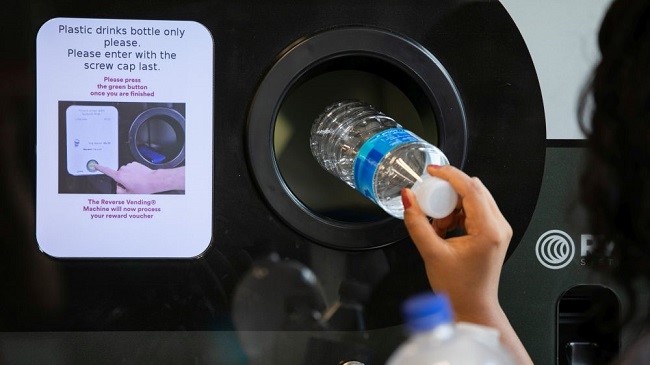
A reverse vending machine. Photo credit: Greenpeace
The scheme, which awards a 10p voucher for every bottle
returned, has resulted in 311,500 plastic bottles being recycled so far. The
bottles must have been brought in an Iceland store and only bottles up to 3
litres were accepted.
Richard Walker, Iceland’s Managing Director, said: “Iceland
has continually led the way in the fight against the scourge of plastic since
making our announcement to eliminate plastic from our own-label product
packaging. It’s clear from the results that consumers want to tackle the
problem of plastic head on and would be in support of a nationwide scheme.”
Iceland will share the results of the scheme with the government
in an attempt to encourage more supermarkets to introduce reverse vending
machines in their stores.
Other supermarkets, including Tesco, have recently trialled
the machines in a bid to reduce the growing plastic pollution, but no results
have been published.
In March 2018, Michael Gove, Environment Secretary,
announced a consultation to introduce a bottle deposit scheme that will
increase recycling rates and slash the amount of waste polluting our last and
seas.
Presently, UK consumers go through an estimated 13 billion
plastic bottles a year, with more than 3 billion being incinerated, sent to landfill,
or left to pollute our streets, countryside and marine environment.
Will McCallum, Greenpeace UK head of oceans, said: “The
success of Iceland’s reverse vending machine trial demonstrates that deposit
return schemes to boost recycling and tackle plastic pollution are both popular
with consumers, and eminently doable. We hope that other retailers follow suit.
However, we can’t just rely on businesses to tackle the problem of throwaway
plastics; we also need leadership from Government. The Environment Secretary
Michael Gove must deliver on his promise to introduce a deposit return scheme
without delay and ensure that it covers containers of all sizes and
materials.”
This news follows the European Union agreeing on deal for a single-use plastic ban which is set to be put in place in 2019.
A not-for-profit outfit, the Developmental Association for
Renewable Energy (DARE), has began training youths on collecting waste plastics
in Kaduna metropolis, Kaduna State, for recycling.
Green interlocks made from plastic waste
The recycling is aimed at using them for interlocking tiles,
blocks, roofing tiles, and decorating houses, to protect the environment.
Chief Executive Officer of the organisation, Mr Yahaya
Ahmed, said this in an interview with newsmen in Kaduna on Sunday, January 6,
2019.
Ahmed, an engineer, explained that the technology was the
first of its kind in Nigeria and some parts of Africa.
“This tried-and-tested new technique of turning waste
plastic into interlocking tiles, blocks and roofing tiles is a low-cost method
that helps keep plastic wastes out of the environment completely.
“We have been working on the idea for a long time on how to
recycle the waste plastics that are polluting the environment every day.
“We are in contact with our partner organisations in Germany
and United Kingdom, but the real idea comes from Waste AID UK.
“We planned on having them in Nigeria for training our
people, but things are not ready at that time, so they did the training in
Cameroon and told us there are good people in Cameroon that can come to Nigeria
and train other interested persons which is better for us,” he said.
Ahmed pointed out that the waste plastic interlocking tiles
is stronger and everlasting than the normal interlocking blocks that are sold
in the market.
According to him, it will take hundreds of years to
decomposes because the interlocking tiles are constructed with only plastic
waste, adding that there is a market for the product.
He said the association wanted to train many Nigerians in
the new technology to reduce unemployment, fight poverty and reduce idleness
among the youth.
“This will create jobs, reduce street begging as many youths
will engage in it, making them to become self-employed in the future.
“We are targeting training 1,000 unemployed youths including
women and graduates from various institutions across the 36 states of Nigeria.
“We buy the plastics and measure it in kilos and pay in cash to waste collectors/scavengers.
“The waste plastics have detrimental impact on the
community, environment, human health and even on agricultural land hence the
need for our technology to recycle them and help Nigerians transform them into
money.
“We have started training many interested persons, and we
are hoping to see that those that receive the training will also train others
so as to spread the idea and save our environment,” he said.
He said their greatest challenge was how to get government
to be involved in the programme and sustain it.
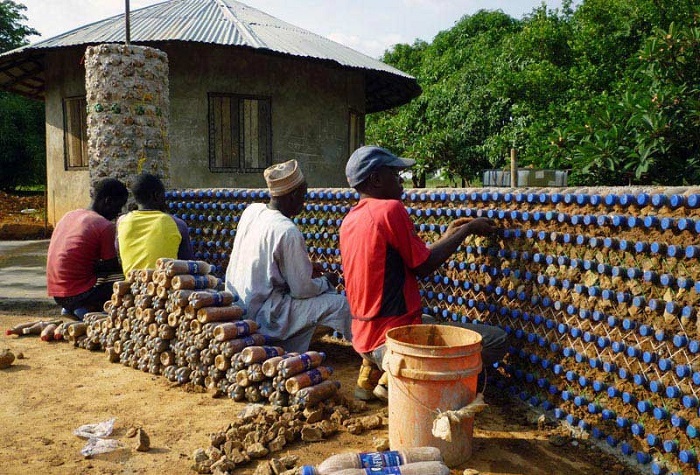
Plastic bottle house under construction in Nigeria
Ahmed was the engineer who constructed the first plastic
bottled house in Africa that could last for over 200 years. The house is
located at Yalwa Village, which is along the Kaduna-Zaria Road.
Responding, Mr Pierre Kamsouloum, the trainer and expert on
recycling plastic from Cameroon, said it was interesting coming to Nigeria to train
young people interested in learning the technology of transforming waste
plastics to something important in the society.
“This idea started 12 years ago in my country Cameroon, in
my town Garoua and, few years later, I joined other organisations to spread the
message which involves travelling from one country to another.
“We are here in Nigeria to teach youths how to collect waste
plastics from the trash centre, transform them into something that is useful
for the construction of houses and other interior decoration.
“I train them on how to collect the waste plastic, wash it
and dry-it before putting it into a big pot for melting while mixing it with
sand that is extracted from the Kaduna River,” he said.
Mallam Ahmed Dala, one of the youths receiving the training,
expressed gratitude and satisfaction with the organisers.
Meanwhile the Assistant Director, African Climate Reporters,
Dr Piman Hoffman, has applauded the efforts of the NGO and the International
Waste Plastic Trainer from Cameroon.
Hoffman said Recycling was important in today’s world if we
wanted to leave the planet for our generations.
“Recycling your waste makes you more responsible in the way
you use and dispose of it. It is evident from studies that people who do this
instinctively cut down on buying unwanted things from the supermarket.
” When we recycle, recyclable materials are reprocessed into
new products, and as a result the amount of rubbish sent for incineration
reduces,” he said.
He then called on Government, NGOs and CSOs to always support the spread of iniatives like this one.
Abuja Environmental Protection Board (AEPB) says it has put
measures in place to ensure dirt-free environment in 2019.
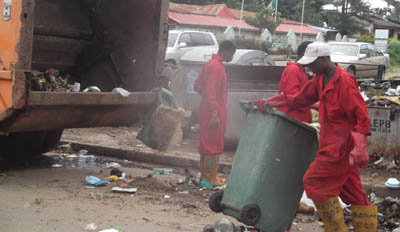
Officials of one of the AEPB waste evacuation contractors, on duty in Garki Area of Abuja
AEPB Head of Information and Outreach Unit, Mallam Muktar
Ibrahim, said this in an interview the News Agency of Nigeria (NAN) in Abuja on
Sunday, January 6, 2019.
Ibrahim said that the measures aimed at ensuring a clean,
hygienic and sustainable environment in the Federal Capital Territory (FCT).
“While wishing all residents of FCT a happy and prosperous
new year 2019, the AEPB is poised more than ever before to ensure a clean,
hygienic and sustainable environment in the FCT.
“To guarantee this, the board has put various measures in
place, including increased monitoring and enforcement activities by AEPB and
constant removal of all sundry nuisances across the city.
“In addition, the board is stepping up its intervention to
deal with any city cleaning contractors who is found wanting.
“This has achieved great results in the sense that they have
been put on their toes as any intervention carried out attracts deductions on
the erring contractor,’’ the information officer said.
He added that the board was working to expand its cleaning
contractors from 27 to 48 in the new contract.
“AEPB solicits the cooperation of residents to cultivate a
civilised attitude towards environmental cleanliness as the board will not
spare any one found to be working in cross purposes to AEPB mandates.
“We put strategies in place to ensure that the usual post
yuletide waste littered have been evacuated and reduced to the barest minimum.
“City cleaning contractors have been mobilised at short
notice to any area of perceived nuisances if there is a complaint from
concerned parties,’’ he said.
Ibrahim advised all residents to maintain environmental
cleanliness to achieve the FCTA’s vision of making Abuja one of the first-class
cities of the world.
According to him, AEPB advises all residents to ensure
proper disposal of waste through proper bagging.
“Residents should provide proper waste bins with lids for
waste collection and avoid throwing of waste out of vehicles.
“They should pay waste service charges to AEPB dedicated
revenue accounts displayed on the service bills and avoid any form of cash
payments which is recipe for fraud.
“They should also ensure proper connection of their properties
to AEPB managed central sewer lines and desist from patronising street
hawkers,’’ he said.
Ibrahim urged residents to report suspicious
persons/activities to the relevant agencies, including scavengers who have been
banned from operating within the city.
“They should fight against open defecation and avoid bush
burning to protect the environment.
“Residents are also advised to report all forms of
environmental pollution to the board for prompt attention.
`These include noise, air and water pollution from
loudspeakers, grinding machines which may result from using residential places
for commercial purposes,’’ Ibrahim said.
According to him, other forms of waste include burning of
hazardous materials that release poisonous fumes into the atmosphere.
He said that the board had rehabilitated several dilapidated
Roro bins to increase the number of available receptacles for waste collection
and minimise litter around waste collection points.
“In addition, AEPB has engaged an additional 300 enforcement
staff to boost its compliance mechanism.
`The FCT Administration has also regularised the employment
of 300 staff, cutting across the relevant departments of the board, especially
the Environmental Health and Safety.
“This will enhance the board’s capacity in inspecting
premises to check sundry nuisances,’’ he said.
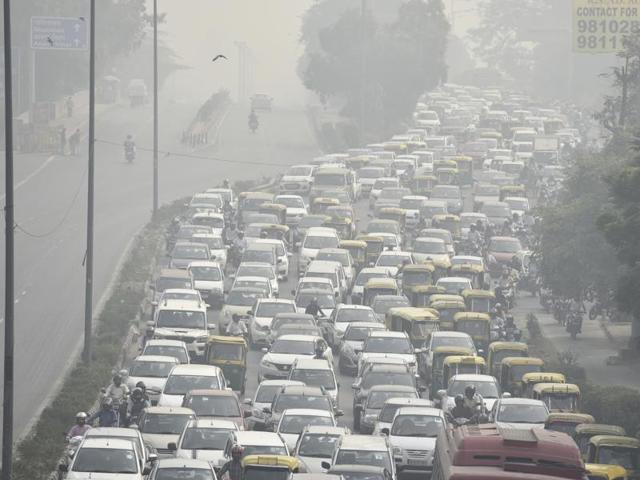
A rainy spell early on Sunday, January 6, 2019 brought
better air to residents of New Delhi, giving them a brief respite from thick
grey smog that has shrouded the Indian capital for the last two months,
although air quality continued to be “very poor”.
As Delhi’s pollution levels rise to severe, the EPCA has directed governments to impose all conditions under the Graded Response Action Plan under severe category
A measure of tiny, hazardous breathable particles known as
PM 2.5 reached an average of 182 by 12 p.m., the Central Pollution Control
Board said, its lowest since Nov. 4.
But pollution was still five times more than a U.S.
government recommended level of 35 to stand at “unhealthy” levels, according to
the U.S. embassy.
“Change in weather conditions by rain or higher wind speed
helps dissipate peak pollution, but we continue to need strong emergency
actions such as shutting power plants,” said Anumita Roychowdhury of the Centre
for Science and Environment think-tank.
The Federal Government air quality index rated Delhi’s air
quality “very poor” on Sunday and had a similar forecast for Monday.
It urged people with respiratory and cardiac problems to
avoid polluted areas and limit outdoor movement.
A sharp drop in temperatures and wind speed over the last
two weeks, combined with vehicle and industrial emissions, dust from building
sites and smoke from garbage burning has stoked pollution over much of north
India.
Levels of PM 2.5, or particles smaller than 2.5 microns in
diameter, hit their highest last year at 450 on Dec. 23, 2018.
Despite the pollution, there is little sign Delhi’s 20
million residents are taking steps to protect themselves.
Activists say the apparent lack of concern gives politicians
the cover they need for not tackling the issue adequately.
The world appears to have taken an important step on the
road to drastically reduce the production and consumption of powerful greenhouse
gasses (GHGs) known as hydrofluorocarbons (HFCs) and limit global warming, with
the Kigali Amendment to the Montreal Protocol on Substances that Deplete the
Ozone Layer coming into force on Tuesday, January 1, 2019.
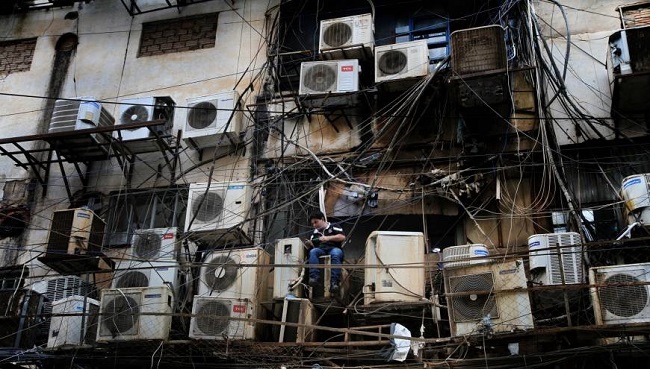
HFCs are described as the world’s fastest-growing climate pollutant and are used in air conditioners and refrigerators. Photo credit: Getty Images
If fully supported by governments, the private sector and
citizens, the Kigali Amendment will avoid up to 0.4°C of global warming this
century while continuing to protect the ozone layer, according to the UN Environment.
The body adds that the amendment will substantively contribute to the goals of
the Paris Agreement.
HFCs are organic compounds that contain fluorine and
hydrogen atoms, and are frequently used as refrigerants in air conditioners and
other devices as alternatives to ozone-depleting substances controlled under
the Montreal Protocol. While HFCs themselves do not deplete the ozone layer,
they are said to be extremely potent GHGs with global warming potentials that
can be many times higher than carbon dioxide.
The parties to the amendment have put in place practical
arrangements for its implementation, including agreements on technologies for
the destruction of HFCs and new data reporting requirements and tools. The
amendment comes with provisions for capacity-building for developing countries,
institutional strengthening and the development of national strategies to
reduce HFCs and replace them with alternatives. Phasing down HFCs under
the Kigali Amendment may also open a window to redesign cooling equipment that
is more energy efficient, further increasing the climate gains.
Implementation of new targets set out in the amendment will
be done in three phases, with a group of developed countries starting HFCs
phase-down from 2019. Developing countries will follow with a freeze of
HFCs consumption levels in 2024 and with a few countries freezing consumption
in 2028.
Ratified by 65 countries so far, the Kigali Amendment builds
on the historic legacy of the Montreal Protocol agreed in 1987. The Protocol
and its previous amendments, which require the phasing out of the production
and consumption of substances that cause ozone depletion, have been universally
ratified by 197 parties.
The broad support for and implementation of the Montreal
Protocol has led to the phase-out of more than 99 per cent of nearly 100
ozone-depleting chemicals and significantly contributed to climate change mitigation.
Evidence presented in the latest Scientific
Assessment of Ozone Depletion shows that the ozone layer in parts of
the stratosphere has recovered at a rate of 1-3% per decade since 2000. At
projected rates, Northern Hemisphere and mid-latitude ozone is scheduled to
heal completely by the 2030s followed by the Southern Hemisphere in the 2050s
and polar regions by 2060.
The United Nations High Commissioner for Refugees (UNHCR) on
Friday, January 4, 2019 said its first five solar-powered safe water systems at
Cox’s Bazar refugee settlements in Bangladesh are delivering at their full
capacity with the aim to supply all refugees this way.
UNHCR spokesperson, Andrej Mahecic
“These new systems improve the daily supply of safe, clean
drinking water to Rohingya refugees living in crowded sites in Southeast
Bangladesh,’’ UNHCR spokesperson Andrej Mahecic said at a UN briefing.
The project, funded by the UN agency, is part of a broader
shift in the humanitarian response toward the expanded use of green and
non-polluting technologies.
“The new safe water systems run entirely on electricity
generated through solar panels,’’ the spokesperson said, adding that UNHCR aims
to provide 20 litres of safe and clean water to each refugee daily.
Report says over 900,000 Rohingya refugees live across 36
different locations in Cox’s Bazar area.
Using solar energy has allowed the humanitarian community to
reduce energy costs and emissions.
The five new water networks, jointly completed by UNHCR and
its partners, are currently providing safe water to no fewer than 40,000
refugees.
A further 55,000 refugees will benefit as UNHCR
and its partner agencies are hoping to install nine more solar-powered water
networks across Kutapalong refugee camp in the coming year, at the cost of $10
million.
The World Health Organisation (WHO) on Friday, January 4,
2019 said there are now more than 600 confirmed or probable cases of Ebola in
Congo.
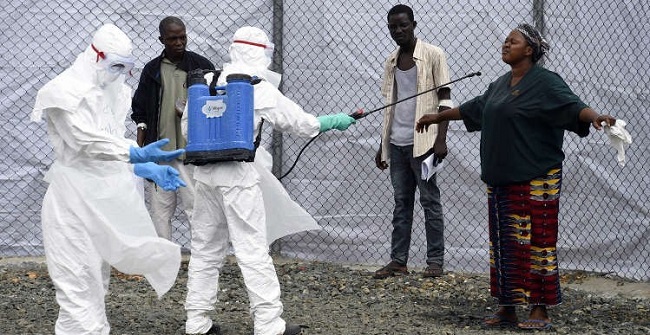
Health workers move to prevent Ebola spread
Most of the new cases occurred in cities and urban areas in
Eastern North Kivu province, where an Ebola outbreak was declared in August
2018.
Numerous militia groups are fighting for control over the
country’s rich natural resources in the province, hampering efforts to combat
the epidemic in the impoverished nation.
“Mass protests that erupted in recent days over a delay in
Congo’s presidential elections have also frustrated the work of aid officials.
“A hospital was attacked in city of Beni, for example, which
resulted in fewer Ebola vaccines being handed out,’’ the WHO said.
The health agency added that a further deterioration in
security would undermine the fight against the life-threatening haemorrhagic
fever.
“According to the latest figures, 560 cases of Ebola have
been confirmed and 48 other cases are considered likely.
“This Ebola outbreak is the second-worst ever recorded,’’
the WHO said.
An Ebola outbreak ravaging Eastern areas of the Democratic
Republic of Congo has claimed several hundred lives.