Home Blog Page 160

UN High Seas Treaty ratified, to take effect in early 2026

0

The high seas will soon have their own Conference of the Parties (COP) as a new body tasked with implementing ocean related agreements is set to enter into force in early 2026, after a legally required 120-day period.

Indeed, a landmark UN treaty to safeguard marine biodiversity on the high seas has now met the required 60 ratifications for entry into force, clearing the way for it to take effect in January 2026.

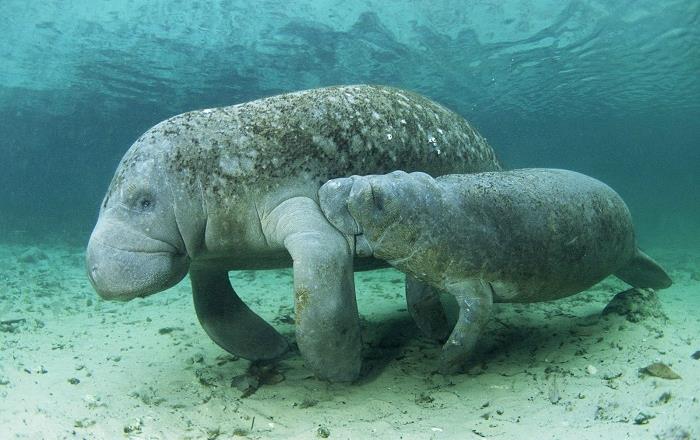
manatee
Aquatic bushmeat: The West African manatee. Manatees are large, fully aquatic, mostly herbivorous marine mammals sometimes known as sea cows.

On Friday, September 19, 2025, the United Nations received the final two state ratifications needed for the agreement, known as the High Seas Treaty, to take effect, as it required formal acceptance by 60 countries. Morocco and Sierra Leone were the latest to join, becoming the 60th and 61st parties to the pact.

This comes as the end of a lengthy process: The agreement was finalised in 2023, after it had been negotiated over the course of two decades. Its quick entry into force, despite a turbulent international context, particularly due to the United States’ withdrawal from the Paris Climate Accords, represents a victory for environmental multilateralism and a success for President Emmanuel Macron.

French diplomatic efforts contributed to accelerating the pace of ratifications, though the president had hoped the 60-ratification threshold would be met as early as June.

The treaty, formally known as the “Agreement under the United Nations Convention on the Law of the Sea on the Conservation and Sustainable Use of Marine Biological Diversity of Areas beyond National Jurisdiction” (BBNJ agreement), was adopted by UN Member States in June 2023 after nearly two decades of negotiations.

A historic achievement

Secretary-General António Guterres welcomed the development, calling it a “historic achievement for the ocean and for multilateralism.”

“In two years, States have turned commitment into action – proving what is possible when nations unite for the common good,” he said in a statement.

“As we confront the triple planetary crisis of climate change, biodiversity loss, and pollution, this agreement is a lifeline for the ocean and humanity.”

The pact – also called the “high seas treaty” – covers two-thirds of the world’s ocean area that lies beyond national boundaries.

It establishes legally binding rules to conserve and sustainably use marine biodiversity, share benefits from marine genetic resources more fairly, create protected areas, and strengthen scientific cooperation and capacity building.

Foundation of our existence

UN Environment Programme (UNEP) Executive Director, Inger Andersen, also hailed the milestone.

“Our ocean is the foundation of our very existence. Today we took an important step forward to save our ocean, and to save our future,” she said in a post on social media.

Safeguarding humanity’s future

The BBNJ agreement builds on the UN Convention on the Law of the Sea, regarded as the “constitution for the oceans.”

Once the high seas treaty enters into force on January 17, 2026, it will provide a global framework to help achieve international biodiversity targets, including the pledge to protect 30 per cent of land and sea areas by 2030 under the Kunming-Montreal Global Biodiversity Framework.

Mr. Guterres urged all remaining UN Member States to join the treaty without delay and called on partners to support its swift and full implementation.

“The ocean’s health is humanity’s health,” he said.

In a reaction, Nina Mikander, Global Director of Policy and Business at BirdLife International, said: “Today marks a historic achievement for the ocean – with 60 ratifications, the High Seas Treaty will now come into force. This demonstrates global commitment for the protection of this shared ecosystem, which is so vital for our existence. The real work starts now.

“At BirdLife International, we stand ready to provide the science, tools and local-to-global action needed to build and implement a strong and effective High Seas Treaty. We call on governments and all stakeholders to join us in turning this promise into lasting protection for birds, the ocean and all life it sustains.”

Chris Thorne, Greenpeace UK senior oceans campaigner, said: “This is a bold testament to what humanity can accomplish when we come together to protect the planet we all share. But while nations around the world celebrate this environmental breakthrough, the UK is chasing the leading group of ratifying countries. The ocean is in urgent peril – along with its rich wildlife and the coastal communities that depend on it.

“It is more vital than ever that the UK signs the Treaty into law by the end of the year and doesn’t risk missing the first Ocean COP. The government can then show global leadership by putting forward ambitious proposals to fully protect huge areas of the ocean such as 30% of the Atlantic, including the Sargasso Sea.”

Mads Christensen, Executive Director, Greenpeace International, said: “This is a landmark moment for protecting the ocean, and proof that countries can come together to protect our blue planet. The era of exploitation and destruction must end, and the Global Ocean Treaty is the tool to make that happen. But we must not get complacent.

“Scientists are clear that we need to protect at least 30% of our ocean by 2030, and time is running out. Governments around the world must use this time now to ensure the first historic Ocean COP becomes a turning point and start to develop plans for the first-ever sanctuaries under the Treaty. Our ocean can’t wait and neither can we.”

United Nations General Assembly set to get underway in New York

0

Every September, world leaders, diplomats, and advocates gather for the United Nations General Assembly – one of the most important moments on the global diplomatic calendar.

Next week, UN Headquarters in New York will once again host critical debates and discussions on some of the world’s most pressing issues: from peace and security to climate action, sustainable development, and human rights.

UNGA
United Nations General Assembly Hall. Photo credit: UN Photo

The 80th session of the UN General Assembly (UNGA 80) opened on Tuesday, September 9, 2025. The high-level General Debate will run from September 23 to 27 and conclude on September 29, 2025. The SDG Moment will be held on September 22 to highlight inspiring action on the Sustainable Development Goals.

As the UN turns 80, this year’s General Assembly is said to be a reminder of how eight decades of global cooperation have improved lives around the world.

Since 1945, the United Nations has worked to prevent conflict, deliver humanitarian aid, defend human rights, promote development, and much more. From eradicating smallpox to delivering lifesaving aid in crises, the UN has helped people everywhere build safer, healthier, and more hopeful lives.

Ahead of this year’s Assembly, United Nations Secretary-General António Guterres stressed that people around the world are calling for answers and action. 

“Our times demand more than posturing and promises. They demand that leaders make progress and follow through.”

Calling on leaders to “get serious and deliver,” the Secretary-General urged: “Let this be a week of solutions.”

UN pressing ahead for better world amid global crises — Guterres

0

The UN is pressing ahead with a mission for a better world during a year of escalating global turmoil, including widening wars, economic hardship and relentless advance of  climate crisis.

UN Secretary-General, António Guterres, stated this in his annual report released on Thursday, September 18, 2025, ahead of the 80th session of the UN General Assembly’s yearly high-level session.

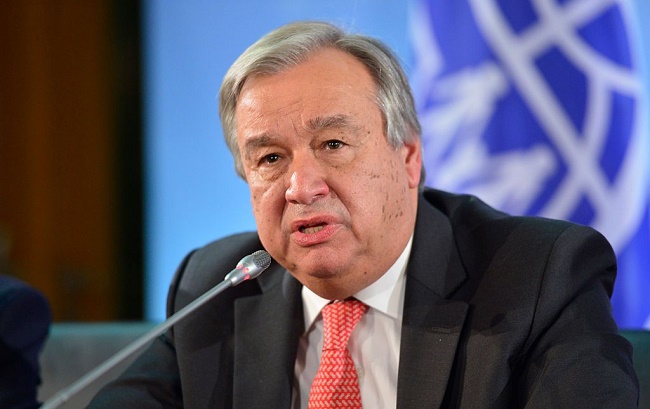
António Guterres
UN Secretary-General, António Guterres

“The present report demonstrates that despite enormously trying times – indeed, precisely because of them – we can and must keep pushing for the better world that we know is within reach.

“We will renew our efforts to achieve peace, foster sustainable development and defend and uphold human rights, for all of humanity,” Guterres said.

“By addressing the pressing issues of our time, the United Nations is paving the way for a more equitable and sustainable future, ensuring that digital technologies are harnessed for the benefit of all humanity,” he said.

The UN chief also said the United Nations has held its ground, working to promote peace, drive sustainable development and ease human suffering.

The report offers a sobering yet resolute account of the UN’s efforts in the face of mounting challenges, he said.

Guterres highlighted the resilience of UN personnel, committed to delivering hope and help to those in need in spite of operating under difficult circumstances.

Together with partners, the report said the UN coordinated a $50 billion appeal for the humanitarian needs of 198 million people.

“In 2024, the United Nations helped to mobilise $25 billion of the $50 billion funding target.

“This enabled life-saving humanitarian assistance to reach 116 million people in urgent need across 77 countries and territories,” Guterres said.

At the same time, UN operations in 2024 came at a heartbreaking human cost.

It was the deadliest year on record for UN staff and humanitarian workers, with 373 aid workers killed.

In launching the report, the Secretary-General paid tribute to their sacrifice, reaffirming the UN’s unwavering commitment to standing with the world’s most vulnerable.

Guterres stressed that diplomacy for peace remained core to the UN’s work amid escalating global challenges to peace and security.

In spite of rising threats, he said the UN’s diplomatic efforts continued to protect hundreds of thousands of civilians daily and advance peace processes.

The UN facilitated peace talks, supported state-building efforts and helped to protect civilians globally, including in the Sudan.

The Peacebuilding Fund allocated over $116 million to support national peace plans in 32 countries and territories, with a focus on gender equality.

Partnerships with regional organisations, like the African Union, further bolstered conflict prevention.

The 2024 Summit of the Future marked a historic turning point for multilateralism.

World leaders adopted the Pact for the Future, a landmark agreement to revitalise international cooperation and deliver solutions for people and planet.

The summit also commits to more representative and effective global governance, including reforms to the Security Council and greater voice for developing countries.

By Tiamiyu Prudence Arobani

African entrepreneurs win $400,000 in catalytic funding to tackle poverty

0

African startups have been awarded a total of $400,000 through the 2025 FINCA Ventures Prize Competition, a flagship initiative of FINCA Ventures. This year’s competition attracted more than 300 applicants from across the continent, with six startups advancing to the final round to compete for catalytic funding to accelerate their impact.

“African entrepreneurs are designing bold, locally grounded solutions to complex challenges,” said Andrée Simon, Global CEO of FINCA. “They deserve support that matches their ambition: resources that accelerate growth, open doors, and amplify their impact.”

FINCA Ventures
2025 FINCA Ventures Prize winners

The 2025 FINCA Ventures Prize Competition accepted applications in two categories: climate-smart agriculture and fintech for financial inclusion. First-place winners in each category – Esther Kimani, founder of Farmer Lifeline Technologies, and Foluso Ojo, founder of truQ – received $100,000 in catalytic funding, while second- and third-place winners received $60,000 and $40,000, respectively.

A Platform for Innovation and Impact

The six finalists – five of which are founded or co-founded by women – pitched their businesses to an esteemed panel of judges at a virtual livestream event on September 15, and the winners were announced at an award celebration in San Francisco on September 16, 2025.

The judging panel represented a diverse cross-section of impact investing, venture capital, fintech, and climate innovation, including leaders such as FINCA International Board Chair David Weisman, FINCA UK Board Member Alex Yew, Christopher Gilkerson of RiAdvantage Consulting, FINCA Ventures Investment Committee Member Tahira Dosani of ResilienceVC, and Rob Trice of Better Food Ventures and The Mixing Bowl, among others.

In addition to catalytic funding, finalists also benefit from expert feedback, strategic introductions, and a platform to elevate their work – support that can be as transformative as the seed money itself. “This is about building an ecosystem that works for African entrepreneurs, by investing in them, but also by connecting them to global networks, mentorship, and opportunity,” said Winnie Mwangi, Managing Director of FINCA Ventures.

To Ojo, whose digital platform connects small-scale transporters to credit, operational tools, and better-paying jobs, winning the FINCA Ventures Prize is a critical vote of confidence. “Getting this kind of support from FINCA goes a very long way – not just as a personal validation of the problems that we’re solving and the solution that we’re providing, but also as a major booster to enable us to make our product and services available to more people,” she said.

Kimani, whose company uses solar-powered devices and AI to detect crop pests and diseases before they spread, underscored the importance of early-stage investment. “With the backing we’re receiving from FINCA, we are so excited,” she said. “This kind of patient capital allows us to invest in research and development, launch into new markets, and even have the right team on board as we look forward to scaling.”

Second-place winners include Silo Africa co-founder Eliud Rugut in climate-smart agriculture and Cladfy co-founders Ebby Gatamu and Kibe John in fintech for financial inclusion. Third-place awards went to Karpolax co-founder Samuel Muyita in climate-smart agriculture and 10mg Health founder Christian Nwachukwu in fintech for financial inclusion.

A Critical Moment for African Innovators

The 2025 FINCA Ventures Prize comes at a pivotal moment for Africa’s startup ecosystem, which has faced a sharp decline in venture capital – with funding down more than 50% and under 10% of investment reaching women-led teams in 2024. By providing early-stage, risk-tolerant funding and global visibility, the Prize aims to close this gap and catalyse solutions for the communities most affected by poverty, climate change, and financial exclusion.

“There is a very young, dynamic population in Africa, full of creativity and entrepreneurship,” Simon said. “We need to shine a spotlight on these opportunities and attract investors who are interested in innovation, in social change, and in building a more prosperous world.”

NAF strikes on illegal refineries boosted oil output to 1.71mbpd, says Commander

0

Sustained air strikes by the Nigerian Air Force (NAF) on illegal refineries have significantly boosted Nigeria’s oil output to 1.71 million barrels per day in the Niger Delta.

The Commander, Air Component of Operation Delta Safe (AC OPDS), Group Capt. Abdulafeez Opaleye, made this known during a periodic brief at the NAF Headquarters on Friday, September 19, 2025, in Abuja.

NAF
A NAF combat helicopter

This is contained in a statement by the Director, Public Relations and Information of NAF, Sir Commodore Ehimen Ejodame.

Opeleye said that daily sorties were choking oil theft networks across seven Niger Delta states following the directive of the Chief of the Air Staff (CAS), Air Marshal Hasan Abubakar.

He explained that the operations neutralised 12 criminals, arrested six suspects, destroyed illegal refining camps, and eliminated cooking tanks and reservoirs.

“Between May and August, our platforms flew sustained ISR, armed reconnaissance and pipeline patrol missions across Ondo, Edo, Delta, Bayelsa, Rivers, Akwa Ibom and Cross River states.

“Each mission not only degraded criminal capacity but also reinforced deterrence, making sabotage riskier and less profitable,” he said.

Opaleye noted that the security gains were translating into improved oil output.

“In July 2025, total production averaged 1.71 million barrels per day, including condensates, while crude oil alone stood at 1.51 million barrels per day,” he added.

In his brief, the Chief of Training and Operations (NAF), AVM Francis Edosa, said the unit executed 117 missions, 189 sorties and 192 flight hours from May to July.

Edosa added that the operations consumed more than 60,000 litres of Jet A-1 fuel and destroyed 25 cooking tanks, 11 reservoirs and three drums used in illegal refining.

“These actions prove that intelligence-driven air operations deliver both security and economic dividends,” Edosa said.

He reiterated the NAF’s commitment to sustain the tempo towards stabilising the Niger Delta, safeguarding oil revenues, and ensuring Nigeria’s skies stay hostile to saboteurs but safe for legitimate operators.

By Sumaila Ogbaje

LAWMA, partner launch organic waste plan to cut emissions

0

The Lagos Waste Management Authority (LAWMA) has unveiled a new organic waste management initiative aimed at cutting methane emissions, boosting recycling, and supporting the state’s climate action goals.

The initiative, launched in collaboration with Proganics Limited, was announced at a stakeholder forum on Friday, September 19, 2025, in Lagos.

Muyiwa Gbadegesin
Muyiwa Gbadegesin, Managing Director/Chief Executive Officer of LAWMA

It targets the growing challenge of organic waste across the state.

Managing Director/CEO of LAWMA, Dr Muyiwa Gbadegesin, said nearly half of the 13,000 tonnes of waste generated daily in Lagos was organic, roughly 6,500 tonnes, which posed a serious environmental risk.

“Sorting organic waste at source is critical to achieving the clean Lagos of our dreams.

“When sent to landfills, this waste generates methane, a greenhouse gas more harmful than CO₂,” he said.

He noted that the initiative was a practical response to the governor’s COP28 pledge to reduce methane emissions and advance Lagos’s role in the global fight against climate change.

Gbadegesin said LAWMA’s partner, Proganics Limited, had established a 200-tonne daily capacity organic waste facility, using Black Soldier Fly (BSF) technology to convert food waste into animal feed and bio-fertilisers.

He added that LAWMA was also deploying smart waste solutions, including RFID-tagged green bins and IoT sensors, to monitor and evacuate organic waste from key locations like restaurants and event centres.

“This innovation will improve operational efficiency, reduce pests and odours, and help businesses lower their waste bills.

“There may also be financial rebates for organisations that comply with the sorting policy,” he said.

Mr. Augustine Ogee, Head of Corporate Strategy at Proganics Limited, highlighted the economic potential of the partnership, calling it a step towards sustainable waste management and circular economic opportunities.

“This is more than waste collection, it’s about building value chains that support jobs, food security, and environmental protection.

“It’s a scalable model for cities across Nigeria,” Ogee noted.

Dr Michael Bankole, Head of the Climate Change Department at the Lagos State Ministry of the Environment and Water Resources, said the project reflected the state’s broader climate vision.

“A clean city boosts public health, attracts investment, and improves quality of life.

“Organic waste is a resource, not a liability, which can drive recycling, energy generation, and food production,” he said.

He added that Lagos was working towards a systemic shift from landfilling to sustainable resource recovery, reinforcing that “waste is not wasted” in the emerging circular economy model.

In her goodwill message, Mrs. Chikezie Iroegbu, National Chairperson of the Property and Environmental Writers Association of Nigeria, commended LAWMA for innovations in Lagos’s waste management system.

She assured the support of the media in raising awareness and advocating for cleaner, healthier, and more sustainable urban environments across the state.

The forum, attended by stakeholders in hospitality, food and beverage industries, and academia, was the first in a series of engagements to be held across Lagos.

Thousands take to the streets worldwide to ‘Draw the Line’ for climate justice

0

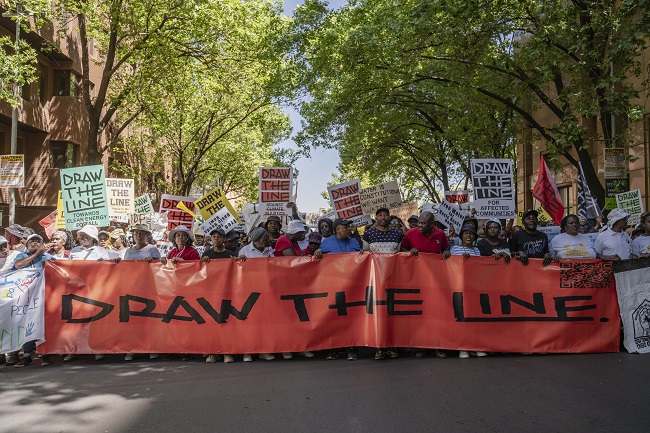
From Belem to Berlin, Nairobi to New York, hundreds of thousands of people are taking to the streets this weekend as part of the Draw the Line Global Week of Action.

United under a call from Indigenous leaders of the Amazon and the Pacific, people across more than 90 countries are joining marches, rallies, strikes, and creative actions to demand an end to fossil fuels, a just transition, and real climate justice.

Draw The Line
Draw The Line campaign in South Africa

More than 600 actions are taking place from September 15 to 21, 2025, culminating in mass demonstrations over the weekend. The mobilisations highlight escalating climate impacts, rising food and energy costs, deadly floods and heatwaves, and growing insecurity driven by fossil fuels and conflict. Protesters are also uplifting community-led solutions: renewable energy systems, debt cancellation, fair taxation, and land rights for Indigenous peoples and traditional communities.

Draw the Line actions showcase both resistance and hope. From mass rallies to candlelight vigils, participants are demanding a future built on peace, clean energy, and fairness.

Regional Highlights

Pacific

Hundreds will gather across Pacific villages, cities, and shorelines to demand stronger action in line with the 1.5℃ target. In Fiji, communities will assemble at the Suva foreshore to Draw the Line against further loss and damage. Pacific communities in Melbourne, Brisbane, and Sydney will rally to condemn Australia’s weak newly released emissions targets.

Youth across the Marshall Islands, Palau, Aotearoa, Papua New Guinea, Samoa, Tuvalu, and Kiribati are organising cultural celebrations, education programmes, and storytelling events to defend their heritage from climate chaos. These actions build momentum towards COP30, where leaders will face mounting pressure to close the Ambition Gap and keep 1.5℃ alive.

Asia

Across Indonesia, the Philippines, Bangladesh, Japan, South Korea, Taiwan, and China, thousands marched or held creative local actions demanding climate and social justice. Frontline communities hit hardest by coal, gas, and extreme weather demanded an end to fossil fuel expansion and called on wealthy nations to meet their obligations. Festivals showcasing renewable energy solutions demonstrated where climate funds should flow, and what a fairer, safer future could look like.

Africa

From Nairobi to Lagos, Johannesburg to Dakar, communities will be mobilising to Draw the Line against fossil fuel dependency that drives both economic instability and worsening climate disasters. On Thursday, September 18, a Draw the Line demonstration took place in Johannesburg.

In Abuja, the Global Initiative for Food Security and Ecosystem Preservation (GIFSEP) is promoting the “March for the Future” in support of the passage of the Environmental, Social and Health Impact Assessment (ESHIA) Bill and the “Draw The Line” campaign on Saturday, September 20, 2025.

“This march is a crucial step towards ensuring the ESHIA Bill, designed to address Nigeria’s urgent environmental and climate challenges linked to developmental projects, receives timely passage by the National Assembly,” said Akintunde Akinmolayan, the GIFSEP Field and GIS Analyst.

Dr Michael Terungwa David, the GIFSEP Executive Director, stated: “Today, we join voices with millions around the world for the #DrawTheLine Day of Global Climate Action, a united stand against climate injustice, poverty, environmental destruction, and the silent genocide facing vulnerable communities.

“We are drawing the line against the use of public funds to support destructive industries that fuel floods, fires, heatwaves, hunger, and poverty. Instead, we demand that public money be invested in building a safer, fairer, and more sustainable future for all Nigerians.”

He called for:

  1. Climate finance, especially increased support for adaptation financing to protect vulnerable communities.
  2. Debt cancellation for climate, enabling African countries like Nigeria to channel resources toward resilience and sustainability.
  3. Respect and uphold of the territories of Indigenous Peoples and Traditional Communities
  4. Support people and community-led solutions
  5. The National Assembly to expedite action on the Environmental, Social and Health Impact Assessment (ESHIA) Bill currently before the House, a key step toward protecting people and planet.

Europe

From September 18 to 21, tens of thousands took to the streets. In London, the Make Them Pay march united unions, migrant justice groups, and climate campaigners. In Berlin, workers, Fridays for Future activists, and economic justice groups led a creative march, with more than 60 additional demonstrations across Germany.

Across the continent, from Amsterdam to Athens and Lisbon to Istanbul over 80 demonstrations brought together farmers, students, and social justice groups to demand taxes on the super-rich and polluters to fund climate action and public services. Momentum is now building toward 28 September in Paris, where unions, racial justice groups, and climate organisations will join in a carnival-style mass march.

United States

Tens of thousands will rally in more than 30 cities across the U.S, demanding that Billionaires Pay and to fight back against fueling big oil, the dismantling of democracy and attacks on immigrants. 

Canada

From Vancouver to Toronto and Montreal, people everywhere are rising up to demand climate justice, peace, and real democracy. Drawing the line for a better world: with clean energy for all, protection for people and nature, and accountability for those.

Latin America

In the Brazilian Amazon, fishing communities in Marajó formed a striking 20-boat line on the waters of Jubim. The action will draw a visible line against the climate crisis and political inaction, sending a clear message to world leaders that fossil fuels have no place in the future of the Amazon or the climate negotiations at COP30. 

EU Commission to ban Russian LNG imports by 2027

0

The European Commission said it aims to move forward a ban on imports of liquefied natural gas (LNG) from Russia into the European Union by one year.

The commission said the ban to beginning early in 2027, as part of the bloc’s 19th package of sanctions on Russia.

Ursula von der Leyen
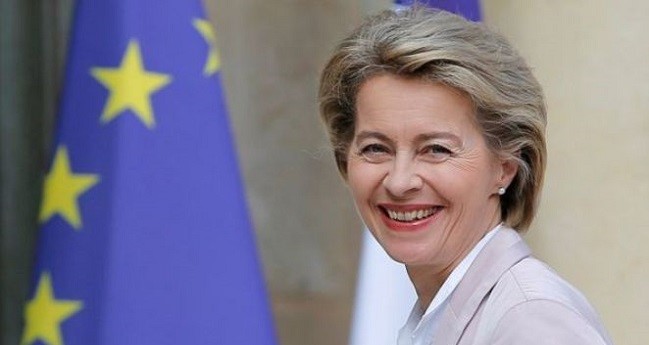
Ursula von der Leyen, President of the European Commission

“Europe is increasing its pressure,” European Commission President, Ursula von der Leyen, said.

“Russia’s war economy is sustained by the revenues from fossil fuels. We want to cut these revenues,” she said.

“We are banning imports of Russian energy into European markets. It is time to turn off the tap.”

The EU was ready for the ban thanks to efforts to save energy, diversify supply, and investments in low-carbon sources of energy, the commission president said.

Friday’s announcement came days after von der Leyen said she aims to achieve a faster halt to European fossil fuel imports from Russia following a conversation with U.S. President Donald Trump.

Since Russia’s full-scale invasion of Ukraine in 2022, the EU has imposed extensive import restrictions on Russian coal and oil.

There have however been no gas sanctions in place so far.

According to EU figures, the bloc imported LNG from Russia worth almost 4.5 billion Euros (5.3 billion dollars) in the first half of 2025.

In 2024, Moscow’s gas deliveries still accounted for around a fifth of all gas imports, more than half of these imports came in the form of LNG.

The proposal for the new sanctions package also includes further punitive measures in the financial sector and additional trade restrictions, von der Leyen said.

The bloc’s 27 member countries have to back the new package unanimously before it can enter into force.

Seplat unveils $3bn five-year growth plan

0

Seplat Energy Plc has unveiled a five-year roadmap to boost production capacity by 50 per cent between 2026 and 2030.

Chief Executive Officer, Roger Brown, disclosed this in a statement on Friday, September 19, 2025, following the firm’s successful acquisition of Mobil Producing Nigeria Unlimited (MPNU).

Roger Brown
Chief Executive Officer, Seplat Energy Plc, Roger Brown

He said the roadmap would be anchored on $2.5 to $3 billion capital investment over five years, beginning in 2026.

The investment will fund 120 to 150 new wells and up to three major gas projects, aimed at strengthening Nigeria’s energy and power supply.

Brown said Seplat’s strategy was supported by a significantly larger resource base, confirmed by a new independent Competent Person’s Report (CPR).

The report revealed proven and probable reserves above one billion barrels of oil equivalent, an 18 per cent increase from previous estimates.

It also showed total reserves and resources rose nearly 90 per cent to 2.3 billion barrels of oil equivalent, providing long-term growth and energy security.

Brown said the roadmap would materially grow production, increase cashflow, and drive enhanced shareholder returns, while supporting Nigeria’s economic future.

He described Nigeria as a land of opportunity with strong population growth and economic vibrancy, positioning Seplat as a key energy player.

Brown noted the plans reflected confidence in the Nigerian economy, stressing Seplat’s commitment as a reliable partner to government and investors.

As part of its strategy, Seplat is in talks with the Nigerian National Petroleum Company Ltd. (NNPC) on selling a 10 per cent joint venture interest.

This would align NNPC’s stake at 70 per cent, reinforcing the partnership.

Brown also confirmed a revised dividend policy, committing 40 to 50 per cent of free cash flow to investors.

He said the policy included a base dividend of at least $120 million annually, with a 10 per cent rise in the third-quarter dividend for 2025.

He further disclosed plans to cut operating costs to $10 per barrel of oil equivalent by 2030, strengthening Seplat’s position as a low-cost operator.

By Taiye Olayemi

Lokoja varsity commits to checkmate flood, erosion in Nigeria

The Vice Chancellor, Federal University Lokoja, Prof. Olayemi Akinwumi, says the institution is committed to checkmating the reoccurrence of flood and erosion affecting many parts of the country.

Akinwumi stated this at the inauguration of an International Centre for Climate Change, Flood and Environmental Sustainability on Thursday, September 18, 2025, in Lokoja, the Kogi State capital.

Federal University Lokoja
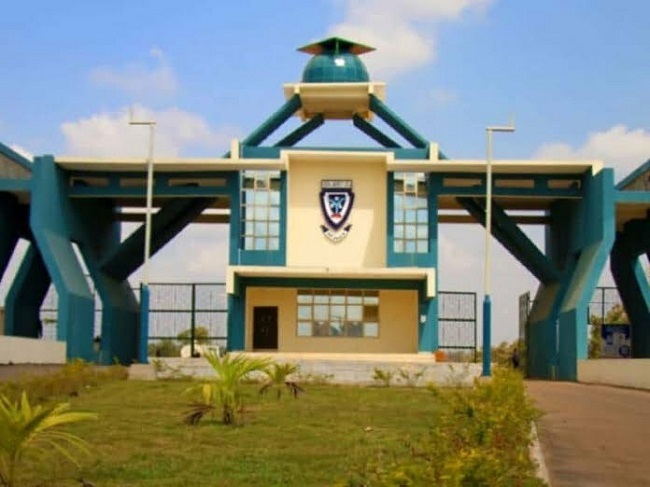
Federal University, Lokoja

The VC said that climate change and environmental degradation posed significant threats to the planet; as such, it was a collective responsibility to offer solutions and policies to mitigate the impacts.

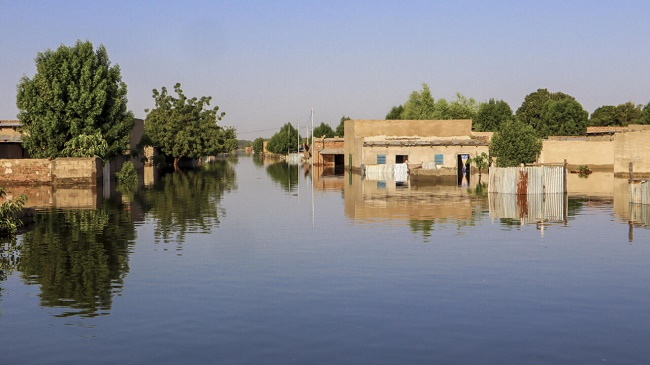
“Lokoja, the confluence of the Niger and Benue rivers, had witnessed a devastating consequence of recurrent floods and environmental challenges.

“These realities compel us not only to study climate change but to pioneer sustainable solutions that will safeguard lives, livelihoods, and the future of generations,” he said.

According to him, the centre is more than a research hub but a beacon of hope, innovation, and resilience.

Akinwumi added that the centre would serve as a hub for interdisciplinary research, collaboration, and knowledge-sharing, fostering a deeper understanding of these complex issues.

He explained that it would provide evidence-based research, policy direction, and community-focused interventions to mitigate the impacts of climate change.

“It will also reduce flood vulnerability and promote sustainable development in Nigeria, Africa, and beyond,” Akinwumi said.

Also speaking, the Centre Director, Prof. Jimmy Adegoke, said that climate change was a global issue that demanded urgent attention to save humanity and the environment.

“Flooding is a major issue here in this region, due to climate change, which respects no boundaries.

“What is expected of us is urgent response, collaborative, and unwavering action to fight the trend for the good of humanity,” he said.

Earlier, the Chairman of the Local Organising Committee, Prof. Olarewaju Ifatimehin, said that the centre was both an academic unit and a beacon of resilience, innovation, and global collaboration.

He said that through cutting-edge research, policy engagement, and community outreach, the centre would serve as a hub for climate change adaptation and mitigation.

By Thompson Yamput