Even though governments are increasingly prioritising national interests in their economic and financial policies, these very priorities can still offer ways to achieve greater cooperation in tackling global warming.
This is the central message of a joint discussion paper presented on Wednesday, November 12, 2025, at the COP30 climate conference by the Potsdam Institute for Climate Impact Research (PIK) and the research team at KfW, one of the world’s leading promotional banks. The paper highlights the growing need for investment in fossil-free technologies and outlines incentive mechanisms for new international cooperation.
Keeping global warming below 1.5°C in the long run requires global CO₂ emissions to be reduced to net zero by the middle of the century. According to the authors, this will require a much faster ramp-up of investment in CO₂-free energy.
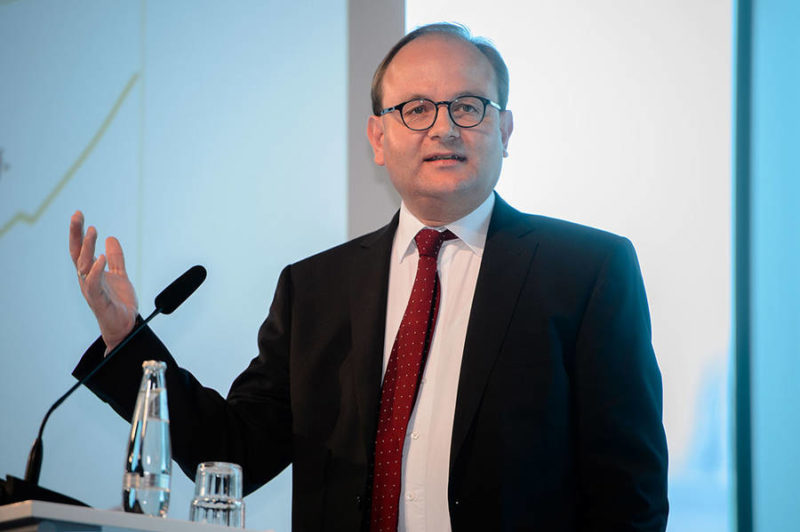
Ottmar Edenhofer, Chief Economist at the Potsdam Institute for Climate Impact Research (PIK), and author of the paper
While global investment in 2024 is estimated at around $2 trillion, annual needs are closer to $6 trillion up to 2050. If the current pace continues, an investment gap of $26 trillion would accumulate by 2036. In the Global South, investments would have to rise six- to nine-fold compared with current levels.
The paper by PIK and KfW Research highlights three key reasons why financing climate action in the Global South also serves the economic interests of wealthier countries: First, climate investments anywhere help limit climate damages, because the greenhouse effect does not respect national borders. Second, a truly global shift to fossil-free technologies can spur innovation and new industries at home. And third, a shift in the global balance of power away from dependence on oil-exporting countries can strengthen national sovereignty and energy resilience.
Minilateral cooperation as key strategy in geopolitically tense times
CO₂ emissions are currently rising at a particularly rapid pace in middle-income countries. Reversing this trend requires effective mechanisms that create incentives for cooperation and ensure that international climate finance delivers real results. The European Carbon Border Adjustment Mechanism (CBAM), which encourages trading partners to raise their climate ambitions, has great potential in this regard.
Another approach is a funding system that rewards countries based on the actual implementation of climate action. The analysis shows that large fossil fuel-importing economies could benefit from financial cooperation to support the energy transition in the Global South. Model simulations suggest that a “minilateral” coalition between the EU and China as investor countries, for example, could cut global demand for oil, gas and coal while also benefitting coalition partners more than it would cost them.
Such cooperation therefore not only benefits the planet but also supports national prosperity, due to the so-called terms-of-trade effect – reduced demand for fossil fuels lowers global demand and thus the world market price, which in turn reduces costs for domestic consumers. The avoided climate damage is an additional benefit.
Turning global challenges into new opportunities
“This example illustrates that geopolitical tensions and national interests need not stand in the way of effective global climate protection,” says PIK Director Ottmar Edenhofer, author of the paper.
“Joint action can emerge from national interests if the right incentive structures are in place. The EU’s carbon pricing combined with the new CBAM climate tariffs already illustrate this. Other countries are now introducing CO₂ prices – not out of green idealism, but because it benefits prosperity and growth.”
With US President Donald Trump skipping the UN’s climate summit in the Amazon, California Governor Gavin Newsom grabbed the spotlight on Tuesday, November 12, 2025, and unleashed a barrage of attacks on the fossil fuel agenda of his political nemesis.
The well-coiffed Democrat – seen as a potential 2028 presidential candidate – blasted Trump for twice leaving the Paris climate accord and for “doubling down on stupid” through his support of Big Oil.
Newsom said a future Democratic administration would rejoin the Paris Agreement “without hesitation.”
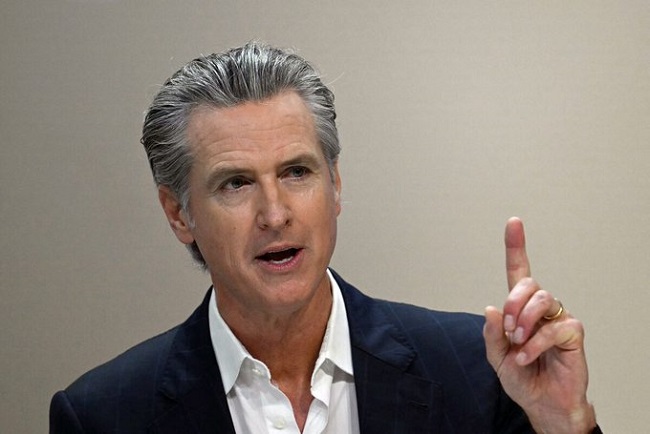
California Governor, Gavin Newsom
“It’s a moral commitment, it’s an economic imperative,” Newsom said in response to a question by AFP in Belem, the Brazilian Amazon city in northern Para state hosting the climate summit known as COP30.
It is “an abomination that he has twice, not once, pulled away from the accords.”
After returning to office in January, Trump withdrew the United States from the landmark Paris deal for a second time — the first was during his first term — and he has sneered at the idea of human-caused planetary warming, calling it a “con job.”
Newsom’s first appearance of the day came alongside Helder Barbalho, governor of Para, where he touted California’s green credentials between bites of tropical fruit and sips of acai juice – noting that the Golden State, the world’s fourth-largest economy, is now two-thirds powered by renewables.
He then launched into a whirlwind of meetings and press events with officials from Germany’s Baden-Wurttemberg state, Brazil’s minister for Indigenous Peoples and the Brazilian president of COP30 — all the while trailed by large media scrums normally reserved for national leaders.
Not part of negotiations
Still, there are limits. Regional leaders have no part of official negotiations at COP30, which opened on Monday with urgent calls to stay the course on climate action.
New Mexico Governor, Michelle Lujan Grisham, who also attended events on Tuesday, acknowledged these constraints.
“Certainly, our meetings with leaders at the UN and others was to demonstrate that we’re interested in any possibility that does more about that direct negotiation and representation,” she said.
Her aim in coming, she added, was to show that “when the federal government leans in, we do more, and when they lean out, we do more. It’s both.”
But Christiana Figueres, an architect of the Paris Agreement, said the summit was better off without Trump’s government showing up.
“I actually think it is a good thing,” she said, suggesting that while the United States may work behind the scenes with petrostates including Saudi Arabia, “they can not take the floor” and directly bully other nations.
‘Trump is temporary’
Even without a seat at the table, US states and cities have concrete power.
A recent analysis by the University of Maryland found that if these governments ramp up their efforts – and a climate-friendly president is elected in 2028 – US emissions could fall by well over 50 percent by 2035, approaching the 61-66 percent reduction targeted by Biden’s administration.
“The president can’t throw a switch and turn everything off – that’s not how our system works,” Nate Hultman, who led the report, told AFP.
The market-driven green shift remains a strong factor including in US states with climate-hostile leadership, like Texas, the country’s renewable energy generation leader last year, added Hultman, who previously worked for Democratic presidents.
Even so there are questions over how far state-level action can go without federal support. Trump’s Republicans recently passed a law bringing an early end to clean energy tax credits, seen as a potentially crippling blow to the renewable sector.
Beyond pushing for more drilling at home and declaring war on green energy, Trump’s administration recently torpedoed international efforts to impose a carbon tax on shipping by vowing reprisals against countries that backed the plan.
Newsom urged nations to hold firm against further intimidation efforts, saying it was vital to remember “Trump is temporary” and that “you stand up to a bully.”
African climate negotiators have outlined a unified set of priorities for the major UN climate change conference (COP30) in Belém, Brazil, highlighting climate finance as top priority.
Chair of the African Group of Negotiators on Climate Change (AGN), Dr. Richard Muyungi, says COP30 must deliver “ambitious, balanced, fair and just outcomes across adaptation, mitigation, loss and damage, and climate finance,” emphasising that negotiations must be anchored in the latest science and the principles of equity and common but differentiated responsibilities and respective capabilities (CBDR–RC).
Chair the African Group of Negotiators (AGN), Dr. Richard Muyungi
He warned that despite contributing less than 4% of global emissions, Africa faces rapidly intensifying climate impacts and requires outcomes that reflect its “special needs, developmental context, and heightened vulnerability.”
The negotiators called for a clear alignment between financing flows and the ambition reflected in countries’ next round of Nationally Determined Contributions (NDCs 3.0).
Key demands include concrete steps to operationalise US$1.3 trillion annually by 2030 and the US$300 billion climate finance goal.
This year’s global climate summit kicked off in the Amazonian city of Belém in Brazil, amid a warning from United Nations Climate Change Executive Secretary, Simon Stiell, that the world is not doing enough to combat the crisis, and strategic compromises over the elements of the official agenda of the summit.
At the opening plenary, the UN climate chief said the world is not moving fast enough to confront the climate crisis but was quick to note that global cooperation had at least prevented “an impossible future” of runaway heating.
“We have so much more work to do. We must move much, much faster; both in reducing emissions and in strengthening resilience,” he told delegates.
Stiell credited the Paris Agreement, adopted 10 years ago, with bending the curve of projected global heating from as high as 5°C to below 3°C, saying “it is still perilous, but it proves that climate cooperation works”.
He said success now depends on two interlinked pillars: stronger, more credible national climate plans, the Nationally Determined Contributions (NDCs); and the financing to make them possible.
“Plans without finance cannot reach their full potential,” he said.
Finance is the great accelerator
Stiell pointed to the Baku to Belém Roadmap, a new initiative that seeks to increase global climate finance from about US$300 billion a year to US$1.3 trillion by 2035, describing it as a shared investment in “stability and prosperity” and noting that countries acting fastest on clean energy would reap the greatest economic benefits.
“Every dollar invested in climate solutions brings multiple dividends; jobs, cleaner air, better health, resilient supply chains, and stronger energy and food security,” he said.
Supporters hailed the roadmap as an ambitious but necessary step to close the gap between climate pledges and real-world funding.
Brazil, hosting COP30 under President Luiz Inácio Lula da Silva, described the roadmap as “a blueprint for collective resolve.” The Brazilian delegation urged negotiators to focus on fairness and delivery rather than rhetoric.
“The science is clear, the moral imperative undeniable. What remains is the resolve,” they said.
Mohamed Adow, founder and director, Power Shift Africa, said: “COP30 must deliver the priorities for Africa and the wider developing world which are clear: we need a fair deal that delivers finance for adaptation in vulnerable countries and supports a just transition to renewable energy.
“These are not acts of charity, but investments in a stable, liveable planet. We need to see the sharing of clean energy technology by the global north with the global south, and we need to see more national climate plans published by all countries, laying out how we’re going to accelerate the momentum towards a safe and prosperous planet for us all.”
Over the next two weeks, the COP30 Presidency is understood to be positioning the summit as a political reckoning that will test whether the Paris Agreement, the crown jewel of international climate diplomacy, can still deliver results at scale.
Growing fatigue in climate process
Since 2015, global emissions have plateaued but not fallen fast enough. The 1.5°C target, the threshold scientists warn the world must stay below to avoid catastrophic consequences, is slipping out of reach.
The Belém conference comes amid growing fatigue and distrust in the global climate process, particularly over financing and equity. The Baku to Belém Roadmap aims to restore faith by setting a long-term financing goal, but key questions remain unanswered: who pays, how much, and under what terms.
Omar Elmawi, Convenor of the Africa Movement of Movements, noted: “We cannot keep sailing blindly into a climate apocalypse while pretending everything is merry. COP30 must be the turning point, where words become action, and promises become justice. Over eight billion people globally are looking at Belém to be the moment we will all look back to and celebrate and not one we curse.”
For Africa, COP30 is a moment of reckoning. The continent contributes less than 4 per cent of global emissions but bears the heaviest costs of climate change, from droughts and cyclones to collapsing agricultural yields and energy insecurity.
African negotiators have consistently argued that without predictable, affordable finance, developing nations cannot deliver on their commitments. The Baku to Belém Roadmap could be transformative if implemented fairly, ensuring that new funds reach life-saving adaptation projects in vulnerable communities, not just emissions reductions in middle-income economies.
African countries are also demanding a rebalancing of the climate finance equation to include more grants, fewer debt-driven instruments, and direct access for local governments and institutions.
The hope is that the roadmap will address long-standing inequalities that have left Africa sidelined when it comes to green investment.
The Global Initiative for Information Integrity on Climate Change on Wednesday, November 12, 2025, launched the Declaration on Information Integrity on Climate Change at COP30, establishing shared international commitments to address climate disinformation and promote accurate, evidence-based information on climate issues.
The Declaration commits signatories to promote the integrity of information related to climate change at international, national and local levels, in line with international human rights law and the principles of the Paris Agreement.
Drafted in collaboration with civil society members of the Global Initiative Advisory Group, the Declaration has been endorsed by 10 countries so far – Brazil, Canada, Chile, Denmark, Finland, France, Germany, Spain, Sweden and Uruguay.
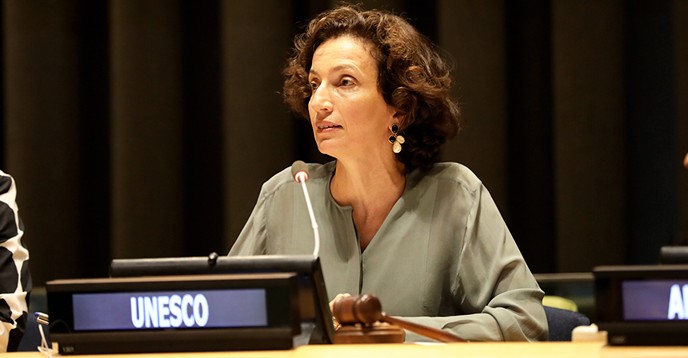
Audrey Azoulay, UNESCO Director-General
“Climate change is no longer a threat of the future; it is a tragedy of the present,” said President of Brazil Luiz Inácio Lula da Silva in Belém. “We live in an era in which obscurantists reject scientific evidence and attack institutions. It is time to deliver yet another defeat to denialism.”
The Declaration calls on governments, the private sector, civil society, academia and funders to take concrete action to counter the growing impact of disinformation, misinformation, denialism and deliberate attacks on environmental journalists, defenders, scientists and researchers that undermine climate action and threaten societal stability.
“We must fight mis- and disinformation, online harassment, and greenwashing,” said UN Secretary-General, António Guterres, in the lead-up to COP30. “Through the Global Initiative for Information Integrity on Climate Change, Governments and organisations are working together to fund research and action promoting information integrity on climate issues. Scientists and researchers should never fear telling the truth.”
“Without access to reliable information about climate disruption we can never hope to overcome it. Through this initiative, we will support the journalists and researchers investigating climate issues, sometimes at great risk to themselves, and fight the climate-related disinformation running rampant on social media,” urged Audrey Azoulay, UNESCO’s Director-General, at the launch of the Initiative.
The Declaration emphasises that mobilising all actors in society requires access to consistent, reliable, accurate and evidence-based information on climate change, which is indispensable for raising awareness, fostering public participation, enabling accountability and building public trust in urgent climate policies and actions.
Key Commitments
Under the Declaration, signatories commit to:
Promote the integrity of information related to climate change in line with international human rights law, including freedom of expression standards
Support the sustainability of a diverse and resilient media ecosystem to ensure accurate and reliable coverage on climate and environmental issues
Support the inclusion of information integrity commitments into the Action for Climate Empowerment agenda under the UNFCCC
Promote informed and inclusive climate action by advancing equitable access to accurate, evidence-based, understandable information for all
Foster cooperation and capacity-building to address threats to information integrity, safeguarding those reporting on and researching climate issues
With resources falling short of needs globally, the Declaration calls on governments to ensure funds to research climate information integrity, especially in developing countries.
It also urges the private sector to commit to information integrity in their business practices and ensure transparent, human-rights responsible advertising practices that bolster information integrity and support reliable journalism.
Four New Countries Join the Initiative
The Global Initiative announced that Belgium, Canada, Finland and Germany have joined as new member countries, bringing the total membership of States to thirteen.
This expanded membership reflects growing international recognition that threats to information integrity represent one of the defining challenges of our time, weakening the foundations of public debate and undermining societies’ capacity to build collective solutions to the climate crisis.
Global Fund Supports First Projects
Since its launch in June 2025, the Initiative’s Global Fund for Information Integrity on Climate Change has received 447 proposals from nearly 100 countries. With initial funding of $1 million from the Government of Brazil, the Fund has begun supporting its first wave of projects across multiple continents, with nearly two-thirds of eligible proposals originating from the Global South.
The Declaration recognises the central role of the Global Initiative in strengthening global cooperation to uphold the integrity of information related to climate change and calls on funders to donate to the Global Fund and support projects that promote information integrity locally, nationally and internationally.
A new civil-society report, “Inequity, Inequality, Inaction”, has delivered a stark verdict: three decades after the Rio Earth Summit and a decade on from the Paris Agreement, governments are still protecting profits over people – shielded by elite capture and fossil-fuel disinformation. Climate cooperation is breaking down, and COP30 must deliver a fair-shares reset rooted in justice, not greed.
The report shows that Global North countries have failed to cut emissions and are still expanding oil and gas, while also failing to deliver promised finance. The global finance system is failing too: instead of providing public funds at the scale needed, it traps many countries in debt and dependence.
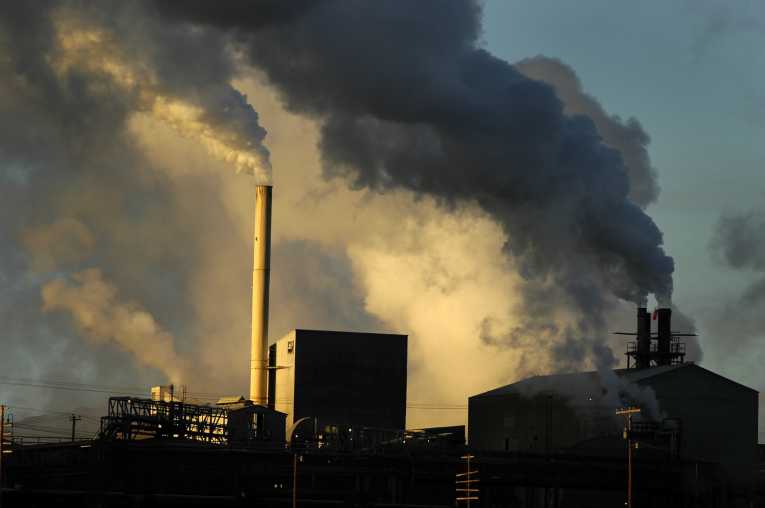
Greenhouse gas increases: Global North countries have failed to cut emissions and are still expanding oil and gas. Photo credit: earthtimes.org
While the Global South is closer to meeting its fair share, it still needs to take more effective climate action but is all too often held back by this debt and lack of funds. Climate cooperation is paralysed, and global goals will remain out of reach unless COP30 delivers a reset – moving from loans to grants, from profit-driven finance to public support that enables countries to invest in clean energy, resilience, and jobs.
The collapse of ambition at COP29 in Baku left trust in ruins and cooperation stalled. The Global South’s calls for trillions in real public finance were met with token pledges and false accounting, leaving the poorest nations trapped between debt and disaster. COP30 in Belém is therefore more than another negotiation – it is a chance to rebuild trust, deliver fair shares, and keep climate ambition alive.
The report also warns that inequality within countries is driving the crisis. The global rich can shield themselves from many climate impacts while pushing the costs of transition and disaster onto workers and overstretched public systems. This elite capture – particularly by fossil fuel interests – of crucial political processes is deepening injustice, fuelling political paralysis, and blocking the stronger action needed to keep us within climate limits. This paralysis extends to militarised conflicts that divert trillions from climate action – COP30 must redirect those resources to peace and genuine multilateral cooperation.
In the face of this systemic failure, incrementalism is obsolete. COP30 must confront this political reality with a new climate realism – one that pushes ahead with rapid transformative change anchored in equity, justice, and cooperation.
Climate failure isn’t about a lack of ambition – it’s about injustice. COP30 must prove that ambition and justice are not opposites but inseparable: only fair shares can unlock the scale of action needed.
What COP30 must deliver
The report identifies three breakthroughs COP30 must achieve:
1. Fair-shares NDCs: clear commitments on finance and fossil fuel phaseout.
2. A finance reset: a radical overhaul of international financial architecture, shifting from debt and loans to substantial public, grant-based support, including debt cancellation and global taxation.
3. Just transition frameworks: putting workers, women, youth, and Indigenous peoples at the centre, breaking elite capture through progressive taxes and zero-carbon economic shifts, while redirecting militarised resources towards peace, cooperation, and strengthened democratic institutions and human rights law, with protection for jobs, schools, healthcare, housing, and transport.
Tasneem Essop, Executive Director, Climate Action Network International, said:“Climate ambition and climate justice are not competing visions – they are one and the same. But both are being strangled by elite capture and fossil lies. Belém must break that grip, reset cooperation on fair shares, and put power back in the hands of people and communities. The Global North must end its wealth hoarding and deliver its overdue debt – in trillions for climate finance, in a rapid fossil-fuel phaseout, and in restoring trust through real solidarity, not empty rhetoric.”
Hemantha Withanage, Chair, Friends of the Earth International:“Ten years after the Paris Agreement we see the familiar story of wealthy Global North countries falling far short of delivering their fair share of emissions reductions and international climate finance, even as they gaslight and blame larger Global South countries for the accelerating climate crisis.
“Conversely, the majority of Global South countries, despite facing severe climate impacts, have made pledges close to, or exceeding their fair share of climate action. What is stark in this analysis is the role of elites in perpetuating this disastrous and willful inaction. We must tackle inequality and elite emissions by confronting power, privilege, and historical injustice and fighting for system change.”
Alex Rafalowicz, Executive Director of the Fossil Fuel Treaty Initiative: “The new report shows how fossil fuels drive inequality in every sense – within nations, enriching elites at the expense of the people, and between nations, trapping vulnerable countries in poverty and debt. It reveals decades of sabotage: wealthy countries expanding fossil fuel exploitation while depriving the Global South of financing. We must end this injustice by tackling its source: delivering fair-share funding, equitably phasing out fossil fuels, and prioritising people over profits.
“This crisis has never been about a lack of solutions but about making the right political choices. Countries like Colombia and the Small Island States are leading the charge to build a fossil-free future through a Fossil Fuel Treaty. They are proving that true climate leadership comes from those most impacted, not from polluters blocking progress. The path forward is clear; the question is whether governments will finally follow the courage of those already leading the way.”
Niranjali Amerasinghe, Executive Director, ActionAid USA:“After 10 years of the Paris Agreement, it is absolutely unacceptable that rich developed countries are failing to contribute their fair share of climate action. These countries – especially the United States – have not cut emissions sufficiently in the past decade. Worse, they also are not making meaningful commitments to accelerate action in the future, even as global temperature goals are breached and the science is extremely clear that much more urgency is needed from the world’s historical polluters.
“On top of that, rich countries are also failing utterly to provide climate finance – support for poorer and more vulnerable countries to implement their own climate goals. Climate finance is a cornerstone of the Paris Agreement; without it, the entire structure of international climate cooperation falls apart. Rich countries must do their part – there is no time left to wait.”
Lidy Nacpil, Coordinator, Asian Peoples Movement on Debt and Development, APMDD:“The Report proves that the NDCs approach to international climate action where governments simply define what they are willing to do without any due regard for the consequences for the common climate goal, or for the principles of equity and fairness, and for what the science says is failing. Governments must be compelled through citizens actions to do what is right for humanity and for the planet. This is a call that we, all citizens of the world, must step up and escalate pressure on all governments, but especially those from the Global North.”
Mark Lutes, WWF Senior Advisor Global Climate Policy: “At a time when the need for scaled up climate action and support is blindingly obvious, and global conflicts and authoritarianism threaten to displace cooperation and multilateral institutions, a principled equitable approach to global climate action is more important than ever. This report cuts through the excuses and provides a clear vision for who should do what when as part of a fair and equitable effort-sharing to meet our shared climate objectives.”
Mariana Paoli, Global Advocacy Lead, Christian Aid: “This year’s report is a wake-up call for the climate community and beyond. The energy transition we urgently need – one that phases out fossil fuels and centres fairness – will not happen without a radical shift in the global economy and a deep reform of the international financial system. Without structural change, climate action will continue to fall short.”
“The climate crisis is a justice crisis. Developed countries must take responsibility not only for their failure to deliver meaningful climate action, but also for perpetuating a global economic system that entrenches inequality and neo-colonial control. To unlock real progress, we need to democratise economic decision-making and redirect financial flows toward the global South. It’s time for wealthy nations to act in the interests of the global majority.”
Tom Athanasiou, Climate Equity Reference Project:“Paris could have been a turning point. It posited a world in which all countries – both the wealthy and the rest – would do their parts, as they saw them, to stabilise the climate system. The Paris Agreement wasn’t ideal – there were no agreed national fair shares, and of course there was no enforcement. But there was a chance, and it was real.
“Today, 10 years later, the guarded hope has dissipated. How could it not, when the wealthy have utterly failed to do their fair shares? The Global South countries – with important exceptions – have done better, but absent the finance and technology support they need to leapfrog to a post-carbon world, it has not been enough. They have not been able to break the death grip of the fossil fuel complex.
“In this report, we’ve looked back upon the squandered opportunities of the last decade and drawn conclusions. We have, in particular, concluded that the finger of blame must be pointed at the world’s rich, who have used their wealth to amass far too much political power, and used that power to service their conceits and self-interests. This is not exactly news, but neither have the dots been clearly connected.
“The brutal fact is that the world’s rich could easily afford to finance a global just transition. The necessary expenditures, though huge, are far smaller than their holdings. They would hardly know the difference. There is little time now. Even as the government’s deadlock, the natural world is hitting its first tipping points. This really is, now, the time of consequences.”
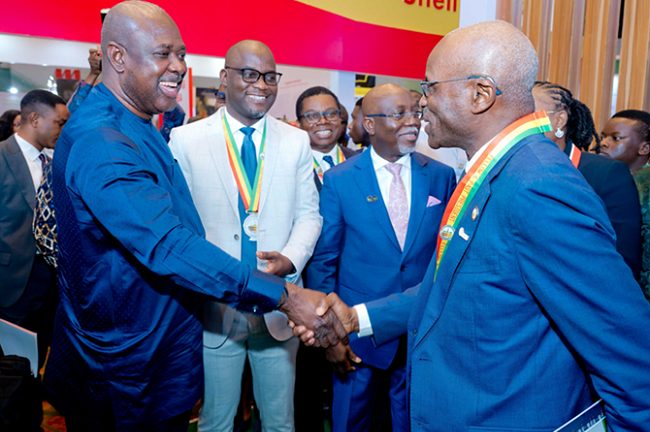
Nigeria’s Minister of State for Petroleum (Oil), Senator Heineken Lokpobiri, has commended the leadership and staff of Renaissance Africa Energy Company Limited for driving the oil and gas output increase less than a year after the deal that saw the exit of Shell from onshore Nigeria. The $2.4 billion deal resulted in Renaissance emerging the operator of the biggest joint venture in Nigeria’s oil and gas industry.
The Minister’s commendation came during his visit to the exhibition booth of Renaissance at the ongoing 43rd annual international conference of the Nigerian Association of Petroleum Explorationists (NAPE) in Lagos.
Nigeria’s Minister for Petroleum (Oil) Senator Heineken Lokpobiri (left), is received by the Chairman of Renaissance Africa Energy Company Limited, Dr. Layi Fatona (right), during the minister’s visit to the company’s exhibition booth at the ongoing 43rd annual international conference of the Nigerian Association of Petroleum Explorationists (NAPE). With them are the President of NAPE, Johnbosco Uche (2nd from left); Chief Operations Officer & Executive Director, Seplat Energy Plc, Samson Ezugworie; and the Governor of Ondo State, Lucky Orimisan Aiyedatiwa… at the conference in Lagos.
Receiving the minister and NAPE leadership, Chairman of the Board of Renaissance, Dr. Layi Fatona, reiterated the company’s commitment to continuing on the trajectory of growth which has ramped up the company’s production post the share sale deal by over 40 percent and restored uninterrupted gas supply to the Nigeria LNG plant.
“Renaissance, as operator of the joint venture, holds a portfolio spanning onshore and shallow-water terrains, as well as the Bonny and Forcados crude export terminals and the Sea Eagle FPSO. We are aware of just how much our nation needs for us to succeed and we remain focused,” Dr. Fatona said.
According to Dr. Fatona, Nigeria retains enormous strategic advantages in today’s energy world because the country holds world-class reserves; a young and dynamic population; entrepreneurial agility, and resilience to innovate forward.
“This is why, at Renaissance, we spend time with young talents, to help the upskilling of Nigeria’s youthful energy talent and help them appreciate the opportunities available to achieve incredible targets and join to industrialise our nation with our energy resources,” Dr. Fatona said.
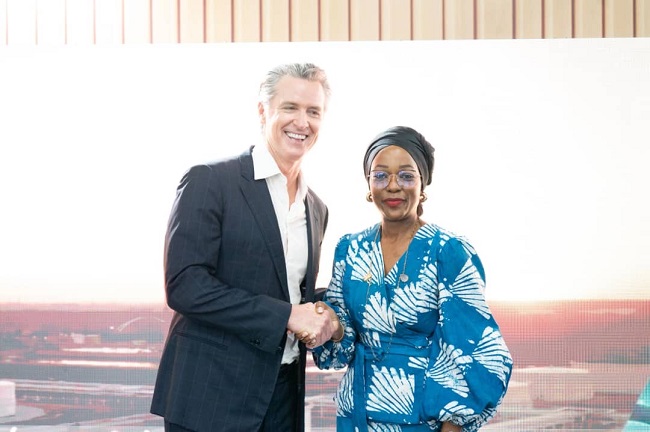
The Federal Republic of Nigeria and the State of California of the United States of America on Wednesday, November 12, 2025, signed a Memorandum of Understand (MoU) to strengthen their cooperation on climate, environment and trade.
Mrs. Tenioye Majekodunmi, the Director-General, National Council on Climate Change Commission (NCCC), said this during the signing on the side of 3Oth United Nations Climate Change Conference of the Parties (COP30) in Belem, Brazil.
Majekodunmi said that the partnership would immensely reinforce the parties.
Mrs. Tenioye Majekodunmi, the Director-General, National Council on Climate Change Commission (NCCC), with the Governor, State of California, Mr. Gavin Newsom
According to her, the parties had desired to enhance actions and policies to further strengthen and coordinate efforts to combat climate change, protect the environment, and strengthen trade relations.
“Nigeria is scaling up its technology, clean energy, creative industry and agricultural economic sectors, which complement California’s key economic sectors.
“Nigeria has committed to being a country of net-zero emissions across all sectors of its development and climate-resilient with high-growth circular economy in a gender-responsive manner by 2060.
“By 2050 Nigeria’s population will grow from 240 million people to 400 million people, and this demographic growth represents a vast workforce and consumer base to drive economic growth,” she said.
According to her, the purpose of the MoU is to establish a flexible framework, to collaborate on protecting the environment, combating climate change, and strengthening economic ties.
In his remarks, the Governor, State of California, Mr. Gavin Newsom, said the MoU would strengthen the parties to promote the protection of the natural and built environment, as well as reduce air pollution and carbon emissions.
Signing of the MoU between Nigeria and California
According to him, the common objectives of the MoU include advancing medium- and long-term low-carbon development and national climate plans; promoting policy research, development and innovation for sustainable transportation and clean energy goals.
“It is also aimed at promoting mutually beneficial trade relations and opportunities for private sector collaborations, as well as public-private partnerships within the targeted areas of cooperation outlined below.
“It focuses on advancing policy research, development, and innovation in sustainable land use and urban planning that reduces long commutes and urban sprawl, while promoting integrated land use and transportation systems,” he said.
Governments and everyday people have been charged to acknowledge that nature has rights just as humans do, and that ecosystems deserve to exist, thrive, and bounce back.
The submission is contained in a declaration released by the International Rights of Nature Tribunal at a side event at COP30 to mark the close of its 6th international tribunal. The declaration is titled: “A New Pledge for Mother Nature”.
The Tribunal noted that the loss of species is occurring at an alarming rate and that it is time to stop exploiting nature and start protecting it.
Nnimmo Bassey, co-president and judge of the International Rights of Nature Tribunal
The Tribunal urged nations to write laws that protect rivers, forests, oceans, and to end ecocide, recognise and support Indigenous communities, who have always been the best caretakers of the land.
The pledge, among other things, noted that “We are all part of the Earth, an indivisible and living community of interrelated and interdependent beings with a common destiny but with different existential conditions and rights. The multiple crises we are experiencing are rooted in the economic, political, legal and social systems established by the industrial and growth-oriented cultures that dominate the world today, including capitalism, along with patriarchy, sexism, racism, and anthropocentrism.”
It was noted that the choice by the Brazilian government to host COP30 serves as a symbol of the importance of the Amazon. They denounced the current and future impacts of the expansion of the extractivist frontier, deforestation, fossil fuels and large-scale mining.
It was urged that the Amazon, with its ecosystems, animal, plant species, and rich biodiversity, natural medicines and its vital and reproductive cycles, should be considered as a subject of rights together with the Indigenous Peoples, and other communities that inhabit it.
The co-president and judge of the tribunal, Nnimmo Bassey, while delivering the verdict, noted that the defence of the rights of Nature is the right way to carry out real climate action and that there is no climate justice without the rights of Nature.
The tribunal stressed the need to phase out fossil fuels and quickly move to renewable energy as a way that protects both communities and ecosystems from false solutions that merely benefit financial speculators and compound climate injustices. The Tribunal also urged the United Nations to adopt the pledge as a blueprint for international environmental law.
Judges at the Tribunal included Ana Alfinito of Brazil, Nnimmo Bassey ( Nigeria), Enrique Viale (Argentina), Shannon Biggs (USA), Casey Camp Horinek (Ponca Nation, USA), Tom Goldtooth (USA), Princes Esmeralda (Belgium), Cormac Cullinan (South Africa), Patricia Gualings (Ecuador), Francesco Martone (Italy) Tzeporah Berman (USA), Ashish Katharine (India), Osprey Orielle Lake (USA), Pooven Moodley (South Africa) and Felicio Pontes (Brazil).
The International Energy Agency (IEA) on Wednesday, November 12, 2025, called on governments to diversify supplies and increase cooperation as global need for energy continues to grow.
The Paris-based agency warned of “pressing energy security threats and growing longer-term risks across an unprecedented range of fuels and technologies” as it released its flagship World Energy Outlook.
The outlook highlights that, while renewable energies were deployed at record rates for a 23rd consecutive year in 2024, traditional sources of energy like oil, natural gas and coal also hit all-time highs.
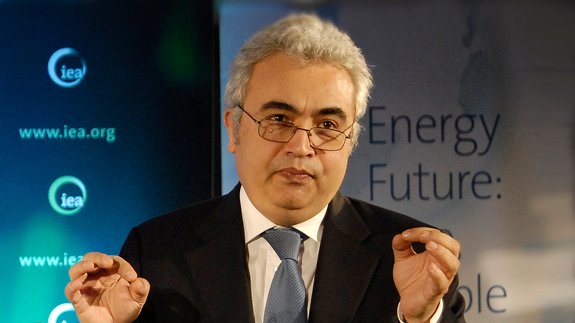
Fatih Birol, Executive Director of the International Energy Agency (IEA)
“When we look at the history of the energy world in recent decades, there is no other time when energy security tensions have applied to so many fuels and technologies at once,” said IEA head, Fatih Birol.
“With energy security front and centre for many governments, their responses need to consider the synergies and trade-offs that can arise with other policy goals on affordability, access, competitiveness and climate change.”
The report presents three scenarios “none of which is a forecast” the agency stresses based on the latest data policies, technologies and markets and aided by modelling.
In all three scenarios the Current Policies Scenario (CPS), the Stated Policies Scenario (STEPS) and the Net Zero Emissions by 2050 (NZE) Scenario.
The world is projected to surpass the threshold of 1.5 degrees Celsius above pre-industrial levels.
The NZE scenario however, would see temperatures dropped back below the 1.5-degree threshold in the long term, the agency said.
It insisted that, while the energy sector must be set up to deal with the security risks brought by higher temperatures, “there is still scope to avoid the worst climate outcomes.”
Birol said that the consumption of electricity in no longer growing merely in emerging and developing economies, marking a change in trend.
“Breakneck demand growth from data centres and AI is helping drive up electricity use in advanced economies, too,” Birol said.
“Last year, we said the world was moving quickly into the Age of Electricity and it’s clear today that it has already arrived.
“Global investment in data centres is expected to reach $580 billion in 2025.
“Those who say that ‘data is the new oil’ will note that this surpasses the $540 billion being spent on global oil supply a striking example of the changing nature of modern economies,” the IEA chief noted.
In response to the IEA’s World Energy Outlook, observers have submitted that the governmental OECD and global think tank has shown how it largely does not have its finger on the pulse of where most countries are at regarding support for net zero emissions.
“Even if temperature overshoot is very likely in the next few decades, getting below 1.5C° is still possible with political will. This is crucial, as across the world people and ecosystems are already experiencing more frequent weather disasters, sea level rise and heatwaves. While the likely prioritisation by the IEA of its new Energy ‘Access’ scenario shockingly ditches the UN SDG agreement to overcome energy poverty by 2030 and moves that goal to 2040.”
Dr Stephan Singer, Global Energy Senior Advisor, CAN International, said:“In a nutshell, the IEA is backsliding. As a global think tank, the IEA has largely failed to represent where most countries in the OECD and the developing world are, as they’re supporting net zero emissions with 98% CO2 emissions reductions by mid-century. The IEA has also failed to put the global 1.5 C objective as the fundamental centre piece of its WEO and across all their reasoning and missed out on calling the other scenarios what they are – a strong violation of the Paris Agreement. Even if temperature overshoot is very likely in the next few decades, getting below 1.5C° is still possible with political will.”
Svitlana Romanko, Founder and Executive Director of Razom We Stand, said:“While this vital new report highlights the urgency of quickly transitioning to renewables to achieve energy security and a chance to stop climate disruption, it also gives hope. We can clearly see that clean energy is now cheaper than ever, and its rapid buildout is happening at a faster pace than ever. In Ukraine, this also gives us hope, because the faster we can end global consumption of fossil fuels, especially those from Russia, the quicker we can dry up the Kremlin’s funded war, and have a chance for a just peace in Ukraine.”
Mohamed Adow, Founder and Director of Power Shift Africa, said: “The march of clean energy is now unstoppable and it’s offering a lifeline to people in Africa and around the world living with the impacts of the climate crisis. Not only is it cheaper and cleaner than fossil fuel, renewable energy is also far more agile, adaptable and quicker to get up and running. For Africa this is a huge opportunity. We have an abundance of wind and solar potential that can power our development, but this report also shows that keeping global heating rise to 1.5C is still possible with the right investments and a phase out of fossil fuels.
“We need countries at the COP30 climate summit to heed the message of this report and realise they have nothing to fear from committing to a phaseout of fossil fuels, something that Brazil’s President Lula has mooted could be on the table. In fact, when it comes to the impacts of the climate crisis that are biting hard around the world, countries would be mad not to embrace the benefits of the clean energy revolution.”
Kaisa Kosonen, Senior Policy Advisor, Greenpeace Nordic, said: “This report clearly shows we still have a choice: a path still exists to avoid the worst of climate disasters by defending the Paris Agreement 1.5°C warming limit and it comes with many benefits. That’s the path governments in Belém must take, by agreeing on a roadmap for a fair fossil fuel phase out. The great news here is that solar, wind and energy smart solutions are ready to deliver faster CO2 cuts than what countries currently assume in their pledged climate targets. So the key is to push fossil fuels out of the way, and eliminate barriers related to grids, storage and climate finance gaps.
“Regardless of which future scenario you looked at, the winners are clear. The future will be increasingly powered by cheap, abundant renewable energy, coupled with electrification. But we need to speed up and scale up and governments at COP30 must now agree on a global response plan to urgently bridge the 1.5°C ambition gap.”
David Tong, Global Industry Campaign Manager at Oil Change International, said: “This year’s World Energy Outlook makes the choice clear: uphold 1.5ºC with no new fossil fuels and a just energy transition, accept a business-as-usual path to 2.5ºC, or backslide into a nightmare future. Under U.S. pressure, the IEA reintroduced a regressive obsolete scenario. Despite the industry spin, the facts of the WEO show Donald Trump’s path is a dystopian energy fantasy with high energy costs and climate disaster. The IEA affirms that breaking free from fossil fuels is the best, most affordable way to secure energy for all. At COP30, governments must commit to a fast, fair, and funded phase-out of fossil fuels.”
Maria Pastukhova, Programme Leader Energy Transition at E3G, said: “This year’s World Energy Outlook makes the choices for the global energy system and the global economy unambiguous. The Current Policies Scenario points to continued fossil fuel dependence, persistent market volatility, and structurally high energy prices… If countries want to grow their economies and protect their citizens from rollercoaster energy prices, they need to focus relentlessly on energy efficiency and the decarbonisation of energy demand. These are not just climate measures: they are economic imperatives.”
Dr. Rachel Cleetus, Senior Policy Director for Climate and Energy, Union of Concerned Scientists, said:“The IEA’s latest report underscores the daunting challenge ahead for rapidly decarbonizing the world’s economy but also highlights the tremendous opportunity to do so in a way that prioritizes renewable energy, energy efficiency, climate resilience and addressing energy poverty. With the world on the brink of overshooting 1.5C, it’s crucial to double down on clean energy policies and investments that align with climate and sustainable development goals.
“A fast fair phaseout of fossil fuels – coal, oil and gas – is also essential, yet nations continue to recklessly expand these polluting sources of energy. Contrary to the IEA’s framing, cooperation among countries will be key to accelerating the manufacture and deployment of clean energy technologies globally. At COP30, we need world leaders to live up to the commitments they made in Dubai to advance a clean energy transition within this critical decade.”
Mariana Paoli, Global Advocacy Lead, Christian Aid, said:“The IEA’s report confirms what many climate-vulnerable communities have known for years: the fossil fuel era is ending, but governments are still dragging their feet when it comes to building the clean energy systems that need to replace it. Oil and coal are peaking, renewables are surging, yet public money continues to flow into new fossil fuel projects that the IEA itself says we simply don’t need.
“This report underlines why the issue of funding the energy transition is so important. Developing countries want to embrace the benefits of clean energy and not follow the destructive fossil fuel development of the global north, but they need climate finance to allow them to do that.”
Janet Milongo, Senior Manager Energy Transition, CAN International, said:“The IEA World Energy Outlook illustrates that a full, fast, and funded phase-out of all fossil fuels is critical and urgent. The world needs renewable energy to deliver universal access and eradication of energy poverty for all people, while attaining the 1.5°C survival limit. Nuclear energy and other false solutions only delay real progress. Governments must lead the way to realize 100% renewables through enabling policies and step up with public finance to power a truly just transition that protects people, not polluters.”
Sriram Madhusoodanan, US Climate Action Network, Director of Policy & Advocacy, said: “The latest edition of the IEA’s World Energy Outlook is one more sad example of how the regressive mindset and bullying actions of the US government are having deadly consequences even though they are absent at COP30. Despite the signs of caving to US pressure – the scenarios outlined in the report must be a wake up call to delegates in Belem – most especially for Global North countries – if we are to stand any chance of a liveable planet. Delegates at COP30 have an opportunity to choose which of these scenarios becomes a lived reality for billions around the world. We hope they rise to the moment.”
Hari Krishna Nibanupudi, Global Climate Change Adviser, HelpAge International, said: “The IEA’s outlook confirms a stark truth: pathways that keep fossil fuels flowing lock in deadly heat, energy poverty and widening inequality. Only a rapid, fair transition to renewables and efficiency can protect lives – especially older people – while delivering affordable, clean energy and honouring the 1.5°C promise to future generations in all countries.”
The African Coalition of Communities Responsive to Climate Change (ACCRCC) appears to have cemented its position as a leading advocate for grassroots climate justice at the 30th Conference of the Parties (COP30) to the United Nations Framework Convention on Climate Change (UNFCCC).
At COP30, ACCRCC pushed for the recognition of pastoralist governance systems, particularly the “mom” dialogue mechanism used across the Kenya-Uganda border and other parts of eastern Africa. This traditional governance model – representing more than 50 million pastoralists – was highlighted as a vital climate adaptation and conflict management tool that aligns with the principles of global climate diplomacy.
Participants at the Local Communities and Pastoralists side event at COP30
“Our communities are not just victims of climate change; they are innovators, custodians of knowledge, and rightful actors in shaping global climate policy,” said Henry Neondo, Policy Advocacy and Influencing Advisor at ACCRCC, during the Mandated Dialogues on Community Inclusion.
Pastoralists across Africa face climate-related violence, and inadequate climate policies that do not solve their challenges from Uganda to Djibouti
Through active participation in the Local Communities and Indigenous Peoples Platform (LCIPP) and collaboration with partners such as the European Union, ACCRCC helped shape discussions on Decision 14/CP.29, which reinforces the inclusion of local communities across all UNFCCC workstreams.
Geert Freema, representative of the European Union, to discuss local community engagement emphasised the importance of respecting and promoting the rights of indigenous peoples and local communities in any working arrangements.
Freema stressed the need for transparent, inclusive, and constructive processes in enhancing local community participation but noted concerns about conflating local communities and indigenous peoples urging for recognition of the rights of both groups.
Participants pushed for the recognition of African pastoralist governance (“mom”) in adaptation dialogues, inclusion of grassroots leaders in the Facilitative Working Group (FWG) discussions and advocacy for direct climate financing to local governance structures. In addition, they urged for the elevation of local communities as rights and knowledge holders within global climate policy.
“Pastoralists do not need to be made resilient. They already practice resilience daily, relationally and collectively, let the UNFCC send a new kind of message, one that travels both ways, from crowds to the COP and from the COP to the crowds, from observation to co design, from policy for pastoralist to policy with pastoralists,” said Simon Longoli, a leader among the pastoral peoples of Uganda, linked to the Karamoja Herders.
COP21 held in Paris, France in 2015 established the local communities and indigenous peoples’ platform (LCI, PP) for the exchange of experiences and sharing of best practices on mitigation and adaptation in a holistic and integrated manner.
This recognition has been reinforced in several subsequent COPs and CMA decisions. During Climate Week in Ethiopia, local community representatives shared powerful accounts where communities, particularly pastoralists, emphasised their reciprocity and shared stewardship, as long-standing practices sustaining livelihoods and ecosystems for generations, noting that local organisations and leaders are not merely project implementers, but drivers of transformation that strengthens food systems social inclusion and resilience through their knowledge mobility.
ACCRCC will continue building continental networks of local climate governance platforms, strengthening engagement with national adaptation planning, and advocating for direct access to climate finance that empowers communities on the frontline.
“Climate justice begins with inclusion. Without grassroots voices, global climate solutions remain incomplete,” said Neondo.