

African climate leaders, government representatives, frontline communities and development partners have issued a call for renewed global commitment to climate justice, warning that the continent is being pushed to the brink by escalating climate‑induced losses and damages.
The declaration emerged from the 5th African Regional Conference on Loss and Damage, held from March 25 to 27, 2026, in Lilongwe, Malawi, where participants condemned the weakening political will of major emitters and the chronic underfunding of climate response mechanisms.
The communiqué paints a stark picture: despite contributing the least to global emissions, Africa continues to shoulder the heaviest burden of climate impacts.
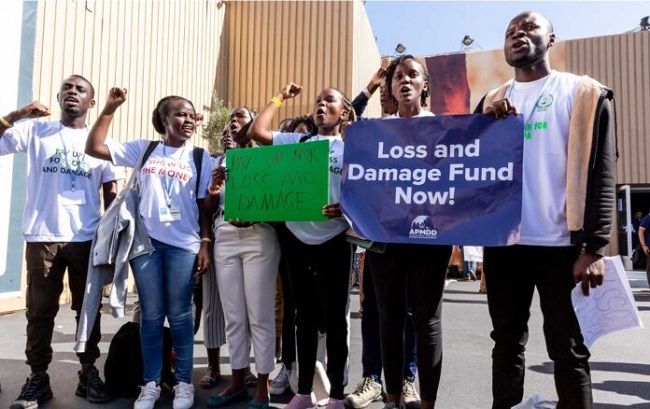
Delegates expressed deep concern that less than $1 billion has been mobilised globally for loss and damage over the past four years – an amount dwarfed by the $400–800 billion required annually. Even more troubling, only 10% of climate finance reaches frontline communities, while children and youth receive a mere 2.4%, leaving the most vulnerable with the least support.
Participants criticised the persistent reliance on debt‑creating finance, arguing that loans for climate response only deepen the fiscal crises of African nations already struggling with poverty, debt distress and limited fiscal space.
They emphasised that loss and damage is not a humanitarian gesture but a matter of reparatory justice, rooted in historical responsibility and supported by international legal principles. The communiqué referenced the 2025 International Court of Justice Advisory Opinion, which affirmed binding state obligations under customary international law, and drew inspiration from the recent UN resolution recognising the transatlantic slave trade as a grave crime against humanity.
While acknowledging progress such as the operationalisation of the Santiago Network on Loss and Damage (SNLD) and the Barbados Implementation Modality, delegates stressed that these mechanisms remain too distant from affected communities. They called for simplified, decentralised and community‑led access pathways within the Fund for Responding to Loss and Damage (FRLD), ensuring that resources reach the “last mile” where impacts are most severe.
The conference also highlighted Africa’s strategic opportunity as host of COP32, urging the continent to use this moment to redefine global norms and push for loss and damage finance to be recognised explicitly as part of a broader reparatory justice framework. Delegates pressed the African Union to establish a continental coordination mechanism and a Pan‑African Loss and Damage Data Initiative to strengthen evidence generation and policy influence.
In a strong call to action, participants demanded that developed countries honour their obligations under the Paris Agreement, scale up grant‑based finance, and accelerate global financial reforms to ensure timely, accessible and fit‑for‑purpose responses. They committed to launching a multi‑stakeholder advocacy platform, establishing grassroots networks across Africa, and documenting loss and damage cases – including non‑economic losses – to support litigation, accountability and global advocacy.
The Lilongwe communiqué signals Africa’s determination to reclaim agency in global climate negotiations and to centre justice, equity and historical responsibility in the global response to the climate crisis. It is a reminder that the continent is no longer pleading for support – it is asserting its rights.