

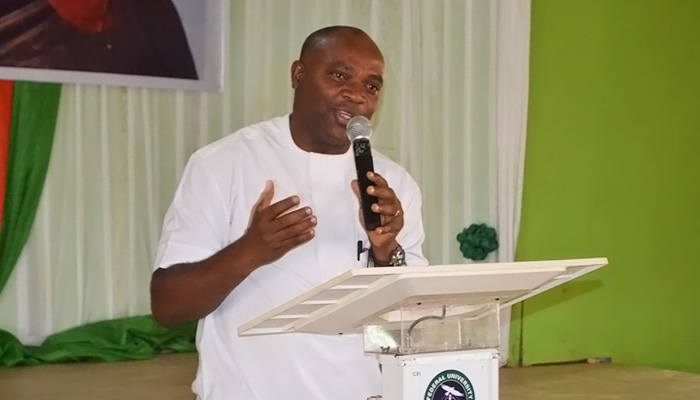
A presentation by Prof Chinedum Nwajiuba at the Maiden National Conference of the Faculty of Social and Management Sciences, Alvan Ikoku Federal University of Education, Owerri, Imo State, on Thursday, March 12, 2026
The theme of this conference, “Rethinking Values and Priorities for Sustainable Development: Balancing Security, Economic Growth and Environmental Protection in Nigeria,” is a very powerful one, with multi-dimensional possibilities as regards conceptualization. Being asked to contribute to this via a Lead paper, I was given the freedom to interpret it as I saw fit.
I have crafted a title, posed as the question: “When the Post-WW2 Order Falls, can Peripheral States like Nigeria Survive?”
Preamble
Before delving into the kernel of my presentation, permit me a short preamble that recognises that we are in a university, and it may have become necessary that, as often as we can, we must reflect on the conditions of our universities, and how we contribute to the evolution of society and humanity, via our triple mandate of teaching/learning, research and community service. May our universities never act
as if forgetting the meaning, the idea, and the culture of the university. May we not be anything less than institutions of excellence. May we be conscious of the ivory on the tower. May we not be collaborators in the demystification of the crimson comb on the head of the cock, the university.
Introduction
The theme of this conference, “Rethinking Values and Priorities for Sustainable Development: Balancing Security, Economic Growth and Environmental Protection in Nigeria”, has packed and woven very important keywords, which, standing alone or interrelated, are very germane. In dealing with this, a spatial component has been clearly defined, to the extent that Nigeria is specified. It does have a temporal component, but not as clearly stated. We will try doing that.
In reflecting on the theme, an imperceptible matter is the framework under which much of development has been pursued in Nigeria (and most countries in Africa) since her independence, and even the preceding colonial era. That framework is the world order that emerged after the Second World War.
That is to say that a rethinking of values and priorities for sustainable development, focused on balancing security, economic growth, and environmental protection in Nigeria, is located within a temporal framework of a world order defined following the end of the Second World War in 1945.
This framework has several components, institutions, and rules that govern world security, the economy, including financing and trade, among others. The belief is that this was designed to ensure peace, stability, and economic cooperation through a rules-based system, led by the United States. Key elements included the creation of the United Nations (UN) for collective security, the Bretton Woods institutions (IMF/World Bank) for economic stability, and the promotion of democracy.
This framework is evidently under severe threat of disintegration. This has informed the topic we have crafted, “When the Post-WW2 Order Falls, can Peripheral States like Nigeria Survive?” The central issue is, if the current stress on the world order in
which Nigeria emerged and has operated falls, can Nigeria and similar states in the peripheries of the world order survive?
Survival here has to be seen in the context of the keywords in the theme. These include Nigeria’s values, developing sustainably, security, economic growth, and protection of her environment.
Very critical is a word employed in the title, “Rethinking”. Thinking, in relation to the other words in the title, is a responsibility of the elite, as has been historically demonstrated. These ranges from the intellectual elite to the economic, spiritual, and other elites, up to the political and governing elite.
The political and governing elite appears to seat atop all other elites, and has capacity and responsibility to influence the emergence, conduct and performance of all other elites, and therefore the current situation and future of Nigeria, and indeed all other countries.
The political and governing elite may even choose to influence the reportage and interpretation of the past, and the history of the country, which begins to manifest as positive or negative socialisation of a mass of the people of the country, and therefore the future trajectory of the country. This may indeed have been the case with Nigeria and her history.
The reality is that the majority of Nigerians are mired in multidimensional poverty, so the issues of interest in this paper are not of primary interest to them; their main concern being daily survival. One illustration: a very poor person dealing with daily survival would not be interested in environmental protection, let us say forest preservation, if he needs to cut down trees to find fuel wood to cook whatever he finds to eat.
The theme of this conference seems to assume that there are persons in the business of thinking, and may then be willing to rethink. Perhaps there are persons who may be engaged with thinking, critical thinking, and not mere imagining. Ideally one group that such an assumption should stand a chance of validation should be the academia.
I give another illustration, maybe somewhat embarrassing: In many serious circles, the expectation is that university academics are elites, indeed intellectual elites who would have time to think and rethink the conduct and performance of our universities, for example, over the quality of their products in terms of their graduates and their research.
The intellectual elite in Nigeria may also have become nominal in this responsibility, not engaged in any critical thinking, whether incapable or by choice, and may have become “de-elited”, so that they may also not have the privilege of thinking and re-thinking even their own conditions. Why this has emerged is debatable.
Suffice it to add that a country without an elite consensus of national values is on shaky ground. A country without a critical, thinking, patriotic, and enlightened elite has feet of clay when action is required.
Charged with the denaturing of the intellectual elites, as represented by university academia, are the governing and political elites. As a consequence, on several parameters of development, whether sustainable or not, it is questioned whether our society is progressing or retrogressing.
An illustration: if by 1960, Owerri city and many rural communities had pipe-borne water, but today, after six decades, the children and grandchildren and great grandchildren of the generations that achieved pipe-borne water have never seen such, then it becomes clear the nature of development we have achieved, and may be asked to think and rethink to sustain.
We will now briefly look at the world order created after World War 2, and how it seems to be unravelling, after which we will examine the other parameters of development, and the peripherality of Nigeria and similar states that may seek to survive in this changing world order. In doing this, we shall acknowledge that so far this paper has been positioned at the macro level. We will also present a few micro examples of the relevance of the issues.
The peripherality of Nigeria
Two principal classes can be identified. One is the core and the other, the periphery (https://transportgeography.org/contents/chapter2/transport-and-spatial-organization/world-core-periphery/). Countries in the core have high development levels, while the periphery have limited economic development. Nigeria belongs in the periphery.
Historically, this dominance was political through incorporating the periphery into colonial empires, but from the second half of the 20th Century, economic factors became the key drivers. Most high-level economic activities and innovations are located in the core, with the periphery subjugated to processes conferring a lower added value, such as resource extraction and labour-intensive manufacturing.
A distinguishing characteristic of the periphery from the core is the dominance of their economies by resource extraction and export of raw materials. Nigeria has been, and remains solidly in this category.
A few countries have emerged since the 1970s into what may be described as the semi-periphery, with improvements in economic development (China, South Korea, Brazil, Malaysia, etc.). This is in line with Wallerstein’s World-Systems Theory, which classifies the world into core, semi-periphery, and periphery (https://www.researchgate.net/publication/49615339_IMMANUEL_WALLERSTEIN%27S_WORLD_SYSTEM_THEORY).
Inherent in these classifications is a consolidation into raw materials countries and industrialised countries. In many schools of thought, and fundamentally in the dealings of the Bretton woods institutions – the World Bank and the IMF – and as seen by the essentials of the policy prescriptions they had for countries in the periphery, for instance in the era of the Structural Adjustment Programmes (SAP), seem to be influenced by this classification. That is, countries in the periphery should supply produce in form of raw materials and natural resources to countries in the core, who may in return sale products from those produces to the peripheries, and may offer aides and assistance to sustain the peripheries at a stable but low-level equilibrium.
Assistance may come in the form of offer of security including military bases, intelligence, equipment and facilities, sustenance of the governing class, even if extracted wealth of the countries of the peripheries are kept in private accounts in financial platforms of the core, and if in difficulties with the public finances of the peripheries may be availed loans, grants, etc.
This classification may not be static as shifts may occur, with some countries migrating to semi-peripherals. Some recent examples of these are China, Brazil, and India. A look at these three countries shows that they are also the core of the new
economic block emerging as BRIC – Brazil, Russia, India, and China, and then with South Africa joining, metamorphosing into BRICS. Nigeria was not considered for the core of the BRICS, and even in the first wave of expansions, Nigeria is not in there. Nigeria was only admitted as a partner country in January 2025, and by this, may attend some special sessions. In effect, Nigeria is peripheral even to BRICS.
The continued peripherality of Nigeria and most African countries
Why have Nigeria and most of Africa continued to be peripheral to the world order? The answer to this is multi-dimensional. There are several long-term historical and current factors for this. Among these factors, two would seem to be more fundamental.
The first is the inherited colonial state structures, which Africans have agreed should be kept. The second is the poor-quality leadership and governance elite. On these two hang all other possible factors driving the continued pitiable conditions of development, insecurity, etc., in Nigeria and most of Africa.
Indeed, these two factors are interrelated. It is the common internal contradiction of African states, different from states in Europe, and elsewhere, that makes the emergence of a national elite consensus of values and priorities nearly impossible. These therefore festers the emergence of unpatriotic political and governing elites, and contending centripetal and centrifugal forces that sustains a low-level circle of underdevelopment and comfort in the company of periphery countries.
Similarly, poor quality political and governing elites sustain the burden of the colonial state structures, predominantly because of lack of vision, confidence, and loyalty to the choices of the core. Something the Igbo will summarize as “Anu Oke ju m akpa, kporo nne m”, transliterated as “If you give me sufficient rat meat, you may take my mother”.
These two factors – the colonial state structures, and poor quality political and governing elites, commonly unpatriotic, lacking in capacity for critical thinking, and often unenlightened – jointly create a condition in which national thinking and rethinking is alien, and therefore unable/unwilling to priorities sustainable development, balancing security, economic growth and environmental Protection.
It is against this background that Nigeria and most of Africa have to confront an emerging new world order, different from the post-World War 2 order. It is even doubtful if a significant proportion of elites of all hues in Nigeria, perceive or understand the changing global geopolitical landscape and the risks which peripheral countries like Nigeria are facing, and will face in the years ahead. Before looking at this emerging challenge, we need to see the some elements of the world order established after the Second World War, which has been the frame for the effort at development in Nigeria and most of Africa.
Key elements of the post-World War 2 order
The post-World War 2 order was primarily designed by the United States, and a few of her allies, with its most critical establishments headquartered in the United States. Among these are the United Nations (UN) for collective security, and the Bretton Woods institutions (IMF/World Bank) (https://www.sociostudies.org/almanac/articles/evolution_of_world_order).
United States leadership passed through the era of the bipolar world with a contending but less influential role by the USSR, to the era following the end of the USSR and the emergence of a world dominated by the United States. At the height of this, the United States, through its strong international engagement using multiple approaches, a key one of which is USAID, and other aide platforms, then her most strategic tool as the largest funder of the UN system, including institutions like the World Health organisation (WHO). Today, that is changing. The United States is withdrawing from these.
At the same time, the United States is manifesting tendencies that are contrary to the world’s acceptance of its leadership in global security. Among these being a seeming non-restraint in the use of her awesome military powers.
How United States military activities in Nigeria, and possibly neighbouring mineral rich countries in the Sahel, plays out for Nigeria and other countries in the periphery is not clear. How the withdrawal of the United States from the Paris Climate Agreement, and participation in the United Nations Framework Convention on Climate Change (UNFCCC) Conference of Parties (COP) on climate change is not yet understood. How these will impact on key countries such as China and Russia is not still understood.
How pressures on the global use of the US Dollar and payment platforms in response to signals form the Unted states, by her historical allies such as Canada, United Kingdom, Australia, etc. is not yet clear. How all these will impact on countries in the periphery like Nigeria and her peers is also not yet clear. We can only say that the world, and importantly the peripheries are in for uncertainties.
Key elements of the United States recent policies with implications for Nigeria
Among these would be the withdrawal of funding for programmes that have implications for Nigeria’s sustainable development and security. Specifically, the withdrawal from funding for health, education, agriculture, and climate change has serious implications for several government programmes, as well as some by non- governmental organizations.
Without these supports, the services they provide Nigerians in the concerned sectors are under several challenges. All these have adverse implications for these services, especially priorities for sustainable development and the balancing of security, economic growth, and environmental protection in Nigeria.
Pathways for Nigeria’s survival
Countries like Nigeria were shaped to operate within a system of defined global trade rules, western-led financial institutions, development loans, oil markets, and multilateral cooperation. Now there seems a shift towards power being more self- interested. Global cooperation is weaker and more focused on personal, rather than general interest.
Global trade has become more political, with the World Trade Organisation (WTO), under pressure. Debt is rising. Climate rules are not the same. The world can be said to be less stable, more divided, and has more uncertainties.
Two factors have been identified as defining the conditions of Nigeria and her inability to address the issues in the theme – Rethinking priorities for Sustainable
Development: Balancing Security, Economic Growth and Environmental Protection in Nigeria. These are the inherited state structure and the poor quality of the political and governance elite.
The first, that is inherited state structures in Africa, including Nigeria, which act as internal disturbances and distractions of both her leadership and the followership. These have led to unending decades of instability and insecurity, which are not consistent with development.
The second, that is poor quality leadership and governance, is well acknowledged. It is this that has ensured that Nigeria and other countries in most of Africa are unable to reach their potential frontiers as defined by the colonial inherited state structures.
Conclusion
With so much global uncertainties concerning the world order under which we merged as a country, and which we have been used to, what should Nigeria be doing to survive? What is a country without a patriotic, enlightened and thinking elite?
If we are to stand any chance of rethinking sustainable development and the related issues of insecurity with economic development simultaneously happening with environmental protection, we will require enlightened leadership and governance elite.
That leads me to something I have hoped would be done by researchers. Why have Nigeria and most of Africa been ruled/governed by men who manifest elements of underdeveloped minds prancing about the political space and governance? Perhaps they do not create them in the mode of Nnamdi Azikiwe and Michael Okpara anymore.
There seems to be an absence of philosopher kings and nation builders with sights set on enlightened horizons. It is justifiable to research the quality of political leadership we have seen in Nigeria, especially since 1999. Some years ago, I suggested to my wife, who is a professor of sociology of education, to do this, without success.
Take for instance the degradation of the intellectual elite as represented by the universities, by the political and governing elite. There are several hypotheses on the attitude of the political class to universities in Nigeria. Can the hypothesis that the political class is dominated by those who were weak students and have grudges against the university be validated?
Were they a priori supposed to lead society if they came mostly from the weakest of primary, secondary, and university students, those who often ran afoul of the rules, were sent away on suspension, and “ate” their school fees?
How many of those constituting the current class of political and governing elites were class monitors and prefects: an indicator of foundation for leadership? Please note that serious countries in the world understand that the leadership recruitment process is not a joke.
It may also have become necessary to revise our theories of development and emphasise quality and responsible political leadership as perhaps an overriding factor. Can we have that in the curriculum and teach our students this?
Prof Chinedum Nwajiuba is former Vice-Chancellor (February 2016 – 10 February 2021), Alex Ekwueme Federal University Ndufu-Alike; Chairman, Board of Directors, Nigerian Environmental Study/Action Team (NEST); and chair of the West African Science Service Centre on Climate Change and Adapted Land Use (WASCAL) Governing Board and Nigeria’s representative on the Board