The Buganda Road court in Kampala, Uganda, will on Friday, April 17, 2026, sentence eight anti-EACOP activists after convicting them on a nuisance on road charge last week. The activists, some of whom are students, have already spent over eight months in remand since their arrest on August 1, 2025, while peacefully protesting Stanbic Bank Uganda’s decision to finance the controversial East African Crude Oil Pipeline (EACOP).
According to campaigners, their arrest and repeated denial of bail, leading to months in detention, reveal a clear pattern of pre-trial punishment designed to intimidate activists and silence opposition.
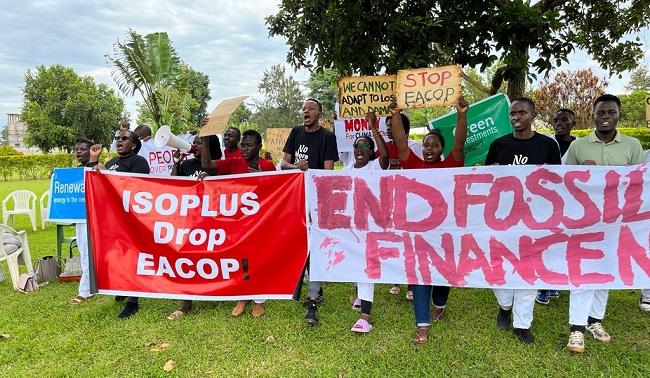
“Keeping accused persons on remand for more than eight months for a ‘nuisance on roads’ offence whose maximum sentence on conviction does not exceed one year raises serious concerns about proportionality, fairness, due process, and legitimate democratic expression. It has cost these young people their freedom, their studies, and valuable time with their families. Those linked to this case, including the banks at the centre of the protest, should not remain silent,” said lawyer Brighton Aryampa.
The group, StopEACOP Campaign, stated that it witnessed a similar pattern in April 2025, when 11 StopEACOP activists protesting KCB Bank Uganda’s involvement in EACOP were arrested and spent three months in remand as their case was repeatedly adjourned and bail denied.
It added that, in both instances, major financial institutions whose support for EACOP was being challenged remained silent while activists were dragged through the courts and kept away from their families, studies, and livelihoods for engaging in peaceful protest.
“Stanbic Bank Uganda, like KCB before it, remains silent even as young people are punished for calling on it to withdraw support from this destructive project,” added the group.
StopEACOP Campaign Coordinator, Zaki Mamdoo, said: “At COP28, when I confronted TotalEnergies CEO Patrick Pouyanné over the arrest of yet another group of anti-EACOP activists, he confirmed to me that the company was in direct communication with Ugandan authorities over the detention of those activists. That demonstrates that the companies behind EACOP are not passive observers of the repression meted out by the authorities.
“They have channels of influence available to them. So when Stanbic and others remain silent while young people are jailed for attempts at engaging their decision makers, that silence is far from neutral. It is a measure of what they are willing to tolerate in defence of EACOP.”
On this basis, the StopEACOP campaign says it denounces the systemic weaponisation of the Ugandan judiciary to protect EACOP project proponents and their financial backers from scrutiny by Ugandan citizens. The campaign insists that TotalEnergies and China National Offshore Oil Company (CNOOC) cannot continue with business as usual when citizens are jailed on their behalf for peacefully protesting their project.
“These students were arrested for a legitimate protest against the Stanbic Bank’s financing of a project with well-documented human rights concerns. They are clearly human rights defenders, and as such Stanbic and its owner Standard Bank have clear responsibilities to respond. This includes speaking out against their conviction, and using all its leverage to call for their release for these unjust charges to be overturned. So far they have just stood by, apparently content to benefit from repression. This is unacceptable,” said Ryan Brightwell from BankTrack.
The StopEACOP coalition demands that specific magistrates involved in this judicial misconduct be held accountable and that key bodies like the Uganda Law Society (ULS), the Pan African Lawyers Union (PALU), and the East Africa Law Society (EALS) take this matter seriously, holding their members accountable and upholding the rule of law.
The coalition also calls on the United Nations Special Rapporteur on Human Rights Defenders to urgently take up the matter, given the clear implications for the rights to protest, organise, and engage in democratic and lawful dissent. In the same breath, the coalition draws the attention of the UN Special Rapporteur on the Independence of Judges and Lawyers to investigate if these magistrates are operating under threats or intimidation, or whether there is, as we suspect, external interference preventing them from performing their duties professionally.
“When peaceful protestors spend more than eight months in remand for opposing an oil pipeline, we are no longer looking at justice. We are looking at repression organised around the protection of corporate power. These eight activists should be free, and the banks and fossil fuel interests benefiting from this climate of fear must be named and held accountable,” said Kumi Naidoo, President of the Fossil Fuel Non-Proliferation Treaty.