

The Young Advocates for a Sustainable and Inclusive Future (YASIF), the Federal Ministry of Environment, and civil society groups have called for a wide range of public awareness campaigns to help address the challenges of poor waste disposal and its impact on Nigeria’s economy.
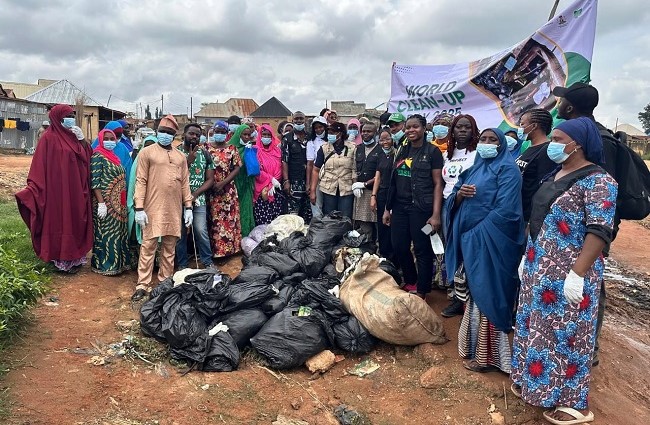
The group, which referred to waste as wealth, made the call on Friday, September 20, 2025, just after a cleanup exercise in Karonmajiji, a small community on the outskirts of Abuja, the capital of Nigeria, as part of its activities to celebrate this year’s World Cleanup Day.
It continued by saying that Nigeria will be more than halfway to tackling the problem and accomplishing its sustainability objective if it can persuade its citizens to realise this hidden truth.
Blessing Ewa, the founder of YASIF, told EnviroNews in an interview that the desire to confront the aforementioned problem actually motivated her organisation to earlier sensitise some selected women in the community on waste upcycling and recycling, and most of them reported that they were already earning income from the skills they had acquired.
According to her, the women leader informed her in a conversation that many of their members have generated over N150,000 each from selling some of their products which they made from pure water sachets.
Ewa said this is “what they previously considered as waste.” This gesture reveals how pleased the women are with the training, which has not only provided them with knowledge about environmental sustainability but has also enriched their pockets by allowing them to earn money from recycling agencies that buy their products.
She expressed her happiness at the development, which she says her establishment anticipates because of its impact in positioning the beneficiaries as pacesetters of ecological conservation.
In a similar vein, Lawrence Okechukwu, an assistant chief chemical engineer with Solid Waste Management and Technology in the Federal Ministry of Environment’s Department of Pollution Control, underscored the pressing need to change the stereotype that waste is typically associated with into its true value as an economic asset.
When asked about his thoughts on using the law to solve the issue, he strongly expressed his belief that people will be more reluctant to commit crimes if there is a shift in public perception ofwaste. So, for him, there is no need to go to such lengths because the majority of the people being referred to are already poor and require the environment for empowerment.
“The primary concern is reorientation; with effective reorientation, this issue can be addressed at its roots – that is my honest opinion,” he stated, commending YASIF for its efforts in working with women and young people to help them recognise that they can profit from the items they no longer need.”
On her part, Mrs. Rita Nnaji, assistant director of the Environmental Education and Awareness division with the National Environmental Standards and Regulations Environmental Enforcement Agency (NESREA), acknowledged that her institution has regulations that deal with waste control, which spell out penalties that can be used to punish offenders.
This can be done by requiring the person or group to clean up the mess, taking them to court, or even providing them with an abatement notice, she continued. If the problem is not resolve, the offenders can be arrested.
Like Ewa and Okechukwu, she supported the idea that public education should be the first step in resolving the crisis and urged the people of Karomonjiji to form a task force unit that would not only enforce good waste management principles but also ensure coordinated monitoring to protect the environment.
“All the communities have to set a day aside, which is compulsory, so that everybody will be mandated to clean up the environment,” she noted in her response to what she would do differently if in the position to put things into the right perspective.
Zainab Musa, the women’s leader of Karomonjiji, who spoke on their behalf, expressed gratitude for identifying the community for the cleanup exercise, especially given how filthy the neighbourhood is.
She reported that more than 50 women participated in the cleanup initiative, which impressed the Hakimi, the community’s traditional leader, after he watched the women’s efforts.
Musa bestowed blessings on YASIF for training women in the locality, specifically for empowering them to own a small shop where they produce and sell items created from waste products.
“People may look at what they have given to us as small, but we do really appreciate it, and thank God,” the women leader said, urging the government and stakeholders to support YASIF’s efforts by providing additional resources to expand their work.
To summarise, promoting sustainability through a waste management culture requires grassroots communities to consider themselves as environmental advocates rather than vulnerable groups or victims of environmental degradation.They must realise that everyone has a responsibility to play in trash management because a mountain of waste requires everyone to dump waste together, and a clean community requires everyone to practise waste management.
By Etta Michael Bisong, Abuja