

For more than 50 years, gas flaring has scarred the Niger-Delta.
Flames rent the skies, wealth is burnt, air and water poison released as a natural resource that many countries crave is wasted.
According to experts, gas flaring is a deliberate and controlled burning of natural gas; it goes hand-in-hand with oil extraction.
The root cause of gas flaring is dearth of infrastructure to capture, transport, or process the gas arising from oil extraction.
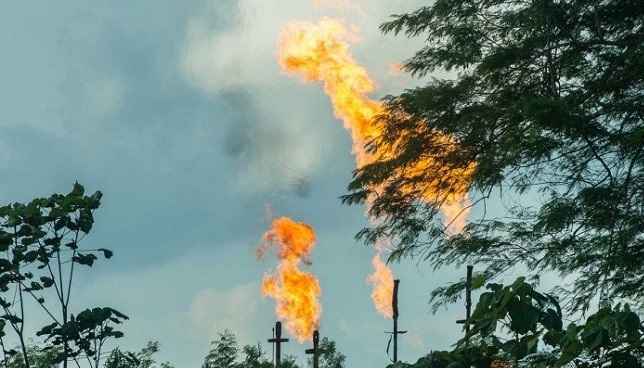
In the process, harmful pollutants are released into the air.
As the case of Nigeria’s oil-producing riverine Niger-Delta, humans and aquatic lives are threatened.
For a region that is still underserved, industry wise, many are left aghast as flared gas is capable of powering an industrial revolution in the region.
Its multiplier effect in terms of job creation and impact on the lives of the people of the area can only be imagined.
Statistics indicate that this practice has cost Nigeria billions in lost revenue, damaged ecosystems, and deprived local communities of economic benefits.
Each year, Nigeria flares billions of cubic feet of natural gas, fueling climate change, worsening health risks, and eroding economic potential.
In spite of repeated government pledges and the inauguration of the Nigerian Gas Flare Commercialisation Programme (NGFCP), the problem persists.
To discourage gas flaring and encourage oil companies to put the gas arising from their extractive activities to good use, the Federal Government initiated the penalties for gas flaring.
However, the move has not stopped the menace even as many oil companies fail to pay the fines.
Nigeria has lost 1.4 billion dollars to unpaid gas royalties and gas flaring penalties, according to a new report by the Nigeria Extractive Industries Transparency Initiative (NEITI).
Ogbonnaya Orji, the executive secretary of NEITI, provided further insights during a roundtable event organised by BudgIT Foundation, a non-governmental organisation, on tracking energy transition costs and transparency in the budgeting.
Orji said that the situation was unfortunate.
Nigeria lost 443.8 million dollars, about N710.08 billion to gas flaring in four months, says the National Oil Spill Detection and Remediation Agency (NOSDRA)
In its gas flare report for January to April, NOSDRA stated that the value of gas flared in the first four months of the year was 19.88 per cent higher than the 370.2 million dollars, approximately N592.32 billion, lost to gas flaring in the same four-month period in 2024.
This is because marginal oil fields often produce small, scattered volumes of gas that large pipelines and LNG plants cannot profitably absorb.
For operators, it is still cheaper to burn gas than to monetise it.
Between 2022 and 2024, an average of 187 billion standard cubic feet of gas was flared annually, enough to generate 27 to 29 terawatt-hours of electricity each year.
In 2024 alone, Nigeria’s electricity generation averaged 4,000 to 4,500 megawatts, or about 35 to 40 terawatt-hours per year, this is abysmal for a country that wastes gas, a major source of electricity.
Flaring releases 14 to 15 million tonnes of carbon dioxide annually making it one of the world’s top gas flarers despite holding Africans largest natural gas reserves, increasing emissions and undermining Nigeria’s energy transition goals.
Mr Charles Deigh, an petroleum engineer and environmentalist, said Nigeria had great potential and should optmise the waste business in maximising its energy and power potential.
According to him, other countries have shown that small-scale gas-to-power plants and micro-LNG facilities can capture waste gas and turn it into electricity, fuel, and jobs; Nigeria must adapt these models to its own reality.
He said that the amount of gas flared annually between 2022 and 2024 estimated at 187 billion standard cubic feet of gas was capable of powering over 2 million homes.
Deigh said if properly utilised, flared gas could have supplied 70 to 80 percent of the generated 35 to 40 terawatt-hours per year.
However, small-scale, modular gas monetisation, supported by improved policy alignment and financial risk mitigation, offers a practical solution.
“Large LNG projects require steady, high-volume flows and marginal fields cannot deliver that; what they can support are modular technologies, micro-LNG plants that liquefy 5–50 million standard cubic feet per day for transport to power plants, factories, or export hubs.
“Equally, small gas-to-power plants can sit close to host communities, feeding mini-grids and industrial clusters; these models bring three big advantages:
“Government initiatives like the Nigerian Gas Flare Commercialisation Programme and the Petroleum Industry Act aim to address flaring by incentivising gas conversion.
However, progress has stalled due to weak community governance, currency risk, regulatory challenges in gas pricing, and slow policy recognition of informal market demand.
“The first challenge is social legitimacy; the Host Community Development Trust, created to promote local participation, has struggled with elite capture and limited transparency, without genuine community involvement, operational risks like vandalism rise, discouraging investment.
He emphasised that Greater transparency and local accountability were essential to win this fight against wastage and devalue of our gas flaring potential.
More so, Dr Cabel Nwaogwugwu ,an environmentalist, has highlighted financing as a major barrier in harnessing the gas-to-power plants industry.
“While small-scale modular plants cost less than large LNG projects, investors face significant foreign exchange risk.
“Revenues are in naira, but most loans are in dollars, creating a mismatch that threatens project viability.
“Recent interventions have helped, but funding needs still exceed available resources,” he said.
Dr Bariza Nubel, a petroleum engineer, also noted that regulatory misalignment was another challenge in the face of stabilising electricity costs through gas flaring
He explained that prices for power were set at 2.42 dollars per MMBtu to stabilise electricity costs, but approved tariffs did not reflect actual expenses.
“This gap prevents cost recovery, leads to debt, and discourages both gas supply and new investment in flare-gas generation.
“In spite of these challenges, the informal energy sector has shown strong demand for gas.
“After the petrol subsidy was removed in 2023, adoption of compressed natural gas and LPG increased for generators and transport; households, businesses, and transport unions are ready to buy gas if supply infrastructure is developed.
“This shift alters the investment landscape. Nigeria now faces a supply infrastructure challenge rather than a demand problem.
“Rapid deployment of modular, decentralised midstream infrastructure, micro-LNG plants, mini gas processing hubs, CNG trucking networks, and embedded power solutions is needed for communities and industrial clusters,” he said.
According to him, these commercially viable models are quick to deploy and well-suited to the dispersed, low-pressure flare volumes of marginal fields.
These experts agree that with supportive policies, streamlined permitting, increased CBN-backed gas infrastructure loans, and inclusive community governance, Nigeria can transform gas flaring from a liability into a driver of development.
Effective flare monetisation will result in cleaner air, more reliable electricity for local industries, job creation, and new revenue from taxes, royalties, and potential carbon credits.
The question they say is no longer if Nigeria can stop flaring gas, but how quickly it can turn this wasted resource into value.
By sharpening focus on monetisation, modular technology, and targeted risk mitigation, policymakers have a clear route to unlock growth; execution, alignment, and inclusion are now critical.
Nigeria is at a pivotal moment; with decisive action, experts say the country can transform a history of waste into one of prosperity.
By Patricia Amogu, News Agency of Nigeria (NAN)