

Isolated thunderstorms are forecast to sweep across much of Malawi this week, raising concerns in a country where flooding has already killed 36 people and displaced thousands since the rainy season began.
The Department of Climate Change and Meteorological Services issued a forecast Saturday, January 10, 2026, warning of partly cloudy conditions coupled with isolated thunderstorms across most regions through Sunday, driven by northeasterly moist air masses moving over the landlocked southern African nation.
The timing is particularly worrisome for disaster management officials who have been scrambling to respond to what has become one of the most destructive rainy seasons in recent memory.
More than 160,000 people across 29 districts have been affected by disasters including stormy rains, strong winds, flash floods and lightning since Sept. 1, according to the Department of Disaster Management Affairs.
Nkhotakota District has borne the brunt of the devastation, with more than 10,700 households affected, 11 deaths, 37 injuries and two people still missing.
The district is currently hosting 2,132 displaced households – approximately 9,600 people – in 12 emergency camps.
The weekend forecast calls for varying conditions across the country’s distinct geographic zones, with temperatures reaching as high as 32 degrees Celsius (about 90 degrees Fahrenheit) in the low-lying Shire Valley.
In the Shire Valley – areas along the Shire River and around Lakes Chilwa and Chiuta – forecasters predict partly cloudy conditions Saturday night and Sunday morning, transitioning to hot conditions with localised showers in the afternoon.
Temperatures in Ngabu are expected to range from a minimum of 24°C (75°F) to a maximum of 32°C.
The Southern Highlands, encompassing Blantyre, Zomba, Mulanje, Thyolo and surrounding areas, will see milder conditions with temperatures in Blantyre ranging from 20°C (68°F) to 28°C (82°F).
The forecast calls for mild and partly cloudy conditions overnight, shifting to cloudy with isolated showers in the afternoon.
Central areas including Lilongwe, the capital, along with Mchinji, Ntchisi, Dowa, Kasungu and parts of Mzimba District face partly cloudy conditions coupled with thunderstorms over scattered areas in the afternoon.
Lilongwe temperatures will range from 19°C (66°F) to 26°C (79°F).
Lakeshore communities – Mangochi, Salima, Nkhotakota, Nkhata Bay, Likoma and Karonga – can expect partly cloudy conditions with isolated thunderstorms both overnight and during the day, with thunderstorms developing over scattered areas in the afternoon.
Mangochi will see temperatures from 23°C (73°F) to 29°C (84°F).
Northern areas excluding the lakeshore will experience mild and partly cloudy conditions overnight, transitioning to partly cloudy and warm with isolated showers over scattered areas in the afternoon.
Mzuzu temperatures will range from 18°C (64°F) to 26°C (79°F).
Winds will be generally from the northeast but gusty in areas experiencing storms, forecasters warned.
Monday’s outlook calls for continued partly cloudy conditions with isolated thunderstorms.
The meteorological service’s forecast takes on added significance given that flash flood warnings remain in effect for 14 districts: Nkhotakota, Salima, Mzimba, Kasungu, Nkhata Bay, Dowa, Mchinji, Ntchisi, Mzuzu, Likoma, Machinga, Mangochi, Zomba and Balaka.
Defense Minister, Feston Kaufa, who visited hard-hit Nkhotakota last week, reported that torrential rains caused the Dwangwa River to overflow with unprecedented force, rising to 3,200 cubic meters and unleashing flooding the district had never experienced before.
The disaster management department has been distributing food and non-food relief items to affected communities, with local search and recovery operations continuing in Nkhotakota District.
The national search and rescue team remains on high alert, with standby arrangements in place to deploy to at-risk areas.
Aid organisations have mobilised to support overwhelmed local authorities. Wandikweza, a Malawian child and maternal health organisation, delivered emergency relief on Wednesday to flood survivors at Kalimanjira Camp, providing maize flour, hygiene kits and waterproof tarpaulins to address urgent needs.
The flooding crisis comes as Malawi implements a 209 billion kwacha (about $121 million) Lean Season Food Insecurity Response Programme following a difficult farming season marked by erratic rainfall that worsened food insecurity nationwide.
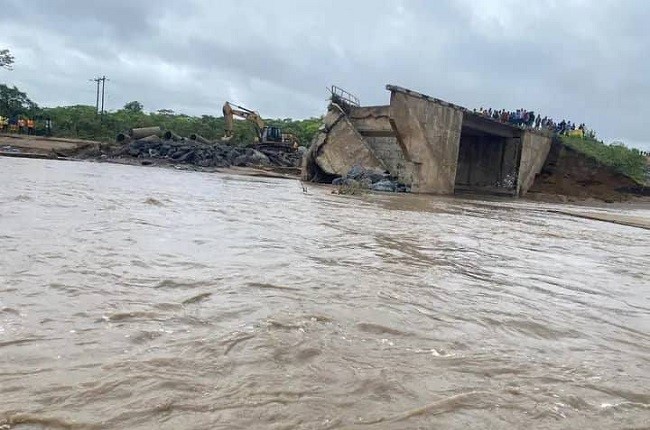
Heavy rains since late December have compounded the crisis, damaging infrastructure, including collapsed bridges and washed-away road diversions that have cut access for thousands of residents.
For a country where subsistence agriculture supports most of the population and where infrastructure remains fragile despite years of development efforts, the combination of immediate flood damage and longer-term food insecurity presents compounding challenges that will likely persist long after the rains stop.
By Winston Mwale, AfricaBrief