

A South Korean agritech company, E Green Global, has been named runner-up in the food category of the 2026 Zayed Sustainability Prize, following an announcement made during Abu Dhabi Sustainability Week held from January 13 to 15, 2026.
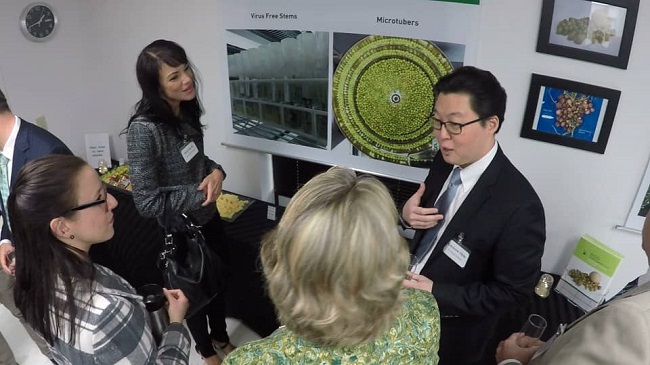
The small and medium-sized enterprise (SME) specialises in seed potato production and was recognised for its use of microtuber technology, an indoor, laboratory-based system that produces disease-free seed potatoes without traditional greenhouses.
Potatoes are the world’s fourth-largest crop by production and the third most consumed food crop globally, according to the United Nations (UN) Food and Agriculture Organisation and the International Potato Centre. Yet access to high-quality seed remains a persistent challenge. Industry estimates suggest that only about 20 per cent of seed potatoes meet acceptable quality standards, limiting yields and farmer incomes in many regions.
Founded in 2009 by Keejoon Shin, E Green Global developed a plant-factory system that replaces greenhouse cultivation with controlled light-based production. The company says its approach reduces land use, water consumption, chemical inputs, and carbon emissions, while shortening delivery times.
Today, E Green Global produces more than 10 million seed potatoes annually, supplying farmers across South Korea, the United States, China, Saudi Arabia, and parts of Europe. The company estimates its technology supports agricultural livelihoods linked to roughly 15 million people worldwide.
Speaking during an interview conducted via Microsoft Teams at Abu Dhabi Sustainability Week, Shin said global disruptions in recent years, including the COVID-19 pandemic and the war in Ukraine, exposed the fragility of cross-border seed supply chains.
According to him, “Farmers ordered seed potatoes that never arrived,” he said. “Geopolitics directly affected food production and income.”
To address this, the company is pursuing localised seed production systems in partnership with governments and regional operators. In Saudi Arabia, E Green Global has established a joint collaboration aimed at replacing imported seed potatoes, which can cost farmers more than $1,000 per tonne, including shipping, and have a limited storage life.
“If countries can produce their own high-quality seed locally, they gain food security and sovereignty,” he stated.
The company has signed memoranda of understanding (MoU) with regional governments and partners, including a joint venture agreement in China, a production facility in Saudi Arabia, and a local government partnership in Bonghwa County, South Korea. In 2022, E Green Global raised 7.6 billion South Korean won ($5.6 million) for its European subsidiary to expand direct-to-field seed production.
Shin said recognition by the Zayed Sustainability Prize brings visibility to an industry that often operates out of public view.
“This is a closed sector – most people don’t think about where seed potatoes come from,” he said. “Being selected helps bring attention to a fundamental part of the food system.”
E Green Global says its next focus is expansion across the Middle East and Africa, regions where seed quality and affordability remain significant barriers to agricultural productivity.
By Nsikak Ekere, Abuja