

Seetsele Nthomiwa is a natural history long-lens camera operator and presenter from Botswana, celebrated worldwide for his compelling visual storytelling of Africa’s wildlife. His work includes the “Big Cats 24/7 Series 1 & 2” for BBC and PBS, “I am Okavango”, and the Emmy-nominated “Living with Leopards” on Netflix.
He is featured as the Elephant Protection Initiative (EPI) Foundation’s Friend of the Month in a conversation that highlights his commitment to conservation and impact-driven filmmaking.
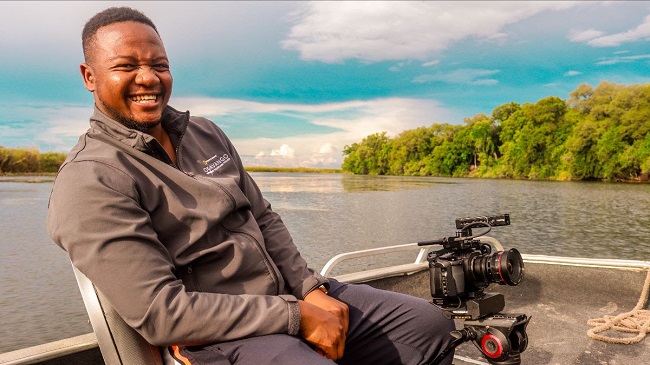
Hi Seetsele, can you tell us a little about yourself and where you grew up?
I am a nature lover and a storyteller. I love both telling stories and listening to them. I grew up in the city, Gaborone, which is Botswana’s capital. Although I was a city boy, I loved watching wildlife shows. I remember watching Savage Season on VHS tapes that my parents bought, and once we got DSTV, I binge-watched NatGeo every chance I got. In my earlier years in school, we’d go on school trips to a nature reserve just outside the city called Mokolodi and Gaborone Game Reserve. I think that’s where the seed of my current career got planted.
What first sparked your interest in wildlife and filmmaking?
I didn’t just consume wildlife shows; I became active in the natural history world in school. I joined my first conservation club in junior high school, the Cheetah Conservation Society. They got me hooked by teaching us about the African wild dog (my favourite animal then). And when I went to study my undergrad at the University of Botswana, I joined the University of Botswana Wildlife and Environmental Conservation Society (UBWECS). I figured since my undergrad was in media studies, and I love wildlife, I would absolutely love a career that combines the two. And I was right.
As a wildlife cinematographer, what do you enjoy most about filming animals in the wild?
The thing about filming wildlife is that all I have to do is witness what is happening in nature, and I just happen to be holding a camera. Life in the wild will always go on. All the fauna and flora go through a cycle of life and death. And I am very blessed to be one of the few people in the world to witness life in the wild unfolding. The lives of the animals aren’t too different from our lives as humans, I must admit. They are complicated, emotive, and, at the end of the day, life moves on, just like we do.
While working on productions like Big Cats 24/7, is there a moment behind the camera that really stands out for you?
There are tonnes of moments during production that I wish to share with the world. A lot of what we see out here is not filmed. But what really stands out to me during the productions is the camaraderie that is built in the relentless wilderness. Nature is unforgiving, and long shoots often take a toll on you. I am very fortunate to have worked in an environment that not only fostered great relationships and a work ethic but also lifelong friendships outside of production. Genuine, good-hearted people, from all the variations of production teams to supporting staff.
Have you encountered the elephant populations in the Okavango Delta? If so, how have those experiences been?
I have cultivated my career in Botswana’s wilderness. Encountering elephants is something that is a certainty. I’ve had dicey moments around breeding herds, but I’ve had more wonderful encounters with them. The most magical moments I’ve had were around breeding herds in the evening. Fortunately, the elephants that I’ve filmed have been kind to me. With that said, I remember being woken up by a bull elephant shaking my truck… It was scratching itself on the spare tyre at the back of the truck, hahaha.
You often speak about the pride you feel in showing Botswana to the world. What do you hope audiences take away from your work?
I am proud of what Botswana has to offer to the world. Nothing will make me happier than sharing stories about my country with the world. Not just mainstream stories but intricate stories as well. The experiences my people have with wildlife are not black and white; neither should their stories be. A balance should be struck. Working in the wild can be unpredictable.
What has living and filming in such dynamic environments taught you?
You must be ready for anything in the wild. That is the first thing that is drilled into you. Nature has its own rhythm; the more time you spend in an area, the more you understand its ebb and flow. That rhythm informs how you track and find the wildlife and, most importantly, how you film it. And the best thing you can do is to be welcoming to nature. The energy you give her is the energy you’ll get back.
What has been one of the biggest lessons you’ve learned since starting your career in wildlife filmmaking?
The biggest lesson of my career is patience: a steady belief that all your efforts will contribute to growth in your career. Patience when filming; the amount of waiting for the “perfect shot” demands it. Exercising patience has helped me make sense of my career and film the best sequences of my career. That patience needs to be coupled with tenacity as well.
For young people in Botswana who dream of working with wildlife or film, what advice would you give them?
Everyone has a story bubbling from within. Find out how that can manifest for you. I am blessed to be the first native Motswana to break into the natural history film industry. I am ready to celebrate new stories from other people, stories that will inspire more people to thrive in this industry. I want to be inspired as well. I’m always happy to have a chat about this industry and finding your place in it. For those looking to join this industry, be tenacious, bold, genuine, and patient; it will all work out.