

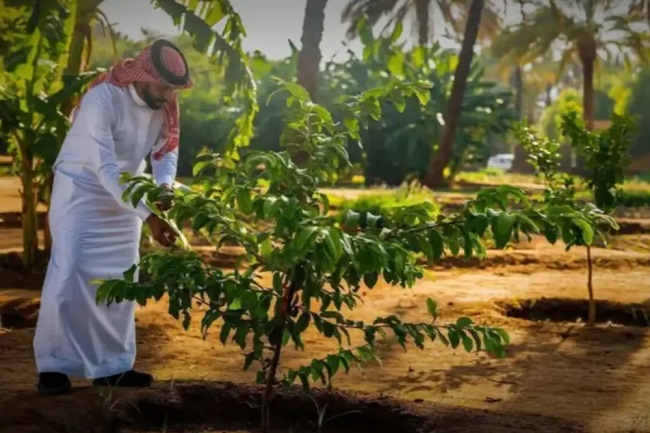
The Kingdom of Saudi Arabia (KSA) has reached a major milestone in restoring degraded land, announcing the rehabilitation of one million hectares under the Saudi Green Initiative, demonstrating that large-scale land restoration is achievable even in some of the world’s most water-scarce environments.
The achievement comes at a time of growing global pressure on land and water systems, as droughts intensify, food systems face increasing strain, and land degradation continues to affect nearly half of the global population.
“This milestone shows that restoring land at scale is not only possible but also it is already happening,” said UNCCD Executive Secretary, Dr. Yasmine Fouad, in a recorded message marking the occasion.
“In a world facing rising drought and increasing water stress, this achievement sends a clear signal: with the right policies, science, and commitment, countries can turn environmental challenges into opportunities for resilience and growth,” Fouad added.
“Reaching one million hectares of restored land marks a pivotal milestone in Saudi Arabia’s environmental journey. It reflects our leadership’s commitment to sustainability and demonstrates how coordinated action across government, private sector and communities can deliver lasting impact, strengthening ecosystems, supporting biodiversity, and advancing our Vision 2030 goals,” stated Abdulrahman bin Abdulmohsen Al-Fadley, Minister of Environment, Water and Agriculture, KSA.
Implemented under challenging climatic conditions and limited water availability, the restoration effort reflects a comprehensive approach combining innovation, science-based solutions and long-term planning. Measures such as cloud seeding programmes, early warning systems for sand and dust storms, and the expansion of protected areas have contributed to strengthening ecosystem resilience and improving land productivity.
Land restoration is increasingly recognised as a critical investment in sustainable development. Healthy land systems underpin food security, water availability, economic resilience and stability, making restoration not only an environmental priority, but a strategic economic and social imperative.
“Land is our most vital infrastructure,” added Dr. Fouad. “When land degrades, water systems weaken, food production declines, and communities become more vulnerable. Investing in healthy land is investing in people, stability and long-term prosperity.”
Saudi Arabia’s efforts also contribute to strengthening international cooperation on land, including through initiatives such as the Middle East Green Initiative and the G20 Global Land Initiative, hosted by the United Nations Convention to Combat Desertification (UNCCD). The Kingdom’s leadership during its presidency of the UNCCD Conference of the Parties has further reinforced global ambition to address land degradation and drought.
The milestone illustrates the importance of aligning national action with global frameworks, demonstrating how countries can translate commitments into measurable progress on the ground.
As the international community prepares for the seventeenth session of the Conference of the Parties (COP17) to the UNCCD, to be held in Mongolia in August 2026, this achievement provides a timely example of the scale and pace of action required to restore land, strengthen drought resilience and support sustainable livelihoods worldwide.
“Restoring land is not only an environmental necessity, but also a pathway to resilience, stability and prosperity,” Dr. Fouad said. “The progress we are seeing today shows what is possible when ambition is matched with action.”
The Saudi Green Initiative (SGI) Day, observed annually on March 27 following a Cabinet decision, reflects the Kingdom’s commitment to establishing a culture of sustainability, enhancing national environmental efforts, and encouraging all sectors to achieve sustainable development goals in line with Vision 2030.
The initiative recently achieved a significant national milestone by rehabilitating one million hectares of degraded land through the National Greening Programme, overseen by the National Centre for Vegetation Cover Development and Combating Desertification. This objective aims to expand vegetation cover, reduce desertification, improve quality of life, and enhance the natural capacity of local environments to adapt to climate change.
The achievement is an extension of the Kingdom’s broader efforts to protect natural resources, reduce emissions, promote reliance on clean energy, and preserve biodiversity, thereby strengthening Saudi Arabia’s regional and international standing in environmental action.
Over the past year, the initiative has continued to make tangible progress. More than 159 million trees were planted across the Kingdom, and environmental reserves saw the birth of Arabian oryx calves for the third consecutive year. Furthermore, the National Water Efficiency and Conservation Center currently saves 120,000 cubic meters of water daily, with plans to increase this capacity to 300,000 cubic meters.
These combined efforts align with the objectives of Vision 2030 and contribute to strengthening the Kingdom’s regional and international standing in environmental sustainability.
SGI Day is observed annually to highlight the initiative’s achievements, review its future goals, and encourage broad sector participation in environmental efforts and sustainable development.
These efforts reflect the Kingdom’s approach to environmental and climate action, driven by the Saudi Green Initiative and the Middle East Green Initiative, both launched by His Royal Highness Prince Mohammed bin Salman bin Abdulaziz Al Saud, Crown Prince and Prime Minister, underscoring its ongoing commitment to supporting the transition toward a more sustainable development model.