

Demand for wildlife products supplied through illegal trade supply chains continues to place significant pressure on many wild species. As international bodies recognise the need to pair demand‑side action with traditional enforcement, countries are expanding the use of behaviour‑change and public‑engagement approaches.
Within the Convention on International Trade in Endangered Species of Wild Fauna and Flora (CITES), “demand reduction” refers to measures that discourage and prevent the consumption of wildlife derived from illegally traded species listed in the Appendices, particularly through behaviour‑change interventions.
These measures form a key part of a holistic approach that also includes enforcement and support for rural livelihoods. By guiding consumers toward lawful, sustainable choices, demand‑reduction strategies help strengthen broader regional efforts to conserve CITES‑listed plant and animal species.
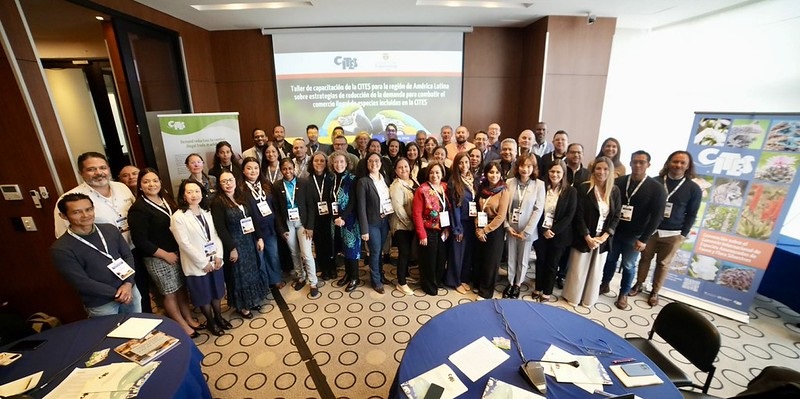
Colombia and the CITES Secretariat hosted a regional workshop in Bogotá from March 18 to 19, 2026, to strengthen the capacity of Latin American CITES Parties in applying the Guidance for CITES Parties to Develop and Implement Demand Reduction Strategies to Combat Illegal Trade in CITES-listed Species, which outlines a five‑step, behaviour change–based approach designed to increase the effectiveness of interventions on the ground.
Working sessions facilitated by TRAFFIC enabled countries to translate the Guidance’s conceptual elements into practice, while considering their specific national contexts. Participants identified the need for behaviour change interventions for timber, birds, sharks, and amphibians.
Over two days, 52 participants (31 women and 21 men) representing 20 Parties worked together to identify priority CITES‑listed species illegally traded in the region and to discuss where demand‑reduction interventions could effectively reinforce ongoing efforts to combat illegal trade. Participants exchanged national experiences and received guidance from expert facilitators on addressing complex or ambiguous issues.
CITES Secretary-General, Ms. Ivonne Higuero, highlighted the significance of these efforts, noting: “Illegal trade continues to threaten wild species, destroy ecosystems, and harm communities that depend directly on biodiversity. Its effects go beyond conservation: it fuels organised crime, undermines security, and hinders sustainable development. We also know that legal, well-managed trade can support those who make their living from nature, strengthen local economies, and provide real, sustainable opportunities. That is the balance we seek, and reducing the demand fueling illegal trade is a key part of achieving the CITES Strategic Vision and ensuring international wildlife trade is sustainable, legal and traceable.”
Mr. Luis Francisco Camargo, Coordinator of the Biodiversity Group of the Directorate of Forests, Biodiversity and Ecosystem Services and representative of Colombia’s CITES Management Authority, stressed the importance of the initiative, stating: “For many years, the response to the problem of illegal trafficking has focused primarily on monitoring and law enforcement actions. And these measures remain essential. But today there is an increasingly clear consensus within the international community: if we want to address the root causes of illegal wildlife trade, we must also understand and transform the dynamics that drive the demand for wildlife and its products.
“For Latin America, this meeting represents a particularly valuable opportunity. Our region is home to approximately 40% of the planet’s biodiversity, making us a key region for global conservation, but also a territory that is especially vulnerable to illegal wildlife trafficking.”
This workshop builds on efforts undertaken since the 19th meeting of the Conference of the Parties to CITES (CITES CoP19) in 2022 to promote the use of the CITES Guidelines on demand reduction. This includes the regional training seminars held in Singapore and Zambia and pilot projects in selected countries.