

When the seventh edition of the Global Environment Outlook (GEO-7) – a sprawling report on the state of the natural world – came out early in December 2025 its warnings were stark.
Humanity is pushing the Earth to its environmental breaking point, the report’s authors warned, with potentially dire consequences for everything from human health to the global economy.
But GEO-7, produced by the United Nations Environment Programme (UNEP), says it is not too late for humanity to change course. Within its pages is a recipe for a healthier planet that focuses on transforming five key systems: economic and financial; materials and waste; energy; food; and the environment.
These reforms would have a host of advantages, the GEO-7 authors say. By 2050, they could prevent 9 million premature deaths, lift 100 million people out of poverty and provide 200 million people with relief from undernourishment, They could also create US$100 trillion annually in economic benefits by the end of the century.
“Remaking the five systems will take a whole-of-government, whole-of-society effort the likes of which the world has never seen before,” says Maarten Kappelle, Chief of Service in UNEP’s Office of Science. “But that is absolutely vital if we are going to build a better, fairer, more sustainable planet.”
In the second of three stories exploring the findings of GEO-7, here are the report’s recommendations for forging a global economy that’s better for both people and the planet.
Move beyond gross domestic product
For decades countries have relied on gross domestic product (GDP) as a barometer of their wealth. But GDP doesn’t account for important things, like the long-term financial fallout of environmental degradation.
That’s why GEO-7 argues countries should take a broader view of their fiscal well-being. One way to do that is through something called natural capital accounting, which places a dollar value on the resources and the services that nature provides. This type of measurement can give nations a truer picture of their wealth, helping them make decisions that are better for the environment and their bottom lines.
Overhaul the incentives that govern the global economy
Right now, the global economic system too often rewards practices that harm the planet, say the GEO-7 authors.
To change that, they recommend several things, including repurposing US$1.5 trillion a year in environmentally damaging government subsidies for the energy, mining and food sectors. In some cases, countries should also consider taxes on goods and services that damage the environment. For example, food and energy production often swallow natural spaces and generate pollution, but those costs aren’t reflected in market prices. The revenues from any taxes should support the most vulnerable.
The report also urges governments to align their budgets and economic policies with the goals of major environmental accords, like the Paris Agreement. As well it says countries should promote investments in green technology, encourage their citizens to make environmentally friendly choices and compel businesses to cover the full costs of the damage they do to the planet.
Improve waste management and embrace circularity
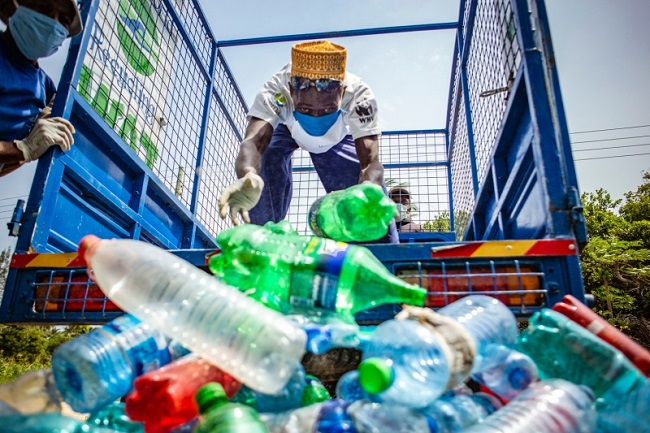
Plastic bottles, obsolete electronics, hazardous chemicals – many parts of the world are being swamped by pollution and waste. That’s why, GEO-7 says, it’s critical that countries adopt circular economic models. The concept emphasises keeping resources in use for as long as possible by redesigning, reusing, repairing and recycling things already made.
To promote circularity, countries and business can adopt design standards that make products last longer and easier to repair. Governments can require businesses to be responsible for what happens to products at the end of their lives while creating rules that compel companies to disclose their impact on the natural world. Finally, states can reform their tax codes to incentivise the development of circular products, redirect subsidies from extractive sectors to circular endeavours, and work together to expand international agreements that tackle waste and pollution.
At the same time, nations can make circularity part of school curriculums, offer incentives for consumers that make more sustainable choices, and implement laws that phase out short-lived and one-time-use products.
The report concludes that circularity is a cross-cutting enabler of food, energy, and material system transformations, essential for aligning economic and financial systems with the environment.
Pour money into renewable energy
In 2023, just over 80 per cent of the world’s energy came from the burning of fossil fuels, feeding a climate crisis that is already sparking droughts, floods, superstorms and other calamities.
To avoid a full-fledged climate breakdown, the report said countries need to scale up the generation of renewable energy, like wind and solar power. They should also electrify fossil-fuel-dominated sectors, like transport, and explore alternative fuels, including hydrogen, for industries that are hard to electrify.
At the same time nations need to reduce the demand for power by making buildings more efficient, encouraging people to walk and cycle more, and planning cities that are relatively compact.
While doing these things it’s important for countries to make sure the extraction of so-called energy transition minerals, like the heavy metals used in solar panels, is done in a way that doesn’t damage the environment or deprive communities of their rights.
Rethink how food is made and consumed
The way the world produces food is unsustainable. It drives climate change, generates pollution and swallows up natural spaces, leading to biodiversity loss.
To change that, GEO-7 focuses on five key things. First countries, especially wealthy ones, need to shift to more environmentally friendly diets, which in many cases means eating less meat and more plant base food. Second, crop and livestock farming need to become more efficient, use less land, and be gentler on the environment, while fisheries need to become more sustainable. Third, governments, businesses and consumers should work together to reduce food waste, which puts needless pressure on the planet. Fourthly, countries need to explore novel types of foods, like lab-grown meat, and production methods, including vertical farming, which often have a smaller environmental footprint.
Finally, countries can reform their food systems, emphasising locally grown fare and diversifying agribusiness supply chains.
Do everything possible to protect the natural world
A triple planetary crisis of climate change, nature, land, and biodiversity loss, and pollution and waste, is whittling away at nature and in the process, threatening the future of billions of people.
Ending nature’s decline will be crucial to building a more sustainable future, GEO-7 found. To do that, its authors urged countries to expand protected areas, like nature reserves, restore ecosystems that have been damaged by development, and find more sustainable ways to manage the resources on land and at sea.
As well, the report called for the scaling up of natural solutions to environmental problems, like the planting of trees to reduce temperatures in cities facing extreme heat because of climate change. It also recommended countries develop what are known as bioresources, a growing field when materials from plants, animals and other organisms are used to do things like generate energy or make products.
Finally, the report said it was important to make the management of shared resources – from forests to fisheries – more transparent and more equitable.