

From October 2 to 3, 2025, the Public Service International (PSI) and DGB hosted a two-day Campaign and Strategy Meeting on “Promoting Transparency and Decent work in the Supply Chain in Electricity, Water and Waste Services in Sub-Saharan Africa” in Owerri, Imo State, in collaboration with the National Union of Electricity Employees (NUEE), the Amalgamated Union of Public Corporations, Civil Service Technical and Recreational Services Employees (AUPCTRE) and civil society organisations.
The meeting aimed to capacitate trade unions, civil society activists and focal persons with the required skills and competences to effectively implement the project. It also served as an opportunity for the participants to elaborate strategies on how to engage legislators and policy makers in implementing concrete advocacy actions and campaigns.
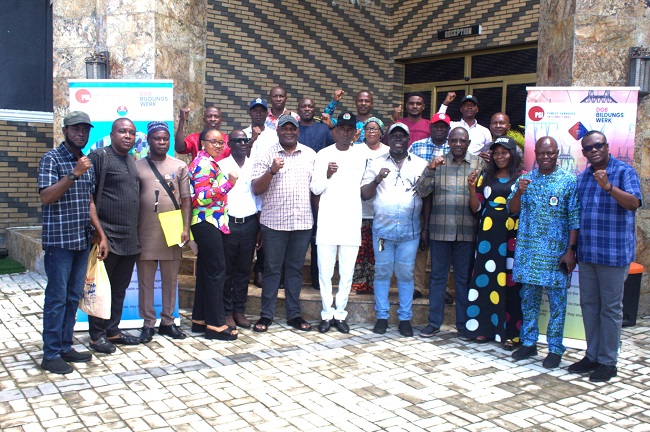
During the opening formalities, remarks were taken from AUPCTRE Acting General Secretary, Comrade Lawrence Alo, NUEE General Secretary, Comrade Dominic Igwebike, and Comrade Sani Baba, the Executive Director of Citizens Free Service Forum (CFSF), representing civil society.
In his welcome words, National Coordinator of the project, Comrade Abiodun Bakare, explained that the project had made tremendous impact on the trade unions and civil society partners especially in Lagos where pressure by the project partners has stalled the plans of the state government to privatise water.
Four key presentations were made at the event. They are: “Influencing Policy and Decision Makers: Trade Union Advocacy Strategies” by Professor Hosea Mande of the Kaduna State University, “Campaign against privatisation in Africa: Lessons Learnt” by Comrade Sani Baba of CFSF, as well as “Campaign Planning Strategy” and “Communication and Strategies of building an impactful legislative advocacy campaign”, both presented by Philip Jakpor, Executive Director of Renevlyn Development Initiative (RDI).
The engagement allowed participants to x-ray challenges to the three key sectors – water. electricity and waste, in the light of privatisation and making the following observations:
In the water sector the participants decried the dilapidated state of water schemes in the 36 states of the federation and Abuja, the federal capital territory, due to years of mismanagement and diversion of funds by the respective governments. They also frowned at the state of water utilities in Imo State where the meeting was held, describing the state’s water sector as comatose.
They also revealed that irregular supply of power has resulted to epileptic production of water and periodic shutdowns of water facilities across Nigeria, adding that the obsolete water reticulation network is replete across the federation with old or broken pipelines in many communities leading to contamination of water.
Poor staff welfare across the public spectrum is a subject they want the government to address, believing it continues to demotivate workers. They also believe that lack of working equipment and protective safety tools make workers susceptible to the elements and often hazardous chemicals.
To address the issues, they demanded the rehabilitation of dilapidated water schemes across the country, regular supply of power to ensure water facilities and producing to optimum capacity, and need for replacement of obsolete water reticulation networks across the federation to avoid contamination of water sources.
In the electricity sector they maintained that the privatisation of the electricity sector in 2013 is yet to achieve the government promised adequate and uninterrupted power supply as power generation continues to hover around 4000 megawatts like it was in 2013. Additionally, they insist that private entities have failed to invest in the sector.
They stressed that privatisation has led to increased costs for the public with the categorisation of customers under bands further increasing the burden on domestic customers and businesses. They also accused the private entities that bought the assets of the National Electric Power Authority (NEPA) of providing poor service quality, even as the legal entanglements associated with the contractual agreements for sale of the electricity utility continue to plague the sector.
To address these issues, they demanded the reversal of the 2013 privatisation exercise as well as immediate review of tariffs on electricity reflecting the current hardships Nigerians are suffering.
In the waste sector, they said that dump sites were inadequate to meet the demands of residents in major cities, forcing people to discard waste indiscriminately. Like other sectors, they believe there is unwillingness on the part of employers in the waste sector to allow unionism.
As a way forward, they called on the government to create more landfill sites to ease the pressure on existing sites to avoid a pandemic. They insisted that workers have a legitimate right to unionise and that sustained training and retraining of staffers in public utilities is a must.