

As International Zero Waste Month draws to a close, environmental NGO, BAN Toxics, has urged the Philippine government to abandon plans to pursue waste-to-energy (WTE) as a solution to the country’s escalating waste problem.
The call came after Congresswoman Gloria Macapagal-Arroyo announced during the 25th anniversary of RA 9003, or the Ecological Solid Waste Management Act of 2000, that she intends to file a bill amending said law to allow the use of WTE technology for waste disposal. RA 9003 was the first law she signed as president.
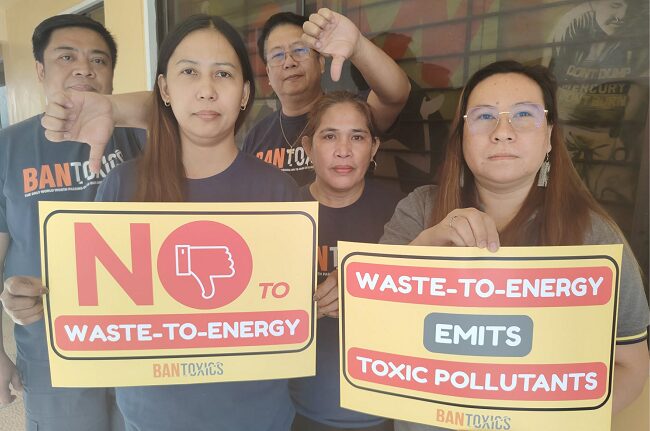
According to the group, the government should first focus on effectively implementing RA 9003 and addressing persistent gaps, noting that improper waste disposal, insufficient infrastructure, and lack of public awareness remain widespread. BAN Toxics emphasised that the law has yet to be fully realised, even after 25 years.
The 2023 Commission on Audit (COA) report shows that only a fraction of barangays have operational Materials Recovery Facilities (MRFs), with just 39 percent of barangays (16,418 of 42,046) served by MRFs in 2021. Many local government units also lack adequate sanitary landfills, with only 29.25 percent (478 of 1,634 LGUs) having access to SLFs, leaving much of the country’s waste improperly managed or sent to dumpsites instead of environmentally sound facilities.
Under RA 9003, LGUs are mandated to divert at least 25 percent of their solid waste through reuse, recycling, composting, and other resource recovery activities, with targets increasing every three years. However, official assessments show that many LGUs have struggled to meet these diversion requirements in practice, with much waste still unmanaged or improperly disposed.
The Department of Environment and Natural Resources (DENR) has also acknowledged a lack of recycling infrastructure and waste processing facilities as a key barrier to effective implementation, adding that waste segregation at the source remains inconsistent across local governments.
“We should first conduct a comprehensive assessment of RA 9003, and invest our efforts and resources in improving its implementation before considering waste-to-energy or other burn technologies,” said Jam Lorenzo, BAN Toxics Deputy Executive Director and Head of Policy Development and Research.
According to Lorenzo, WTE is not clean energy, as it produces a wide range of toxic chemicals, including persistent organic pollutants (POPs) that remain in the environment for a long time. Citing a biomonitoring study by Zero Waste Europe from 2023–2024, Lorenzo said that even the most advanced waste incineration technologies emit unintentionally produced POPs, such as dioxins and furans.
He also noted that WTE facilities prefer dry, inorganic waste such as plastics due to its high energy content. “WTE is often framed as a solution to plastic pollution, but burning plastics creates new environmental and health risks by releasing toxic pollutants. Instead of reducing plastic waste, it only encourages continued virgin plastic production derived from fossil fuels, reinforcing dependence on extractive industries that drive pollution and climate change.”
The DENR estimates that the Philippines produces about 61,000 metric tons of solid waste every day, 12 to 24 percent of which is plastic. This translates to around 163 million plastic sachet packets, 48 million shopping bags, and 45 million thin-film bags used daily.
BAN Toxics is advocating for a Zero Waste framework to address the waste crisis, calling for decisive action to reduce or eliminate waste at the source by cutting reliance on plastics, especially single-use plastics, and ensuring accountability from producers and corporations for the full lifecycle of their products.
The approach emphasises designing products and systems that prevent waste from being generated, while promoting reusable and refillable packaging, community-based recycling and composting, and behavioral change among consumers to adopt more sustainable habits.
“Waste-to-energy may promise an easy solution, but it is a false one. Easy fixes rarely solve systemic problems. Lasting change comes from investing in systems and infrastructure needed to properly implement our waste management laws and reduce waste at the source,” Lorenzo said.
BAN Toxics stresses the need for a fundamental shift from fragmented, “end-of-pipe” waste disposal to integrated, sustainable, and holistic approaches. The group notes that current siloed efforts by the government can be inefficient, costly, and environmentally harmful. It advocates for a systems approach that coordinates technologies, policies, and community actions to achieve more sustainable waste management outcomes.