

Ahead of the International Women’s Day on March 8, 2026, and the World Consumer Rights Day on the 15th, the toxics watchdog group, EcoWaste Coalition, has announced its discovery of two more “made in Pakistan” cosmetics with extremely high levels of mercury sold online despite the global ban on the production and trade of cosmetics with mercury, a potent neurotoxin that causes severe damage to the brain, kidneys, lungs, skin, and immune system.
“We urge online shoppers not to add to cart and buy Yaz skin-lightening and skin-renewing facial creams that we have verified to contain horrendous levels of mercury measured at 33,970 and 29, 870 parts per million (ppm), respectively,” said Aileen Lucero, National Coordinator, EcoWaste Coalition. “These imported products, marketed to women to enhance youthful radiance, are a serious threat not only to the health of women but also to their households.”
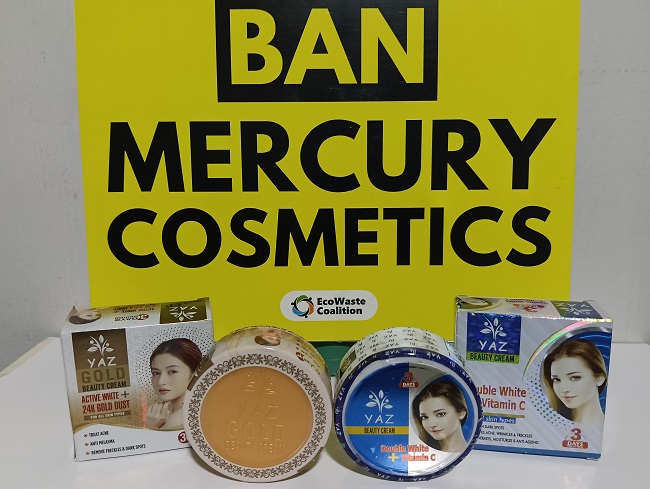
“Our latest discoveries mark the over 25 Pakistan-made cosmetics our team has verified as mercury-tainted through X-Ray Fluorescence (XRF) analysis and subsequently publicised and reported to the authorities,” she said.
The continued production and trade of mercury-laced cosmetics in the said South Asian country prompted the EcoWaste Coalition to press the Government of Pakistan to come down hard on violators and prosecute the culprits to the fullest extent of the law. The Competition Commission of Pakistan on October 15, 2025, announced a crackdown on such toxic products.
“We acknowledge and support the Pakistan government’s ongoing drive to weed out the market of mercury-added cosmetics and urge it to apply the country’s Competition Act to penalize violators and deter would-be offenders,” stated Lucero. Pakistan’s competition law prohibits false or deceptive marketing, which can lead to penalties of up to 75 million rupees (over PH15 million) or 10 percent of annual turnover.
The EcoWaste Coalition obtained the Yaz Beauty Cream Double White + Vitamin C and Yaz Gold Beauty Cream Active White + 24K Gold Dust from an online seller for P160 each (the seller also offers a wide variety of other local and imported cosmetics).
The former claims it “removes acne, wrinkles, freckles and other signs of ageing” and promises it can make users look “pretty and young.” The latter is supposed to “lighten, brighten and moisturise (the) skin,” while “it reduces the appearance of fine lines and wrinkles and also helps eliminate skin flakiness and remove dark spots to provide a smooth and even complexion.” Both products are marketed as “3-day solution.” Yaz Beauty Cream, in particular, claims “difference in color from dark brown to pinkish white” in three days.
Like other cosmetics found to be contaminated with mercury, the labels of both products did not specify mercury or other related terms in the listed ingredients, nor did they provide any mercury content warning.
Aside from Yaz Beauty Cream and Yaz Gold Beauty Cream, the EcoWaste Coalition has reported to the Food and Drug Administration (FDA) the following Pakistan-made cosmetics with mercury content: Aima Gold Beauty Cream, AQME Beauty Cream, Aneeza Gold Beauty Cream, Aneeza Saffron Whitening Cream, Armena Gold Beauty Cream, Biocos Beauty Cream, Chandni Whitening Cream, Due Beauty Cream, Faiza Beauty Cream, and Golden Pearl Beauty Cream (old and new packaging).
Also reported were Goree Beauty Cream with Lycopene (solo and 3-in-one kit), Goree Day & Night Beauty Cream, Goree Gold 24K Beauty Cream (solo and 3-in-one kit), Jhalak Beauty Cream, Morning Face Beauty Cream, Parley Beauty Cream, Parley Goldie Advanced Beauty Cream, Parley Herbal Whitening Cream, Pure Pearl Beauty Cream, Safora Beauty Cream, Sandal Beauty Cream, Zartaaj Beauty Cream, Zoya Gold Beauty Cream, and Tibet Snow Cream.
“Many of these tainted products have been flagged by the FDA and are not easy to obtain, but some are advertised and sold with impunity, particularly the three variants of Goree, and Due, Faiza, Golden Pearl, Parley Goldie, Sandal beauty creams,” Lucero said.
“With the steadfast commitment of the Pakistani and Philippine governments, we remain optimistic that the campaign against the unlawful production and trade of cosmetics with mercury additives will reach a successful outcome,” she added. “Moreover, a government-led advocacy to fight colourism and promote acceptance and respect for the skin colour we are born with will be needed to discourage people from using chemical whiteners containing mercury and other hazardous substances.”