The British Deputy High Commission and the Lagos State Office for Disability Affairs (LASODA) on Wednesday, November 26, 2025, hosted a landmark event in Lagos, spotlighting the importance of disability inclusion and gender equality as part of the global 16 Days of Activism Against Gender-Based Violence and the International Day of Persons with Disabilities (IDPD).
Hosted by the British Deputy High Commissioner, Mr. Jonny Baxter, the event underscored a shared and unwavering commitment to advancing the rights, dignity, and full participation of persons with disabilities, particularly women and girls across Lagos State and beyond.
L-R: Nigerian Presidential Fiscal Policy and Tax Reforms Implementation Committee, Mr. Tolu Adegbie; Permanent Secretary, Lagos State Ministry of Youth & Social Development, Pharm. Mrs. Toyin Oke-Osanyintolu; British Deputy High Commissioner, Mr. Jonny Baxter; General Manager, Lagos State Office of Disability Affairs (LASODA), Mrs. Adenike Oyetunde-Lawal; Founder/Executive Director, Live Abundantly, Dr. Ama Onyerinma; Hon. Commissioner, Lagos State Ministry of Youth and Social Development, Mr. Mobolaji Ogunlende and Senior Advisor Institutional Funding, Sightsavers, Mrs. Jumoke Alagbe… at the 16 Days of Activism 2025 and International Day of Persons Living with Disabilities, in Lagos
Under the theme “Breaking Barriers, Building Bridges: A Unified Stand for the Rights of Women and Girls with Disabilities,” discussions focused on the unique challenges faced by women and girls with disabilities, including heightened risks of violence and discrimination, while celebrating their resilience and leadership.
British Deputy High Commissioner in Lagos, Mr. Jonny Baxter, said: “The UK is proud to partner with Lagos State in advancing disability inclusion and gender equality. Today’s event is not just dialogue; it is a decisive call to action. Women and girls with disabilities face heightened risks of violence and discrimination, and tackling these challenges demands unwavering collaboration, commitment, and courage. Together, we can create a society where every person, regardless of ability, is empowered to lead and succeed.”
General Manager of LASODA, Adenike Oyetunde-Lawal, said: “This collaboration with the British High Commission is a significant step forward in our mission to create a truly inclusive and accessible Lagos. By aligning the 16 Days of Activism with the International Day for Persons with Disabilities, we send a powerful message that the rights of women and girls with disabilities are non-negotiable. We are committed to breaking down barriers and ensuring their full participation in all aspects of social, economic, and political life.”
Commissioner for Youth and Social Development, Mr. Mobolaji Ogunende, said: “Our youth and social development agenda is rooted in inclusion and equality. This partnership with the British High Commission and LASODA sends a clear message: no one should be left behind. Women and girls with disabilities deserve not only protection but opportunities to thrive. Together, we are building systems that dismantle barriers and create a Lagos where every individual can contribute and lead.”
The high-level forum convened government officials, diplomats, disability advocates, civil society organisations, development partners, and media stakeholders. The programme featured keynote addresses, panel discussions on inclusive policies, and powerful testimonies, fostering dialogue on actionable strategies to combat violence and enhance accessibility.
The Climate and Sustainable Development Network (CSDevNet), through GUARD Plus Africa Project and the Tukpechi Women’s Association, on Wednesday, November 26, 2025, launched a groundbreaking initiative titled “Empowering Women through Composting and Organic Waste Management to Strengthen Foundational Agroecology for Climate Action.”
The pilot project, implemented in the Tukpechi community of the Kuje Area Council, FCT, aims to empower Tukpechi women to lead local composting and organic waste management systems that strengthen and center youth women in climate solutions by transforming organic waste into a resource for soil restoration and sustainable farming.
Participants at the “Empowering Women through Composting and Organic Waste Management to Strengthen Foundational Agroecology for Climate Action.” initiative
Addressing an urgent challenge as Abuja rapidly urbanises, the Federal Capital Territory faces rising environmental pressures from unmanaged waste, declining soil fertility, and increasing climate vulnerability. More than 60% of municipal waste is organic, yet most of it is dumped indiscriminately into the environment.
CSDevNet programme officer, Paul Joseph, highlighted the value of embracing locally driven methods of organic waste management, stressing that such practices not only boost crop productivity but also safeguard the community’s biodiversity. He encouraged the women and youth in attendance to take ownership of the initiative, acting as its custodians and champions within Tukpechi.
By doing so, he noted, they could transform the approach into a viable source of livelihood, one that showcases the community’s ingenuity and can be replicated by neighbouring areas seeking sustainable, low-cost solutions to agricultural and environmental challenges.
Mr. Paul Joseph and the CSDevNet Team took the participants through the practical session rooted in community participation. Participatory training sessions demonstrated how to sort organic waste, build compost pits, use sacks for small-scale composting, and raise earthworms for vermicompost. Tools and materials such as compost bins, gloves, and sorting bags were provided to support the women’s work.
A demonstration farm now showcases how compost improves soil structure, boosts moisture retention, and strengthens crops and Local authorities from Kuje Area Council have been engaged to support environmental compliance and integrate the initiative into broader waste management strategies.
Mr. Habilla Zine, the Community Chief, emphasised that, in Tukpechi, women play a central role as stewards of household farming and food production, yet their efforts are often constrained by limited access to climate-smart tools and techniques. This lack of resources, he explained, has made it increasingly challenging for them to preserve soil fertility and adapt to the growing unpredictability of weather patterns.
He noted that the recent training arrived at a crucial moment in the harvest season, when crop residues are abundant and can be transformed into organic fertilisers.
Chief Habilla said:“This new knowledge empowers community members to produce their own soil-enhancing inputs instead of relying on costly chemical fertilizers, easing financial burdens while promoting more sustainable farming practices.”
Mrs. Dorcas Isaac, a farmer in the Tukpechi community, shared an emotional account of how the rising cost of chemical fertilisers had severely affected her cultivation this year, forcing her to reduce the size of her farmland and compromising her harvest. She explained that many women farmers like herself have been struggling to keep up with the escalating prices, which continue to consume a significant portion of their seasonal income.
With visible relief, she expressed deep gratitude for the composting and organic waste management training, noting that it has opened her eyes to a sustainable alternative that allows her to manage her resources more wisely. By learning how to produce organic fertilisers from simple agricultural residues and everyday household waste, Mrs. Isaac said she now feels empowered, more self-reliant, and optimistic about restoring soil fertility without the financial strain that chemical inputs impose.
Additionally, CSDevNet’s intervention revives indigenous knowledge and combines it with modern agroecological practices to provide a low-cost, sustainable solution: community-led composting.
The Tukpechi composting and agroecology initiative shows that climate action begins at home with the everyday practices of women who nurture both land and life. By transforming waste into wealth and restoring the soil through indigenous methods, the project offers a replicable model for communities across the FCT and beyond. It affirms the wisdom that when you empower women, you empower the land and when the land thrives, so does the community.
Minister of Power, Chief Adebayo Adelabu, has announced that the Federal Government’s strategic interventions in the power sector are already yielding significant results, culminating in a landmark synchronisation of the Nigerian grid with the wider West African network and attracting over $2 billion in fresh investments.
The Minister disclosed this on Thursday, November 27, 2025, while delivering the keynote address at the PwC’s Annual Power and Utilities Roundtable 2025 in Lagos, themed: “Nigeria’s Multi-Tier Electricity Market: Imperatives for Successful Evolution.”
Chief Adelabu, an alumnus of the consulting firm, framed the reforms as a fundamental shift from a monolithic national market to a “dynamic, multi-tier federation of markets,” driven by the Electricity Act 2023.
Minister of Power, Chief Adebayo Adelabu
“Under the Renewed Hope Agenda of President Bola Ahmed Tinubu, the Nigerian power sector has entered a new phase defined by decentralisation, liberalisation, and a shift from a single national market to a multi-tier, multi-actor electricity ecosystem,” the Minister stated.
He outlined the profound strategic value of this decentralization, noting that it “enhances efficiency and competition, enable state-specific solutions, attract greater investment, and improve reliability.”
He pointed to states like Enugu and Lagos as early beneficiaries where subnational energy strategies are “unlocking new opportunities and shaping local development pathways.”
However, the core of his address was a detailed presentation of the tangible outcomes achieved from the government’s interventions.
“These interventions are already showing results. Under President Tinubu’s leadership, the sector has recorded major milestones,” Chief Adelabu declared, before listing a series of achievements.
A standout milestone was the “first ever successful synchronisation of the Nigerian power grid with the wider West African grid.”
The Minister described this as a “remarkable milestone for West Africa,” noting that the West African Power Pool (WAPP) achieved synchronisation across all 14 member countries for over four hours, marking a major step toward a fully integrated regional electricity market.
On the economic front, the Minister said there had been a 70 percent increase in the sector’s revenue in 2024 and a reduction of government liability by N700 billion, attributing this to the “commencement of the process to transition the industry towards full commercialisation.”
Further bolstering the sector’s financial health is the successful mobilisation of N700 billion from the Federation Account Allocation Committee (FAAC) to implement the Presidential Metering Initiative, (PMI) aimed at closing the nation’s massive metering gap. This is complemented by a World Bank DISREP fund of $500 million, which together will add millions of new meters to the system.
“Procurement of the meters have commenced,” the Minister confirmed.
He said Operational capacity has also been on the upward swing, with the country’s installed generation capacity rising from 13GW to 14GW. More critically, the nation achieved an all-time generation peak of 5,801.44 MW and a maximum daily energy record of 128,370.75 MWh on March 4, 2025.
Other key results include the activation of 15 States electricity markets, the development of a National Integrated Electricity Policy after 24 years, and the attraction of over $2 billion in fresh investments to extend electricity access.
While acknowledging challenges such as regulatory overlap, weak infrastructure, and liquidity issues, Chief Adelabu assured that the Ministry was proactively addressing them through coordinated engagement, capacity building, and expanded public-private partnerships.
He concluded by asserting that Nigeria’s transition to a multi-tier electricity market “is not optional, it is necessary,” and called on stakeholders to “think boldly, challenge assumptions, and generate solutions” to build a decentralised, competitive, and inclusive power sector for the nation.
The East African Court of Justice (EACJ) Appellate Division on Wednesday, November 26, 2025, delivered its ruling in a high-stakes case challenging development of the East African Crude Oil Pipeline (EACOP).
Through the ruling, the judges upheld the decision by the First Instance Division of the EACJ which, in November 2023, dismissed a case filed by four East African civil society organisations (CSOs) in November 2020, much to the disappointment of the EACOP-Project Affected Persons (PAPs) who viewed the court as having shut the door of justice on them.
The Court ruled that the case filed by Natural Justice (Kenya), Africa Institute for Energy Governance (AFIEGO) Uganda, Centre for Food and Adequate Living (CEFROHT) Uganda, and the Centre for Strategic Litigation (Tanzania) fell outside the required filing period.
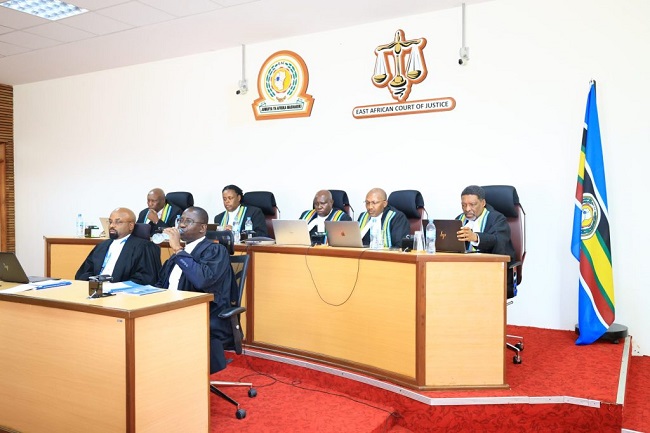
The East African Court of Justice (EACJ) Appellate Division
The CSOs sought to stop the human rights, environmental, and climate impacts or risks associated with the EACOP project.
During Wednesday’s court session, judges at the Appellate Division of the EACJ observed that the First Instance Division did not err in ruling that the case by the CSOs was filed out of time.
The judges, who include Justice Nestor Kayobera, the president of the Appellate Division of the EACJ; Justice Anita Mugeni, the Vice President of the court; and Justice Kathurima M’Inot, agreed with the First Instance Division, noting that the EACJ does not have jurisdiction to hear the main case.
The other judges present in court included Justice Cheboriona Barishaki and Justice Omar Othman Makungu.
The judges however overturned the order issued by the First Instance Division awarding costs to the governments of Uganda and Tanzania, as well as to the Secretary General of the East African Community (EAC). The three are the parties against whom the CSOs filed the suit.
While reading the ruling, Justice Kayobera observed as follows, “We have carefully considered the pleadings of the parties … (and) from the chronology of events [relating to signing of the EACOP agreements], any sane person would adduce that the reference (case filed by the CSOs) … runs afoul of the time limitation provision (in) the EAC (East African Community) Treaty. The case is hereby dismissed”.
By upholding the ruling of First Instance Division, the judges dismissed the case by the CSOs on a narrow legal technicality in EAC laws which provides that cases filed outside a 60-day time limit are not heard by court.
Worth noting is that key agreements related to the EACOP were made public only years after they were signed. The case by the CSOs was based on EACOP-related agreements such as the Inter-Governmental Agreement (IGA) and Host Government Agreement (HGA).
The judges failed to consider when communities and CSOs actually became aware of the project’s impacts and EACOP agreements, effectively shutting the door on the case without examining any of the evidence.
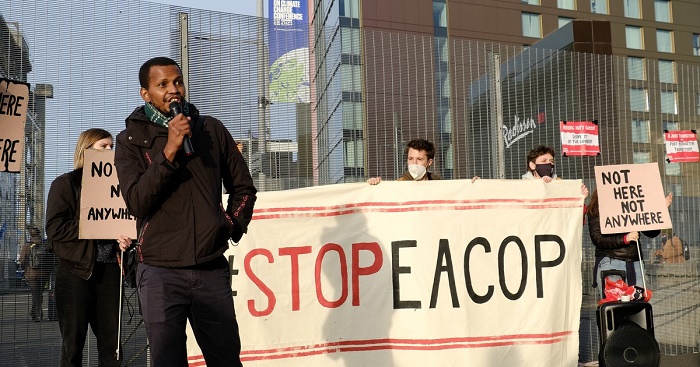
“We strongly condemn the ruling made by the East African Court of Justice, which has told millions of people across the region that technicalities matter more than their lives, their land, and their future. That is not neutrality nor objectivity. It is a choice in favour of oil companies and the governments that serve them,” said Zaki Mamdoo, StopEACOP Campaign Coordinator.
The StopEACOP Coalition maintains that the decision to dismiss the case on procedural grounds prevents examination of the substantive issues including land compensation disputes, transboundary impacts, environmental impacts including impacts on water sources and protected areas, and the project’s overall alignment with the EAC Treaty on its commitments to sustainable development, the protection of human rights, and the responsible and ethical management of transboundary resources.
“In refusing to hear the harms of EACOP on a technical pretext the legitimacy of this Court now hangs by a thread, and history will have to decide whether it was a forum for justice or simply an office providing cover for corporate plunder,” continued Mamdoo.
Independent bodies, local and international civil society organisations have documented the negative impacts of the controversial EACOP project from irregular land acquisition processes, potential risks to the Lake Victoria basin that over 40 million people depend on to human rights violations.
Similarconcerns have just been raised by civil society groups in the Democratic Republic of Congo (DRC) following disastrous pollution recently observed by local communities and subsequently corroborated by a scientific report published by Environmental Law Alliance Worldwide (ELAW), pertaining to cross-border oil developments in the region.
To that end, the CSOs in DRC under the banner “Our Land Without Oil” have taken their government, the government of Uganda, and the Secretary General of the EAC to the EACJ over an ecological disaster, disrupting the livelihoods of fisher communities in Lake Albert and Lake Edward as a result of lake asphyxiation and chemical contamination linked to oil activity in the region.
While the StopEACOP Coalition holds out hope for this legal effort, the dismissal of Wednesday’s case sends a chilling message to all those seeking regional remedies for regional harms: that even the highest court in the Community may refuse to hear evidence when powerful interests are at stake represents a gravely concerning injustice.
“We must insist that the Court, and all regional institutions, do better. We will continue to demand that they live up to their mandates. But this ruling also shows us that we cannot afford the illusion that these institutions will save us.
“Our survival depends on continuing the struggle on every front and with every tool available to us, organising in our communities, confronting financiers and insurers, challenging governments, and building a renewable energy future for our communities,” said Recheal Tugume, an EACOP-impacted community member from Hoima.
Mr. Dickens Kamugisha, the Chief Executive Officer of AFIEGO, stated, “The court’s decision is a setback for regional justice and the protection of vulnerable communities as well as biodiversity and our shared climate. The decision has left over 331 million East Africans at the mercy of greedy corporations, which pillage and destroy important ecosystems that communities depend on. The ruling is a travesty, but we remain determined to use all available strategies to protect people and nature.”
Ms. Elizabeth Kariuki, Hub Director – Nairobi Hub, Natural Justice,noted, “This ruling is devastating for the very people whose lives have been upended by EACOP – the families that lost their land and livelihoods, and the communities watching their ecosystems disappear. Today, the court has closed its doors to them. But we will not give up. We will continue to fight alongside communities to ensure that their suffering is not ignored.”
Mr. Cosmas Yiga, a project affected person from Uganda, added, “We have seen the oil curse. We, the PAPs, have been oppressed and we don’t expect any gain from the oil industry. And, as far as I see, let not any ordinary Ugandan expect anything good from the oil industry, besides oppression. Today is a sad day.”
On Wednesday, November 26, 2025, at UNESCO in Paris, France welcomed over 100 leading global scientists as they embarked on the start of a vital new and authoritative multi-year assessment of the state of knowledge about global biodiversity and nature’s contributions to people.
The French Minister Delegate for Francophonie, International Partnerships and French Nationals Abroad, Eléonore Caroit, addressed the opening session of the first author meeting of the second global assessment of the Intergovernmental Platform on Biodiversity and Ecosystem Services (IPBES).
IPBES Chair, Dr. David-Obura
Minister Caroit reaffirmed France’s unwavering commitment to free, rigorous, independent science, as an essential component of the international efforts to tackle biodiversity loss and climate change, especially “at a time when science is under attack and is confronted with disinformation campaigns that undermine climate and environmental action”.
In 2019, the first IPBES Global Assessment alerted the world to the fact that 1 million species of plants and animals are already at risk of extinction, and ranked, for the first time ever, the direct drivers of biodiversity loss, setting a very high bar as one of the most impactful environmental reports ever launched.
IPBES Executive Secretary, Dr. Luthando Dziba, noted “how special this venue is because, in 2019, the IPBES Plenary approved the first Global Assessment here at UNESCO in Paris. That report was groundbreaking in both its reach and impact. It was welcomed by French President Macron at the Élysée Palace on the day it was launched and used that same week to help inform undertakings by the G7 under the French Presidency. The Report went on to underpin the targets set by Parties to the Convention on Biological Diversity in the Kunming-Montreal Global Biodiversity Framework, among its many outstanding achievements.”
Minister Caroit thanked IPBES and its expert authors for the major role of IPBES in producing knowledge essential for public decision-making and reiterated that France will continue to actively support the Platform and its scientific community.
Expected to be published in 2028, in time to inform the global stocktaking on the 2030 deadlines of the Sustainable Development Goals, Global Biodiversity Framework and the Paris Agreement on climate change, and to inform the post-2030 global biodiversity framework, the 2nd IPBES Global Assessment is now underway, with 117 world-leading experts from around the world as authors.
The assessment will assess progress towards the Global Goals and address critical gaps in the first Global Assessment, as well as emerging issues. These gaps and issues, for example, include the need for more comprehensive attention to oceans, and issues related to Indigenous Peoples and local communities will be comprehensively addressed, including multiple worldviews and values.
It will also consider somewhat neglected components of biodiversity and relevant social issues. The second global assessment will assess the different challenges, lessons learned and potential solutions within and among regions in a scientific and balanced manner.
IPBES Chair, Dr. David Obura, concluded: “This assessment brings together experts across the sciences and Indigenous and local knowledge systems, in an ambitious design to help governments and other stakeholders take stock on progress towards goals for 2030 and to shape the post-2030 global agendas on biodiversity and sustainability, to progress the global vision of living in harmony with nature.”
Dangote Group has announced a series of strategic technical partnerships to support the next phase of expansion of its fertiliser operations in Nigeria, as well as the development of new fertiliser plants in Ethiopia. These collaborations, according to the organisation, mark a significant step in its long-term plan to strengthen regional food security, enhance agricultural productivity, and deepen Africa’s position in the global fertiliser market.
Through these strategic partnerships, Dangote Group will increase its urea production capacity in Nigeria from the current three million metric tons to nine million metric tons annually. The existing facility operates two trains with a combined capacity of three million metric tons.
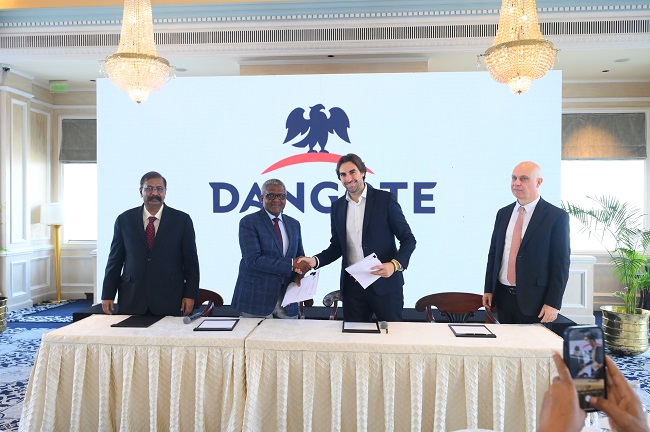
Vice President, Oil and Gas, Dangote Industries Limited, Devakumar Edwin; President and Chief Executive of DIL, Aliko Dangote; Chief Operating Officer of Saipem’s Energy Carriers Line, Botta Fabrizio; and Managing Director of Saipem India Projects, Villa Stefano, during the signing of a partnership agreement in India on Wednesday, November 26, 2025
The expansion will introduce four additional trains, enabling the Group to meet the rising demand for high quality fertiliser across Africa and global markets.
In addition to the Nigerian expansion, the Group recently held the groundbreaking ceremony for a $2.5 billion fertiliser plant in Gode, Ethiopia. The facility is designed to produce three million metric tons of urea annually and represents a significant step in Dangote Group’s commitment to strengthening food security and industrial growth across the continent.
To deliver world class facilities and ensure the highest standards of technology, reliability, and operational efficiency, Dangote Group has entered into the following partnership agreements:
Topsoe
Topsoe will provide ammonia technology licensing and complete process design packages for six ammonia plants. Four of these plants will be located in Nigeria and two in Ethiopia. Topsoe is recognised globally for advanced ammonia process technologies that support efficient and environmentally responsible production.
Saipem
Saipem will deliver technology licensing and the full process design package for urea melt units across all six plants. This includes four units in Nigeria and two in Ethiopia. Saipem brings deep engineering expertise and decades of experience in fertiliser production systems.
Thyssenkrupp through UFT
Thyssenkrupp’s UFT division will supply the granulation technology license and complete process design package for granulation units in the six fertiliser plants. This will support the production of premium quality urea granules suited for domestic and international markets.
Engineers India Limited
Engineers India Limited has been appointed as project management consultant and engineering procurement and construction management consultant for the four fertiliser plants being developed by DFFZE in Lekki, Nigeria. Engineers India brings proven competence in large scale industrial engineering and project delivery.
“These partnerships reflect Dangote Group’s commitment to delivering high quality industrial assets that meet the most rigorous global standards. The planned expansion will significantly increase regional urea and ammonia production capacity, create new jobs, support agricultural value chains, and contribute to sustainable economic growth in Nigeria, Ethiopia, and across the continent,” submitted the organisation.
Dangote Group adds that it remains dedicated to building resilient industrial capacity, supporting national development priorities, and forging strong global collaborations that advance Africa’s long-term prosperity.
The Federal Government said on Tuesday, November 25, 2025, that the country can achieve the Global Methane Pledge target of a 30 per cent reduction in emissions by 2030.
Dr Ekperikpe Ekpo, Minister of State for Petroleum Resources (Gas), said this in Abuja at a two-day Sub-Saharan African Roundtable on Methane Emissions.
The event, organised by the International Energy Agency (IEA) in partnership with the Ministry of Petroleum Resources and the African Energy Commission (AFREC), had its theme as “Turning Methane Pledges into Action”.
Minister of State Petroleum Resources (Gas), Mr Ekperikpe Ekpo
“Nigeria achieving the Global Methane Pledge target is realistic and economically advantageous for oil and gas producing countries,” he said.
Ekpo described methane as one of the most potent greenhouse gases accelerating global warming.
He highlighted Nigeria’s strength in methane management, noting that the country became the first African nation to publish a Methane Action Plan after recording major progress through sustained reductions in routine gas flaring and extensive mapping of flare sites.
He said the country had also recorded progress in advancement of the Nigerian Gas Flare Commercialisation Programme, deployment of leak detection and repair technologies, and expanded Liquefied Petroleum Gas (LPG) utilisation in households.
According to him, these actions, alongside ongoing gas infrastructure projects under the Decade of Gas Initiative demonstrate Nigeria’s commitment to environmental stewardship, economic diversification, improved energy access and public health.
Permanent Secretary, Ministry of Petroleum Resources, Dr Emeka Obi, described the roundtable as timely, especially as the world had shifted attention from broad climate declarations to measurable emission-reduction outcomes.
Obi said methane reduction was central to Nigeria’s environmental, economic and energy priorities.
“While Nigeria holds vast natural gas reserves, decades of flaring and venting have resulted in significant financial losses and environmental damage.”
He said the Federal Government was reversing the trend through strengthened regulatory frameworks under the Petroleum Industry Act (PIA), which prohibited unauthorised flaring and enhancing environmental oversight across the energy value chain.
”Nigeria’s updated Nationally Determined Contribution (NDC) under the Paris Agreement, demands that the country cut greenhouse gas emissions by up to 47 per cent by 2030 on a conditional basis, and 20 per cent unconditionally with international support.
“These commitments are not abstract targets, they are embedded in national programmes, policy reforms and infrastructure investments currently underway,” he said.
He urged African countries to leverage methane reduction as a development catalyst capable of delivering cleaner industries, improving public health, creating jobs, expanding energy access and attracting investment.
To tackle the environmental challenges facing the nation’s capital, a non-governemental organisation (NGO) has called on the Minister of FCT, Nyesom Wike, to reactivate environmental court and tribunals.
The NGO, the CRUX Environmental Rights, Advocacy and Development Foundation (CERADF), stated this in a letter written to the minister.
The letter is titled, “Request for the Reactivation of Environmental Courts and Tribunals in the Federal Capital Territory (FCT), Abuja.”
Minister of FCT, Nyesom Wike
It reads: “The CRUX Environmental Rights, Advocacy and Development Foundation (CERADF) respectfully presents this formal request for the reactivation and strengthening of dedicated Environmental Courts and Tribunals within the Federal Capital Territory (FCT).
“Specifically, we request the establishment of a central Environmental Court within the High Court of the FCT, as well as Environmental Tribunals across all six Area Councils.
“This call is made pursuant to relevant constitutional and statutory provisions and in recognition of the urgent environmental challenges confronting the nation’s capital.”
According to CERADF, the Abuja Environmental Protection Board (AEPB), established in 1997, introduced mobile courts in May 2022 to address environmental infractions.
It, however, said that these measures had proven inadequate for the scale and complexity of the environmental crisis now facing the FCT.
“Recent CERADF’s field monitoring across Gwarinpa, Utako, Mpape, Kubwa, Nyanya, Karu, Lugbe, Kuje, Apo Mechanic Village, and even parts of the Central Business District reveals widespread waste accumulation and poor sanitation.
“These conditions have resulted in: Overburdened AEPB and waste-management agencies; Blocked drainages and recurrent flooding; Increased rodent infestation and heightened public-health risks,” it said.
Besides, it said the situation had also resulted in “escalating pollution and offensive odours; reputational damage to Abuja as Nigeria’s administrative and diplomatic capital; weak enforcement due to slow court processes and insufficient deterrent penalties.”
CERADF said while public sensitisation efforts are ongoing, these cannot succeed without a dedicated judicial framework that would ensure speedy trials, consistent application of environmental laws, and firm sanctions for violators.
The NGO, therefore, gave some recommendations which include collaboration with the Chief Judge of the High Court of the FCT, among others.
The Lagos State Government says it is on track to unveil the Lagos Greenhouse Gas Registry by the first quarter of 2026 as part of measures to reduce greenhouse gas emissions and promote a sustainable environment.
This, it said, would make Lagos the first African city to operate a functional, verifiable emissions registry.
The Lead Consultant, TPHG Technologies Ltd., Dr Mofoluso Fagbeja, disclosed this during the second stakeholders’ engagement on the Lagos GHG Registry held on Wednesday, November 26, 2025, in Lagos.
General Manager, Lagos State Environmental Protection Agency (LASEPA), Dr Tunde Ajayi
Fagbeja said the registry would serve as the central infrastructure for carbon accounting and future carbon trading activities in the state.
He said the state had made significant progress since the first engagement held last year, expanding participation to include a broader set of industry players, regulators and professional groups.
According to him, the development of the registry is not limited to technology but includes regulations, governance frameworks and operational guidelines already reviewed by national and state-level experts.
He said organisations such as NESREA, the Lagos State Ministry of Justice, Ministry of Environment and Water Resources, and sector-specific professionals had contributed to the reviewed documents.
Fagbeja said the next phase would involve sharing sector-specific data collection templates that would guide organisations on the type of emissions data required ahead of the platform’s launch.
He said the registry would cover major sectors including transport, commercial enterprises, waste management, industry and agriculture, but would not extend to individual households.
According to him, the registry will strengthen transparency, support the state’s energy transition goals and attract climate finance for organisations willing to decarbonise.
He said carbon trading would also become possible when emission limits are established, enabling organisations with lower emissions to trade with those exceeding their thresholds.
The General Manager, Lagos State Environmental Protection Agency (LASEPA), Dr Tunde Ajayi, said the initiative was essential for accountability and effective climate governance.
Ajayi said accurate measurement of emissions was the only way the state could track progress and implement responsible policies, likening it to the diagnostic processes in healthcare.
He described the engagement as an important step towards Lagos becoming the first African city to operate a functional greenhouse gas registry, adding that such a system would ultimately come with economic benefits.
Mrs. Ayodele Oso, Director, Air Quality and Emissions Control Unit, LASEPA, said the registry would provide a transparent and reliable system for tracking emissions across key sectors of the economy.
Oso said the initiative would strengthen environmental governance, improve climate reporting and enhance Lagos State’s sustainability profile.
She noted that the success of the registry depended heavily on the cooperation of industry players, regulators, technical experts and partner institutions.
Oso urged participants to work collectively to turn the registry from a policy design into a functional tool that supports the state’s climate resilience goals.
She said Lagos, as a rapidly growing megacity, carried both the responsibility and opportunity to lead Africa in responsible environmental stewardship.
Oso encouraged participants to be open-minded and contribute actively, adding that the future of the state’s environment depended on decisions made today.
The Lagos GHG Registry will serve as the foundation for future carbon market activities, climate finance mobilisation and improved environmental accountability across sectors in the state.
The Minister of Power, Mr. Adebayo Adelabu, has reaffirmed the Federal Government’s commitment to expanding clean and modern energy access across Nigeria.
He made the pledge at the ongoing two-day Renewable Energy Conference 2025 in Abuja on Wednesday, November 26, 2025.
Adelabu was represented by Mr. Metu Francis, Principal Electricity Engineer at the Ministry.
Participants at the Renewable Energy Conference 2025 in Abuja
He said collaboration across the renewable energy value chain is essential as Nigeria expands local manufacturing, solar systems, mini-grids and climate-smart technologies.
“The Ministry remains committed to enabling policies, improved financing and support for industry players expanding clean electricity access,” he said.
He said this year’s theme aligns with the Ministry’s drive to deliver clean, reliable and affordable energy for all Nigerians.
Adelabu commended the Renewable Energy Association of Nigeria (REAN) for promoting collaboration, innovation and dialogue in the sector.
He said private-sector leadership, local manufacturing and community-driven solutions are vital to achieving national energy transition targets.
“Together, we can expand mini-grids, strengthen local capacity and support women, small businesses and underserved communities,” he said.
President of the Renewable Energy Association of Nigeria, Mr. Ayo Ademilua, said the association continues to drive strong advocacy and strategic partnerships.
He said members have established solar panel assembly plants in the North and South, supplying domestic and export markets.
He said these investments have increased investor confidence, foreign investment and strengthened the renewable energy value chain.
Ademilua said Nigeria still faces major energy access gaps, with 3.3 gigawatts far below the 9 gigawatt target for 2030.
He said millions of Nigerians still lack reliable electricity despite progress in the energy transition plan.
He called for predictable policies, stronger legislative engagement and full implementation of the Electricity Act 2023.
He said a Just Energy Transition must benefit rural communities, women, youths, small businesses and farmers.
Director-General of the Energy Commission of Nigeria (ECN), Dr Mustapha Abdullahi, represented by Mr. Halilu Sale, said the conference reflects Nigeria’s commitment to inclusive energy access.
He said strong public and private partnerships are essential for achieving universal access.
He said the Commission is building national capacity through its Energy Research Centres.
He added that decentralised renewable solutions, including mini-grids and standalone solar systems, are key to reaching underserved communities.
He said true energy access must empower households, businesses and youths through green jobs and local manufacturing.