25.7 C
Lagos
Thursday, December 25, 2025
Home Blog Page 6

New policy playbook provides recipes for successful implementation of Kampala Declaration

0

A panel of global agricultural and policy experts has released a new playbook to support African countries as they begin implementing the Kampala Declaration on building resilient and sustainable agrifood systems from January 1, 2026.

Recipes for Success 2: Policy Innovations to Achieve the Kampala Declaration Goals synthesises lessons from 70 country case studies conducted by the Malabo Montpellier Panel based on 16 flagship reports published since 2017, offering practical and replicable approaches for African governments, nonstate actors, and development partners for the third phase of the Comprehensive Africa Agriculture Development Programme (CAADP) 2026-2035.

Ousmane Badiane
Dr. Ousmane Badiane, Executive Chairperson, AKADEMIYA2063

CAADP, the foundational framework for Africa’s agricultural development, was launched in 2003 following the endorsement of the Maputo Declaration. In 2014, the Malabo Declaration set forth seven commitments to be achieved by 2025. These included ending hunger in Africa by 2025, halving poverty through inclusive agricultural growth, and enhancing the resilience of livelihoods and production systems to climate variability and other related risks.

Africa has experienced sustained economic growth over the last two decades, with a steady increase in agricultural production. Despite progress, the continent has faced severe setbacks from climate shocks, the COVID-19 pandemic, and global commodity market disruptions linked to the Russia-Ukraine war.

In response to these pressing challenges, the Kampala Declaration and the associated CAADP Strategy and Action Plan (2026–2035) were adopted by African Union Member States in 2025, proposing a holistic agrifood systems approach to shape the next decade of Africa’s agrifood system transformation. With case studies from 22 countries and lessons from Regional Economic Communities, “Recipes for Success 2” maps the Panel’s body of evidence against the six commitments outlined in the Kampala Declaration.

“The Kampala Declaration is an ambitious framework to make up ground on the continent’s agrifood systems transformation, and the good news is that African countries already possess a rich foundation of policy innovations, institutional reforms, and programmatic successes to build on,” said Dr. Ousmane Badiane, Co-Chair, Malabo Montpellier Panel, and Executive Chairperson at AKADEMIYA2063.

“Evidence from the Panel’s work over nearly a decade shows that the success of the Kampala era would largely depend on Africa’s capacity to learn from documented experiences and scale up proven solutions through coordinated and sustained action,” Badiane added.

With this report, the Malabo Montpellier Panel presents an integrated agenda to support policy and programmatic interventions across areas such as agrifood finance, agro-processing, climate resilience, digitalisation, fisheries, irrigation, mechanisation, nutrition, and youth and women’s empowerment.

The report offers critical recommendations and highlights relevant, successful interventions for adoption and scaling under each of the six Kampala commitments.

Intensifying sustainable food production, agro-industrialisation, and trade: Achieving a 45 percent increase in output, halving postharvest losses, and tripling intra-African trade by 2035 will require sustained investment in technology, diversification, and competitive value chains. Experiences from Ethiopia, Rwanda, and Senegal provide workable models that show productivity gains rise sharply when policies align with investments in irrigation, digital advisory services, improved mechanisation, and climate-smart agricultural innovations responsive to farmers’ needs.

Trade-enhancing reforms in Kenya, South Africa, and Uganda demonstrate that reducing tariff and non-tariff barriers can stimulate regional markets, boost competitiveness, and strengthen food availability across borders.

Boosting investment and financing for agrifood systems transformation: The Kampala Declaration calls for mobilising at least $100 billion in public and private investment by 2035, allocating 10 percent of national budgets to the sector, and reinvesting 15 percent of agrifood GDP annually. Examples from Morocco, Seychelles, and Zambia show that innovative financing mechanisms, including revolving funds, blended finance instruments, and results-based subsidies, have expanded access to capital for women, youth, and other small producers.

Ensuring food and nutrition security: The Kampala Declaration targets Zero Hunger by 2035, 30 percent reductions in child stunting, wasting, and overweight, and ensuring that at least 60 percent of the population can afford a healthy diet. Interventions in Malawi, Côte d’Ivoire, and Ghana show that school feeding schemes, dietary diversification incentives, strengthened safety nets, and biofortified crops, along with stronger monitoring systems to track nutrition outcomes across all ages for both females and males, have proven effective in improving dietary quality, reducing food insecurity, and building human capital.

Advancing inclusivity and equitable livelihoods: Reducing extreme poverty and narrowing the gender yield gap by half requires reforms that prioritise equitable access to productive resources. Programmes that have expanded women’s and youth participation in agrifood systems, as observed in Ethiopia, Uganda, Kenya, and Zimbabwe, demonstrate that key enablers of inclusivity include secure land and resource rights, tailored financial services, access to mechanisation and digital tools, and agricultural innovation hubs that enable young people, in particular, to transition from being job seekers to job creators.

Building resilient agrifood systems: Protecting 40 percent of households from shocks requires a shift from reactive to anticipatory governance. Successful programmes in Niger, Mali, Zambia, and Morocco show that effective delivery of scalable technologies, such as solar irrigation, drought-tolerant seed varieties, and climate-informed advisory services, combined with early warning systems and risk financing mechanisms, have strengthened countries’ ability to withstand such shocks.

Investments in restoration, circular economy approaches, and sustainable land and water management can ensure long-term resilience for households engaged in agrifood-system-related livelihoods, as demonstrated in Ghana and Uganda. Furthermore, Mozambique and Malawi demonstrate that infrastructure and cross-border cooperation can turn aquatic resources into a pillar of resilient, nutrition-sensitive food systems.

Strengthening agrifood systems governance: Evidence indicates that countries that have invested in coherent policies, data-driven planning, accountable institutions, and participatory decision-making have achieved faster and more sustainable results in transforming their agrifood systems. As observed in Rwanda and Senegal, inter-ministerial coordination, regular performance reviews, and transparent regulatory systems, especially those designed around the use of digital technologies, enhance trust, efficiency, and investment attractiveness.

“The wealth of evidence in this report serves as a practical reference for African governments, development partners, and private-sector actors to advance the ambitions of the Kampala Declaration,” said Prof. Joachim von Braun, Co-Chair, Malabo Montpellier Panel at the Centre for Development Research (ZEF), University of Bonn. “The African research communities will play a key role providing guidance to implementation actions at continental and country level.”

As the continent embarks on the implementation phase of the Kampala Declaration, these policy solutions, along with robust communication and advocacy strategies, can serve as a blueprint for continentwide implementation, scaling, and monitoring to accelerate impact. 
Renewables: TotalEnergies divests 50% of 424 MW portfolio in Greece

0

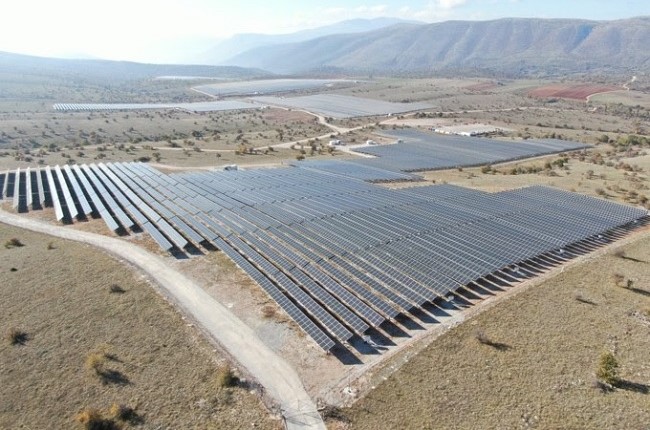
In line with its renewable energy business model, TotalEnergies says it has finalised the sale to Asterion Industrial Partners of 50% of its 424 MW portfolio of wind and solar projects located in Greece.

This transaction values ​​the portfolio at €508 million, or approximately €1.2 million per MW installed.

TotalEnergies retains a 50% stake and remains the operator of the assets. Furthermore, TotalEnergies will purchase and market the majority of the electricity produced by these assets once they are no longer eligible for regulated tariffs.

TotalEnergies
A TotalEnergies solar energy facility

TotalEnergies’ business model in electricity

TotalEnergies is building a competitive portfolio combining renewable (solar, onshore wind, offshore wind) and flexible (CCGT, storage) assets to provide its customers with low-carbon electricity available 24/7.

To achieve its profitability objectives and share the risks, TotalEnergies sells up to 50% of its interests in renewable assets, thus allowing the Company to maximise the value of its portfolio.

CSOs decry poor funding, seek govt intervention

0

Civil society organisations (CSOs) in Adamawa State have expressed concern over poor access to direct funding, calling for urgent government intervention to sustain humanitarian and development operations across Nigeria.

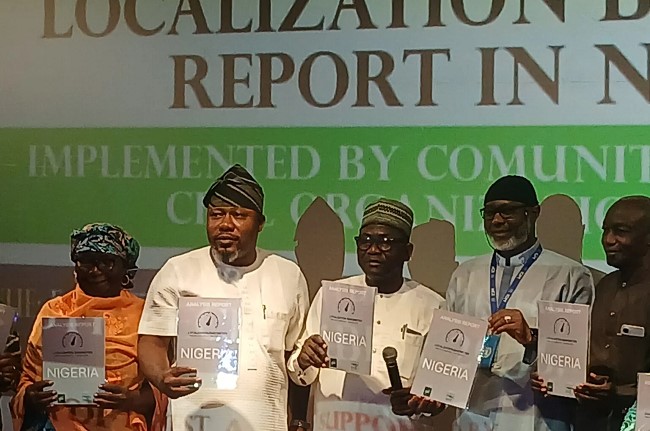
Mr. Peter Egwudah, Chairman of the Network of Adamawa Non-Governmental Organisations (NANGO), made the call on Wednesday, December 17, 2025, in Yola, the state capital, during the unveiling of the Nigeria Localisation Barometer Report.

Egwudah said limited access to direct funding remained a major challenge facing local organisations, in spite of global commitments to strengthen locally led humanitarian responses.

CSOs
Participants at the unveiling of the Nigeria Localisation Barometer Report in Yola

He recalled that the 2016 Grand Bargain agreement in Istanbul set a target of allocating at least 25 per cent of humanitarian funding to national actors, noting that the benchmark had yet to be met.

According to him, inadequate funding is already affecting the capacity of local CSOs to respond effectively to conflict-induced and climate-related humanitarian crises.

He added that dwindling donor support had further constrained operations, making it necessary to assess the localisation agenda and advocate stronger government involvement.

Egwudah noted that governments at the federal, state and local levels did not directly fund NGOs, stressing the need for advocacy to encourage public investment in humanitarian response.

He said humanitarian crises had spread nationwide, citing insecurity in the North-East, North-West and North-Central, oil spillage in the Niger Delta, and other socio-economic challenges.

Egwudah added that Nigeria hosted more than three million internally displaced persons, requiring stronger government ownership and increased budgetary commitment.

He stressed that humanitarian assistance should not be left solely to international organisations, urging government investment to ensure sustainability and accountability.

Also speaking, Mrs. Amy Gaman, Managing Director of Nuru Nigeria, said the 25 per cent funding commitment to local actors had not been realised, adding that it might not have reached 10 per cent.

Gaman urged federal and state governments to support the localisation model through counterpart funding, noting that development efforts were anchored on strong government leadership.

By Talatu Maiwada

NCE 2025: Nigeria charts stronger path to environmental sustainability

Stakeholders in Nigeria’s environmental sector have been assured of resolutions that would strengthen policy direction and promote environmental sustainability nationwide.

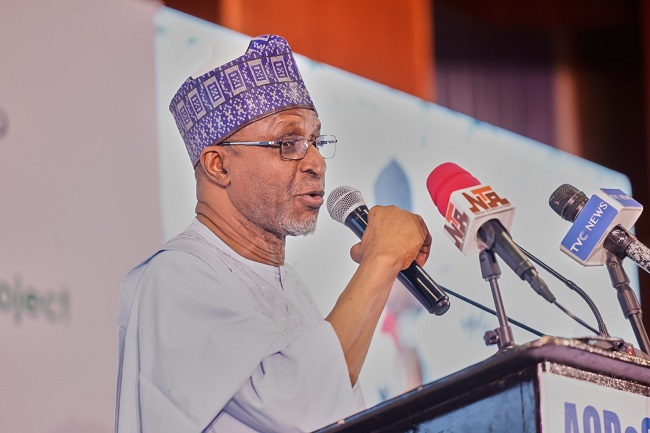
The assurance was given on Tuesday, December 16, 2025, in Katsina by Mahmud Adam-Kambari, Permanent Secretary, Federal Ministry of Environment.

Adam-Kambari gave the assurance at the opening of the Technical Session of the 18th National Council on Environment (NCE)

Malam Balarabe Abbas Lawal
Malam Balarabe Abbas Lawal, Minister of Environment

He described the council as the highest policy-making body on environmental matters, providing a critical platform for stakeholders to review progress, address emerging challenges and adopt resolutions that shape national environmental policy.

According to him, deliberations at the council will drive coordinated action towards a safer and more sustainable environment for all Nigerians.

He stated that the 2025 theme, “Tackling the Triple Planetary Crisis of Climate Change, Biodiversity Loss and Pollution for Sustainable Development in Nigeria”, reflected the urgent need for collective action.

The permanent secretary stressed that climate change, biodiversity loss and pollution posed serious threats to ecosystems, food security, public health and Nigeria’s sustainable development aspirations.

Adam-Kambari also commended the Katsina State Government and its people for their warm hospitality and strong partnership.

He also praised the Minister of Environment for his visionary leadership, as well as state commissioners, development partners and other stakeholders for their continued commitment to environmental sustainability.

Earlier, the Katsina State Head of Service, and Chairman of the Local Organising Committee, Falalu Bawale, welcomed the participants and described their presence as a clear demonstration of shared resolve to protect the environment.

He said the council provided an opportunity to deepen professional collaboration and deploy expertise towards effective environmental management.

Bawale thanked the Federal Ministry of Environment for selecting Katsina State to host the prestigious national forum.

He reaffirmed that the NCE remained Nigeria’s most strategic environmental policy organ, offering states access to best practices in environmental resilience and climate change adaptation.

By Abbas Bamalli

Post COP30: Stakeholders seek concrete implementation on global climate action 

0

Stakeholders in the environment sector have called for concrete implementation of existing policies, financial commitments to effectively address the global climate crisis.

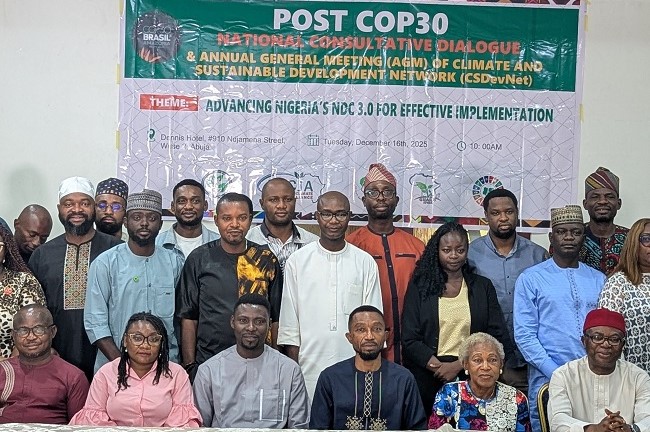
They made the call at the Post COP30 National Consultative Dialogue on Advancing Nigeria’s Nationally Determined Contribution (NDC) 3.0 at the Climate and Sustainable Development Network (CSDevNet) Annual General Meeting in Abuja on Wednesday, December 17, 2025.

Rep. Sam Onuigbo, CSDevNet Patron, said that global climate action has entered a new phase, shifting from pledges to concrete implementation.

CSDevNet
Participants at the CSDevNet Post COP30 National Consultative Dialogue in Abuja

“For Nigeria, the Nationally Determined Contribution under the Climate Change Act 2021 remains the central framework guiding national climate action.”

He highlighted the importance to ensure that post-COP30 priorities response to the lived experiences of communities facing climate impacts, while promoting equity, inclusiveness, and a just transition.

Onuigbo further identified key opportunities within NDC 3.0 implementation, including; Strengthening mitigation and adaptation measures, scaling up nature-based solutions, enhancing transparency and accountability in climate governance, expanding renewable energy deployment and green job creation.

He also emphasised the potentials of Nigeria’s emerging carbon market to mobilise climate investment and accelerate emissions reduction, and stressed on the need for strong environmental integrity and community safeguards.

He reaffirmed his commitment to collaborative, evidence-driven climate action and expressed optimism that Nigeria can emerge as a continental leader in low-carbon development and climate resilience.

“Post COP 30 priorities must respond to the lived experiences of communities grappling with climate shocks, farmers contending with shifting seasons, young people seeking green livelihoods, and institutions working to protect ecosystems.

“Implementing Nigeria’s NDC 3.0 offers us an opportunity to deepen mitigation pathways, expand adaptation finance, enhance nature-based solutions, and reinforce the transparency frameworks that underpin trust in our climate governance,” Onuigbo said.

Dr Sam Ogallah, Head of Unit, Climate Change, Africa Union, worried that Africa did not create the climate crisis, but Africa is paying the highest price.

“The outcome of COP30 reinforced the long-standing African demands for protection of livelihoods, jobs and development prospects fair and just transition pathways and scaled adaptation loss and damage support.

“Nigeria’s NDC 3.0 rightly prioritises emissions reduction of greenhouse gases by 29 per cent by 2030 and 32 per cent by 2035 (from 2018 levels) and energy transition by 50 per cent of national power from renewables by 2030,” Ogallah said.

Prof. Ibrahim Choji,  Chairman of the CSDevNet Board, reaffirmed the Network’s strong commitment to aligning Nigeria’s national climate priorities with global climate processes.

Choji said that Nigeria had experienced significant climate-related challenges, including devastating floods, rising food insecurity, and increasing vulnerability among communities.

Inspite of these challenges, he highlighted positive developments such as the validation of Nigeria’s NDC 3.0, gradual progress in climate-related policies, and renewed global momentum following COP 30.

He reiterated that CSDevNet remains committed to translating climate policies into action by amplifying civil society voices in national and global climate spaces, supporting grassroots and community engagement and accountability in climate governance.

Also, he emphasised that civil society plays a critical role in ensuring that climate commitments move beyond policy documents and result in measurable improvements in people’s lives,“ Choji said.

Mrs. Anna Kalu, a representative from the Federal Ministry of Agriculture and Food Security, said that COP30 emphasised the interconnectedness of agriculture, food security, climate resilience, and sustainable development goals.

“For Nigeria, these outcomes resonate with national mandates to enhance sustainable agricultural productivity, strengthen resilience to climate shocks, and safeguard food production for a rapidly growing population.”

She reaffirmed the Ministry’s commitment to align with COP30 outcomes national policies, climate adaptation plans, and ongoing agricultural governance reforms.

“As we move into the post-COP 30 implementation phase, the ministry will continue engagement with CSDevNet in translating ambition into impact for climate-secure food security for Nigeria,” she assured.

By Abigael Joshua

Nigeria unveils Presidential Executive Order prohibiting exportation of wood, allied products 

0

The Federal Government of Nigeria, on Wednesday, December 17, 2025, in Katsina, unveiled a Presidential Executive Order prohibiting exportation of wood and allied products across the country.

The Minister of Environment, Alhaji Balarabe Abbas-Lawal, said that the order, tagged: “Presidential Executive Order on Prohibition of Exportation of Wood and Allied Products, 2025″, was signed by the President Bola Tinubu.

He said that, henceforth, exportation of wood, charcoal and other allied products are prohibited across the country.

Executive Order
Minister of Environment, Alhaji Balarabe Abbas-Lawal, with other participants at the National Council on Environment, in Katsina

The minister was in Katsina for the 18th meeting of the National Council on Environment (NCE).

According to the minister, the order was supposed to be launched in Abuja but used the opportunity of the NCE meeting to unveil it in Katsina.

The meeting had as theme: “Tackling the triple planetary crises: climate change, biodiversity loss and pollution for sustainable development in Nigeria”.

Abbas-Lawal revealed that forests in the country belongs to the states, and they are responsible for controlling them.

He added that the Federal Government owns and control the national parks.

According to the executive order, “forests resources included all trees, vegetation, and associated biodiversity found within forested areas of Nigeria.

“Illegal logging means, unauthorised harvesting, transporting, processing, buying and selling of timber or other forests products in contravening of Nigerian laws.”

Earlier, Gov. Dikko Radda, represented by his Deputy, Faruk Lawal-Jobe, promised to ensure enforcement of the order.

He thanked the ministry for giving the state an opportunity of hosting the meeting.

Radda said that the meeting represented a national dialogue on the environment sector, its spirit, capacity, professionalism, and centrality to the democratic governance and national development.

By Zubairu Idris

New influenza strain circulates in Europe – WHO

0

The early arrival of seasonal influenza has continued sweeping across Europe, with at least 27 European countries reporting “high or very high” flu activity as of Wednesday.

In six countries – Ireland, Kyrgyzstan, Montenegro, Serbia, Slovenia, and the UK – more than one in two patients with influenza-like symptoms tested positive for the virus, according to the World Health Organisation (WHO)

The UN agency confirmed that a new influenza variant called A (H3N2) now accounts for up to 90 per cent of all confirmed cases in the European region.

Hans Kluge
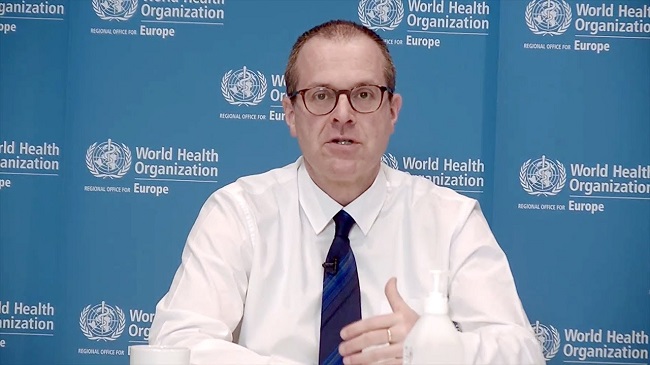
WHO Regional Director for Europe, Hans Kluge

“It shows how just a small genetic variation in the flu virus can place enormous pressure on our health systems because people don’t have built-up immunity against it,” Dr Hans Kluge, WHO Regional Director for Europe, said.

He also emphasised the importance of getting vaccinated quickly.

As in previous episodes of influenza, school-aged children are the primary drivers of community spread. But adults aged at least 65 are usually most at risk, constituting the majority of severe cases that require hospitalisation.

WHO had briefed reporters on Tuesday, warning that a new variant of influenza virus was rapidly gaining ground but expressed hope that vaccination remained the “most effective defence.

Dr Wenqing Zhang, Unit Head for Global Respiratory Threats at the Department of Epidemic and Pandemic Threats Management of WHO, said that 2025  was marked by “the emergence and the rapid expansion of a new AH3N2 virus subclade”.

“The new variant – called J.2.4.1 or subclade K – was first noted in August in Australia and New Zealand and had since been detected in more than 30 countries,” she said.

“Current epidemiological data do not indicate an increase in disease severity, although this genetic shift makes a notable evolution in the virus,” Zhang said.

Influenza viruses are constantly evolving, she explained, which is why the composition of the influenza vaccine is regularly updated.

“WHO tracks these changes, assesses associated risks to public health and makes vaccine composition recommendations twice a year, through a longstanding global system – the Global Influenza Surveillance and Response System (GISRS), in collaboration with other global experts.

The new variant has not been incorporated, and is not part of the composition of the latest vaccines produced for the Northern Hemisphere influenza season, the WHO expert explained.

Still, “early evidence suggests that current seasonal vaccines continue to offer protection against severe diseases and reduce the risk of hospitalisation,” she said.

WHO estimates that there are around one billion cases of seasonal influenza annually, including up to five million cases of severe respiratory illness.

It added that up to 650,000 deaths each year are due to seasonal influenza-related respiratory disease.

By Cecilia Ologunagba

Tinubu seeks Senate approval for new petroleum regulators’ chiefs

0

President Bola Tinubu on Wednesday, December 16, 2025, asked the Senate to approve new chief executives for Nigeria’s petroleum regulators following the resignation of their substantive heads.

The affected agencies are the Nigerian Midstream and Downstream Petroleum Regulatory Authority (NMDPRA) and the Nigerian Upstream Petroleum Regulatory Commission (NUPRC), both created under the Petroleum Industry Act.

The resignations involve Mr. Farouk Ahmed, former Chief Executive of the NMDPRA, and Mr. Gbenga Komolafe, former Chief Executive of the NUPRC.

Bola Tinubu
President Bola Tinubu has nominated Mrs. Oritsemeyiwa Amanorisewo Eyesan (top) as NUPRC Chief Executive and Mr. Saidu Aliyu Mohammed as NMDPRA Chief Executive

Both officials were appointed in 2021 by former President Muhammadu Buhari to lead the newly established regulatory institutions.

In separate letters to the Senate, Tinubu nominated Mrs. Oritsemeyiwa Amanorisewo Eyesan as NUPRC Chief Executive and Mr. Saidu Aliyu Mohammed as NMDPRA Chief Executive.

The President urged senators to treat the nominations with urgency, saying confirmation would “ensure continuity and stability within the petroleum regulatory framework”.

Eyesan is a seasoned petroleum economist with nearly 33 years’ experience at the Nigerian National Petroleum Company Ltd. and its subsidiaries.

She is a graduate of Economics from the University of Benin and retired as Executive Vice President, Upstream, at NNPC Ltd., serving between 2023 and 2024.

She earlier served as Group General Manager, Corporate Planning and Strategy, from 2019 to 2023, contributing to strategic reforms in the upstream sector.

Mohammed, born in 1957 in Gombe State, is a Chemical Engineering graduate of Ahmadu Bello University, Zaria, where he earned his degree in 1981.

He recently served as an independent non-executive director at Seplat Energy and has decades of leadership experience across Nigeria’s oil and gas industry.

His previous roles include Managing Director of Kaduna Refining and Petrochemical Company and the Nigerian Gas Company.

Mohammed also chaired boards of the West African Gas Pipeline Company, Nigeria LNG subsidiaries and NNPC Retail.

He served as Group Executive Director and Chief Operating Officer, Gas and Power Directorate, providing leadership on major gas projects and policy frameworks.

These included the Gas Masterplan, the Gas Network Code and contributions to shaping the Petroleum Industry Act.

He played key roles in delivering projects such as the Escravos–Lagos Pipeline Expansion, the Ajaokuta–Kaduna–Kano Gas Pipeline and Nigeria LNG train expansions.

The nominations were conveyed in a statement issued by the President’s spokesman, Mr. Bayo Onanuga.

By Muhyideen Jimoh

UN Climate Change renews drive to strengthen NAZCA portal for non-state climate action

0

After a decade of providing critical information on real-world climate action, the UN Climate Change Non-State Actor Zone for Climate Action (NAZCA) portal is entering a new chapter of ambition and innovation.

At COP30 in Belém, UN Climate Change unveiled the NAZCA Portal Redevelopment and Engagement Roadmap to develop a modern, data-driven platform that strengthens the role of the UNFCCC secretariat as the custodian and central repository of credible climate action data from non-party stakeholders (NPS). The redeveloped NAZCA portal will consolidate NPS information related to mitigation, adaptation and resilience, and means of implementation.

COP30
Participants at the UN Climate Change unveiling of the NAZCA Portal Redevelopment and Engagement Roadmap, at COP30

Background

Launched at COP20 in Lima, Peru, and named after the country’s iconic Nazca lines, the NAZCA portal was created to showcase climate action commitments from non-Party stakeholders and Cooperative Climate Initiatives. At COP21 in Paris, Parties formally recognised the portal, acknowledging its critical role in enhancing transparency, tracking progress, and recognising leadership across states, regions, cities, businesses, and civil society.

Since then, the portal has been expanded to include commitments, inventories, climate plans, and concrete actions, while also showcasing progress towards disclosed targets. Today, it stands at the threshold for its next phase: a strengthened, modernised user-experience, synced with the new UNFCCC Climate Data Hub, and designed to elevate transparency, ambition, and implementation of the Paris Agreement.

A new era of implementation

The roadmap presented at COP30 outlines the purpose of the redevelopment: to inform stakeholders, invite feedback, and advance a near-term vision that positions the NAZCA portal as the authoritative transparency hub for non-Party climate action. While several redevelopment elements are already underway, others remain in an exploratory phase.

At the COP30 event, UN Climate Change Transparency Manager, Vlad Trusca, highlighted that the portal’s modernised digital architecture within the UNFCCC secretariat will update its technological foundations, improve user experience, expand data accessibility, and introduce new stakeholder engagement tools – reflecting a holistic and inclusive vision for non-Party stakeholder climate action.

The roadmap also illustrates the evolution of the NAZCA portal into a comprehensive ecosystem. Planned enhancements include improved digital tools, regional engagement mechanisms, and powerful new features such as full data downloads, geospatial mapping, and domain-specific AI-driven insights.

Transparency as a foundation of transformation

In a keynote address at COP30, Manuel Pulgar-Vidal, COP21 President and former Minister of the Environment of Peru, reflected on the evolution of climate transparency – from National Communications to Nationally Determined Contributions, and now Biennial Transparency Reports – highlighting how these tools have shaped trust and awareness, particularly in the Global South.

He noted that climate governance has increasingly shifted from negotiation-driven processes towards pathways of economic transformation, with transparency mechanisms serving as crucial enablers in that transition.

Recalling its origins, Pulgar-Vidal emphasised that the NAZCA portal was created to integrate non-state actors into the formal climate space, providing visibility and legitimacy to their climate contributions. Today, he stressed, the NAZCA portal continues to embody the “spirit of Paris,” countering narratives of weaking ambition and reaffirming the importance of voluntary action within the global climate ecosystem.

NAZCA redevelopment and engagement roadmap event at COP30

A central pillar of the NAZCA portal redevelopment is the introduction of the NAZCA Network, an engagement strategy designed to bring climate action information, analysis, and recognition closer to partners. Through workshops, outreach activities, and collaborations, the Network will amplify local efforts, support peer learning, and gather feedback to inform the continuous improvement to the public-facing portal.

Complementing this engagement approach, the modernised NAZCA portal will provide enhanced digital tools, including Entity and Initiative Self-Service systems, upgraded modules for subnational actors, corporations, and cooperative initiatives, as well as country pages that link non-Party stakeholder action with national contexts.

Expert insights from CDP (formerly Carbon Disclosure Project), the Council on Energy, Environment and Water (CEEW), and the UNFCCC Regional Collaboration Centres (RCCs) highlighted the secretariat’s pivotal role in linking data, transparency and implementation through the NAZCA portal.

Clare Everett, Associate Director at CDP, noted that the multi-stakeholder nature of the portal – subnational governments, companies, and investors – provides a baseline not only for ambition, but also for localised climate action.

Vishwas Chitale, Fellow at CEEW, emphasised that showcasing real-world climate action stories in the NAZCA portal is a potentially powerful means for addressing climate risks, sharing experiences, and reaching more people who can benefit from the portal.

Andrea Camponogara, UN Climate Change RCCs’ Team Lead, added that the NAZCA portal serves as a matchmaking platform, making non-state action visible and attracting interest from investors, donors, and development banks.

A decade on, strengthening global climate action

As UN Climate Change advances this strategic redevelopment, the NAZCA portal is reaffirmed as the central repository of credible climate action data from non-Party stakeholders, spanning mitigation, adaptation, resilience, and means of implementation. By aligning with the Climate Data Hub, strengthening stakeholder engagement, and adopting an approach to enhance transparency, the NAZCA portal can help catalyse higher ambition and support implementation across the global climate action agenda.

AfricaRice, Kasetsart varsity join forces to transform Africa’s rice sector

0

The Africa Rice Centre (AfricaRice) and Kasetsart University (KU) have signed a Memorandum of Understanding (MoU) to advance research rice farming, innovation and food security across Africa. The agreement was formalised during the relaunch of the Thailand-Africa Initiative (TAI) in Bangkok, in the presence of Mr. Sihasak Phuangketkeow, Minister of Foreign Affairs of Thailand, and Yusuf Maitama Tuggar, Minister for Foreign Affairs of Nigeria.

The innovative partnership is rooted in AfricaRice’s pan-African mandate and Kasetsart University’s world-renowned Rice Science Centre to deliver cutting-edge solutions to the rice sector in Africa.

Yusuf Maitama Tuggar

Four pillars of collaboration

The partnership will focus on:

  1. Varietal development – Acceleration of climate-resilient, high-quality rice varieties through germplasm exchange, genome editing and Advanced Breeding Techniques
  2. Nutrition and Biofortification – Addressing micronutrient deficiencies through fortified rice products adapted to African markets
  3. Mechanisation – Deployment of appropriate post-harvest technologies, including the potential creation of an assembly plant in Côte d’Ivoire
  4. Capacity building – Training of African researchers, extension workers and youth through joint programmes and technical exchanges

Transforming Africa’s rice economy

This collaboration comes as African countries step up their efforts to achieve rice self-sufficiency and reduce dependence on imports. By combining AfricaRice’s regional expertise and KU’s advanced research capabilities, the partnership aims to bring tangible benefits to millions of smallholder farmers and consumers across the continent.

Dr. Baboucarr Manneh, Chief Executive Officer of AfricaRice, said: “This partnership strengthens our capacity to deliver cutting-edge rice innovations across Africa. Kasetsart University’s excellence in rice science is in line with AfricaRice’s mission to transform rice value chains and improve food and nutrition security for millions of people on the continent.”

Professor Dokrak Marod, Vice President for Research and Internationalisation at Kasetsart University, emphasised: “Kasetsart University is proud to partner with AfricaRice. Together, we will harness scientific advances to develop high-quality, climate-resilient rice varieties and technologies that support sustainable growth of the rice economy in Africa.”

A model of South-South cooperation

The MoU represents one of the flagship outcomes of Thailand’s renewed commitment to Africa under the Thailand-Africa Initiative, demonstrating how developing nations can Collaborate to address common challenges in food security and sustainable development.

×