The Deputy Governor of Taraba, Alhaji Haruna Manu, on Monday, January 22, 2018 said the state government would implement the anti open grazing law gradually.
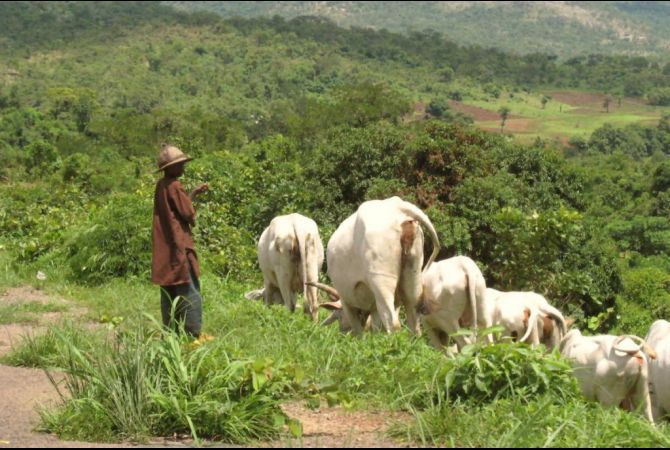
Open grazing
Manu disclosed this in media briefing shortly after a closed door meeting with traditional rulers in the state.
He said there would be aggressive awareness campaigns across the state before the implementation of the law, scheduled to take effect as from Jan. 24, 2018.
He added that traditional rulers in the state had accepted ranching as best option to feed and take care of animals, noting, however, that implementation would be in phases.
The deputy governor said “our anti open grazing law which is slated to take off on Jan. 24 would be implemented gradually.
“The Taraba Government would establish pilot ranches in the three zones of the state and carry out aggressive awareness campaigns in the state, local government and ward levels.”
He urged the people of the state not to politicise the law, saying it was meant to enhance peaceful coexistence between herdsmen and farmers.
Similarly, a civil society organisation (CSO), Search for Common Ground, on Monday in Abuja urged the Benue State Government to review its Open Grazing law to end perceived discrimination against individuals or groups in the state.
Dr Chris Kwaja, Research Fellow of the organisation, made the call after its investigations into the “Implication of Open Grazing Prohibition Laws’’ between farmers/herdsmen in the Middle Belt region of the country.
The News Agency of Nigeria (NAN) reports that report of the investigations was made available to newsmen.
The report said that while legislation could be useful in addressing drivers of conflicts, it should not be used as a panacea.
It added that while the law was enacted in response to incessant conflicts between farmers and herdsmen, its effectiveness to manage the conflict was yet to be determined.
“There is a clear distinction between the procedure and mechanism for land acquisition with respect to citizen’s of Nigeria who are not indigenes of Benue on one hand and the indigenes of the state.
“There is the need for the Benue government to review this procedure and mechanism procedures for land acquisition to remove clauses that are discriminatory.
“The law and its implementation deepened division between farmers and herdsmen in the state so the government needs to counter the narrative that the law is to evict herdsmen.
“The government also needs to facilitate a platform to address the concerns of herdsmen and lastly ensure farmers, herdsmen and relevant experts jointly develop inclusive and gradual implementation plan for the law.’’
The report said that the multi-stakeholder engagements should also be a platform for the parties to highlight aspects of the law that could be interpreted as discriminatory and recommend possible amendments of such aspects.
The report also urged Benue government to look beyond the “binary do or do not open grazing options’’ to identify alternatives with incentives that would attract herdsmen to gradually embrace ranching in line with the law.
It further advised the government to engage investors to invest in industrial ranching and develop incentives to stimulate ordinary herdsmen to establish subsistence and community –based ranches in the short, medium and long term.
This, it said would aid in curbing the diverse implications of the law across economic, cultural, security and religious dimensions.
It said that the situation in Benue had presented a unique opportunity for state governments to be conflict sensitive in the development and implementation of legislation that addresses the farmer-herdsmen conflict in Nigeria.
Tomato growers in Kano State have lost over N1 billion this dry season farming following the recent closure of Tiga Dam by the Hadeja-Jama’are River Basin Development Authority (HJRBDA).
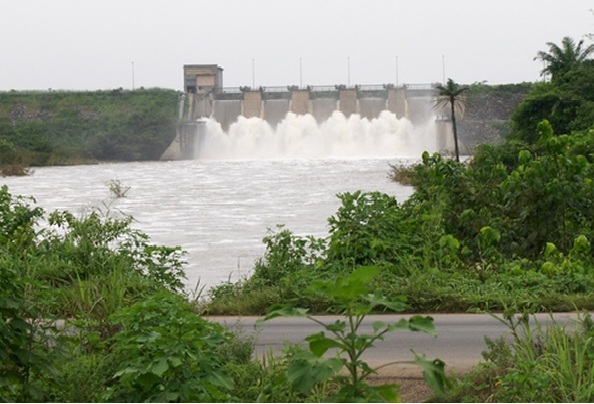
A dam in Nigeria
The Secretary General of the Tomato Growers Association of Nigeria (TOGAN), Alhaji Sani Danladi-Yadakwari, disclosed this in an interview with the News Agency of Nigeria (NAN) in Kano, the state capital, on Monday, January 22, 2018.
According to him, the closure of the water from the dam which is the main source of water for irrigation activities at all irrigation sites in the state had negatively affected tomato production this irrigation season by 60 per cent.
“Kano State is producing over 400,000 metric tons of tomato every dry season because farmers cultivate over 2,000 hectares of irrigable land.
“So the recent closure of the dam by the Hadeja-Jama’are River Basin Development Authority has affected 60,000 of our production due to drought,” he said.
According to him, tomato growers in the state had lost 250,000 tons of the commodity which represents 60 per cent of their total production.
He said the water which was closed for over 40 days would affect bumper harvest of the commodity as most of the tomato farms had experienced serious water shortage during the period.
“Many of our members had planted the tomato when suddenly the HJRBDA closed the dam and the closure had affected our farms.
He, therefore, advised the authority to always notify critical holders whenever they wanted to conduct maintenance of facilities at the dam site to avoid a repeat of similar problem.
“The authority should have given us and all other irrigation farmers three weeks notice before the commencement of maintenance at the dam.
“But they did not tell us until after they started the work and the closure had affected many tomato farms at Kura, Garunmalam, Bunkure and some parts of Rano irrigation sites,” he said.
According to him, the association had written to the Minister of Agriculture and Rural Development, Chief Audu Ogbeh, over the issue with a view to finding a lasting solution to the problem. When contacted, the Public Relations Officer of the Hadeja-Jama’are River Basin Development Authority (HJRBDA), Alhaji Salisu Baba-Hamza, said the authority had contacted Chairman and Secretary of the water users association before the commencement of the maintenance at the dam.
In addition, he said, the management of the HJRBDA had sponsored jingles announcement for one week on some radio stations before the repairs of the affected place was started at the dam.
According to him, the repairs of the affected place was necessary in order to avoid possible collapse of the embankment of the dam.
“What happened was that the outlet of Tiga Dam which supply water to the channels collapses and water was going through a place where it could affect the embankment of the dam.
“The project manager reported the issue and management had to close the outlet in order to effect repairs of the affected area.
“So, it is not true that the farmers were not contacted before the closure of the dam,” he said.
The Tiga Dam provides irrigation for the farmers of Kano. It is a major reservoir on the Kano River, the main tributary of the Hadejia River. The dam was built during the administration of Governor Audu Bako in an attempt to improve food security through irrigation projects.
The Nigeria Extractive Industries Transparency Initiative (NEITI) has welcomed steps by both chambers of the National Assembly to pass the Petroleum Industry Governance Bill (PIGB).
Executive Secretary of NEITI, Waziri Adio
The decision of the Senate and the House of Representatives to consider the bill as priority resulting in its eventual passage is bold, courageous and progressive, says NEITI, given the challenges the bill has passed through in its legislative journey for over 10 years.
NEITI, as an agency set up to enthrone transparency and accountability in the management of extractive industries in Nigeria, has legitimate interest in the PIGB.
NEITI says its interest is in view of the urgency and strategic importance of a new law to replace the existing archaic legislations that have aided huge revenue losses, impeded transparency, accountability and investment opportunities in the nation’s oil and gas industry.
NEITI recalls that, as an anti-corruption agency in the sector, it boldly alerted the nation last year through a special Policy Brief – titled: “The urgency of a new petroleum sector law” – that the current stagnation of investment opportunities in the Petroleum Industry was as a result of the absence of a new law for the sector. This, adds NEITI, has led to huge revenue losses to the tune of over $200 billion. In the publication, NEITI argued that the “revenue losses were as a result of investments withheld or diverted by investors to other (more predictable) jurisdictions.” The publication added that “the hedging by investors stems from the expectation that the old rules would no longer apply, but not knowing when the new ones would materialise.”
In addition, NEITI reports in the sector had also disclosed that over $10.4 billion and N378.7 billion were lost through under-remittances, inefficiencies, theft or absence of a clear governance framework for the oil and gas industry. The total cost to the nation in 2013 alone was N1.74 trillion largely as a result of the absence of a new law.
NEITI is optimistic that, with the new governance law for the industry, such huge revenue losses to the nation as a result of process lapses and outright stealing will be strictly checked if not eliminated.
Furthermore, NEITI notes that the implementation of the global Extractive Industries Transparency Initiative which Nigeria is a key signatory, have over the years been frustrated by the absence of a dynamic law that suits modern business modules and trends in the ever evolving oil and gas industry.
NEITI remains convinced that the PIGB, when assented to by the President, will provide “a dynamic governance framework required to re-position the Petroleum industry to fully embrace competition, openness, accountability, professionalism and better profit returns on investments to both companies and government”.
NEITI notes that it is encouraged that the National Assembly in this particular instance threw politics aside and dealt with the PIGB issue with the attention it deserves. The PIGB, now passed and ready for possible Presidential assent, is a product of this creative initiative, stresses NEITI.
NEITI also commends the media, civil society, development partners, industry, stakeholders and experts who it says have followed the bill in the National Assembly for their valued contributions to what has been achieved so far.
While hoping for early Presidential consideration and assent to the bill, NEITI says it hopes to work with multi-stakeholders, development partners and the industry to set the stage for informed stakeholders’ engagements to ensure effective implementation when the bill becomes law.
“Finally, we call on all the media, the civil society and above all the National Assembly to show similar coordinated attention to commence legislative process in the remaining legal frameworks in the industry especially the Petroleum Industry Fiscal Bill and the Host Communities Bill. These two key pending legislations will help complement and strengthen the provisions of the PIGB,” adds NEITI.
The Republic of Burundi on Wednesday, January 17, 2018 deposited its instruments of ratification of the Paris Agreement on Climate Change, making the East Africa nation the 174th Party to the global treaty.
Pierre Nkurunziza, President of Burundi. Photo credit: The Telegraph
According to the United Nations Framework Convention on Climate Change (UNFCCC), Burundi’s ratification will come into force on February 16, 2018.
Previously, Macedonia (173rd), Montenegro (172nd), DR Congo (171st), Syria (170th), Nicaragua (169th), Switzerland (168th), the Czech Republic (167th), Dominican Republic (166th) and Cape Verde (165th) had deposited their instruments of ratification of the Paris Agreement on Climate Change.
Before this, Liechtenstein (164th), Ecuador (163rd), Myanmar (162nd) and Bhutan (161st), had also ratified the treaty.
The Paris Agreement was adopted on December 12, 2015 at the 21st session of the Conference of the Parties (COP21) to the United Nations Framework Convention on Climate Change (UNFCCC) held in Paris, France from November 30 to December 13, 2015.
On December 12, 2017 governments and representatives from all over the world gathered in Paris at the instance of French President, Emmanuel Macron, to celebrate the two-year anniversary of the Paris Agreement at the One Planet Summit. The Summit presented an opportunity to reaffirm global climate commitments to combat climate change and to emphasise the transition from negotiation to implementation of the Paris Agreement.
The Paris Agreement entered into force on November 4, 2016, 30 days after the date on which at least 55 Parties to the Convention accounting in total for at least an estimated 55% of the total global greenhouse gas (GHG) emissions have deposited their instruments of ratification, acceptance, approval or accession with the Depositary.
The Paris Agreement builds upon the Convention (UNFCCC) and – for the first time – brings all nations into a common cause to undertake ambitious efforts to combat climate change and adapt to its effects, with enhanced support to assist developing countries to do so. As such, it charts a new course in the global climate effort.
The Paris Agreement’s central aim is to strengthen the global response to the threat of climate change by keeping a global temperature rise this century well below 2 degrees Celsius above pre-industrial levels and to pursue efforts to limit the temperature increase even further to 1.5 degrees Celsius.
Additionally, the agreement aims to strengthen the ability of countries to deal with the impacts of climate change. To reach these ambitious goals, appropriate financial flows, a new technology framework and an enhanced capacity building framework will be put in place, thus supporting action by developing countries and the most vulnerable countries, in line with their own national objectives. The Agreement also provides for enhanced transparency of action and support through a more robust transparency framework.
The secretariat of the Minamata Convention has disclosed that its Specific International Programme (SIP) received support from Denmark, Norway, Switzerland and the United Kingdom.
Dalia Grybauskaitė, President of Lithuania
This is even as the Government of Lithuania deposited its instrument of ratification on Monday, January 15, 2018 thereby becoming the 86th Party to the Minamata Convention.
The Minamata Convention on Mercury (“Minamata Convention”) is an international environmental convention for global community to work collaboratively against mercury pollution. It aims at achieving environmentally sound mercury management throughout its life cycle. The Convention was adopted at the diplomatic conferences held in Minamata City and Kumamoto City in October 2013.
The 1st Conference of the Parties to the Minamata Convention (COP1), which gathered governments, intergovernmental and non-governmental organisations from around the world, held in Geneva, Switzerland from September 24 to 29, 2017.
The mercury accord entered into force on Thursday, May 18, 2017 after having garnered the required 50 ratifications.
The Minamata Convention’s SIP is one of the two mechnisms for the provision of adequate, predictable, and timely financial resources. The second is the Global Environment Facility Trust Fund.
The Mechanism is to support developing country Parties and Parties with economies in transition in implementing their obligations under the Convention.
The SIP is being operated under the guidance of and be accountable to the Conference of the Parties, which at its first meeting in Geneva decided on the existing entity’s hosting institution.
All Parties and other relevant stakeholders are supposed to provide financial resources to the Programme, on a voluntary basis.
The Global Environment Facility Trust Fund, on the other hand, shall provide resources to meet the agreed incremental costs of global environmental benefits and the agreed full costs of some enabling activities.
Prior to Lithuania, Armenia (December 13, 2017; 85th Party), Lebanon (October 13, 2017; 84th Party) as well as Croatia and Argentina (September 25, 2017; 83rd) had ratified the treaty.
A non-governmental organisation (NGO), the Society for the Promotion of People’s Rights, has called on the Federal Government to set up special recycling plants for electronic scrap materials to protect the environment.
Waste of electrical and electronic equipment (WEEE) such as computers, TV-sets, fridges and cell phones is one the fastest growing waste streams in the developing world
President of the organisation, Mr Williams Osaze, made the call in an interview with News Agency of Nigeria (NAN) in Abuja on Monday, January 22, 2018.
He said that electronic waste was dangerous and harmful to human beings and the environment.
He said that the establishment the recycling plants would facilitate efforts to sort out electronic waste into usable and non-usable components.
Osaze said that nearly 75 per cent of old electronic items in the country continued to be stored in households because of the dearth of recycling options.
He noted that old electronic devices contained toxic substances such as lead, mercury, cadmium and chromium.
He, therefore, underscored the need for proper processing and recycling of electronic waste so as to ensure that the toxic materials were not released into the environment.
Osaze said that as an alternative to the expensive recycling plants, landfills could be established at specific locations across the country for the disposal of electronic waste.
He, however, warned that if electronic waste was buried in an unsystematic way, certain poisonous chemical components of the waste could seep into the groundwater, pollute the soil and cause health problems.
He urged government to redouble its efforts to safeguard the environment from the harms of electronic waste by establishing electronic waste recycling plants across the country.
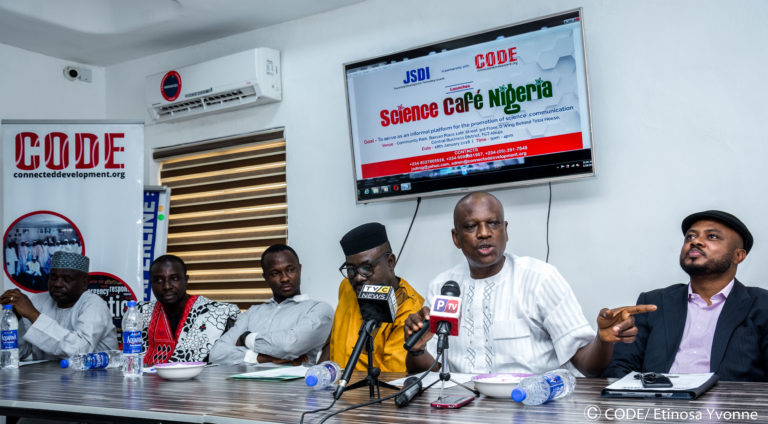
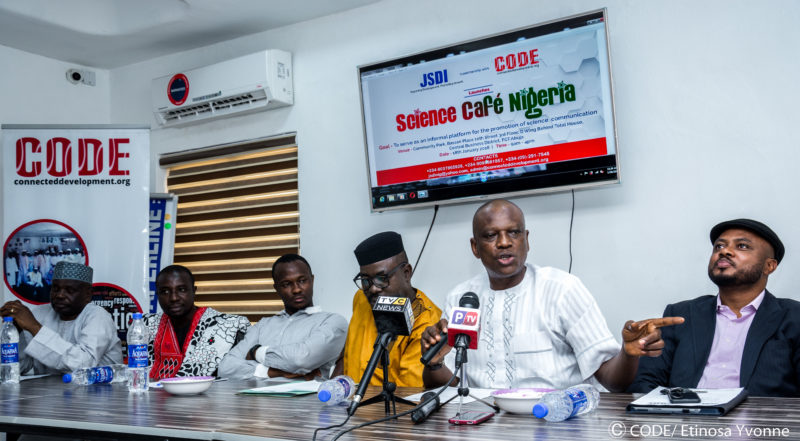
The National Biosafety Management Agency (NBMA) has disclosed plans to partner with Journalists for Social Development Initiative (JSDI) and Connected Development (CODE) through their Science Café initiative to train journalists on safe science reporting.
L-R: Director General, APUDI Institute of Peace Studies and Social Rehabilitation (APIS), Professor Danladi Atu; Coordinator, Journalists for Social Development Initiative (JSDI), Etta Michael Bisong; Head of Governance, Connected Development (CODE), Emmanuel Njoku; Director-General/CEO, National Biosafety Management Agency (NBMA), Dr. Rufus Ebegba; Publisher, Forefront Media, Mr. Amos Dunia; and Representative, Nigerian Biosafety Association, Mr. Livinus Ibiang, during the opening ceremony of the inaugural Science Cafe in Nigeria, in Abuja on Thursday, January 18, 2018
Director General of the Agency, Dr. Rufus Ebegba, who made the disclosure during the opening ceremony of a Science Café on Thursday January 18, 2018 in Abuja, described safe science as a vital ingredient and foundation for national development.
And if this ingredient is not properly mixed to lay the required foundation, according to him, the nation may not reap the desired benefit of modern technologies and harness their potentials for sustainable living.
“Communicating safe science appropriately will make Nigerians understand and appreciate the role science can play in their daily lives,” Dr. Ebegba said. “It will also inspire our youth to boldly enter various fields of scientific study.”
However, the NBMA helmsman lamented that the lack of proper awareness on how new technologies can improve human activities has negatively influenced consumer choice and acceptance of certain innovations.
The Director General, who cited the case of modern biotechnology and its products in his lecture paper at the event titled: “Science, Technology & Modern Society: Role of Communication in achieving sustainable livelihood”, expressed displeasure over how some activists have taken to misinforming as well as misrepresenting issues, and inciting the people against government agencies like the NBMA.
He explained that these misconceptions have created a serious burden by generating fear and mistrust especially influencing how quickly a technology is adopted to solve local problems and facilitate national growth.
He reinforced the controversy surrounding agricultural biotechnology, genetically modified organisms (GMOs) and biosafety in particular to underscore how scientific findings, public opinions and attitudes can make the public either accept or resist new technological innovations.
“Issues like these are precisely why good scientific communication is important,” he said.
The biosafety advocate referred to the media as a powerful tool which Nigeria must leverage on to move from being a net consumer of the products of scientific innovations to being a pioneer in various scientific and technological fields.
He submitted that good science journalism should help to build the consciousness of the people and educate them on the truth about certain controversial scientific and technological innovations.
During his remarks at the occasion, Director General, APUDI Institute of Peace Studies and Social Rehabilitation (APIS), Professor Danladi Atu, talked about the need to adopt a formal and an informal approach in the search for solutions to decipher the challenges facing science & technology in society.
Prof. Atu said the combination of these approaches is important to help solve the problem that the conventional way of learning science has created.
His words: “Part of the problem here is that we are so involved in conventional curriculum programmes to the point that informal approaches are neglected.”
He noted that the establishment of the Science Café is a clear departure from the conventional to a total new way of teaching science because, research has shown that there is a connection between past and present experiences.
The APIS boss urged Nigerians to accept science & technology and find a way to mitigate its impacts for progressive livelihood.
Other participants at the event canvassed the need for more scientific research, simplification of terminologies, as well as continuous engagement with stakeholders especially the private sector to help implement government blueprint on science & technology across the country.
The International Institute of Tropical Agriculture (IITA), African Development Bank (AfDB) and other stakeholders on Monday, January 22, 2018 in Ibadan, Oyo State, inaugurated the Technologies for African Agricultural Transformation (TAAT) programme to revitalise agriculture in Africa.
Dr Nteranya Sanginga, Director General of the IITA
Speaking during the inauguration, Dr Jonas Chianu, AfDB Agricultural Economist and TAAT Programme Manager, said that the multi-year multi-partner TAAT programme was funded by the AfDB.
He said it was conceptualised based on “Africa Feeding African” core priority of AfDB and aligned with the bank’s 10-year strategy (2013 to 2022) for inclusive and green growth in the continent.
Chianu said that the programme was aimed at revitalising Africa’s agriculture and was conceived at a high-level conference on African agricultural transformation attended by experts in agriculture, the academia, and other stakeholders in Dakar in 2015.
“TAAT heralds a new dawn in African agricultural transformation because of its key benefits,’’ the AfDB official said.
Chianu said the initiative would lead to increased agricultural productivity and diversification, leading to improved food and nutrition security, improved socioeconomic status of farmers including women and youth due to higher incomes.
He added that it would also lead to reduced vulnerabilities to market fluctuation due to agricultural product imports, and job creation, among others.
“TAAT will execute an ambitious and bold plan to achieve rapid agricultural transformation across Africa by raising agricultural productivity along nine Priority Intervention Area (PIA) and over 18 agricultural commodity value chains.
“The execution of TAAT will involve close partnership among the AfDB, World Bank, and development partners to ensure increased financing for agricultural research and development along the value chains.
“FARA, the CGIAR System Organisation, and 11 of its 15 international agricultural research centers most active in Africa, have embraced the bank’s initiative.
“They are co-sponsoring the programme to revitalise and transform agriculture through TAAT within the shortest possible time while restoring degraded land and maintaining or strengthening the ecosystems that underpin agriculture,” he said.
Also speaking, the Deputy Director-General, Partnerships for Delivery, IITA, Dr Ken Dashiell, reiterated the need for the experts to work in harmony with other teams from other countries to see the great accomplishment of the programme.
Dashiell urged them to ensure that the plans and resolutions made at the workshop, which would last for three days, were implemented.
The Director, TAAT Programme Management Unit, IITA, Dr Chrys Akem, said part of the workshop’s objectives was to network and interact with the various TAAT programme teams.
He added that it was also to develop plans and budgets for year one of the first tier of TAAT.
Bishop William Aveya of Gboko Catholic Diocese in Benue State has said that the anti-open grazing law passed by the state government will enable children of herdsmen to acquire education.
Governor Samuel Ortom signs anti-grazing bill into law as Speaker, Benue State House of Assembly, Terkimbi Ikyange, lends a hand
“Open grazing makes it impossible for the children of herdsmen to acquire education because they remain in the bush chasing cows.
“If the herdsmen embrace ranches, the children will be less busy with the cattle and have more time for education which is very crucial to a better future,” Avenya told the News Agency of Nigeria (NAN), in Gboko on Monday, January 22, 2018.
NAN reports that the herdsmen, under the aegis of the Miyetti Allah Cattle Breeders Association of Nigeria (MACBAN), have remained opposed to the law and have vowed to resist it.
But Avenya told NAN that the law would promote and protect the rights of herdsmen’s children usually denied their rights and privileges.
“Nigeria is a signatory to many Child Right charters and conventions that seek to protect and enhance children’s welfare.
“While other children enjoy such rights and privileges, herdsmen’s children are left behind because they are holed up in the hinterland running after cows and getting exposed to the vagaries of the environment.
“It is certainly not fair to leave the herdsmen’s children uneducated because that will denies them the privilege of exploring opportunities in life,” he said.
He argued that cattle ranching was the best option that could provide some comfort for cattle, herders and their children, adding that cattle feeding would be improved at the ranches.
Avenya appealed to herdsmen to accept the law as a panacea to frequent farmers/herders clashes and explore its immense benefits.
He challenged Nigerians resident in the North-East to evolve ways of reclaiming the desert wastelands, and suggested the growing of grasses to help tackle desertification and provide pasture for cattle.
Avenya, however, condemned the killing of innocent people by gunmen, and called on the Federal Government to encourage ranching as a way out of the frequent skirmishes.
The Bishop said that the Church would not encourage reprisal attacks saying, saying that such action had no place in the Christian faith.
“Instead of carrying arms in self defense, we must encourage each other to pray for the attackers so that God will arrest their spirit and purge them of such wickedness,” he said.
The National Institute for Pharmaceutical Research and Development (NIPRD) says it has successfully researched and developed six traditional herbal products for the treatment of Ebola, Malaria and other diseases.
Minister of Health, Professor Isaac Adewole
The NIPRD Director-General, Prof. Karniyus Gamaniel, said this while presenting the score card of his eight-year tenure (2009 to 2017) in Abuja on Friday, January 19, 2018.
The programme, organised by NIPRD, aimed to present the products researched and developed by the institute and present staff service awards to deserving workers.
He said that “NIPRIBOL”, a fixed dose combination drug, was developed by the institute for the treatment of Ebola Virus Disease, adding that the institute had completed the Phase I study of the drug.
Gamaniel said that the institute had also developed “NIPRIMAL”, an anti-malaria for treatment of uncomplicated malaria, stating that the drug was also safe for use by pregnant women.
Others are: “NIPRIMUNE”, an immunostimulant which can also be used to manage HIV in Nigeria and “NIPRIFAN” for the treatment of fungal skin infection.
He said that another product developed by the institute, “NIPRD Oil”, could be used as a nasal decongestant, insect repellant, air freshener and an anti-inflammatory agent.
He however noted that excessive use of this oil could cause irritation.
In a related development, the Dr SickleCell Centre for Sickle Cell Disease (SCD) has said that it is offering what could be the world’s most effective treatment for sickle cell disease which, according to the organisation, results have shown to be the fastest treatment yet for eliminating the pain crisis suffered by people living with the disease.
Acute sickle cell pain crises or pain episodes also referred to as vaso-occlusive crises, are a common painful complication of the disease and the main reason that patients seek medical care in hospitals. It is characterised by severe pains all over the body of the patients, from bones to joints, weakness, loss of vision, loss of mobility, inability to breathe and when left under-treated often leads to adverse life-threatening complications such as gallstones, lung crises (acute chest syndrome), pulmonary hypertension, stroke, eye damage, and even death.
The SCD treatment is said to be natural and administered to patients orally, eliminating the use of Syringe or IV Transfusions. According to the promoters, it is a non-invasive form of treatment which makes it stress-free for a patient experiencing mild or severe pain crisis. Backed by over three decades of intensive research and live results, the treatment is said to have shown to significantly improve the overall health outcomes and quality of life of people living with sickle cell disease in both children and adults, enabling them a life free from pain crisis, adverse complications and hospitalisation due to the disease.
“With over 35 years in the medical practice of treating chronic diseases and several breakthroughs in the field, I finally in 2016 ventured into focusing on the treatment of sickle cell disease having had significant results from my intensive research and successful treatment outcomes over the years. Dr SickleCell Centre for SCD is proud to have the best solution for sickle cell disease in the world at the moment as the treatment results are second to none in its class,” said Dr. David Ajaere, M.D., Chief Medical Director, Dr SickleCell Centre for SCD, a consulting Naturopath and Homeopath.
He added: “This treatment is purely natural, and can effectively eliminate the pain crisis in both children and adult patients experiencing pain crisis in less than six to12 hours depending on the crisis severity and we have records to show for it. Patients who opt-in for preventive care using this treatment live a healthy and normal life, feeling energised and experience an overall increase in health and quality of life. In the cases of patients who religiously stayed on their treatment plan, they never experienced further pain crisis or even visit the hospital unless for their routine check-ups. Patient must adhere to their treatment to attain total wellness.”
He continued: “The Pain Crisis is the primary cause of suffering in sickle cell disease. With this new treatment, patients no longer experience pain crises or adverse complications related to the disease. The likeliness for them to experience another pain crisis after commencing their treatment is virtually zero percent. The results are consistent regardless of the severity of disease or genotype. That is potentially the most significant new development for patients, especially in Nigeria where treatment options for the disease until now has been significantly limited. No pain crises mean no organ damage long term and no further adverse complications due to the disease.”
Prof Gamaniel of the NIPRD, speaking on the the treatment of Ebola, Malaria and other diseases, said: “The institute has also developed ‘NIPRISAN’ for the management of sickle cell anaemia. We are currently concluding plans to carry out commercial production and distribution of this product.
“We have developed and implemented various institutional policies for effective governance, these include the scheme and condition of service, intellectual policy and quality management system.
“We have also ensured the introduction of traditional herbal medicine into the national health system and established partnerships with local and international organisations.
“The core competence of NIPRD is in the development of phytomedicines from indigenous plants and products, clinical trials, among others; we are a quality assured institute,” Gamaniel said.
He said that presenting a report was necessary as it would serve as a baseline for the new leadership and provide an opportunity for new strategies to be introduced.
The institute presented awards to over 150 staff for their hard work and dedication to the growth of the institute, and the research and development of traditional herbal products.
The News Agency of Nigeria (NAN) reports that the Federal Government in 1987 approved the establishment of the institute as a parastatal under the Federal Ministry of Science and Technology.
It was established with the primary objective of developing drugs, biological products and pharmaceutical raw materials from indigenous resources towards the growth and development of the country.
The institute was later moved to the Federal Ministry of Health in 2001.
Dr. Ajaere said that, in 2016, The Dr SickleCell Centre for SCD launched with a patient-centered community campaign, the “SaveOne campaign” which offered to treat 100 sickle cell patient experiencing pain crisis at that time for free.
“The results and observations from the SaveOne campaign have greatly informed our decisions and strategy over the years. We quickly discovered that sickle cell disease was fast becoming a public health epidemic as the response to the campaign was immense and the offering of treatment alone cannot sufficiently improve on the disease status in the country.
“There were barriers that hindered people living with sickle cell disease from accessing quality care throughout the nation and these were identified as lack of healthcare infrastructure and SCD qualified healthcare professionals, lack of adequate awareness and knowledge of the disease in rural areas, accessibility, availability, and affordability of quality care. These are barriers that must be addressed in other to adequately and effectively tackle and possibly overcome sickle cell disease in Nigeria.
“Our major contribution to this is in our treatment offering and expertise, we are also partnering with reactive stakeholders, health bodies, SCD foundations and organisations within the government and private sectors. Through our partnership with some NGOs, we have been able to subsidise this treatment thereby improving on its affordability but more needs to be done especially in regards to the underserved of the Sickle cell community who still cannot access this treatment and we believe this can be achieved through effective and reactive partnerships.”
SCD is an inherited blood disorder and one of the most prevalent genetic diseases in the world. It predominates in sub-Saharan Africa, East Mediterranean areas, Middle East, and India, and the World Health Organisation (WHO) estimate that more than 300,000 babies are born with sickle cell disease worldwide each year.
While 75 percent (225,000) of all babies born with Sickle Cell Disease live in sub-Saharan Africa, Nigeria alone accounts for more than 66 percent (150,000) new births in sub-Saharan Africa every year, meaning that, in every two new babies born with sickle cell disease, one is a Nigerian and only 5% of these babies live past age 10.
Also, an estimated 25% (over 40 million) of its adult population are carrying sickle cell trait (AS) and 3.6 million people live with sickle cell disease. In other words, Nigeria has the world’s largest population of people with Sickle Cell Disease.