The Democratic Republic of Congo has started using the experimental mAb114 Ebola treatment on patients in the east of the country, the health ministry said on Tuesday, August 14, 2018. This is the first time it has been deployed against an active outbreak.
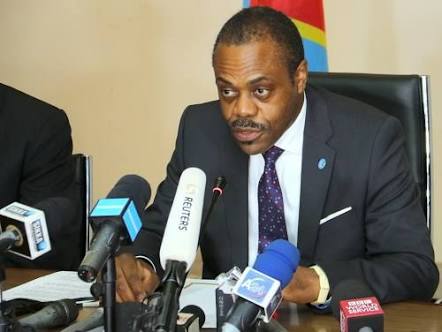
Oly Ilunga, the Congolese Minister of Health
The outbreak in eastern Congo’s North Kivu province has now spread to neighbouring Ituri province, where a person who was a confirmed case died after returning home from the flare-up’s epicentre in the North Kivu town of Mangina, the ministry said in a statement.
Five new cases have been confirmed, the ministry said, bringing the total number of cases between 57.
The ministry said that 41 people are believed to have died in all from the haemorrhagic fever.
The mAb114 treatment was developed in the U. S. by the National Institutes of Health using the antibodies of the survivor of an Ebola outbreak in the western Congolese city of Kikwit in 1995.
It was 100 per cent effective when tested on monkeys.
The ministry said that several other experimental treatments have arrived in the regional hub of Beni and are awaiting approval from an ethics committee, including Remdesivir, Favipiravir and REGN3450, REGN3471 and REGN3479.
“Are we happy to suppose that our grandchildren may never be able to see an elephant, except in a picture book?” – David Attenborough.
Poaching: Forest elephants are poached for their ivory and skin, and threatened with extinction
Of the five big games, it is not so easy to come by an elephant in Nigeria today – both in the wild and in captive areas – except you find yourself in the Yankari National Park, believed to have the largest and most important elephant herd of merely 100 to 150 or the Omu-Shasha Forest in Ogun State. The other place you can readily come by an elephant is at the Jos Wildlife Park where an 8-foot, one-tusked, African Savannah Elephant (Loxodonta africana) has been stranded in an isolated block for 38-years.
A report by the United Nations in 2015 asserts that up to 100 elephants – both Savannah and Forest species – are being slaughtered daily in Africa by poachers, primarily for their tusk which the Chinese market constantly demands.
As organisations and conservationists intensify efforts to halt illegal ivory trade and wildlife trafficking, recent research posits that the whole of Africa has an estimate of 352,271 Savanna Elephants left, a far cry from between 3 to 5 million censored by World Wildlife Foundation in the 20th century.
Some 25 years after a ban was placed on ivory trade, emerging markets still make it more difficult to address the menace. In 2015, the Chinese government, in a bid to reduce the demand for African tusks and protect wild elephants, made conscious efforts to curb ivory imports; however, reoccurring reports and pictures stress that a lot more elephants are being poached in southern and northern Nigeria and their tusks exported to Asian countries. The most recent that made the news are in Bauchi, Ogun, Osun and Idanre area of Ondo state, Nigeria.
Across the globe, as World Elephant Day is celebrated on August 12, one wonders what will become of the few elephants left in Nigeria; hence, the call for pragmatic, pro-wildlife actions to turn the tide and save the remaining elephants in Nigeria. The efforts of Nigeria-based organisations like Wildlife of Africa Conservation Initiative through her various Wildlife Education programmes and the Nigerian Conservation Foundation through her Forest Elephant Alive Campaign, among others, should not only be commended, they should be better funded to help them explore effective, science-based conservation strategies.
If we want future generations to live in a world where elephants thrive, the Wildlife Conservation Society has outlined and advocated the need to:
Increase aerial surveillance in strongholds.
Train and deploy more rangers in the protected areas.
Supply new rangers with equipment.
Assist the authorities in tracking and shutting down trafficking networks.
Grow our community development programmes to support local communities to co-exist with wildlife.
The World Travel and Tourism Council (WTTC) has signed up to the United Nations Climate Neutral Now initiative with a pledge to measure its greenhouse gas emissions, reduce what it can and offset the rest, while promoting the same climate-friendly regimen to its 150 members worldwide.
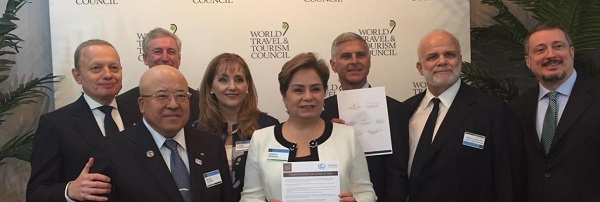
Executive Secretary of UN Climate Change, Patricia Espinosa, with travel and tourism industry officials
This pledge adds momentum to global climate action taken by organisations, companies, events and individuals to limit the average global temperature rise to 1.5 degrees Celsius above pre-industrial levels, in line with the goals of the Paris Climate Change Agreement.
Travel and tourism is said to generate just over 10% of global GDP and plays a crucial role in climate change. WTTC supports 313 million jobs in this industry and seeks to reduce 50% of total travel and tourism carbon emissions by 2035.
During the this year’s WTTC Global Summit, WTTC announced a partnership with UN Climate Change and agreed on a common agenda for climate action in travel and tourism.
The Executive Secretary of UN Climate Change, Patricia Espinosa, said: “We recognise that travel and tourism has a huge role to play in addressing climate change. While climate change itself poses significant risks to some tourism destinations, in many of the most high-risk areas, tourism can provide opportunities for communities to build resilience to its impacts.”
As part of the commitment, WTTC will compile the best sustainability practices in the travel and tourism sector and encourage companies to set science-based targets.
Chris Nassetta, WTTC Chair and CEO of Hilton, said: “Building on the global scientific consensus around decarbonisation efforts that came out of the 2015 Paris Climate Agreement and WTTC’s subsequent call for the dialogue on carbon to turn to science-based targets, now it is time to turn that dialogue into action.”
To push for sustainable growth in tourism, WTTC has initiated the “Tourism for Tomorrow” awards to encourage companies to do business in an environmentally-friendly way. This involves a wide range of activities such as investments in green technologies, development of environmental policies, and strategies to address climate change.
Here are 10 categories of climate action in the travel and tourism industry in which stakeholders have demonstrated inspiring leadership:
Supplying sustainably sourced food:
The Accor Hotel chain grows its own vegetables, on site, at many of its hotels.
Soneva Group in South East Asia also grows organic food to serve its guests 15,000kg of produce per year, worth $48,000.
Virgin Atlantic has worked with the Sustainable Restaurant Association (SRA) to create the world’s first framework designed to address the sustainability challenges of inflight catering.
Using renewable energy
Xanterra Parks & Resorts powers its Ohio park with a 10kilowatt wind turbine and uses electric vehicles to transport guests and laundry.
Using sustainability dashboards
Many companies now use a dashboard monitoring system to measure carbon emissions and energy usage. In March 2017, EarthCheck launched the Global Sustainable Tourism Dashboard to gather information on global tourism and sustainable development. Their clients operate across 70 countries in more than 30 tourism sectors.
Improving technology
The Climate Neutral Groupand its partners developed Carmacal, a tourism oriented businessto-business carbon calculator able to provide carbon footprints for complete holiday and travel packages.
Cruise Lines International Association(CLIA) now paints its ship hulls with nontoxic coatings to reduce fuel consumption by up to five percent. In addition, the association uses LED lights, higher efficiency appliances and solar panel installations to provide emissions-free energy.
Reducing water usage and waste
Chepu Adventures Ecolodgein Chile displays resource usage, and challenges customers to use maximum amounts of water and energy per person with tablet screens in each room.
Using electric vehicles and alternative fuel
Many large car rental companies now offer electric and hybrid vehicles as a standard. Enterprise Renta-Car established the Institute for Renewable Fuelswhich works towards the advancement of alternative fuels and clean technologies.
Offsetting from large corporations
Marriott has committed $2 million to preservethe Juma reserve in Brazil’s Amazon rainforest.
Over 30 International Air Transport Association (IATA) member airlines have introduced an offset programme either in their websales engines or through a third party offset provider.
Using cycling options for transport
Paradisus Playa del Carmen, run by Meliá Hotels Internationalencourages the use of bicycles among its staff and has improved its local community’s access to wellbeing facilities through donating a bike path and a sports park. Many other hotels also offer free bike hire to encourage guests to travel sustainably.
Building infrastructure with sustainable materials and low-impact designs
InterContinental San Franciscois a LEED Goldcertified hotel with about 2 million gallons of water saved each year from low-flow faucets and toilets, as well as other water-reduction features.
The Zetter Hotelin London used sustainably sourced building materials and is controlled by an intelligent building management system.
Protecting local environment and enhancing biodiversity
Misool resortin Indonesia has established an 828 sq km ‘No take zone’ where all fishing, shark finning, and harvesting of turtle eggs and shellfish are prohibited. As a result, fish biomass has increased by over 250% in the last six years, and in some areas, the increase has been over 600%.
Over the last 17 years, Biosphere Expeditionshas delivered over 150,000 hours of voluntourism, wildlife conservation and research, helping projects such as the Kavango Zambezi Transfrontier Conservation Area.
As part of the “Common Agenda For Climate Action”, the WTTC engagement with the UN Climate Change, Global Climate Action will be showcased in a Travel & Tourism event at the upcoming COP24 in Katowice, Poland.
In fulfillment of President Muhammadu Buhari’s campaign promises to unlock the country’s potential through sustainable and effective rail services, the 154km Itakpe-Ajaokuta-Warri standard gauge line will be ready for commercial operations by September, after 35 years of neglect.
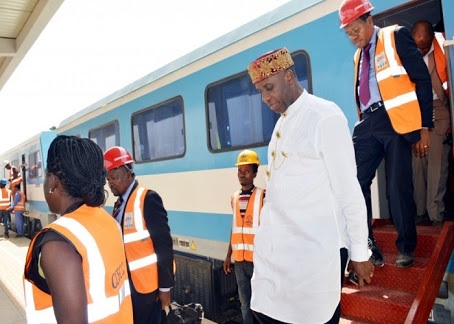
Minister of Transportation, Chief Rotimi Amaechi, after a trip on a newly commissioned rail service
The Minister of Transportation, Chief Rotimi Amaechi, gave the assurance on July 27 while inspecting the railway line which connects Kogi State to Delta State and will later extend to Lokoja (in Kogi State) and Abuja (Federal Capital Territory).
Amaechi, the Managing Director of the Nigeria Railway Corporation (NRC), Mr Fidet Okhiria, and some other members of the NRC management, were on an almost 10-hour train ride from Itakpe in Kogi State to Agbor, Delta State.
According to the minister, the standard gauge line from Itakpe to Agbor is 80 per cent completed, while the contract for the extension has already been advertised.
The rail line involves completion of 12 modern stations with two to be located between Itakpe and Ajaokuta, and 10 between Ajaokuta and Warri.
Other features of the rail project are construction of a railway city and a facility yard.
“While we cannot be sure when this line would be commissioned by Mr President, we are happy that the line has been stabilised and we can commence activities on it by September, after more test-runs would have been carried out,” Amaechi said.
The minister, who took delivery of two double-end-driver’s-cabin standard gauge locomotive engines from China, on July 27, 2017, believes that improved rail system will boost trading and encourage transportation of up to three million tonnes of cargo in the first year of service.
Amaechi is optimistic that effective rail system will reduce traffic pressure on roads.
He is convinced that the rail project will create more than 250,000 jobs during and after completion.
Buhari had in July 2016, inaugurated 10 coaches and two locomotives for the Abuja-Kaduna rail service in preparation for the standard gauge train service.
During the inauguration, the president promised that his administration would vigorously pursue railway development through implementation of the 25-year strategic railway master plan.
According to him, train will be a preferred means of transportation from Abuja to Kaduna on completion of the project.
“We are also looking forward to a more efficient railway service on the narrow-gauge line to be driven by the private sector, creating a conducive environment for participation by strengthening the legal and regulatory framework,” Buhari had said.
Consequently, Vice President Yemi Osinbajo on March 7, 2017, performed the ground-breaking ceremony of the Lagos-Ibadan Standard Gauge Rail Track, saying that a viable self-sustaining rail service was vital for the country’s economic growth.
Osinbajo said at the event in Lagos that the improved rail service would cut across the nation.
He gave the assurance that the government would focus more on costal rails such as Lagos-Calabar rail line with branches to Benin, Agbor and Onitsha; Port Harcourt to Maiduguri standard gauge rail line with branches to Owerri, Akwa, Abakaliki, Yola and Damaturu.
According to Osinbajo, the government would give priority attention to the Kano-Kazure, Daura, Kastina, Jibya rail route to link to Maradi in Niger Republic as part of regional railway inter-connectivity of the ECOWAS sub-region.
“The new standard gauge will also help the country in its economic diversification process and help to ease distribution of good and services across the country.’’
Sen. Gbenga Ashafa, Chairman, Senate Committee on Land Transport, predicts that the Lagos-Kano and Calabar- Lagos rail project alone will create up to 7,000 jobs.
“On our part as senators holding the mandate of our constituents, we are totally committed to assisting the executive arm in the actualisation of every developmental project within our purview,” Ashafa assures Nigerians.
He spoke during an oversight visit of the committee to the NRC in Lagos. The committee paid the visit together with its Local and Foreign Debts counterpart.
“As requested, the sum of $5.851 billion being the total approved loan would be expended on modernisation of Lagos-Kano, Lagos-Ibadan and Calabar-Lagos segments.’’
According to Sen. Shehu Sani, Chairman of the Senate Committee on Local and Foreign Debts, the senate attaches much seriousness to the successful completion of the rail projects.
He is convinced that the projects will to fast-track the nation’s economic growth, provide gainful employment and overall development of the country.
Oba Rilwan Akiolu of Lagos desires that Nigerian workers should be heavily involved in the execution of the projects.
The traditional ruler appeals to the contractors handling the rail projects to employ indigenes while executing them.
The monarch observes that many Nigerian youths are jobless and can be employed by the contractor to carry out the projects.
Alhaji Muhammed Musa, the Chairman of the Road Transport Employees Association of Nigeria, Lagos State Chapter, hopes that, when completed, the projects will reduce annual spending on road maintenance.
“It will give passengers the option of travelling by rail as obtained in advanced countries.
“The standard gauge line will modernise the country’s transport system and boost economic activities of various communities,’’ he says.
Musa is optimistic that efficient rail services will enhance freight services and reduce the number of articulated vehicles on roads.
In the view of the Federal Road Safety Corps (FRSC), standard gauge rail line will address the perennial gridlock on Apapa roads in Lagos, which resulted from indiscriminate parking of articulated vehicles.
“Trains will help in evacuating containers in bulk instead of using trucks to pick them, thereby reducing traffic on roads,” says Mr Hyginus Omeje, the Lagos State Sector Commander of FRSC.
For the NRC, one of the gains of the standard gauge line will be a permanent end to sitting or hanging on train roofs by commuters.
The NRC Lagos District Manager, Mr Jerry Oche, believes commuters hang or sit on train roofs because of the relatively low speed of the trains in operation now.
“When standard gauge line starts, it will bring an end to that. If you are in a train with high speed, how will you sit on the roof? The wind will knock you off,” he argues.
Analysts commend the Federal Government for renewed efforts to improve rail transportation and urge it to sustain the commitment to implementation of all rail projects to give Nigerians a lease of life.
They call on states, relevant agencies and communities to support the projects and join hands to tackle challenges that may arise such as relocating pipelines and cables on the routes.
By Kazeem Akande and Augusta Uchediunor, News Agency of Nigeria of Nigeria (NAN)
Germany’s Agriculture Ministry is holding steady in its decision to wait for final official figures on the extent of damage caused by drought before drumming up aid for farmers.
Angela Merkel, German Chancellor
State and federal officials met in Berlin on Monday, August 13, 2018 to discuss the ongoing drought, which may have caused more than €1 billion ($1.14 billion) of damage to the agriculture sector.
However, a state secretary for the ministry said on Monday that it was still too early to decide.
“The exact extent of the damage can be measured only next week. Therefore, we’re sticking to our road map: Only when concrete and reliable figures are available can a final decision on federal aid be made,” said Hermann Onko Aeikens.
“A range of aid initiatives are already under way on the state level,” Onko Aeikens added.
The German Farmers’ Association has called for one billion euros in aid to be stumped up to counteract the costs of failed harvests.
Of particular concern is a shortage of cattle feed and the ministry is yet to publish its own damages estimate.
The World Health Organisation (WHO) has called for “free and secure” access to the Ebola-affected people in the conflict-affected region of North Kivu in the Democratic Republic of the Congo (DRC).
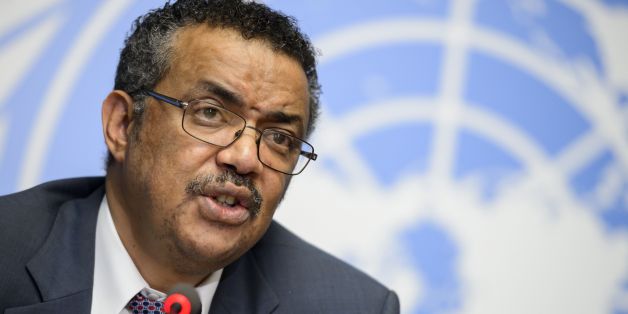
Dr Tedros Adhanom Ghebreyesus, Director-General of the World Health Organisation (WHO). Photo credit: AFP / FABRICE COFFRINI / Getty Images
WHO Director-General, Dr Tedros Ghebreyesus, said after seeing first-hand the complexities of the Ebola response, said that unhindered access to the disease-affected people was necessary in order to bring the outbreak under control.
Tedros said: “All of those participating in the response must be able to move freely and safely in conflict areas to do the work that is needed to bring the outbreak under control.
“The population must also have access to treatment centers that save lives and stop the spread of disease.”
While the latest Ebola outbreak was the country’s 10th, it was the first time that the disease had struck a densely populated active conflict zone, WHO said.
As was done in the recent outbreak in the west of the country, WHO said it was supporting the Ministry of Health in DRC in key aspects of the response.
A little more than a week since the government declared the new Ebola outbreak, Tedros and other top WHO officials went on a two-day mission to the city of Beni as well as to Mangina, the epicentre of the epidemic, where most of the confirmed cases had been reported so far.
The top officials of the global health agency were Dr Matshidiso Moeti, WHO Regional Director for Africa and Dr Peter Salama, WHO Deputy Director-General for Emergency Preparedness and Response.
A range of armed groups are active in the area and, according to WHO, this insecurity is creating a challenge for health teams attempting to reach communities for active case finding and monitoring, often requiring armed escorts.
WHO warned that the violence could also discourage members of the community from coming forward for treatment.
Moeti said: “WHO has vast experience with delivering health services in conflict zones in Africa.
“We will build on this experience to ensure that our staff and partners can do their work and save the lives of the people we are here to help.”
On Wednesday, August 8, 2018, health responders in DRC launched a vaccination campaign to mitigate the risk of spread of the Ebola disease.
The Federal Mortgage Bank of Nigeria (FMBN) Board has approved the implementation of the “Rent-To-Own” pilot housing scheme to begin with 3,000 houses nationwide.
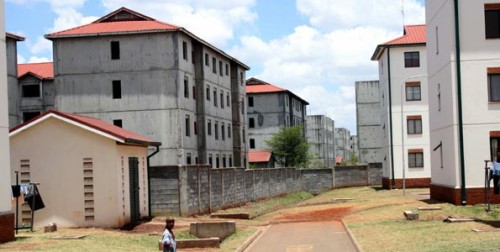
Observers say Nigeria’s housing deficit is far in excess of 17 million. Photo credit: lagos.all.biz
A statement signed by Mrs Zubaida Umar, FMBN Corporate Communications Group Head, on Sunday, August 13, 2018 in Abuja, stated that the scheme was a strategic move designed to make home ownership more accessible and affordable for Nigerian workers.
The FMBN “Rent-to-Own” scheme is an innovative affordable housing product that provides an easy and convenient payment plan towards home ownership for Nigerian’s workers.
The scheme is designed for workers to move into FMBN homes as tenants, pay for and own the properties through monthly or yearly rent payments spread over periods of up to 30 years.
Umar noted that the properties would also attract a single digit interest rate of nine per cent on the price of the property on an annuity basis to increase affordability.
“The product will cover properties with the maximum value of N15 million.
“The rent-to-own housing product targets Nigerian workers who are contributors to the National Housing Fund (NHF) and will be implemented in phases. About 3000 houses are planned for the pilot phase with 3,000 beneficiaries.
“To deliver on the rent-to-own housing scheme, FMBN will partner with reputable estate developers for the construction of cost-effective housing stock nationwide.
“Payments for the houses will be domiciled with the CBN through the Treasury Single Account (TSA).
“Properties that are planned for the rent-to-own scheme are Existing Estates that are funded by FMBN nationwide and non-funded estates,” she said.
Speaking on the development, FMBN Managing Director, Mr Dangiwa Ahmed, was quoted as saying that the rent-to-own was another groundbreaking initiative targeted at increasing access to affordable housing by workers in the low-medium income brackets.
“The rent-to-own housing product is designed to make sure that any worker who collects salary should be able to live in his own home and pay conveniently over periods as long as 30-years!
“This is a massive relief especially given how little workers earn.
“I am delighted that we have successfully added this product to the many other initiatives that we have made possible to make homeownership a lot easier for Nigerian workers.”
Ahmed commended President Muhammadu Buhari for his commitment to the development of housing and the Minister of Power, Works and Housing, Babatunde Raji Fashola, for his continual support on the ongoing reforms to re-position FMBN.
He added that the scheme would eliminate the burden of equity contributions by workers for housing loans, complement its existing products and help the bank to utilise abandoned estates that were to be transferred to the scheme.
The Nigerian Conservation Foundation (NCF) on Sunday, August 12, 2019 urged companies manufacturing Fast-Moving Consumer Goods (FMCG) to save the environment from plastic pollution through recycling.
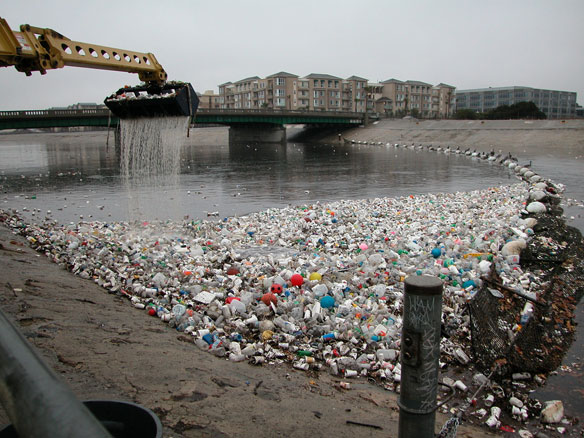
Plastic pollution
Mrs Abidemi Balogun, NCF’s Senior Conservation Officer, Environmental Education, gave the charge in an interview with the News Agency of Nigeria (NAN) in Lagos.
The consultant also appealed to multinational companies to join the campaign against plastic pollution.
Balogun said the companies could attach incentives to waste collection and recycling to create more jobs and reduce plastic pollution to save the environment.
She explained that the NCF was carrying out an advocacy programme on proper waste collection, recycling and management in 17 communities in Eti-Osa Local Government Area of Lagos.
The NCF official said the aim of the campaign was to educate residents on dangers of inappropriate waste disposal, and that the residents were trained on waste-to-wealth and recycling initiatives.
Balogun said the foundation also introduced recycling points to buy the sorted wastes from the residents, saying most participants were earning good money from the programme.
She suggested the need for FMCGs and multinational corporations to perfect ways of buying back plastic wastes from residents for the purpose of recycling plastic products.
She said the NCF carried along community heads as it sensitised residents and engaged in physical clean up with them.
Balogun added that the foundation introduced a point-based collection with centres within the communities and participants were paid after reaching a particular level.
“Some of the communities just generate the waste; they did not know that they could generate income from it.
“One thing we identified from the exercise is that most of the waste is plastic and it is none biodegradable, it does not break down, so, most of it goes back into the environment or the water bodies.
“That is why for the 2018 World Environment Day, plastic pollution was the focus because it is a global concern.
“We call on other corporate organisations, the beverage companies to have initiatives like this, where they can develop programmes to buy off plastics from communities thereby engaging them.
“It will serve as a source of employment to the communities because if some people know that they can get money from collecting plastics, they will want to go into it as a full-time job because plastic is everywhere,’’ she said.
Balogun said the NCF had also started discussing with clubs in schools across the council area, and that the schools usually went round to clean up the environment while creating awareness.
“The students can also use the waste materials to make things they can use in the home.
“We want continuity of the initiative, that is why we are going beyond the communities to working with the schools because even when the children graduate, other children are there to continue the activity,’’ she said.
Balogun said the foundation got a grant of N7 million in 2017 for the programme, and that the criteria for selection of the communities included proximity to NCF and low-income areas.
She listed the communities to include, Mopo Onijebu, Ataguntan, Sangotedo, Badore and Ikate, among others.
African governments have been told to urgently transit to renewable energy, while diversifying their economies away from dependence on fossil fuels, exploitation of peoples and the destruction of the gifts of nature.
Members of Oilwatch
This submission formed part of the declarations issued on Tuesday, August 7, 2018 at the close of the Oilwatch Africa conference held in Lamu, Kenya.
While declaring full support for the demands of the Save Lamu movement, delegates at the conference that comprised Oilwatch Africa network members, Lamu community representatives, non-governmental organisations (NGOs) and community-based organisations (CBOs) declared their opposition to the use of public funds to subsidise fossil fuel.
The forum wants land tenure systems on the continent to respect community ownership as dictated by culture and tradition It likewise stressed that communities must give their free prior informed consents for projects proposed for their territories while retaining their right to say “No”.
Theme: “Beyond Fossil Fuels”, the two-day conference considered the politics of fossil fuel extractions, the impacts of fossil fuels on the continent and the strategy to unlock Africa’s power using alternatives to fossil fuels energy systems that are environmentally friendly and socially just.
Participants also considered the implications of the proposed LAPSET project (Coal power plant, deep Sea Port and Oil extraction) by the Kenyan Government on the socio-economic lives of the people of Lamu, including the impacts of these project on their culture, agriculture, fisheries and livelihoods of the people.
After listening to the Save Lamu movement experiences, the conference noted that Lamu is an example of similar dirty energy and mega projects being pursued on the continent without full consultations with the people and without their free prior informed consent.
The conference further analysed:
Africa’s energy needs and the politics of a just transition;
The challenges that fossil fuels funding in African countries, including the issues of debt and the resolution of disputes under a jurisdiction different from the involved country;
The way Africa should go about renewable energy in relation to land tenure and land use;
The political corruption and abuse of political power as a major problem faced by the people;
The destruction of livelihoods and local economies by the polluting activities of fossil fuels industries; and,
The issues of land grabbing, displacements and the marginalisation of communities in Africa due to fossil fuel industry activities, among others.
The Coordinator, Food Sovereignty Programme for Friends of the Earth Africa, Mariann Bassey-Orovwuje, has said that the commercialisation of Bt Cotton in the country is not a victory but a breach of law and order.
Samples of the Bacillus thuringiensis cottons (Bt. Cotton) on display
Bassey-Orovwuje was reacting to the recent announcement by National Committee on Naming, Registration and Release of Crops, Livestock/Fisheries varieties at National Centre for Genetic Resources and Biotechnology (NACGRAB) and remarks made by Dr. Rufus Ebegba, DG/CEO of National Biosafety Management Agency (NBMA) and Dr Rose Gidado, the country representative of Open Forum on Agricultural Biotechnology (OFAB) and staff of the National Biotechnology Development Agency (NABDA) concerning the release and commercialisation of Bt Cotton in Nigeria.
In a statement on Thursday, August 9, 2018, the activist described the development as “a pointed disregard of the best interest of the Nigerian people and their right to be consulted and respected”, adding that “this adds a new dimension to the suspicion that disregard for judicial processes is taking a worrisome turn in current situation of things in Nigeria and if we have surrendered our sovereignty to corporate interests”.
According to her, NBMA and NABDA are defendants in the pending suit filed by the Registered Trustees of Health of Mother Earth Foundation (HOMEF) and 16 other civil society organisations (CSOs) in the Federal High Court of Justice of Nigeria in the Abuja Judicial Division, September 13, 2017, suit No FHC/ABJ/C5/846/2017.
It was gathered that the Plaintiffs – HOMEF and 16 others – sought, amongst other reliefs, a declaration that NBMA, the 1st Defendant in the case, did not comply with the provisions of the National Biosafety Management Agency Act in granting the permits to the 3rd Defendant, Monsanto Agricultural Nigeria Limited, and NABDA, the 4th Defendant in the case, for the purpose of commercial release of Bt Cotton (Mon 15985) and confined field trial with (1) NK603 and (2) MON89034 x NK603 maize in Nigeria.
The plaintiffs reportedly sought an order of perpetual injunction restraining the 3rd Defendant and 4th Defendant by themselves, their agents, servants, workmen or otherwise or whatsoever from carrying out any activity or further activities pursuant to the permits granted by the 1st Defendant.
The Plaintiffs, claimed Bassey-Orovwuje, considered the permits granted by NBMA to Monsanto and NABDA in breach of and a threat to the Fundamental Human Rights of the Plaintiffs as well as the general public as stipulated in the 1999 Constitution of Nigeria as amended in 2011. The Plaintiffs, she added, also want an order revoking the permits granted by the 1st Defendant to the 3rd and 4th Defendants/Respondents, stressing that the Plaintiffs opined that the issuance of the said permits on May 1, 2016 which happened to be a public holiday being Sunday and Workers’ Day is illegal, null and void.
She alleged that while the court is yet to deliver her judgement on the case, the defendants, NBMA, NABDA and Monsanto in apparent defiance to the ongoing court process went ahead on Thursday, July 26, 2018 to register and release some Genetically Modified (GM) products and the Bt cotton – one of the subjects of litigation, into the Nigerian environment.
Bassey-Orovwuje said: “The newly released and registered products amongst others include two transgenic hybrid cotton: MRC 7377 BG11 and MRC 7361 BG1.1 They were developed by Mahyco Nigeria. Mahyco is another name for Monsanto and MRC 7377 BG11 and MRC 7361 BG11 refer to the same Bt Cotton (Mon 15985). That is the subject of litigation. This information is displayed on the webpage of the International Service for the Acquisition of Agri-Biotech Applications (ISAAA).
“Dr. Rufus Ebegba, DG/CEO of NBMA, a regulator whose agency is named in this suit and an agency that is supposed to be unbiased and ensuring a thorough regulation of these products, stated in the light of this development that he has severally said that the country is ripe for commercialisation of Genetically Modified (GM) products.
“This singular action speaks volumes. If these agencies can show this brazen disregard for due process, if they can show this level of contempt for an ongoing court case over a matter of such grave importance, how do Nigerians trust them with their food, crops and livestock?
“The Federal Government should notify Nigeria if the NBMA, NABDA and Monsanto are above the laws of Nigeria. In the meantime, Nigerians, farmers and potential traders and buyers should beware of this threat to your foods, health and environment.”