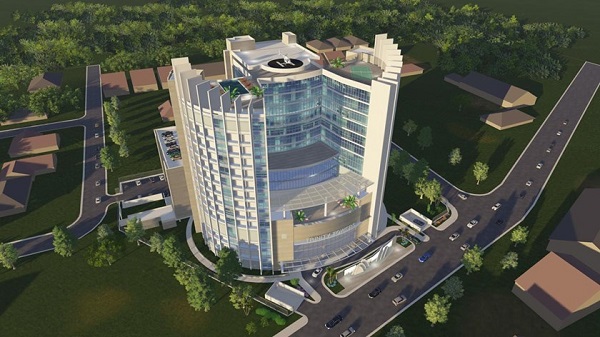
Lagos-based construction firm, ITB Nigeria Ltd, has disclosed that it is about to complete the Trinity Towers located on Victoria Island in Lagos.
An impression of Trinity Towers
The “21st century style” structure is a flagship project by The City of David, a parish of the Redeemed Christian Church of God (RCCG) and is designed to provide space for a blend of worship, work and recreation. The edifice, which sits n 10,000 square metres, has three towers of 14 floors each linked together and separated by corridors. Its special features include a helipad, garden terraces, gymnasium, 5,000-seater auditorium, wellness centre, and parking spaces for over 650 cars.
Speaking on the project, George Makhoul, Project Manager, Trinity Towers for ITB Nigeria Ltd, said, “This is a remarkable project for ITB Nigeria. The design and scope of the project with its attendant structural requirements speaks to our ability as a company to deliver excellent projects that set the standards for architecture in Nigeria. It also reaffirms our position as leaders in the construction industry.
“The features and amenities of the Trinity Towers is like no other. It is essentially a work of art brought to life with eco-friendly materials and proper utilisation of natural light and ventilation. We employed high efficiency glazing that reduces heat loss and reflects ultra-violet rays for lower energy consumption. Upon completion, Trinity Towers will no doubt be the ideal place for business and relaxation in Victoria Island.”
Valued at N2 billion, Trinity Towers, according to ITB, is positioned to raise the bar for contemporary office and relaxation space in the country.
“It boasts of an interior that will position it as prime residential and commercial property. The 5,000-seater concert hall will have automated and integrated lighting, sound and video system and state-of-the-art audiovisual facilities suitable for live broadcast. There are also indoor amusements for the kids, retail facility and cinema experience for all the family from the two cinema halls, recreational theme park and shopping centre,” adds Makhoul.
The Lagos State Government on Friday, August 17, 2018 urged residents to be mindful of the environment, as they celebrate the Eld-el-Kabir festival.
The Lagos State Commissioner for Environment, Mr Babatunde Durosimi-Etti
Commissioner for the Environment, Mr Babatunde Durosinmi-Etti, said in a statement that it was necessary to enlighten Lagosians to show utmost love for their environment, even as they celebrate.
The Federal Government has declared Tuesday, August 21 and Wednesday, August 22 as public holidays to mark the Eid-el-Kabir, an Islamic festival to commemorate the willingness of Ibrahim (also known as Abraham) to follow Allah’s (God’s) command to sacrifice his son.
Durosinmi-Etti said that the administration of Gov. Akinwunmi Ambode had been in the forefront of the campaign for healthy people and cleaner environment.
He urged Lagosians to desist from acts that could have negative impacts on the environment.
According to him, a lot of waste will be generated during the Sallah and should be disposed properly.
“Lagosians should respect the environment and dispose of animal waste properly, as well as bag their refuse and put at designated points.
“To guide against the outbreak of epidemics, residents of this state must always ensure that they handle waste in the most appropriate way,’’ the commissioner said.
Durosinmi-Etti said that government was committed to bequeath a cleaner Lagos, where improved waste management facilities would enhance the turn-around time of waste disposal services.
He said that government had directed the rehabilitation of access roads to the Ikorodu and Epe dump sites.
The commissioner said that the law against street trading was still in force.
“Government will not tolerate any form of street trading, be it display of rams on major highways, road medians, lay-byes, gardens and parks across the state,’’ Durosinmi-Etti said.
He said that while it was not unusual for traders to take advantage of the season to market and sell rams, this must be done without defacing the state or compromising the wellness and well-being of Lagosians.
The commissioner urged Lagosians to take advantage of the various parks and gardens across the state during the celebration for leisure, funfair and relaxation.
A coalition of non-governmental organisations (NGOs) on Friday, August 17, 2018 called on government at all levels, institutions, private sector, groups and individuals to support the tree planting awareness campaign.
Governor Yahaya Bello of Kogi State
Mr Ufana Husseini, Kogi State Coordinator, Rural Wealth Foundation (RWF) and leader of the coalition, made the call during a tree planting exercise to mark the 2018 Tree Planting campaign in Lokoja, the state capital.
The 2018 tree planting has its theme as: “Mitigate the Impact of Climate Change and Improve Food Security.”
According to Husseini, the aim is to guarantee food security and safety of the earth for future generations.
The agricultural expert said there was need for the country to also embark on forestation of the environment in view of the effort to diversify the economy from oil-dependent to agriculture-dependent one.
“The issue of tree planting is not only important but a necessity. People in the flood prone areas need to be sensitised and enlightened about the importance of tree planting.
“Tree planting can preserve homes and farmlands from being washed away by flood, thereby saving lives and property.
“Every nation, including Nigeria, needs to grow enough food for its citizens and rely less on imported food.
“Climate change is a global phenomenon and a nation that depends on imported foods is taking a very big risk,” he said.
Husseini attributed the issue of poverty and malnutrition prevalent in Africa, especially in rural areas, to lack of knowledge to exploit the abundant natural resources in the continent to advantage.
“In the rural areas, people are sitting on a goldmine, but they are still prone to poverty and malnutrition leading to so many diseases such as anemia among pregnant women and Kwashiorkor in children.”
These, according to him, are deficiency diseases which vegetable consumption could easily control but still prevalent in rural areas due to lack of enlightenment and sensitisation.
He said that the coalition, in view of the prevailing circumstances of rapid deforestation and desertification of the environment, resolved to sensitise Nigerians on the gains of tree planting.
“We began with the formation of Climate Change Clubs in primary schools with the hope for expansion to both secondary and tertiary institutions to create awareness on the dangers of climate change and need for tree planting.
“It is necessary to get them properly informed regarding the need for tree planting for carbon dioxide (CO2) sequestration, food and erosion control,” he said.
The coalition includes: Rural Wealth Foundation (RWF) Justice, Development and Peace Commission (JDPC) and MOM Orphanage, Rehoboth Communication Advancement Initiative.
Others are Teens Educational Development Initiative (TEEDIN), Citizens Emancipation and Advocacy Trust (CEPAT) and Dual Communication Initiative.
The Edo State Government says it will partner landlords in Benin City, the state capital, on its greenery project as part of its efforts on environmental sustainability.
Governor Godwin Obaseki of Edo State
Commissioner for Environment and Sustainability, Dame Omoua Alonge Oni-Okpaku, said this while speaking with journalists on Friday, August 17, 2018 in Benin.
She said that the project would be driven on a social and behavioural change template aimed at encouraging landlords in the city to plant and maintain trees in front of their houses.
She said: “There is a big drive at enhancing the beauty of our state. We are looking at parks and gardens.
“We are also looking at building what the old Edo should look like in a modern form.
“Governor Godwin Obaseki’s drive is to create a beautiful Edo, a state where people can encounter with tradition and have a feel of it in the 21st century.
“We are looking at building up our parks, the ring road, and intend to get our landscaping right.
“In the greenery project, we will commence an awareness campaign to appeal to people to plant flowers in front of their houses,” she said.
The commissioner said that the state government would support the people in achieving the greenery project.
According to her, if everybody does their bit, it will become easier for the government to work on areas that are not owned by individuals.
Oni-Okpaku said that the state government would roll out a clean-up initiative, noting that the state government was planning to acquire and distribute dustbins in vehicles for the control and collection of plastic wastes.
The Executive Director, Project Pink Blue, an NGO, Mr Runcie Chidebe, says Nigeria records about 102,000 new cases of cancer every year and a significant low surviving rate.
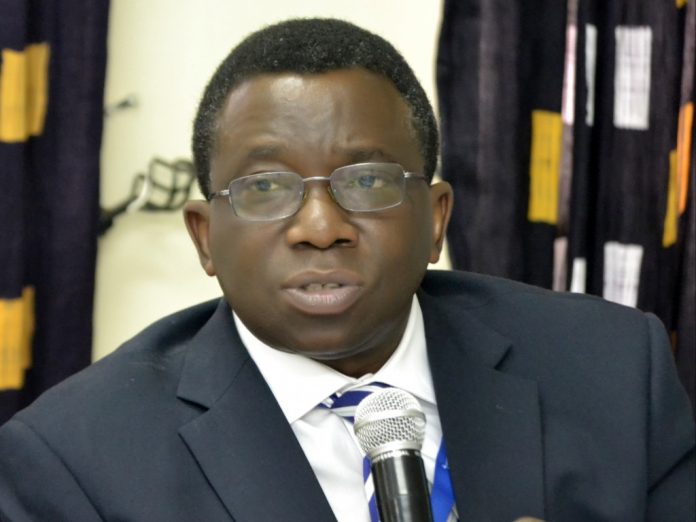
Minister of Health, Isaac Adewole
Chidebe made this known in an interview with the News Agency of Nigeria (NAN) on Friday, August 17, 2018 in Abuja.
He said cancer was responsible for the death of 72,000 Nigerians annually.
According to him, less than 50 oncologists is not enough to cater for the cancer related cases in various health institutions in the country.
He stressed the need for the government at all levels to encourage more resident doctors to go abroad to train as oncologists that would tackle the rising cases of cancer in the country.
“In Nigeria, cancer is leading to 72,000 deaths yearly; this number is set to increase given that there are about 102,000 new cases of cancer every year and a significant low surviving rate.
“For a country with more than 180 million people and 102,000 new cases of cancer, there are less than 50 trained oncologists in Nigeria.
“For instance, survival rate for breast cancer in U.S. is 85 per cent, while it is a dismal 1.9 per cent to 10 per cent in Nigeria.
“This is partly due to absence of skilled professionals in cancer care, which leads to poor quality of service and poor treatment outcome,’’ Runcie said.
He expressed regret that when patients are diagnosed with cancer in remote south-south villages the only place they can receive treatment is in Port Harcourt, saying there are so many alarming cases in the country which are not reported by the media.
The executive director, however, called on the government to invest more in the prevention and treatment of cancer and other non-communicable diseases.
Project Pink Blue is a non-profit organisation engaged in raising cancer awareness, patient navigation, advocacy and free breast and cervical cancer screening for under-privileged women in Nigeria.
The TB Alliance has congratulated the World Health Organisation (WHO) on the issuance of its rapid communication informing all stakeholders about the key implications for MDR-TB treatment regimens based on a new evidence assessment.
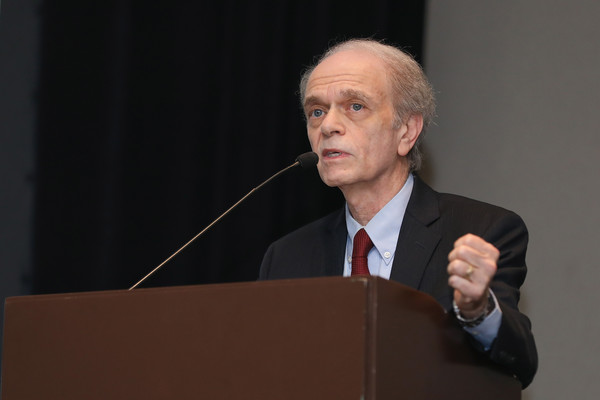
Dr. Mel Spigelman, President and C.E.O., TB Alliance
The restructuring, says TB Alliance, will limit the use of injectable drugs while prioritising the use of novel drugs including bedaquiline and linezolid.
In a statement, Dr. Mel Spigelman, President and C.E.O., TB Alliance, said: “As outlined, the revised grouping of medicines recommended for use in MDR-TB regimens highlights the progress that has been made. We are closer than ever to the time when every person with drug-resistant tuberculosis can be treated with a short course, all-oral therapy consisting entirely of drugs to which there is minimal pre-existing resistance, and when toxic and relatively ineffective injectable TB drugs can be rendered obsolete.
“Looking ahead into the not too distant future, novel, all-oral drug regimens should make it possible to meaningfully shorten the duration of therapy for drug-resistant TB to six months or less. Drug sensitivity testing should be infrequently needed. The treatment of what we now call drug resistant TB should be no more complicated, costly, lengthy or less safe or effective than that which is now available for what is presently termed drug sensitive TB.
“There remains, however, an urgent need to build out a solid base of evidence for new treatment recommendations. New guidelines should be based on high grade data which clearly define the advantages and side effects of novel regimens. With the appropriate funding, research and development of these novel therapies will transform the therapeutic TB landscape, enabling health care systems to become significantly more effective while simultaneously saving millions of lives.”
The Lagos State Government has said that it has not privatised water supply, neither has it awarded water privatisation contract to any organisation. The authorities say that the Public Private Partnership (PPP) model that it was initiating in the water sector was still at bidding stage.
LWC Managing Director, Mr Muminu Badmus
This was made known on Thursday, August 16, 2018 in Ijora by Muminu Badmus, Managing Director, Lagos Water Corporation (LSWC), while reacting to reports in some section of the media.
Badmus debunked reports by some online media that the state government had awarded water privatisation contract to a discredited company as false, stressing that such insinuations were at best preemptive as government had only shortlisted a number of reputable companies, none of which was yet to have the contract.
He explained that the Lagos Water Corporation had publicly advertised an Expression of Interest (EOI) which attracted seven local and international firms, out of which four firms were shortlisted following a rigorous and transparent process.
He assured Lagosians that government would continue to work in their interest in the bid to promote their wellbeing, adding that this was the main reason why the Akinwunmi Ambode administration had prioritised provision of potable water to the people by investing in water facilities as evidenced by the increase of water supply to 220 million gallons per day (MGD) to rapidly bridge supply gap.
Badmus stated that the exponential increase in population has continued to push the water supply need of Lagos State to 570MGD, leaving a gap of over 300MGD, while for the same demographic reason, the state’s resources faced pressure from other critical areas.
“Globally, attention is being shifted to the PPP arrangement to provide infrastructure for the people as government can no longer shoulder the responsibility alone,” he said.
He said that what the government was working towards was ultimately a PPP arrangement and not outright withdrawal, adding that government was midwifing an arrangement that would ensure the injection of both public and private funds and expertise to drive seamless provision of potable water to the teeming population of Lagosians.
He assured Lagosians that, as the ultimately beneficiaries, they would have cause to rejoice at the outcome of the ongoing process which not only promise to evolve an effective and enduring solution to the water supply needs of Lagosians, but also bring about a model for the country and the entire West Africa sub-region.
As part of the activities of International Climate Change Development Initiative (ICCDI) to celebrate this year’s International Youth Day (observed globally on August 12, 2018), ICCDI in partnership with BudgitCo hosted an event tagged ‘’Creating Safe Spaces for Youth’’ on Tuesday, August 14, 2018 in Lagos.
Participants at the event
The event relates to the United Nations theme for the International Youth Day tagged ‘’Safe Spaces for Youth.’’ The theme for this year was in line with Goal 11 of the 2030 Global Goals. The purpose of the event was how youths can efficiently engage in activities related to their needs and interests in areas of sports, environment and entrepreneurship in exploring their talents and potentials; participate in decision making processes and freely express themselves.
The event began by 2pm with guest speakers who have excelled in their diverse fields and endeavours. They include David Lanre Messan, Founder/CEO of Troggeurban; Chisom Mbonu-Ezeoke, the first and only female soccer analyst to have ever anchored on Super Sports Nigeria; and Chuks Anyaduba, Social Entrepreneur/Media Consultant.
Co-Founder, Olumude Idowu, in his welcome address, reiterated about the 2030 Global Goals and the need for all hands to be on deck. He also emphasised how the youths can expand their network in building a fruitful relationship with mentors and role models in their area of interest. Also, a representative of BudgitCo gave a speech on how BudgitCo, the business arm of BudgIT, successfully funded start-ups and helped entrepreneurs in achieving their dreams of owning a business.
This was followed by an engagement session where speakers decided to share their success stories as well as their challenges. Several key points shared by them was that whatever area of business you develop a strong interest in, be passion-driven about it irrespective of what others would do to want to make you quit. Challenges are bound to happen which would want to deter you from your focus and make you throw in the towel, but there is always a glimpse of hope in an environment of despair. A good mentor is also needed very necessary for you thrive and keep pushing your goals and aspirations through all the daunting challenges.
The session was very engaging, which was followed by questions and answers session. The questions of lack of women’s involvement in sporting activities, compared to their male counterparts were addressed; also, on how to promote your ideas and your project globally to make it a brand name were also addressed.
Idowu gave the closing remark with a presentation of an award plaque to the guest speakers while showering encomium on them for their great work and achievement in their endeavours. He also took time to express his appreciation for BudgitCo in making the year’s International Youth Day a success.
By Idemudia Isaac (Research & Development, ICCDI Africa)
Until readers finish reading this piece, the above title remains a puzzle in search of a meaning. The choice of the title was traceable to the first Lagos Tourism Summit (LTS) held on Monday, April 16, 2018, at the Eko Hotels and Suites in Victoria Island under the auspices of the Lagos State Government. This writer’s habitual search for ICYMI (In Case You Missed It) news items about Nigeria and Lagos, in particular, led to the discovery of the Lagos Tourism Summit news report, which the incumbent Governor of Lagos State, Mr. Akinwunmi Ambode was the initiator.
Akinwunmi Ambode, Lagos State governor, delivering a speech at the Lagos Tourism Summit
A handful of cities have proven that tourism can positively drive the urban economy
Examples of cities whose economy thrives on tourism are not far-fetched. Listed hereto, not necessarily in order of prominence, are the globally-acclaimed cities noted for their tourism innovations and success stories such as Chicago, New York City, Miami, Orlando, Los Angeles in the United States of America; Dubai, UAE, City-State of Singapore, New Delhi, India, Tokyo, Japan, Jerusalem, Israel, Istanbul, Turkey, London, UK, Rome, Italy, Paris, France, Sydney, Australia, Nairobi, Kenya and Madrid, Spain. The mere mention of the name of any of the cities cited in this piece conjures a quick memory of “the attractions” that make the city popular as a destination point for tourists from all over the world. Orland has Disney World, Nairobi has a Wildlife tourism, Singapore has ecotourism, Rome and Jerusalem are popular for religious tourism, Paris is a magnet for the fashionista, Madrid is the city of bullfighting festival, New York is the world capital city with an array of “must see and to-do-list” of things available to first-time visitors and tourist returnees. Chicago is home to numerous fascinating museums and its awesome architecture and breathtaking Millennium Park (Chicago’s tourist square). The list of other popular attractions in all these cities is inexhaustible but can be easily accessed on the internet by intending tourists to any of the cities prior to choosing the best place to go on tourism.
Statistics of revenue from tourism affirm the importance of tourism as an economic booster
From well-organised tourism, some cities rake in huge revenue to boost and sustain their local economy. According to a 2013 report by Master Card Global Destination Cities Index, revenue receipt from tourism was stupendous. New York City grossed $18.6 billion, London $16.3 billion, Paris $14.6 billion, Tokyo Singapore $ 13.5, $12.7 billion, Dubai $ 10.4 billion, Los Angeles $7.8 billion and Rome $6.4 billion. The updated survey of the same report for recent years would show an increase in revenue from tourism because there is a corresponding increase in global tourism in the last ten year. Tourism competition among countries and cities is very keen. It is those with cutting-edge attractions, friendly environment, innovation, safety and proactive policy that stay afloat in the business.
Lagos tourism is overdue for a Risorgimento – a time of renewal
Therefore, the Lagos Tourism Summit was a commendable initiative by governor. On the surface, it is viewed as a clarion call by the governor that all hands must be on deck to rejuvenate a “comatose industry. Methinks it goes beyond a call. As good as the initiative was, the outcome and the follow-up on what transpired at the Tourism Summit would determine whether the LASG is ready to walk the talk. Like the proverbial journey of one thousand miles, the LASG has rightly taken the first step. The government has put up an advertorial calling for an Expression of Interest (EoI) from industry experts to submit proposals for the development of a long-range Tourism Plan for Lagos State. If at the end of the day a Tourism Plan is drawn, the skepticism is that the plan would remain what it is: A plan on paper.
The political will to implement the elements of the plan by the government that initiated it is always a major problem. History is replete with the story of various plans made by the government which either fails to take-off or poorly implemented. Sadly enough, some projects are abandoned mid-stream once there is a change of baton in government. We have failed woefully in our (wrong) perception of not accepting governance as a “continuum.”
We, therefore, counsel that being a long-range plan, it must be sustainable for the plan period (15-20 years) beyond the tenure of Governor Ambode administration. A new administration can continue to do a periodic review and modification of the plan to determine its successes or pitfalls instead of using scarce state resources again on a new tourism plan trying to re-invent the wheels.
Governor Ambode cuts the image of a zealous leader who is running faster than a deer to deliver the dividends of democracy to Lagosians
It is to his credit that he has initiated the execution of many social programmes and ambitious infrastructural projects. To the governor, caution is the word. He should realise that commitment is not the synonymy success. In his new attempt to enhancing tourism in Lagos State, he must ponder why that viable sector of the economy has failed woefully in the past despite its potentials. He must query the lack-luster performance of the Lagos State Ministry of Tourism, Arts, and Culture which fails to impress no tourist. Here is the next narrative of the past failure.
The diversification of the economy must include tourism
Tourism in Lagos is a metaphor for an “unpolished diamond” which needs to be polished to shine. Put in simple language, it is a cash-cow in need of food to grow. Even if the LASG is going to start from ground zero, the potentials are there to make Lagos a tourist paradise. However, the potentials have not been fully exploited. What are the factors responsible for the neglect of Lagos tourism sector?
Number one deficiency is instability of institutional arrangement and policy somersault for tourism management in Lagos State. The institutional arrangement has continuously suffered an identity crisis. From 1991 to-date, the sector went through frequent name changes/nomenclatures and institutional arrangements without corresponding achievements. During Governor Michael Otedola in 1991, it was yanked from the Ministry of Home Affairs to embrace an all-encompassing name: Bureau of Information, Tourism, and Culture. In 1994, it was merged with the Ministry of Information and Culture during which period the Lagos Tourism Board (LTB) was established. The LTB’s onus responsibility was to promote tourism under another new supervisory Ministry of Commerce, Industry, and Tourism.
By 1998, it morphed to Lagos State Waterfront and Tourism Development Corporation (LSWTDC) and by 2007, two distinct Ministries were created from the LSWTDC namely: Ministry of Tourism and Intergovernmental Relations and Ministry of Waterfront Infrastructure Development. When Mr. Akinwunmi Ambode assumed office as the Executive Governor of Lagos State in 2015, at his whims, he changed the institutional nomenclature to the Ministry of Tourism, Arts, and Culture.
The constant change in name and institutional arrangement apparently created a lot of confusion. Little or no time was given to the formulation of a coherent policy on tourism. The development of both old and new tourist sites/attractions were neglected including a robust machinery for information dissemination. The government effort at promoting tourism in the state was disjointed. Every new administration wants to outdo each other in the “name change” race while performance stock-taking was inadvertently sidelined.
A new name does not translate to excellent performance. Strong institutional leadership, vision, dynamism, innovation and team spirit ought to have been cultivated by previous administrations ab initio instead self-aggrandisement.
Information is the currency of tourism
Poor information outreach cannot effectively promote tourism. Samuel Johnson (1709-1784) British author made the point very clear that “the best thing to knowing something is knowing where to find it.” In the contemporary world, the Internet of Things (IoT) has made information dissemination so simple even in the comfort of people’s home. If there is a paucity of information about a place and its attractions, the urge to visit is nil. It counts twice if the source to get the information is non-existent or not user-friendly.
While writing this piece, a comparative analysis was done regarding two cities (Chicago and Singapore). The City of Chicago has a prolific information machinery. It has a well-developed website loaded with an array of information a tourist would want to know about Chicago tourism. E-information on tourism is complemented with innumerable documentation in form of flyers, outdoor advertisements, brochures, and visitor’s information centres and human contacts popularly called the “Chicago Greeters” who serve as tour guides. On the website, a user can effortlessly surf for such information as Chicago attractions, festivals, famous restaurants, hotels, music concerts, cultural centres, museums, amusement parks, aquariums, coming events and daily tours. Tourists also have the luxury of watching video documentary about Chicago Tourism on YouTube and the option of downloading a series of Apps to search for more information on a phone device. The Chicago Cultural Centre is usually a beckon for in-town tourist searching for what to do in the windy city.
If the Chicago information machinery is superb, Singapore’s is superlative. It is a city that operates fully on Information, Communication, and Technologies (ICT). The city-state is A+ smart city and a tourist delight. Its Tourism information is known as “Open Access.” There is no inhibition. The city’s sloganeering about its tourism and hospitality is rated the best in the world. The Singapore Tourism Board (STB) does an excellent job by using the reflection of the mood and times to come up with an ideal slogan to lure tourists from all over the world. “Instant Asia, Surprising Singapore, New Asia, Uniquely Singapore, Your Singapore and Passion Made Possible” are a few of the fascinating slogans Singapore has used to the hilt to boost its tourism industry. The high-end tourism infrastructure that Singapore had to develop and still developing to enhance the growth of the tourism industry, is another storyline beyond the scope of this piece.
The comparison of the above narrative with the Lagos State Ministry of Tourism, Arts, and Culture (MTAC) is a comparison between day and night. The difference is clear. Chicago and Singapore are both accomplished smart cities very prominent on the information highway. Whereas Lagos is at the threshold of becoming a smart city. Meaning a city that uses information and communication technologies regularly to improve the delivery of government services to the public. Many of the Lagos State Government’s Ministries, Departments, and Agencies (MDAs) are poorly managed information-wise. The Lagos State Ministry of Tourism is guilty as charged. Its website is devoted to irrelevances. There is no useful information available to prospective tourist in dire need of knowledge about Lagos tourism. Most tourists won’t give a hoot about the names of the past commissioners or permanent secretaries of the Ministries. Similarly, no news report meant for a local audience can be of interest to foreign nationals using the website from far-flung countries such as Australia, Canada, Russia, Fiji, Mexico or the Philippines. The information most tourists would be eager to read is: what is so special about Lagos, places to visit, safety, upcoming events, ease of doing business, local transportation, local cuisines and entertainment…music, movie theaters, clubhouses and more of spectacular things tourists savour when they are on vacation in other foreign countries.
The Ministry of Tourism, Arts and Culture ought to be restructured
Among the 25-point responsibilities of the Ministry, “tourism promotion and information dissemination” is listed as a key responsibility. Unfortunately, the function has suffered serious setback either due to government neglect or clueless institutional leadership. Governor Ambode having determined to revive the tourism industry with gusto, he must completely overhaul the entire Ministry of Tourism, Arts, and Culture and if found necessary, he should consider a change of its leadership and eliminate redundancy. Information is the life-support of a thriving tourism economy analogous to water, as the sustenance of human life. Tourism also thrives on visuals- i.e what tourists see one on one. What excites them and make them nostalgic about the places they visited. The huge expenditure committed on tourism revival in Lagos might not make the desired impact due to the weak channel of information dissemination. Put simply, a situation of “worth seeing? Yes, but not worth going to see,” may form in the mindset of foreigners who have the intention to visit the megacity on vacation.
Postscript
After the conclusion of this piece, the newly released 2018 Global Cities Liveability Index report by The Economist Intelligence Unit and World Bank was made public on the Internet. Of the 140 cities surveyed, Lagos ranked 138 making it the third worst city to live in the world after Bangladesh, Pakistan, and Damascus, Syria. Sadly too, Lagos maintained the same position in the 2017 global report. The 2018 report is a drawback on the public image of Lagos. It places an additional burden on the LASG’s effort to showcase the megacity to the rest of the world as a “choice destination” for intending tourists from foreign countries. Therefore, the government would have to redouble its effort to have a niche in the volatile global tourism industry.
The Special Adviser to the President on Niger Delta and Coordinator, Amnesty Programme Office, Prof. Charles Dokubo, says the office will collaborate with the National Oil Spill Detection and Response Agency (NOSDRA) on disaster reduction programmes in the Niger Delta.
Director-General, National Oil Spill Detection and Response Agency (NOSDRA), Sir Peter Idabor
Mr Murphy Ganagana, Special Assistant on Media to Special Adviser to the President on Niger Delta and Coordinator, Amnesty Programme, made this known in a statement on Thursday, August 16, 2018 in Abuja.
Dokubo said that this partnership would include sensitisation campaigns on environmental hazards occasioned by decades of oil exploitation and safety measures.
He assured the agency on the readiness of his office to partner NOSDRA towards curtailing the effects of environmental degradation on communities in the Niger Delta.
According to him, plans are underway for a conference on oil exploration and environmental degradation to investigate the geological background of the Niger Delta and impact assessment.
“I think we have to look at the ripple effects of environment; environmental degradation and economic resurgence is one issue we should always look at.
“It has taken a long time and now that the government has decided that clean up period has come, it is commendable.
“I face a peculiar problem in the sense that whenever there is a crisis, most of the people I deal with will go and blow up pipelines.
“I always tell them that they are not blowing up pipes that are in Kaduna; they are blowing up pipes that are in their own environment and that children yet unborn will suffer from these activities.
“Oil pollution are not things that we hear in developed countries; new technologies are available that we can use now, but for our environment, it is already devastated.”
He said that to resuscitate the environment, there was need to create awareness that this environment belongs to us, adding and if we do not take care of it, it would affect us negatively.
Mr Peter Idabor, Director General, NOSDRA, said the agency was concerned about the health of people living in the Niger Delta, especially the infusion of toxic substances through food chains.
Idabor commended Dokubo for his efforts at deepening peace and stability in the Niger Delta.
He called for the conversion of deep pits created during the construction of major roads in the Niger Delta to fish ponds to create jobs and wealth for beneficiaries of the Amnesty Programme.
“We have noticed that your activities have drastically reduced cases of vandalism of pipelines in the Niger Delta, and we commend you for that.
“We are responsible for the national oil spill contingency plan which is geared towards the third-tier oil spills in the country.
“We are very much concerned about the health of our people; our greatest concern is the infusion of some of these toxic substances through the food chains and the effect on the health of our people.
“So, one of the things we do is to help create awareness; sensitise people on how to deal with this problem of having oil spillage in their immediate environment.
“At this stage, there is little anybody can do, but if we can prevent people from getting too close to the substances, contaminated areas or eating foods that are contaminated, it will go a long way to educate the people.
“That is why we have come to see if we can partner with you, and also have an opportunity to present resource persons from our own agency for you in any area that you require,” he said.