Home Blog Page 180

Thousands take to the streets worldwide to ‘Draw the Line’ for climate justice

0

From Belem to Berlin, Nairobi to New York, hundreds of thousands of people are taking to the streets this weekend as part of the Draw the Line Global Week of Action.

United under a call from Indigenous leaders of the Amazon and the Pacific, people across more than 90 countries are joining marches, rallies, strikes, and creative actions to demand an end to fossil fuels, a just transition, and real climate justice.
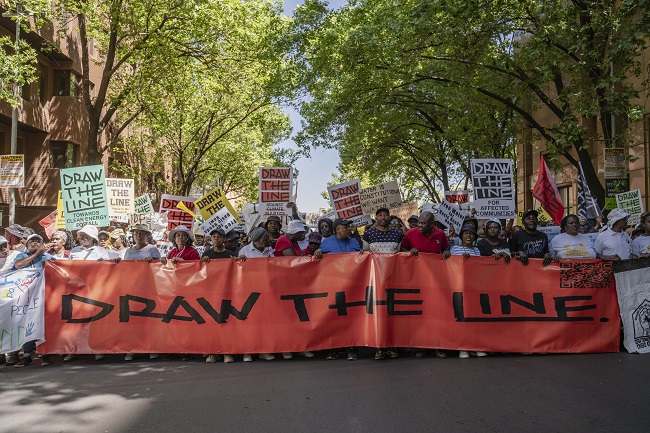
Draw The Line
Draw The Line campaign in South Africa

More than 600 actions are taking place from September 15 to 21, 2025, culminating in mass demonstrations over the weekend. The mobilisations highlight escalating climate impacts, rising food and energy costs, deadly floods and heatwaves, and growing insecurity driven by fossil fuels and conflict. Protesters are also uplifting community-led solutions: renewable energy systems, debt cancellation, fair taxation, and land rights for Indigenous peoples and traditional communities.

Draw the Line actions showcase both resistance and hope. From mass rallies to candlelight vigils, participants are demanding a future built on peace, clean energy, and fairness.

Regional Highlights

Pacific

Hundreds will gather across Pacific villages, cities, and shorelines to demand stronger action in line with the 1.5℃ target. In Fiji, communities will assemble at the Suva foreshore to Draw the Line against further loss and damage. Pacific communities in Melbourne, Brisbane, and Sydney will rally to condemn Australia’s weak newly released emissions targets.

Youth across the Marshall Islands, Palau, Aotearoa, Papua New Guinea, Samoa, Tuvalu, and Kiribati are organising cultural celebrations, education programmes, and storytelling events to defend their heritage from climate chaos. These actions build momentum towards COP30, where leaders will face mounting pressure to close the Ambition Gap and keep 1.5℃ alive.

Asia

Across Indonesia, the Philippines, Bangladesh, Japan, South Korea, Taiwan, and China, thousands marched or held creative local actions demanding climate and social justice. Frontline communities hit hardest by coal, gas, and extreme weather demanded an end to fossil fuel expansion and called on wealthy nations to meet their obligations. Festivals showcasing renewable energy solutions demonstrated where climate funds should flow, and what a fairer, safer future could look like.

Africa

From Nairobi to Lagos, Johannesburg to Dakar, communities will be mobilising to Draw the Line against fossil fuel dependency that drives both economic instability and worsening climate disasters. On Thursday, September 18, a Draw the Line demonstration took place in Johannesburg.

In Abuja, the Global Initiative for Food Security and Ecosystem Preservation (GIFSEP) is promoting the “March for the Future” in support of the passage of the Environmental, Social and Health Impact Assessment (ESHIA) Bill and the “Draw The Line” campaign on Saturday, September 20, 2025.

“This march is a crucial step towards ensuring the ESHIA Bill, designed to address Nigeria’s urgent environmental and climate challenges linked to developmental projects, receives timely passage by the National Assembly,” said Akintunde Akinmolayan, the GIFSEP Field and GIS Analyst.

Dr Michael Terungwa David, the GIFSEP Executive Director, stated: “Today, we join voices with millions around the world for the #DrawTheLine Day of Global Climate Action, a united stand against climate injustice, poverty, environmental destruction, and the silent genocide facing vulnerable communities.

“We are drawing the line against the use of public funds to support destructive industries that fuel floods, fires, heatwaves, hunger, and poverty. Instead, we demand that public money be invested in building a safer, fairer, and more sustainable future for all Nigerians.”

He called for:

  1. Climate finance, especially increased support for adaptation financing to protect vulnerable communities.
  2. Debt cancellation for climate, enabling African countries like Nigeria to channel resources toward resilience and sustainability.
  3. Respect and uphold of the territories of Indigenous Peoples and Traditional Communities
  4. Support people and community-led solutions
  5. The National Assembly to expedite action on the Environmental, Social and Health Impact Assessment (ESHIA) Bill currently before the House, a key step toward protecting people and planet.

Europe

From September 18 to 21, tens of thousands took to the streets. In London, the Make Them Pay march united unions, migrant justice groups, and climate campaigners. In Berlin, workers, Fridays for Future activists, and economic justice groups led a creative march, with more than 60 additional demonstrations across Germany.

Across the continent, from Amsterdam to Athens and Lisbon to Istanbul over 80 demonstrations brought together farmers, students, and social justice groups to demand taxes on the super-rich and polluters to fund climate action and public services. Momentum is now building toward 28 September in Paris, where unions, racial justice groups, and climate organisations will join in a carnival-style mass march.

United States

Tens of thousands will rally in more than 30 cities across the U.S, demanding that Billionaires Pay and to fight back against fueling big oil, the dismantling of democracy and attacks on immigrants. 

Canada

From Vancouver to Toronto and Montreal, people everywhere are rising up to demand climate justice, peace, and real democracy. Drawing the line for a better world: with clean energy for all, protection for people and nature, and accountability for those.

Latin America

In the Brazilian Amazon, fishing communities in Marajó formed a striking 20-boat line on the waters of Jubim. The action will draw a visible line against the climate crisis and political inaction, sending a clear message to world leaders that fossil fuels have no place in the future of the Amazon or the climate negotiations at COP30. 

EU Commission to ban Russian LNG imports by 2027

0

The European Commission said it aims to move forward a ban on imports of liquefied natural gas (LNG) from Russia into the European Union by one year.

The commission said the ban to beginning early in 2027, as part of the bloc’s 19th package of sanctions on Russia.

Ursula von der Leyen
Ursula von der Leyen, President of the European Commission

“Europe is increasing its pressure,” European Commission President, Ursula von der Leyen, said.

“Russia’s war economy is sustained by the revenues from fossil fuels. We want to cut these revenues,” she said.

“We are banning imports of Russian energy into European markets. It is time to turn off the tap.”

The EU was ready for the ban thanks to efforts to save energy, diversify supply, and investments in low-carbon sources of energy, the commission president said.

Friday’s announcement came days after von der Leyen said she aims to achieve a faster halt to European fossil fuel imports from Russia following a conversation with U.S. President Donald Trump.

Since Russia’s full-scale invasion of Ukraine in 2022, the EU has imposed extensive import restrictions on Russian coal and oil.

There have however been no gas sanctions in place so far.

According to EU figures, the bloc imported LNG from Russia worth almost 4.5 billion Euros (5.3 billion dollars) in the first half of 2025.

In 2024, Moscow’s gas deliveries still accounted for around a fifth of all gas imports, more than half of these imports came in the form of LNG.

The proposal for the new sanctions package also includes further punitive measures in the financial sector and additional trade restrictions, von der Leyen said.

The bloc’s 27 member countries have to back the new package unanimously before it can enter into force.

Seplat unveils $3bn five-year growth plan

0

Seplat Energy Plc has unveiled a five-year roadmap to boost production capacity by 50 per cent between 2026 and 2030.

Chief Executive Officer, Roger Brown, disclosed this in a statement on Friday, September 19, 2025, following the firm’s successful acquisition of Mobil Producing Nigeria Unlimited (MPNU).

Roger Brown
Chief Executive Officer, Seplat Energy Plc, Roger Brown

He said the roadmap would be anchored on $2.5 to $3 billion capital investment over five years, beginning in 2026.

The investment will fund 120 to 150 new wells and up to three major gas projects, aimed at strengthening Nigeria’s energy and power supply.

Brown said Seplat’s strategy was supported by a significantly larger resource base, confirmed by a new independent Competent Person’s Report (CPR).

The report revealed proven and probable reserves above one billion barrels of oil equivalent, an 18 per cent increase from previous estimates.

It also showed total reserves and resources rose nearly 90 per cent to 2.3 billion barrels of oil equivalent, providing long-term growth and energy security.

Brown said the roadmap would materially grow production, increase cashflow, and drive enhanced shareholder returns, while supporting Nigeria’s economic future.

He described Nigeria as a land of opportunity with strong population growth and economic vibrancy, positioning Seplat as a key energy player.

Brown noted the plans reflected confidence in the Nigerian economy, stressing Seplat’s commitment as a reliable partner to government and investors.

As part of its strategy, Seplat is in talks with the Nigerian National Petroleum Company Ltd. (NNPC) on selling a 10 per cent joint venture interest.

This would align NNPC’s stake at 70 per cent, reinforcing the partnership.

Brown also confirmed a revised dividend policy, committing 40 to 50 per cent of free cash flow to investors.

He said the policy included a base dividend of at least $120 million annually, with a 10 per cent rise in the third-quarter dividend for 2025.

He further disclosed plans to cut operating costs to $10 per barrel of oil equivalent by 2030, strengthening Seplat’s position as a low-cost operator.

By Taiye Olayemi

Lokoja varsity commits to checkmate flood, erosion in Nigeria

The Vice Chancellor, Federal University Lokoja, Prof. Olayemi Akinwumi, says the institution is committed to checkmating the reoccurrence of flood and erosion affecting many parts of the country.

Akinwumi stated this at the inauguration of an International Centre for Climate Change, Flood and Environmental Sustainability on Thursday, September 18, 2025, in Lokoja, the Kogi State capital.

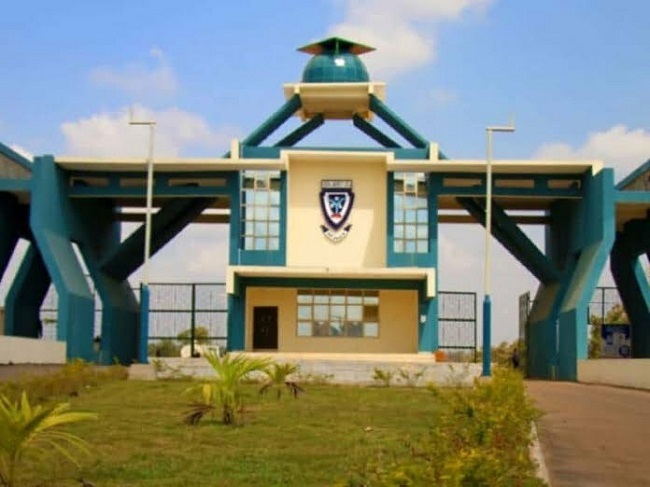
Federal University Lokoja
Federal University, Lokoja

The VC said that climate change and environmental degradation posed significant threats to the planet; as such, it was a collective responsibility to offer solutions and policies to mitigate the impacts.

“Lokoja, the confluence of the Niger and Benue rivers, had witnessed a devastating consequence of recurrent floods and environmental challenges.

“These realities compel us not only to study climate change but to pioneer sustainable solutions that will safeguard lives, livelihoods, and the future of generations,” he said.

According to him, the centre is more than a research hub but a beacon of hope, innovation, and resilience.

Akinwumi added that the centre would serve as a hub for interdisciplinary research, collaboration, and knowledge-sharing, fostering a deeper understanding of these complex issues.

He explained that it would provide evidence-based research, policy direction, and community-focused interventions to mitigate the impacts of climate change.

“It will also reduce flood vulnerability and promote sustainable development in Nigeria, Africa, and beyond,” Akinwumi said.

Also speaking, the Centre Director, Prof. Jimmy Adegoke, said that climate change was a global issue that demanded urgent attention to save humanity and the environment.

“Flooding is a major issue here in this region, due to climate change, which respects no boundaries.

“What is expected of us is urgent response, collaborative, and unwavering action to fight the trend for the good of humanity,” he said.

Earlier, the Chairman of the Local Organising Committee, Prof. Olarewaju Ifatimehin, said that the centre was both an academic unit and a beacon of resilience, innovation, and global collaboration.

He said that through cutting-edge research, policy engagement, and community outreach, the centre would serve as a hub for climate change adaptation and mitigation.

By Thompson Yamput

Floods, storms to worsen as global heating continues, WMO says

0

The UN World Meteorological Organisation (WMO) says there is no end in sight for floods and storms as global warming continues.

According to it, the world’s water resources face growing pressure from climate change while emergencies involving the life-giving resource are increasingly impacting lives and livelihoods,

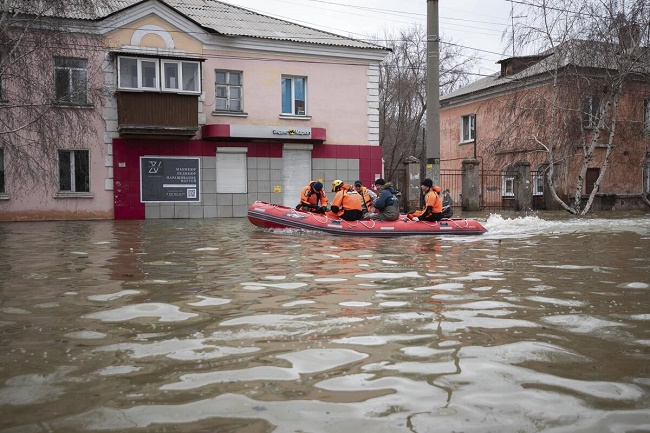
Flooding in Russia
Flooding in Russia

“Water-related hazards continue to cause major devastation this year,” Celeste Saulo, WMO Secretary-General said on Thursday, September 18, 2025.

“The latest examples are the devastating monsoon flooding in Pakistan, floods in South Sudan and the deadly flash floods in the Indonesian island of Bali.

“And unfortunately, we see no end to this trend.”

Saulo said: “2024 was the third straight year with widespread glacial loss across all regions.

“Glaciers lost 450 gigatonnes, this is the equivalent of a huge block of ice seven kilometres in height, seven kilometres wide and seven kilometres deep.

“Or 180 million Olympic swimming pools, enough to add about 1.2 millimetres to global sea level, increasing the risk of floods for hundreds of millions of people on the coasts.”

The report also highlights the critical need for improved data-sharing on streamflow, groundwater, soil moisture and water quality, which remain heavily under-monitored.

Saulo noted that the emergencies had  been happening amid increasingly warm air temperatures, which allowed more water to be held in the atmosphere leading to heavier rainfall.

Her comments coincided with the publication of a new WMO report on the state of the world’s waterways, snow and ice.

The report notes that 2024 was the hottest in 175 years of observation, with the annual mean surface temperature reaching 1.55 °C above the pre-industrial baseline from 1850 to 1900.

Against this backdrop in September 2024, central and eastern Europe experienced devastating flash-floods caused by deadly Storm Boris which uprooted tens of thousands of people.

Similar disasters are likely to happen more often, even though they should, in theory, be extremely rare.

In the Czech Republic, several rivers flooded in an extreme fashion “that actually statistically should only occur every 100 years,” Stefan Uhlenbrook, WMO Director of Hydrology, Water and Cryosphere Division, said.

“A ‘century event’ happened, unfortunately, statistics show that these extreme events might become even more frequent.”

The WMO report findings confirmed wetter-than-normal conditions over central-western Africa, Lake Victoria in Africa, Kazakhstan and southern Russia, central Europe, Pakistan and northern India, southern Iran and north-eastern China in 2024.

One of the key messages of the UN agency report was that what happened to the water cycle in one part of the world had a direct bearing on another.

Melting glaciers continue to be a major concern for meteorologists because of the speed at which they are disappearing and their existential threat to communities downstream and in coastal areas.

By Tiamiyu Prudence Arobani

Oilwatch demands cleanup, restoration as UN decries Niger Delta divestment

0

Oilwatch International, a coalition of environmental activists, has welcomed the intervention by a coalition of United Nations Special Procedures led by the UN Working Group on Business and Human Rights and several UN Special Rapporteurs, which exposes how international oil companies (IOCs) have been divesting from the Niger Delta without cleaning up their toxic legacy, trampling fundamental rights in the process.

The UN experts’ letter (Ref: AL OTH 61/2025, dated July 2, 2025) squarely links decades of pollution and the current wave of divestments by Shell, Eni, ExxonMobil and TotalEnergies to ongoing violations of the rights to life, health, safe water, an adequate standard of living, a clean, healthy and sustainable environment, access to information, and effective remedy.

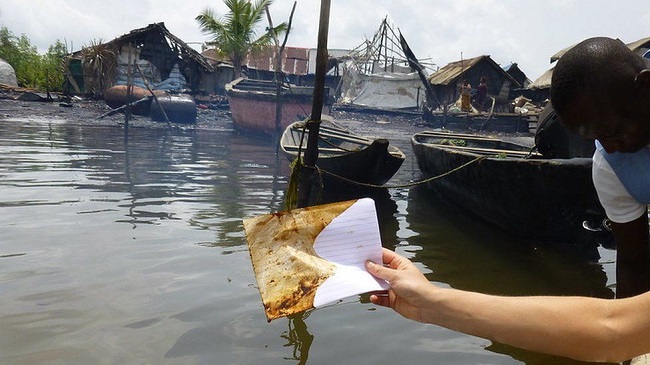
Bille Community
Pollution in Bille Community of the Niger Delta

The UN letter warns that the divestments approved by the Nigerian government, including Shell’s sale of its onshore subsidiary (SPDC) to the Renaissance consortium in 2024, were advanced without transparency, which could risk undermining environmental remediation. It further highlights the absence or weakness of required decommissioning/abandonment funds, as well as the risk that buyers lack the capacity to address ageing, leaking infrastructure and legacy pollution.

The experts also highlight chronic regulatory failures, gaps in spill investigations, incomplete containment, and poor remediation sign-offs, reminding duty-bearers that Nigeria remains in breach of binding ECOWAS Court rulings aimed at protecting the rights of the Niger Delta people. The letter also notes fresh legal momentum: on 20 June 2025, the UK High Court ruled that Shell Plc can be sued over legacy pollution in Nigeria and that failure to clean up may constitute a continuing legal wrong.

Independent reporting has also detailed systemic cleanup failures, including serious governance lapses in Ogoniland’s cleanup program, which the UN withdrew due to persistent concerns about corruption.

The coordinator of Oilwatch International, Kentebe Ebiaridor, urges the Presidency, the National Assembly, and state governments to convene open public hearings with affected communities, civil society, regulators, and companies on the violations and demands that regulators ensure that protections and ecologically sound conditions for any asset transfer are respected.

Member of the steering committee of Oilwatch International and the executive director of HOMEF, Nnimmo Bassey, stated that, for years, communities have insisted on “no exit without cleanup.”

“The UN has now affirmed what we have long insisted on: no sell-off of toxic assets, leaving behind poisoned water, dead soils, and shattered livelihoods. Nigeria must halt these divestment plans immediately until there is a binding, fully funded plan to decommission, remediate, restore, and prevent further harm with communities at the centre.”

Coordinator of Oilwatch Nigeria, Emem Okon, stated that civil society actors have consistently called for a halt to all IOC divestments until comprehensive cleanup and justice are secured. “Divestment without repair is dispossession. Women, fishers, and farmers are bearing the heaviest burden from toxic water and lost livelihoods to alarming health risks for infants and newborns. No community should be treated as a sacrifice zone.”

Oilwatch International calls for the following immediate action: that the Federal Government of Nigeria should declare a halt to the divestment and sale of assets in Nigeria until remediation and cleanup are assured, decommissioning and dismantling of abandoned wells are done, and community restoration and reparation are irrevocably done. As a start, an environmental restoration fund should be established with an initial deposit of $1 trillion.

It also demands the provision of safe water for polluted communities, implementation of health audits, monitoring and treatment programmes for exposed populations, and an immediate cleanup of the Niger Delta.

NCDMB boss charges West African Ventures, others on deepwater operations

0

The Executive Secretary of the Nigerian Content Development and Monitoring Board (NCDMB), Felix Omatsola Ogbe, on Tuesday, September 16, 2025, acknowledged the advanced capabilities and proven track record of a leading indigenous service company, West African Ventures (WAV) Nigeria Limited, noting that the firm and others well established Nigerian companies need to pivot to the deepwater segment of oil and gas operations where vast opportunities exist.

Speaking during a facility tour of the WAV Fabrication Yard, Machine Shop, and jetties at the Federal Ocean Terminal (FOT), Onne, in Rivers State, the Executive Secretary revealed that he awarded the company their first offshore pipe-laying contract when he (Ogbe) served as the Construction Manager with Chevron Nigeria Limited, recalling that the execution of the project was very satisfactory.

NCDMB
NCDMB and West African Ventures (WAV) Nigeria Limited officials during the facility tour

“You have worked hard; you are a very good company,” he declared, adding that what he had seen during the tour were an eye-opener, indicative of the current capabilities of the company, which he described as impressive.

“You have a (50mm) rolling mill; you have ocean-going vessels; apart from that you have a good yard to do fabrication, good load-out equipment like the JASCON 8, and a crane with a tonnage of 160,” he noted.

He said West African Ventures Limited should start looking at how it could participate in offshore operations because “all the big players in the oil and gas industry] are going to deepwater.”

While emphasising that “projects are by competitive bidding” and that NCDMB stands for transparency and professionalism, he was confident that indigenous companies have what it takes to participate effectively in the deepwater space.

Earlier at the occasion, the Managing Director of West African Ventures, Mr. Michael Dumbi Amaeshike, expressed appreciation at the visit by the NCDMB boss and Management, stating that his company has been a service provider in the oil and gas industry for over 40 years, and has been “a showcase for what it takes to have a proud Nigerian company that portrays local content the way it should be.”

He said many personnel occupying critical positions in different subsectors in the oil and gas industry, notably, maritime, engineering, procurement and construction (EPC), are products of his company, and that WAV recently completed a major infrastructural project for a marginal field operator.

In an overview of the company’s operations, the Manager, Fabrication, Chimeziri Onwukwe, said WAV is actively involved in the fabrication of platforms, jackets, modules, tanks and many other structures used in the industry.” According to him, “We are not only fabricating but have an offshore base where we provide logistics assistance and load-out to all marine activities.”

In addition, the company has invested in integrated pipe profiling and plate-cutting machines and other equipment. He solicited the support of the NCDMB in making its capabilities known within the industry, pointing out that despite the huge investments and the firm’s excellent track record, patronage has been low.

The NCDMB team on the facility tour included Abayomi Bamidele, Director, Capacity Building; Mr. Ossaowa Andrew Uchendu, Acting Director, Finance and Personnel Management; Barr. Naboth Onyeso, Acting Director, Legal Services; Mr. Ene Ette, General Manager, Planning, Research and Statistics; and Mr. Suleiman Ozimede, General Manager, Facilities and Logistics.    

Barikor goes after errant recyclers as NESREA seals 29 Southwest facilities

0

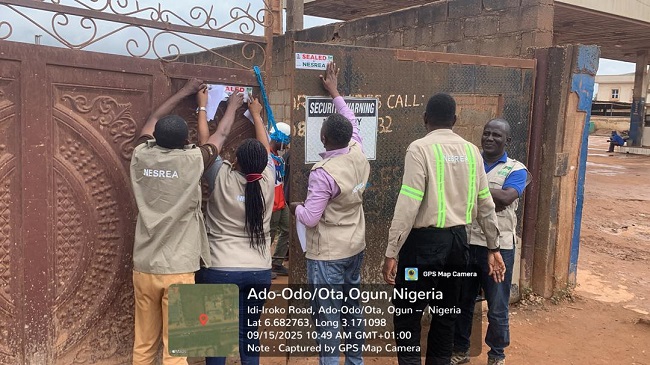
The Director General of the National Environmental Standards and Regulations Enforcement Agency (NESREA), Prof. Innocent Barikor, appears to have made good his promise to residents of Ogijo, a community in Ogun State, as the agency sealed nine recycling facilities for environmental pollution.

The ongoing enforcement exercise in the Southwest Zone of the country has also seen the sealing of 20 other facilities in Ekiti, Osun and Ogun states.

NESREA
NESREA officials sealing a facility

Prof. Barikor said the enforcement exercise is in line with the mandate of the NESREA, which gives the agency the responsibility of prohibiting activities and processes which undermine environmental quality.

He noted that it had become expedient to take drastic action against non-compliant recyclers in Ogijo community in Ogun State as their operations have continued to endanger the environment and lives of the citizens.

“The situation in Ogijo has been of concern due to the harmful activities of battery and scrap metal recyclers. Improper disposal of hazardous slag from battery recycling threatens environmental degradation and public health risks from toxic lead content. Tests have revealed presence of lead in residents, resulting in illnesses and deaths.”

Prof. Barikor stated that the failure of the facilities to adopt best available technology in their operations was in contravention of the National Environmental (Battery Control) Regulations 2024.

“There have been several stakeholders intervention which involved Federal and State Ministries of Environment, NESREA, State Environmental Protection Agencies, non-governmental organisations (NGOs) and development partners in a bid to get the facilities to upgrade their operations to more environmental friendly technology and institute sustainable plan for management of slag and other waste from their processes but a recent tour of the community revealed total disregard for environmental laws of the land, a clear signal that some of these facilities do not have any intention of complying and their continued operation is a big threat to the health of residents and the environment in which they live.”

He stressed that the sealing of the facilities was therefore to protect the lives of vulnerable citizens and put a stop to the operations of the recycling facilities that undermine the law and expose Nigerians to danger.

“These facilities were closed for violating the provisions of the National Environmental (Battery Control) Regulations, 2024. Their offences include lack of Environmental Documents such as Environmental Audit Report (EAR), Environmental Impact Statement, Permits, Lack of Fume treatment plant; indiscriminate discharge of black oil, failure to carry out blood-lead test on staff, no proper slag management, manual battery breaking and washing and non-compliance with the Extended Producer Responsibility (EPR) Programme,” he added.

The facilities sealed in Ogijo, Ogun State, are listed to include:

  1. Vedanta Metal Industries Limited, Ogijo, Ogun State
  2. Metal Manufacturing Nigeria Limited, Ogijo, Ogun State
  3. African Non-Ferrous Limited, Ogijo, Ogun State
  4. True Metals Nigeria Limited, Ogijo, Ogun State
  5. BPL Nigeria Limited, Lagos-Ibadan Expressway
  6. Hanushi Manufacturing Limited, Lagos-Ibadan Expressway
  7. Pristine Elt. Pvt. Limited, Ogijo, Ogun State
  8. Timto Alu Company Limited, Ogijo, Ogun State
  9. Ecomade Industries Limited, Ogijo, Ogun State

Enforcement was also carried out in the construction and quarry sectors where a total of 10 sites were sealed for lack of Environmental Documents contrary to the provisions of the National Environmental (Construction Sector) Regulations, 2011 and the National Environmental (Quarrying and Blasting Operations) 2013 respectively.

The sites include:

  1. Laralek Ultimate Limited (Arc Legacy Project) Ota, Ogun State
  2. Visible Construction Limited, Ota, Ogun State
  3. Strabic Construction Limited, Ota, Ogun State
  4. Areatech Construction Limited, Ota, Ogun State
  5. Medaville Construction Limited, Ota, Ogun State
  6. Adron Home & Properties operational base office (Gbongan Road, Oshogbo) for three project sites viz: (a) Paris Park Gaden.Ikirun Road, Iragbiji: EAR; (b) Bukingham Parks and Garden, Poponla, Ede: EAR; and (c) Miami City, Ilesha Road: EIS.
  7. S & M Nigeria Ltd, Ekiti State EIS
  8. Step Development Ltd, Ekiti State EIS
  9. Hitech Construction Limited Papalanto, Ogun State EIA
  10. Craneburg Construction Company Limited, Ota, Ogun State EIA
  11. SLAVABOGU Nigeria Limited Awo-Iyowe Road, Egbedore LGA, Osun State

In the Domestic and Industrial Plastic sector, five facilities were shut down for operating in flagrant disregard for the National Environmental (Domestic and Industrial Plastic, Rubber and Foam Sector) Regulations 2011. They operated without Environmental documents, lack of fume abatement technology, non-submission of Quarterly Compliance Monitoring Report.

The facilities include:

  1. Polo Good Intl Company Ltd, Lagos Ibadan Express Way, Ogun State
  2. Meibalun International Limited, Lagos Ibadan Express Way, Ogun State
  3. Jomoo International Industrial Limited, Lagos Ibadan Express Way, Ogun State
  4. Zhong Ju Nigeria Limited, Lagos Ibadan Express Way, Ogun State
  5. Vanke Machinery Limited, Lagos Ibadan Express Way, Ogun State

 One facility, GS Agriculture Limited, Osogbo, Osun State, was sealed for violating the National Environmental (Food, Beverages and Tobacco. Sector) Regulations 2009. The facility was faulted for not having the necessary Environmental Documents.

In the Non-Metallic Mineral Manufacturing sector, one facility, West Stone and Marble Processing Company Limited, Ikirun, Osun State, was sealed for non-submission of Environmental Audit Report (EAR).

For refusal to comply with the National Environmental (Motor Vehicle and Miscellaneous Assembly) Regulations 2011, one facility, Icheetah Nigeria Limited, Abeokuta, was shutdown.

Enforcement of the National Environmental (Protection of Endangered Species in International Trade) Regulations, 2011 led to the sealing of one facility, Solomon Kensington Agro Allied, Iperu-Remo in Ogun State. The operators failed to provide relevant environmental documents, install an Effluent Treatment Plant (ETP), and refused to provide the agency with comprehensive list of animal species being kept.

Prof Barikor further stated: “Our duty to Nigerians is a solemn responsibility. We are no longer appealing to any facility to comply with the laws, when you refuse to obey, you face the consequences. We will not hesitate to enforce the law.”

Why COP11 is Africa’s chance to rethink tobacco control

0

In November this year, governments from across the world will gather in Geneva for COP11, the global meeting of the Framework Convention on Tobacco Control (FCTC). For Africa, the stakes could not be higher. Almost every country on the continent has signed onto the treaty, but the reality is that enforcement remains weak.

Laws on smoke-free spaces, taxes, and health warnings exist, but implementation is patchy. Limited resources, lack of political will, and deep-rooted cultural acceptance of tobacco mean millions remain exposed to preventable disease and death.

Tobacco smoking
Tobacco smoking

Tobacco use has decreased significantly since 2000; however, poorer countries are still lagging. That’s why COP11 matters. Africa can’t keep fighting a 21st-century tobacco epidemic with only half-measures. Yes, traditional tactics like high taxes, ad bans, and smoke-free policies are important. But they aren’t enough. The continent needs to add harm reduction to the discussion.

Harm reduction is straightforward: give people who smoke access to safer alternatives so they can move away from the most dangerous form of tobacco use-burning cigarettes. Products like nicotine pouches, regulated e-cigarettes, or medicinal nicotine therapies are not risk-free, but they are far less harmful than smoking. In a region where quitting support is limited and enforcement is thin, these alternatives could be a game-changer.

The debate is often framed as either-or: either we enforce the FCTC perfectly, or we risk undermining it with new products. But that thinking is flawed. Africa doesn’t have the luxury of waiting until institutions are stronger and resources are endless. Harm reduction doesn’t replace traditional measures; it complements them. By regulating safer products carefully, setting standards, keeping them out of the hands of young people, and taxing them differently from cigarettes, governments can cut smoking rates faster, save money on health care, and save lives.

COP11 is the moment for Africa to demand a more realistic, risk-based approach. Instead of being left behind, the continent can lead by showing that tobacco control must be pragmatic, not just aspirational. For African policymakers, the choice is clear: hold on to rigid approaches that have failed to deliver, or embrace harm reduction as a tool to close the gap between good laws on paper and real health progress on the ground.

Without proper regulation, however, Africa is already experiencing a surge in illicit and unregulated products flooding the market, thereby putting consumers at even greater risk.

We cannot wait for perfect enforcement of every FCTC article before taking action. By combining traditional measures with regulated harm reduction, governments can speed up the decrease in smoking, protect young people, and prevent hundreds of thousands of unnecessary deaths.

The world will be watching in Geneva. Africa should speak with one voice: harm reduction is not a threat to tobacco control; it is the missing piece that can help us finally turn the tide.

By Joseph Magero, Chair: Campaign for Safer Alternatives

NDC 3.0: Environmentalists flay Australia’s ‘watered-down’ emissions target

0

Australia on Thursday, September 18, 2025, set its 2035 emissions target at a reduction of 62%-70% from 2005 levels, a lower-than-expected figure that was criticised by green groups.

The United Nations has asked countries to submit their climate plans, called Nationally Determined Contributions, or NDCs, before the end of September so that their efforts can be assessed before the COP30 climate summit in November in Brazil.

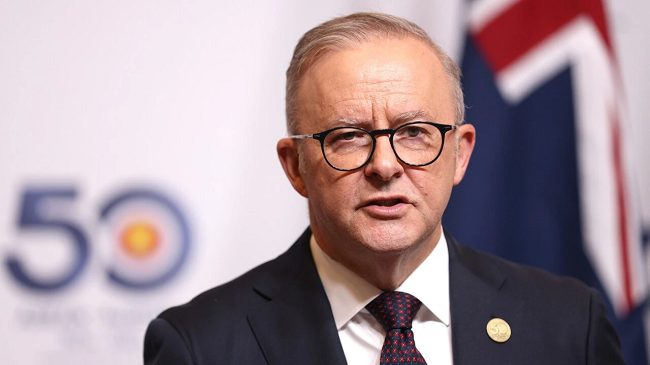
Anthony Albanese
Anthony Albanese, Prime Minister of Australia

Australia is one of the world’s highest polluting countries per capita, largely due to its resources industry that extracts large amounts of coal and natural gas.

The country’s target falls below the range of 65%-75% that was modelled by the Treasury Department and initially suggested by the Climate Change Authority, an independent body that advises the government on climate policy.

Minister for Climate Change and Energy, Chris Bowen, told a news conference on Thursday the lower target was a more realistically reachable level.

“The target must be two things, ambitious and achievable. A target over 70% is not achievable. That advice is clear. We have gone for the maximum level of ambition that is achievable,” he said.

The pledge comes days after the national climate risk assessment warned of “cascading, compounding and concurrent” threats if heating exceeds 1.5°C, and days after the Albanese government approved an extension for the North West Shelf gas project until 2070.

The reduced target drew sharp criticism from environmentalists, who said it lacked ambition and prioritised industry over communities vulnerable to climate change in the region.

“The Albanese government’s new climate plan is an affront to communities across the Pacific and Australia facing the escalating impacts of dangerous climate change,” said Shiva Gounden, head of Pacific at Greenpeace Australia Pacific.

“Today the government has chosen coal and gas profits over the safety of Pacific and Australian communities.”

The target falls “dangerously short of what the science demands,” said Dermot O’Gorman, CEO of WWF-Australia.

Fenton Lutunatabua, 350.org Deputy Head of Regions, says: “Anything less than a 75% cut this decade backed by a plan to phase out coal, oil and gas is not a climate plan, it’s a denial of climate justice. Pacific peoples are already living the losses that come from every fraction of a degree of warming. The supposed ‘sweet spot’ decided by the Albanese government is nowhere near what is needed to secure our survival. Not only that, but it also doesn’t address the enormous burden of Australia’s fossil fuel exports, the consequences of which the children of the Pacific will have to bear.”

Jacynta Fa’amau, 350.org Pacific Campaigner, says: “Australia had the chance to begin its COP31 legacy as a true climate leader and did not deliver. This target is short of what is required to keep communities in Australia and the Pacific safe. We made it clear that drawing the line at 1.5°C would require at least a 75% decrease in emissions by 2035. As a Pacific Islander living in Australia, I’m concerned for both of my homes. The Pacific has long known and lived with the severity of the climate crisis, but Australia’s new risk assessment makes it clear that this country will not be spared the consequences of climate inaction either.”

Shani Tager, 350.org Australia Senior Campaigner, says: “This target is a betrayal of the science of climate change and the communities across our region. Albanese has failed to lead and instead capitulated to the big coal and gas polluters. Today’s announcement puts us all at risk of more extreme heat, worse bushfires and unlivable towns.”

Observers believe that the announcement adds momentum to this weekend’s global Draw the Line mobilisations, where people across the Pacific, Australia and Aotearoa will demand governments draw the line at 1.5°C and stop billionaires and fossil fuel corporations from fuelling inequality and disaster.

COP30 is the next critical checkpoint for the Paris Agreement where governments must arrive with NDCs aligned to a 1.5 °C pathway and ready to agree on a global deal to phase out fossil fuels while scaling up renewable energy and finance for communities already living the climate crisis. Success in Brazil will determine whether the world can still avoid the worst tipping points described in Australia’s own climate risk report, which emphasised that every fraction of a degree of global heating that can be prevented, counts.

As Australia campaigns to co-host COP31 with Pacific nations, its stance at COP30 will be under intense scrutiny. Anything less than bold leadership will undermine both global ambition and Australia’s legitimacy as a UNFCCC host.