The Minister of Power, Mr Adebayo Adelabu, says the Federal Government has taken decisive steps to address persistent gas supply challenges affecting electricity generation.
Adelabu said this on Thursday, March 19, 2026, in his Eid-el-Fitr message made available by Mr Bolaji Tunji, his Special Adviser on Strategic Communication and Media Relations.
He expressed optimism that these interventions were already yielding gradual improvements and would significantly enhance power supply in the near future.
Minister of Power, Chief Adebayo Adelabu
“Concrete measures are being implemented to ensure more reliable and sustainable electricity for homes, businesses, and industries.
”The reforms initiated by President Bola Tinubu are beginning to take root, and Nigerians will soon witness the full benefits,” the minister said.
According to him, sustained public trust and cooperation are critical to the success of the administration’s reform agenda.
He said the president was actively repositioning Nigeria on the global stage to attract investment and foster development.
“As we celebrate, we take pride in the strides being made under Mr President’s leadership, including his recent engagements in the United Kingdom, which promise significant gains in investment, bilateral relations, and economic cooperation.
”These milestones underscore a new direction for our nation. I urge all Nigerians to continue supporting these efforts, so that the gains can be consolidated for the benefit of all,” he said.
Adelabu also urged Nigerians to carry forward the spirit of sacrifice cultivated during the 30 days of Ramadan into sustained commitment to national development.
He said that collective discipline and selflessness remained vital to unlocking the nation’s vast potential.
The minister said that through continued personal and national sacrifice, the transformative agenda of President Tinubu would increasingly translate into tangible progress across key sectors of the economy.
“Let me warmly felicitate with Nigerians, particularly our Muslim brothers and sisters, on this auspicious occasion.
“The past 30 days have been devoted to spiritual renewal, self-denial, and a recommitment to faith and righteousness.
”As we have individually sought purification and growth, we must now extend that same spirit of sacrifice to our nation through unwavering dedication to its progress.
”The challenges we face today are, without doubt, the building blocks of a more prosperous tomorrow,” he said.
Adelabu called for unity, patience, and shared responsibility, noting that enduring national progress could only be achieved through collective sacrifice and steadfast commitment to a common vision.
In the heart of Midtown Manhattan, United for Wildlife and the CITES Secretariat hosted leaders from the finance, technology, and transportation sectors, as well as governments, international organisations, and conservation organisations to celebrate United Nations World Wildlife Day 2026 at Deloitte’s office at 30 Rockefeller Plaza, calling for stronger cross‑sector action to conserve wildlife and combat wildlife crime.
Observed each year on March 3, World Wildlife Day commemorates the signing of the Convention on International Trade in Endangered Species of Wild Fauna and Flora (CITES) in 1973.
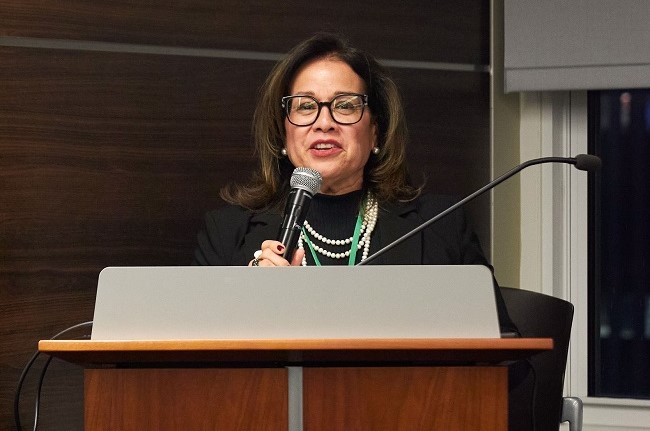
Ivonne Higuero, Secretary-General of CITES
This year’s World Wildlife Day celebration spotlighted Medicinal and Aromatic Plants (MAPs), a group of 50,000 to 70,000 plant species used worldwide for the support of many healthcare systems, millions of local livelihoods and cultural heritage. Ensuring that international trade in MAPs remains sustainable, legal, and traceable is therefore essential for both conservation and human wellbeing.
In keynote remarks, Ms. Ivonne Higuero, Secretary-General of CITES, highlighted the growing global demand for medicinal and aromatic plants and the need for meaningful stakeholder engagement such as supporting sustainable harvesting practices and recognising the knowledge and contributions of the communities who depend on and care for these species.
Ms. Higuero emphasised: “Only through strong partnerships across governments, enforcement authorities, the private sector and conservation organisations can we effectively safeguard the wild plants that support our health, heritage and livelihoods.”
The programme featured a moderated panel discussion titled “Stories of Hope: Working Together to End the Illegal Plant and Wildlife Trade,” which highlighted three case studies on American ginseng, shea and licorice, all considered medicinal and aromatic plants. Panelists from the U.S. Fish and Wildlife Service, the International Fund for Animal Welfare, The Nature Conservancy, the FairWild Foundation and the Wildlife Conservation Society shared perspectives on strengthening enforcement, supporting Indigenous knowledge, promoting sustainable supply chains and advancing collaborative solutions to conserve MAPs and combat wildlife trafficking in general.
Mr. Robert Campbell, Director, United for Wildlife, said: “Events like this are more than just an awareness day, they are opportunities to celebrate wins, highlight best practices, develop and build relationships both transnationally and across sectors, and even share challenges that we can work to resolve together.”
The evening also featured a conservation ballet performance by Vildwerk, highlighting the connections between culture, nature and conservation.
An outreach exhibition showcased the work of organizations including the World Wildlife Fund / HSBC, Conservation X Labs, the International Fund for Animal Welfare, the Wildlife Conservation Society, the Pan African Sanctuary Alliance, the Saiga Conservation Alliance, Vildwerk, Quantifind, the U.S. Fish and Wildlife Service, wildlife artist Nayana Rathmalgoda, and the Jane Goodall Institute.
The event concluded with a networking reception, generously sponsored by Quantifind, reinforcing the importance of partnerships across governments, international organisations, the private sector and civil society to ensure that MAPs – and the communities that depend on them – can continue to thrive.
Kia Corporation and TotalEnergies Lubrifiants have renewed their global partnership for an additional five-year term effective April 1, 2026. The agreement builds on a 15-year collaboration dedicated to delivering high-quality lubricants across Kia’s global network.
Under the renewed partnership, Kia dealerships worldwide will continue to offer Quartz high-performance engine oils. The cooperation also leverages TotalEnergies’ expertise in lubricant technology, marketing support and electric mobility solutions.
“We are truly honoured to extend our longstanding partnership with Kia as we embark on a fourth consecutive global term, continuing to build together a trusted collaboration dedicated to excellence and to creating meaningful value for customers worldwide,” said Elodie Luce, Vice President Automotive Business Unit at TotalEnergies Lubrifiants.
Kia and TotalEnergies in a fourth contract renewal
“This renewed commitment strengthens our ability to accelerate the development of cutting-edge lubricant solutions tailored to the rapidly evolving demands of modern powertrains, including the latest hybrid and electric technologies.”
Dong-Hwan Hwang, Head of Ownership Management Subdivision at Kia Corporation, added, “TotalEnergies has been a valued partner for the past 15 years. The renewed agreement will enable us to explore new opportunities together, further enhancing the ownership experience for Kia drivers and improving service competitiveness in the changing market.”
Beyond lubricants, this new chapter also opens avenues for deeper collaboration in electrification, mobility services, and sustainability – areas that reflect both companies’ shared dedication to cleaner technologies, enhanced performance, and innovation that truly serves customers.
Support for developing countries on climate transparency is entering a new phase, following decisions adopted by Parties at COP30 in Belém and new plans agreed by the Consultative Group of Experts (CGE) in Bonn.
The CGE convened its 8th Informal Forum and 14th meeting earlier this month in Bonn, Germany, reinforcing support for developing country Parties on climate transparency as implementation of the Paris Agreement advances.
The meetings took place following key transparency-related decisions adopted in Belém, where Parties recognised the CGE’s achievements and agreed to make it a permanent body serving both the Convention and the Paris Agreement, while also adopting revised terms of reference and updating the group’s composition.
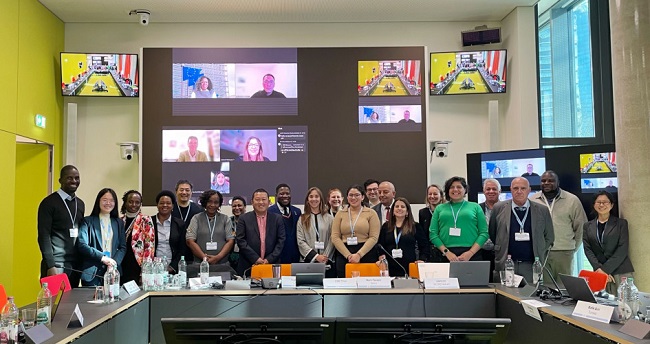
Participants at the 14th Consultative Group of Experts (CGE) meeting on March 3, 2026
Sharing lessons from the first cycle of ETF implementation
The 8th Informal Forum brought together CGE members, national transparency experts and Biennial Transparency Report (BTR) reviewers from Cuba, Finland, Georgia, Ghana, Kazakhstan, Malawi, Panama and South Africa, as well as partner organisations including the IPCC, UNDP, UNEP, CBIT-GSP and ICAT.
A total of 127 participants attended the event to exchange experiences and lessons learned from participating in the Enhanced Transparency Framework (ETF). Discussions focused in particular on experiences with the technical expert review (TER) of BTRs and the facilitative multilateral consideration of progress (FMCP).
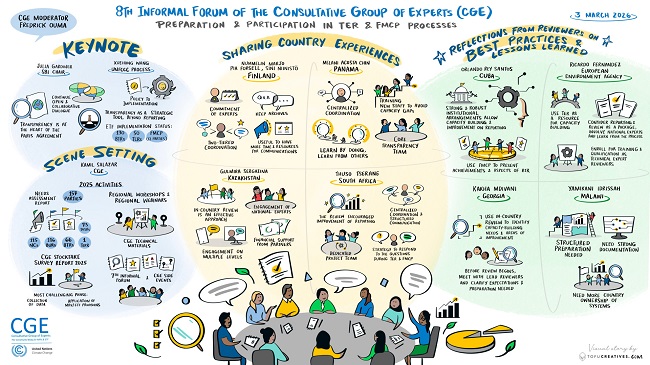
Participants actively shared questions, challenges and practical insights drawn from their own involvement in the processes. Key highlights from these exchanges are illustrated in the visual summary below.
CGE visual summary. Photo credit: UN Climate Change
In her keynote remarks, Julia Gardiner, Chair of the Subsidiary Body for Implementation (SBI), emphasised that transparency lies at the heart of the Paris Agreement and that BTRs play a crucial role in tracking progress and informing processes such as the Global Stocktake.
Xuehong Wang, Director of Transparency at UN Climate Change, noted that developing countries are now moving into full ETF implementation through BTR preparation and participation in the TER and FMCP processes. She reaffirmed the secretariat’s commitment to continue supporting the CGE and developing country Parties in strengthening their national transparency systems.
Setting the direction for the CGE’s work
Following the Informal Forum, the CGE held its 14th meeting from March 3 to 5, 2026. Members considered outcomes from Belém, findings from the group’s annual capacity-building needs assessment, and feedback collected through CGE activities in 2025 to help shape the next phase of its work.
The 2026-2029 work programme reflects the evolving support needs of developing countries as they move into full implementation of the ETF. The CGE will continue to promote, support and enable transparency arrangements in developing countries while helping improve reporting over time.
The group will also continue to assess gaps, needs, lessons learned and areas for improvement, with the aim of providing targeted technical advice and support to developing countries. Collaboration with key partners and stakeholders will remain central to strengthening and scaling up this support.
The 2026 workplan outlines a range of activities for the year ahead, including the development of technical materials, regional hands-on training workshops and webinars tailored to regional priorities, as well as continued collaboration with partner organizations.
Through the outcomes of the Informal Forum and its 14th meeting, the CGE reaffirmed its central role in supporting developing countries to implement transparency arrangements under the Convention and the Paris Agreement, helping strengthen trust and collective climate action.
The Climate Action Network (CAN), a global network of over 1,900 civil society organisations (CSOs) in over 130 countries working to combat climate change and promote climate justice, has condemned the U.S. and Israeli military attacks on Iran, while calling for an immediate and permanent ceasefire.
The group described the attacks as “an illegal act of aggression that violates international law, Iran’s sovereignty, the fundamental human rights protections it is meant to uphold and risks dragging an already devastated region into a wider war”.
CAN lamented that the normalisation of civilian death in the Gaza genocide is now spilling out across the region, adding that the bombing of a girls’ school in Minab, killing more than 160 civilians, “is a crime that should shock the conscience of the world”.
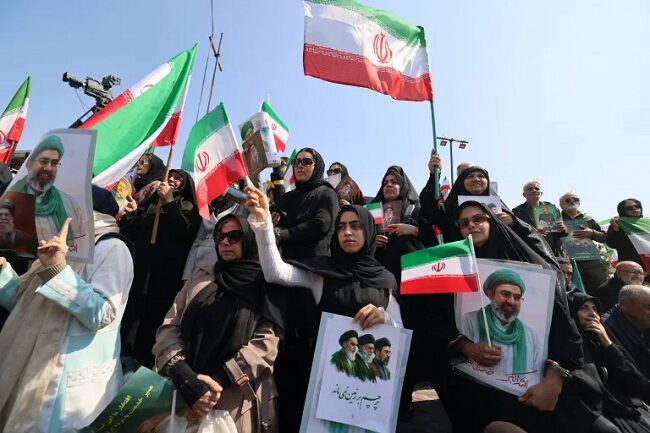
A string of strikes has decimated Iran’s leadership since the war began nearly three weeks ago. Photo credit: Atta Kenare
It maintained that civilian infrastructure – schools, hospitals, homes and cultural sites – must never be targeted in war.
CAN added: “The attacks on Iran’s oil storage facilities have unleashed massive health and environmental harm. Burning fuel depots poison air, land, water and lungs that will linger in the atmosphere long after the bombing stops. This meets the criteria for Ecocide. Corporations, financial institutions and the arms industry form part of the same fossil-fuelled war economy that profits from destruction while also accelerating climate breakdown.
“Across the Global South – from Asia and Africa to the Caribbean – are also paying the price of this expansion of violence and are vulnerable to unilateral attacks on their sovereignty by Imperialist interests. Escalating wars over resources, territory and power deepen global inequality and existing hardships.
“Israel’s ongoing attacks on Lebanon are another alarming sign of the widening conflict across the region. Strikes have continued despite ceasefire agreements, displacing civilians in southern Lebanon and illustrating how the conflict is spreading. The use of white phosphorus and other weapons harming civilians and the environment underscores the devastating human and ecological costs of this escalation.
“Climate justice cannot exist in a world where war and impunity are allowed to expand unchecked.
“We will not remain silent in the face of this aggression. We demand that the U.S. and Israeli governments be held accountable for these unlawful attacks, for the war crimes committed against civilians, and for violating the international legal order that prohibits unilateral attacks on sovereign states.
“Governments must act now to prevent the expansion of this conflict and the further loss of life – including refusing to participate in the aggression, imposing an immediate arms embargo on the aggressors and those enabling the war economy, and ensuring that those responsible are held to account under international law.
“Climate Action Network stands in solidarity with people in Iran, Palestine, Lebanon and across the region – and with all those around the world defending peace, human rights, democratic freedoms and dignity, and demanding an end to occupation, aggression and impunity.
“The same system that fuels these wars is the one driving the climate crisis. Ending one requires confronting the other.
“An immediate and permanent ceasefire is the only path forward.
“Diplomacy must replace war and international law must prevail – because climate justice cannot be built in a world at war.”
Oil and gas prices soared on Thursday, March 19, 2026, after Iran hit the world’s largest liquefied natural gas (LNG) facility in Qatar and threatened to destroy the region’s energy infrastructure, while Donald Trump warned of a furious US response if such attacks continued.
International benchmark Brent surged 10 percent before falling back while European gas rose 35 percent after Iran attacked Qatar’s huge Ras Laffan LNG facility in retaliation for an Israeli strike on its South Pars gas field.
Trump, whose country started the war alongside Israel with their attack on Iran on February 28, said Washington did not know about the strike on South Pars.
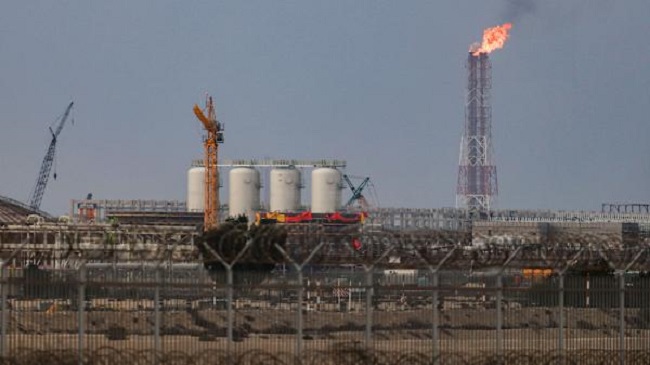
A Qatari LNG facility
But he warned the United States would itself “blow up” the Iranian gas field if Tehran did not stop attacking Qatar.
Iran’s military responded on Thursday with defiance, saying it had been a “major mistake” to hit South Pars, which supplies around 70 percent of the country’s domestic natural gas.
“If it is repeated, subsequent attacks against your energy infrastructure and that of your allies will not stop until their complete destruction,” operational command Khatam Al-Anbiya said in a statement carried by Fars news agency.
Lasting impact
Qatar is one of the world’s top LNG producers, alongside the United States, Australia and Russia, and its Ras Laffan facility is the world’s largest LNG hub.
It has been repeatedly targeted by Iran since the war began. State-run QatarEnergy said on Thursday that two waves of Iranian strikes had caused “sizeable fires and extensive further damage” to several LNG facilities.
French President, Emmanuel Macron, condemned Thursday the “reckless escalation”.
He warned that if Middle Eastern energy “production capacities themselves are destroyed, this war will have a much more lasting impact”.
He called for “direct talks between the Americans and Iranians on this matter”.
UK Prime Minister Keir Starmer’s office also warned that “attacks on critical infrastructure risked pushing the region further into crisis”, after talks with Macron and NATO chief Mark Rutte.
Gulf nations had also warned of the fall-out from Israel’s attack on Iran’s South Pars gas field, which is part of the South Pars/North Dome megafield, the largest known gas reserve in the world that is shared with Qatar.
The United Arab Emirates said that targeting energy infrastructure poses a “direct threat to global energy security”.
Meanwhile Saudi Arabia said Thursday it reserved the “right to take military actions” if necessary after repeated missile and drone attacks on its energy facilities from Iran.
Energy prices had already spiralled since tanker traffic through the Strait of Hormuz, which normally carries a fifth of the world’s oil and LNG, was brought to a near standstill by the threat of Iranian attacks.
Since the war began, fuel shortages have sparked long queues at petrol stations across Asia, where many economies are heavily dependent on fossil fuel imports, while Sri Lanka and Philippines have shifted to a four-day week.
It is also hitting businesses. “I am currently spending more than 33 percent more on fuel than I used to,” said Adeola Sanni, a 36-year-old Nigerian entrepreneur making corporate uniforms in Lagos.
Despite decades of progress, inequalities continue to compromise global water security, disproportionally impacting women and girls, who despite of being the main collectors of water, continue to be excluded from water management and leadership roles.
This is the conclusion of the United Nations World Water Development Report, published by UNESCO on behalf of UN-Water. The report reveals that women are responsible for collecting water in over 70% of unserved rural households.
“Ensuring women’s participation in water management and governance is a key driver for progress and sustainable development. We must step up efforts to safeguard women and girls’ access to water. This is not only a basic right, when women have equal access to water, everyone benefits,” said Khaled El-Enany, UNESCO’s Director General.
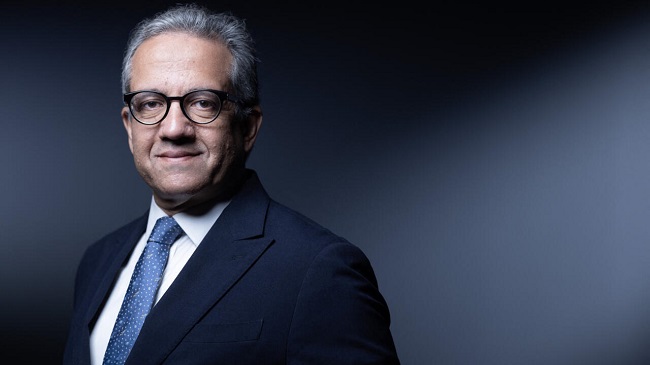
Khaled El-Enany, UNESCO Director-General
“It is time to fully recognise the central role of women and girls in water solutions – as users, leaders and professionals. We need women and men to manage water side by side as a common good that benefits the whole of society,” said Alvaro Lario, President of the International Fund for Agricultural Development (IFAD), and Chair of UN-Water.
The United Nations World Water Development Report is released annually in the context of World Water Day. This year’s report, Water for All People: Equal Rights and Opportunities, warns that 2.1 billion people still lack safely managed drinking water, with women and girls bearing the heaviest burden.
Women and girls are most often responsible for collecting and managing water for their households, exposing them to physical strain, lost education and livelihoods, health risks, and heightened vulnerability to gender-based violence – particularly where services are unsafe or unreliable.
Key findings
Globally, women and girls spend a total of 250 million hours every day collecting water, time that could otherwise be spent on education, leisure, or income-generating activities. Girls under 15 (7%) are more likely than boys under 15 (4%) to fetch water.
Poor sanitation facilities disproportionately affect women and girls, especially in urban slums and rural areas. Lack of toilets and water for menstrual hygiene leads to shame and absenteeism: an estimated 10 million adolescent girls (15–19), across 41 countries, missed school, work, or social activities between 2016 and 2022.
Despite their central role in household water provision, agriculture, ecosystem stewardship, and community resilience, women remain systematically underrepresented in water governance, financing, utilities, and decision-making.
Despite numerous gender equality declarations and policies, progress towards equal access to water and sanitation, and women’s participation in water management, remain insufficient due to weak integration into operational plans.
Gender inequalities in land and property ownership directly impact women’s access to water. Water rights are often linked to land rights, directly impacting the availability of water for productive uses such as farming. Land tenure-related laws and regulations that discriminate against women leave them at social and economic disadvantages. In some countries, men have ownership over twice the amount of land than women.
Women remain under-represented in water management and governance, available data from 64 utilities in 28 low- and middle-income countries indicated that fewer than one in five water workers were women, and they were paid less than their male counterparts (World Bank, 2019). In 2021/2022, women held fewer than half of WASH positions in government jobs in 79 of 109 responding countries and fewer than 10% in almost a quarter of responding countries (WHO,2022).
Gender inequality in times of crisis
Climate change, water scarcity and hydro-meteorological disasters are exacerbating existing gender inequalities, particularly in water-stressed and disaster-prone contexts. Gender remains a key determinant of vulnerability, shaping exposure to risk as well as access to early-warning systems, recovery support and long-term livelihood security. Evidence shows that climate change disproportionately affects women: a 1°C rise in temperature reduces incomes in female-headed households by 34% more than in male-headed households, while women’s weekly labour hours increase by an average of 55 minutes relative to men.
A call to bridge the gender gaps in water access and leadership
The report provides concrete recommendations to drive meaningful progress, including:
Removing legal, institutional and financial barriers to women’s equal rights to water, land and services
Scaling up gender‑responsive financing and budgeting, with strong accountability mechanisms
Investing in sex‑disaggregated water data to expose inequalities and guide policy
Valuing unpaid water‑related labour in planning, pricing and investment decisions
Strengthening women’s leadership and technical capacity, particularly in scientific and technical fields of water governance
Moving beyond “low‑cost” solutions that rely on unpaid labour and exacerbate inequality.
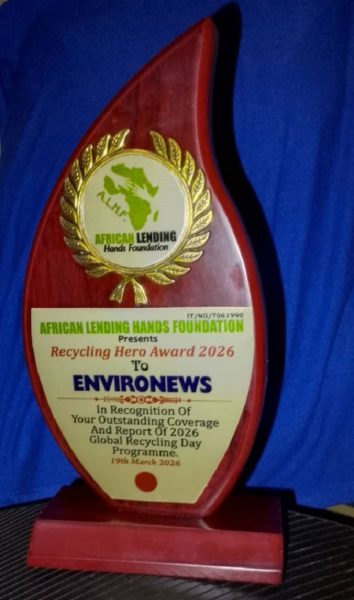
Environmental journalism took the spotlight at the 2026 Global Recycling Day celebration as EnviroNews Nigeria was awarded the prestigious Recycling Hero Award 2026 in recognition of its outstanding coverage and advocacy for sustainability.
The award, presented during a high-level event organised by the African Lending Hands Foundation, underscored the growing importance of media in shaping environmental consciousness and driving grassroots action.
The honour placed EnviroNews among key stakeholders championing the “waste-to-wealth” movement, highlighting its consistent reporting on recycling, climate change, and sustainable development.
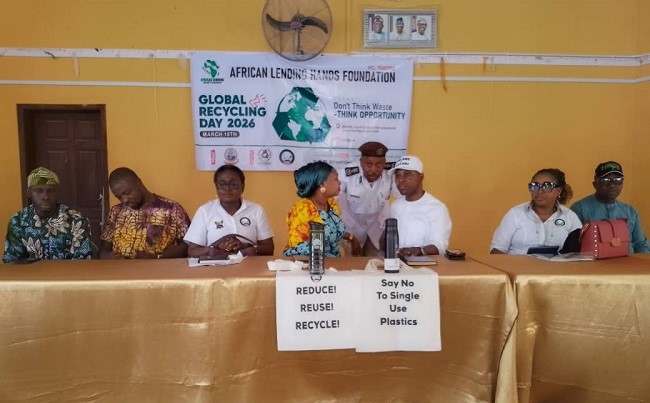
Dignitaries at the 2026 Global Recycling Day celebration in Lagos
Presenting the award, organisers noted that the platform has played a critical role in amplifying environmental issues, educating the public, and holding institutions accountable.
“Media is a powerful tool in changing behaviour. EnviroNews has demonstrated that storytelling can inspire action and influence policy,” a representative said during the ceremony.
The event brought together government officials, environmental experts, educators, and students, all united under the theme “Think Waste – Think Opportunity.” While the programme focused heavily on youth engagement, the recognition of EnviroNews signaled a broader strategy – leveraging media to sustain momentum beyond physical events.
Founder of the African Lending Hands Foundation, Ayodele Phillip Afolabi, emphasised that awareness is the first step toward meaningful environmental change.
EnviroNews Nigeria was awarded the prestigious Recycling Hero Award 2026
“Without information, there can be no transformation. Platforms like EnviroNews are helping to bridge that gap,” he said.
In a rapidly urbanising city like Lagos, where waste generation continues to rise, public awareness remains a major challenge. Stakeholders at the event stressed that accurate, consistent reporting is essential in educating citizens on responsible waste management.
The Lagos State Environmental Protection Agency (LASEPA) also commended media organisations for supporting government efforts through public sensitisation campaigns.
Environmental experts noted that coverage by platforms like EnviroNews has helped:
Promote recycling culture among residents
Highlight the dangers of plastic pollution
Encourage participation in waste-to-wealth initiatives
Support policy awareness and compliance
EnviroNews was not alone in receiving honours. Other awardees included the Lagos State Environmental Protection Agency (LASEPA), as well as key environmental officials such as Mr. Jeremiah Ogunbare and Mr. Kazeem Bolaji Adeniyi of the Oriade LCDA.
However, the recognition of a media platform stood out as a clear indication that environmental sustainability is no longer confined to policymakers and activists – it is now a communication-driven movement.
For EnviroNews, the recognition marks both an achievement and a call to action. As environmental challenges intensify, the role of journalism in shaping public behaviour is expected to grow even more critical.
Stakeholders urged the platform and other media outlets to continue driving conversations around sustainability, especially among young people.
The award reflects a broader shift in how environmental progress is measured – not just by policies or projects, but by awareness, engagement, and public participation.
As Lagos continues to confront waste management challenges, the role of the media in informing and influencing citizens may prove just as vital as infrastructure and legislation.
For EnviroNews, the Recycling Hero Award is more than recognition – it is a reminder that telling the right stories can help change the future of the environment.
The Office of the Special Adviser to the Governor on Climate Change and Circular Economy (OCCE), Lagos State, will convene industry leaders, sustainability professionals, and private sector stakeholders at EcoNexus 3.0, a high-level engagement focused on unlocking the financial value of climate and circular economy actions within industry.
The event, themed “Beyond Compliance: Monetising Climate and Circular Actions for Industries,” will take place on Tuesday, March 24, 2026, on Victoria Island, Lagos.
EcoNexus 3.0 builds on the successes of previous editions of the platform, which have brought together industry actors and sustainability leaders to explore practical approaches to climate accountability and circular economy opportunities within the private sector.
Mrs. Titilayo Oshodi, Special Adviser to the Governor on Climate Change & Circular Economy (OCCE)
According to Titilayo Oshodi, Special Adviser to the Governor of Lagos on Climate Change and Circular Economy, this year’s edition introduces a new dimension to the conversation by spotlighting an area that many organisations have historically overlooked. The ability to translate sustainability and climate actions into measurable economic and financial value is the next frontier that will scale action and responsibilities.
While many companies are already implementing initiatives such as energy efficiency improvements, waste reduction, recycling systems, and responsible sourcing practices, the financial implications and opportunities embedded within these actions often remain untapped.
“Through EcoNexus 3.0, we are introducing a new approach to help industries move beyond regulatory compliance and begin to recognise, structure, and monetise the sustainability and circular economy initiatives they are already implementing.
“During the session, we will also be showcasing innovative tools and solutions that can enable organisations to measure, manage, and optimise their climate and circularity performance. We will be introducing DecarbonIQ, a platform that supports organisations in understanding and managing their carbon emissions and circularity footprint as part of OCCE’s broader effort to equip industry with practical sustainability solutions,” Oshodi explained.
EcoNexus 3.0 programme will also include a dedicated session exploring business and economic opportunities for women within the sustainability and circular economy sectors, aligning with the broader global conversations around International Women’s Day and recognising the growing role of women professionals in shaping sustainability and ESG leadership across industries.
EcoNexus represents an important step in strengthening collaboration between government and industry as Lagos continues to position itself as a leader in climate action and circular economy innovation in Africa.
The event is expected to bring together senior private sector leaders, sustainability practitioners, and policy stakeholders to explore practical pathways for integrating profitability with climate responsibility.
According to the organisers, participation in the event is strictly by invitation.
Food occupies a central place in our culture. It plays a key role in religious/social activities and is a major marker of the passage of times and seasons. It is a celebration. Food unites people and families and marks one’s acceptance in a home, family, or community. Food is not just an object thrown into the stomach to quench hunger.
Not surprisingly, food varieties mark the peculiarity of ethnic nations and cultures. A tour of food varieties in a nation tells tales of the diversity of peoples in such nations.
Over time and due to cross boundary interactions, certain foods have been adopted across nations. In Nigeria one can find restaurants serving amala, ofe nsala, banga, afang soup and edikangikong virtually anywhere you go to.
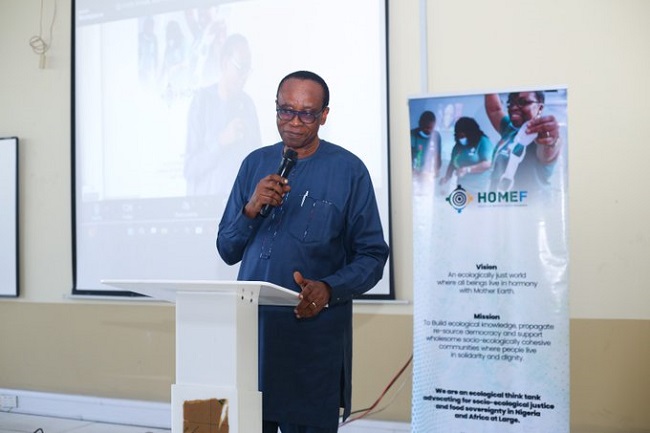
Nnimmo Bassey
Internationally you are likely to find Chinese or Indian curry in most countries. And the idea of an English breakfast is taken for granted. The spread of food and the adoption of some have been spurred by commerce, colonialism and other factors.
Food and humanitarian aid were weaponised during the Biafra-Nigerian war and deeply impacted the diet and wellbeing of the people in the then Eastern Nigeria. I recall seeing that after the war, families ate less nutritious foods and those who were lucky ate more of eba made from cassava, the poor man’s crop. That was clearly attributable to displacement, blockages, destruction of livelihoods and other causes of poverty occasioned by the fratricidal war. Distended bellies were not signs of overeating, but often of kwashiokor.
Knowing that food is the anchor on which our culture is built, we must remind ourselves that for our people agriculture is a way of life, not just a business. Any policy or law that prohibits seed sharing is basically aimed at disrupting solidarity in our communities and replacing our communal power structures with ones built on exploitation, profiteering, poverty and hunger.
Food travels. Tastes are cultivated. Taste buds adjust to what is fashionable. This has birthed the fast or junk food and the related junk culture. Fast foods caught on quickly because humans have become addicted to instant gratification. We want freshly made food but cannot wait for it for 30 minutes at the restaurant. So we all make a quick dash for the “food is ready” shop. To ensure the food is attractive the fast food outlets are brightly coloured, brightly lit and totally surrounded by music so loud your wrist watch warns that staying there for extended periods will lead to permanent hearing impairment.
To keep you from pondering the food set before you, there are big screens in every direction offering you soccer, wrestling, music, violent news and war movies. Distracted and deafened we gulp the foods, enjoy the colours and sounds and go away with a load of heavy metals, colourings and other loads in our guts.
When top politicians make a show of eating junk foods, and gulp litres of sugary beverages, they send a powerful but wrong message that obviously deviant junk culture is hip.
Our worries do not end with fast foods. We are equally assailed by the rush of Frankenstein foods produced through genetic engineering. Many of such products are imported without queries into Nigeria. Some of the genetically modified (GM) crops are already in our farms, markets and dining tables.
Those approving them swear they are safe for human consumption. We are served doses of insecticide as the GMOs are fabricated to kill certain pests. If junk foods birth junk culture, certainly genetically modified foods will produce transgenic cultures.
The biggest factor pushing these food cultures around the world is geopolitical in nature. Hegemonic control of cultural products go beyond movies and sink their claws into our food systems. Poverty, wars, debt, cultural manipulations open the way for food colonialism to take root. It is a power play arena and requires conscious efforts to halt, overcome and reverse.
Decolonising our food systems requires that we liberate our tongues and taste buds. It requires that we recover lost varieties. It requires that we reject GMOs. It requires that we preserve and share indigenous seeds and celebrate our foods. It requires that we expose the underlying market forces driving and influencing food system governance solely to their benefit and to the detriment of small holder farmers who feed the world and the attendant environmental and socio-cultural impacts.
We must critically examine the root causes or main drivers of hunger in Nigeria/Africa and resist its weaponisation to entrench a culture that does little or nothing to improve food systems but instead maximise profit for a handful of enterprises.
Who benefits from Hunger? Is hunger solely a question of productivity? Does hunger persist because farmers are not producing enough, even though in climes like Nigeria almost half of food produced goes to waste? How do global market relations and policies affect the rights of local food producers or their power to compete? These are pertinent questions that require deliberate attention and responses if our governments are serious about addressing hunger or food insecurity.
This session of our Sustain-Ability Academy brings to fore these questions amongst others and recommends critical recalibration of our food systems to ensure fairness and justice, resilience and sustain-ability.
Bassey made these remarks at the Sustain-Ability Academy on Food, Power and the Politics of Hunger hosted by Health of Mother Earth Foundation and the Centre of Politics, University of Port Harcourt, on Thursday, March 19, 2026