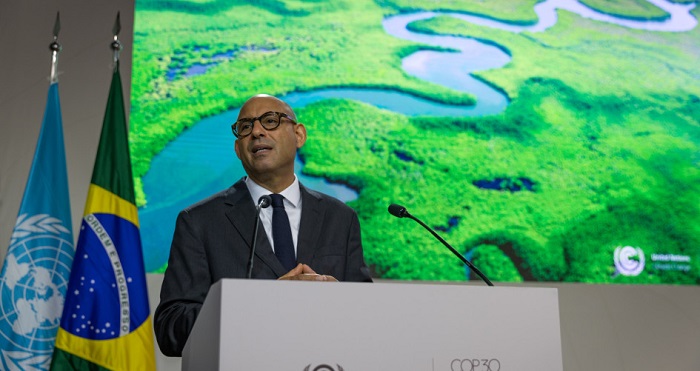
At COP30 on Tuesday, November 11, 2025, Ethiopia was confirmed as the host country for the 32nd session of the Conference of the Parties (COP32) to the United Nations Framework Convention on Climate Change (UNFCCC).
The long-confirmed “Africa COP” has seen Ethiopia and Nigeria vying for hosting rights, with Ethiopian Prime Minister Abhi Ahmed dubbing Addis Ababa “a global city in climate ambition” during September’s Africa Climate Summit. Ethiopia defeated Nigeria in a closely contested bid.
Observers have welcomed the announcement of Ethiopia as COP32 host and celebrate the opportunity for Africa to take centre stage in advancing climate justice and solutions.
Abhi Ahmed, Prime Minister of Ethiopia
Rukiya Khamis, Africa Senior Organiser at 350.org, says: “We welcome the announcement of COP32 in Ethiopia and look forward to the opportunity to elevate Africa’s climate priorities, solutions and leadership. The world cannot afford to treat climate diplomacy as a political bargaining chip. We call on all parties to resolve the COP31 stalemate to avoid undermining momentum at a pivotal moment for climate action. The Pacific has spoken clearly in support of a COP hosted between Australia and the Pacific, as a matter of respect, dignity and recognition of the frontline realities Pacific communities face.”
The news comes as the decision on COP31 remains at a stalemate. Australia’s bid to co-host COP31 with Pacific nations has been complicated by Turkiye’s continued bid for hosting rights. Pacific nations are supportive of an Australia-Pacific COP31, and in the case of an Australia-Turkiye co-presidency remain adamant that the Albanese government be held accountable for Australia’s position as one of the world’s major fossil fuel exporters and center Pacific demands for climate action in negotiations.
If neither Australia nor Turkiye withdraws, Germany will be forced to host the talks as per the treaty agreement.
Fenton Lutunatabua, 350.org Deputy Head of Regions, says: “We are pleased that Ethiopia has been confirmed as COP32 host, but we need an urgent decision on whether Australia will win its bid to host COP31 with Pacific nations and maintain that an Australia-Pacific COP is necessary to build on the legacy of Pacific climate leadership.
“With COP30 in the Amazon rainforest, it is vital that the world now turns its attention to the oceans, our planet’s other great climate frontier. Our oceans are warming rapidly, with devastating consequences. Sea levels in the Pacific Islands are rising at a rate that is near or twice the global average. As Pacific islanders, we have been instrumental in keeping the Paris Agreement’s 1.5°C goal alive, driving the creation of the Loss and Damage Fund through COP negotiations, and achieving the historic International Court of Justice ruling earlier this year.
“Hosting rights should not be used as political bargaining tools or trophies: these are the largest climate negotiations in the world, and we must remember what their purpose is: to address the most urgent crisis of our time, one that impacts people’s lives and futures. “
As the world gathers in Belém, Brazil, for the 30th United Nations Climate Change Conference (COP30), millions of people from frontline communities are watching with a single question: Will our voices finally be heard?
For the people of Nigeria’s Niger Delta, climate change is not a policy debate – it’s a daily struggle. Sea-level rise swallows ancestral farmlands. Oil spills destroy rivers that once sustained livelihoods. Gas flaring burns endlessly above our homes. Yet, the same communities that suffer the most from extraction and pollution are excluded from the global negotiations that decide their future.
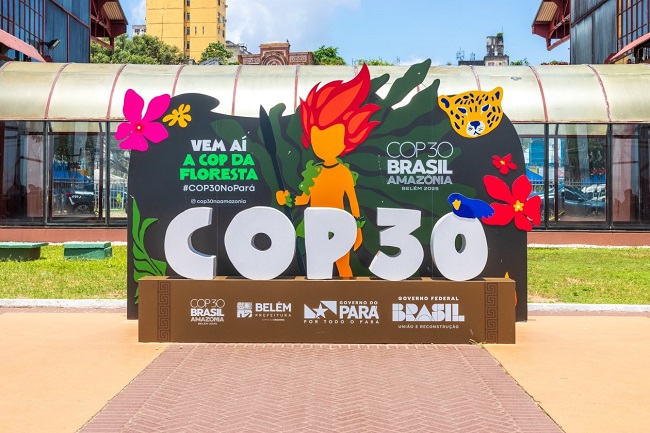
COP30
At Connected Advocacy, we stand at COP30 to say: Enough is enough. The climate crisis is global, but its impacts are local – and solutions must be local too. The world cannot win this fight without the people who are living it.
Our Five Demands for COP30
Climate Finance That Reaches the Ground Climate finance remains trapped in bureaucratic systems that rarely benefit local actors. We call for direct access to climate-blended finance for civil society, community networks, and youth-led initiatives. Funding must empower those implementing real solutions, not just those managing paperwork.
Local Design, Global Impact True climate action begins in communities. Governments and donors must support local climate design and innovation – enabling indigenous, youth, and women-led groups to deliver renewable energy, climate education, and ecosystem restoration tailored to their needs.
Green Skills for a Just Transition The energy transition must lift people, not leave them behind. COP30 must prioritize green skills development, especially for young people and women in Africa, ensuring that new jobs in clean energy, climate adaptation, and digital innovation are accessible to all.
Environmental Justice and Accountability For decades, the Niger Delta has been the ground zero of environmental injustice. Polluters must pay. Communities must heal. COP30 must ensure that Loss and Damage funds are operationalized with justice at their core – compensating those most affected by fossil extraction and climate impacts.
Meaningful Participation, Not Tokenism Indigenous and grassroots voices deserve seats at the decision-making table. We call for inclusive national delegations and mechanisms that make participation real – not symbolic. Nothing about us, without us.
Why Belém Matters
Belém, at the heart of the Amazon, symbolises both the beauty and vulnerability of our planet. It is a powerful reminder that the global climate crisis is interconnected – from the rainforests of the Amazon to the mangroves of the Niger Delta.
The choices made here will determine whether the transition to renewable energy becomes a story of justice or exclusion, of shared prosperity or deepening inequality.
Our Call to Action
We urge COP30 negotiators, global leaders, and climate financiers to:
Invest in grassroots innovation that combines local knowledge with sustainable technology;
Support youth and women with green skills and leadership opportunities;
Hold polluters accountable through enforceable Loss and Damage mechanisms; and
Empower local voices as co-creators in the global climate process.
The people of the Niger Delta – and countless communities like ours – have waited too long to be seen and heard. The time for promises has passed. The time for climate justice and shared power is now.
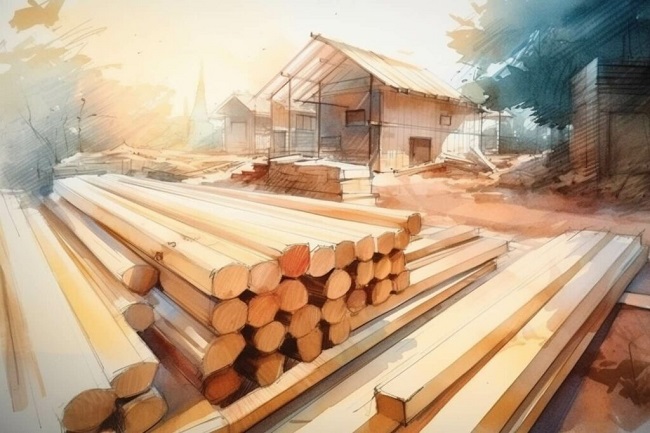
At COP30, 11 governments joined over 300 companies and civil society groups in endorsing the Principles for Responsible Timber Construction (Principles), a science-based framework to guide the responsible use of timber from forest to building. This endorsement, it was gathered, marks a significant step in aligning global efforts to transform the global construction industry in ways that benefit climate, nature and people.
The Principles were developed through a collaborative process co-led by the Forest & Climate Leaders’ Partnership, Built by Nature and Bauhaus Earth, along with a wide coalition of experts, governments and industry leaders. This brought together a wide array of stakeholders from around the world for extensive collaboration on making the Principles a reality on the road to COP30.
Sustainable construction
According to the promoters, the endorsement represents the first time such a diverse global group – from forest managers and certification bodies to developers, architects, engineers, investors and national governments – has aligned behind one common approach to scaling timber in construction.
Vice Minister Carlos Isaac Pérez, Ministry of Environment and Energy, Costa Rica, stated: “Costa Rica not only adheres to these Principles but also actively promotes them internationally, encouraging adoption by other producer countries committed to transparency, traceability and deforestation-free wood products.”
Welcoming the launch and representing Canada’s co-leadership of the FCLP Greening Construction with Sustainable Wood initiative, Emmanuel Kamarianakis, Ambassador of Canada to Brazil, said: “This best practice approach can transform the market for responsible timber construction, providing a win-win for the climate and global goals to halt deforestation. These Principles and the guidance that accompanies them are a testament to the tremendous collaboration between stakeholders across all sectors with a determination to turn an aspiration into a reality. Together, the five principles provide a common language and approach that can be used to inform the development of public policy, regulation and industry practices.”
Andrew Waugh, Co-Founder of Waugh Thistleton Architects added: “These principles reflect everything we’ve been advocating for: low-carbon, high-performance buildings that are beautiful, healthy, and financially viable. Timber allows us to build at scale without compromising the planet. The Principles give the industry a clear framework to move from innovation to mainstream adoption, which is exactly what the future demands.”
Paul King, CEO of not-for-profit Built by Nature stated: “These Principles were developed to build trust and confidence across the value chain—but we know they’re already being applied. This year’s Built by Nature Prize attracted nearly 400 entries from almost 40 countries, showcasing completed timber buildings that bring the Principles to life. That global response proves they’re not just aspirational – they’re achievable. All five Principles are ambitious yet realistic. To drive the transition, we need in the built environment, we must apply them everywhere, all the time.”
Demand for new buildings is expected to double by 2050, especially in the Global South. At the same time, the construction sector already accounts for nearly 40 per cent of global greenhouse gas emissions, with the production of building materials like concrete and steel making up at least a quarter of those emissions. The Principles set out how timber can safely replace more carbon intensive materials, store carbon in buildings for decades, and create economic value for forest communities, but only if demand is matched by sustainable forest management.
The framework draws on IPCC science and builds on the FCLP “Greening Construction with Sustainable Wood” initiative launched at COP28 in Dubai, which was backed by 17 governments. Today’s endorsements show that this work has matured into an actionable, globally accepted model for the construction sector. Additional governments, companies, and non-governmental actors are expected to continue to back the Principles throughout COP30 and beyond.
Climate campaigners at COP30 on Monday, November 10, 2025, confronted Big Agriculture lobbyists in a protest at the “AgriZone”, a new zone near the COP venue dedicated to agribusiness interests and sponsored by corporate giants Nestlé and Bayer.
The AgriZone is the latest development in the growing trend of COP–the world’s only multilateral decision-making forum on climate change–being co-opted by big polluters and business interests. In recent years, the influence of industry lobbyists over the climate convention has grown, with more than 5,000 fossil fuel lobbyists given access since COP26.
Climate activists at AgriZone
Despite the COP Presidency including land restoration and sustainable agriculture in its Action Agenda, the Brazilian government made the unprecedented move to capitulate to industrial agriculture, which is a main driver of deforestation in the Amazon and produces a third of global greenhouse gas emissions. The campaigners, as part of the Global Campaign to Demand Climate Justice, condemned the move, emphasising the danger of allowing Big Agriculture to influence world leaders and climate negotiators.
Elodie Guillon, World Animal Protection, said: “It is deeply concerning to see a third zone popping up at COP30 dedicated entirely to agribusiness interests. Industrial animal agriculture is not only a leading cause of emissions, but a major driver of deforestation and farmed and wild animal suffering.
“Giving agribusiness a major seat at the table at this COP will drown out the voices most affected by climate change. ‘Big ag’ are not climate champions, they are fuelled by greed as they harm animals, people and the planet.”
Prayash Adhikari, Asian Peoples’ Movement on Debt and Development and Digo Bikas Institute: “Asian movements are here to fight back against the co-optation of COP and other multilateral processes. Asia is the biggest hunger hotspot in the world, representing 55% of the world’s hungry, and incurring trillions of dollars in climate-related losses per year. Asian peasants, fishers, and women are forced to feed the world, while they are left starving.
“That is why we cannot let this greenwashing from Bayer, Nestlé, JBS, and their allies in government go unchallenged. We know industrial agriculture has contributed greatly to the food and climate crises, and we cannot let Big Ag get away with it. Food, land, and water are for people, not profit! Food is a right, not mere commodities for Big Ag’s profits.”
Andrea Echeverri, Global Forest Coalition: “The AgriZone is nothing more than a huge greenwashing space. While social organisations and other mortals usually compete to be heard in spaces in the Blue Zone and the Green Zone, agribusinesses have a huge space dedicated to dazzling negotiators and convincing them that they are not major polluters but rather the saviours of the planet.
“The globalised agri-food system focused on livestock does not fulfill its purpose of feeding the world because it is designed to produce money, not food.
“Inside the AgriZone, large companies, think tanks, and supposedly independent research centres are disguising their model with their ‘climate-smart’ models, their smart seeds, their digitisation, and their metrics, while they are producing a food and agricultural crisis and a countryside without peasants, and without memory and diversity.”
Sebastian Ordoñez Muñoz, War on Want: “Industrial agriculture is fuelling both the climate and food crises, yet its biggest players are being given a stage at COP30 to greenwash their destruction. We’re here to say: food is not a commodity, it’s a right – and real climate action means taking power away from polluters and putting it in the hands of the people who feed the world.”
Joelmir Silva, riverine from Middle Earth, Xingu River:“Our land doesn’t need promises of market, it needs respect. Our food comes from the live forest, not from fabrics that kill the People’s rivers and souls.”
Erika Xananine Calvillo Ramirez, Stop Financing Factory Farming Coalition / Mesoamerican Caravan for Climate and Life: “Climate spaces must stop being complicit with all forms of extractivism creating the crisis. The agribusiness has been responsible for the water crisis in the Ngiwa Valley of Tehuacan region in Mexico, and they must stop greenwashing their image at COP30.”
Gertrude Kenyangi, Women and Gender Constituency /SWAGEN:“An intersectional lens in strategies to combat climate change is not optional but critical for effective resilience of marginalised women. The realities of nomadic women, widows, and women with disabilities cannot be addressed through one-size-fits-all responses. Intersectional data collection and participatory methodologies that center marginalised voices are key to ensuring no one is left behind!”
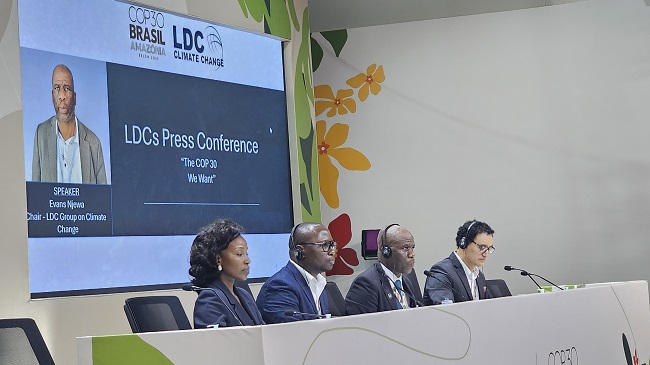
As world leaders gather in Belém for the 30th session of the Conference of the Parties (COP30) to the UNFCCC, the Least Developed Countries (LDC) Group has outlined its key priorities and expectations, urging the global community to take bold, equitable, and immediate action to keep the 1.5°C goal within reach.
Ten years after the adoption of the Paris Agreement, the LDC Group, representing 44 of the world’s most climate-vulnerable nations, warns that global efforts remain far from sufficient to safeguard communities already facing severe climate impacts. The Group calls for urgent multilateral action to close persistent gaps in climate finance, emissions reduction, adaptation support, and addressing loss and damage.
Evans Njewa, Chair of the LDC Group (second, right) with other COP delegates
“We have entered a decisive decade for climate action,” said Evans Njewa, Chair of the LDC Group. “The world must not allow the 1.5°C goal to slip away. COP30 must deliver a credible roadmap for addressing the gap in finance, ambition, and implementation, not promises for the future, but commitments today that are backed by adequate resources and the best available science.”
1. Climate Finance: Delivering on Commitments and Defining the Future
The LDC Group is calling for clear milestones for post-2025 adaptation finance targets, including a tripling of grant-based adaptation finance by 2030 to at least USD 120 billion, recognising that this still falls short of actual adaptation needs. The Group further urges a tripling of contributions through the Least Developed Countries Fund (LDCF) to a minimum of USD 3 billion under the GEF-9 cycle.
On the New Collective Quantified Goal (NCQG), the Group calls for robust follow-up on its implementation within the broader Baku to Belém Roadmap and a shared definition of climate finance to enhance accountability and transparency. The LDCs also support the new COP agenda item to ensure that developed countries fully meet their obligations under Article 9.1 of the Paris Agreement.
2. Mitigation: Urgent Action for 2030 and a Clear Roadmap to 2035
To maintain the 1.5°C target, the LDCs stress the need for countries to strengthen their 2030 targets reflecting the highest possible ambition, in line with the outcomes of the first Global Stocktake (GST1), and implement sectoral action and initiatives across renewable energy, fossil fuels transition, methane reduction, and forests conservation.
The Group calls for Belém to deliver a roadmap to keep 1.5°C on track, a structured plan with annual milestones, and follow-up process to guide the current and the next cycle of nationally determined contributions (NDCs). Further, implementation of our NDCs in pursuit of just transition pathways must be given due attention at this COP.
3. Adaptation: From Indicators to Implementation
The LDC Group urges the adoption of a comprehensive set of adaptation indicators with strong means of implementation and the creation of a dedicated technical workstream beyond COP30 to operationalise these measures. The Group also calls for the launch of fast-track funding to fully implement National Adaptation Plans (NAPs) by 2030.
4. Loss and Damage: Delivering Support Where It’s Needed Most
The Group welcomes the launch of the Fund for Responding to Loss and Damage (FRLD) under the Barbados Implementation Modalities (BIM) and emphasises the need for rapid, direct, and effective disbursement of resources to countries already suffering climate-induced devastation. The LDCs also support the decision to begin the FRLD replenishment process by 2027, ensuring predictable and adequate funding cycles to meet escalating needs.
Shell is highlighting its contributions to the Nigerian economy in an exhibition at the 2025 International Conference and Exhibition of the Nigeria Association of Petroleum Explorationists (NAPE) which began in Lagos on Monday, November 10, 2025. The 43rd NAPE conference comes as the professional body turns 50 this year, having been founded in 1975.
The theme of the conference is, “Revitalising the Nigerian Petroleum Exploration and Production Strategies for Energy Security and Sustainable Development.”
L-R: Senior Production Geologist, Shell Nigeria Exploration and Production Company Limited (SNEPCo), Abidemi Belgore; SNEPCo’s Communications Manager, Gladys Afam-Anadu; Ondo State Governor, Dr Lucky Aiyedatiwa; Incoming NAPE President , Olajumoke Ajayi ;President NAPE, Uche Johnbosco; Chairman of the Nigerian National Petroleum Company Limited (NNPC) Ahmadu Musa Kida and Minister of State for Petroleum Resources (Oil), Heineken Lokpobiri at Shell booth during at the 43rd Annual International Conference and Exhibition of the Nigeria Association of Petroleum Explorationists in Lagos
Shell, a Titanium sponsor of the event, is complimenting its support and participation with an exhibition on the full range of its businesses in Nigeria – Shell Nigeria Exploration and Production Company Ltd (SNEPCo), Shell Nigeria Gas, All On and Daystar Power Limited.
Executive Vice President Nigeria and Country Chair, Shell Companies in Nigeria, Marno de Jong, commented: “Shell has powered progress in Nigeria for over 60 years through our businesses and social investments. The Final Investment Decisions on Bonga North and HI projects underscore our commitment to the development of the country. Our exhibition tells this story of progress and partnership.”
Minister of State for Petroleum Resources (Oil), Heineken Lokpobiri, and Ondo State Governor, Lucky Aiyedatiwa, were among dignitaries who visited the Shell stand as the exhibition got underway. Senior Production Geoscientist & Subsurface Integrator, Abidemi Belgore, conducted visitors round the stand, which featured Shell’s footprints in deep-water production, domestic gas distribution and empowerment of businesses through provision of renewable energy and other power solutions.
“We’re pleased that our presentations have been well received by visitors,” Abidemi said.
The President and Chairman of the Board of Directors of the ECOWAS Bank for Investment and Development (EBID), Dr. George Agyekum Donkor, has advocated for the strategic importance of innovative climate financing instruments for Africa’s sustainable growth and transformation at the 2025 Africa Financial Summit (AFIS) in Casablanca, Morocco.
Speaking on the topic, “Climate and Bond Markets: How to Build Africa’s Sustainable Finance Arsenal,” Dr Donkor intimated that the continent has enough resources to finance its climate-smart investments. He opined that the continent holds in excess of $160 billion in pension funds alone, with over 90% held in government securities and instruments, of which West Africa holds $40 billion.
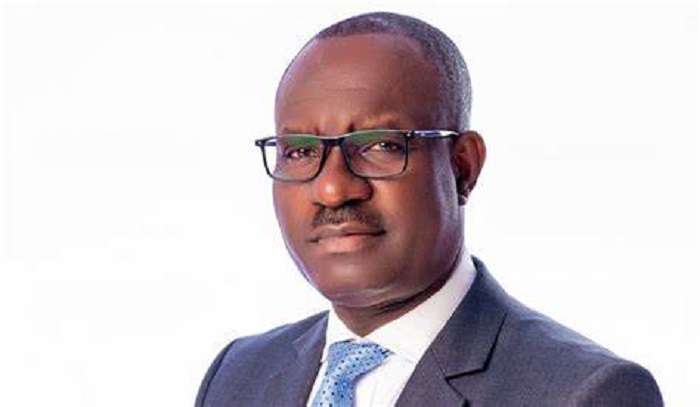
President and Chairman of the Board of Directors of the ECOWAS Bank for Investment and Development (EBID), Dr. George Agyekum Donkor
Dr. Donkor posited that what remains is project appeal (i.e. healthy investment returns) and the will to do it. He called on African governments and institutions to take active steps towards de-risking climate projects and promulgating enabling regulatory regimes and mechanisms to facilitate the mobilisation of climate-sensitive financing, thereby fostering sustainable growth and development.
Donkor further indicated that DFIs possess the unique advantage of catalysing such green resources to support governments to achieve their green investment objectives. As an example, he highlighted that EBID was the first DFI to issue a Green, Social and Sustainable (GSS) bond on the WAEMU Market in July 2024 to support GSS-themed projects.
The African Finance and Industry Summit (AFIS) is a leading annual platform that brings together financial institutions, private sector leaders, policymakers, and development partners to advance dialogue and action for Africa’s industrial and financial transformation.
COP30 opened on Monday, November 10, 2025, with an urgent call to deliver on climate promises and accelerate the implementation of the Paris Agreement across all sectors.
Thousands of diplomats and climate experts are gathering in Belém, Brazil’s Amazon, for COP30 – the latest round of UN climate talks. Their task couldn’t be clearer: turn promises into action and agree on tougher plans to cut greenhouse gas emissions.
After decades of pledges and annual summits from Kyoto to Sharm el-Sheikh, the planet keeps getting hotter and pressure on governments and big business to act – not just talk – has never been greater.
During the 2025 UN Climate Change Conference, countries will need to reaffirm their commitments and create climate plans that will bring the world closer to the Paris Agreement’s 1.5 degree C goal. Photo credit: Luis War
Holding COP30 in Belém, at the edge of the world’s largest tropical rainforest, underscores the stakes: the Amazon region is both a vital carbon sink and a frontline in the fight against deforestation and climate change.
So, this year’s meeting aims to shift gears. Delegates will review national climate plans, push for $1.3 trillion a year in climate finance, adopt new measures to help countries adapt, and advance a ‘just transition’ to cleaner economies.
COP30 has been billed as a turning point – a moment of truth and a test of global solidarity. scientists say the planet is on course to temporarily breach the 1.5°C warming limit set by the Paris Agreement.
That overshoot could still be short-lived, experts warn, but only if countries act fast to ramp up efforts on cutting emissions, adapting to climate impacts, and mobilizing finance.
Speaking at the Leaders’ Summit, UN Secretary -General Antonio Guterres was blunt: “It’s no longer time for negotiations. It’s time for implementation, implementation and implementation.”
Under Brazil’s presidency, COP30 will revolve around an action agenda of 30 key goals, each driven by an ‘activation group’ tasked with scaling up solutions.
The effort has been dubbed a mutirão – an Indigenous word meaning “collective task” – reflecting Brazil’s push to spotlight Indigenous leadership and participation at the conference and in the global fight against climate change.
The government says it wants all sectors – from Indigenous communities to business leaders – to help deliver on past climate promises.
Action agendas at COPs are built on voluntary pledges rather than binding law. But the scale of change needed is enormous: at least $1.3 trillion in climate investments every year by 2035.
Another key focus in Belém is the latest round of Nationally Determined Contributions (NDCs) – national climate plans that spell out how countries intend to cut emissions. To keep warming below 1.5°C, global emissions must fall by 60 per cent by 2030. Current NDCs would deliver only a 10 per cent cut.
Of the 196 Parties to the Paris Agreement, just 64 had submitted updated NDCs by the end of September. At preparatory talks in Germany in June, many countries warned that this ambition gap must be closed at COP30.
Delegates are also expected to approve 100 global indicators to track progress on climate adaptation, making results measurable and comparable across nations.
Today, 172 countries have at least one adaptation policy or plan, though 36 are outdated. The new indicators should help shape more transparent and effective policies.
With the planet heating faster than ever, adaptation is now a central pillar of climate action. But the UN Environment Programme (UNEP) warns adaptation finance must rise twelvefold by 2035 to meet developing countries’ needs.
COP30 will also push forward the Just Transition Work Programme – aimed at ensuring climate measures don’t deepen inequality. Civil society groups are calling for a “Belém Action Mechanism” to coordinate just transition efforts and expand access to technology and finance for the most vulnerable nations.
The Conference of the Parties to the UN Framework Convention on Climate Change (UNFCCC) – known simply as COP – remains the world’s leading forum for tackling the climate crisis. Decisions are made by consensus, driving cooperation on mitigation, adaptation and finance.
Over the years, COPs have delivered landmark deals. In 2015, the Paris Agreement set the goal of keeping global temperature rise “well below 2°C” while striving for 1.5°C.
At COP28 in Dubai, countries agreed to transition away from fossil fuels “in a just, orderly and equitable manner” and to triple renewable energy capacity by 2030.
2024 in Baku, COP29 raised the annual climate finance target for developing nations from $100 billion to $300 billion, with a roadmap to scale up to $1.3 trillion.
Taken together, the legal framework built over three decades under the UNFCCC has helped avert a projected 4°C temperature rise by the end of this century.
COP30 opened Monday, November 10, and runs through Nov. 21.
The Executive Secretary of UN Climate Change, Mr. Simon Stiell, has called on countries to deepen efforts toward reducing emissions and strengthening resilience to tackle climate change.
Stiell made the call on Monday, November 10, 2025, in Belém, Brazil in his remarks at the opening of the 30th United Nations Climate Change Conference (COP30).
According to him, taking faster steps on reductions of emissions and strengthening resilience is crucial to bring back temperature to 1.5°C.
Executive Secretary of UN Climate Change, Mr. Simon Stiell. Photo credit: Kiara Worth | UN Climate Change
He said the future that was designed 10 years back in Paris had started seeing the curve of emissions bending downward with governments legislating, and markets responding.
He, however, stated that much more work still needed to be done.
”The science is clear: we can and must bring temperatures back down to 1.5°C after any temporary overshoot. Lamenting is not a strategy. We need solutions.
”We find ourselves here in Belém, at the mouth of the Amazon. And we can learn a lot from this mighty river. The Amazon isn’t a single entity, rather a vast river system supported and powered by over a thousand tributaries.
”To accelerate implementation, the COP process must be supported in the same way – powered by the many streams of international cooperation, because individual national commitments alone are not cutting emissions fast enough,” he said.
He said there was no need to wait for late Nationally Determined Contributions (NDCs) to slowly trickle in, to spot the gap and design the innovations necessary to tackle it.
”Not one single nation among you can afford this, as climate disasters rip double-digits off GDP.
“To falter whilst mega-droughts wreck national harvests, sending food prices soaring, makes zero sense, economically or politically.
”To squabble while famines take hold, forcing millions to flee their homelands, this will never be forgotten, as conflicts spread. While climate disasters decimate the lives of millions, when we already have the solutions, this will never, ever be forgiven.
”The economics of this transition are as indisputable as the costs of inaction. Solar and wind are now the lowest-cost power in 90 per cent of the world. Renewables overtook coal this year as the world’s top energy source,” he said.
According to Stiell, investment in clean energy and infrastructure will hit another record high before the end of 2025 with investments in renewables outstripping fossil fuels 2 to 1.
He said the conference would focus on deals to strike and accelerate tripling of renewables and doubling energy efficiency as agreed to transit away from fossil fuels.
”Now is the time to focus on how we do it fairly and orderly. We have already agreed to deliver at least $300 billion in climate finance, with developed countries taking the lead.
”We now need to put the Baku to Belem Roadmap to work. To start moving towards the $1.3 trillion. We have already agreed to a global goal on adaptation.
”We now need to agree on the indicators that will help speed up implementation, to unleash its potential,” he said.
Stiell called on countries to agree on concrete steps to turn aspirations into actions on transition pathways to cover whole economies and societies.
He urged all countries to properly key into the agreed technology implementation programme to keep it in motion.
Stiell said every gigawatt of clean power would cut pollution and create more jobs.
He added that every action to build resilience would help to save lives, strengthen communities, and protect the global supply chains that every economy depends on.
The 2025 global climate summit, COP30, kicked off on Monday, November 10, in the Amazonian city of Belém in Brazil, amid a warning from United Nations climate chief, Simon Stiell, that the world is not doing enough to combat the crisis, and strategic compromises over the elements of the official agenda of the summit.
After hours of tense exchanges on the agenda, delegates finally agreed on the compromises and resolved sticky matters at around 11:30pm on Sunday. Experts from Power Shift Africa on the ground in Belem understand that the suggestion for the inclusion of Africa’s “special needs” in the agenda didn’t make the cut, and that this will instead be handled through informal consultations led by the COP Presidency, running until Wednesday.
COP30
Other key items under discussion last evening included Article 9.1 of the Paris Agreement, which outlines finance obligations of the Global North to the Global South, national climate plans known as Nationally Determined Contributions (NDCs), the EU’s proposal on biennial transparency reports, and the developing countries proposal to discuss restrictive universal trade measures. Meanwhile, a special session on Africa’s unique climate interests was announced, together with a promise for the agenda to be taken up more fully at COP32, which will be hosted in Africa and for which Ethiopia has placed a strong bid.
Despite the usual first-day wrangling, negotiators are portraying this as a smooth and cooperative start, a signal from the Presidency that multilateralism is alive and well. With anti-climate lobbies waiting to exploit any sign of gridlock, the Brazilian COP30 Presidency is eager to demonstrate unity and progress.
At the opening plenary, Simon Stiell, the UN Climate Change Executive Secretary, said the world is not moving fast enough to confront the climate crisis but was quick to note that global cooperation had at least prevented “an impossible future” of runaway heating.
“We have so much more work to do. We must move much, much faster; both in reducing emissions and in strengthening resilience,” he told delegates.
Stiell credited the Paris Agreement, adopted 10 years ago, with bending the curve of projected global heating from as high as 5°C to below 3°C, saying “it is still perilous, but it proves that climate cooperation works”. He said success now depends on two interlinked pillars: stronger, more credible national climate plans, the Nationally Determined Contributions (NDCs); and the financing to make them possible.
“Plans without finance cannot reach their full potential,” he said. “Finance is the great accelerator.”
He pointed to the Baku to Belém Roadmap, a new initiative that seeks to increase global climate finance from about US$300 billion a year to US$1.3 trillion by 2035, describing it as a shared investment in “stability and prosperity” and noting that countries acting fastest on clean energy would reap the greatest economic benefits.
“Every dollar invested in climate solutions brings multiple dividends; jobs, cleaner air, better health, resilient supply chains, and stronger energy and food security,” he said.
Supporters hailed the roadmap as an ambitious but necessary step to close the gap between climate pledges and real-world funding. Mukhtar Babayev, Azerbaijan’s Minister of Ecology and President of last year’s COP29, said it offers “a rare opportunity to transform promises into tangible progress.”
Brazil, hosting COP30 under President Luiz Inácio Lula da Silva, described the roadmap as “a blueprint for collective resolve.” The Brazilian delegation urged negotiators to focus on fairness and delivery rather than rhetoric. “The science is clear, the moral imperative undeniable. What remains is the resolve,” they said.
Mohamed Adow, founder and director, Power Shift Africa, said: “COP30 must deliver the priorities for Africa and the wider developing world which are clear: we need a fair deal that delivers finance for adaptation in vulnerable countries and supports a just transition to renewable energy. These are not acts of charity, but investments in a stable, liveable planet. We need to see the sharing of clean energy technology by the global north with the global south, and we need to see more national climate plans published by all countries, laying out how we’re going to accelerate the momentum towards a safe and prosperous planet for us all.”
Speaking on the adoption on the agenda, he added: “It’s good to see the agenda formally adopted and the start of the COP underway in a reasonably orderly fashion. It suggests that countries recognise the importance of this summit and the need for international cooperation if we’re going to tackle the climate crisis.
“But saving the multilateral UN process doesn’t mean we’re guaranteed to save the planet. To do that we need to see actual steps taken here in Belem to boost climate finance to help vulnerable countries adapt to the impacts of the climate crisis. We also need countries to commit to the just energy transition by moving away from polluting fossil fuels and investing much more in clean renewables. The world has spent the last 10 years agreeing the rules of the international climate regime. We now need to see countries acting on the regime they have signed up to, not just speaking warm words.”
Sandra Guzmán, Director General of the Climate Finance Group for Latin America and the Caribbean (GFLAC), warned that “private and philanthropic funds must complement, not replace, the obligations of developed countries.”
Over the next two weeks, the COP30 Presidency is understood to be positioning the summit as a political reckoning that will test whether the Paris Agreement, the crown jewel of international climate diplomacy, can still deliver results at scale.
Since 2015, global emissions have plateaued but not fallen fast enough. The 1.5°C target, the threshold scientists warn the world must stay below to avoid catastrophic consequences, is slipping out of reach.
The Belém conference comes amid growing fatigue and distrust in the global climate process, particularly over financing and equity. The Baku to Belém Roadmap aims to restore faith by setting a long-term financing goal, but key questions remain unanswered: who pays, how much, and under what terms.
Omar Elmawi, Convenor of the Africa Movement of Movements, noted: “We cannot keep sailing blindly into a climate apocalypse while pretending everything is merry. COP30 must be the turning point, where words become action, and promises become justice. Over eight billion people globally are looking at Belém to be the moment we will all look back to and celebrate and not one we curse.”
Brazil’s Presidency of the COP is attempting to shift the focus back to justice and implementation, linking climate action to forests, energy transition, and sustainable industrialisation. Hosting the talks in the Amazon, the planet’s largest carbon sink, is both symbolic and strategic, a reminder that global climate progress hinges on protecting ecosystems and empowering the communities that depend on them.
For Africa, COP30 is a moment of reckoning. The continent contributes less than 4 per cent of global emissions but bears the heaviest costs of climate change, from droughts and cyclones to collapsing agricultural yields and energy insecurity.
African negotiators have consistently argued that without predictable, affordable finance, developing nations cannot deliver on their commitments. The Baku to Belém Roadmap could be transformative if implemented fairly, ensuring that new funds reach life-saving adaptation projects in vulnerable communities, not just emissions reductions in middle-income economies.
African countries are also demanding a rebalancing of the climate finance equation to include more grants, fewer debt-driven instruments, and direct access for local governments and institutions. The hope is that the roadmap will address long-standing inequalities that have left Africa sidelined when it comes to green investment.
There is also optimism. Across Kenya, Rwanda, Morocco and South Africa, governments are already investing in electric mobility, renewable energy, and green manufacturing, practical examples of how climate action can drive growth and jobs if backed by finance and technology transfer.
Despite the challenges, Stiell insisted the Paris framework remains valid. “The framework created by the Paris Agreement is still sound,” he said. “But the next decade will determine whether it delivers in full. History will not ask what we intended. It will ask what we achieved.”