Home Blog Page 141

Ogonize and Yasunize: A hidden battle of words

0

We have always been concerned about words. Words are powerful. They help us communicate events that unfold around us. They are building blocks for action. They aid mobilisation. They can be tools for organising, control, or even of colonisation and exploitation. Negotiations at local, national and global levels often enter quagmires due to disputes over words and their meanings. A word can have multiple meanings and with a little inflection a benign word can turn into an insult and ignite a wildfire

Global actions can be forever delayed due to manipulation of perceptions that make emergencies appear to be less so. An example is the framing of the climate crisis as global warming. If the crisis had been labelled global heating or climate chaos, it would probably have garnered serious attention. Warming can be a nice thing because most people love keeping warm.

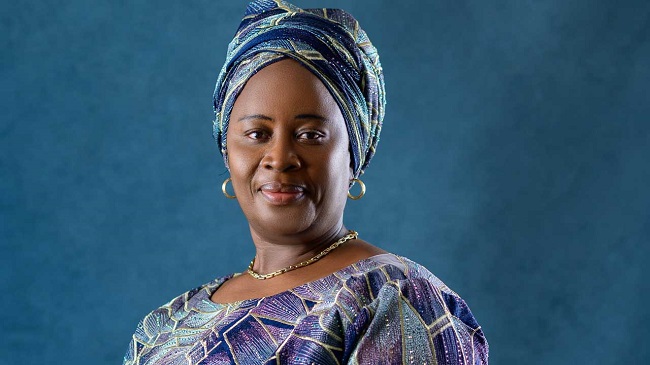
Nnimmo Bassey
Nnimmo Bassey

For years, climate campaigners have demanded a fossil fuels phase out. Rather than do that, COP26 came up with the idea of a phase down of unabated coal power and phasing out of inefficient fossil fuel subsidies, not phasing out of fossil fuels. A phase down should have pulled someone’s face down in shame. After kicking and screaming, COP28 in the United Arab Emirates ended up with an agreement to move away from fossil fuels in energy systems with the objective of achieving net-zero emissions by 2050. This was the agreement that the UNFCCC characterised as a pointer to the “Beginning of the End” of the Fossil Fuel Era.

With that sort of wordsmithing negotiators and some campaigners came off celebrating that the word ‘fossil’ was mentioned, not caring whether it would be phased down or phase out. To avoid dumping coal, we were told we can have clean coal. Cutting carbon emission at source was suddenly considered an uneconomic way of thinking and the preferred path became carbon offsetting.

So, polluters are permitted to carry on polluting provided they can show that an equivalent of their emissions is compensated for by those who pollute less or by mechanisms that can capture or bury such pollutions. Another sleight of hand was played by pushing a concept of net zero down gullible throats even though everyone knows that net zero is not zero.

At another level we have seen how colours have been used to lull the world to sleep while escalating the exploitation and marketisation of Nature. The green economy was quickly followed by the blue economy. There are blue, green, grey, turquoise, and other colours of hydrogen. All these are plied to show that a choice of colour can clear your conscience and allow a particular action to be acceptable or to attain certain degrees of acceptability.

It was in recognition of the potency of words that Oil Companies turned to calling themselves Energy Companies. If oil tends to soil anyone’s hand, certainly what energy does is to strengthen you. So, Energy Corporations swagger into the communities and continue their polluting activities with reckless abandon.

Polluters have not only adopted colours and words to hide their crimes, sometimes they simply subvert the meaning of words that previously provided moorings for a drifting world. A key word in this bracket is sustainability. Truth be told, the meaning of the word is now thrown into the air. The United Nations Brundtland Commission in 1987 defined sustainability as “meeting the needs of the present without compromising the ability of future generations to meet their own needs.” That original definition ought to stick to our memories and keep us on guard so that subverted definitions do not become acceptable and thus aid dysfunctions to become normalised. An example is when an oil company issues an annual “sustainability report” while mindlessly engaging in persistent ecological destruction or ecocide.

This led Health of Mother Earth Foundation to adopt a hyphenated Sustain-Ability so that we emphasise that anything that does not sustain the ability cannot be termed sustainability. Another hyphenated word is re-source which eliminates the consideration of the gifts of nature as mere commodities but require that we recognise the sources, return to the sources and see them as what they are both tangibly or otherwise.

How about when a military establishment announces that they would carry out an environment-friendly warfare?

The climate arena births many words, besides the ones already mentioned, that we must be wary of. Such words include decarbonisation as a process of moving in a low carbon economy. The wedlock to carbon is so strongly welded by capital that there appears to be no life beyond carbon. This is why the possibility of defossilization appears anathema to carbon moguls.

Most people agree that an energy transition is vitally essential if we are to avoid catastrophic climate change. That transition basically refers to a shift from fossil fuels to renewable energy sources. There is however plenty of acrobatics over what constitutes green or renewable energy resources. There are pundits who argue that nuclear power is renewable, ignoring its hazardous life cycle – from cradle to its dubious grave. Someone may even argue that hydroelectric energy, hydrogen, nuclear or thermonuclear energy are clean energy modes.

The necessity of a shift from dirty to renewable energy has triggered a rush for the minerals required for the process. The extractivist mindset that drives capitalism, and violence threw up a powerful word to numb the sensibilities and permit destructive mining of the minerals. That word is “critical”. The key resources needed for renewable energy components are thus termed critical minerals.

The connotation is that if you stop or slow down the extraction of these minerals you can be accused of being against the transition to renewable energy. This subtle label permits violence, displacement and environmental genocide in many nations and territories, but especially in the Democratic Republic of Congo. Nothing is clean or “renewable” if it reproduces patterns of territorial exploitation and degradation epitomised by fossil fuels extraction.

The power in the use of words and the subversive twist of meanings requires epistemic challenges, including the creation of new words and phrases. New words are birthed so regularly that older people sometimes have difficulties understanding the language of youths. In Nigeria words creep into common vocabulary through music, movies and street yarns. Such new words include japa and kpai. To japa means to emigrate out of one’s country, while kpai means to die, and to kpai something means to kill that thing.

The call for epistemic reclamation of the true meaning of certain words is an anti-colonial enterprise. We also see this in the concept of thingification as espoused by Aimé Césaire in his “Discourse on Colonialism,” where he characterised thingification as a situation where a colonised subject is reduced to a thing, objectified along with the land and resources, and used as a commodity. Our reading here is that we can forfeit our very being when words are used to invisibilise us or our territories.

In our struggle to have community-centred just energy transition we believe that the primary focus must be to keep fossils in the ground. To do this requires bold actions and a robust challenge on our imaginaries. One approach is to learn from the David and Goliath battles that communities and territories have successfully waged against corporate giants and their allied political structures. We propose a learning from the Ogoni people of the Niger Delta, Nigeria and the Waraoni people in the Yasuni territory of Ecuador. With due deference to their rugged resistance to the claws of fossil fuel extraction machines we call this resistance Ogonizing and Yasunizing. The clarion call is for the world to Ogonize and Yasunize.

As a working definition we see Ogonize and Yasunize to mean “a call for the protection of territories with natural or cultural diversity threatened by serious environmental impacts such as from oil and gas extraction, open cast mining, and other mega-projects.”

Here is the background to the birthing of these words. Yasuni is a territory in Ecuador where the people voted in a national referendum in 2023 to keep the oil in the ground. Over 59% of voters chose to end oil extraction activities in the Ishpingo, Tiputini, and Tambococha (ITT) oil fields, located inside the Yasuni Park. Ogoni is a territory in the Niger Delta where the people halted oil extraction in 1993 by declaring Shell a persona non grata.

This move led to the militarisation of Ogoniland and the execution of Ken Saro-Wiwa who was the leader of the Movement for the Survival of Ogoni People (MOSOP) and eight other Ogoni leaders on November 10, 1995. Because the people have remained ogonized (and are not agonising) they have stood their ground and rejected efforts by colonial extractors to return to the oil fields of Ogoniland.

To Ogonize and to Yasunize is to reject the culture of poverty and death and to stand for the wellbeing of Mother Earth and her children. It is to stand for Ubuntu, Etiuwem and buen vivre.

It is a decolonial struggle against authoritarian extractivism.

By Nnimmo Bassey, Director, Health of Mother Earth Foundation (HOMEF)

This article provided the talking points used by Nnimmo Bassey at the Wisdom Gathering hosted by Health of Mother Earth Foundation at the OND Conference Hall, Benin City, Nigeria on Wednesday, October 8, 2025

IUCN faces historic vote on fossil fuels as Congress opens in Abu Dhabi

0

As the International Union for Conservation of Nature (IUCN) World Conservation Congress opened on Thursday, October 9, 2025, Members are preparing to vote on a historic motion that could redefine the future of global conservation by tackling the world’s biggest threat to nature: fossil fuels.

Motion 42: “Addressing the climate and biodiversity crises through fossil fuel supply-side measures and a just transition” calls on the IUCN to develop guidance, analysis, and pathways for a fair and funded phaseout of coal, oil, and gas – placing fossil fuel supply at the heart of conservation for the first time in the IUCN’s history.

UAE
UAE President receives participants in 2025 IUCN World Conservation Congress

If adopted, the motion would make the IUCN the first major environmental body to formally call for international cooperation toward a Fossil Fuel Non-Proliferation Treaty – a new global framework to stop fossil fuel expansion, equitably phase out existing production, and enable a just transition for workers and communities.

Ralph Regenvanu, Minister of Climate Change of Vanuatu, says: “Vanuatu knows what is at stake. Our islands are on the frontline of this crisis. That is why we became the first country to call for a global Fossil Fuel Non-Proliferation Treaty – to phase out fossil fuels fairly and support a just transition. With the recent ICJ Advisory Opinion, it is now clear: states have legal obligations to prevent climate harm. This is our chance to act together.

“Phasing out fossil fuels could reduce extinction risks by 75% and free up billions for biodiversity protection. By supporting Motion 42, we can show that the conservation movement is ready to confront the fossil fuel crisis head on.”

Fernanda Carvalho, WWF Global Climate and Energy Policy Head, says: “Fossil fuels are not just heating the planet – they’re dismantling the natural systems that sustain life – and the longer we delay action, the deeper the damage. The IUCN has a historic opportunity to address a main cause of both the biodiversity and climate crises.

“The planet can’t afford to wait another four years. Motion 042 is our chance to turn the tide. It will be a critical step toward ending this harm at its source and restoring the balance between climate, nature, and people, and we urge all IUCN members to support it.”

Kumi Naidoo, President of the Fossil Fuel Non-Proliferation Treaty Initiative, says: “Ending fossil fuels is not just climate action. It is biodiversity conservation at its most crucial. By passing Motion 42, IUCN will be the first major environmental body to put fossil fuel supply front and centre on the conservation agenda. This is about science, justice, and ensuring our collective survival. It is the leadership needed to set new norms, to shift what the world thinks is possible, and to inspire governments to follow.”

For decades, the IUCN has guided global conservation efforts through resolutions and recommendations that influence international environmental law. However, none have directly addressed fossil fuel supply, despite the clear link between the biodiversity and climate crises. The fossil fuel industry is already responsible for over 50% of ocean acidification and widespread habitat destruction. A successful vote on Motion 42 would mark a turning point – embedding fossil fuel phaseout into conservation policy alongside nature protection and climate goals.

The proposal is supported by the World Wide Fund for Nature (WWF), the Fossil Fuel Non-Proliferation Treaty Initiative, and a growing coalition of governments, civil society organisations including BirdLife International and COICA, Indigenous leaders, and youth movements urging IUCN to take bold leadership.

Oil leak from OML 29 crude delivery line pollutes Bayelsa communities

0

An oil spill from an 8-inch crude delivery pipeline at Oil Mining Lease 29 (OML 29) has polluted Nembe communities around the Santa Barbara River in Bayelsa State.

The OML 29 asset is operated by Nembe Exploration and Production Company Limited, formerly Aiteo Eastern Exploration and Production Company Limited.

Oil spill
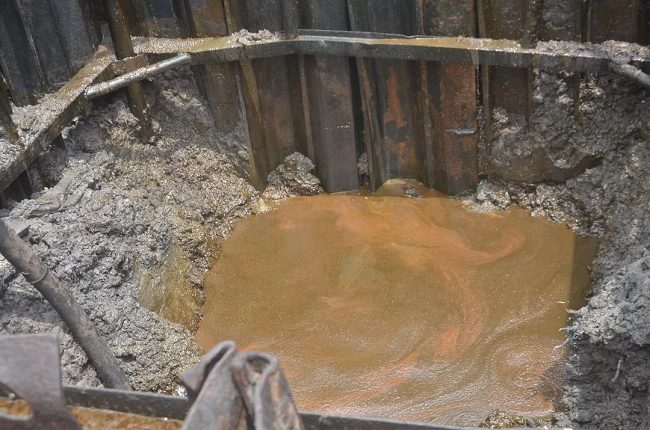
Oil spill in Nembe, Bayelsa State

The leak at Tora area in Nembe occurred on October 1, 2025, discharging a yet-to-be ascertained volume of crude stress into the Santa Barbara River and adjourning areas.

According to a letter to the operator of OML 29 by the legal counsel to the Opu Nembe Kingdom signed by Mr. Iniruo Wills, Managing Partner of Ntephe Smith and Wills, the spill has adversely impacted the people who depend on the Santa Barbara River.

The letter was in response to an invitation to a Joint Investigation Visit (JIV) to the spill site to ascertain the cause and volume of the spill.

The oil firm had confirmed the oil spill in a letter Ref: NEPCo/HSE-JIV/2025/04 dated October 5, which proposed a JIV for October 6.

The Nembe communities in a response to the letter kicked against the October 6 date and opted for October 9.

“We remind you, as you are quite aware of already that the community requires and deserves decent notice to assemble a competent JIV team, some of whom usually come from Lagos, Port Harcourt and/or Yenagoa, in order to ensure due diligence and avoid or countervail the perennial practice of manipulating the JIV process and suppressing critical information.

“Please note that our clients demand a thorough and competent investigation of this spill, and adequate management (including swift post-spill assessment and remediation).

“Beyond this spill, for the records, we demand on behalf of our clients again for a top-level engagement (Company, Community Technical Team, and Regulators) for a lasting overall framework to put a stop to this unbearable and continual burden.” the letter read in part.

By Nathan Nwakamma

Nigeria’s Ministry of Petroleum Resources named ‘Reformer of the Year’ at 2025 African Energy Week 

0

Nigeria’s Ministry of Petroleum Resources has been named Reformer of the Year at the African Energy Week: Invest in African Energies 2025 conference, in recognition of its commitment to transforming the oil and gas sector through sweeping reforms that are reshaping Nigeria’s investment landscape.

A cornerstone of this agenda is the Petroleum Industry Act (PIA) of 2021, complemented by a series of Executive Orders – most notably the “Upstream Petroleum Operations” (Cost Efficiency Incentives) Order – signed this year. Since the enactment of the PIA, Nigeria has pursued a bold exploration and production strategy, reengaging global investors through fiscals designed to incentivise investment.

Ministers
Minister of State, Petroleum Resources (Oil), Sen. Heineken Lokpobiri (left) with Minister of State, Petroleum Resources (Gas), Ekperipe Ekpo

The legislation overhauled sector governance, unbundled the Nigerian National Petroleum Company into a commercially oriented entity, and established a modernized regulatory framework to attract capital and foster sustainable growth.

The PIA introduced a more equitable fiscal regime, transparent licensing systems and a Host Community Development Fund, ensuring communities directly benefit from nearby projects. Since its introduction, the Act has catalysed over $17 billion in foreign direct investment into Nigeria’s oil and gas industry, reflecting growing confidence in the country’s new policy environment.

Building on this momentum, the Federal Government has intensified reforms aimed at restoring competitiveness and unlocking long-delayed projects. In April 2025, President Bola Ahmed Tinubu signed a landmark Executive Order on Oil and Gas Sector Reform, targeting fiscal efficiency and cost competitiveness across upstream operations.

The Order introduced a performance-based tax credit framework, incentivising operators to achieve verifiable cost reductions. These reforms are expected to enhance fiscal stability, accelerate project execution and remove long-standing bottlenecks that have historically impeded investment.

These reforms arrive as Nigeria aims to increase oil production above two million barrels per day while advancing gas monetisation and infrastructure projects. Major initiatives progressing under the new investment climate include the $10 billion Nigeria–Morocco Gas Pipeline, ongoing AKK pipeline development, and multiple deepwater Final Investment Decisions by international and indigenous operators. At the same time, the Ministry is accelerating modular refinery development, enhancing downstream transparency and expanding the country’s role as a regional gas hub.

“The Ministry of Petroleum Resources has shown extraordinary leadership in building a transparent, competitive and resilient energy sector. Nigeria’s reforms are unlocking billions in investments, advancing infrastructure and ensuring energy development directly benefits its people,” stated NJ Ayuk, Executive Chairman of the African Energy Chamber.

UN Women, IOFS launch climate-smart cassava project for women

0

UN Women and the Islamic Organisation for Food Security (IOFS) have launched an initiative to equip women farmers with climate‑smart technologies to boost cassava yields and reinforce Nigeria’s agricultural value chain.

Ms. Beatrice Eyong, UN Women’s Country Representative to Nigeria and ECOWAS, said at the Cassava Value Chain Stakeholders’ Debriefing & Consultation in Abuja on Wednesday, October 8, 2025, that the programme would drive inclusive transformation of Nigerian agriculture.

Beatrice Eyong
Beatrice Eyong, UN Women Representative to Nigeria and ECOWAS

Eyong underscored women’s pivotal role in agriculture, especially cassava, saying that despite comprising over two‑thirds of the workforce, women face persistent barriers to land, finance, technology, and markets across West and Central Africa.

She claimed addressing those gaps could raise yields by 30 per cent, increase food output by 4 per cent, and cut malnutrition by 17 per cent, offering substantial gains for food security and public health.

She noted that women in cassava value chains were often confined to low-income, labor-intensive roles, lacking improved seedlings, modern processing tools, credit, and secure market access to scale operations.

Eyong called for women to gain access to climate-smart technologies, microfinance, cooperative support, and formal market linkages to help them move from subsistence to viable agribusiness.

She reaffirmed the initiative’s commitment to making women leaders, not just beneficiaries, in food security and climate resilience, increasing their agency in the sector.

“Let us expand women’s access to climate smart technologies, finance, and markets; strengthen policies that recognise and protect their roles; and create green jobs for a resilient, equitable Nigeria,” she said.

Dr William Agyei-Manu, IOFS Representative, said the initiative placed women at the core of food security and climate-resilient agricultural systems across OIC member states.

“Together, we can transform cassava from subsistence farming into a growth driver, inclusive development, and women’s economic empowerment across Africa.

“Let us build a future where no woman farmer is left behind, where her contributions are recognised as central to sustainable food security,” he added.

By Justina Auta

Group reiterates calls for climate financing, clean energy

A non-governmental organisation (NGO), Vectar Energy, has reiterated the need for sustainable solutions through converting solar data into real capita via accelerating climate finance and clean energy in Nigeria.

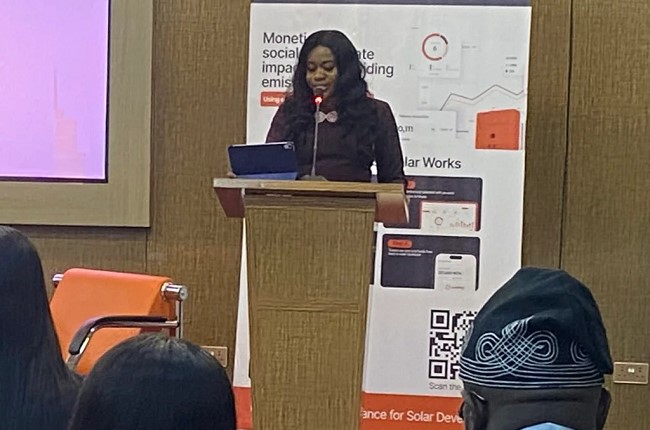
The Founder of Vectar Energy, Deborah Fadeyi, made the call at the maiden EcoWise multi-stakeholder forum under the theme: “Trust, Scale, Impact: Unlocking climate finance through carbon credits for Solar in Nigeria” on Wednesday, October 8, 2025, in Abuja.

Vectar Energy
Founder of Vectar Energy, Deborah Fadeyi

According to her, access to electricity has become a burden, particularly with no fewer than 8.6 million Nigerians unable to access electricity, amidst plenty power supply.

Fadeyi said, “When we go to COP events, we pretty much ask for aids to be able to build climate resilience, which is one key thing for us as a country.

“Having to build climate resilience through access to electricity, not just for day-to-day, but for sustainable industrialisation, then we realise that aids don’t work.

“The conversation of aids doesn’t work. So how about we trade something? This is where carbon credits come in. If we strive to deploy low-carbon renewable projects, is there way for us to get concessions from that?

“To be able to finance more renewable energy projects, more solar projects, there is the mechanism for that, it is called the Clean Development Mechanisms.”

She explained that such mechanisms could bolster Nigeria’s ability to convert solar data or any sort of low-carbon or renewable green energy data into carbon credits. 

According to her, carbon credit is also sold to corporate buyers such as Amazon, Microsoft, to be able to showcase their net zero confidence as the world progresses to net zero by 2050.

Commenting, Ms. Damilola Asaleye, Vice President, Renewable Energy Association of Nigeria, commended the launch of the EcoWise platform by Vectar Energy, to be an innovative platform that is needed currently in Nigeria and Africa at large.

She described EcoWise as a platform locally built by a Nigerian to bolster sustainable solutions in the renewable energy sector and to enable Africans have access to climate finance.

“We can have access to environmental finance and then, we can turn all the data from our solar installations right now in Nigeria, we can turn this into revenue through the climate credits.

“I am glad that a private sector, organisation is actually taking the bull by the horn to implement this climate finance platform right now, whereby we can convert climate, environmental data into revenue. 

“We do not have to wait for government for everything to be done. We private sector owners too need to step up to the game and ensure that we have data credibility,” Asaleye said. 

Meanwhile, the Ambassador of Israel to Nigeria, Michael Freeman, represented by Thelma Agada, B-Technology Project Manager, commended Vectar Energy to be result of the partnership between Nigeria and Israel through the establishment of the Innovate Hub.

According to him, Nigeria has everything it takes to lead Africa’s clean energy transformation through vast sunlight, abundant natural resources and most importantly, a young, talented, determined population.

 “The challenge and the opportunity lies in connecting innovation to implementation and ideas to investment. This forum is exactly the kind of platform that makes such connections possible.

“This brings together government, private sector, academia and development partners, the four pillars that most work hand-in-hand if we can and will achieve the lasting impact.

“Let me also assure you that Israel stands ready to partner with you on this journey, whether it is through technology transfer, capacity building or joint ventures in renewable energy infrastructure,” Freeman said. 

The highpoint of the event was EcoWise Technical Paper unveiling, virtual presentations on: Nigeria’s solar ambition, empowering people for climate resilient energy access and financing the solar transition.

By Fortune Abang

UpwardEco: Using waste-to-wealth strategies to promote sustainability  

While many may find UpwardEco’s goal of reducing dumpsite waste by 90% to be very ambitious, it’s CEO, Muhammad Sanusi, told EnviroNews in this exclusive interview that he believes it is achievable if stakeholders work together. Excerpts:

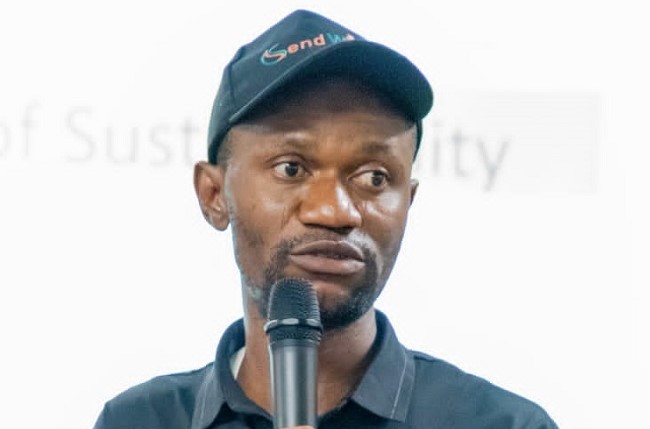
Muhammad Sanusi
Muhammad Sanusi

Problems and solutions  

We know that tackling waste pollution requires more than just awareness; it demands action, innovation, and community. I know that our goal of reducing materials ending up in dumpsites by over 90% is ambitious, but we also believe that it is possible when every stakeholder plays a role. That is why we begin with education and engagement, encouraging households and businesses to separate waste at the source. This is to enable us to channel recyclables to processors, upcycle materials into new products, and connect artisans and green innovators to resources they need.

By creating this closed-loop system, nothing is wasted; everything finds a purpose. Most importantly, we are building a culture where sustainability is not an option but a way of life, because every kilogram saved from the dumpsite is proof that collective action works, and together, we can reimagine waste as a resource that sustains both people and the planet.

Ecosystem and its impact

Our ecosystem is designed to make sustainability a simple and inspiring journey. It begins with GreenBridge, where people first encounter awareness and education about living green. From there, many take the next step into green recovery, joining us in the practical work of waste segregation and collection. The recovered materials don’t just stop at being saved from dumpsites; they are reborn.

Through the AURA Store, we showcase beautiful, functional products created from what was once considered waste, proving that sustainability can be both innovative and stylish.  Holding all these efforts together is the Sendwaste.com, our technology backbone that tracks recovery, connects stakeholders, and ensures transparency every step of the way.

Together, these services form a closed-loop system where waste is not the end of the story but the beginning of something new. This ecosystem has already helped divert over 50 tonnes of plastics from dumpsites while sparking a culture of green living.

Challenges

Like many young organisations, our biggest challenges lie in access to the right tools, equipment, and facilities that can help us scale our recovery and recycling efforts, and access to strong, long-term partners who believe in this mission as much as we do. At times, limited resources slow us down, but they have also taught us creativity and resilience.

So, we address these gaps by building partnerships with local artisans, recycling processors, and community groups, turning shared struggles into shared solutions.

Our back-end technology also helps us maximise efficiency with what we have, ensuring nothing is wasted. Most importantly, we lean on the passion of our team and the support of everyday people who believe in a cleaner, greener Nigeria.

These challenges are real, but they remind us daily that this journey is worth fighting for—and that together, we can overcome them.

Uniqueness

What sets UpwardEco apart is that we don’t just manage waste; we transform it into a journey of awareness, action, and value creation.

Many organisations stop at collection or recycling, but we have built a connected ecosystem that starts with education through GreenBridge, moves into practical recovery with Green Recovery, showcases impact through the AURA Store, and is all powered by our technology platform. This closed-loop approach ensures that waste is not only diverted from dumpsites but also reborn into products that inspire people to live greener.

Beyond technology and products, our uniqueness lies in the emotional connection we create, helping individuals and businesses see their contribution, track their progress, and share their sustainability story, because we are not just reducing waste; we are building a culture of responsibility and hope, where everyone feels part of the solution.

 Public awareness 

Public awareness of waste management is growing, and the informal sector has played a commendable role in keeping our cities cleaner. However, awareness alone is not enough; we must move from telling people what to do to showing them how it can be done.

At UpwardEco, we’ve seen that many Nigerians are willing and eager to be part of the solution; what they need are the right tools, simple systems, and consistency.

That is why our approach combines education with practical engagement: through GreenBridge we raise awareness, through Green Recovery we involve people directly in segregation, and through the AURA Store we showcase what is possible when waste is given new life.

By making sustainability visible, accessible, and rewarding, we bridge the gap between knowledge and action, turning good intentions into lasting impact against waste pollution.

Fund raising plan 

While our long-term needs go far beyond seven to ten million Naira, we believe in planning, prioritising, and taking steady steps forward. This immediate fundraising is designed to keep us afloat while strengthening the very core of our operations.

With it, we will establish a fully functional UpwardEco Hub, which will serve as a centre for recovery, innovation, and community engagement. More importantly, the funding will allow us to empower women and youth within the AURA product creation value chain, equipping them with skills, tools, and opportunities to turn waste into value.

This step will not only improve the delivery of our services but also create a model of revenue stability that ensures sustainability in the long run. Every Naira invested in this initiative is an investment in people, in livelihoods, and in a cleaner, greener Nigeria.

Recommendations 

If I had the power to transform the sector, I’d combine positive incentives with firm, fair enforcement, but design both to avoid perverse outcomes.

Practically, I’d roll out deposit-return and pay-as-you-throw schemes, tax breaks and microgrants for businesses that adopt low-waste packaging, and direct payments or subsidies to informal waste workers who deliver verified recyclables.

At the same time, I’d enforce graduated penalties for non-compliance fines, licensing sanctions and public transparency. So the cost of polluting is real.

Crucially, I’d pair enforcement with alternatives: invest in viable reuse options, create green jobs for women and youth, and pilot programmes with rigorous monitoring to prevent unintended “cobra effect” incentives.

The result: align economic interest with responsible behaviour so people are rewarded for doing the right thing, not punished into poverty.

Next steps

Our next steps are focused on scaling impact and deepening engagement. We are expanding our recovery coverage to reach more neighbourhoods across Abuja, ensuring that more households and businesses can actively participate in diverting waste from dumpsites.

At the same time, we are working on developing a more diverse and exciting product line through the AURA Store, giving sustainability lovers new ways to experience beauty and creativity born from recovered materials.

For the public, we want you to watch for these stories of transformation, waste becoming resources, communities coming together, and small actions adding up to big change.

Finally, we want people to see that this is not just UpwardEco’s journey but a collective one, where every contribution matters. Together, we can shape a future where Abuja leads as a model for sustainable living and responsible waste management.

Lagos gov calls for collective action on clean urban transport

Gov. Babajide Sanwo-Olu of Lagos State has urged stakeholders to harness clean urban transport innovation and investment to achieve economic development, social equity, and climate resilience.

Sanwo-Olu made this call at the 2025 Lagos Metropolitan Area Transport Authority (LAMATA) International Conference on Sustainable Urban Mobility, held in Ikeja, on Wednesday, October 8.

Lagos
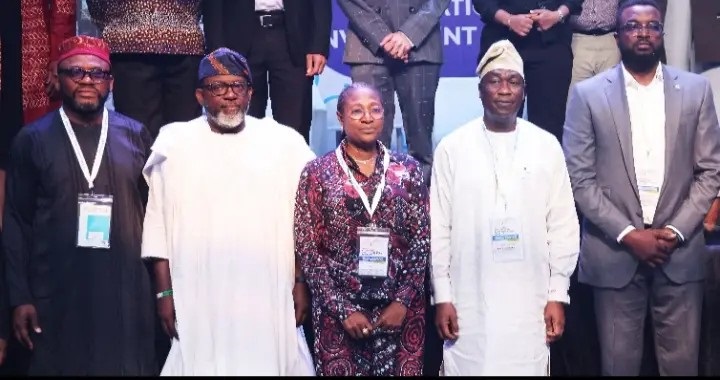
L-R: Permanent Secretary, Lagos State Ministry of Transportation, Mr Olawale Musa; Chairman of the Lagos State House of Assembly’s Committee on Transport, Temitope Adedeji; Managing Director, Lagos Metropolitan Area Transport Authority (LAMATA), Abimbola Akinajo; Deputy Gov. Dr Obafemi Hamzat, and Commissioner for Transportation, Mr Oluwaseun Osiyemi, at the 2025 Lagos Metropolitan Area Transport Authority (LAMATA) International Conference on Sustainable Urban Mobility (SUMConference25), held in Ikeja

The conference had “Harnessing Clean Urban Transport Innovation and Investment in Africa” as its theme.

The governor, who was represented by his Deputy, Dr Obafemi Hamzat, emphasised the need for sustainable mobility in Africa.

He noted that sustainable mobility is not a luxury but a necessity for achieving economic development, social equity, and climate resilience in Africa.

Sanwo-Olu challenged Africans to think big, act bold, and move together to build a continent that moves efficiently, inclusively, and sustainably.

“Let us harness clean urban transport innovation and investment not as abstract ideals but as instruments of continental renaissance.

“Let us build an Africa that moves efficiently, inclusively, and sustainably.

“By 2050, over 1.3 billion Africans will live in cities. How we move those people cleanly, affordably, and equitably will determine whether our growth is sustainable or self-defeating,” he said.

The governor highlighted Lagos transformation in urban mobility, citing the Bus Rapid Transit corridors, ferry terminals, smart ticketing systems, and upcoming electric bus pilot as examples of what is possible when African cities believe in themselves.

He also mentioned the state’s deployment of a citywide sensor network to track urban transport-induced emissions in real-time.

Sanwo-Olu emphasised that the conference must move Africa closer to a continental Air Quality Alliance, linking African cities in a shared platform of open data for clean air.

He noted that the journey to sustainable urban mobility demands political courage, financial creativity, institutional resilience, and partnerships that cross continents.

The Commissioner for Transportation, Mr. Oluwaseun Osiyemi, reiterated the state’s commitment to driving Africa’s clean and sustainable transport revolution.

Osiyemi said that Africa’s rapid urbanisation, presents both great challenges and tremendous opportunities for sustainable development.

“As our cities grow, we must prioritise clean, affordable, and efficient mobility for all,” he said.

The commissioner noted that sustainable mobility was key to improving air quality, reducing congestion, and promoting economic growth.

He noted that several African cities, such as Nairobi, Addis Ababa, Cape Town, Accra, and Lagos, are already implementing electric mobility initiatives, non-motorized transport infrastructure, and multimodal public systems.

Earlier, LAMATA’S Managing Director, Mrs. Abimbola Akinajo, stated that the conference served as a knowledge hub for policymakers, planners, engineers, researchers, operators, and other key stakeholders at both national and sub-national levels in Nigeria.

She recalled that, in 2024, Lagos State Government, through LAMATA, formally institutionalised an annual conference on sustainable urban mobility.

She said the conference was geared toward fostering synergy, cooperation, commitment, and unity among African governments, businesses, and communities to adopt sustainable transport practices, reduce carbon footprints, and promote renewable energy sources.

Meanwhile, the Chairman of Badagry Local Government Area, Mr. Babatunde Hunpe, has commended Gov. Babajide Sanwo-Olu for his commitment to the development of Badagry, through the inauguration of the Late Sunny Akinsanya Ajose Housing Estate in Ajara.

Hunpe gave the commendation at the inauguration of the project, which was initially started in 2013 by the New Towns Development Authority (NTDA) and later transferred to the Ministry of Housing in 2017 for completion.

He noted that the new project, coming barely two months after the inauguration of several road networks, showed the governor’s strong dedication to the holistic development of the Badagry division.

“This is truly a season of bountiful harvest for our people under your purposeful and progressive leadership,” he said.

According to him, the Lagos Homes Project in Badagry is not just another housing scheme but a continuation of a vision first conceived by President Bola Tinubu during his tenure as governor of Lagos state.

“What we see today is that noble dream turned into reality through your hands, the hands of a builder and a doer,” Hunpe said.

He, however, appealed to Sanwo-Olu to help complete some abandoned state projects in the area.

“These include the Lagos State VIP Chalet, Yafin Road Project, Agbovipe–Agadangba–Erekiti Road, the second phase of Hospital–Topo–Idale Road, Aradagun–Mowo Road, Owode–Apa Road, and the Badagry Deep Sea Port,” he said.

Hunpe noted that completing the projects would further cement the governor’s legacy as a leader,  who transformed Badagry into a world-class hub for tourism and commerce.

Also speaking, the Akran of Badagry, Aholu Menu Toyi I, represented by Chief Anthony Tunji, expressed gratitude to the governor for completing many projects in the town.

He said the people of Badagry, like Oliver Twist, are asking for more developmental projects.

Similarly, Mr. Bonu Solomon, the lawmaker representing Badagry Constituency 1 in the Lagos State House of Assembly, thanked Sanwo-Olu for completing the estate and urged him to ensure that indigenes benefitted from its allocation.

Mr. Abdulhafis Toriola, Chairman of the Lagos State House of Assembly Committee on Housing, assured residents that their interests would be protected in the allocation process and urged them to continue living in peace and harmony.

The residential buildings are 35 blocks of 12-in-1 buildings (one, two, three-bedroom apartments) making a total of 420 units.

By Oluwatope Lawanson, Raji Rasak, Aderonke Ojediran and Lydia Chigozie-Ngwakwe

All is now set for GOCOP 2025 Annual Conference

0

All is now set for the 2025 Annual Conference of the Guild of Corporate Online Publishers (GOCOP), scheduled to hold at 10:00 a.m. on Thursday, October 9, 2025, at the Radisson Blu Hotel, Ikeja GRA, Lagos.

The ninth edition of the GOCOP Annual Conference will focus on the theme: “Reconciling Campaign Promises with Governance Realities: Challenges and Prospects.”

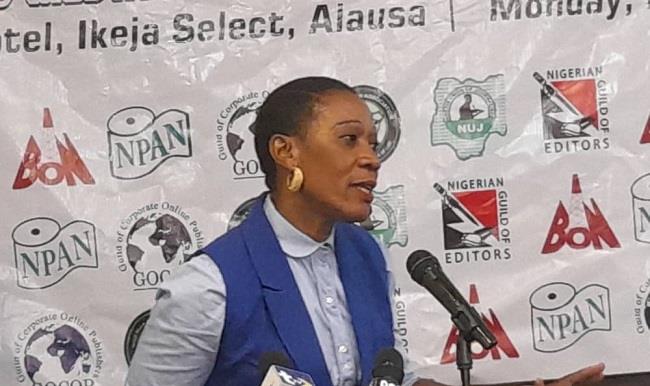
Maureen Chigbo, GOCOP President
Maureen Chigbo, GOCOP President, at Media Roundtable on self-regulation

In a press statement signed by the Publicity Secretary of GOCOP, Ogbuefi Remmy Nweke, the Chairman of the Conference Planning Committee and GOCOP Deputy President, Danlami Nmodu, mni, confirmed that all arrangements have been concluded to ensure a highly impactful and well-attended event.

According to Nmodu, the 2025 conference aims to generate practical insights and strategies for bridging the gap between political campaign promises and the realities of governance in Nigeria and across Africa.

The event will feature a keynote address, followed by a high-level panel discussion involving seasoned experts in media, governance, and policy.

The conference, he said, would be chaired by the former Governor of Old Ondo State and former Deputy National Chairman of the Peoples Democratic Party (PDP), Chief Bode George, while the former Speaker of the House of Representatives and immediate past Governor of Katsina State, Aminu Bello Masari, would deliver the keynote address.

Panel discussants, he said, include the Director, Institute of Continuing Education, University of Lagos (UNILAG), Prof. Abigail Ogwezzy-Ndisika, and the Director-General, National Orientation Agency (NOA), Alhaji Lanre Issa-Onilu.

Nmodu further noted that the GOCOP Conference had evolved into a credible platform for dialogue among online publishers, policymakers, and industry leaders, advancing the Guild’s mission of promoting responsible and ethical journalism in the digital age.

He recalled that past editions of the conference have featured notable personalities such as Rev. Matthew Hassan Kukah; Mr. Boss Mustapha, former Secretary to the Government of the Federation; Prof. Mahmood Yakubu, INEC Chairman; Prof. Uche Uwaleke; and former Governor Liyel Imoke; who have all provided critical perspectives on national issues ranging from security and the economy to elections and digital transformation.

GOCOP, a professional body of over 120-member organisations, comprises publishers, editors, and senior journalists who transitioned from traditional media to online platforms, upholding the values of credibility, accuracy, and professionalism in digital journalism.

Nmodu emphasised that the GOCOP 2025 conference also presents strategic sponsorship and partnership opportunities for brands seeking meaningful engagement with influential media leaders, policymakers, and corporate decision-makers.

The untold story of Nigeria’s abandoned housing dreams in Ilorin

0

Unarguably, Nigeria is facing a worsening housing crisis.

Access to affordable housing remains a major challenge for low- and middle-income earners, hampered by high construction costs, inadequate financing, weak infrastructure, and limited government delivery.

According to the Federal Mortgage Bank of Nigeria (FMBN), the deficit is currently estimated at more than 28 million units.

Housing
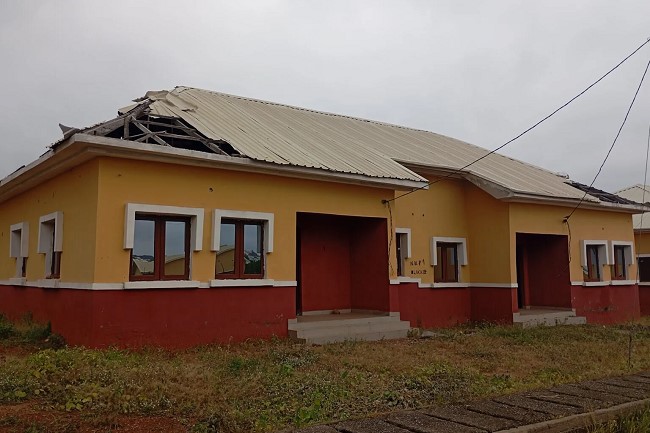
The roof of one of the buildings in Ali Ara, already blown away by wind

To bridge this gap, the Federal Government unveiled the National Housing Programme (NHP) in 2016 under former President Muhammadu Buhari, aiming to provide affordable homes for Nigerians across 34 states.

The initiative, now rebranded as the Renewed Hope Housing Programme under President Bola Tinubu, targets Nigerians aged 21 and above in paid employment, who contribute 2.5 per cent of their monthly salary to the National Housing Fund managed by the FMBN.

Yet, in Ilorin, Kwara, two of these housing projects – one located in Ali-Ara, off Asa Dam Road, and another at Ogbondoroko in Asa Local Government Area – stand as symbols of unfulfilled promises.

One has been completed but left unallocated; the other remains partially finished years after groundbreaking.

The estate at Ali-Ara, inaugurated with fanfare in December 2022, comprises 76 housing units under Phase One of the NHP. The facilities include roads, drainage, electricity connections, and water supply.

The project features 48 units of two-bedroom bungalows, 20 three-bedroom bungalows, four one-bedroom units, and four three-bedroom units built using stabilised earth technology.

During the inauguration, the then Minister of Works and Housing, Babatunde Fashola, disclosed that building contracts were awarded in November 2016 at a cost of N728.49 million, while infrastructure contracts followed in May 2017 at N619.26 million.

The breakdown included N446.1 million for roads and drains, N85.1 million for electricity, and N87.9 million for boreholes.

In spite of these investments, none of the housing units has been occupied nearly three years later, a situation that has turned optimism into concern among nearby residents, who now fear the empty buildings could become a hideout for criminals.

Dr Abdulazeez Olatunji, Chairman of the New Era Community, has lived in the Ali-Ara area for over a decade.

He recalls the excitement that greeted the project’s construction.

“We were delighted when the project started; it brought good roads and drainage, and we thought facilities like markets and health centres would follow.

But today, the houses stand empty; that’s the real abandonment,” he lamented.

While the estate has not yet become a serious crime spot, Olatunji expressed fears that its isolation and lack of habitation make it a potential security threat.

“The guards securing the place sometimes collude with others to steal livestock; we have had reports of goats and rams being kept inside the empty houses before being moved out at night,” he said.

The community chairman urged the Federal Ministry of Housing and Urban Development to address all issues delaying the allocation of the houses before the infrastructure deteriorates further.

Sharing a similar sentiment, a military officer residing nearby, who pleaded anonymity, said he donated part of his land to make access roads possible, hoping the estate would bring development.

“I gave part of my land for the road, believing the project would improve the area.

“But since completion, nothing has changed; some boreholes have been vandalised, and only two of six industrial boreholes are working; the rest were stripped of their pumping machines,” he said.

He added that while the government provided security guards, vandalism and theft of electrical components persist due to inactivity.

For Mrs Tawakalitu Mustapha, who runs a small shop beside the estate, the empty houses have dashed her hopes of increased patronage.

“We thought business would boom once people moved in, but that has not happened. Some say they’ve been allocated the houses but can’t move in because facilities are already spoiling,” she said.

At Ogbondoroko, Phase 2 and 3 of the NHP project tell a similar story, though construction is yet to be completed.

Mrs Faith Ilesanmi, a resident of eight years, believes the estate’s poor access road and distance from the city deter potential subscribers.

“The location is far from town, and the road is terrible; even if completed, it will be difficult for civil servants to live here,” she explained.

Another resident, Mr. Abdulgafar Abdulsalam, described the project as “a white elephant venture,” arguing that most civil servants, which is the programme’s target group, cannot afford the houses due to existing loan deductions from their salaries.

“If I had the money they’re asking for, I would rather buy land and build my own house.

“The purpose of this programme to help civil servants has been defeated,” he said.

Housing experts have long warned that Nigeria needs to build at least 700,000 units annually to close its housing deficit, yet fewer than 100,000 units are produced each year across public and private sectors combined.

Stakeholders aver that abandoned or unallocated estates like those in Ilorin further worsen this deficit, especially when thousands of government workers continue to pay high rents in urban centres.

The Federal Ministry of Housing and Urban Development maintains that allocation of completed NHP estates is ongoing nationwide.

However, residents and civil servants in Kwara say they have received no official communication or allocation notice since the 2022 commissioning.

Mr. Badamasi Haiba, Director, Press and Public Relations in the Ministry of Housing and Urban Development through documents shared, said the government had allocated the completed units.

He, however, could not provide information on the reasons contractors are yet to go back to site to complete others.

In their views, urban planners warn that abandoned estates can quickly deteriorate and attract criminal activities.

A report by the UN-Habitat highlights that unoccupied housing developments often lead to infrastructure decay, illegal occupation, and increased insecurity.

Olatunji and others in the New Era Community call on the Federal Government to act swiftly.

“These houses should not rot away while people struggle for accommodation. If the allocation process is delayed by bureaucracy, the government should at least put them to temporary public use; for example, as training centres, clinics, or low-cost rentals,” he urged.

Until then, observers say the estate stands as a reminder of Nigeria’s recurring pattern–a nation building homes but not housing people.

By Usman Aliyu and Bushrah Yusuf-Badmus