The Centre for Crisis Communication (CCC) has raised fresh concerns over a dangerous convergence of insecurity, political distrust, and disinformation across Nigeria’s information ecosystem, warning that the trend is already shaping public sentiment ahead of the 2027 general elections.
In its latest new media and social listening analysis, the Centre reported a growing mix of public emotions – ranging from grief over persistent insecurity to anger at perceived leadership gaps – combined with a countercurrent of government support. CCC described this blend as a “volatile compound sentiment” spreading across digital and traditional platforms.
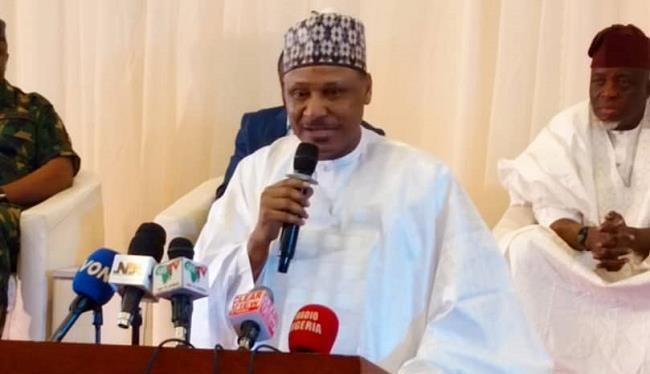
Minister of Information and National Orientation, Mohammed Idris
The study relied on PRrev, an automated AI driven media monitoring and social listening tool developed by IMPR, complemented by human intelligence. It tracked narratives across mainstream and social media relating to security incidents, political developments, economic pressures, religious and ethnic tensions, human rights concerns, misinformation, electoral manipulation, hate speech, and conflict early warning signals. The brief also incorporated regional community listening insights and an assessment of disinformation patterns affecting Nigeria’s socio political landscape.
The 42 page report, produced for Crisis Communication Hub (CCH) stakeholders, analysed conversations on X (formerly Twitter), Facebook, WhatsApp groups, online news platforms, and diaspora driven forums. It found that recent national events are increasingly triggering volatile public reactions shaped by both factual developments and coordinated falsehoods.
A key focus of the analysis was the March 16, 2026, triple suicide bombing in Maiduguri, which occurred just as President Bola Ahmed Tinubu departed for an official visit to the United Kingdom from March 17 to 19. CCC said the overlap of these events created what analysts termed a “leadership legitimacy strain,” with competing narratives dominating public discourse.
One of the strongest narratives online argued that national leaders should prioritise domestic crises over foreign engagements. CCC noted that this sentiment quickly evolved from political commentary into a “viral moral judgement,” blurring the line between opinion and fact.
A major highlight of the report was the uncovering of a high impact disinformation campaign tied to the unfolding events. CCC revealed that PRNigeria’s fact checking team detected a fabricated statement falsely attributed to U.S. President Donald Trump, purportedly criticising President Bola Ahmed Tinubu over his trip to the United Kingdom following the Maiduguri suicide bombings. The fake statement spread rapidly across social media, garnering more than 500,000 views and over 5,200 reposts before corrective information could gain comparable visibility.
CCC warned that the speed, reach, and coordination behind the false narrative reflect the growing sophistication of disinformation networks operating within Nigeria’s digital space.
“The incident represents one of the most consequential disinformation spikes in Nigeria’s emerging 2027 pre election environment,” the report stated.
The analysis also highlighted a widening gap between official communication and public perception, especially during national crises. CCC observed that delayed or inconsistent government responses often create information vacuums quickly filled by speculation, misinformation, and emotionally charged narratives. In today’s hyperconnected environment, the report stressed, timeliness, clarity, and credibility of official communication are critical to shaping public trust.
CCC identified five dominant narrative streams shaping public discourse: leadership accountability versus political loyalty; national security concerns versus diplomatic priorities; public grief amplified by digital outrage; diaspora driven narratives influencing domestic perception; and disinformation campaigns exploiting emotional vulnerabilities.
The Centre warned that the intersection of insecurity, distrust, and disinformation poses a significant threat to national cohesion as political activities intensify ahead of the 2027 elections. CCC cautioned that unchecked fake news could deepen divisions, erode institutional credibility, and undermine democratic processes.
The report called for urgent reforms in Nigeria’s crisis communication architecture, including real-time digital monitoring systems, strengthened fact-checking mechanisms, improved inter-agency coordination, and strategic engagement with media and digital influencers. It also urged stakeholders to prioritise media literacy and public awareness to help citizens identify and resist false information.
CCC concluded that the current media environment offers a preview of the challenges likely to define Nigeria’s pre-election landscape. “The convergence of insecurity, political narratives, and digital misinformation is no longer incidental – it is systemic,” the report warned.
It stressed that without proactive intervention, Nigeria could face a deeper crisis of public trust as the election season approaches. The findings underscore the urgent need for credible, transparent, and technology-driven communication strategies to safeguard national stability in the digital age.
The Executive Secretary of the Nigerian Content Development and Monitoring Board (NCDMB), Felix Omatsola Ogbe, has expressed confidence that the five-star Radisson Hotel and Conference Centre, Yenagoa, Bayelsa State, will be completed and commissioned in December 2026, just as South Africa’s Edison Corporation, incorporating Radisson Hotels Group, assured of world-class services.
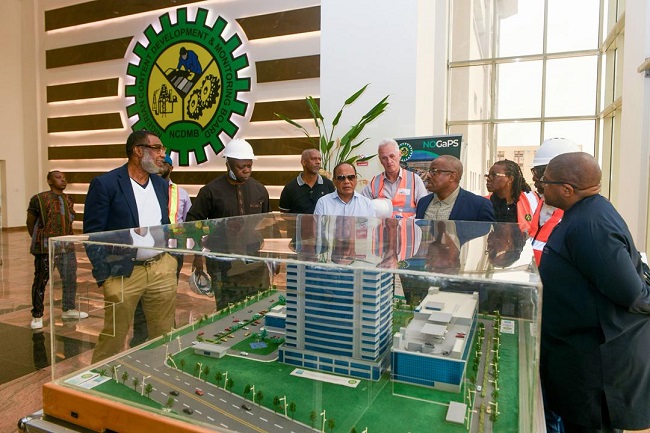
Addressing visiting top executives of Edison Corporation and Megastar Technical and Construction Company, at the conclusion of a one-day project management tour and workshop at the Nigerian Content Tower (NCT), Swali, Yenagoa, on Friday, March 20, 2026, Ogbe described the hospitality facility as a top priority project to the Board, whose progress he would be “following up every day, every week.”
Officials of NCDMB, Edison Corporation and Megastar Technical and Construction Company during the project management tour and workshop
“This project is critical to the Board, critical to Yenagoa, and to Bayelsa State and Nigeria,” he stated, adding, “With this hotel becoming functional at the end of the year, I believe there will be tourism in Bayelsa State; and that’s one of my dreams.” According to him, “When I took up this job (as Executive Secretary in December 2024), I said I must make this hotel work.”
He commended the team from Edison Corporation and the project contractor, Megastar Technical and Construction Company, for the quality and pace of work, and reminded its Management that much responsibility rests on the company for delivery on schedule.
Ogbe said, “Most of the critical aspects of the project have been resolved in terms of mark-up room, scope of work in terms of financing and contracting strategies,” and that he was sure all hands would be on deck to ensure that work proceeded unhampered.
In his own remarks, the Chief Executive Officer of Edison Corporation, Mr. Vivian Reddy, said the team from Edison Hotel Group was very excited to have come into a contractual arrangement with the NCDMB, assuring that “Radisson Hotel and Conference Centre, Yenagoa, will put this place on the world map.”
According to him, “What is so important with the group Radisson International is that, if anyone around the world looks for Radisson Yenagoa, they will see this place pop up, and it’s going to help to uplift the area in terms of visitors and tourism.”
In a brief interaction with media men, he said, “Our role is to make sure we deliver a world-class quality hotel; from start to finish, we will open the hotel; we will furnish it.” He disclosed that his company is working with the main contractor to make sure the facility meets world-class standards.
On how the contractual deal with the NCDMB got finally sealed, he noted that it took great efforts. According to him, “Getting Radisson in here wasn’t easy: It took months and months – in fact over one and a half years – of discussions and thousands of pages of documentation.”
He pointed out that such rigorous processes were not without gains. In his words, “When a group like Radisson, one of the largest hotel groups in the world, decide and commit that they will come in here, it actually is a mark of confidence in the area.”
The Edison boss, who is reputed to be the first South African businessman to lead a high-level business delegation from that country to Nigeria during the tenure of President Thabo Mbeki in 1999, was full of commendation for the NCDMB boss, describing him as “a great visionary, an excellent leader.”
“His vision and dream are going to become a reality,” he assured, adding, “We’re going to help him and make it – and it’s going to be the best hotel in this region.”
He also commended the project contractors and professional teams involved, stating that his team has every confidence in their technical competence.
On the team of Edison Corporation and Radisson International were Brian Sibusiso Mpono and Govindasami Monogren, among others.
The Radisson Hotel and Conference Centre, Yenagoa, as the NCDMB explained in a statement by the General Manager, Corporate Communications Division, Dr. Obinna Ezeobi, is designed to meet global five-star standards and is expected to serve as a strategic hub for industry conferences, investor engagements, and high-level business meetings, thereby boosting economic activities in Bayelsa State and the Niger Delta.
As Europe seeks diversified and lower-carbon energy supplies, emerging electricity interconnections and gas infrastructure across North Africa – including Libya’s grid ambitions – are drawing investor attention ahead of the Invest in African Energy Forum in Paris
For decades, Europe’s energy relationship with North Africa has centered primarily on hydrocarbons – Algerian pipeline gas, Libyan oil and LNG shipments from the Mediterranean basin. At the same time, another energy link is gaining momentum: electricity.
With growing renewable capacity, expanding transmission networks and new cross-Mediterranean interconnectors under development, North Africa’s power sector is emerging as a strategic complement to Europe’s energy system.
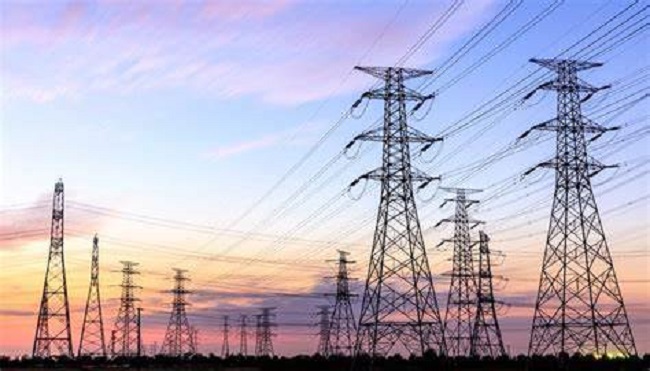
Power grid lines
The trend is already visible in major infrastructure projects linking the two regions. The ELMED interconnector, a planned high-voltage subsea cable connecting Tunisia to Sicily, will allow bidirectional electricity flows between the African and European grids when it comes online later this decade. The project will transmit up to 600 MW of power through a 220-km cable, helping integrate North African electricity markets with Europe and enabling exports when surplus generation is available.
Libya’s Untapped Electricity Potential
Libya’s electricity sector remains largely domestically focused today, but the country sits at the centre of a potential North African power corridor. Discussions between Libya, Algeria and Tunisia have already explored an “electric corridor” project linking their grids, a step that could eventually connect with broader Mediterranean power systems feeding into Europe.
Such initiatives would allow electricity generated in North Africa – whether from gas-fired plants, renewables or hybrid systems – to flow across borders and ultimately toward European markets. For Libya in particular, electricity exports could complement its longstanding role as a hydrocarbon supplier to Europe.
The country already holds substantial gas resources and power-generation capacity, much of which is fueled by domestic natural gas. With targeted investment in grid modernisation, renewable integration and regional transmission infrastructure, Libya could evolve into a flexible power exporter within a wider Mediterranean electricity market.
Complementing LNG With Power
Electricity trade does not replace Africa’s LNG expansion – it complements it. Across the continent, gas developments in countries such as Mozambique, Senegal-Mauritania and Nigeria are strengthening Africa’s position in global LNG supply chains.
North Africa’s electricity ambitions add another layer to this energy relationship. Gas-fired generation can provide stable baseload power for export through cross-Mediterranean cables, while renewables help reduce emissions intensity and align with Europe’s decarbonisation targets.
For European buyers facing volatile energy markets and geopolitical supply risks, this hybrid model – LNG imports paired with electricity interconnections – offers diversification across both fuels and delivery systems.
New Opportunities for Energy Investors
These developments are set to inform discussions at the upcoming Invest in African Energy Forum (IAE) in Paris, where government officials, utilities and infrastructure investors will assess emerging cross-border energy opportunities. Participation from the Renewable Energy Authority of Libya, including Chairman Dr. Abdulsalam Elansari, signals growing Libyan interest in positioning the country within this evolving regional power landscape.
For investors, the appeal lies not only in generation projects but also in the infrastructure connecting them: high-voltage transmission lines, subsea cables, storage systems and grid modernization.
Electricity trade between North Africa and Europe remains at an early stage, but the foundations are forming rapidly. As Europe accelerates its search for diversified and lower-carbon energy sources, North Africa’s combination of gas resources, solar potential and geographic proximity could transform the region into a strategic electricity partner.
If the current wave of interconnectors and regional grid initiatives succeeds, the Mediterranean may soon carry not only pipelines and LNG tankers – but high-voltage power as well. And for investors gathering in Paris, that emerging electricity corridor could become one of the most compelling energy stories linking Africa and Europe.
The Nigerian Meteorological Agency (NiMet) has predicted sunshine and cloudiness from Sunday, March 22 to Tuesday, March 24, 2026, across the country.
The weather outlook released by NiMet on Saturday, March 21 in Abuja envisaged sunny skies over the northern region throughout the forecast period.
According to the agency, sunny skies with patches of clouds are expected over the North Central region throughout the day.
Cloudy weather
It forecast isolated thunderstorms with or without rain over parts of Kogi, Niger, the Federal Capital Territory, Nasarawa and Kwara states during the day.
Cloudy conditions with intervals of sunshine are anticipated across the southern region, with prospects of isolated thunderstorms accompanied by light rain over parts of Lagos, Ondo, Ogun, Delta and Cross River states during the morning hours.
Later in the day, thunderstorms with moderate rain are expected over parts of Ondo, Ogun, Ekiti, Osun, Edo, Imo, Enugu, Abia, Anambra, Bayelsa, Rivers, Akwa Ibom and Delta states.
According to the agency, sunny skies are anticipated over the northern region throughout the forecast period on Monday, with prospects of isolated thunderstorms over parts of southern Taraba State.
NiMet predicted sunny skies over the North Central region with patches of clouds, with chances of thunderstorms accompanied by light rain over parts of Kogi and Nasarawa states in the morning period.
It added that isolated thunderstorms with moderate rain are expected over parts of Benue State later in the day.
Cloudy conditions with intervals of sunshine are anticipated across the southern region, with prospects of isolated thunderstorms accompanied by light rain over parts of Bayelsa, Akwa Ibom, Ondo, Delta, Lagos, Ogun, Edo and Cross River states during the morning hours.
Later in the day, thunderstorms with moderate rain are expected over parts of Lagos, Ondo, Ogun, Ekiti, Osun, Oyo, Imo, Enugu, Abia, Anambra, Ebonyi, Edo, Bayelsa, Rivers, Akwa Ibom, Cross River and Delta states.
NiMet predicted sunny skies over the northern region on Tuesday during the forecast period.
According to the agency, sunny skies with patches of clouds are anticipated across the North Central region during the morning hours.
Later in the day, isolated thunderstorms with light rain are expected over parts of the Federal Capital Territory, Plateau and Niger states.
Cloudy conditions with intervals of sunshine are anticipated across the southern region, with prospects of isolated thunderstorms accompanied by light rain over parts of Lagos, Rivers, Akwa Ibom, Bayelsa, Delta, Edo and Cross River states during the morning hours.
Later in the day, thunderstorms with moderate rain are expected over parts of Ondo, Edo, Imo, Bayelsa and Delta states.
According to the agency, strong winds may precede thunderstorms in areas where they are likely to occur; hence, the public is advised to take adequate precautions.
It further advised the public to ensure that loose objects are secured to avoid collisions.
“Driving under heavy rain should be avoided. Disconnect electrical appliances from sockets. Stay away from tall trees to avoid impact from falling branches and broken trees.
“Temperatures are expected to remain high, causing thermal discomfort. The public is advised to wear breathable clothing, stay in well-ventilated environments and remain hydrated.
“Airline operators are advised to obtain airport-specific weather reports (flight documentation) from NiMet for effective operational planning,” it said.
The agency urged residents to stay informed through weather updates from NiMet via its website: www.nimet.gov.ng.
Director-General of the Forestry Research Institute of Nigeria (FRIN), Prof. Zachariah Yaduma, says Nigeria holds over 10.6 million hectares of forests with vast economic potential.
This is contained in a statement on Saturday, March 21, 2026, by his media aide, Idara Umoh-Ido, marking the International Day of Forests and World Wood Day.
The International Day of Forests is observed annually on March 21 to highlight the importance of all forest types.
Director-General, Forestry Research Institute of Nigeria (FRIN), Prof. Zachariah Yaduma
The 2026 theme, “Forests and Economies”, underscores the critical role forests play in driving economic growth and sustainable development.
Yaduma said forests extend beyond income and jobs, sustaining agriculture, improving productivity, and protecting vital watersheds for communities nationwide.
He, however, lamented that current approaches capture only a fraction of forests’ economic and environmental potential.
According to him, FRIN has advanced conservation, research and community engagement, laying foundations for an inclusive and sustainable green economy.
“The 2026 theme resonates with national aspirations. We are at the forefront of a transformative vision to unlock forests’ economic potential,” he said.
Yaduma, also Chair of the Man and Biosphere Committee in Nigeria, said FRIN was pursuing UNESCO Biosphere Reserve status for key forest reserves.
These include Shere Hills, Omo and Oban reserves in Plateau, Ogun and Cross River states, respectively.
He said the initiative would promote harmony between biodiversity conservation and sustainable economic development.
“The activation of Nigeria’s National Carbon Market framework positions the country as an emerging player in the global carbon economy,” he said.
He added that it creates direct financial incentives for reforestation and conservation nationwide.
“FRIN’s scientific data, monitoring protocols and verified planting stock are vital for attracting climate finance and maintaining global credibility,” Yaduma said.
He said the era of extractive economies was waning, replaced by innovation, regeneration and shared prosperity driven by green growth.
“It is now incumbent on policymakers, the private sector and citizens to transform forests into engines of future economic growth,” he said.
Yaduma urged collective action, saying FRIN’s efforts have laid a strong foundation for a sustainable and greener Nigeria.
“As we commemorate the Day, Nigerians must protect forests and their resources, which remain essential from cradle to coffin,” he added.
The Nigerian Institution of Surveyors (NIS) has identified inadequate land data and skill gaps in sustainability as key limitations faced by land surveyors while discharging their duties in Nigeria.
The institute also listed poor public recognition and lack of multi sectoral growth for robust practice among the challenges faced by practitioners.
Pius Eze, NIS President, made these known on Saturday, March 21, in Abuja at a rally to commemorate the 2026 Global Surveyors’ Day with the theme, “Surveyors’ Challenges in Multi-Sectorial Growth”.
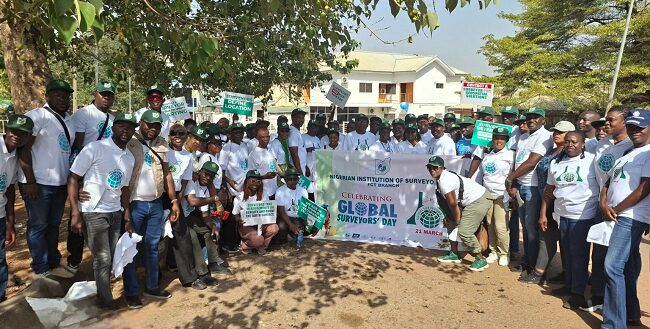
NIS members in Abuja at a rally to commemorate the 2026 Global Surveyors’ Day
According to him, surveyors’ work defines locations, boundaries, builds infrastructure, and drives progress.
This, he said, was by providing data for planning purposes and decision making at all levels by governments, captain of industries for any meaningful and sustainable developments.
In addressing the challenges, Eze advocated capacity building and multi-sectorial collaborations for development
“The multi sectoral approach in our Profession is the only way to guarantee robust practice, achieve the intents of Survey Coordination Act, creation of National Survey Data Bank, to be called ‘The Survey of Nigeria’.
“This is for planning, decision making and national development,” he said.
Eze said that the challenges notwithstanding, NIS believed in creating technology and service delivery that would not just meet today’s demands but sets the stage for tomorrow’s possibilities.
He, therefore, enjoined all surveyors to regularly equip themselves with deserving intellect and tools that would empower them, simplify their workflows, and maximise their productivity.
“Be assured, NIS is committed to building the foundation for the next generation of Surveying excellence,” he said.
Eze explained that the Global Surveyors Day remarkably celebrated annually every March 21, aimed to recognise the vital contributions of surveying and geo-informatics to the society.
He said that the Day, initiated in 2018 by the International Federation of Surveyors (FIG), highlighted the profession’s role in shaping communities, pioneering technologies and tactical security response.
The president added that it also highlighted academic research, maritime and blue economy initiatives, oil and natural resources, digital mapping and supporting sustainable development worldwide.
Also speaking, the Chairman of the NIS, Federal Capital Territory branch, Yakubu Atanda, noted that NIS contributes to national security and development through mapping and data generation.
Atanda stressed the importance of collaboration between citizens and government in land management.
He acknowledged improvements in the enabling environment for surveyors and stressed the need for greater cooperation between stakeholders to enhance national development.
He noted that surveyors operate across multiple sectors, including the military, security agencies, and civil institutions, contributing significantly to national planning and security architecture.
Atanda expressed optimism that ongoing mapping and geospatial initiatives would help address developmental challenges and improve decision-making processes across the country.
He also called on citizens to respect land use regulations, warning that encroachment on designated lands delays development and complicates government projects.
In her remarks, Dr Charity Olla, a fellow of the institution, praised surveyors as unsung heroes behind Nigeria’s infrastructure and security systems.
Olla noted that their work ensures land ownership security, disaster mitigation through floodplain mapping, and precision in military and aviation operations.
“Behind every road, every building, and every navigation system are surveyors whose efforts often go unnoticed.
“Without proper land titles and accurate mapping, development and security would be impossible.”
Olla, however, raised concerns about the safety of surveyors in the field, citing incidents of harassment, assault, and theft of equipment.
She called for improved security measures and insurance coverage for professionals operating in high-risk environments.
She also addressed gender inclusion in the profession, noting that women surveyors were increasingly making significant strides.
She said that through initiatives like Women in Surveying, the institution is promoting the profession to younger generations and encouraging more female participation.
Speech by Rep. Sir Sam Ifeanyichukwu Onuigbo FCIS, FNIM, KJW (Odozi obodo Gburugburu) declaring his intention to contest for the Abia Central Senatorial Seat in the Senate of Federal Republic of Nigeria on the platform of All Progressives Congress (APC) in the 2027 National Assembly election on Friday, March 20, 2026, at Odoziobodo Hills Obuohia Obi Ibere, Ikwuano LGA, Abia State
Time to Invest Experience in Renewed Hope.
My dear good people of Abia Central Senatorial District, it is with great sense of responsibility and historical imperative that I stand here before you to declare my intention to contest the Abia Central Senatorial seat in the Senate of the Federal Republic of Nigeria in next year’s general election.
Rep. Sam Onuigbo
I have consulted with my immediate family, friends and associates on this historic decision. This gathering of my extended political family and leaders of our great party, the APC, is part of this ongoing conversation to engender commonality of understanding and ensure that we embark on this journey as a united family.
Right from my early life journey, I have always dedicated my attention on how to render service. This is supported by the motto of my organisation; Odoziobodo which is Service to Humanity.
This knack for leadership through humble service found concrete expression in my nearly 18 years of unbroken and meritorious service with the US Embassy (Consulate General) in Lagos.
That diplomatic environment was the precursor to my community development vision and the actions that followed. It was there that I was first elected in December 1991 and inaugurated in February 1992 to represent quality people at the US Mission to Nigeria like the great people of Abia Central.
Recall that I had my humble beginnings around this Odozi Obodo Hills – not far from this spot. I hunted rats, squirrels and other animals in the surrounding bush. It was also here that I trekked a total of 12 kilometres a day going and returning from school, felt the pain of doing so and wondered what the future would hold. Never did I know at the time that these experiences would crystalise or mould my understanding of life, and the drive to be of service to humanity.
That experience led to my decision to attract some classroom blocks to my alma mater , Community Primary School Obuohia Obi Ibere, from the United States’ Consulate.
Although the construction of classroom blocks was not the equivalent of constituency projects, that effort came as part of sustained advocacy and pressure on the US Embassy to ease the congestion of Primary School children in my local community.
I also conceived the plan to attract to my community a secondary school to ease the suffering of future generation of students and overcome the suffering of trekking more than 12 kilometres in their bid to access secondary education like I did during my time. I brought US Ambassador in Nigeria to lay the foundation of Ambassador’s College in this village. This College has stood the test of time, and it is still standing today to the glory of God.
Apart from the classroom blocks and secondary school I attracted to the community, my 18 years’ stint as a staff of the United States Consulate in Lagos helped me to hone skills in public policy, as well as hands-on experience in diplomatic, legislative, and policy leadership experience across governance and international cooperation.
With due respect, I make bold to say that riding on these unparalleled skills acquired at the US Embassy in various positions of Supervisory Fraud Prevention Specialist, I was privileged to serve Abia State meritoriously as Commissioner for Lands & Survey (2011–2012) and Finance (2012–2013), respectively.
My journey towards excellence in public service also led me to Special Adviser on Public Affairs to the Honourable Speaker of the House of Representatives during the 6th National Assembly.
As God will have it, at about this time in 2015, I was elected to represent the good people of Ikwuano/Umuahia North and Umuahia South Federal Constituency in the House of Representatives for two consecutive terms (2015–2019; 2019–2023). To date, I was the representative to have been re-elected in this great federal constituency.
In 2020, when some people decided to play god, I identified myself with the dire need for progressive politics and moved from Peoples Democratic Party (PDP) to the All Progressives Congress (APC). It was a great show of political foresight, because in recent times, most of those who celebrated impunity in PDP have found their way into APC or somewhere else. I feel vindicated, not only because these power mongers have seen what I saw like John the Baptist, but above all, that the present times and season dictate that honour should be placed beyond political expediency.
By declaring for the Senate contest, I wish to assure you, my people; that I will always reflect humility, integrity, honour and diligence in the work of representing you. I have shown myself a good ambassador to our community, state and people by the string of excellent record of achievements in my previous assignments.
For instance, today, the singular signature legislation that catapulted Nigeria into global reckoning in sustainability was sponsored by me, your son. As a result of that unique achievement, many domestic and international organisations have recognised me with various honours and awards.
I say these with every sense of modesty, but most importantly to put it on record that the mandate I seek as your Senator is not for selfish aggrandisement.
Rather, I feel elated that I am not only doubly qualified to serve our zone as Senator, but also confident to bring you honour and accomplished representation. I am bold to say that my journey to the Nigerian Senate is to invest my rich experience and reflect hope as enacapsulated in the Renewed Hope Agenda of our leader, President Bola Ahmed Tinubu GCFR.
I wish to state that the consolidation of the Renewed Hope Agenda is predicated on the preponderance of qualitative lawmakers in the 11th National Assembly. Consequently, Abia State, as God’s Own State, cannot afford to send intellectual Lilliputs, or persons of doubtful pedigree to the next star-studded National Assembly being envisaged by Nigerian nation led by President Tinubu and Nigerians.
What this calls for is that only those that have been tried, tested and not found wanting, either in character, carriage and comportment deserve your support to represent Abia Central Senatorial Zone in the 11th Senate.
Let me use this opportunity to thank the leaders and members of Abia Central chapter of APC for supporting me to fly the party’s flag in 2023. I commend you immensely for that stalwart, because it confers on me the right of first refusal and defending champion in the forthcoming Senatorial poll come January 8, 2027.
I have continued to engage in issues of national and international importance to buttress the fact that I possess the strong voice and network to represent Abia Central Senatorial Zone in the Red Chamber come June 2027.
My excellent people of Abia Central, while the coming election season provides opportunity for many individuals to show up in search of your mandate, please do well to base your consideration on proven track records on personal integrity and sense of responsible performance.
If supported to represent our zone in the Senate, I will ensure that every ward, state constituency and local government will serve as fulcrum of representation through a seamless constituency consultation strategy.
I have produced a small magazine to serve as a brief outline of what I have been able to do in the past, believing accountability should be the watchword of every ing more than 12 kilometres in their bid to access educational facility.
Apart from the classroom blocks and secondary school I also attracted a Secondary School to my community to ease the pain of students who had trek 12 kilometres to and from school every schoolday, my 18 years’ stint as a staff of the United States Consulate General in Lagos helped me to hone skills in public policy, as well as hands-on experience in diplomatic, legislative, and policy leadership experience across governance and international cooperation.
With due respect, I make bold to say that riding on these unparalleled skills acquired at the US Embassy in various positions of Supervisory Fraud Prevention Specialist, I was privileged to serve Abia State meritoriously as Commissioner for Lands & Survey (2011–2012) and Finance (2012–2013), respectively.
My journey towards excellence in public service also led me to Special Adviser on Public Affairs to the Honourable Speaker of the House of Representatives during the 6th National Assembly.
As God will have it, at about this time in 2015, I was elected to represent the good people of Ikwuano/Umuahia North and Umuahia South Federal Constituency in the House of Representatives for two consecutive terms (2015–2019; 2019–2023). To date, I was the only representative to have been re-elected in this great federal constituency.
In 2020, when some people decided to play god, I identified myself with the dire need for progressive politics and moved from Peoples Democratic Party (PDP) to the All Progressives Congress (APC). It was a great show of political foresight, because in recent times, most of those who celebrated impunity in PDP have found their way into APC or elsewhere. I feel vindicated, not only because these power mongers have seen what I saw like John the Baptist, but above all, that the present times and season dictate that honour should be placed beyond political expediency.
By declaring for the Senate contest, I wish to assure you, my people; that I will always reflect humility, integrity, honour and diligence in the work of representing you. I wish to restate that I will continue to run on my principle of EAR – Effectiveness, Accessibility, and Responsiveness. I have shown myself a good ambassador to our community, state and people by the string of excellent record of achievements in my previous assignments.
I have listed below just a few of the projects that I facilitated to our federal constituency and state when I represented the people of great Ikwuano/Umuahia North and Umuahia South Federal Constituency.
Additionally, in my two terms in the House of Representatives, I moved critical motions for the benefits of my constituents and wider Nigerians. I attracted and executed many projects in Ikwuano/Umuahia North/South Federal Constituency of Abia State. The communities that were impacted by these projects are here today and can testify. Such projects included:
● Rehabilitation of the failed sections of the Umuahia-Ikwuano-Ikot Ekpene federal road in December 2016 to April, 2017;
● The ongoing total reconstruction of the Umuahia-Ikwuano-Ikot Ekpene federal road awarded in 2019;
● The facilitation of the design of the Umuahia-Umudike 16 Kilometres Dualization Project with an interchange (flyover) from Amachara to Ossa Ibeku;
● Facilitation of the construction of a Federal Secretariat to Abia State after 34 years of its creation;
● Erosion control work at Ukwudara Amankwo Ezeleke, Amachara, Umuopara in Umuahia South LGA;
● Erosion control works at Okweukwu Oboro-Obuohia Road in Ikwuano LGA;
● Major electricity project at Usaka and so many other projects that can be verified.
The restoration in 2025 of the delisted Management Sciences Courses from Michael Okpara University of Agriculture Umudike (MOUAU) since 2016/2017
Additionally, today, the singular signature legislation that catapulted Nigeria into global reckoning in sustainability was sponsored by me, your son. As a result of that unique achievement, many domestic and international organisations have recognised me with various honours and awards.
I say these with every sense of modesty, but most importantly to put it on record that the mandate I seek as your Senator is not for selfish aggrandisement.
Rather, I feel elated that I am not only doubly qualified to serve our zone as Senator, but also confident to bring you honour and accomplished representation. I am bold to say that my journey to the Nigerian Senate is to invest my rich experience and reflect hope as enacapsulated in the Renewed Hope Agenda of our leader, President Bola Ahmed Tinubu GCFR.
I wish to state that the consolidation of the Renewed Hope Agenda is predicated on the preponderance of qualitative lawmakers in the 11th National Assembly. Consequently, Abia State, as God’s Own State, cannot afford to send intellectual Lilliputs, or persons of doubtful pedigree to the star-studded National Assembly being envisaged by Nigerians and President Tinubu.
What this calls for is that only those that have been tried, tested and not found wanting, either in character, carriage and comportment deserve your support to represent Abia Central Senatorial Zone in the 11th Senate.
Let me use this opportunity to thank the leaders and members of Abia APC, especially Abia Central chapter of our great party for supporting me to fly the party’s flag in 2023. I commend you immensely for that stalwart, because it confers on me the right of first refusal and defending champion in the forthcoming Senatorial poll come January 8, 2027.
I have continued to engage in issues of national and international importance to buttress the fact that I possess the strong voice and network to represent Abia Central Senatorial Zone in the Red Chamber come June, 2027.
My excellent people of Abia Central, while the coming election season provides opportunity for many individuals to show up in search of your mandate, please do well to base your consideration on proven track records on personal integrity and sense of responsible performance.
After nearly 27 years of unbroken democratic dispensation, Nigerians should be able to elect leaders who deserve to lead them based on their verifiable track records of genuine and transparent accomplishments.
If supported to represent our District in the Senate, I will ensure that every ward, state constituency and local government will serve as fulcrum of representation through a seamless constituency consultation strategy.
I have produced a small magazine to serve as a brief outline of what I have been able to do.
Renevlyn Development Initiative (RDI), an environmental non-governmental organisation, has called on the federal and state governments to adopt gender-responsive approaches in tackling Nigeria’s water challenges.
The organisation made the call in a statement by its Project Officer, Tracy Ohovwore, on Saturday, March 21, in Lagos to mark the 2026 World Water Day, commemorated annually on March 22.
Ohovwore said the call aligns with this year’s theme, “Water and Gender,” and its campaign slogan, “Where water flows, equality grows,” which highlights the link between water access and gender equality.
Prof. Joseph Utsev, Minister of Water Resources and Sanitation
She noted that the global commemoration, led by UN Women and UNICEF, underscored how water inequality disproportionately affects women and girls.
According to her, the 2026 theme reflects the realities faced by women and girls in Nigeria and across the Global South, particularly the physical and mental strain associated with sourcing water.
She said in many communities, women and girls bear the burden of water scarcity.
“The daily drudgery women and the girl child contend with due to dry taps in their communities is real.
“This situation is not limited to rural areas alone; it is also prevalent in cities like Lagos and Abuja,” she said.
Ohovwore added that the situation exposes women and girls to risks and, in many cases, deprives the girl-child of access to education.
She noted that lack of access to water affects women’s hygiene, increasing their vulnerability to diseases.
Ohovwore said it aligned with global recommendations that women and girls should be placed at the centre of water solutions to achieve key Sustainable Development Goals, including Goal 5 on gender equality and Goal 6 on clean water and sanitation.
She urged governments at all levels to move beyond rhetoric and adopt deliberate, gender-sensitive policies covering water governance, management, and infrastructure development.
The President, Association of Waste Managers of Nigeria, Dr Olugbenga Adebola, says global recycling economy will reach $4.5 trillion by 2030.
Adebola, who disclosed this in an interview on Saturday, March 21, 2026, in Lagos, said the projection highlights vast investment opportunities in recycling and circular economy, especially for rapidly growing cities like Lagos.
He described waste management as capital-intensive, requiring huge investments across bins, collection logistics, and processing infrastructure such as material recovery and waste-to-energy facilities.
Mr. Olugbenga Adebola, President of Association of Waste Managers of Nigeria (AWAMN)
According to him, high inflation, rising fuel costs, and expensive financing significantly increase operational costs for investors in the sector.
He noted that recycling infrastructure demands higher upfront investment but offers long-term economic and environmental benefits compared to landfill management.
“Waste is not a social service. Investors must recover costs within a reasonable timeframe,” he said.
Adebola stressed that effective waste collection and segregation remain critical to achieving a functional circular economy.
He disclosed that private operators in Lagos have created over 26,000 jobs, spanning formal and informal sectors, including waste pickers and recyclers.
The expert added that efforts were ongoing to formalise thousands of informal waste workers to improve livelihoods and efficiency.
On environmental impact, he warned that poor waste disposal contributes to flooding, groundwater pollution, and microplastic contamination in oceans.
He said recycling helps reduce environmental degradation and promotes sustainability across urban centres.
Adebola, however, said Nigeria’s major challenge lies not in policy formulation but weak enforcement and poor implementation.
He urged regulators, including Lagos Waste Management Authority, to strengthen monitoring and enforcement mechanisms.
He called for enabling policies such as long-term concessions, infrastructure support payments, and cost-reflective tariffs to attract investment.
Adebola also advocated enforcement of the polluter-pays principle to ensure financial sustainability in the sector.
He stressed the need for public awareness campaigns to change perception and encourage viewing waste as a valuable resource.
On future prospects, he described Nigeria’s rising population as an opportunity to harness increased waste generation for economic value.
Adebola recommended waste traceability systems to ensure accountability among generators and operators.
He identified key challenges as high interest rates, lack of green financing, policy inconsistency, and bureaucratic bottlenecks.
Adebola commended the Lagos State Governor, Mr Babajide Sanwo-Olu, for the ongoing reforms and urged other states to prioritise sustainable waste management.
He reiterated that waste should be treated as a resource capable of driving economic growth and environmental sustainability.
The Nigerian Conservation Foundation (NCF) has decried the continued depletion of Nigeria’s forests as the world commemorates the International Day of Forests, calling for an urgent practical solution to save the country’s most critical natural asset.
This year’s International Day of Forests theme, “Forests and Economies,” underscores the critical role forests play not only in environmental sustainability but also in driving livelihoods, economic resilience, and national development.
Nigeria’s forests are in a critical state of decline, marked by one of the highest deforestation rates in the world. The country loses an estimated 400,000 hectares of forest annually, driven largely by illegal logging, agricultural expansion, and urbanisation.
Forest ecosystems
Over the past three decades, the country has lost nearly 90% of its forest cover, leaving only a fraction of its original forest landscape intact. Today, less than 10% of the country’s original forest cover remains, highlighting the urgent need for large-scale restoration and sustainable forest management interventions.
A significant proportion of Nigerians rely on fuelwood and charcoal for daily energy needs, placing immense pressure on remaining forest reserves. Beyond energy, forests support agriculture, regulate water systems, and provide raw materials and income for millions, particularly in underserved communities. Yet, despite their immense economic value, forests remain one of the most undervalued natural assets in Nigeria’s development planning.
Despite ongoing efforts from government and various stakeholders pushing for stronger measures, significant challenges remain. Illegal logging, weak enforcement of environmental regulations, increasing demand for land and energy, and limited investment in restoration continue to drive forest loss across the country. Without urgent and coordinated action, the long-term economic and ecological costs could be severe.
Dr. Joseph Onoja, Director General of NCF, said, “We all know and agree that forests are vital for life on Earth, producing oxygen and absorbing carbon dioxide, which helps combat climate change. They host most of the planet’s land biodiversity, regulate water cycles, protect soil, and provide essential resources like timber, food, medicine, and livelihoods for millions.
“The question remains: why are we destroying the very systems that sustain us? Isn’t it our duty to protect the lungs of our planet and preserve the natural beauty that’s been gifted to us? We would be doing ourselves a great service if we left the forest alone and stopped the criminal and indiscriminate exploitation of our forests that’s causing irreversible environmental damage.”
NCF has implemented a range of interventions aimed at reversing forest loss and promoting sustainable livelihoods, such as the Green Recovery Nigeria Programme – a flagship national initiative aimed at restoring Nigeria’s forest cover to 25% by 2047. In 2025 alone, NCF with support from its partners planted 265,561 trees across various ecosystems.
Other initiatives include community-based forest management programmes, biodiversity conservation efforts, forest reserve project management and strategic partnerships with government and the private sector to promote sustainable land use practices while creating alternative livelihood opportunities that reduce dependence on unsustainable forest exploitation.
NCF calls on government at all levels to strengthen forest governance, enforce existing environmental laws, and increase budgetary allocations for forest conservation and restoration. The Foundation urges the private sector to invest in sustainable practices and nature-based solutions as nature provides essential resources, regulates climate, and supports agriculture, tourism, and innovation, making it crucial for businesses.
Communities and individuals are encouraged to play their part by supporting tree planting initiatives, adopting sustainable resource use practices, and raising awareness about the importance of forest conservation.
NCF reaffirms its commitment to working with all stakeholders to ensure that forests continue to provide ecological and economic benefits for present and future generations.