As Africa moves into 2026, the continent is quietly becoming one of the most consequential battlegrounds for the future of tobacco harm reduction. With a fast-growing population, limited healthcare capacity, and millions of adult smokers, policy decisions taken in the next year will determine whether smoking declines rapidly or remains entrenched for decades.
Across the continent, tobacco control is strengthening. Taxes are rising, smoke-free laws are expanding, and public awareness of smoking harms is improving. Yet one reality remains unchanged: cigarettes still dominate nicotine consumption. The question for 2026 is whether African governments will begin to actively enable safer alternatives or continue regulating all nicotine as if risk were equal.
Residue from tobacco smoke can end up in indoor air even in nonsmoking spaces
A Shift from ‘Control Only’ to Risk-Proportionate Policy
In 2026, the most important trend to watch is the growing tension between traditional tobacco control and modern harm-reduction approaches. While many African countries remain cautious about vaping, heated tobacco, and oral nicotine products, regulatory silence is no longer sustainable. These products are already in the market, legally or otherwise.
Policymakers are increasingly confronted with a choice: regulate safer nicotine products to displace smoking, or leave adult smokers with only combustible options while illicit markets expand.
Countries that adopt risk-proportionate regulation, distinguishing cigarettes from significantly lower-risk alternatives, will likely see faster declines in smoking prevalence and reduced long-term healthcare costs.
Country Signals to Watch in 2026
South Africa will remain the regional bellwether. Its proposed tobacco legislation could set a precedent for how emerging nicotine products are treated across Southern Africa. Whether the law differentiates risk levels or regulates all products identically will be closely watched by regulators, industry, and advocates alike.
Kenya represents a market of opportunity constrained by policy uncertainty. Vaping and oral nicotine products exist but remain expensive and inconsistently regulated. In 2026, tax reform and clearer product standards could unlock harm reduction as a genuine smoking-cessation pathway rather than a niche consumer option.
Nigeria, Africa’s largest market, remains largely unregulated when it comes to novel nicotine products. This regulatory vacuum presents both risk and opportunity. A science-based framework could rapidly position Nigeria as a continental leader in pragmatic tobacco control, or, if delayed, allow informal markets to dominate.
Zambia highlights the challenge of over-restriction. High taxes or bans on safer alternatives may protect public health in theory, but in practice risk preserving cigarette dominance. In 2026, pressure will grow for evidence-based reassessment.
The Bottom Line
Africa’s tobacco control story is no longer just about reducing smoking, it is about how fast and how effectively that reduction happens. Tobacco harm reduction is not a replacement for tobacco control; it is its most underused accelerator.
In 2026, the countries that move beyond ideology and regulate nicotine based on risk will define the next chapter of African public health. Those that do not may find that cigarettes remain the default, not by choice, but by policy design.
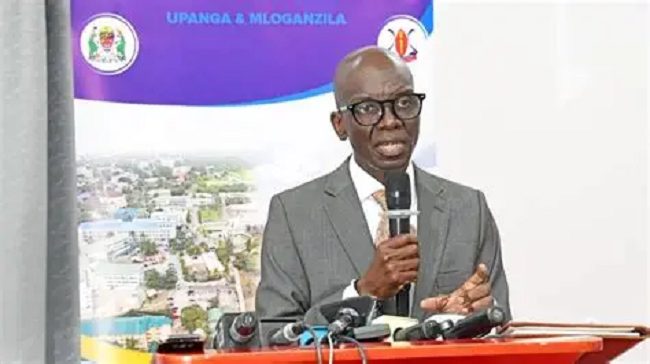
Health analysts say the reform agenda unveiled by the World Health Organisation (WHO) Regional Director for Africa, Dr Mohamed Janabi, signals an important shift in how African countries prepare for disease outbreaks.
According to them, it will also help strengthen routine health services, particularly in Nigeria.
The analysts said this in an interview on Saturday, January 3, 2026, in Abuja.
Dr Mohamed Janabi, WHO Regional Director for Africa
Janabi said Africa must prioritise early detection of outbreaks, stronger primary healthcare (PHC) systems and regional manufacturing of vaccines and medical commodities to reduce dependence on emergency responses.
He warned that delayed reporting and weak laboratory systems had contributed to the wider spread of infections across the continent, noting that preparedness should no longer rely on funding that only increases during crises.
“Africa has learned repeatedly that delayed action is costly. If we strengthen systems early, we reduce the severity of the shocks that follow,” he said.
Dr Ishaku Akyala, an Associate Professor of Infectious Diseases at Nasarawa State University, said that the blueprint was particularly relevant to Nigeria, which continued to battle recurring outbreaks such as Lassa fever, cholera and diphtheria, alongside a growing burden of non-communicable diseases.
Akyala noted that Janabi’s emphasis on district-level surveillance, real-time data, laboratory readiness and reliable electricity in health facilities aligned with Nigeria’s ongoing efforts to modernise disease intelligence systems.
According to him, the approach could help the country detect outbreaks earlier, reduce response delays and limit both economic and human losses.
Janabi identified PHC as the strongest lever for improving public health in Africa, warning that heavy investment in tertiary care at the expense of community-level services leaves millions exposed to out-of-pocket health expenditure.
“If we strengthen the foundations, everything upstream becomes more efficient,” he said.
Meanwhile, Dr Samuel Eleojo, a Public Health Expert, said that this supported Nigeria’s plans to revitalise PHC centres, expand health insurance coverage and scale up community-level care through initiatives such as the Basic Health Care Provision Fund.
Janabi also called for increased local manufacturing of vaccines, diagnostics and medicines, saying Africa must not continue to depend almost entirely on foreign supply during global emergencies.
He said coordinated procurement, regulatory harmonisation and sustained financing were needed to make regional production viable.
Eleojo said that Nigeria would benefit from such reforms through its ongoing national vaccine manufacturing and pharmaceutical sector revitalisation initiatives.
Janabi further acknowledged funding pressures within WHO Africa and pledged reforms to make country offices more responsive, technically strong and accountable to member states.
He said WHO Africa would continue to support governments to shift from a crisis-driven response to a predictable, long-term system strengthening.
“The momentum is there. Our task is to turn promising progress into standard practice,” he said.
Observers said that the blueprint challenged Nigeria to sustain health financing, improve coordination, strengthen PHC delivery and invest in early warning systems to ensure resilience against shocks such as pandemics, climate-related disease spread and economic strain.
They noted that full implementation would help Nigeria move toward routine readiness, protecting households from catastrophic health spending and strengthening health security.
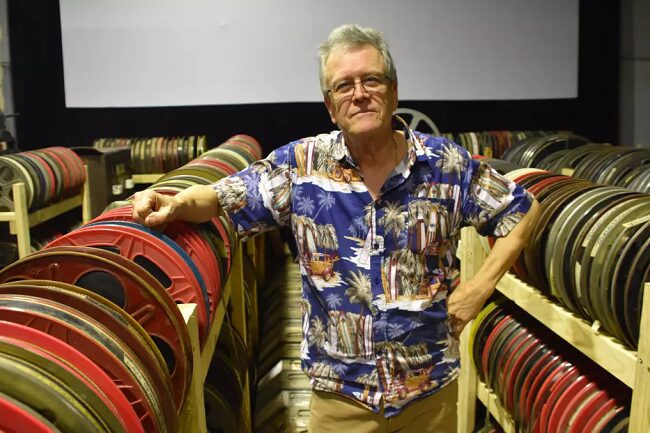
A Chicago filmmaker decided to create a classroom in Africa, where he shares his knowledge and insight with wildlife conservationists in Rwanda and Uganda.
The images they’ve captured are wonderful; the gaze of a gorilla, a hidden herd of hippos. But the people behind the cameras are not professionals.
“These are the people on the front lines of wildlife management,” said filmmaker David McGowan. “They’ll see things other people won’t see because they’re there all the time, and it’s only fair – they want to have a voice in the discussion too.”
David McGowan
As much as a voice, McGowen wanted them to have “the eyes,” the camera gear to tell their stories. So in 2022 he decided to go to Rwanda, bringing them the equipment they needed and teach them himself.
“It worked like a charm. The people who took the class were rangers, trackers and guides. They got it right away,” he said.
The idea began in 2007 when McGowan was in Uganda. A veterinarian he was working with told him a story: a silverback gorilla he was watching died, which wasn’t unusual. What happened after that was.
“The body was surrounded by juveniles and females in an unmistakable mourning rite,” McGowan recalled. “He had never seen that. He went to his colleagues, and they had never seen that. He went back to the literature – nothing. He said, ‘If I had a camera and knew how to use it, that would have been international news and a boon to science.'”
It took several years, but McGowan bought everything budding filmmakers would need; most of it with his own money.
He headed to Africa, where he taught a month-long course to rangers and guides, the people who drive the wildlife tourism industry but had never documented what they see every day in their backyard.
“I feel like this is working,” he said. “This is exactly what we want to do. We want them to have the tools and the skills to offer their voices about what are the solutions to keeping wildlife wild.”
McGowan’s students have already produced several short documentaries they share online, about everything from wildlife conservation to human, animal and environmental health. And their teacher is never far away; every Monday, McGowan gets on a Zoom call to encourage his students and answer any questions they have.
One of the film projects his students in Rwanda asked to do focused o how locals were learning to create handmade paper from banana plants, a full-circle moment because McGowan was nominated for an Academy Award in 1992 for his documentary on an Indiana couple who create handmade paper.
“I don’t know what to make of it, it’s like serendipity,” McGowan said.
Life, indeed, has a way of opening doors, many of them unexpected, like an opportunity to learn, fulfill dreams, protect and document a way of life for generations to come.
“I’m training people to feel like I do,” said McGowan. “They’re as passionate about conservation as I am. I know I have allies on other continents. I know there’s a cohort who will continue to do what I did with my career.”
Two non-governmental organisations (NGOs) have decried the ongoing attack by the Lagos State Government on Makoko community, an impoverished and predominantly fishing community in Lagos.
While describing the development as “a symbolically inhuman and vicious New Year gift on the urban poor”, the groups called on the state governor, Mr. Babajide Sanwo-Olu, to halt the exercise.
The Health of Mother Earth Foundation (HOMEF) and Centre for Children’s Health Education Orientation and Protection (CEE-HOPE) in a joint statement condemned what they termed a “gross human rights abuse” against the people of Makoko community in Lagos in response to the ongoing forced eviction exercise being carried out by the Lagos State Government using armed security personnel and thugs.
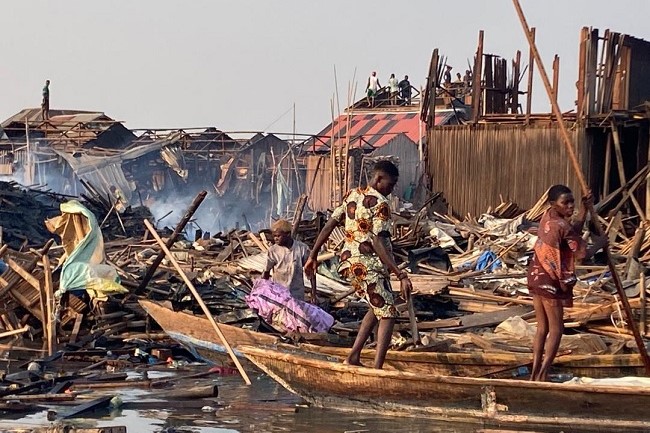
Houses are set ablaze at Makoko community
Houses are being set ablaze with people’s properties in the houses and with community members including children, women and aged persons scampering for safety amidst a major chaos.
According to community insiders, in a swift and unannounced move on Monday January 5, 2026, the Lagos government sent bulldozers into the waterfront community and started setting fire on houses.
“We earlier had a meeting with some government representatives, and they assured us that only houses which were 30 metres to the power lines would be pulled down. We are extremely shocked that they came and started setting fire on other houses.
“They came around 8am today and starting shooting, spraying teargas and seizing people’s boats. As I speak, they have almost reached 100 metres, burning houses down. Many of the occupants of the houses have either gone to the market or fishing jobs or traveled for the holidays and their properties are being set on fire.
“The chiefs were summoned to government house today after they complained about the presence of bulldozers in the community and while they were away, the demolition squad came and started the destruction. This is unimaginable. They are bent on driving us away by hook or crook,” said an insider.
HOMEF and CEE-HOPE described the latest eviction exercise as unlawful and condemnable and another attack on poor and vulnerable members of the society.
“It is really sad that rather than securing citizens, government and their agents are adding to the horrors, deprivations, harms and insecurity in the land. The assault on Makoko is absolutely reprehensible and unacceptable,” said Dr. Nnimmo Bassey, HOMEF’s Executive Director and eminent human and environmental rights activist.
“The human and shelter rights of every resident of Makoko must be respected by the Lagos State Government. Enough of this dehumanising treatment of the urban poor by the state in cahoot with private developers,” he added.
‘”It is sad indeed that the state government has shown itself to be consistently lawless on so many fronts especially in its dealing with the urban poor,” said Betty Abah, CEE-HOPE’s Executive Director. “Just after the savage attack on Oko-Baba, Ayetoro followed by that of Otumara and Baba-Ijora followed by the recent massive eviction of Oworonshoki all of which led to the displacement of tens of thousands of people, the government is turning its vicious searchlights on Makoko again. Lagos has an acute short of housing issue, why then is it not provision of affordable or social housing that is making the headlines from Lagos every year?”
She added: “Why is it the vicious attack on poor and vulnerable masses and massive forced homelessness, most times in direct violated of set down rules of prior and informed notification, resettlement and compensation plans? Why are these evictions mostly in direct flouting of existing court rulings or injunctions?”
She further lamented the toll of the demolition on children, thousands of whom are typically removed from school following such developments.
“These perennial attacks by a government on people to whom they owe a duty of care and protection are lawless, unwarranted, reprehensible and should stand condemned by all well-meaning Nigerians and indeed the world. They fall short of international and local standards of engagements. They must stop now and treat and compensate all wounded members and displaced members of the community immediately. Lagos must upgrade slums in line with international best practice and not destroy lives,” the statement concluded.
Dangote Petroleum Refinery has rejected a circulating report claiming the refinery is shutting down for maintenance, describing the story as false and misleading.
In a statement released on Monday, January 5, 2026, the refinery emphasised that production remains ongoing, stable, and uninterrupted.
“Dangote Petroleum Refinery continues to operate at scale and retains the capacity to supply between 40 million and 50 million litres of Premium Motor Spirit (PMS) daily through January and February, subject solely to market demand,” the statement said.
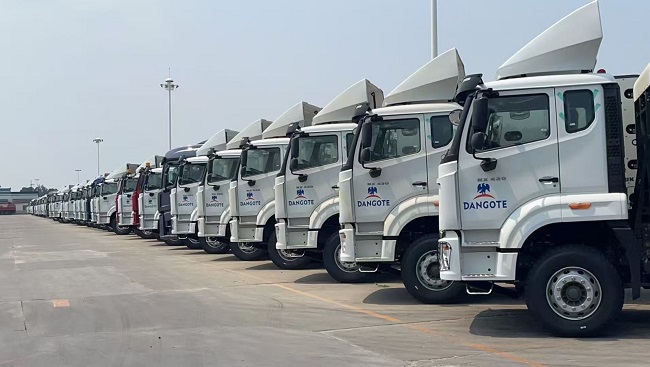
Dangote Refinery CNG trucks
It added that, on January 4, the refinery produced 50 million litres of PMS and evacuated 48 million litres via its gantry. “Current stock levels cover over 20 days of national consumption, effectively dispelling any concerns about supply.”
The refinery clarified that routine maintenance on specific units, including the Crude Distillation Unit (CDU) and Residual Fluid Catalytic Cracking (RFCC), does not interrupt overall production, owing to the sophisticated and integrated design of its processing units. Other critical units, such as the Naphtha Hydrotreater, CCR Reformer, and Hydrocracker, remain fully operational, producing PMS, Diesel (Automotive Gas Oil), and Jet A-1.
“Dangote Petroleum Refinery confirms that it has consistently maintained adequate PMS availability for the domestic market. From 16 December 2025 to date, the refinery has loaded between 31 million and 48 million litres of PMS daily from its gantry, in line with prevailing market demand. These volumes are fully verifiable against depot loading records maintained by the Nigerian Midstream and Downstream Petroleum Regulatory Authority (NMDPRA) in the normal course of its regulatory responsibilities,” the statement said.
The refinery also reaffirmed its ex-gantry price of N699 per litre for PMS, available to all marketers and bulk consumers. It encouraged filling stations, large-scale users, and institutional buyers to patronise locally refined products, which are more affordable, reliable, and of high quality, rather than relying on imported alternatives.
“By sourcing PMS locally at N699 per litre, marketers are better positioned to pass on price relief to consumers, enhance market stability, conserve foreign exchange, and support Nigeria’s broader economic recovery and energy security objectives,” the refinery said.
Dangote Petroleum Refinery accused fuel importers of promoting false reports to justify recent, unwarranted increases in petrol pump prices, noting that such actions run counter to national interest and impose unnecessary hardship on Nigerians. According to the refinery, without domestic refining, petrol prices could rise to as much as N1,400 per litre in a post-subsidy environment, highlighting the stabilising role of local production.
“Recent price movements further highlight an uncomfortable reality. In the absence of the Dangote Petroleum Refinery, fuel importers would continue to operate without restraint, with petrol prices potentially escalating to levels estimated at up to N1,400 per litre in a post-subsidy environment. The refinery’s operations have therefore served as a critical stabilising force in the downstream petroleum market,” the statement added.
Reiterating its commitment to energy security and market stability, the refinery said it would continue supplying high-quality petroleum products, maintaining steady availability, and supporting Nigeria’s broader economic growth. Stakeholders and the public were advised to disregard misinformation and rely on verified sources.
“Dangote Petroleum Refinery will continue to act in the national interest by supplying high-quality, locally refined petroleum products while supporting Nigeria’s economic stability, energy independence, and industrial growth,” it concluded.
Two breakthrough offshore discoveries in Namibia in 2022 – one by Shell and one by TotalEnergies – marked an important milestone for the country’s future energy landscape and for Africa’s broader upstream ambitions.
The excitement generated by high-impact discoveries creates a ripple effect that benefits the entire continent. I’m convinced that the ongoing interest we’re seeing today in African exploration and production (E&P) stems in part from the major discoveries in Namibia, alongside recent successes in Côte d’Ivoire, Angola, and Egypt.
When you factor in advances in E&P technology, the promise of newly emerging basins, and the continued strength of Africa’s established producing regions, there are genuine reasons to feel confident about the future of African oil and gas.
Onshore drilling: Upstream activity in the oil industry
That sentiment is reflected in the African Energy Chamber’s 2026 Outlook Report, “The State of African Energy,” which projects renewed momentum in the continent’s upstream market during the next several years. According to the report, global E&P capital expenditure (capex) is forecast to reach approximately $504 billion by 2026, with Africa contributing about $41 billion.
Africa’s hydrocarbon production is expected to remain stable at roughly 11.4 million barrels of oil equivalent per day (boe/d) through 2026, and new projects are on track to increase output toward 13.6 million boe/d by 2030.
Yes, the report acknowledges that optimism is being tempered by caution. Keen to protect their balance sheets, investors are scrutinising opportunities closely. But overall, the potential for sustained upstream expansion is truly promising for African states with petroleum reserves. The key will be doing as much as possible to attract the capital needed to pursue the next wave of discoveries.
Frontier and Emerging Basins Signal Strong New Potential
As investors weigh their options, the most compelling signs of progress are coming from Africa’s frontier and emerging basins.
In Namibia’s Orange Sub-Basin, where more than 6 billion boe have been discovered in less than four years, operators are preparing the next wave of high-impact wells. Côte d’Ivoire, meanwhile, is seeing a surge of activity around its recent deepwater finds.
Egypt, which already has long history as a producing state, is experiencing fresh momentum in underexplored offshore acreage. Earlier this year, drilling in the Herodotus Basin confirmed gas at the Nefertari-1 well.
Even in Libya, where hydrocarbons have been produced for decades, frontier acreage remains. BP and Eni aim to spud the Matsola-1 ultra-deepwater gas prospect later this year. If it delivers, the well could pave the way for deeper Sirte Basin exploration and reduce geological risk across the broader Gulf of Sirte.
“The continent continues to offer up new frontiers, all of which may draw exploration capital,” our Outlook report notes. “Places to keep an eye on are the ultra-deepwater portion of the Congo Fan in Angola, the Gabon–Douala Deep Sea Basin offshore São Tomé and Príncipe, the Namibe Basin in Namibia and Angola, the Herodotus Basin offshore Egypt and the offshore portion of the Sirte Basin.
“Others that have already played host to exploration cycles may still present significant opportunities in a similar fashion to the Côte d’Ivoire-Tano Basin. One example is the MSGBC Basin, where over 9.5 Bboe was discovered between 2014 and 2019, but which is still viewed as immature in terms of exploration.”
Still, prospects alone are not enough. To translate discoveries into development, Africa must confront the operational and investment challenges that stand in the way.
Data, Imaging, and a New Era of African Prospecting
As encouraging as the upstream outlook is, Africa’s geology remains complex, and that complexity can shape how and where companies invest. In parts of West Africa, for example, thick layers of salt can distort seismic signals and make it difficult to identify potential reservoirs with confidence. And in the far south, strong offshore currents can interfere with seismic acquisition itself, degrading data quality and forcing operators to invest in more advanced imaging and noise-reduction technologies.
But as our Outlook report notes, technology is starting to change these dynamics. “Recent advancements in seismic acquisition, processing technologies, and drilling capabilities have enabled exploration efforts over the past decade to target more intricate prospects at greater depths in Africa as elsewhere,” it states.
These advances have been helping oil and gas companies de-risk prospects once considered too complex or too costly to pursue.
Emmanuelle Garinet, TotalEnergies’ vice president for exploration in Africa, has pointed to Namibia as a prime example of how high-resolution seismic imaging and advanced subsurface modeling can reshape exploration strategies. She noted that the company’s decision to drill the Venus prospect – which lies within the Namibian portion of the Orange Sub-Basin – was possible because the technical data provided enough confidence to reduce uncertainty ahead of drilling. The results validated that choice: the 2022 Venus-1 discovery, estimated at 1.5 to 2 billion barrels of recoverable oil, stands as the largest ever made in sub-Saharan Africa. Its scale has reshaped expectations for what may still be unlocked across the Orange Sub-Basin.
The trend is also visible offshore Angola, where better subsurface imaging and advanced drilling systems are opening deepwater and ultra-deepwater opportunities in heavily salt-influenced geology. Azule Energy aims to drill the Kianda prospect in late 2025. If the ultra-deepwater test succeeds, it could pave the way for exploration across a vast area – more than 30,000 square kilometres – previously viewed as high risk.
The Capital Challenge: Competing for Global Investment
But geological complexity isn’t the only factor shaping investment decisions. Political and security challenges persist in several countries – among them Nigeria, Mozambique, and the Democratic Republic of the Congo – and can materially affect both operations and capital flows. Add to that the lack of clarity around monetisation and industrialisation pathways, and it becomes clear why some investors remain cautious.
The Outlook report notes that upstream capital spending in Africa has risen consistently over the past three years as the sector recovers from the pandemic-related lows of 2020. Even so, worldwide investment growth has not kept pace with the strong cash flows generated by upstream operations. Analysts from firms like Wood Mackenzie and Deloitte all describe the same pattern: Companies are channeling a significant share of their cash flow into dividends, buybacks, and debt reduction instead of chasing growth at any cost.
In short, Africa is competing for capital at a time when global investors are more disciplined than ever.
In this environment, African states cannot simply assume that interest in our geology will translate into final investment decisions. We must move quickly to capitalise on today’s E&P appetite by reducing above-ground risks, providing clear monetisation and industrialisation pathways, and building stable, predictable frameworks that give investors the confidence to commit for the long term.
The window of opportunity is open, but it will not stay open forever.
By NJ Ayuk, Executive Chairman, African Energy Chamber
Some farmers in Hinna Community, Yamaltu-Deba Local Government Area of Gombe State, have raised concerns over increasing hippopotamus attacks on their farmlands and livelihoods.
Mr. Zakari Ladan, Head of Farmers in Hinna Community, raised the alarm in an interview on Monday, January 5, 2026.
Ladan said persistent hippo attacks had resulted in huge losses, noting that the animals frequently destroyed crops and posed serious threats to residents.
Hippopotamus
He said the population of hippopotamuses in the area had grown to more than 40, wreaking havoc on farmlands and affecting both farmers and fishermen.
According to him, from Sept. 2025 to date, no fewer than 100 hectares of farmlands cultivating various crops and vegetables had been destroyed.
Ladan said crops affected included rice, beans, cabbage, maize, carrots, okro, sweet melon, watermelon, onions and other vegetables, with losses estimated at more than N180 million.
“We are seriously worried about the hippos in our community that are destroying our farmlands and livelihoods.
“Currently, the population of the animals has grown to more than 40. They are destroying our crops and killing people.
“From Sept. 2025 to date, three persons have been killed in my community, while three others who sustained serious injuries are currently hospitalised in Gombe.
“If you come to my community, you will see hippos moving freely on farmlands. A single hippo can destroy up to two hectares of farmland in one day.
“We are calling for help to protect our lives and livelihoods because we are losing a lot on a daily basis,” he said.
Another farmer, Malam Haruna Hinna, said his carrot and okro farm had been destroyed by hippos, adding that one hectare of carrot was valued at N1.7 million.
Hinna said farmers were helplessly losing their investments in spite of reporting the situation annually to the state government, non-governmental organisations and other relevant authorities.
“We need urgent support from both the federal and state governments. We are tired and financially exhausted,” he said.
Other farmers shared similar experiences and appealed to the government to support them with farm inputs to enable them to return to farming.
They also called on relevant stakeholders to support fishermen in the community to adopt fish farming as an alternative livelihood.
The Margo Abayomi Memorial Evergreen (MAMIE) Foundation has advocated preservation of animals’ DNA as a long-term scientific strategy to help regenerate species threatened with extinction globally amid biodiversity loss pressures worldwide today.
Dr Dayo Abayomi, co-founder of the foundation, made the call on Monday, January 5, 2026, in an interview in Abuja discussing conservation science, policy, sustainability and awareness.
Abayomi explained that conserving genetic material from endangered animals could enable scientists recreate species that might had disappeared as advances in biotechnology continued to evolve globally through research, innovation, collaboration efforts.
Founder of MAMIE Foundation, Prof. Akinola Abayomi
According to her, DNA represents the fundamental unit of life, carrying the complete blueprint that defines an organism and determines its development, function and reproduction across species, ecosystems and evolution broadly.
“If we can replicate the DNA system and maybe incorporate that result in another animal, you can reproduce that animal,” Abayomi said, explaining potential scientific applications of genetic replication techniques conceptually.
According to her, assuming the pangolin becomes extinct and its DNA has been preserved, that genetic material could be applied in scientific research.
She underscored possibilities for endangered species recovery through conservation efforts.
Abayomi said science was developing and one could use that DNA in another animal to give birth to a pangolin.
She cited future scientific incubator possibilities similar to stored human eggs research.
“From eggs, we are moving down to the actual unit that generates life and that can copy itself until it produces itself,” Abayomi said, describing genetic research focus evolution over time.
She noted that similar scientific concepts already existed in practices such as the storage of human eggs and embryos, adding that research was gradually moving beyond cells to core genetic material.
“Scientists and anthropologists have, in some cases, extracted DNA from ancient bones, fossils and preserved biological materials to study or attempt regeneration,” she said, citing global research examples, experiments, discoveries worldwide.
She emphasised that without proactive conservation and DNA preservation, future generations would lack essential genetic resources needed for scientific breakthroughs and species regeneration efforts, innovation, resilience, sustainability, research, and planning globally.
She added that such initiatives were part of the mandate of the foundation, which was committed to long-term environmental sustainability and biodiversity protection through conservation, advocacy, education, partnerships, research programmes nationwide.
The foundation, made up of three siblings, is conserving the Emerald Forest Reserve, a small forest by a river in Ikoyi-Osun, Osun State as part of practical conservation efforts locally today.
According to Abayomi, the reserve serves as a biodiversity area and a practical step towards protecting wildlife and ecosystems threatened by deforestation and climate change impacts, habitat loss, erosion, flooding risks.
She called for better investment in conservation science, supportive policies and public awareness to ensure Nigeria did not lose its rich biodiversity heritage, ecosystems, wildlife, livelihoods, resilience, sustainability, development, and future generations.
The Federal High Court in Abuja, on Monday, January 5, 2026, ordered Mr. Heineken Lokpobiri, Minister of State for Petroleum Resources (Oil), and others to maintain status quo pending the hearing and determination of a case involving four oil fields.
Justice Emeka Nwite gave the order after Mr. Ambrose Unaeze, who appeared for the plaintiffs, Hi-Rev Oil Limited and Hi-Rev Exploration and Production Ltd, moved the application to the effect.
The 2nd and 3rd defendants in the suit, marked: FHC/ABJ/CS/2678/2025, are the Attorney-General of Federation (AGF) and Nigeria Upstream Petroleum Regulatory Commission (NUPRC).
Mr. Heineken Lokpobiri, Minister of State for Petroleum Resources (Oil)
Justice Nwite had, on Dec. 22, 2025, ordered the minister, the AGF and NUPRC to show cause why the reliefs of the plaintiffs in their motion ex-parte should not be granted.
The judge made the order after Unaeze moved the motion dated and filed on Dec. 11.
The oil and gas companies had sought an order of interim injunction restraining the defendants or whomsoever is acting on their behest from selling, assigning or allocating the Yorla South (Petroleum Prospecting Licence (PPL) 2A32 – OML 11) located in Rivers.
The order is to also restrain the defendants from allocating Akiapiri (PPL 2A48 – OML 25) located in Bayelsa; Diebu Creek East (OML 32) also located in Bayelsa; and Idiok (PPL 2A41 – OML 67) located in Akwa Ibom, “same being direct replacements for Utapate Oil Field (formerly part of OML 13) and OPL 2002, previously allocated to the plaintiff but was later withdrawn by the defendants, pending the hearing of the interlocutory application in this suit.”
Giving four grounds why their application should be granted, the lawyer said the companies were previously allocated the Utapate Oil Field (formerly part of OML 13) and OPL 2002, but were unreasonably withdrawn by the Federal Government.
He said parties had a settlement agreement for the replacement of the Utapate Oil Field, which was accepted or adopted and it became consent judgement.
Unaeze stated that the firms had taken substantial steps and offered consideration in respect of the grant of the licence to operate OPL and licence to establish a petroleum refinery.
He argued that the companies’ legal right is being threatened by the defendants, pursuant to the threat to sell or allocate the oil fields at Yorla South, Akiapiri, Diebu Creek East, and Idiok to third parties via the defendants’ offer to the public for round bid, hence, the need for the interim order.
Although the judge did not grant the order, he, however, ordered the defendants to appear on Monday, Jan. 5.
When the matter was called on Monday, Unaeze informed the court that an order was made for the defendants to show cause why their relief should not be granted.
The lawyer said the 1st and 3rd defendants (minister and NUPRC) just served on him their memorandum of conditional appearance, counter affidavit and preliminary objection in court and that he would need time to respond.
Unaeze, however, applied that the defendants, who were duly represented in court by their lawyers, should give an undertaking not to take any action that might affect the subject matter pending the hearing and determination of the case.
“This is because of the nature of the case and the risk the res (subject matter) may face before the next adjourned date,” he said.
Speaking, Oyinlade Koleoso, who appeared for the 2nd defendant (AGF), said they filed a counter affidavit and a preliminary objection, though they were yet to serve same.
When the judge asked him if he had filed affidavit to show cause, Koleose said he believed that the processes he had filed would take care of that.
The lawyer told the court that, based on Unaeze’s application, their submission was that the AGF was not in the position to allocate oil blocks.
The 3rd defendant (NUPRC)’s lawyer, J. A. Olugbade, disagreed with Unaeze’s application.
He said he opposed the plaintiffs lawyer’s prayer since he had already filed a counter affidavit and a preliminary objection.
B. J. Tabaya, counsel for the 1st defendant (minister), said he did not have the instruction of his client to make such undertaking sought by Unaeze.
“But when a case is in court, what are you supposed to do?” the judge asked Tabaya.
“Party will maintain status quo,” the lawyer responded.
“So go and tell your client that as far as this matter is before the court, parties should maintain status quo,” the judge said.
Delivering the ruling, Justice Nwite, who granted Unaeze’s application, ordered the parties to maintain status quo pending the hearing and determination of the matter.
The judge then adjourned the matter until Jan. 26 for hearing.
President Bola Tinubu has written to the Senate, seeking confirmation of 21 nominees for the boards of the Nigerian Midstream and Downstream Petroleum Regulatory Authority (NMDPRA) and the Nigerian Upstream Petroleum Regulatory Commission (NUPRC).
This is contained in a statement issued by Presidential Spokesperson, Mr. Bayo Onanuga, on Monday, January 5, 2026, in Abuja.
In the first letter, Tinubu nominated Sen. Magnus Abe as Chairman of the NUPRC Board.
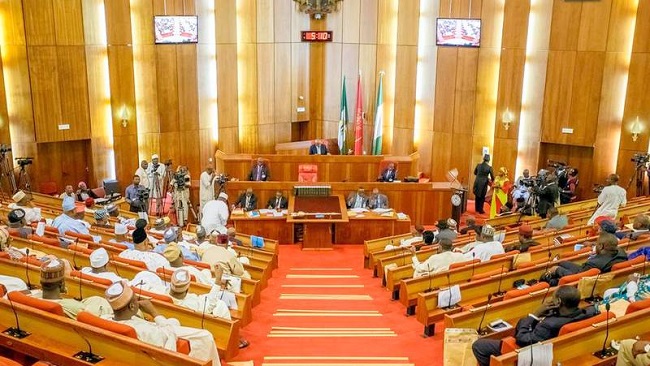
The Nigerian Senate
Abe, who represented Rivers South-East Senatorial District for two terms, is a former board member of the Nigerian National Petroleum Corporation and currently chairs the National Agency for the Great Green Wall.
Other nominees for the NUPRC Board as non-executive commissioners are Mr. Paul Jezhi, a former Chairman of the Trade Union Congress in Kaduna State, and Mr. Sunday Babalola, a former Deputy Director of the defunct Department of Petroleum Resources.
The president also nominated executive commissioners to the board.
They include, Mr. Muhammed Lamido (Finance); Mr. Edu Inyang (Exploration and Acreage); Mr. Justin Ezeala (Economic Regulation and Strategic Planning); and Mr. Henry Oki (Development and Production).
Others are Mr. Indabawa Alka (Corporate Services and Administration); Mr. Mahmood Tijani (Health, Safety and Environment); and Ms. Olayemi Adeboyejo as Secretary/Legal Adviser.
Lamido and Adeboyejo were appointed in 2022 by former President Muhammadu Buhari, while Alka was appointed by President Tinubu in 2023. Inyang, Ezeala, Tijani, Babalola and Jezhi are new nominees.
In a second letter, President Tinubu nominated Mr. Adegbite Adeniji, a lawyer, as Chairman of the NMDPRA Board.
Adeniji has over 30 years’ experience in energy and natural resources and previously served as Special Technical Adviser to the Minister of State for Petroleum on upstream and gas matters.
He is currently the Managing Partner at ENR Advisory.
Also nominated as non-executive members are Chief Kenneth Kobani, a former Minister of State for Trade and former Secretary to the Rivers State Government, and Mrs. Asabe Ahmed.
Other nominees for the NMDPRA Board are Mr. Abiodun Adeniji (Executive Director, Finance); Mr. Francis Ogaree (Executive Director, Hydrocarbon); Mr. Oluwole Adama (Executive Director, Midstream and Downstream Gas Infrastructure); and Dr Mustapha Lamorde (Executive Director, Corporate Services and Administration).
Adama was appointed in 2024, while Adeniji and Lamorde were appointed in 2021 and Ogaree in 2022 by the late President Muhammadu Buhari.
Additional nominees are Mr. Yahaya Yinusa (Executive Director, Distribution Systems); Mr. Adeyemi Aminu (Executive Director, Corporate Services); Ms. Modie Ogechukwu (Executive Director, Economic Regulation and Strategic Planning); and Mr. Olawale Dawodu as Board Secretary/Legal Adviser.
The President urged the Senate to consider and approve the nominees expeditiously.
The request followed the recent confirmation by the Senate of Mrs. Oritsemeyiwa Eyesan as Chief Executive Officer of NUPRC and Saidu Mohammed as Chief Executive Officer of NMDPRA.
Tinubu charged all nominees to discharge their duties professionally in regulating Nigeria’s oil and gas sector.