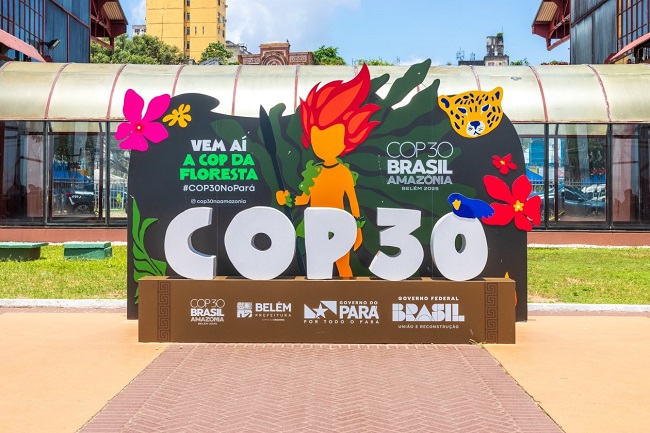
COP30 opened on Monday, November 10, 2025, with an urgent call to deliver on climate promises and accelerate the implementation of the Paris Agreement across all sectors.
Thousands of diplomats and climate experts are gathering in Belém, Brazil’s Amazon, for COP30 – the latest round of UN climate talks. Their task couldn’t be clearer: turn promises into action and agree on tougher plans to cut greenhouse gas emissions.
After decades of pledges and annual summits from Kyoto to Sharm el-Sheikh, the planet keeps getting hotter and pressure on governments and big business to act – not just talk – has never been greater.
During the 2025 UN Climate Change Conference, countries will need to reaffirm their commitments and create climate plans that will bring the world closer to the Paris Agreement’s 1.5 degree C goal. Photo credit: Luis War
Holding COP30 in Belém, at the edge of the world’s largest tropical rainforest, underscores the stakes: the Amazon region is both a vital carbon sink and a frontline in the fight against deforestation and climate change.
So, this year’s meeting aims to shift gears. Delegates will review national climate plans, push for $1.3 trillion a year in climate finance, adopt new measures to help countries adapt, and advance a ‘just transition’ to cleaner economies.
COP30 has been billed as a turning point – a moment of truth and a test of global solidarity. scientists say the planet is on course to temporarily breach the 1.5°C warming limit set by the Paris Agreement.
That overshoot could still be short-lived, experts warn, but only if countries act fast to ramp up efforts on cutting emissions, adapting to climate impacts, and mobilizing finance.
Speaking at the Leaders’ Summit, UN Secretary -General Antonio Guterres was blunt: “It’s no longer time for negotiations. It’s time for implementation, implementation and implementation.”
Under Brazil’s presidency, COP30 will revolve around an action agenda of 30 key goals, each driven by an ‘activation group’ tasked with scaling up solutions.
The effort has been dubbed a mutirão – an Indigenous word meaning “collective task” – reflecting Brazil’s push to spotlight Indigenous leadership and participation at the conference and in the global fight against climate change.
The government says it wants all sectors – from Indigenous communities to business leaders – to help deliver on past climate promises.
Action agendas at COPs are built on voluntary pledges rather than binding law. But the scale of change needed is enormous: at least $1.3 trillion in climate investments every year by 2035.
Another key focus in Belém is the latest round of Nationally Determined Contributions (NDCs) – national climate plans that spell out how countries intend to cut emissions. To keep warming below 1.5°C, global emissions must fall by 60 per cent by 2030. Current NDCs would deliver only a 10 per cent cut.
Of the 196 Parties to the Paris Agreement, just 64 had submitted updated NDCs by the end of September. At preparatory talks in Germany in June, many countries warned that this ambition gap must be closed at COP30.
Delegates are also expected to approve 100 global indicators to track progress on climate adaptation, making results measurable and comparable across nations.
Today, 172 countries have at least one adaptation policy or plan, though 36 are outdated. The new indicators should help shape more transparent and effective policies.
With the planet heating faster than ever, adaptation is now a central pillar of climate action. But the UN Environment Programme (UNEP) warns adaptation finance must rise twelvefold by 2035 to meet developing countries’ needs.
COP30 will also push forward the Just Transition Work Programme – aimed at ensuring climate measures don’t deepen inequality. Civil society groups are calling for a “Belém Action Mechanism” to coordinate just transition efforts and expand access to technology and finance for the most vulnerable nations.
The Conference of the Parties to the UN Framework Convention on Climate Change (UNFCCC) – known simply as COP – remains the world’s leading forum for tackling the climate crisis. Decisions are made by consensus, driving cooperation on mitigation, adaptation and finance.
Over the years, COPs have delivered landmark deals. In 2015, the Paris Agreement set the goal of keeping global temperature rise “well below 2°C” while striving for 1.5°C.
At COP28 in Dubai, countries agreed to transition away from fossil fuels “in a just, orderly and equitable manner” and to triple renewable energy capacity by 2030.
2024 in Baku, COP29 raised the annual climate finance target for developing nations from $100 billion to $300 billion, with a roadmap to scale up to $1.3 trillion.
Taken together, the legal framework built over three decades under the UNFCCC has helped avert a projected 4°C temperature rise by the end of this century.
COP30 opened Monday, November 10, and runs through Nov. 21.
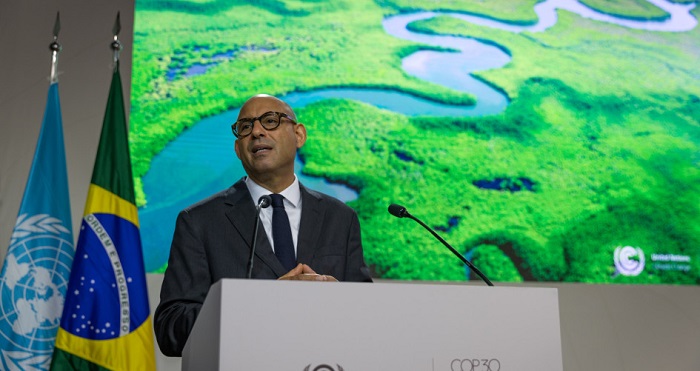
The Executive Secretary of UN Climate Change, Mr. Simon Stiell, has called on countries to deepen efforts toward reducing emissions and strengthening resilience to tackle climate change.
Stiell made the call on Monday, November 10, 2025, in Belém, Brazil in his remarks at the opening of the 30th United Nations Climate Change Conference (COP30).
According to him, taking faster steps on reductions of emissions and strengthening resilience is crucial to bring back temperature to 1.5°C.
Executive Secretary of UN Climate Change, Mr. Simon Stiell. Photo credit: Kiara Worth | UN Climate Change
He said the future that was designed 10 years back in Paris had started seeing the curve of emissions bending downward with governments legislating, and markets responding.
He, however, stated that much more work still needed to be done.
”The science is clear: we can and must bring temperatures back down to 1.5°C after any temporary overshoot. Lamenting is not a strategy. We need solutions.
”We find ourselves here in Belém, at the mouth of the Amazon. And we can learn a lot from this mighty river. The Amazon isn’t a single entity, rather a vast river system supported and powered by over a thousand tributaries.
”To accelerate implementation, the COP process must be supported in the same way – powered by the many streams of international cooperation, because individual national commitments alone are not cutting emissions fast enough,” he said.
He said there was no need to wait for late Nationally Determined Contributions (NDCs) to slowly trickle in, to spot the gap and design the innovations necessary to tackle it.
”Not one single nation among you can afford this, as climate disasters rip double-digits off GDP.
“To falter whilst mega-droughts wreck national harvests, sending food prices soaring, makes zero sense, economically or politically.
”To squabble while famines take hold, forcing millions to flee their homelands, this will never be forgotten, as conflicts spread. While climate disasters decimate the lives of millions, when we already have the solutions, this will never, ever be forgiven.
”The economics of this transition are as indisputable as the costs of inaction. Solar and wind are now the lowest-cost power in 90 per cent of the world. Renewables overtook coal this year as the world’s top energy source,” he said.
According to Stiell, investment in clean energy and infrastructure will hit another record high before the end of 2025 with investments in renewables outstripping fossil fuels 2 to 1.
He said the conference would focus on deals to strike and accelerate tripling of renewables and doubling energy efficiency as agreed to transit away from fossil fuels.
”Now is the time to focus on how we do it fairly and orderly. We have already agreed to deliver at least $300 billion in climate finance, with developed countries taking the lead.
”We now need to put the Baku to Belem Roadmap to work. To start moving towards the $1.3 trillion. We have already agreed to a global goal on adaptation.
”We now need to agree on the indicators that will help speed up implementation, to unleash its potential,” he said.
Stiell called on countries to agree on concrete steps to turn aspirations into actions on transition pathways to cover whole economies and societies.
He urged all countries to properly key into the agreed technology implementation programme to keep it in motion.
Stiell said every gigawatt of clean power would cut pollution and create more jobs.
He added that every action to build resilience would help to save lives, strengthen communities, and protect the global supply chains that every economy depends on.
The 2025 global climate summit, COP30, kicked off on Monday, November 10, in the Amazonian city of Belém in Brazil, amid a warning from United Nations climate chief, Simon Stiell, that the world is not doing enough to combat the crisis, and strategic compromises over the elements of the official agenda of the summit.
After hours of tense exchanges on the agenda, delegates finally agreed on the compromises and resolved sticky matters at around 11:30pm on Sunday. Experts from Power Shift Africa on the ground in Belem understand that the suggestion for the inclusion of Africa’s “special needs” in the agenda didn’t make the cut, and that this will instead be handled through informal consultations led by the COP Presidency, running until Wednesday.
COP30
Other key items under discussion last evening included Article 9.1 of the Paris Agreement, which outlines finance obligations of the Global North to the Global South, national climate plans known as Nationally Determined Contributions (NDCs), the EU’s proposal on biennial transparency reports, and the developing countries proposal to discuss restrictive universal trade measures. Meanwhile, a special session on Africa’s unique climate interests was announced, together with a promise for the agenda to be taken up more fully at COP32, which will be hosted in Africa and for which Ethiopia has placed a strong bid.
Despite the usual first-day wrangling, negotiators are portraying this as a smooth and cooperative start, a signal from the Presidency that multilateralism is alive and well. With anti-climate lobbies waiting to exploit any sign of gridlock, the Brazilian COP30 Presidency is eager to demonstrate unity and progress.
At the opening plenary, Simon Stiell, the UN Climate Change Executive Secretary, said the world is not moving fast enough to confront the climate crisis but was quick to note that global cooperation had at least prevented “an impossible future” of runaway heating.
“We have so much more work to do. We must move much, much faster; both in reducing emissions and in strengthening resilience,” he told delegates.
Stiell credited the Paris Agreement, adopted 10 years ago, with bending the curve of projected global heating from as high as 5°C to below 3°C, saying “it is still perilous, but it proves that climate cooperation works”. He said success now depends on two interlinked pillars: stronger, more credible national climate plans, the Nationally Determined Contributions (NDCs); and the financing to make them possible.
“Plans without finance cannot reach their full potential,” he said. “Finance is the great accelerator.”
He pointed to the Baku to Belém Roadmap, a new initiative that seeks to increase global climate finance from about US$300 billion a year to US$1.3 trillion by 2035, describing it as a shared investment in “stability and prosperity” and noting that countries acting fastest on clean energy would reap the greatest economic benefits.
“Every dollar invested in climate solutions brings multiple dividends; jobs, cleaner air, better health, resilient supply chains, and stronger energy and food security,” he said.
Supporters hailed the roadmap as an ambitious but necessary step to close the gap between climate pledges and real-world funding. Mukhtar Babayev, Azerbaijan’s Minister of Ecology and President of last year’s COP29, said it offers “a rare opportunity to transform promises into tangible progress.”
Brazil, hosting COP30 under President Luiz Inácio Lula da Silva, described the roadmap as “a blueprint for collective resolve.” The Brazilian delegation urged negotiators to focus on fairness and delivery rather than rhetoric. “The science is clear, the moral imperative undeniable. What remains is the resolve,” they said.
Mohamed Adow, founder and director, Power Shift Africa, said: “COP30 must deliver the priorities for Africa and the wider developing world which are clear: we need a fair deal that delivers finance for adaptation in vulnerable countries and supports a just transition to renewable energy. These are not acts of charity, but investments in a stable, liveable planet. We need to see the sharing of clean energy technology by the global north with the global south, and we need to see more national climate plans published by all countries, laying out how we’re going to accelerate the momentum towards a safe and prosperous planet for us all.”
Speaking on the adoption on the agenda, he added: “It’s good to see the agenda formally adopted and the start of the COP underway in a reasonably orderly fashion. It suggests that countries recognise the importance of this summit and the need for international cooperation if we’re going to tackle the climate crisis.
“But saving the multilateral UN process doesn’t mean we’re guaranteed to save the planet. To do that we need to see actual steps taken here in Belem to boost climate finance to help vulnerable countries adapt to the impacts of the climate crisis. We also need countries to commit to the just energy transition by moving away from polluting fossil fuels and investing much more in clean renewables. The world has spent the last 10 years agreeing the rules of the international climate regime. We now need to see countries acting on the regime they have signed up to, not just speaking warm words.”
Sandra Guzmán, Director General of the Climate Finance Group for Latin America and the Caribbean (GFLAC), warned that “private and philanthropic funds must complement, not replace, the obligations of developed countries.”
Over the next two weeks, the COP30 Presidency is understood to be positioning the summit as a political reckoning that will test whether the Paris Agreement, the crown jewel of international climate diplomacy, can still deliver results at scale.
Since 2015, global emissions have plateaued but not fallen fast enough. The 1.5°C target, the threshold scientists warn the world must stay below to avoid catastrophic consequences, is slipping out of reach.
The Belém conference comes amid growing fatigue and distrust in the global climate process, particularly over financing and equity. The Baku to Belém Roadmap aims to restore faith by setting a long-term financing goal, but key questions remain unanswered: who pays, how much, and under what terms.
Omar Elmawi, Convenor of the Africa Movement of Movements, noted: “We cannot keep sailing blindly into a climate apocalypse while pretending everything is merry. COP30 must be the turning point, where words become action, and promises become justice. Over eight billion people globally are looking at Belém to be the moment we will all look back to and celebrate and not one we curse.”
Brazil’s Presidency of the COP is attempting to shift the focus back to justice and implementation, linking climate action to forests, energy transition, and sustainable industrialisation. Hosting the talks in the Amazon, the planet’s largest carbon sink, is both symbolic and strategic, a reminder that global climate progress hinges on protecting ecosystems and empowering the communities that depend on them.
For Africa, COP30 is a moment of reckoning. The continent contributes less than 4 per cent of global emissions but bears the heaviest costs of climate change, from droughts and cyclones to collapsing agricultural yields and energy insecurity.
African negotiators have consistently argued that without predictable, affordable finance, developing nations cannot deliver on their commitments. The Baku to Belém Roadmap could be transformative if implemented fairly, ensuring that new funds reach life-saving adaptation projects in vulnerable communities, not just emissions reductions in middle-income economies.
African countries are also demanding a rebalancing of the climate finance equation to include more grants, fewer debt-driven instruments, and direct access for local governments and institutions. The hope is that the roadmap will address long-standing inequalities that have left Africa sidelined when it comes to green investment.
There is also optimism. Across Kenya, Rwanda, Morocco and South Africa, governments are already investing in electric mobility, renewable energy, and green manufacturing, practical examples of how climate action can drive growth and jobs if backed by finance and technology transfer.
Despite the challenges, Stiell insisted the Paris framework remains valid. “The framework created by the Paris Agreement is still sound,” he said. “But the next decade will determine whether it delivers in full. History will not ask what we intended. It will ask what we achieved.”
The sixth meeting of the Conference of the Parties to the Minamata Convention on Mercury (COP-6), held in Geneva from November 3 to 7, 2025, brought together over 1,000 participants in person and nearly 4,000 online viewers. Parties adopted 22 decisions to advance the Convention’s objective of protecting human health and the environment from mercury pollution, marking a week of collaboration, determination, and shared purpose.
In his closing remarks, COP-6 President Osvaldo Álvarez Pérez (Chile) highlighted the discipline, flexibility, and unity of purpose that continue to drive progress under the Convention: “Thank you all for your trust, your humor, and your tireless cooperation. With your creativity and commitment, we have set ambitious new goals, and left mercury a little further behind, together”.
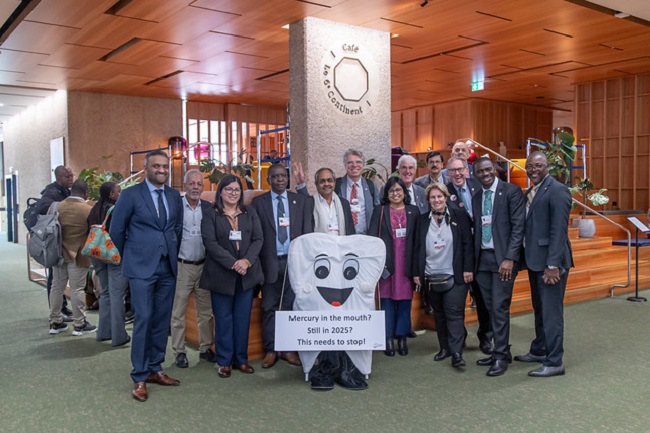
Campaign to end use of dental amalgam at COP-6
Minamata Convention Executive Secretary, Monika Stankiewicz, expressed appreciation to all delegates, observers, partners and the Secretariat team. “We have just opened the door to another chapter of the mercury history book. What you all have accomplished here this week is truly inspiring,” she said. “You show the promise of multilateral action, at a time when it is most urgently needed”.
COP-6 Decisions
COP-6 adopted new amendments to Annex A, establishing a global phase-out of dental amalgamby 2034, a decision described by many delegations as a historic milestone for the Convention. The adoption was met with applause and standing ovations in plenary, reflecting the shared commitment of Parties to protect people and the planet from mercury exposure. This science-based, time-bound agreement marks a decisive step toward the total elimination of mercury use in dentistry and a safer future for all communities.
Parties also agreed to step up global efforts to eliminatemercury-added skin-lightening products, enhancing enforcement and cooperation with the World Health Organisation and other partners to curb illegal trade and protect public health. In addition, some extensions were granted to Parties for specific mercury-added products still transitioning toward phase-out.
Parties strengthened action on artisanal and small-scale gold mining (ASGM), recognizing the importance of providing alternative livelihoods for mining communities, particularly those in vulnerable situations, when moving away from mercury use. The COP requested the Secretariat, in coordination with relevant international initiatives, to explore how supply-chain transparency and certification can reduce mercury use and enhance accountability of buyers and intermediaries across the gold trade. Parties also call for strengthened collaboration with the Global Mercury Partnership and the engagement of Indigenous Peoples, local communities, women and youth in this effort.
To tackle the supply and trade of mercury, the COP adopted a decision updating guidance on identifying mercury stocks and the use of forms, while requesting the Secretariat to develop strategies to address illegal trade and prepare guidance on harmonized customs codes for mercury-containing goods. Complementing this, a separate decision on mercury compounds invites Parties and stakeholders to submit information on their supply, use and trade, and establishes an open-ended expert group to advance technical discussions ahead of COP-7.
On biodiversity, the COP encouraged Parties and stakeholders to implement the roadmap for enhancing co-benefits between the Minamata Convention and the Kunming–Montreal Global Biodiversity Framework, including integrating actions to reduce mercury pollution from ASGM into national biodiversity strategies.
On capacity-building, technical assistance and technology transfer, and on the financial mechanism, Parties signified the importance of a robust replenishment of funds in the next programmatic period. GEF-9 will be critical in supporting Parties to meet the obligation on time. A decision on knowledge management endorsed the continued development of digital tools to enhance transparency and data accessibility, explore the use of artificial intelligence, and promote information exchange among Parties and stakeholders. Looking ahead, Parties also adopted a decision outlining preparations for the first effectiveness evaluation of the Minamata Convention, setting in motion a key milestone to assess global progress of the Convention’s impact.
Parties called for closer collaboration with the Intergovernmental Science-Policy Panel on Chemicals, Waste and Pollution, the Global Framework on Chemicals, the Basel, Rotterdam and Stockholm Conventions, and others. Stakeholder participation reached new levels at COP-6, with women, youth, Indigenous Peoples and civil society taking an increasingly visible and engaged role in the discussions.
The establishment of the International Indigenous Peoples Forum on Mercury, the launch of the Convention’s Women’s Caucus, and the Youth Declaration are milestones in reaching the objective of the Convention to protect human health and the environment from mercury pollution.
Activities
During the week, COP-6 featured a wide range of activities organised in cooperation with the Geneva Environment Network and other partners. These included public events such as From Science to Action: Protecting the Amazon from Mercury Pollution, the launch of the Minamata Women’s Caucus, and a dialogue on lessons learned from the planetGOLD programme.
The Global Mercury Partnership also organised activities addressing skin-lightening products and harmful beauty practices, including the Humanæ photo exhibition by Angélica Dass on the Geneva lakeshore and a film screening and panel discussion on Detoxifying Cosmetics and Beauty Ideals.
Information exchange and networking were fostered through 19 Knowledge Labs held at the venue throughout the week, while partner institutions and organisations showcased their projects in the exhibition area, including the Minamata Photographer’s Eye display and other initiatives highlighting science, innovation, and cooperation under the Convention.
Looking ahead, the seventh meeting of the Conference of the Parties (COP-7) will take place in Geneva from June 14 to 18, 2027, under the presidency of Marie-Claire L’Henry (France) who will lead Parties in the next phase of implementation.
In the coming days the world’s gaze will turn to Belém, Brazil, as COP30 convenes under the canopy of the Amazon. There, the global climate community will confront a defining question: Can money truly buy justice? COP30 is expected to build on COP29’s legacy by operationalising the $1.3 trillion annual climate finance target by 2035, a pledge meant to close the widening gap between ambition and reality.
The roadmap, initiated by Azerbaijan and now guided by Brazil, aims to scale public–private investments, reformed carbon markets, and financial restructuring, alongside stronger accountability and grant-based support.
COP30
Brazil’s presidency has already framed its agenda around Amazon protection, equity, and resilience for vulnerable nations. Yet the political economy of climate finance remains stubbornly unequal. For Africa and much of the Global South, the real struggle is not only to access finance but to reclaim agency over its purpose and governance. The tension runs deeper than numbers on a balance sheet. Beneath the trillion-dollar headlines lies a moral reckoning: Who defines climate finance, and who benefits from its flow?
In Nairobi, Abuja, and Dakar, policymakers see both promise and peril. Billions were pledged in Paris (2015) and Glasgow (2021), yet less than 20 percent of that capital reached the continent. Meanwhile, African countries like Malawi and Mozambique continue to suffer devastating floods, and Sudan and Ethiopia face cascading droughts – while their adaptation budgets shrink under the weight of debt servicing
The Mirage of Climate Finance: Reform or Rebranding?
The $1.3 trillion target sounds transformational. Yet, most of this money will not arrive as grants but it will come as loans, equity investments, or carbon credits, mediated through private finance. Which leads to a piercing question: Is the green transition being built on debt? The shorthand answer is: yes. What has emerged is that the climate finance architecture increasingly mirrors the conditionalities of the structural adjustment era.
“Green loans” are tied to policy reforms and fiscal discipline, often prioritising investor confidence over community well-being. Africa’s sovereign debt crisis, already acute, is being exacerbated by the cost of adaptation itself. Unfortunately, this is a cruel irony for a continent that contributed less than 4 percent of global emissions.
In Kenya, the government’s green infrastructure loans have pushed debt above 70 percent of GDP. Zambia’s 2023 debt-for-nature swap, hailed as a breakthrough, has been criticized for externalizing control over its forests. In Nigeria, green bond programmes face volatility due to exchange-rate instability, while Ghana’s climate adaptation loans arrive with IMF supervision clauses that restrict domestic policy flexibility.
So, we must ask: When climate finance arrives as credit, can it ever be called justice? If climate finance merely rebrands the old instruments of dependency, then the “just transition” risks becoming a mirage hence it is another exercise in rebranding colonial finance under a green flag or veneer. As the age-worn cliché puts: It is new wine in old wine skin.
Carbon Markets as Africa’s Opportunity or Another Extraction Frontier?
At the heart of COP30’s agenda lies a seductive proposition: carbon markets. In theory, they offer Africa a way to monetise its abundant natural assets such as forests, wetlands, and mangroves while attracting billions in investment. But the central question still remains: Can Africa trade carbon without trading away sovereignty? We all know the answer. In Kenya, the Shamba Project promised smallholder farmers sustainable income but delivered little beyond paperwork and unmet expectations.
In Zimbabwe, the Kariba REDD+ project collapsed amid allegations of mismanagement and inequitable revenue sharing. In Nigeria REDD+ project in Cross River State ends up criminalising indigenous people who are custodians of nature while transnational elite plot how to share national commons. These are not isolated failures; in fact, they reveal a structural pattern where carbon ownership lies offshore while ecological risk remains local.
National Commons and the Battle for Climate Sovereignty
Africa’s national commons, its forests, rivers, soils, and carbon-rich savannas are the lifeblood of its economies and cultures. Yet these shared treasures are increasingly being enclosed under the banner of “green growth.” Through carbon offset deals, conservation finance, and biodiversity bonds, foreign actors are acquiring control over vast landscapes once managed by local communities. The tragedy is that what should be a foundation of sovereignty has become a frontier of speculation.
The REDD+ projects in Nigeria’s Cross River State, for instance, were meant to protect the forest but instead restricted local access while global intermediaries monetized the carbon stored within it. Similar patterns emerge inKenya’s rangelands, where carbon credit schemes reward investors more than pastoralists.
At stake is not merely money, it’s ownership. Who controls Africa’s national commons determines who shapes its green future. COP30 offers Africa an opportunity to reclaim the commons not as collateral for debt, but as a moral and ecological inheritance one that must serve its people first.
Yet, there are glimmers of hope. Gabon, a leader in rainforest protection, has pioneered sovereign carbon credits under Article 6 of the Paris Agreement, demonstrating how African countries can define their own carbon integrity standards. Rwanda and Senegal are building national registries to curb “carbon laundering,” while Nigeria’s carbon market framework seeks to integrate subnational participation into federal policy. But will green capital allow local agency or reinforce existing peripheralisation and unequal exchange?
Still, the warning signs are clear. If measurement, reporting, and verification remain under foreign control, carbon trading could become the new scramble for Africa hence it is the “carbon plantations” of the 21st century replacing the oil wells of the 20th. So, what Africa has succeeded in achieving is closing one door on exploitation of fossil fuel while opening new one in carbon offset scheme that only benefit is creating new “green billionaires”. So, Africa’s carbon future must be built on integrity, equity, and local ownership. Only by creating continental institutions that govern benefit-sharing and transparency can carbon finance evolve into a development instrument, not another extraction frontier.
Debt, Dependency, and the Politics of the Green Transition
Africa’s energy transition is entangled with its debt burden. Over 20 African nations are now in or near debt distress, even as they are urged to invest heavily in clean energy. Which provokes an unsettling question: Can nations decarbonise while still colonised by debt? Take South Africa’s Just Energy Transition Partnership (JETP). Supposedly, an $8.5 billion deal with Western donors intended to help phase out coal. Initially celebrated as a model, it now faces criticism for loan-heavy financing that tightens fiscal pressure while neglecting coal worker livelihoods.
In Egypt, COP27 (I was fortunate to have attended with private capital) demonstrated African leadership but also exposed the fragility of multilateral promises. Despite loud commitments to “loss and damage,” actual disbursements remain marginal barely 10 percent of what the continent requires annually for adaptation. This dynamic reveals an uncomfortable truth: Africa is being asked to transition without transformation.
Essentially, we are to decarbonise while trapped in a global economy that profits from its vulnerability – Is it a case of climate profiteering (green greed) disguised as environmental salvation? Until the debt architecture itself is restructured, no amount of green rhetoric can deliver justice. A truly just transition demands financial decolonisation through the rewriting of global rules, not merely the reallocation of funds.
Local Innovation and Indigenous Wisdom: The Real Engines of Change
Amid the global negotiations and jargon, Africa’s most radical climate leadership is emerging not from conference halls but from communities. In Kaduna, Nigeria, solar cooperatives are lighting rural homes left behind by the grid. In Ghana’s Northern Region, women’s groups are using solar dryers for shea production, linking gender empowerment with climate resilience. In Rwanda, electric motorcycles moto e-taxis have reshaped urban mobility and created green jobs. These stories illustrate a profound truth: the just transition is not imported rather it is already alive across Africa.
Again, we ask: What if Africa’s greatest climate solution is not finance, but imagination?
Ownership of knowledge is key to Africa green future. By valuing indigenous knowledge alongside science Africa can overcome epistemic dependency which has shaped national outcomes. Traditional water harvesting in the Sahel, rotational farming among the Maasai, and community forest conservation in the Congo Basin embody centuries of ecological wisdom.
Yet, these systems remain undervalued in a global order that privileges data over tradition and GDP over dignity. For the just transition to be truly just, indigenous knowledge must stand alongside science, and community-led solutions must inform global policy. The world’s climate future may depend on how seriously it listens to Africa’s ancient lessons on balance and renewal.
Rethinking Climate Justice: From Charity to Sovereignty
A just transition cannot be reduced to compensatory frameworks where those who polluted pay those who didn’t. Justice is not a transaction rather it is a transformation. What does sovereignty look like in a decarbonizing world? It means ownership over resources, data, and decisions. It means ensuring that Africa’s solar corridors, from the Sahara to the Kalahari, and its geothermal treasures from Kenya to Djibouti, power African homes before foreign markets.
It means designing a climate finance system where Africans are not clients but partners, not recipients but rule-makers. This vision does not reject cooperation. It insists on equity, reciprocity, and shared prosperity. The future of climate governance must rest on solidarity, not charity, on co-creation, not conditionality.
Who Owns the Future?
As delegates gather beneath the Amazon canopy, COP30 will once again echo with speeches, pledges, and applause. But Africa must ask harder questions: Will this be another season of promises or the beginning of planetary justice? Will the next chapter of the climate story be written in the language of power or the language of equity? At COP30, Africa stands at a decisive crossroads. Africa is at the threshold of rewriting its history and it is also at a point where its history is being rewritten for it.
We can either remain governed by green capital, or it can lead the world toward a new paradigm of ecological sovereignty and moral leadership. The answer will not be written in communiqués or pledges. It will be forged in the courage of African nations, cities, and communities that refuse to be defined by vulnerability and instead, claim authorship of their own climate destiny.
When the curtains fall in Belém and the applause fades, one truth will remain: Who owns the green future? The answer is blowing in the Amazon wind waiting for Africa to claim it.
By Sadiq Austine Igomu Okoh, PhD (Climate Governance/Net-Zero & Energy Transition/GHG Accounting/Capacity Building Expert)
The Petroleum Technology Association of Nigeria (PETAN) has announced the official programme for the 10th edition of the Sub-Saharan Africa International Petroleum Exhibition and Conference (SAIPEC), taking place from February 10 to 12, 2026, at the Eko Convention Centre, Lagos.
Now marking a decade of convening Africa’s foremost oil, gas, and energy leaders, SAIPEC 2026 is once again hosted in strategic partnership with the Nigerian Content Development and Monitoring Board (NCDMB), NNPC Ltd, the Nigerian Upstream Petroleum Regulatory Commission (NUPRC), and AOS Orwell, alongside over 30 national oil companies, regulators, and government agencies from across Sub-Saharan Africa.
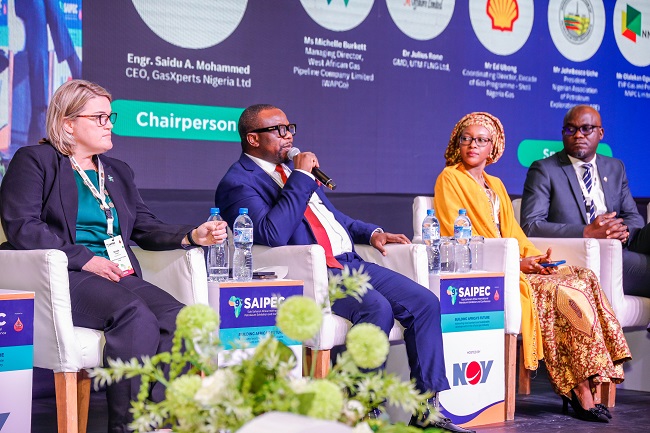
A panel discussion session at SAIPEC 2025
Ten Years of Growth, Partnership, and Impact
Since its inception in 2017 as WAIPEC – the West Africa International Petroleum Exhibition and Conference – with just 148 delegates and the participation of two National Oil Companies (NOCs), SAIPEC has evolved into a pan-African platform, engaging over 1,400 delegates and 23 NOCs in 2025, with even greater participation expected in 2026.
The international exhibition has more than doubled in scale; from 35 exhibitors in its debut year to an anticipated 150+ exhibitors this February spanning exploration, drilling, engineering, digitalisation, and energy transition technologies.
Over the past decade, SAIPEC has facilitated millions of dollars in contracts and partnerships, driving projects and investments across Africa’s energy value chain. “From a regional platform to a continental force, SAIPEC has evolved into Africa’s leading meeting place for oil, gas, and energy dialogue,” said Mr. Ibe Chubby Ibe, PETAN/SAIPEC Conference Chairman. “Our tenth anniversary represents both a celebration and a call to action – to shape the next decade of sustainable growth through collaboration, innovation, and African content leadership.”
Charting Africa’s Energy Future: Inside the 2026 Programme
The opening day will feature welcome addresses from senior government and industry leaders, followed by keynotes reflecting on SAIPEC’s decade-long impact. A regulatory panel will assess how reforms and investment frameworks can unlock exploration and production growth across the continent. Country spotlight sessions will present upstream, midstream, and refining projects from key markets including Nigeria, Angola, Ghana, Namibia, Senegal, and Mozambique. The Investment Forum will focus on capital deployment, risk management, and financing mechanisms for new energy ventures.
The second day will explore “Africa’s Gas Opportunity – A Pillar for Industrialisation and Export.” Sessions will evaluate the continent’s LNG outlook, domestic gas infrastructure, and regional collaboration. Panels on local content and indigenous capacity building will highlight policy frameworks, project implementation, and supplier development strategies. The day will culminate in the 10th Anniversary Gala Dinner and SAIPEC Awards, honouring industry leaders and long-term partners driving Africa’s energy growth.
The final day will turn to the workforce of the future, opening with a keynote on diversity and leadership transformation. The DEI Leadership Panel will spotlight women and youth advancing in technical and leadership roles, followed by the SPE Futures Forum, connecting young engineers, academics, and entrepreneurs.
SAIPEC 2026 will close with a presentation of actionable outcomes, policy insights, and collaboration pathways for the next phase of Africa’s energy transformation.
New Features for 2026
New for this edition, SAIPEC introduces in-country roundtables, a Local Content Pitching Session, and an expanded technical conference, offering deeper insights into engineering, project execution, and technology trends.
Networking remains a cornerstone of the event, with exclusive receptions, business lunches, and PETAN’s signature golf day designed to foster partnerships and investment discussions. The international exhibition will serve as a live showcase featuring digital solutions, field optimisation tools, and sustainability-driven innovations redefining Africa’s energy operations.
In addition, and as part of the extended 10th Anniversary Celebratory Week, the Nigerian Content Development and Monitoring Board (NCDMB) will host theLocal Content – African Continental Free Trade Agreement (AfCFTA) Energy Summit on February 9, 2026, serving as a prelude to SAIPEC 2026. The Summit will explore the opportunities AfCFTA presents for strengthening intra-African energy trade and advancing local content participation across the continent.
With vast hydrocarbon reserves, expanding gas potential, and a growing drive toward renewable integration, Sub-Saharan Africa remains central to global energy diversification. For ten years, SAIPEC has played a critical role in driving collaboration, investment, and knowledge exchange across the continent’s energy markets.
SAIPEC 2026 will once again unite policymakers, operators, investors, and innovators to define Africa’s energy future ensuring growth that benefits its people and economies.
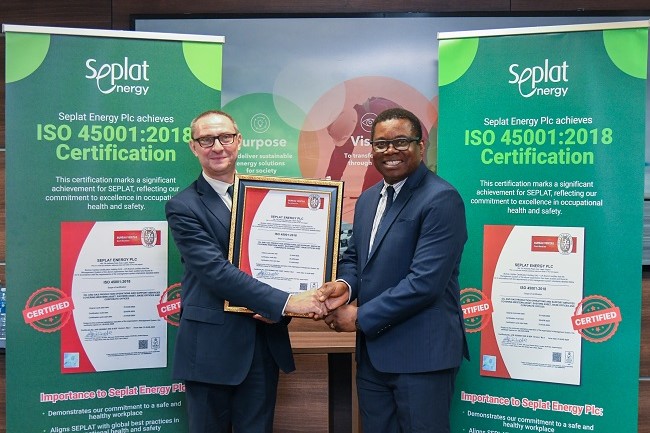
Seplat Energy PLC, leading Nigerian independent energy Company listed on both the Nigerian Exchange and the London Stock Exchange, has achieved the ISO 45001:2018 certification in line with its strides towards operational excellence and employee wellbeing,
The certification was officially presented to the company at its headquarters in Lagos by officials of Bureau Veritas (VS).
Seplat Energy’s journey to ISO 45001:2018 certification has been one of collaboration, commitment, and continuous improvement. From conducting gap assessments to implementing robust controls and engaging its workforce, every step was guided by the energy company’s vision to create a safer and healthier workplace, according to a statement from the company by Stanley Opara, Manager, Corporate Communications, Seplat Energy.
L-R: Jean-Michel Perret, District Chief Executive & Managing Director, Bureau Veritas Nigeria, and Samson Ezugworie, Chief Operating Officer, Seplat Energy Plc, during the presentation of ISO 45001:2018 Certification on Operational Excellence and Workforce Wellbeing by Bureau Veritas to the Seplat Energy Plc Team at the Company’s headquarters in Lagos …recently
“This globally recognised standard enhances its operational resilience, reduces risks, and reinforces the company’s duty of care to employees. It also positions it competitively, demonstrating to stakeholders that Seplat Energy operates with integrity, responsibility, and excellence. This certification is not the end; it’s a foundation for sustained growth and safety leadership.”
Commending on the certification, Roger Brown, Chief Executive Officer, Seplat Energy, said: “Achieving the ISO 45001:2018 certification marks a significant milestone in our journey towards operational excellence and employee wellbeing. It reflects our unwavering commitment to creating a safe, healthy, and resilient workplace.
“This global recognition reinforces our belief that safety is not just a priority, it is a core value embedded in our culture. We will continue to lead by example, ensuring our people thrive in an environment built on trust, care, and world-class standards.”
Speaking on the certification and what it meant to the company, Samson Ezugworie, Chief Operating Officer, Seplat Energy, said: “This certification is a testament to the dedication and discipline of our teams across all levels. We have always taken proactive steps to manage risks, enhance safety performance, and foster a culture of continuous improvement.
“The ISO 45001:2018 certification validates these efforts and reinforces our commitment to protecting our workforce as a fundamental part of our success. We remain focused on sustaining and evolving our health and safety practices to meet and exceed global benchmarks.”
Earlier, Adenike Akinbote, Certification Manager, Bureau Veritas (VS) Nigeria, commended Seplat Energy for its commitment and adherence to global best practices, adding that: “We commend the unwavering commitment of Seplat’s leadership in driving the implementation of ISO standards and successfully steering the organisation toward certification.
“Throughout the audit process, the professionalism, receptiveness, and openness demonstrated by both the leadership and employees of Seplat were truly commendable. We were particularly impressed by the level of implementation achieved during this initial certification phase.”
In his remarks, Adeshina Sadiq, General Manager, HSE, Seplat Energy, said: “Achieving the ISO 45001:2018 certification is a proud moment for all Seplat employees as Health, Safety, and Environment stewardship is a shared responsibility. It reflects the strategic integration of safety into all our operations and the relentless efforts of our teams to always uphold the highest standards.
“This milestone is not just a certification, it’s a validation of our systems, our people, and our culture of care. We will continue to strengthen our safety framework and empower every employee to be a champion of workplace wellbeing.”
The Lagos State Government (LASG) has signed three separate Memoranda of Understanding (MoU) with various reputable companies to advance waste conversion.
This is contained in a statement issued and signed by the Director, Public Affairs, Mr. Kunle Adeshina, on Sunday, November 9, 2025, in Lagos.
Adeshina added that the MoU was aimed at reducing the quantum of waste in the state.
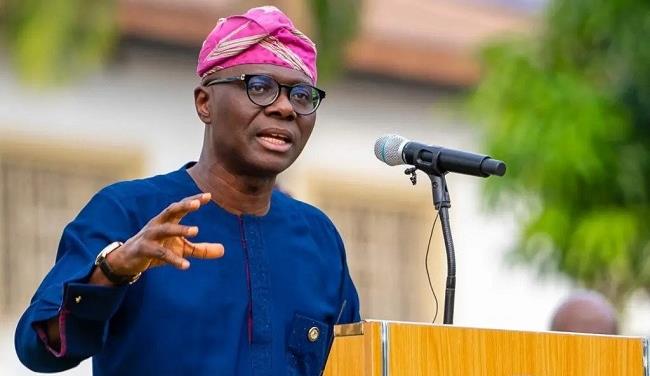
Governor Babajide Sanwo-Olu of Lagos State
“The state over the weekend demonstrated its irrevocable commitment to advanced waste conversion.
“This is the 11th Lagos International Climate Change Summit climaxed with breakout and panel sessions on thematic areas featuring experts,” he said.
He said the Commissioner for the Environment and Water Resources, Mr. Tokunbo Wahab, while addressing the investors, stated that the state government was determined to convert waste to wealth.
He added that the LASG was determined to move from linear waste management (pick and dump), to conversion of waste to wealth which was more sustainable.
He said the new MoUs represented a new vista in the quest of the state to reduce the quantum of waste that finally gets to the various landfill sites.
He said the proposition from one of the companies, HAK Waste Ltd., was to establish a circular beverage container bottle recycling and recovery.
“This is through a deposit refund system hinged on the Extended Producer’s Responsibility mechanism (EPRM),” he said.
He added that the new proposal was an investor’s confidence in the EPRM policy of the state on waste reduction.
He added that it would involve the establishment of a packaging circularity ecosystem.
He said that another of the MoUs would bring about a first-of-its-kind establishment of a world-class tyre collection and recycling of end-of-life tyres in the state.
“Haggai Logistics Ltd. proposes to build a first-of-its-kind tyre recycling plant.
“This will be responsible for processing end-of-life tyres via a fully automated Waste Tyre Recycling Factory and deployment of environmentally sound recycling technologies.
“The third of the MoU is from Mondo 4 Africa, proposing to convert non-recyclable plastic waste into sustainable fuel and other valuable resources through environmentally friendly technology,” he said.
He said the state was determined to continually sensitise the residents to cultivate the habits of waste sorting from the source and always bear in mind that waste was a resource and not a waste.
“We are trying to make people change the culture of seeing waste as waste but waste as a resource.
“We are also trying to shift their mindset from the practice that has been in use for decades,” he said.
He said the state was determined to address these key issues simultaneously for a proper financial intervention.
He emphasised that what the government was speaking to was proper financing and how to access it constantly as well as speaking to the vulnerabilities of Lagos being a coastal state.
Speaking further on the new MoUs, the Managing Director of LAWMA, Dr Muyiwa Gbadegesin, said the new initiative was part of the organisation’s quest to improve the state’s environment.
Gbadegesin noted that the state government or LAWMA alone cannot be saddled with the responsibility of managing the quantum of daily generated solid waste in the state.
He added that the state needed the partnership of the private sector to turn waste into a resource and wealth.
In their response, the investors expressed their appreciation and willingness to work with the LASG to actualise the waste-to-wealth initiative of the state.
The event was witnessed by the Special Adviser on Environment, Mr. Rotimi Akodu; the Permanent Secretary, Office of Environmental Services, Dr Omobolaji Gaji and the Permanent Secretary, Office of Drainage Services, Mr. Mahamood Adegbite, among others.
UN Secretary-General, António Guterres, has continued his campaign to accelerate the global shift from fossil fuels to clean energy – “the cheapest source of new electricity in nearly every country.”
The latest push came on Friday, November 7, 2025, in his remarks to the Energy Transition Roundtable in Belém, Brazil, held just days before the formal opening of the COP30 climate change conference.
“The fossil fuel age is ending. Clean energy is rising. Let us make the transition fair, fast, and final,” he said.
UN Secretary-General, António Guterres
The UN chief told world leaders that “the global energy landscape is changing at lightning speed.”
Green energy sources accounted for 90 per cent of new power capacity last year, while investment in them reached $2 trillion, or $800 billion more than fossil fuels.
“The renewables revolution is here,” he said. “But we must go much faster – and ensure all nations share the benefits.”
The international community must ensure a “just, orderly and equitable” transition from fossil fuels, triple renewable energy capacity and double energy efficiency by the end of the decade.
However, countries are falling short. Even if new national climate action plans are implemented, global temperature rise is still expected to exceed 2 degrees Celsius above the pre-industrial era.
“That means more floods, more heat, more suffering – everywhere,” he warned.
“To return below 1.5 degrees by century’s end, global emissions must fall by almost half by 2030, reach net zero by 2050, and go net negative afterwards.”
The secretary-general outlined five areas for action, calling first for countries to “align laws, policies and incentives with a just energy transition; and eliminate fossil fuel subsidies that distort markets and lock us into the past.”
Governments must “put people and equity at the centre of the transition” and support workers and communities who depend on oil, coal and gas for their living, including through training and new opportunities.
This is particularly the case for young people and women.
“Invest in grids, storage, and efficiency. Renewables are surging, infrastructure must catch up – fast,” he continued.
As “technology must be part of the solution, not a new source of strain,” clean energy must power all new electricity demand “including from the data centres driving the AI revolution.”
His final point stressed the need to “unlock finance at scale for developing countries,” noting that Africa receives just two per cent of global clean energy investment.
“We must support developing countries to implement their commitment to transition away from fossil fuels: through stronger cooperation, investment and technology transfer – and calibrated to different capacities and dependencies,” he said.
The Food and Agriculture Organisation (FAO) has reaffirmed its commitment to restoring degraded ecosystems and strengthening livelihoods across Africa’s drylands.
This follows the launch of the Scaling-Up Resilience in Africa’s Great Green Wall Area (SURAGGWA) project in Abuja on Friday, November 7, 2025.
FAO Representative in Nigeria and ECOWAS, Mr. Hussein Gadain, said the initiative is supported by the Green Climate Fund (GCF).
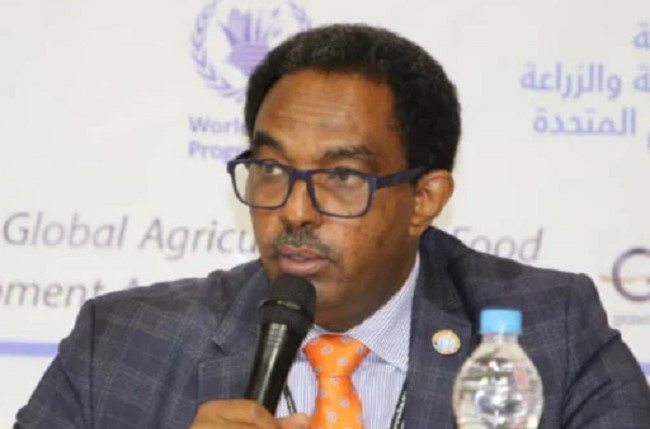
FAO Representative in Nigeria and ECOWAS, Hussein Gadain
He said it aims to promote climate-smart agriculture and sustainable land use practices across eight countries within the Great Green Wall region.
Gadain said the project would be implemented in collaboration with the National Agency for the Great Green Wall (NAGGW), the National Council on Climate Change (NCCC), and the Agro-Climatic Resilience in Semi-Arid Landscape project.
According to him, the Federal Ministry of Environment and relevant commissions will provide oversight, while FAO will lead implementation alongside ministries, technical agencies, and development partners.
Gadain explained that each participating country will establish a Country Implementation Unit for day-to-day coordination, with FAO providing technical support and guidance.
He added that, at the regional level, a Programme Steering Committee will operate under the Pan-African Agency of the Great Green Wall (PAGGW) to ensure strategic alignment and coordination.
The initiative will also establish National Steering Committees in all eight countries: Burkina Faso, Chad, Djibouti, Mali, Mauritania, Niger, Nigeria, and Senegal to monitor project delivery.
Minister of Environment, Mr. Balarabe Lawal, said the SURAGGWA project was a step in the right direction toward restoring degraded lands and promoting low-emission value chains.
He said the project reflects the Federal Government’s determination to build a greener, safer, and more prosperous Nigeria under the Renewed Hope Agenda.
Lawal explained that Nigeria remains the largest beneficiary, with about 1.9 million people expected to benefit directly from interventions promoting climate resilience and inclusive green growth.
He emphasised that collective action among government agencies, civil society, and private partners was crucial to transforming the Great Green Wall into a symbol of resilience and hope.
Earlier, Director-General of the NAGGW, Mr. Saleh Abubakar, commended FAO for its leadership, noting that SURAGGWA aligns perfectly with Nigeria’s restoration and livelihood improvement mandate.
He said the agency would continue to provide field presence and institutional support to ensure tangible benefits for communities and landscapes across affected regions.
Abubakar added that NAGGW was establishing community-based nurseries, empowering women and youths, and promoting climate-smart livelihoods to ensure long-term sustainability.
He said the programme is expected to benefit nearly 8.7 million people across Africa’s drylands by enhancing ecosystem services and fostering inclusive growth.
He added that the initiative would strengthen national and regional institutions for sustainable coordination while promoting non-timber forest product value chains for improved livelihoods.
The Great Green Wall initiative, launched by the African Union in 2007, seeks to restore 100 million hectares of degraded land, sequester 250 million tonnes of carbon, and create 10 million green jobs by 2030.